Advisor: Thomas Nixon.
This paper discusses an assessment case study conducted at the Ullman Classics
Departmental Library at the University of North Carolina at Chapel Hill. The aim of the project was to discover the effectiveness of independent, departmental libraries at serving their primary faculty, graduate student, and undergraduate populations. The research was conducted using mixed methods. Usage statistics from the main UNC library system were analyzed and compared with user-reported usage information regarding similar items in the Ullman Library collection. Semi-structured interviews were conducted with eight representative members of the population group to provide a context for the
statistical usage data. The data revealed that elements including convenience of access, continuity of the departmental community across generations, and the departmental library as a physical information commons all contributed to a more positive library experience as an independent, isolated collection than would be gained from integration with the main library system.
Headings:
Departmental libraries in universities and colleges Academic departmental libraries
BETTER TOGETHER OR APART:
A CASE STUDY ON DEPARTMENTAL LIBRARY ISOLATIONISM
by Katy E. Sandlin
A Master’s paper submitted to the faculty of the School of Information and Library Science of the University of North Carolina at Chapel Hill
in partial fulfillment of the requirements for the degree of Master of Science in
LibraryScience.
Chapel Hill, North Carolina April 2012
Approved by
Table of Contents
Introduction ...2
Case Study Setting ...3
Research Questions ...4
Literature Review ...5
Methodology ...16
Davis Library Circulation Data Analysis ...19
User-Reported Survey Data Analysis ...21
Interview Data Analysis ...26
Limitations ...32
Conclusion ...33
Bibliography ...35
Appendix A ...38
Appendix B ...39
Appendix C ...41
Appendix D ...43
Appendix E ...45
Appendix F...48
Appendix G ...51
Appendix H ...53
Appendix I ...55
Introduction
While most University Library Systems have absorbed scattered departmental and satellite library collections into their main university systems to increase access and functionality, there are still a few independent libraries and collections dispersed throughout some university campuses. The reasons for the lack of integration of these collections seem to vary widely from institution to institution based primarily on the sentiments of the faculty and library staff involved, the varying levels of technological advancement on a campus, and the topical subject matter of the departmental collection in question.
While many studies have been done about the process of integration of
departmental libraries and collections, the predominant literature on the subject views the topic through a very narrow and pragmatic lens. Most research discussed in the literature of the past fifty years solely address issues of access and the physical processes involved with integration. Very few stop to ask the question of why certain departments might wish to remain independent and whether it would be in the best interest of all parties involved for them to remain that way. Even if researchers do stop to discuss why a
department might not want to integrate, it is usually only to posit that the department does not understand the full implications of integration with the main library system.
Therefore, through my research, in an attempt to fill a gap in the existing literature of the field and provide a more accurate depiction of the full range of issues surrounding these complex cases of integration, I have performed an assessment case study of one of these independent, departmental libraries on a university campus to determine the various advantages for the department and examine the situation as a whole.
Case Study Setting
I looked specifically at the Ullman Classics Library located at the University of North Carolina at Chapel Hill for this case study, where I currently work as the
Departmental Librarian in addition to my employment at the Walter Royal Davis Main Library (Davis) on campus. As a researcher, I was presented with a unique opportunity for an internal comparison and assessment of the situation, since I technically work on both sides of the fence.
The Ullman Classics Library presented a new and unique opportunity to look at these issues prior to an actual integration being conducted. At the point which I conducted my study, neither the main library system nor the Department of Classics strongly desired or intended to pursue any kind of integration, but the predominant factors which have provided an impetus for collections to merge at other institutions, such as budgetary cuts and dwindling space in a swiftly growing collection, were beginning to crop up in both environments.
Library also possesses a private archive of Journal Offprints from the last two hundred years of scholarship. Currently, Classicsemploys one part-time, paid librarian to manage the collection, supplemented by four unpaid interns. In the past, graduate students and faculty from the Classics Department and other assorted volunteers and part-time librarians have managed and shaped the collection (Linderski, 2008). The Ullman Library currently uses standard Library of Congress cataloging, and possesses both its own independent database and online catalog. Technological and physical updates have been regularly undertaken at the Ullman Classics Library to keep it current with recent library practices and policies of small institutions, though no moves have been made to push for an integration of either the physical holdings of the library or the online catalog interface with the main UNC Library System.
Research Questions
In order to ascertain the full range of the issues surrounding integration or isolation of a departmental library collection, there were a variety of potential questions I desired to investigate. The specific research problems I was interested in investigating were:
1. How effective are departmental libraries at serving the research needs of their faculty, graduate student, and undergraduate populations?
2. How often do departmental users resort to the main library system for materials vs. the departmental library? Do they only use the main library materials when the departmental library does not possess a copy of something or is there overlap?
the main library if both hold the work? Or is it usually just an issue of convenience?
3. At what point would it become mutually beneficial for the departmental library to integrate their holdings with the main library’s catalog to allow for increased access and better searching features? What disadvantages might this bring to the department to cause them to shy away from integration?
a. Is this “point” determined by usage numbers? New technologies? What seems to constitute the tipping point for these decisions?
4. What are the implications forcollection development for both the departmental library and the main library for continued separation versus some form of
integration, especially as the departmental library begins to grow significantly in size?
Finally, as more of an overarching approach to the whole process, I was interested in assessing the level of resistance by the department in question over the topic of collection integration. I was particularly interested in comparing the current tensions on a
university campus today to the sentiments and concerns from the early decades of the nineteenth century when these initial situations began to crop up at institutions across the country.
Literature Review
centralization has clearly won the day in terms of achieving a majority situation on university campuses in this new digital and technological age (Evans and Tilton, 2010), it is interesting to note that the same concerns universities and individual departments were raising over integration and centralization fifty to a hundred years ago are still the same problems many hold-out departments continue to possess today (Miller, 1939). Because of this theoretical continuity, it is both important and incredibly useful to begin by reviewing the history of departmental library collections and the development of university library systems in the United States as a whole.
The majority of the departmental library collections in the United States grew out of imitations of the German seminar model in the early years of the nation, and “it was only after the War between the States that true departmental libraries were installed in American Universities along with other innovations imported from Germany”
(Thompson, 1942, p. 59). Part of the difficulties in tracking the exact development of such satellite and departmental collections in the formative years of the previous century stemmed from a lack of a true definition for exactly what constituted a “departmental library,” and it seems that even now a hard-and-fast definition of a departmental library is a difficult thing to come by, as the understanding changes from university to university and case study to case study. In Thompson’s 1942 article, “The Historical Background of Departmental and Collegiate Libraries,” he explains that the origins for this semantic confusion come from the lack of standardization among institutions when describing their own satellite collections:
institutions have consistently reported laboratory and classroom collections often containing less than a hundred volumes. (p. 50) He continues to explain that in particular the distinction between a “collegiate” library and a “departmental” library led to much of the initial confusion on the subject. In his terms, a “collegiate” library was developed to address the needs of the students of a professional school or college, with the primary examples being medical and journalism schools, and differed quite drastically in size and purpose from the “departmental” libraries possessed by individual teaching groups within liberal arts colleges (Thompson, 1942, p. 52).
It is interesting to recognize these early distinctions and reflect on the current state of departmental and satellite collections with this idea in mind. By Thompson’s
definition, I would posit that the majority of “collegiate” collections have been integrated into main university systems through the centralization movement of the twentieth century, since their primary goals included sufficient access to materials and were often developed to require interdisciplinary resources as the twentieth century progressed. In fact, the majority of the empirical case studies on the subject from the later decades of the twentieth century seem to come out of the health sciences and medical libraries
(Stefenacci, Wood, & Huff, 1977; Craig & Grefsheim, 1977) whose patrons required ease of access perhaps more than any other topical area in the interdisciplinary push of the later part of the century. The departmental collections of liberal arts colleges, however, which would have been drastically more specific and narrowly focused to the individual teaching needs of a faculty, were so specially cultivated and regarded by the professors who developed and used them that it is not surprising that factors of sentimental
environments led to tense and complex socio-political environments on university campuses across the country.
In addition to the historical beginnings of departmental libraries, it is also necessary to examine the issues surrounding centralization and decentralization in university library systems as a whole and how they have progressed throughout the past hundred years. The same kinds of issues, including budgetary concerns and limited space, that plague the current library scene, were equally relevant and evident in the library literature of the thirties and forties. Robert Miller, in his 1939 article
“Centralization versus Decentralization” divides the issues up into seven categories: “Accessibility, Cost, Efficiency, Adequacy, Use, Interrelation of Subject Fields, and Educational Significance” (p. 75). He then proceeds to provide a pro and con argument for each of these categories, keeping in mind that despite their differences, a desire for “efficient and adequate library service is the end in view for both centralists and decentralists” (Miller, 1939, p. 75). Overall, in terms of accessibility, Miller (1939) found that the pros of decentralization clearly outweighed the cons, claiming “studies have shown that immediate accessibility is probably the most important factor in the use of books” (p. 75). On the cost and administrative efficiency fronts, the centralized approach was clearly favored, but overall the conclusion of the article was that it really depended on the individual situation and could not be determined by a set of overarching principles (Miller, 1939).
In a slightly later article published in The Library Quarterly, J.C.M. Hanson (1943) argues:
for one who has not for years been in the closest possible touch with the details of technical administration as affected by efforts to operate several libraries as a unit through centralization of administration in spite of the decentralization of the book” (p. 132).
While Hanson’s statement seems a bit ambiguous, it provides some key insight into the fact that a combination of these ideals through centralized administration and distributed collections does not necessarily provide a magical solution to the problem. Taking a very practical stance, Hanson reiterates many of the same concerns articulated in Miller’s article regarding accessibility versus cost and efficiency issues. Ultimately, for Hanson (1942), “in the long run, economic considerations must decide the issue, not the personal convenience or predilections of professor or librarian” (p. 135). Hanson’s article was written in the years immediately following the Great Depression and the beginning of the Second World War, and given the similarities currently being drawn between the
economic situations of that era and the present day, his conclusion has probably been the harsh reality for many institutions in recent years.
an age where communication and sharing of resources is becoming drastically easier. He warns of “brushfire effects” where “every division, no matter how small will desire its own branch library” if care isn’t taken to curb these advances (p. 197). Watts tempers his argument by explaining, “There is no quarrel here with the broad subject division
approach within centralized library collections,” but he sticks to his guns that
departmental libraries only breed unhealthy loyalties and decreased accessibility in an increasingly interdisciplinary academic arena (1983, p. 197).
This background information on the development of departmental and collegiate library collections in the United States provides an excellent canvas for contextualizing my study of the Ullman Classics Library at the University of North Carolina at Chapel Hill. Having examined the arguments for and against centralization throughout the twentieth century, it was fascinating to realize that despite the significant technological advances of the past several decades, these fundamental differences are still being argued today in largely the same capacity and with strikingly similar language. These
similarities bolster my desired approach of exploring the vast array of political and social implications surrounding departmental libraries in addition to the usage statistics and expense reports, grounding the pragmatic approaches of librarians today with the perspectives of their users on multiple library functions.
out of conclusions drawn from contemporary data that might have been influenced by previous factors other than those readily available on the surface of a problem. Since the goal of most of these current studies is to provide a model for others to follow when beginning the same procedures, this oversight is particularly troubling. I hope to attempt to fill this gap with my own research by providing an empirical study that looks at the usage and access statistics, but weighs this information with all the other historical, social, and contextual factors associated with the integration process as a whole.
As previously stated, most modern research studies of departmental libraries are primarily looking at the numerical logistics and statistics concerning access and the number of staff hours required to accession collections that may or may not have been previously cataloged in some format (Bell, 1995; Evans and Tiffton, 2010). I imagine that much of the cause of this focus comes out of the fact that often the research itself is being done out of necessity and being facilitated and coordinated by library practitioners rather than formal scholars or researchers, as evidenced by the job titles provided in the
The earliest contemporary study that is notable is the previously mentioned study by Suzanne Bell (1995), which looks at data gathered concerning the integration of departmental libraries at twenty-one different sites throughout the United States. Bell’s study incorporates newer issues and services into the centralization debate, including issues of more efficient and economic Interlibrary Loan requests and integration of OPAC systems on a university campus (1995, p. 181). Through use of a survey
distributed across a prominent library listserv, Bell recorded information from different libraries that had previously undergone the centralization process. Out of the libraries surveyed, there were many success stories and a few words of warning. Bell (1995) concluded that out of the success stories, the most successful were the cases where the independent collections were informal enough that conflicting catalog records did not create a mass amount of work for the integration staff at the main library (p. 183-184). Overall, however, she found that “despite many reservations expressed about adding records to the OPAC, the majority of the reported success stories used that approach” (Bell, 1995, p. 185). Bell’s study was highly relevant to my own research on the subject, as potential OPAC integration is likely the first step either Davis Library or the Ullman Classics Library would undertake if they ever decided to address potential integration in the upcoming years. Her treatment of social factors is a useful comparison to micro-changes in faculty throughout academia in the last two decades.
content management system could assist in the integration of “a collection of VHS
cassettes and DVDs for the Dr. Ralph H. Wolfe Viewing Center” (Evans & Tilton, 2010). The goal of their project was to increase patron knowledge of satellite collections, while utilizing departmental funds over library funds to help mediate the costs. Using some of the newest technologies, including cloud computing initiatives and open source content management systems, Evans and Tilton (2010) were able to provide a positive study that allowed for the goals and feelings of both the main university library and the individual departments to be validated. Using a kind of post-custodial approach, the study gave the departmental libraries the tools needed to assist with the integration, while providing professional guidance that didn’t exhaust either group’s budget (Evans and Tilton, 2010). Calling their project the “un-catalog,” the Bowling Green State Library used a WordPress MU application to create a sustainable and accessible way for independent collections to merge their existing catalogs with the main library system (Evans and Tilton, 2010, p. 49). This innovative approach provides a great deal of hope and promise for the development of future standards of integration that might satisfy the needs of both the departments involved and the main library system without forcing either party to feel that they are making significant sacrifices.
experimented with the idea of OPAC-only integration to increase access without comprising the integrity of a collection (Elguindi, Kelshian & Sandler, 2011, p. 56).
Providing a similar example of technology use within the University of North Carolina library environment itself, a previous School of Information and Library Science (SILS) student at UNC-Chapel Hill did his master’s paper on the use of a blog interface to allow faculty members to comment on potential collection development decisions for the SILS departmental library collection. The methods employed by Weis were
threefold: first, he helped the librarian craft the initial posts for the blog that would record faculty feedback and test the system technically, including attention paid to metadata fields that would most interest the faculty being solicited, second, Weis conducted a structured, open-ended interview with the departmental librarian to address issues of use and functionality from the institution’s side of the issue, and third, he distributed a user satisfaction survey to the participants, consisting of a mix of open-ended and binary questions (2011, pgs. 12-14). I believe that Weis’s methods of data collection were highly similar to my own, using both qualitative and quantitative survey data and some structured interviews, and his use of current technologies to facilitate these needs was also something that I emulated, at least in terms of survey questions and topics covered in interviews.
Ultimately, while the research and case studies in the predominant literature of the past fifty years are highly relevant to understanding the physical processes that
and librarians involved. Although the authors of many of these case studies might not believe socio-political and contextual information to be relevant to other universities that might intend to use their plan of integration as a model, and in fact might endeavor to hide some of these facts out of a fear of presenting their home institutions as divided or dysfunctional, the issues have not and will not go away in the immediate future. I think if a truly successful model for the integration of satellite collections is ever to emerge from the current research, a complete understanding of all problems and concerns, not just the ones emergent on the surface and able to be examined through statistical analysis, must be undertaken and incorporated into the development of new tools to facilitate the transition. I hope my research may take some strides in this direction, and help fill a gap in the existent literature regarding incorporation of historical precedents and social concerns with statistics and new technologies, while simultaneously providing valuable information to both the department in question and the main library system on the University of North Carolina at Chapel Hill campus.
Methodology
of human interaction and public service with technological data and services, such as search engines and information retrieval practices. R. Burke Johnson and Anthony T. Onwuegbuzie, in their 2004 article, discuss how mixed methods research has really come into its own in the last decade, solidifying itself as a viable third option to positivism or purely qualitative research (p. 14). They explain, “The goal of mixed methods research is not to replace either of these approaches but rather to draw from the strengths and
minimize the weaknesses of both in single research studies and across studies” (Johnson and Onwuegbuzie, 2004, p. 14-15).
I performed the same kinds of empirical research done in predominant
departmental library studies of the past ten years, using mixed methods, but I approached it from a totally different point in the integration timeline, with the ultimate goal being an understanding of the full range of associated issues and factors surrounding departmental library usage, rather than an explanation or analysis of an integration process itself.
For my study, I compared the use of Ullman Library resources by department faculty and graduate student populations to their use of parallel Classics resources held by Davis Library. To accomplish this goal, I received redacted circulation data from the main UNC Library system via the Millennium circulation software. The data listed the total number of items that were checked out or requested from Davis by the full
Because the Ullman Library does not keep detailed records of their own
circulation at this time, the numbers regarding Ullman Library usage specifically relied on user-reported data gathered via means of a brief survey. This data does not
necessarily serve as a direct comparison to the data from the main UNC Library System, but provided a good base understanding of the general topics and types of resources the main user groups recognize as their primary uses of the departmental collection. Of course, because this data was user-reported it will not be as accurate as the initial
empirical data generated from Davis Library, but it did provide enough information to get an idea of the overall issues surrounding the library usage and allow for some statistical comparisons with the data from Davis, especially along subject and topic area lines. Since UNC Classics faculty can take out books from Ullman for an unlimited length of time, I was also interested to see how the graduate and undergraduate populations report their usage of Ullman materials, specifically how often they have attempted to use materials in Ullman but found them checked out, with no means of a recall or knowledge of knowing when the item might be returned due to the current processes.
As I have mentioned extensively, to truly address the full range of issues
of the issues surrounding the situation. I recruited these interview individuals in person on a purely voluntary basis. Following the collection of the interview data and the full collection of the Davis Library circulation information, I spent approximately three weeks analyzing the data and coding the interview transcripts. For the circulation data, I used standard statistical software to analyze the patterns, and for the interview
transcription and coding process, I used coding software to try and locate trends or patterns in the kinds of issues raised and vocabulary used to discuss the collection and any political aspects of potential integration. UNC’s Davis Library intends to use the information gathered in this study in a collaborative wiki project addressing assessment issues and best practices, and might ultimately develop a guide or standard for
departmental libraries interested in these issues and potential integration in the future. Overall, I believe that the mixed methods approach to this research problem provided an effective data set addressing the variouscontexts of departmental library usage and factors both influencing and surrounding potential integration with the main library system.
Davis Library Circulation Data
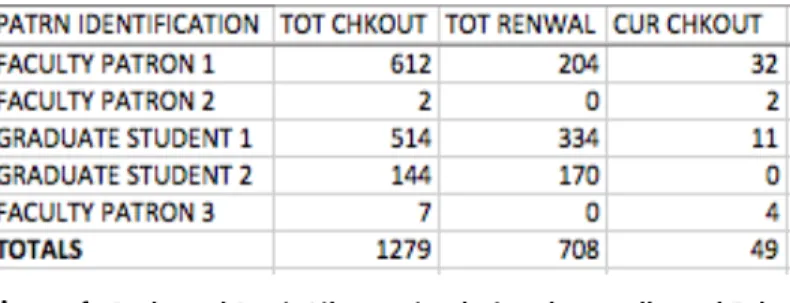
main library materials, it was particularly astounding and telling how few materials were actively checked out by the Classics Department Faculty. Since the data table is so small, it is included in the figure below. The first column of data represents the total number of items that aparticular patron had checked out during their time in the UNC Library System. The second column of data represents the total number of renewals the individual had ever requested on checked out items, and the third column of data represents the number of items currently checked out from the UNC Library System.
Perhaps more surprising than the initial figures was the fact that three weeks later, the data set had not changed by a single figure. None of the individuals who currently had materials checked out returned or renewed any of these materials, nor had any additional faculty or graduate students checked out any materials from Davis Library.
One possibleassumption and conclusion that can be drawn from this data is the fact that the majority of current research and scholarship is being conducted via the use of
Figure 2. Redacted Davis Library circulation data, collected Feb.
21, 2012
Figure 1. Redacted Davis Library circulation data, collected Feb.
online resources and serialized subscriptions. Despite many active research projects and instructional courses occurring during the data collection time period, the faculty and graduate student populations of the Classics Department were actively utilizing a significantly small amount of monographic materials. Though I did not consider the implications of such a conclusion at the time the data was collected, further research on similar subjects might include a comparison of database access by the same list of individuals to monographic circulation statistics to get a more accurate picture of the full usage of the main library system.
However, the relative size of this data was also significant considering the existence of the departmental library. Such a small amount of circulated monographic materials indicates to this researcher that a majority of the departmental users who could in fact circulate items from the departmental library were prioritizing use of these
materials over the necessity for monographs from the main library system. In order to fully support this assertion, it becomes necessary to examine the results and data of the user-reported Ullman Library usage survey and the contextual semi-structured interviews that were conducted alongside this data.
User-Reported Survey Data Analysis
The Ullman Library usage survey produced a varied array of responses and data, but overall was quite insightful as to the general use practices of the primary user
System. It is first essential to more specifically quantify the survey results by percentages of the population groups represented.
Interestingly, the fixed termand adjunct faculty populations were the highest responding population group on the Ullman survey, with a response rate of 40%. These individuals, though not technically faculty or graduate students do have an office
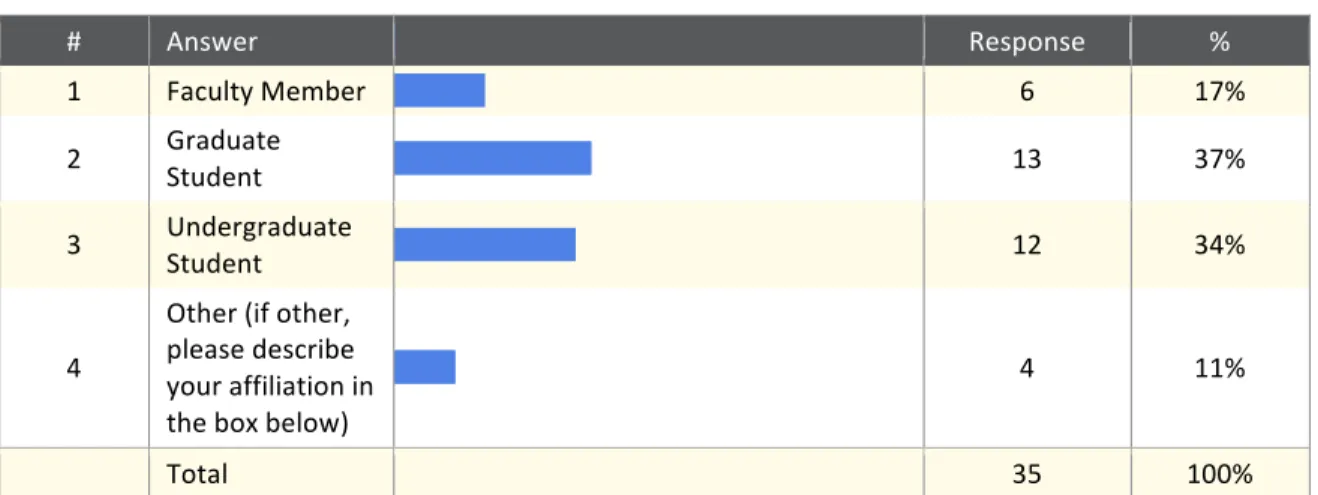
assigned to them in Murphey Hall, and thus are allowed to borrow materials from the Ullman Library during their tenure with the department. The faculty and graduate students were close behind, with a response rate of 37.5% for the faculty and a response rate of 36% for the graduate students. The undergraduate response was fairly low, with only a 12% response rate; however, the responses I did receive from this group were fairly consistent and still provided a good amount of helpful data. Figure 3 below shows the numerical data for the first question and how it was broken down by population group. The smaller inset figure beneath (Figure 4) represents the optional fill-in section for the “other” category or respondents, which represents the fixed term individuals.
1. What affiliation do you have with the UNC Classics
Department?
# Answer Response %
1 Faculty Member 6 17%
2 Graduate Student 13 37%
3 Undergraduate
Student 12 34%
4
Other (if other, please describe your affiliation in the box below)
4 11%
Total 35 100%
Other (if other, please describe your affiliation in the box below -‐ e.g. Visiting Scholar) post-‐baccalaureate
retired faculty Emeritus faculty
currently visiting scholar; also sometimes as faculty
Figure 4. Supplementary responses to “Other” category
Out of the total respondent pool, the length of affiliation was quite varied, with responses in all five of the potential response categories. The majority of respondents, 57%, had been affiliated with the department between one and five years. This data is consistent with the relative length of different potential affiliations, particularly as the graduate students andfixed termrespondents were among the highest, with these affiliations usually being temporary or limited in the number of years. The numerical breakdown of these responses can be seen in Figure 5 below.
2. How long have you been affiliated?
# Answer Response %
1 0-‐11 months 4 11%
2 1-‐5 years 20 57%
3 6-‐10 years 6 17%
4 11+ years 5 14%
Total 35 100%
Figure 5. Length of respondent affiliation with department
Moving past the strictly biographical and population-centered data, the next three questions on the survey addressed how many times individuals who had borrowing privileges checked items out from the Ullman Library, how often these users had trouble locating materials within Ullman Library, and subsequently, how often they resorted to Davis Library in order to rectify an inability to procure the needed items from the
unsurprising, as the majority of departmental users tend to work either within the library itself or use the items from Ullman merely as more of a glorified reference collection for last minute information checks and reserve space for their students. The highest check out range reported fell in the 1-2 books/month category, with a representation rate of 35% of the total respondent pool. The next closest responses were either 0 books/month or 3-5 books/month, both falling just under this percentage. Figure 6 below details the exact breakdown of the responses for this question. Again, there were responses in all five potential answer choices, despite the fact that all undergraduate respondents left the question blank due to an inability to circulate items from the Ullman Library.
3. How many times/month do you check out materials from
Ullman Library (if possible)? **If you cannot check items out
from Ullman Library, please leave the question blank.
# Answer Response %
1 0 7 30%
2 1-‐2 8 35%
3 3-‐5 6 26%
4 6-‐9 1 4%
5 10+ 1 4%
Total 23 100%
Figure 6. Circulation estimates/month by primary Ullman Library user populations.
Out of all the survey response data, the final two questions about difficulty of locating materials in Ullman Library and subsequent use of materials in the main UNC Library System were the most telling, and it actually surprised me how few patrons reported having major issues locating materials within the Ullman collection. The previous Ullman Library catalog was unavailable for nearly a year due to database concerns and other technical considerations. Patrons during this time period were using either their own knowledge of the layout of the stacks or the physical card catalog that still remained in the library, though it had not been updated in nearly five years. However, despite these technical issues causing a rather jarring transition period, most respondents reported either rarely or occasionally having trouble locating items in Ullman Library. Figures 7 and 8 below demonstrate the responses for these two questions.
4. Do you ever have trouble finding items within Ullman Library
(either hard to locate or the items are already checked out)?
# Answer Response %
1 Always 1 3%
2 Frequently 1 3%
3 Occasionally 15 43%
4 Rarely 15 43%
5 Never 3 9%
Total 35 100%
Figure 7. Difficulty level of locating items in Ullman Library
5. How many times/month do you think you check out Classics
materials from Davis Library as a result of not being able to find
an item in Ullman?
# Answer Response %
1 0 13 39%
2 1-‐2 15 45%
3 3-‐5 3 9%
4 6-‐9 0 0%
5 10+ 2 6%
Total 33 100%
Figure 8. Subsequent use of Davis Library materials as supplement
Overall, the Ullman Library usage survey provided a wealth of information, particularly in relation to the seemingly sparse Davis Library circulation data. Across the board it seems that professors are using the physical space of the library more as a
reference collection and communal work area than as a place to find materials for primary research, and I would posit instead that the low check out figures from both libraries reflects the changing technological advancements driving the current online serialized scholarship environment. With that in mind, it becomes almost more important than ever for faculty and students of a department to have a communal and specially designated space to keep commonly referenced monographs without having to travel to the main library or peruse potentially spread out stacks. The information collected in the interviews quite cohesively supplemented and qualified the findings of both the
Interview Data Analysis
For the interviews, I recruited the participants either via email or through in-person interactions. The interviews were recorded on an audio recording device and stored on a password-protected computer. Once the interviews were transcribed, the initial audio recordings were destroyed. Participants could choose to include their name and identity in the final output, or to remain anonymous, and signed consent forms indicating this preference. Out of a total request pool of ten individuals, I ended up interviewing eight people, with six of these individuals being faculty members and two of the individuals being graduate students.
Across the board, particularly among the faculty members, I found in these interviews that the primary user populations of the department view the Ullman Library as an invaluable reference collection for them and for their students, rather than a center of intensive research. Professor Robert Babcock, a current Professor of Latin in the UNC Classics Department and previous curator of the Beinecke Rare Books Library at Yale University, explains this notion of the Ullman Library as a specialized reference collection clearly, stating:
It is the reference books [in Ullman] that I use, and while mostly reference books don't circulate at Davis, they are also not gathered all together in one place. It's a lot easier to look up something quickly [in Ullman].
Sometimes ten minutes before class, I'll realize I can't remember whether Severus came before or after Antoninus Pius, and so I just want to look at basic historical facts or something very basic about a reference sort of question. And having it nearby [is invaluable], but also having most of the major works together. (Appendix D)
Professor Babcock’s sentiment that the primary appeal of the collection is as a
together, they are often in small sections under the appropriate Library of Congress subject headings, potentially with several floors of stacks between two desired texts. The size and granularity of the Ullman Collection allows the faculty members to save both time and energy by having a much smaller set of books to peruse before finding the appropriate title. Another anonymous faculty member echoed similar sentiments, explaining:
I guess one thing I would mention is that when you finish a book, you or your research assistant have to check all the quotations, and that's a wonderful time to have all the basic texts in one place, rather than far different shelves. So when I do that, or a graduate student does that for me, they're all a couple of feet apart, and that's one of the strengths of [Ullman Library], the basic texts of things. (Appendix C)
In addition to attributing the success and value of the Ullman Library to its function as a specialized reference collection, several of the faculty members and
graduate students highlighted its important role in the support of the teaching mission of the department. When asked whether he believed that the Ullman Library Collection successfully supported the research needs of the current faculty and graduate student populations, Professor Robert Babcock explained that he did not believe the function of Ullman Library was really to support the research needs of the faculty as a primary purpose. Instead, he offered, “I would say teaching. I think it's about teaching. It really is helpful for teaching; a lot of what we need sort of basically is there” (Appendix D). These sentiments were reiterated among the other professors, with at least three additional faculty members (Appendices C, E, G) and both graduate students
The final way in which the interview participants really highlighted the positive value of the Ullman Library was as a physical space and information commons for the department. While not a single participant actively acknowledged that the provenance of library materials, most of which are from Emeritus faculty members, made a significant impact on their decision to prioritize materials as I had initially anticipated, Professor James Rives, the incoming Department Chair for the Classics Department explained:
Well, I think another dimension of it is simply the physical space. It gives a common space to the department; everyone uses it. I think it’s important for our communal identity. And also, going back to your question about marginalia, although I don't use that myself so much, I think other people might. It does create a sense of community over time, as well, that we have the collections from Ullman and Broughton, and people from the past, previous members of the department, and so I think it has got an important substantive, you might say symbolic, significance which is important. (Appendix F)
The importance of the library as a physical space and communal gathering place was the single most brought up topic for additional discussion at the end of the interview,
particularly significant since the topic was entirely unprompted. Out of all of the interviews, only three individuals did not mention the library as a physical space. Ted Gellar-Goad, a current doctoral student in the department, even recognized the
importance of this information commons in the development of libraries at large and the success of the Ullman Library at fulfilling this need:
I think, you know, it's also a good space. That's one of the things that libraries have been doing more recently, [they have] been thinking about [the library] as a place to be, not just as a place to store books, and I think ours is good for our purposes and has nice little bits of department history. (Appendix J)
Library materials or online public access catalog in the present or at any undetermined date and time in the future. Some of the limitations of the current collection that could potentially be mitigated through integration with the main UNC Library System included a more user-friendly catalog system, akin to that provided by the Davis Library catalog, as well as assistance with copy cataloging from the main library system and potential use of the main library’s preservation services.
In general, the participants seemed much more open to the idea of OPAC integration rather than any efforts at physical integration or the designation of Ullman Library changing to an official branch library. Many of those interviewed actually were strongly in favor of integration of the catalog to reduce the number of places that they have to search for materials. Professor Robert Babcock voiced his support of catalog-only integration, indicating:
It would be very helpful to me actually, if when I search Davis catalog it would tell me there was a copy here. Sometimes when I just want a Latin text or Greek text, I would be glad to know it was here and I could run and get it quickly instead of having to have it delivered two days later.
(Appendix F)
Several other interview participants voiced similar sentiments, usually centering on the idea of assistance with search time and the ability to perform more robust searches using the main library system’s Endeca catalog. Emma Buckingham, an archaeology graduate student, was strongly in support of integration of the catalog and some library services, explaining:
to be checked out here. (Appendix I)
Her concern about issues of security and availability of materials was a major balancing point for most faculty who did support catalog integration and definitely served to temper all participants from totally endorsing the idea of some level of integration with the main UNC library system.
Additionally, recent updates to the Ullman catalog system that were implemented this past school year seemed to mitigate some of the major concerns faculty and graduate students had on that particular front. When Professor Bill Race, a current Emeritus faculty member, was asked whether he had difficulty locating items in Ullman Library, he reflected on how previously this might have been a more pressing concern, but the recent changes in updating the catalog system had alleviated much of this need. He commented:
Well, you've just absolutely done wonders with the catalog system here. I mean it was unusable before, unreliable, everything bad about it, and you've just taken it to a new dimension. And so, I think it's just fabulous now. (Appendix E)
Professor Race’s sentiments were echoed throughout the interview participants, including mention in the comments another anonymous faculty member who explained:
I had trouble with the catalog before it got easier. The first online catalog was where you had to log in, and I never log in, and I'm also on a
Macintosh. So, most recently its been easier than it used to be, when I would sometimes go there and just not know how to log in because I hadn't done it in 11 months, but it's easier now. (Appendix C)
less of a reason to favor integration, particularly when considering the issues of security that were the primary fear of all those interviewed.
In addition to their increased use of the Ullman Library catalog due to
functionality and interface updates, the Classics Department faculty members were not highly keen on witnessing physical integration with the main library system, particularly if this would result in any amount of departmental control of the materials being lost in the process. Ted Gellar-Goad, a current PhD student in the department, summarized these sentiments succinctly, explaining:
I would not like making it a branch, if that would end up encouraging non-Classics people to go there, or relinquishing any control. I think that our department should have complete control over how it operates. (Appendix J)
interviews and the majority of the data gathered that the department would ever be strongly in favor or pursuing such an integration initiative.
Limitations
The primary limitation in my study was reliance on self-reported circulation data for the Ullman Library statistics and usage information. This was mitigated through attempts at securing as large of a data set as possible, and over 25% of all respondent group populations, save the undergraduates, was achieved. Since the department is of a manageable size, I did not use a representative sample for the survey, but actually distributed the survey to the full population of registered Classics Department affiliates via the email listservs in order to facilitate the largest possible response rate.
Limitations of the Davis Library circulation data included the fact that the data set represented a snapshot image of the currently circulated materials on the particular days surveyed, and not a comprehensive change over time perspective. If future study of this subject area were to be undertaken, a more inclusive and detailed look at the circulation activities of affiliates, including their use of e-resources and a more fluid analysis of the monograph circulation activities would be extremely beneficial.
Conclusions & Recommendations
Ultimately, though for different reasons than I initially hypothesized at the onset, I believe there are many valuable features that the Ullman Departmental Library provides that could not be replicated or enhanced through a combination with the main library system. The idea of a specialized, topic-specific reference collection is something that could never be replicated in a major academic research library due to the size and overwhelming number of departments and research areas supported.
Relinquishing department control, even so far as making the Ullman departmental library a “branch” library, could subject the collection to weeding, theft, and security issues, as well as place an additional burden on the main system in a time of already shrinking budgets. Additionally, since the majority of the materials in the Ullman Library are duplicates of items already held within Davis Library, a total integration of the collection would be a wasted and pointless endeavor for all involved, resulting most likely in mass weeding of what is currently a valuable reference source for the
allowing the subject librarians to focus more heavily on securing the necessary serial subscriptions and electronic databases essential to the more intensive research process.
Bibliography
Bell, S. S. (1995). Integrating access to formal and informal collections: What is important and what succeeds. Journal of Academic Librarianship, 21(3), 181. Retrieved from
https://auth-lib-unc-edu.libproxy.lib.unc.edu/ezproxy_auth.php?url=http://search.ebscohost.com.libpr
oxy.lib.unc.edu/login.aspx?direct=true&db=aph&AN=9506210587&site=ehost-live&scope=site
Craig, James F. & Suzanne F. Grefsheim. (1977). Intraschool cross-indexing system to encourage sharing of departmental collections. Bulletin of the Medical Library Association, 65(3), 382-384. Retrieved from
http://www.ncbi.nlm.nih.gov.libproxy.lib.unc.edu/pmc/articles/PMC199372/
Evans, G., & Tilton, K. (2011). Creating an un-library catalog: A case study in managing satellite collections. Library Resources & Technical Services, 55(1), 45-53. Retrieved from:
http://vnweb.hwwilsonweb.com.libproxy.lib.unc.edu/hww/jumpstart.jhtml?recid=
0bc05f7a67b1790e06bc114cd79d5996c352d7818595c478be4a136c376099a2a43
3504007e2df85&fmt=HPDF:
Hanson, J. C. M. (1943). Central versus departmental libraries. The Library Quarterly, 13(2), pp. 132-135. Retrieved from
http://www.jstor.org.libproxy.lib.unc.edu/stable/4303079
Johnson, R. Burke & Anthony J. Onwuegbuzie. (2004). Mixed methods research: A research paradigm whose time has come. Educational Research, 33(7), pp. 14-26. Retrieved from http://www.jstor.org/stable/3700093?origin=JSTOR-pdf Kasses, Carol D., Susan D. Taylor, & C. Lee Jones. Departmental libraries: Curse or
blessing? Bulletin of the Medical Library Association, 66(2), 177-184. Retrieved from http://www.ncbi.nlm.nih.gov.libproxy.lib.unc.edu/pmc/articles/PMC199443/ Linderski, J. (2008). Bibliotheca Ullmaniana: A historical introduction. UNC
Department of Classics Website. Retrieved from
http://classics.unc.edu/bibliotheca-ullmaniana
Miller, Robert A. (1939). Centralization versus decentralization. ALA Bulletin, 33(2), 75-79, 134-135. Retrieved from
http://www.jstor.org.libproxy.lib.unc.edu/stable/10.2307/25690076
Monyahan, Sharon A. (2008). Bringing in the sheep: Using insourcing to access departmental resources. Cataloging & Classification Quarterly, 28(4), 91-104. Retrieved from
http://www.tandfonline.com.libproxy.lib.unc.edu/doi/abs/10.1300/J104v28n04_0
8
Stefanacci, Michael A., Sandra Wood, & Huff, Laura D. (1977). Departmental libraries: Why do they exist? Bulletin of the Medical Library Association, 65(4), 433-437.
Thompson, L. (1942). The historical background of departmental and collegiate libraries.
The Library Quarterly, 12(1), pp. 49-74. Retrieved from
http://www.jstor.org.libproxy.lib.unc.edu/stable/4302907
Watts, T. D. (1983). Centralization of decentralization of library collections: A symposium. Journal of Academic Librarianship, 9(4), 196. Retrieved from
https://auth-lib-unc-edu.libproxy.lib.unc.edu/ezproxy_auth.php?url=http://search.ebscohost.com.libpr
oxy.lib.unc.edu/login.aspx?direct=true&db=aph&AN=7802407&site=ehost-live&scope=site
Weis, John Jr. (2011). “Faculty Input for a Subject Library Collection’s Development.” (Unpublished Master’s Paper). University of North Carolina, Chapel Hill, NC. Retrieved from
http://dc.lib.unc.edu/cdm4/item_viewer.php?CISOROOT=/s_papers&CISOPTR=
1438&CISOBOX=1&REC=1
Appendix A
Ullman Library Usage Survey Questionnaire
1. What affiliation do you have with the UNC Classics Department? a. Faculty Member
b. Graduate Student c. Undergraduate Student 2. How long have you been affiliated?
a. 0-11 months b. 1-5 years c. 6-10 years d. 11+ years
3. How many times/month do you check out materials from Ullman Library (if possible)?
a. 0 b. 1-2 c. 3-5 d. 5-9 e. 10+
4. Do you ever have trouble finding items within Ullman Library (either hard to locate or the items are already checked out?)
a. Always b. Frequently c. Occasionally d. Rarely e. Never
5. How many times/month do you think you check out Classics materials from Davis Library as a result of not being able to find an item in Ullman?
Appendix B
Ullman Usage Survey Results
1. What affiliation do you have with the UNC Classics
Department?
# Answer Response %
1 Faculty Member 6 17%
2 Graduate Student 13 37%
3 Undergraduate Student 12 34%
4
Other (if other, please describe your affiliation in the box below -‐ e.g. Visiting Scholar)
4 11%
Total 35 100%
Other (if other, please describe your affiliation in the box below -‐ e.g. Visiting Scholar) post-‐baccalaureate
retired faculty Emeritus faculty
currently visiting scholar; also sometimes as faculty
2. How long have you been affiliated?
# Answer Response %
1 0-‐11 months 4 11%
2 1-‐5 years 20 57%
3 6-‐10 years 6 17%
4 11+ years 5 14%
Total 35 100%
3. How many times/month do you check out materials from
Ullman Library (if possible)? **If you cannot check items out
from Ullman Library, please leave the question blank.
# Answer Response %
1 0 7 30%
2 1-‐2 8 35%
3 3-‐5 6 26%
4 6-‐9 1 4%
5 10+ 1 4%
Total 23 100%
4. Do you ever have trouble finding items within Ullman Library
(either hard to locate or the items are already checked out)?
# Answer Response %
1 Always 1 3%
2 Frequently 1 3%
3 Occasionally 15 43%
4 Rarely 15 43%
5 Never 3 9%
Total 35 100%
5. How many times/month do you think you check out Classics
materials from Davis Library as a result of not being able to find
an item in Ullman?
# Answer Response %
1 0 13 39%
2 1-‐2 15 45%
3 3-‐5 3 9%
4 6-‐9 0 0%
5 10+ 2 6%
Total 33 100%
Appendix C
Interview #1: Anonymous Faculty Member, UNC Department of Classics
K1: So, could you state if you are a faculty member or a graduate student, and how long you have been affiliated with the department?
P2: I am a faculty member, and this is my 11th year at UNC.
K: Great. What has your experience been using the departmental library throughout your time here at UNC?
P: I use it quite frequently. I use the collection of journals occasionally. I use the texts, especially the texts and also the monographs, sometimes for my research, often for classes I'm teaching. I put them on reserve and have students use them. I’ll often run in there to check something if I don't have the book in my own office.
K: In what ways does this compare to your use the main UNC Library System holdings of Classics materials?
P: I think of needing to use the main library for extensive specialized research in my own field, but sometimes checking something quickly or doing specialized research where we happen to have the monograph, the collection of texts especially. Someone mentions Cicero supports this, and I run down (say I don't really know that) so I'll run down and I'll check it. I may Xerox something for a class or for something I'm writing on. It's much more convenient, though I know we're not that far from the graduate library, but I don't go to the graduate library that often.
K: Sure, okay -- do any factors about the departmental library outside of convenience influence your decisions to use these materials, like provenance or marginalia, notes, things like that?
P: No, I'm mildly amused that we have certain famous people's books and seeing the notes occasionally is nice, but that's not a strong factor in my use.
K: So do you think that the library has been successful at serving the research needs of the faculty and graduate students especially as people turn over and research interests change and things like that?
P: Yes, it doesn't serve the full research needs, but it serves to make life much easier by having basic texts and monographs, and some journals there, so it makes life easier. I imagine, you know, at some future date many more things will be available online, but so
far it has been a great thing to have and it makes it seem like, huh, it's like, I had a situation like this in graduate school in Ann Arbor, and it was a big part of the department, especially as a graduate student.
K: Definitely. And what are your thoughts regarding any potential integration with the main library system, now or at any point in the future? And this can address either physical integration or just integration of the catalog, where they would take over cataloging and then these items would appear in the main catalog.
P: I'm not really worried about that, except to the extent that if it involves huge beeping things that you have to go through, which seem physically difficult. Popping in there seems like a good part of it, though I know security is important too.
K: So, have you found difficulties using the current catalog system that you would see integration might fix just with the catalog, or do you usually use the card catalog?
P: I had trouble with the catalog before it got easier.
K: Could you elaborate?
P: The first online catalog was where you had to log in, and I never log in, and I'm also on a Macintosh, so most recently its been easier than it used to be, when I would sometimes go there and just not know how to log in because I hadn't done it in 11 months, but it's easier now.
K: Okay, sure.
P: And I do also know when I can use the physical catalog because something is old and I've seen it before, and just want to know where it is.
K: That makes sense. Okay, great -- and was there anything that we didn't discuss that you think is important to add on the topic of the library and any particular ways that it supports the faculty and grad students?
P: I guess one thing I would mention is that when you finish a book, you and or your research assistant have to check all the quotations and that's a wonderful time to have all the basic texts in one place, rather than far different shelves, so when I do that, or a graduate student does that for me, they're all a couple of feet apart, and that's one of the strengths of it, the basic texts of things.
Appendix D
Interview #2: Professor Cecil Wooten, UNC Department of Classics
K: What is your name (if you're willing to provide it), and are you a faculty member or graduate student, and how long have you been affiliated with the department?
P: My name is Cecil Wooten, I am faculty member, and I've been affiliated with the Classics Department here off and on for 45 years.
K: Great. What has your experience been using the Ullman Departmental Library throughout your time here at UNC-Chapel Hill?
P: I would describe my use of it as regular, not heavy, I mean I use it mainly to check reference and check things, to keep me from having to run over to Davis Library.
K: Right, and so the next question is just in what ways does this compare to your use of the main UNC Library System?
P: I mean normally if I'm going to check a book out I get it from Davis, but I use the library upstairs to check references and that sort of thing. It's more reference than anything, because I do sometimes take books out up there and take them down here and use them, but not usually, usually I just use them up there.
K: So do any factors about the departmental library outside of convenience
influence your decision to use departmental materials, such as the provenance of an item or marginalia, notes, things like that?
P: Not usually, no, it's mainly convenience.
K: Okay, do you think that the Ullman Library is successful at serving the research needs of the current faculty and graduate students?
P: Yes. Definitely.
K: Great. And what are you thoughts regarding integration with the main library system, now or at any point in the future? And this can address either physical integration or just integration of the catalog.
K: And is there anything that we didn't discuss that you would like to add regarding the topic that you think analyzes how it supports the faculty and graduate students or just anything about the library?
P: No, but I think it's a real draw, I mean when I'm trying to persuade perspective graduate students to come here I take them up and show them the library and talk about how wonderful it is to have that. It's a wonderful resource and it's a very pleasant space to work, and I've taught in university's that didn't have a departmental library, and it really adds a lot. When I taught at Indiana University, there was no departmental library, the main library was 20 minutes away, and it was often snowing, and it's really
detrimental to everything [not to have one] -- preparing for class, doing research, and so I think it's extremely useful.
K: Right, and lastly do you ever have trouble finding things within the library?
P: No, I mean I've used that library so much I know where everything is. I hardly ever look at the card catalog, I mean if I don't know exactly where the book is, I know pretty much what shelf it's on or what aisle it's in, and most of the time these books are books I've used many times so I know what they look like so I just go to the right aisle, look up, and there it is.
Appendix E
Interview #3: Professor William Race, UNC Department of Classics
K: What is your name, are you a faculty member or graduate student, and how long have you been affiliated with the department?
P: William Race. Faculty Member. And, I have been here fifteen years.
K: So, in your time here, what has your experience been using the Ullman Departmental Library?
P: It's really improved with your coming here, actually, we've had a succession of work study students, etc. who did little things, or nothing at all -- sometimes the library just got piled up with books that were not re-shelved, it was quite honestly, not kept up very well at all. Surprisingly enough, it seems, and maybe you know better, whether or not many volumes were missing? It's hard to tell.
K: Yes, there were actually.
P: Yes, so there were many volumes missing. Once again, it was a whole succession of work-study students and sometimes none at all and so really, when you came to it was in quite bad shape.
K: So, it what ways does your use of materials in Ullman compare to your use of the materials in the main UNC library system?
P: Of course the convenience of being right here, and especially the convenience of putting the materials on the reserve shelf for each of my classes, I mean that's really a major thing. But I also bring Davis books over to supplement, but the first order of business is right here with these, so it's a wonderful convenience to be able to put those on the reserve shelf.
K: Are there any factors about the departmental library outside of convenience that influence your decision to use these materials instead of Davis materials? Things like provenance, who owned the previous books, or marginalia, things like that.
P: No, nothing like that. Sometimes, condition. If they're in really bad shape in the departmental library from overuse, then of course I would prefer to either use my own books to put in there or Davis books.
P: Well, you've just absolutely done wonders with the catalog system here. I mean it was unusable before, unreliable, everything bad about it, and you've just taken it to a new dimension. And so, I think it's just fabulous now. And one question I have for you and I haven't even tried it yet, can I access it from outside the department?
K: Uh, you can still access a version of the old web catalog from home, but the new catalog that's in there, there is support via the program that we use to have that interface be available on the web, and so we're in the process of getting that done.
P: Now that will be super.
K: The interface is just so much better, and there is a way to have that interface as a web interface, but it's a few steps out.
P: Well that's wonderful, even to get to that point, is a huge tribute to you. So, now you're talking about further integration as a sub field or?
K: As a branch, or something the way that the journalism library or some of the other libraries. I suppose when I say physically it doesn't necessarily mean the books would move, but it would become more of an actual branch library as opposed to just a departmental library.
P: What would be the advantages of that?
K: Um, you would have access to the main library's preservation services, though now we're providing our own in house, but you would have access to the main library's preservation system, they would help with the cataloging, we could use millennium, which is the main integrated library system that they use. So, there would be some elements of convenience, the only problem, I think some of the hesitations that some of the faculty members have raised is that if we integrated with the catalog, so for example, the nice thing would be you could search Davis' catalog and our materials would show up that there is a copy here, but on the other hand then other people outside of the department would be able to see that there are copies here and even though they're not supposed to be circulating, it could lead to problems with security. I think those are kind of the two sides of the coin in trying to decide what would be better.
P: I agree that, I don't see why the integration would really be a good thing. I really don't. Especially if one could access this [catalog system] from outside, that would be