Lia Walberg. News Coverage of Government Email Scandals. A Master’s Paper for the M.S. in I.S. degree. April, 2018. 70 pages. Advisor: Christopher A. Lee
In this paper, I ask what news coverage of scandals involving the emails of prominent politicians can tell us about why the American public considers these emails to be important. I performed a qualitative content analysis on news articles related to five specific cases to answer this question. I found that the most prominent reason across cases for why authors of these articles expressed interest in the controversies was that they helped to expose character flaws of prominent politicians. However, I also found that the individual circumstances of the cases played a significant role in the reasons for interest in those cases. Ultimately, I hope that a better understanding of the motivations behind these scandals can help records professionals to better manage the risk associated with the records in their care.
Headings:
Management of public records Email
NEWS COVERAGE OF GOVERNMENT EMAIL SCANDALS
by Lia Walberg
A Master’s paper submitted to the faculty of the School of Information and Library Science of the University of North Carolina at Chapel Hill
in partial fulfillment of the requirements for the degree of Master of Science in
Information Science.
Chapel Hill, North Carolina April 2018
Approved by
Contents
Introduction ... 2
Literature Review... 3
1.1 Email as a Record ... 3
1.1.1 A Brief History and Important Features ... 4
1.1.2 Transparency ... 5
1.1.3 Evidentiary Value ... 6
1.2 The State of Government Records Management ... 6
1.2.1 Legal Standards ... 7
1.2.2 Email Management ... 7
1.2.3 Federal Records Act ... 9
1.2.4 Freedom of Information Act ... 10
1.2.5 DoD 5015.02-STD ... 11
1.2.6 Obama Era Reforms ... 11
1.2.7 State Governments ... 13
1.3 The Cultural Fascination with Celebrity ... 15
1.3.1 Politicians as Celebrities ... 16
1.4 The Relationship between the News Media and the Public ... 18
1.4.1 Influence of the News Media ... 18
1.4.2 Influences on the News Media ... 19
Research Design... 19
1.5 Qualitative Methods ... 19
1.6 Content Analysis ... 20
1.7 Sampling... 21
1.8 Overviews of the Five Email Cases ... 24
1.8.1 Hillary Clinton Email ... 24
1.8.2 Chris Christie Email ... 25
1.8.3 Mike Pence Email ... 26
1.8.4 Trump White House Email ... 27
1.8.5 John Podesta Email ... 27
1.8.6 Emergent Coding ... 28
1.9 A Note on Personal Biases ... 29
Results ... 30
1.10 The Coding Scheme... 30
1.11 Breakdown of Usage ... 39
1.11.1 Influence of Political Bias ... 45
Discussion ... 49
Limitations and Direction for Future Research ... 53
Conclusion ... 55
Introduction
Recently, many news stories have discussed issues that involve records
management. The reporting on these issues primarily focused on political aspects of the incidents, but these “scandals” have implications for the professionals charged with
managing the information at their core. There is an opportunity for records professionals to learn from these high-profile scandals, and to use this knowledge to improve the way they manage records in an increasingly complex information environment.
There are a variety of lessons to be learned from these scandals, but the present research will focus on public opinion in cases involving the emails of prominent
government and political figures. I am interested in studying several of these incidents to shed light on the source of the perceived importance that the public has placed on these records. The goal is to identify why the public is so interested in the information that comes out of the emails, and what about the records themselves the public considers to be important. I will accomplish this by performing content analysis on a collection of news articles about each of the incidents.
What is missing is an attempt to understand the reasons why the public is interested in these controversies in the first place.
In this study, I ask what news coverage of scandals involving the emails of
prominent politicians can tell us about why the American public considers these emails to be important. I performed a qualitative content analysis on news articles related to five specific cases to answer this question. I hope that the results can provide insight into the way the public views these records for those tasked with their management.
Literature Review
Although there is no previous research about the specific topic of this paper, there are several themes in this research that it will be helpful to explore for background. I will give a brief background of previous research on each of these topics in the following section, beginning with an exploration of the role of email as a documentary form.
1.1
Email as a Record
Digital governance is widely understood to provide “improved transparency, accountability, services for citizens and economic performance” (Baron & Thurston
1.1.1 A Brief History and Important Features
Employees at the MIT Computation Center sent the first electronic mail messages on their Compatible Time-Sharing System (CTSS) in the 1960s. These were text files that contained the name of the recipient in the file name, thereby providing the first example of an email “to” field. Our concept of networked email was a product of the Advanced
Research Projects Agency Network (ARPANET) in 1971. It evolved in stages from that point. Employees at ARPANET created the first email format standard in Request for Comment 561 (RFC-561), and the years following saw a series of RFCs refining the preferred format of email messages. The eventual result of this refinement process was the basic format of email that we still know today (Zhang 2014).
There are several features that are common to most email systems. There are automatic date and time fields that the system attaches to each email when it is sent. Users must select a recipient with a valid email address, which will always follow the same general format. Users have the option of organizing messages into various
mailboxes to meet their needs. The way these individual features are managed, either by the email system or the user, has the potential to impact the way the email account is managed (Zhang 2014).
fields. However, some features of email have allowed it to improve upon the functionality of earlier documentary forms. For instance, the digital nature of email facilitates a more robust retrieval system (Zhang 2014). Still, email is similar to already well-known documentary forms.
1.1.2 Transparency
President Barack Obama has said “proper records management is the backbone of open government” (Obama 2011). Archivist of the United States David Ferriero agrees, adding that “the central values of Open Government are transparency, citizen
participation, and collaboration” (Ferriero 2010b). This appears to be a view shared by our nation’s founders. In fact, some of Congress’s first acts were efforts to maximize
government transparency in an age when the mass distribution of information was not nearly as routine or easy as it is today (Jaeger & Bertot 2010). Yet this issue extends beyond our founders, with many worldwide believing that transparency is fundamental to a functioning democracy (Gunnlaugsdottir 2015).
The key function of transparency is to provide the public with information about what the government is doing, thereby strengthening the public’s trust in their
view into what the government is doing, and its successful management may be necessary in a present-day government that aspires to be transparent.
1.1.3 Evidentiary Value
Email records play a prominent role in present-day investigative processes. Waugh suggests that a reason for this lies in the notion of “unselfconscious creation,” or
the idea that users may create email without the explicit awareness that they are creating records. He also points out that email provides a record of collaborations between
individuals within an organization (Waugh 2014). Perhaps in part for these reasons, email records are considered substantive evidence in a court of law, meaning that their
evidentiary value lies in the content of their messages (Duranti & Rogers 2012). The content of email messages can provide a window into how individuals conduct
themselves during their day-to-day work activities. This dynamic can produce significant legal evidence, which courts can use to hold government officials accountable for their actions.
1.2
The State of Government Records Management
the 2015 RMSA, more agencies saw elevated risk in electronic records management than in any other category (NARA 2016).
At the state level, the Council of State Archives (CoSA) created the State
Electronic Records Initiative (SERI) to assist U.S. states and territories in improving their electronic records management practices. In 2017, they conducted an assessment of the progress made since SERI was launched. They found that 65% of states and territories had some sort of electronic records management program in place, which was up from 41% in 2011, although only 27% had a program that was fully functioning. Additionally, states and territories only spend an average of 0.007% of their budgets on electronic records management. This is despite a 1,693% growth in electronic records in state and territory archives in the ten years prior to the assessment (CoSA 2017).
1.2.1 Legal Standards
As technology evolves, the law must attempt to keep up with the societal implications of widespread use of new technologies. Thus, the standards for using electronic records as evidence continue to evolve, and it is essential that the records management profession adapt its practices to meet these standards (Baron & Thurston 2016). Currently, U.S. federal government agencies are required to develop records management solutions adhering to legal requirements outlined in 44 USC Chapter 31 and OMB Circular No. A-130 (Rodriguez Espinoza 2016). Yet, as technology continues to advance rapidly, the law and, consequently, records management, struggle to keep up.
1.2.2 Email Management
& Sprehe 2002). This is still an issue today. The government has used a variety of techniques for managing email records in recent years with varying degrees of success. These include requiring employees to print emails to paper, the use of disaster recovery backup tapes, asking employees to perform records management functions on their own emails, and automated email archiving (Baron & Attfield 2012).
Systems that require printing email records are rarely successful, because users are prone to noncompliance with these requirements (Baron & Attfield 2012). This is the case with many systems that require users to take a significant role in managing their own records. End users have been responsible for performing many records management functions since personal computers first became popular in the workplace in the 1980s. This has never been a successful strategy (Patterson & Sprehe 2002), but it is in particular need of updating today. The current volume of email records that users produce daily has increased significantly since the 1980s, and it is no longer possible for users to manage all these records effectively (Baron & Attfield 2012).
The Department of Defense (DoD) has attempted to save all their emails in the past by writing them to backup tapes. The opposite problem has also been noticed in agencies that deleted all their emails after a certain amount of time. This was usually due to information technology (IT) department limitations (Patterson & Sprehe 2002). Neither of these constitutes a long-term solution to email management, as one will lead quickly to information overload, while the other may lead to the destruction of important government records.
databases where they can be preserved in their original form. It also provides useful options that agencies can take advantage of to improve their records management capabilities. For instance, agencies can set automated rules, such as placing all emails of certain officials or units in default categories. There are also add-ons available, including an add-on that allows the user to create virtual email folders. Because of these benefits, institutions are currently facing pressure to adopt these systems for email archiving (Baron & Attfield 2012).
However, it is important to note that email archiving is not in itself a solution to the email problem. Records professionals must configure these systems correctly, or they can end up harming an agency’s records management program. It is important to
integrate policies and business rules with the email archiving system to ensure that it complies with records management requirements (Ferriero 2010a). Otherwise, the system will hardly function better than systems that automatically save all emails.
1.2.3 Federal Records Act
1.2.4 Freedom of Information Act
Congress passed the Freedom of Information Act (FOIA) in 1966. It guaranteed American citizens the right to request government information and was the first law of its kind in the world (Jaeger & Bertot 2010). It also placed the burden of proof for resisting a request on the government. At the time, it passed despite strong opposition from the executive branch. Congress passed amendments to FOIA in 1974, 1976, 1986, and 1996 to clarify aspects of the law, ensure more efficient compliance, and update it to address electronic records (Relyea 2009).
Despite these efforts, implementation of FOIA remains a challenge. A 2012 GAO study found that four agencies had seen an increase in their FOIA backlogs since 2009, despite pushes to decrease backlogs. Agencies also struggled to meet a call to favor openness in responding to FOIA requests, with six agencies increasing the number of exemptions they were using since 2009. Finally, the GAO found that agencies were successful at making records available online, but they were not successful at making sure those records were easy to locate. This is an issue that can lead to an increase in FOIA requests for agencies to manage (GAO 2012).
There are now Freedom of Information Acts in countries around the world, which have met with different reactions from the people of those countries. A survey of
form the same opinions, this could influence the value that they place upon the emails of those same politicians.
1.2.5 DoD 5015.02-STD
The impetus for DoD 5015.02 came in the early 1990s, when Congress discovered that the Department of Defense had either destroyed or lost many of the records essential to the congressional investigation into the Gulf War Syndrome. In 1993, the Defense Department created a task force to design a new internal records
management plan. The task force released a report in 1995, which established functional requirements for records management applications (RMA). The Defense Information Systems Agency (DISA) further developed this report and released DoD 5015.02-STD two years later. It contained testable criteria for RMAs and has since become an industry-wide standard (JITC 2015).
Many DoD 5015.02 compliant applications require users to do much of the work of managing their email records. These applications offer a variety of functions that users can take advantage of to manage their electronic records, including placing them in categories from dropdown menus, saving them as records, tagging them with functions, or dragging and dropping them into categories. However, users do not always perform these functions reliably (Baron & Attfield 2012). In fact, users need ongoing training to be able to perform these functions adequately, and that training can be expensive when provided by the vendor (Patterson & Sprehe 2002).
1.2.6 Obama Era Reforms
Archivist of the United States David Ferriero, sought to expand upon previous efforts to improve government records management. A day after he took office, President Obama signed two executive orders, one requiring government agencies to favor openness in reviewing FOIA requests, and another opening presidential records to the public (Jaeger & Bertot 2010). Later that year, on December 8, 2009, President Obama issued the Open Government Directive (Ferriero 2010b). It required agencies to publish annual digital FOIA reports, to provide information about how they were improving their records management programs, and to solicit input from the public on which materials to
prioritize for declassification. It also required each agency to create an open government plan and website, and to release information to the public in digital format (Obama 2009).
In 2011, President Obama released a memorandum initiating “an executive branch wide effort to reform records management policies and practices.” It promised a
directive from the Archivist, Director of Office of Management and Budget (OMB), and Assistant Attorney General that would discuss specific requirements for improving government records management practices (Obama 2011). That directive came in 2012, with a stated goal to “Require Electronic Recordkeeping to Ensure Transparency,
The Government Accountability Office (GAO) conducted a study in 2015 to assess agencies’ compliance with the mandate. They found that 23 of the 24 major government agencies had begun to implement plans to manage all their records in electronic format. They also found that 23 out of 24 agencies had reported on their progress towards managing their all their email records in electronic format. In total, five agencies were not in full compliance with all the requirements that had due dates prior to the time of the study. The study resulted in ten recommendations to those agencies, all of which have now been completed (GAO 2015).
In 2013, NARA released a bulletin outlining the Capstone approach to managing email. It promised that Capstone would provide “a more simplified and automated approach to managing email.” It did this by transitioning towards automated methods of
email management. Agencies could identify individuals who were most likely to generate permanent email records and designate their email accounts for automatic preservation. The bulletin suggested that priority be given to the accounts of the highest-level decision makers. It encouraged agencies to use technologies already in use within the agency to implement this approach (NARA 2013). However, two problems that neither the
Archivist’s Directive nor the Capstone approach solved were the question of how to keep
personal records out of official records management systems, and whether to allow government employees to decide which of their emails are personal (Baron & Thurston 2016).
1.2.7 State Governments
independently of the other states, so they all have some differences, which are too numerous to cover fully in this literature review. For example, all states have open records laws in place, but they do not all provide the same level of clarity as to what constitutes a public record. To use to two states most relevant to this study as an example, New Jersey’s open records law clearly states that email is considered a public record, while Indiana does not explicitly address email’s status in its laws (Reporters Committee for Freedom of the Press 2011).
The National Conference of Commissioners on Uniform State Law (NCCUSL) has made strides towards creating more standard electronic records policy across states. In 1999, they enacted the Uniform Electronic Transactions Act (UETA) to establish the validity of electronic counterparts to physical documents and signatures in electronic transactions (NCCUSL 1999). In 2004, they built on UETA with the Uniform Real Property Electronic Recording Act (URPERA), which clarified aspects of the previous act to allow the use of electronic records in real estate transactions (NCCUSL 2004). In 2011, they enacted the Uniform Electronic Legal Material Act (UELMA) to establish a framework for states to publish authentic legal material in electronic format (NCCUSL 2011).
that it is the content of the records, not ownership of the device, which determines whether the records belong to the state (Senat 2014).
1.3
The Cultural Fascination with Celebrity
In addition to being political leaders, the individuals whose emails were at the center of the cases I chose for this study may also be viewed as celebrities. As such, it is important to understand our culture’s general fascination with celebrity, to consider how
it might inform the results of the study. The way our culture processes celebrity scandals may be of interest, as all these cases involve some sort of scandal related to government emails. It is interesting to consider whether the public handles these political scandals in a similar way to other types of celebrity scandals.
The public fascination with celebrity is not always positive. The public often takes a strong interest in shamed celebrities. Some theorize that this is due in part to the fact that, when a celebrity’s flaws become public, it appears to bring them closer to the
level of an average person (Hanukov 2015). This theory appears to suggest that the public disagrees with the level at which our culture places celebrities on a pedestal and
welcomes events that chip away at that tendency.
Earlier in this literature review, I discussed the idea that email records have the inherent benefit of promoting greater accountability. However, that function of email records becomes more complicated in conjunction with the influence that the “cult of celebrity” has on the public. Studies of non-political celebrity scandals appear to reveal a
tendency in all parties involved to sidestep notions of accountability for the opportunity to capitalize on the public’s fascination with celebrity. Celebrities, and their
opportunities for themselves. The press continues to give the shamed celebrity more attention, knowing that the story will sell, and the public continues to consume
information about the celebrity. It is this dynamic that validates the idea that “all press is good press” (Hanukov 2015). Because of this, celebrities can benefit from scandals,
rather than being held accountable for their actions.
However, sometimes particular aspects of a celebrity’s lifestyle to which the
wider public can relate leads the public to hold them to the same moral standards to which they would hold themselves. For instance, Kate Moss faced increased scrutiny during her drug scandal because of her role as a mother (Hanukov 2015). Mayor Len Brown of Auckland, New Zealand faced such extreme scrutiny after a sex scandal that his political career has not recovered. This can be partially attributed to a sense from the media, and the public, that they must expose scandals to hold those in power accountable (Hannis 2016). Thus, successful politicians, because of their roles as government leaders, may also experience higher scrutiny when faced with scandal.
1.3.1 Politicians as Celebrities
Politicians are similar in many ways to other celebrities. Like other celebrities, their careers depend on popularity, and they employ similar strategies to gain popularity as those used in the entertainment industry (Wood, Corbett & Flinders 2016). This adoption of the marketing and communication strategies of popular culture by politicians is often referred to as celebrity politics (Loader, Vromen & Zenos 2015). It is clear from the literature that today’s successful politicians have developed specific marketing
Politicians today strive not to appear exclusively larger-than-life, but to appear normal to everyday citizens. Wood et al found that politicians generally use some combination of marketing strategies that present them as poised “superstar” politicians, and strategies that present them as everyday members of society. In recent years, some of the most successful politicians have found ways to appear both exciting and normal (Wood, Corbett & Flinders 2016). This may be largely in response to the expectations of citizens, who express desires for politicians to be serious, competent, and relatable. They must be able to navigate seamlessly between the “political, public and private spheres” (Loader, Vromen & Zenos 2015).
A common strategy that present-day politicians adopt to enhance their popularity is to associate themselves with the domestic sphere (Wood, Corbett & Flinders 2016). Another strategy is to use social media platforms to engage citizens. This strategy is particularly useful for connecting with younger constituents and is part of a historical trend in which politicians seek to capture the attention of everyday citizens through the most popular forums for communication of the day (Loader, Vromen & Zenos 2015). Politicians also enlist the help of celebrities from the entertainment industry, appearing with them and welcoming their endorsements to appear more likeable and relatable to their fans (Wheeler 2012).
Some have argued that celebrity politics is a positive experience for a democracy (Wood, Corbett & Flinders 2016), in part because it helps to encourage public
autocratic regimes (Street 2012). This is closely related to a larger debate about the political implications of our culture’s general fascination with celebrity (Turner 2014).
1.4
The Relationship between the News Media and the Public
As this study attempts to gauge public opinion by using news stories, it is necessary to explore the influence that the news media has on public opinion. There is a logical aspect to this relationship, which will be discussed below.
1.4.1 Influence of the News Media
We know that the public relies on the media for information about important issues and events (Littlefield & Quenette 2007). We also know that “audiences process information provided by the news media and store it in memory” (Scheufele &
Tewskbury 2006). Therefore, it makes sense that the way an issue is framed by the news media and the facts that news sources choose to include or exclude will color the public discourse on the issue (De la Fuente 2010).
The impact of the news media is evident outside the sphere of academia, as well. In fact, policymakers have noted that the media’s framing of issues impacts the opinions of their constituents in such a way that it limits the policy options available to them, leading some to dub the media as “the fourth branch of government” (De la Fuente 2010).
1.4.2 Influences on the News Media
The news media is not a completely impartial entity. Several factors influence the way the media reports on stories, one of which is the nature of the industry. Today’s news
industry is highly competitive and fast-paced, which has an impact on the way stories are processed and presented to the public. This can lead to a superficial presentation of issues that, in fact, have complex root causes (De la Fuente 2010). This is perhaps truer in the 21st century than ever before, as the news media must compete with a growing volume of citizen-generated content on the Internet (Wheeler 2012). News outlets must compete for the public’s attention in this environment. Thus, they must choose to cover stories that are
most likely to capture that attention.
Research Design
In recent years, the American news media has produced many stories related to scandals involving the emails of political figures. Potential sources of the large volume of controversies involving email may well include the nature of email as a record and the archival and records management community’s still ongoing efforts to develop effective policies and systems for managing email. However, the source of the public’s fascination
with government email has yet to be explored. For that reason, this study asks what news coverage of five specific controversies involving the email of prominent politicians reveals about the reasons for the public’s interest in these stories.
1.5
Qualitative Methods
examples of studies that lend themselves towards qualitative methods involve situations in which one needs to study “meanings” and use “interpretations” (Punch 2016). This
was one of those situations. The question of why people feel the way they do about any given issue is complex and difficult to pin down. To approach this question successfully, a researcher needs to have the flexibility to make interpretations and analyze meanings and contexts.
Additionally, Larsson describes qualitative methodology as “appropriate when the researcher wants to stay open to new perspectives on the topic” (Larsson 2014). As this
study was exploratory as defined by Babbie (2016), it was necessary to maintain that degree of flexibility. There was no previous research on this specific topic, nor was there an existing coding scheme designed to answer this question. It was always possible that some of the answers that emerged would be unanticipated, and that important coding categories could reveal themselves during the data analysis process. I needed the flexibility of qualitative research methods to adapt to these situations.
1.6
Content Analysis
I used content analysis of news media to search for an answer to this research question. Stemler described content analysis as “the most powerful tool in the
researcher’s kit” (Stemler 2015). His point was that the amount of data available to
researchers in this age of mass media and mass communication is staggering, and that researchers today have a unique opportunity to leverage this data to provide insight into a wide variety of human activities. As this study involved the emails of high-profile
cases. Content analysis a particularly appropriate method for answering the present question.
One such benefit of content analysis was its ability to mitigate a major concern regarding the accuracy of self-reported data. The tendency of study participants to inaccurately report on their own behavior, or to behave differently when they know a researcher is observing them, is a well-known problem in social research (Babbie 2016). Content analysis can provide a remedy to this problem, as it provides researchers with relevant data created outside of the context of a research study (Stemler 2015). It can be particularly beneficial in addressing a question as complex and nebulous as why people care about issues. Individuals may not be consciously aware of some of their reasons for taking interest in an issue but may inadvertently reveal these reasons when writing about the issue.
Content analysis can be “used to examine language, characterization and
imagery” (Guillaume & Bath 2008). This was ideal for an exploratory study such as this,
in which a researcher aims to interpret the different ways that individuals might be expressing similar concepts. It is also true that “characterization and imagery” may be
key in helping a researcher to parse the possible answers to such a subjective question.
1.7
Sampling
I focused on five specific cases involving the release of emails of high profile political figures. Those cases were the Hillary Clinton private server email, the Chris Christie bridge closing email, the lawsuit over Mike Pence’s email, the private email use
reasonable range for the given timeframe. Focusing in on a few cases, as opposed to analyzing a small number of articles on a variety of different cases, allowed for a more focused approach that could begin to address the influence of specific factors in each case. The chosen cases cover both major political parties and involve officials from national and state government, as well as addressing the tricky issue of the public’s interest in the emails of campaign officials. They also involve email disclosed with varying degrees of willingness and for various reasons. This provides both the most inclusive and the most thorough approach possible given the time constraints.
I analyzed online news articles pertaining to the five cases included in this study. There is a substantial body of literature that demonstrates a connection between the news media and public opinion. The literature presented evidence to suggest that news
coverage of issues both influences and is influenced by public opinion. Therefore, I decided that news articles provided the most efficient means of gaining insight into public opinion.
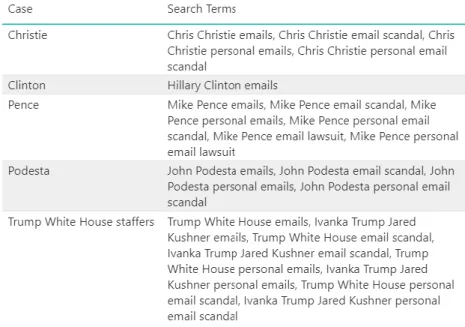
See Table 1 for a full list of search terms used for each case. When searching for articles on the Trump White House email case, however, I was only able to locate nine articles using Google News. To reach 30 articles for this case, I used Google web search to locate the remaining six that I would otherwise have found through Google News.
Table 1. Search terms used for each email case.
referencing the case being examined when they offered their opinion on why email matters.
Google News and MSN News provided a large mix of news sources to examine on each case. Searches yielded news sources of differing political leanings on both the national and local levels, as well as sources specializing in topics such as the information technology and financial industries. This was desirable, as this study aimed to gain insight into the opinions of the general public, rather than any segment of the public. Also, for this reason, I did not consider the political bias or journalistic integrity of the news sources. The goal was simply to understand the reasons why people felt these records were important, not to make judgements about whether those reasons were justified.
1.8
Overviews of the Five Email Cases
I selected five specific scandals involving the email of high-profile politicians to examine for this study. I will give a brief description of each case below.
1.8.1 Hillary Clinton Email
In 2015, a House committee was investigating the attack on the American consulate in Benghazi, which occurred while Hillary Clinton was Secretary of State. They requested to see Mrs. Clinton’s email correspondence related to the Benghazi
attack, and it was discovered that she had exclusively used a private email account to conduct government business while Secretary of State. Her staff went through the process of reviewing her email from her time as Secretary of State and determining which
House committee 900 pages that they deemed to be relevant to the inquiry (Schmidt 2015).
Months later, in July of 2015, the inspectors general for the State Department and Office of the Director of National Intelligence referred the email case to the Justice Department after discovering classified information in Mrs. Clinton’s emails. They
requested that the Justice Department investigate further to determine whether she had mishandled classified information (Welker 2015). This prompted an FBI investigation into Clinton’s private server, to determine whether she had stored her email securely
(Williams 2015).
The investigation concluded nearly a year later in July of 2016. The FBI found 110 emails containing classified information on the Clinton server, with eight of those emails containing top-secret information, the highest level of government classification. They also found that Clinton had used her personal email while in the territory of foreign adversaries. However, they found no evidence that Clinton or her staff intended to violate laws. For this reason, the FBI recommended no charges be brought against Clinton (Siemaszko 2016). Two weeks before the 2016 presidential election, in which Clinton was a candidate, the FBI renewed its investigation into her server after finding potentially relevant emails during a separate investigation. They ultimately determined that the new emails did not change their original conclusion.
1.8.2 Chris Christie Email
Investigations into the 2013 Bridgegate scandal and subsequent court cases
retaliate against Fort Lee Mayor Mark Sokolich for failing to endorse Christie’s reelection with Christie’s deputy chief of staff, Bridget Anne Kelly. The plan involved
reducing Fort Lee’s access lanes to the George Washington Bridge from three, down to one. This plan took effect on September 9, 2013, the first day of school, and caused a huge slow-down in traffic for five days, until the lanes were reopened (Flanagan 2016).
The United States Attorney for the District of New Jersey launched an
investigation in the aftermath of the incident, during which time emails and text messages between Port Authority officials and Christie staffers became public. An email exchange, in which Kelly wrote “Time for some traffic problems in Fort Lee”, and Wildstein responded, “Got it”, came to be known as the “smoking gun” in the case. The
investigations culminated in a guilty plea of conspiracy and corruption from Wildstein, and the later convictions of Kelly and Port Authority official Bill Baroni on similar charges related to the incident. Wildstein, Kelly, and several other staffers accused Christie of knowing about the plot in advance, but no charges have been brought against the former governor at the time of this writing (Domonoske 2016).
1.8.3 Mike Pence Email
While he was Governor of Indiana, Vice President Mike Pence joined a lawsuit that several governors brought against the Obama Administration, challenging an executive order on immigration. Mr. Pence also hired a private law firm to represent the State of Indiana in the case. In 2014, Indianapolis attorney William Groth requested records related to Pence’s decision to hire a private law firm for the case. Pence’s office
Pence’s decision to withhold the white paper in court, but the court ultimately sided with
Pence (Hussein 2017).
The Indianapolis Star then launched a separate investigation into Pence’s email
use as Governor of Indiana. They found that he used a private AOL account to conduct state business, including matters of homeland security and communications with the FBI regarding terrorism arrests in Indiana. They also found that his AOL account was hacked and used in a phishing attack. The hacker did not appear to be targeting him personally (Cook 2017a).
1.8.4 Trump White House Email
In September of 2017, the New York Times reported that several senior officials in the Trump White House had, at least occasionally, been using private email accounts to conduct official business. These officials included Jared Kushner, Steve Bannon, Reince Priebus, Gary Cohn, Stephen Miller, and Ivanka Trump. Mr. Kushner received additional attention for creating a domain shortly after the election on which to host his family’s emails. None of the officials used a private email exclusively, but the revelations
did raise concerns that having relevant emails stored on non-government servers might hinder the special counsel investigation into possible collusion between the Trump campaign and Russia during the presidential election (Apuzzo & Haberman 2017).
1.8.5 John Podesta Email
On October 7, 2016, during the 2016 presidential campaign, WikiLeaks began releasing emails of Hillary Clinton’s campaign chairman, John Podesta. They claimed to
speeches to banks, her own email scandal, and an attack on the U.S. embassy in Benghazi. U.S. intelligence officials were able to determine that the Russian hacking group Fancy Bear was responsible for the stolen emails, and that the Russian government had likely ordered the attack to interfere with the presidential election (CBS/AP 2016).
1.8.6 Emergent Coding
Emergent coding allows one to examine data without an existing coding scheme in mind, allowing relevant concepts to emerge from the data (Stemler 2015). This is founded in the principles of grounded theory, a qualitative research methodology that allows for the development of theories through the flexible interpretation of data (Glaser & Strauss 1967).
This methodology is particularly useful for an exploratory study such as this. I began analyzing the articles without any theory or coding scheme in mind. I looked for important coding categories and commonly expressed ideas as I went along. As I began to develop more concrete categories and subcategories for my coding scheme, I applied them to new data and reviewed old data with these categories in mind. When I was satisfied that the content analysis stage was complete, I looked for significant patterns in the data, which I used to formulate my findings.
themes in the articles, while I broke them down sentence-by-sentence and looked for where new reasons for interest were being introduced. As a result, I generally applied more categories.
Second, sometimes the difference between two categories was dependent on personal interpretation of what those categories meant. For example, she interpreted a mention of the “appearance of impropriety” as an expression of “Character Flaws”, with
impropriety being the character flaw, while I interpreted it to be an implicit reference to corruption. How we coded this depended on what we considered to be a character flaw and how we defined corruption. Ultimately, I decided to keep my original category assignments in both these cases, but it is helpful to better understand how personal interpretation may lead to different results, depending on who is coding.
1.9
A Note on Personal Biases
Although responsible researchers try to remove any bias from their study, the subjective nature of qualitative research means that researchers run the risk of inadvertently allowing their personal biases to influence the results of their study. Therefore, it is best if I disclose my own biases before delving any further into the research. As this study deals with the emails of high profile political figures, the reader should know that I am a registered Democrat and consider my political views to be left leaning. This has the potential to lead to a difference in the way I view cases involving Democrats versus cases involving Republicans, which could influence my coding of those cases.
the emails in these cases were important, not to make judgements about the validity of those reasons. When discussing the results, I will refrain from making any statements on whether I feel the opinions expressed in the articles are justified. I also did not consider my opinions of the news source, the author, or the content when selecting articles. I judged articles solely based on whether they could answer my question, and I took the first 15 for each case, from each aggregator, that met these criteria.
Results
Through the process of examining the 150 articles that I selected for this study, I created a coding scheme that I used to produce the final analysis of my results. Below, I will describe the categories and subcategories that made up the final coding scheme. I will then provide a breakdown of the results of my final analysis.
1.10
The Coding Scheme
At the close of the content analysis phase of this research, the coding scheme has 15 categories, five of which are broken down further into subcategories. For each
scheme is a key component of the output of this research which affects the results of the study, I will provide an explanation of each of the coding categories and how I applied them.
Category Example
Character Flaws Most of the attention to Clinton’s emails came from
Republicans, who perceived her more generally as dishonest and scandal-plagued.
Illegal Activity They still chant ‘Lock her up’ at Trump rallies, just as they did at the New York Stock Exchange as she gave her concession speech.
Lack of Transparency The new documents included 115 Clinton email exchanges that were not previously turned over by the State Department. Unimportant This study will be used by liberals as evidence that the media's
unnecessary focus on Clinton's email server cost her the election.
Security Risk The two stories suggested that the AOL email account was used by Pence to discuss seemingly confidential subjects such as terror attacks and to receive FBI updates.
Political Consequences
As far as is known on the public record, the only Russian activities of any consequence were the email hacking of the Democratic National Committee (DNC) and John Podesta. Corruption The Podesta Emails support accusations that the former
Secretary of State had a cozy relationship with bankers. Sheds Additional
Light
Whistleblower website WikiLeaks has been dumping hacked emails pertaining to the workings of Democratic candidate Hillary Clinton’s presidential campaign for weeks now.
Duty of Government John Vecchione, president of the Cause of Action Institute, said it’s the agency’s duty to recover the records.
Incompetence After all, it was Clinton who never seemed to grasp the
seriousness of the issue and how it eroded the public’s already shaky confidence in her.
Interpersonal Conflicts Another email has long-time Clinton aide Doug Band referring to Chelsea Clinton as a ‘spoiled brat’.
Additional Questions But the email leaves plenty questions about what kinds of conversations came before it and who else was involved. Costing Taxpayer
Money
The former governor’s actions have cost us in terms of time and money.
wish to fly on the same plane with former First Lady Michelle Obama to Betty Ford’s funeral, and an email chain between Clinton staffers showing they drafted a “doctors statement” as to why Mrs. Clinton fainted due to “dehydration” causing her to hit her head and suffer a “concussion” in December 2012. Violent Fallout In December 2016, Edgar Maddison Welch, a man who
believed the viral Internet rumor, opened fire in the restaurant in Washington.
Table 2. Coding categories with examples.
The most widely used category overall was “Character Flaws,” with 85 uses, 69
of which were implicit, and 16 of which were explicit. I assigned this category any time an individual suggested that either the content of the emails, or the circumstances of the email scandal, carried evidence that a person possessed undesirable character traits. I broke this category down into five subcategories, based on which character flaw the person allegedly possessed. In order of frequency, these subcategories were hypocritical (63 uses); dishonest (14 uses); cruel, inconsiderate, or selfish (four uses); racist (two uses); and sexist (one use). Explicit uses of this category typically mentioned the name of the character flaw. The statement, “Most of the attention to Clinton’s emails came from Republicans, who perceived her more generally as dishonest and scandal-plagued” (Edwards-Levy 2017), is an example of this. Implicit uses did not mention the flaw directly but used language that implied the flaw. For example, in the statement, “But a lawyer working on behalf of a New Jersey newspaper seeking public records from the governor recently argued Christie engaged in somewhat similar behavior” (Arco 2016), the author mentions an accusation that Christie criticized Clinton for doing something like what he was doing but does not explicitly mention hypocrisy.
The second most used category was “Illegal Activity,” with 65 uses, 37 of which
expressed the opinion that either the content of the emails, or the circumstances
surrounding the management of the emails, provided evidence of illegal activity. Explicit uses of this category stated that a person may have violated laws or mentioned
punishments that result from illegal activity. The statement, “They still chant ‘Lock her up’ at Trump rallies, just as they did at the New York Stock Exchange as she gave her concession speech” (Traister 2017), is an example of this. Implicit references often
mentioned the use of the emails as evidence in court cases or criminal investigations. In the statement, “Their attorneys now say Christie deleted text messages and hid emails
that may have contradicted his claim that he knew nothing about the lane closures” (Blitzer 2016), the author mentions accusations that Christie’s emails may provide evidence that he was involved in something that was deemed illegal but falls short of explicitly accusing him of illegal activity.
The third most used category was “Lack of Transparency,” with 64 uses, 54 of
which were implicit, and 10 of which were explicit. I assigned this category when an individual expressed the opinion that either the content of the emails, or the
circumstances of the email scandal, indicated that a person was not being transparent in his or her professional conduct. Explicit uses of this category mentioned the word transparency or made clear accusations of inappropriate destruction of public records. The statement, “Two former Christie appointees indicted in the scheme are alleging that
Clinton email exchanges that were not previously turned over by the State Department”, mentions missing email messages (Singman 2017).
The next most used was the “Unimportant” category, with 48 uses, 45 of which
were implicit, and 3 of which were explicit. I assigned this category any time an individual suggested that the email scandal was not important, or that it was not important enough to warrant the level of attention it was receiving. Explicit mentions used the words “unimportant”, “unnecessary”, or equally clear language to describe the
attention given to the controversy. The statement, “This study will be used by liberals as evidence that the media’s unnecessary focus on Clinton’s email server cost her the
election,” is an example of this (Cillizza 2017). Implicit uses undercut the sense of importance assigned to the scandal without stating outright that it was not important. In the statement, “Christie’s lawyers say they’ve now searched that account and found no
emails ‘related to and contemporaneous with the lane realignment’” (Katz & Bernstein 2016), Christie’s lawyers are refuting one of the major reasons for interest in his email.
The next category was “Security Risk,” with 47 uses, 31 of which were implicit,
and 16 of which were explicit. I assigned this category when an individual made the case that the email either presented or revealed a security risk. This category was further broken down into subcategories based on whether the risk was to national security (31 instances) or a state’s security (16 instances). Explicit uses mentioned the security risk
directly. The statement, “Who knows what kind of security ijkfamily.com has” (Daileda 2017), is an example of this. Implicit uses often referenced improper handling of
confidential subjects such as terror attacks and to receive FBI updates” (Rathi 2017),
references the use of an unsecure, private email account to discuss sensitive information. The next category was “Political Consequences,” with 37 uses, 33 of which were
explicit, and 4 of which were implicit. I assigned this category any time an individual presented evidence or expressed the opinion that the emails caused political or professional consequences. I broke this category into three subcategories based on whether the person was making the case that the emails did have political consequences (29 instances), predicting that they would cause political consequences in the future (six instances), or arguing that they should cause political consequences (two instances). Explicit uses directly stated that the email caused, would cause, or should cause a political consequence. The statement, “As far as is known on the public record, the only Russian activities of any consequence were the email hacking of the Democratic National Committee (DNC) and John Podesta” (Lin 2018), is an example of this. Implicit uses
made statements that indirectly suggested consequences. In the statement, “Wikileaks, however, may be holding on to a bag of scandals though, saying Friday’s leak was the first batch of 50,000 emails” (Cox 2016), the author suggests that trouble may be ahead for the Clinton campaign.
The next category was “Corruption,” with 36 uses, 34 of which were implicit, and
among some in the electorate that the Democratic nomination system was corrupt and rigged” (Pollard, Segal & Devost 2018), is an example of this. Implicit uses discussed behavior that is often associated with corruption. For example, the statement, “The Podesta Emails support accusations that the former Secretary of State had a cozy
relationship with bankers” (Cox 2016), mentions Clinton’s relationship with Wall Street,
which is often associated with corruption among the Democratic base.
The next category was “Sheds Additional Light,” with 24 uses, 18 of which were
explicit, and six of which were implicit. I assigned this category when a person discussed revelations about other issues that came out of the emails or used the email scandal to enhance a discussion of a separate issue. I broke this category into subcategories based on the other issue being discussed. Clinton campaign strategies was the most common, with five uses. Politicians’ awareness of information security issues, the voter fraud
commission’s use of private email, and the ability of the Indiana state judiciary to check
the executive branch each had two uses. The following issues each had one use: parole of Paula Cooper, Mike Pence’s endorsement of Ted Cruz, Jared Kushner’s use of private email, Mike Pence’s opinion of Donald Trump, the firing of James Comey, the
Republican tax reform bill, ISIS’s funding sources, Russian attempts to hack Senate email accounts, the special counsel’s Russia investigation, the publication of the book
Clinton Cash, the Keystone XL pipeline, the Uranium One allegations against Hillary Clinton, and the investigation into the FBI’s handling of the Clinton email investigation.
campaign for weeks now” (Pascaline 2016), is an example of this. Implicit uses
referenced the email as a way of enhancing a discussion of a separate issue. In the statement “Pence was also criticized for his use of a private AOL account for state
business while he was governor of Indiana” (Steele 2017), the author uses Pence’s AOL account to provide background information on a controversy involving the voter fraud commission that he led.
The next category was “Duty of Government,” with 21 uses, 19 of which were
implicit, and two of which were explicit. I applied this when an individual stated or implied that it is the duty of the government or the official to provide the email to the public. Explicit uses directly mentioned a government’s duty. The statement, “John Vecchione, president of the Cause of Action Institute, said it’s the agency’s duty to recover the records” (Schoffstall 2017), is an example of this. Implicit uses referenced
ethics or the ways that the duty is reinforced through policy. For example, the statement, “But that doesn’t make their blatant disregard for White House ethics any less alarming”
(Hilton 2017), suggests that the use of private email accounts violates the ethical duties of White House employees.
The next category was “Incompetence,” with 11 uses, nine of which were
it eroded the public’s already shaky confidence in her” (Cillizza 2017), as an implicit expression of the “Incompetence” category, because it mentioned Clinton’s email scandal damaging the public’s confidence in her ability to do her job.
The next category was “Interpersonal Conflicts,” with ten uses, eight of which
were explicit, and two of which were implicit. I applied this category when an individual discussed interpersonal conflicts between government or political figures that were revealed in the emails. For all ten instances, these conflicts were revealed in the content of the email messages themselves. Explicit uses were clear about the fact that they were interested in an interpersonal conflict, while implicit uses mentioned behavior that was often used as evidence of an interpersonal conflict. For example, I coded the statement, “Another email has long-time Clinton aide Doug Band referring to Chelsea Clinton as a ‘spoiled brat’” (Berman & Merica 2016), as an explicit expression of the “Interpersonal Conflicts” category.
The next category was “Additional Questions,” with nine uses, seven of which
was involved” (Phillip & Walshe 2014), as an explicit expression of the who was
involved or had access subcategory within the “Additional Questions” category. The next category was “Costing Taxpayer Money,” with five instances, four of
which were explicit, and one of which was implicit. I applied this category when an individual brought up the concern that taxpayer funds were being used to manage the email scandal. The explicit uses were clear about the use of taxpayer funds to manage the email, while the implicit use referenced the money but was not clear in conveying that it was taxpayer money. For example, I coded the statement, “The former governor’s actions have cost us in terms of time and money” (Cook 2017b), as an explicit expression of the “Costing Taxpayer Money” category.
The final two categories, “Medical Problems” and “Violent Fallout”, had only one instance each. The “Medical Problems” instance had to do with a doctor’s statement that Clinton’s staff drafted after she suffered a concussion in 2012, which was discussed in her released emails. The “Violent Fallout” instance involved a shooting in a Washington pizza parlor by a man who believed the debunked “Pizzagate” rumors. These rumors
began after the release in the Podesta emails, when conspiracy theorists found what they believed to be references to a child sex trafficking ring in the emails.
1.11
Breakdown of Usage
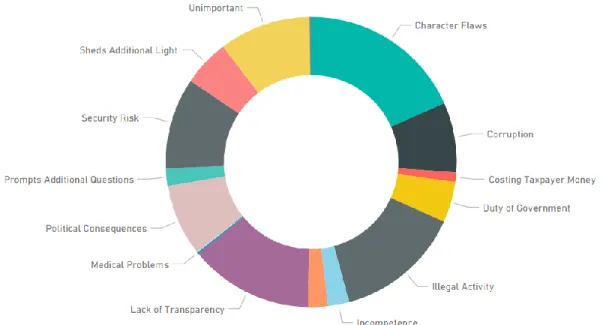
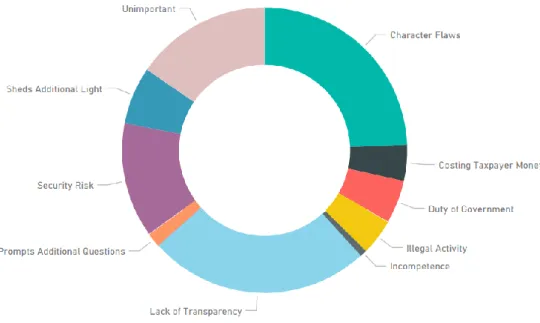
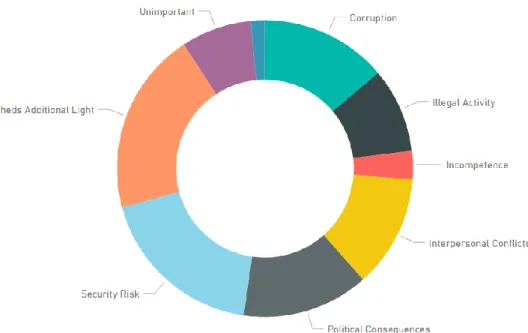
While “Character Flaws” was the most-used category overall (Figure 1), with
18.3% of total category assignments, it only accounted for 3.9% of assignments related to Hillary Clinton’s email scandal. For Clinton’s case (Figure 2), “Political Consequences”
and “Security Risk” were also prominent in the Clinton case, with each accounting for 15.8% of assignments for Clinton’s controversy. This is similar to the percentage of “Illegal Activity” assignments overall, which was 14%. However, it is higher than the overall percentage for “Security Risk”, which was 10.1%, and accounts for a quarter of
all uses of this category.
Figure 2. Category distribution for Hillary Clinton’s case.
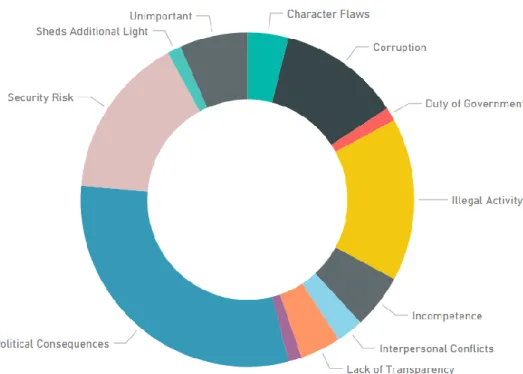
The top three categories in Chris Christie’s case were the same as the top three
overall, although they did not fall in the same order (Figure 3). “Character Flaws” was third in Christie’s case, and held a similar percentage in his case as it did overall, with 19.4%. “Illegal Activity” was the top category for Christie, with 27.2% of category assignments. This accounts for 43% of all the assignments of the “Illegal Activity” category. “Lack of Transparency” was second, with 22.3% of assignments in Christie’s
case, compared to 13.8% of assignments overall. This accounts for 35.9% of all assignments for this category. “Duty of Government” was also more prominent for
Christie than it was across cases, as it was in fourth place for Christie but ninth overall. It had 9.7% of assignments in Christie’s case, but 4.5% overall. This accounts for 47.6% of
Figure 3. Category distribution for Chris Christie’s case.
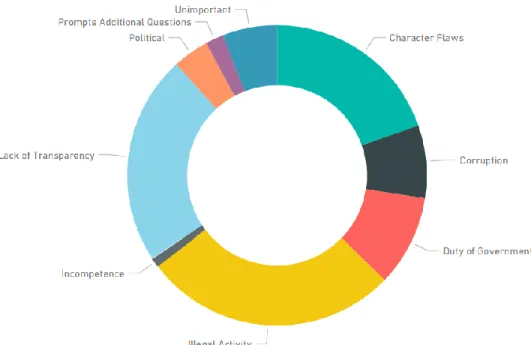
Of the top five overall categories, “Illegal Activity” was the only one that was not among the top categories in Mike Pence’s case, with only 4% of category assignments in
his case (Figure 4). The most used category for Pence’s case was “Lack of
Transparency,” with a quarter of assignments, accounting for 48.4% of all uses of this category. “Character Flaws” was close behind, with 24.4% of assignments for Pence, accounting for 35.3% of all uses of this category. “Unimportant” was also common for
Pence, with 15.4% of assignments in his case, accounting for 39.6% of all assignments for the category. “Security Risk” was the final member of Pence’s top four categories,
Figure 4. Category distribution for Mike Pence’s case.
The top three categories for the Trump White House staffers were also among the top categories overall (Figure 5). “Character Flaws” was the most common, with a third of all category assignments for this case, accounting for 37.6% of assignments for the category overall. Although this far exceeded the numbers for all other categories that were assigned in this case, “Illegal Activity” came closest, with 14.4% of assignments. “Unimportant” was next, with 12.4% of assignments, accounting for a quarter of all assignments in that category. “Corruption” was a bit of an outlier. It only had 10% of
Figure 5. Category distribution for the Trump White House case.
“Security Risk” figured prominently in Podesta’s case, with 18.5% of category
assignments (Figure 6). This was higher than the overall percentage for this category and accounted for a quarter of its total assignments. However, the biggest outlier for Podesta was “Sheds Additional Light”, which was the most common category for this case with
Figure 6. Category distribution for John Podesta’s case.
1.11.1Influence of Political Bias
Of the news sources that I used, 26.7% were Center-Left, 25.6% were Not Rated, 16.3% were Left, 15.1% were Center, 8.1% were Center-Right, and 7% were Right (Figure 7). Media Bias Fact Check classified one source as Conspiracy-Pseudoscience, a special category that the site assigns to sources whose general theme is centered around advancing conspiracy theories or pseudoscience. This accounts for 1.2% of sources.
Figure 7. Distribution of news sources by political bias.
Because some of the articles I used came from the same news sources, the
Figure 8. Distribution of political bias across articles.
Because there could only be one bias category per article, and because there were so few right-of-center news sources represented, it is difficult to gain an understanding of case-by-case trends related to political bias from this study. Still, the data produced by this study did reveal some trends. First, I had no articles from Right news sources for any of the three cases that centered around Republican officials. By contrast, Hillary
Clinton’s case had six articles from Right news sources, while John Podesta’s had four.
Additionally, among cases that had articles from Center-Right sources, there was not much difference between Republican-centered and Democrat-centered cases in the number of articles from these sources. However, Mike Pence’s case did not have any
articles from Center-Right sources, meaning I had no right-of-center articles for his case. When looking at how categories were assigned across news bias categories, some additional trends appear. One is that the “Security Risk” category makes up 6.76% of
14.29% for Center-Right news sources, and 19.35% for Right news sources. So, partisan-leaning news sources were more likely to mention “Security Risk” the farther right they
leaned. However, a news source was more likely to mention “Lack of Transparency” the closer it fell to the center of the political bias spectrum. Among partisan-leaning news sources, those that leaned left were more likely to express concerns about transparency than those that leaned right. Specifically, this category made up 3.23% of assignments for Right sources, 8.11% for Left sources, 9.52% for Center-Right sources, 12.64% for Center-Left sources, 21.01% for Center sources, and 18.18% for sources that were Not Rated.
Sources that leaned to the right were more likely than any other bias category to have “Political Consequences” assignments. This category made up 16.13% of
assignments for Right news sources and 14.29% for Center-Right sources, but the next highest percentage was Center, with 8.4%. However, no right-of-center news sources had any mentions of “Prompts Additional Questions.” “Character Flaws” had a fairly high
percentage for most bias categories, but it was significantly higher among Left sources than all others, with 31.08% of assignments for Left sources and 20.45% of the next-highest bias category, Not Rated. However, news sources on the other far end of the political spectrum – Right – had no mentions of “Character Flaws.”
The two far ends of the political spectrum were the most likely to mention “Corruption”. This made up 14.86% of category assignments on the Left and 16.13% on
center of the political spectrum. It made up 19.57% of category assignments in Center news sources, 10.34% for Center-Left, and 9.52% for Center-Right. Left sources were slightly more likely to mention this category than Right sources, with “Unimportant” making up 6.76% of Left’s category assignments, compared to Right’s 3.23%.
Discussion
The clearest takeaway from these results is that the most dominant reason for showing interest in these email scandals was that they revealed character flaws in prominent government figures. This seems to be a convergence of several ideas previously discussed in the literature review. First, this reflects the idea that people are drawn to celebrity scandals, in part because they have the effect of lowering the individuals from their pedestal of celebrity and bringing them closer to the average person. It also reflects the idea that people may hold government leaders to a higher standard than other types of celebrity, and that they may be drawn to politicians that can appear both relatable and larger-than-life. Being flawed can make these politicians seem more like regular people but having their most glaring character flaws laid bare makes them seem less like the polished leaders they need to be.
On the surface, this seems to suggest that people are interested in these scandals primarily because they value the insight emails can give into how these politicians
contradicting their public images. But only 12.9% of the mentions of character flaws were referring to flaws that were revealed in the content of the emails themselves, while the rest were evident in the circumstances surrounding the controversy. Therefore, these scandals seem to be operating as typical celebrity scandals, at least in terms of the way they are revealing information about the character of the individuals involved.
Still, some of the other highly-used categories seem to suggest that these are different from the typical celebrity scandal. “Illegal Activity” and “Lack of
Transparency” were also top categories. “Illegal Activity” was almost evenly split
between content and circumstances in terms of how the activity was revealed, with content being slightly more prominent. This seems to signify two different things. First, people care about the evidentiary value that emails possess as a documentary form. Second, they place a great deal of value on the roles emails play both as evidence in the legal system and as a tool for greater accountability. They take records laws seriously and judge people harshly who even appear to violate them.
This goes together with the “Lack of Transparency” category. People feel that,
The results of this study also highlight the importance of circumstance in how people perceive and assign importance to a case. Hillary Clinton’s email scandal
coincided closely with a presidential election in which she was one of the primary candidates, so it is no surprise that people would be interested in the political
consequences of the controversy. The emails that came out in Chris Christie’s case were
being used as evidence in a criminal investigation, so it is also clear to see why people were interested in how those emails revealed illegal activity. Donald Trump ran a presidential campaign that heavily featured criticism of Hillary Clinton’s email scandal,
then several of the people who worked on that campaign went on to use personal email in their White House jobs. The primary concern here was hypocrisy. John Podesta was not particularly high-profile before his emails were released, but he was running a political campaign for Hillary Clinton, who had been a high-profile politician for some time. His emails were later revealed to have been stolen by Russian hackers. So, “Sheds Additional Light” and “Security Risk” were both of particular relevance to his case.
There seems to be an interesting relationship between the top two categories in Mike Pence’s case. Some of the news sources mentioned that he had cultivated a belief in
transparency as part of his public image. Others suggested that this scandal confirmed already existing concerns that Pence’s belief in transparency may not be sincere. Many others either implied or explicitly stated that his indignation in response to Hillary Clinton’s email scandal was hypocritical, and that the circumvention of accountability
The results may also signify that political bias also factors into what people find to be important, at least to some degree. Those farther to the right may be more likely to be concerned about protecting national security and the political consequences of an email scandal, while they may be less interested in what further questions may come out of the controversy. Those on the left may be more interested in assuring transparency and learning about the character of their leaders. Those closer to the center of the spectrum may be more likely to be concerned about transparency, and to question whether the scandal is important at all. Those on the far ends may be more interested in uncovering government corruption. Meanwhile, those on the far right may not consider scandals involving politicians with whom they are ideologically aligned to be important at all.
Finally, these results carry some implications for records professionals
responsible for managing government records. The need for improved government email management is not new. It is the level of interest that this issue is currently receiving from the public that has changed. Understanding that increased interest can help records professionals to better understand how to approach their priorities in a time when both the volume of records and interest in those records are growing.