Elizabeth C Bates. The Prevalence and Origins of Contemporary and Historic
Photographs in Wikipedia Articles. A Master’s Paper for the M.S. in L.S. degree. April, 2017. 60 pages. Advisor: Denise Anthony
Cultural heritage institutions are increasingly engaging with Wikipedia to improve its content and reach out to new audiences. This exploratory study investigates the frequency of photographs and historic photographs embedded as illustrations in Wikipedia articles. A random sample of 500 articles was examined, in which roughly half of all articles lacked any illustrations; 128 articles, or 26% of the sample included photographs; of those, only 26 articles, or 5% of the sample, included historic photographs. Sources are examined to determine where these photographs originated, and suggestions are made for future research into related factors and potential automation using software to collect data.
Headings:
Photographs
Photograph Collections
Archives -- Public Relations
Web 2.0
THE PREVALENCE AND ORIGINS OF CONTEMPORARY AND HISTORIC PHOTOGRAPHS IN WIKIPEDIA ARTICLES
by
Elizabeth C Bates
A Master’s paper submitted to the faculty of the School of Information and Library Science of the University of North Carolina at Chapel Hill
in partial fulfillment of the requirements for the degree of Master of Science in
Library Science.
Chapel Hill, North Carolina
April 2017
Approved by
Table of Contents
Table of Contents ... 1
Introduction ... 3
Literature Review... 6
Wikipedia ... 6
Wikipedia in Academia... 9
Criticism of Wikipedia ... 10
Use of Wikipedia ... 11
Cultural Heritage Institutions and Wikipedia ... 12
Collaborations: Librarians and Wikipedia ... 12
Archival Collections: Contributing to Wikipedia to Increase Visibility ... 15
Photographic Collections ... 22
Research Questions ... 25
Methods... 26
Quantitative Content Analysis ... 26
Sampling Units, Units of Analysis, and Variables ... 27
Sampling ... 28
Timeframe ... 29
Results ... 31
Images ... 31
Photographs... 33
Historic Photographs ... 35
Discussion ... 39
Limitations ... 41
Generalizability ... 41
“Random” Sampling ... 41
How does Wikipedia’s Special:Random function work? ... 42
Does this sampling method yield a true random sample?... 43
Reliability ... 43
Further Research ... 44
Introduction
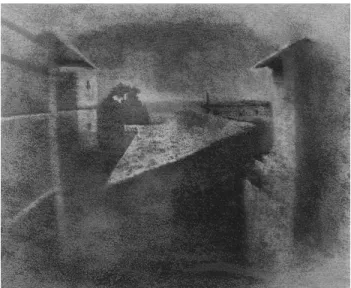
The earliest surviving photograph of an actual physical scene was created on a
sunny day in France, in 1826 or 1827, and was called a “heliograph” (Figure 1).
Nicéphore Niépce exposed a light-sensitized pewter plate to sunlight through a camera
obscura for many hours, to make an image of the view from a high window.
Fig. 1: Niépce, J. N. (ca. 1826). View from the Window at Le Gras.
By 1845, not even twenty years later, daguerreotype studios had sprung up in
towns and cities across the United States, and the ability to document life and likeness
was no longer limited to those who could afford to commission an artist (Ritzenthaler &
Vogt-O’Connor, 2006, p. 1-2). Nearly two centuries have passed, and photography is
digital photograph, and thus instantaneously create a visual document of people, places
and events.
In a similar fashion, though in a shorter and much more recent time span,
Wikipedia, “the free encyclopedia that anyone can edit” (Wikipedia) has also quickly
risen to be practically the default reference tool of the internet. Since its inception in
2001, Wikipedia has become the most popular online reference source, and as of April
2017, it ranks as the sixth most-visited website globally (Alexa). A Google search for
most topics will usually return a Wikipedia article prominently at the top of the search
results. Referring to it for a quick information fix has become second nature for both
casual and serious information seekers, and soon the incoming class of university
freshmen will be a cohort that has neverlived in a world without Wikipedia (or digital
photography).
While there has been debate over Wikipedia’s accuracy, reliability, and even
suitability as a reference source, cultural heritage institutions are increasingly engaging
with the Wikipedia phenomenon to highlight their collections and reach out to a broader
community, including people who never previously had any interest in archival materials.
These interactions have involved editing the text of articles and adding digitized archival
assets.
Photographs are a rich documentary heritage that can be easily integrated into
Wikipedia’s evolving knowledge ‘ecosystem,’ and provide an important way to insert
primary source materials into an environment that otherwise only cites secondary
collections web sites, however, there have been no studies into the impact such
contributions have had on Wikipedia.
Therefore, this is an exploratory study to investigate where Wikipedia and
photography intersect, the frequency with which photographs, especially historic
photographs, are used to illustrate articles, and to explore possible future opportunities for
Literature Review
Wikipedia
As of April 2017, the English-language version of Wikipedia has more than 5.3
million individual articles, more than twice as many as the next largest, the
German-language version which has just over 2 million articles (Wikipedia, n.d.). There are 295
different language versions, which total more than 43 million articles (“List of
Wikipedias,” n.d.). According to data aggregated by Wikimedia Statistics, as of February
2017, English Wikipedia has almost 8.3 billion page views per month, 777 new articles
written per day, and 3.3 million edits are made to articles each month by more than
30,000 active editors (“Wikimedia Project at a Glance: English Wikipedia,” 2017). A
report from Pew Research Center found that the English version had 97.2 billion page
views in 2015, while the next-most-visited language version, Japanese, received just 15
billion visits (Anderson, Hitlin, & Atkinson, 2016). The “free encyclopedia’s” enormous
growth, not just in terms of amount of content but also in terms of usage, is illustrated by
an earlier report from the Pew Internet and American Life Project: in 2007, 25% of all
surveyed adults (36% of adult internet users) in the United States reported using
Wikipedia. Three years later, in 2010, that number had increased to 42% of American
Jimmy Wales and Larry Sanger launched Wikipedia in 2001 (Lih, 2009, p. 64). In
2003, Wales founded the nonprofit Wikimedia Foundation, Inc. to own and fund
Wikipedia and other related projects (Ibid., p. 183-184). Wikipedia refers to itself as “the
free encyclopedia,” which has multiple meanings. Not only is it free to use, but also
freely licensed: anyone can copy, edit, modify, and redistribute content from Wikipedia
for commercial or noncommercial purposes (Ibid., p. xv).
All articles are created by volunteers: at the top of each page is an ‘edit’ button,
allowing anyone to become an editor and add or change information within an article,
even anonymously (Ibid., p. 3). Textual content is copyrighted to the editors, but is
licensed to the public with a variety of free distribution licenses, including the GNU Free
Documentation License, and Creative Commons Attribution Share-Alike Licenses. These
licenses allow anyone to copy, modify, and redistribute the content, but also require that
any submitted content not be under other copyright. In the case of images, this means the
author must freely license them, or the images must be in the public domain or have a
reasonable case to justify fair use (“Wikipedia:Copyrights,” 2016).
Pages are written in a basic markup language called WikiMarkup, which adds
structure to articles, visually separates sections, and automatically generates a
hyperlinked table of contents. Many articles start as “stubs,” or short, incomplete articles
that require additional work from editors (Lih, 90-92).
Just like the articles, The Wikipedia community of editors collectively develops
Wikipedia’s policies and guidelines. Today, those policies are very detailed, but at their
core are three long-standing tenets: a neutral point of view, verifiability, and no original
Neutral Point of View: In order to avoid bias, articles must explain multiple sides
of issues rather than taking a stance. Facts should be reported in such a way that people
on either side of a contentious issue can still agree on them (“Wikipedia:Neutral point of
view,” 2017). This was the only “non-negotiable” policy according to founder Jimmy
Wales (Lih, p. 6).
Verifiability: All facts presented in articles must cite reliable, third party,
published sources, preferably with a reputation for fact-checking. Whether a source is
reliable depends on the type of source, the creator, and the publisher. Published, as far as
this policy is concerned, refers to anything that is made available to the public in some
form. Statements that lack sources, or cite sources deemed unreliable, may be removed
from articles (“Wikipedia:Verifiability,” 2017).
No Original Research: All information in Wikipedia articles must be attributed to
a reliable, published source, and may not contain new analysis or imply conclusions not
stated by those sources (“Wikipedia:No original research,” 2017). For people working
with primary sources, this means that information in primary sources must be referenced
in another publication to be acceptable in a Wikipedia article.
There are many other guidelines, but one that is particularly relevant to this paper
is the policy regarding image use: uploaded images must be the ‘own work’ of the
person uploading it, show some sort of proof that they are freely licensed or in the public
domain, or provide a rationale for using a non-free image justifying a fair use exception
Wikipedia in Academia
In its short lifespan so far, Wikipedia has already been the focus of a great deal of
academic research across multiple fields. A group of researchers from multiple fields and
institutions has published systematic reviews of scholarly research on Wikipedia.
“Wikipedia in the Eyes of its Beholders” (Okoli, Mesgari, Mehdi, Nielsen & Lanamäki,
2014) aggregates and summarizes 99 studies on Wikipedia’s readership, categorized by
academic fields, data sources, research designs, and topics, and outlining trends in
research. The majority of articles studied the English language version of Wikipedia;
30% of the publications reviewed originated in the library and information science field,
with education as the next-highest contributing academic area (24%). The most common
topics were student readership, but library science literature also focused on Wikipedia as
a resource for librarians, and overwhelmingly called on the profession to take advantage
of it.
In a related piece, the same authors reviewed 110 publications covering
Wikipedia’s content, and found that the related fields of information and library science
and information systems account for two-thirds of the included studies (Mesgari, Okoli,
Mehdi, Nielsen & Lanamäki, 2015). The two main topics that research focused on were
quality of content presented in Wikipedia (covered in 82 studies) and the size of
Wikipedia (13 studies). Again, most studies used the English-language version of
Criticism of Wikipedia
Higher education has a historically contentious relationship with Wikipedia.
University faculties have decried its crowd-sourced information as potentially inaccurate
or unreliable, and even banned its use in student assignments (Jaschik, 2007).
However, crowd-sourced information might not be the root cause of those
potential errors: a study in Nature compared 42 science entries in Wikipedia to their
counterparts in Encyclopedia Britannica, and found that each encyclopedia included 4
major factual errors, but that Wikipedia had more minor errors (162 versus 123) (Giles,
2005). Historian Roy Rosenzweig examined multiple Wikipedia articles that covered
historical figures, and found that Wikipedia’s coverage was much broader than other
general encyclopedias, and the misinformation in Wikipedia articles was often the same
sort of misinformation contained in traditionally published works (2006). He noted that
stylistically as well, Wikipedia’s style is bland in comparison to other history sources,
and the policy-driven dedication to a ‘neutral point of view’ often results in dully
summarizations of multiple takes on contentious topics, but that Britannica (whose style
Wikipedia mimics) isn’t a particularly thrilling read either. Another policy he identified
that affects Wikipedia’s coverage of historical topics is ‘no original research’.
Information in articles must cite secondary publications, which severely limits the
contributions from professional historians working from primary sources. This issue
impacts the contributions from archival collections as well, and doubtlessly also
Use of Wikipedia
Despite academia’s generally cautious approach to Wikipedia, people still heavily
use it, especially students. According to Pew Research, the strongest predictor of using
Wikipedia was education: 69% of American internet users with a college degree reported
using Wikipedia as a reference source. Another strong indicator was age: among internet
users age 19-29, 62% were Wikipedia users (Zickuhr & Rainie, 2011).
A study from the University of Washington’s Information School found, using
both surveys and focus groups of American undergraduate students across multiple
college campuses that 76% of college students admitted to using Wikipedia for their class
research. Even if professors forbid them from citing Wikipedia articles, students use it as
a starting point in their research process, providing background information and
overviews or previews of topics (Head & Eisenberg, 2010). Lim (2009) also reports that
student attitudes towards Wikipedia are generally cautious, and despite their heavy usage
of it, college students are aware that Wikipedia may include inaccurate information and
require verification from other sources.
EBSCO Information Services’ user research team argues that easy-to-use
resources like Wikipedia and Google have become a habit for modern
information-seekers; by providing an immediate reward (relevant information) for a small amount of
work (typing a search term), brains are rewired to return to these same sources over and
over again. Their take on this phenomenon was to analyze what features of Wikipedia
users found appealing and useful, in order to redesign library resources to better fit users’
contents, and references section) help readers to orient themselves within a topic, which
is appealing for both students and casual users (Lawrence & Costello, 2014).
Cultural Heritage Institutions and Wikipedia
Andrew Gray and Max Klein, “Wikipedians-in-residence” at the British Library
and OCLC, who have hosted workshops to help academics and librarians improve
Wikipedia’s content, argue that Wikipedia’s frequent use provides information
professionals “the opportunity to catch loosely-interested readers and steer them towards
engaging with original sources and specialist literature” (2013). They particularly
highlight the “aggressive” approach to citations, which often demands providing specific
references for individual statements. The references section uses hyperlinked footnotes
within the text of articles, making it easy for the reader to move from a general
description immediately to the source that provided it, especially if a digital version of
that source is available.
Collaborations: Librarians and Wikipedia
Noting the opportunities available in a widely used reference source that
librarians can actually make changes to, Kathleen de la Peña McCook, instructing at the
School of Information at the University of South Florida, restructured multiple classes to
include editing Wikipedia articles as a major component of assigned coursework. The
aim was to introduce her students to the ins-and-outs of Wikipedia’s culture and
knowledge-sharing process, and at the same time to fill holes and (hopefully) counteract
some biases in its coverage. Students came away with a greater appreciation for
editors in the future (2014). On a side note, Kathleen de la Peña McCook is the subject of
a well-cited, detailed, and robust Wikipedia article, which includes a photographic
self-portrait uploaded by one of her students.
Other higher-education classes have incorporated editing Wikipedia articles into
their coursework, and Wikipedia now includes functions specifically for classes. In 2013,
it spun off the nonprofit Wiki Education Foundatio, which works specifically with
university instructors assigning students to add content to Wikipedia articles. Students
develop their own information literacy and research skills, and gain experience writing
for a public audience, while (ideally) improving Wikipedia by the addition of new
content (Wiki Education Foundation, n.d.).
In 2010, the British Museum entered into a collaboration with Wikipedia by
engaging the first “Wikipedian-in-Residence.” This was an experienced Wikipedia editor
creating articles about the objects within the British Museum, and making use of the
staff’s experience and knowledge to create high-quality articles. This widened the
audience for the museum’s artifacts, and resulted in increased web traffic to the British
Museum’s web site, though the latter was not a specific goal of the project (Ellis, 2014).
Since then, this approach has been developed into Wikipedia’s GLAM-Wiki initiative,
which facilitates collaboration between experienced Wikipedians and galleries, libraries,
archives, and museums, as well as botanical and zoological gardens, to share their
resources (“Wikipedia:Glam,” n.d.).
In 2011, the National Archives and Records Administration engaged a
Wikipedian-in-Residence associated with their communications and social media team
available collections of high-resolution images, so that they could be found by Wikipedia
editors and used in articles. One example is a collection of photographs by Ansel Adams,
commissioned by the National Parks Service in the 1940s had previously only been
available to people who could visit in person, despite being in the public domain as
records produced by the government (Keller, 2016). Other institutions engaging
Wikipedians-in-Residence include the Museu Picasso, the Museum of Modern Art, the
Smithsonian Institution Archives, and dozens of others (“Wikipedian in Residence,”
2017).
Another way in which cultural heritage institutions engage with Wikipedia is by
hosting “edit-a-thons.” These are frequently held in conjunction with open-access week,
an annual scholarly communication event in October. An edit-a-thon is an event, often
hosted by a library or museum, where multiple people work on improving articles, often
focused on a common topic. They frequently include an instructional component,
wherein experienced editors show newcomers the ropes. The New York Public Library
hosted an edit-a-thon about musical theater in New York, introducing many patrons to
their closed-stacks resources for the first time, which were used to research facts for
articles (SinhaRoy, 2011).
Perhaps the largest events are the Art+Feminism edit-a-thons, which attempt to
counteract the skewed content in Wikipedia that is an inevitable result of the fact that
only 13% of contributors are women. Organized in 2014 at the Museum of Modern Art
by Siân Evans, Jacqueline Mabey, and Michael Mandiberg, the project took off by
reaching out via social media and recruiting librarians. Instructional materials and
individual events where thousands of articles were improved or written from scratch
(Evans, Mabey, & Mandiberg, 2015).
Archival Collections: Contributing to Wikipedia to Increase Visibility
Publications from archival institutions engaging with Wikipedia consist mostly of
case studies, wherein special collections staff edit articles to include links to or content
from their repositories. The earliest of these, if not the first published, took place in 2005
when the University of North Texas began systematically adding links in Wikipedia
articles to relevant collections (Belden, 2007). In the published write-up of the case, the
project at UNT edited 700 articles to include direct links to related materials in their
digital collections that include Texas history and government documents, increasing web
traffic to those collections. Referrals from Wikipedia now account for 48% of pageview
at UNT digital collections (Belden, 2008).
The first published case study came from Ann Lally and Carolyn Dunford with
the Digital Initiatives Unit at the University of Washington Libraries, and has heavily
influenced subsequent ventures at other institutions, as well as inspired discussion within
the Wikipedia community (2007). This project, undertaken in May 2006, intended to
“reach out to... users where they begin their information search” (Ibid., Introduction
section, para. 1). The project itself consisted of adding external links at the bottom of
individual Wikipedia articles to relevant digital collections and finding aids, and in some
cases creating new articles where they found gaps. As a result, pageviews of their digital
collections increased significantly, and Wikipedia became the fourth-largest referrer of
web traffic. Interestingly, while traffic referred from University of Washington sites or
Wikipedia continued to increase during those times, suggesting that their collections are
being viewed by nonusers of these resources who are outside their usual university sphere
(Ibid., Results section, figure 7). Additionally, they found that content on Wikipedia
(available under the GNU Free Documentation License), is widely copied and mirrored
across the web, including the inserted links to University of Washington Collections,
driving traffic from other language versions of Wikipedia and web sites that have used its
free content (Results section, para. 7). In their conclusion, they remarked that interactive
web services like Wikipedia offer librarians an opportunity for enhancing a ubiquitous
reference source, and said, “We now consider Wikipedia an essential tool for getting our
digital collections out to our users at the point of their information need. We view this as
a very low cost way to enhance access to our collections, as well as an effective way to
participate in the creation of resources that are used by millions around the world” (Ibid.,
Conclusion section).
After the publication of the above article, discussion took place among Wikipedia
editors, debating if such contributions were enriching, or self-promoting spam
(“Wikipedia talk:WikiProject Spam/2007 Archive Jul.,” 2007). In a follow-up piece
written for The Interactive Archivist, Lally included discussion about this debate, wherein
these link contributions were flagged as spam, or considered conflicts of interest. Based
on these interactions, she reported that their future plans involved engaging more with the
community aspects of Wikipedia and acting commensurate with the spirit of contribution,
by introducing relevant links in associated talk pages to discuss relevancy before adding
Following Lally and Dunford’s initial report on successfully increasing web
traffic to University of Washington Collections, many other institutions began their own
programs of inserting links and content into Wikipedia articles and publishing the results.
University of Nevada, Las Vegas University Libraries, as part of their initiatives
with web 2.0 technologies to “create a presence wherever students and faculty spend their
time both in the real world and the virtual world” (p. 2), investigated the utility of
Wikipedia for reaching out to students. Their efforts include an article about the main
branch of UNLV campus libraries, and linking to digital collections from pertinent
Wikipedia articles. Web statistics show that Wikipedia consistently refers visitors to
library pages (Griffis, Costello, Del Bosque, Lampert, & Stowers, 2007).
The Digital Library at Villanova University undertook a project to add content to
Wikipedia, which included drafting and submitting biographical articles about persons
represented in special collections, as well as linking to collections from relevant
pre-existing articles (Incrovato, 2007).
The California Digital Library at The University of California also began linking
to digitized collections from relevant articles after performing an in-depth collection
analysis to determine collection strengths, and then matching those strengths to
information gaps in Wikipedia. They also discussed the complications of inserting links
without being considered spam by conscientious editors, and the difficulties in
determining if a contribution is “successful” (Zentall & Cloutier, 2008).
Wake Forest University librarians began their own program of editing Wikipedia
articles based on the University of Washington case study (Lally & Dunford, 2007),
articles. However, almost immediately their institutional account was disabled (per
Wikipedia policies only individuals are allowed to have accounts) and an article written
about one of their collections was removed as being promotional (Pressley & McCallum,
2008). As in the articles above from the University of Washington and the University of
California, they found that the difficult part of contributing to articles in a mutually
beneficial way was complicated by incomplete knowledge of the culture of Wikipedia its
lengthy policies.
Another case study at Syracuse University, published by the Society of American
Archivists in A Different Kind of Web, took a different approach and cited, rather than
other case studies, the discussion among Wikipedia editors that had developed after
publication of those articles (Combs, 2011). They used this debate to inform their
understanding of Wikipedia’s culture and policies, and to formulate guidelines for
introducing content to, and linking to their own collections from Wikipedia:
“(1) In accordance with Wikipedia’s policy on spam, we would not link to our finding aids from every single possible related article; we would link only from those for which we have unusual or significant related material; (2) In accordance with “Wikipedia is not just a collection of links” and “Wikipedia is an encyclopedia,” we would also edit to improve the content of the articles” (p. 141).
Additionally, while acknowledging the self-serving nature of using Wikipedia to
drive traffic to their collections, Combs stresses that archivists have an ethical obligation
to promote not just their own collections, but all cultural heritage collections, citing Point
VI of the Code of Ethics of the Society of American Archivists (p. 140).
Starting in 2008 their team edited 43 articles to improve content and to link back
to their collections, and wrote 13 new articles. As a result, server statistics showed a
also translated to other language versions of Wikipedia. They also had physical, local
results, as an SU undergraduate student came to the reading room to access a collection
they had discovered from an article link (pp. 142-143).
In 2010, the University of Houston Libraries Digital Services Department began a
project to link existing articles to their collections, but found instead that it was more
effective to embed relevant digitized items in articles and share them on Wikimedia
commons (Elder, Westbrook, & Reilly, 2012). Images uploaded to Wikimedia commons,
with descriptive metadata including the source URL for the original file, were discovered
and used by other editors, who enhanced their description by adding tags, and used them
in multiple articles across multiple language versions of Wikipedia. While noting that
Wikipedia policy forbids deliberate self-promotion, the authors ensured that their
contributions were relevant to the “dynamic online information and evolution cycle” (p.
35). As in the case studies above, these efforts resulted in increased web traffic to
University of Houston digital collections; the initially added four links began referring
noticeable new traffic within a matter of hours.
Another project started in 2010, at Ball State University Archives and Special
Collections, also involved adding links for specific items in their digitized Hague sheet
music collection to relevant Wikipedia articles for individual songs, songwriters, and
lyricists. Fifty-seven links were added, referring to 40 individual digitized assets,
resulting in an average annual pageview increase of over 600% over the previous year for
those items (over 5000% for some individual items), and increased web traffic to the
parent collection as well. The author concluded that “adding links at the item level
of the digitized Hague Sheet Music assets are often not just simply interested in digitized
sheet music, but rather are often interested in specific songs and songwriters. [Users’]
discovery of assets in the Hague Sheet Music collection via Wikipedia articles about
specific songs, songwriters, and lyricists supports this characterization” (Szajewski, 2013,
Conclusion section). This explanation, of users being interested in and drawn in by
specific items rather than the broader collections that contain them, may likewise account
for Elder, Westbrook, and Reilly’s success with adding digitized objects to articles and
the commons.
The University of Pittsburgh Archives Service Center and Special Collections
Department established their own Wikipedia editing program, after noting that 298
articles already contained links to their digital collections and were the 6th largest driver
of traffic. Rather than just adding more links to enhance discoverability, the goal of this
project was also to improve articles by adding content, or to be good Wikipedians. Prior
to starting the project, the archivists reached out to local Wikipedians, and provided their
staff and student workers with a Wikipedia education course (now part of the Wiki
Education Foundation), hoping to add credibility to their edits as well as to have access to
the “sandbox” feature to draft edits before committing them. According to the published
case study, 97 total articles were edited, from adding sources or small facts to dramatic
overhauls of entire articles or drafting new ones. This resulted in a significant increase in
traffic from links in articles. In that case study, the archivists also discuss the challenges
of adapting to and learning the complexities of Wikipedia style, rules, and guidelines.
They particularly highlight the difficulty surrounding the “no original research” rule,
to say, archival collections). One work-around for this is that university finding aids
summarizing collections and providing biographical collections count as reliable
published sources, and another was finding details reported in newspapers rather than in
letters and journals. (Galloway & Dellacorte, 2014).
Another response to this trend in archives editing Wikipedia articles is a project
from the University of Miami Libraries. They began developing a web-based tool to
extract biographical and historical data from finding aids, allowing that data to be edited
or enhanced, and merged into existing articles or published as new articles if none such
already exist on that topic. They intended not only to streamline the process, but also to
facilitate the inclusion of better archival metadata in citations at Wikipedia (Thompson,
Little, González, Darby, & Carrothers, 2013).
Recently, taking a very different approach to using Wikipedia as outreach for
their collections, Eastern Washington University had an on-campus edit-a-thon, with the
goals of giving undergraduate students hands-on exposure to and experience performing
research with archival materials, and engaging them in the process of collaboratively
sharing knowledge (Sliger, Krause, Rosenzweig, & Victor, 2017). Inspired by prior
endeavors by heritage institutions to improve the quality of information available to the
public, or to increase usage of their digital materials, the staff utilized similar strategies to
develop public programming for outreach at the local level. The same actions, in this
case, were used with the goal of engaging their core constituency, the students of their
Photographic Collections
Compared to the textual record, photographic images are a relatively new
phenomenon, and have not always been considered important by the archival profession.
Archival theorist T. R. Schellenberg, for instance, remarked that “the provenance of
pictorial records in some government agency, corporate body or person is relatively
unimportant. For such records do not derive much of their meaning from their
organizational origins…. Information on the functional origins of pictorial records is also
relatively unimportant” (as cited in Boles, 2005, p. 132). Ritzenthaler and
Vogt-O’Connor also note that in early archival practice, photographs were generally relegated
to a lower status than other kinds of records, and were often overlooked in records
schedules and collecting policies (2006, p. xiii). Essentially, photographs were treated as
being just illustrations that supported other points.
Today, we have a more nuanced understanding of photographic records. Like text
documents, a photograph is taken by a person, for a particular reason, and reflect that
perspective and agenda (Boles, p. 132-133). They also reflect the times in which they
were taken, and provide information about many aspects of life, evidence of activities,
documentation of events, attempts to market to and persuade viewers, or even artistic or
aesthetic merit (Ritzenthaler & Vogt-O’Connor, p. xiii). Photographs can be compelling
tools of communication on their own, and the context in which an image was created and
used makes them into a narrative. For instance, a photograph of a child shows you what
he or she looked like at the time it was taken; knowing, perhaps from notes written on the
back, that the portrait was taken to send to a distant parent who had never seen the child,
However, even when photographs are simply used as illustrations, illustrations are
not just illustrations. Visualizations of all kinds (maps, charts, drawings, photographs,
etc.) help to communicate information in different ways, clarifying textual information or
even acting as a substitute for it. In some instances, visual aids communicate points more
effectively than the written word can. (Burke, 2012, p. 102). A speaker may describe
something using every possible descriptive word, and the person listening may imagine
something totally inaccurate to that description. Consider, for instance, images of exotic
animals painted by medieval monks who had only ever been told about them (Figure 2).
Fig. 2: Illustration from a 14th century manuscript: van Maerlant, J. (ca. 1350). Der Naturen Bloeme.
Visualizations have long been considered important ways of conveying
information. Captain Cook’s scientific voyages employed not just scholars, but also
artists, brought along to paint their findings to convey them back to Britain (Burke, p.
44). In 1853, news publications sent artists and photographers to cover the Crimean War
(Figure 3), perhaps marking the origin of photojournalism, and a new era of
communicating and disseminating information through a visual media that transcends
Fig. 3: Photograph from the Crimean War. Fenton, R. (1855). The valley of the shadow of death.
Published texts have always included visual aids of some kind, from hand-painted
illuminations in manuscripts to digital printing, and digital publications decrease the cost
of reproducing images. There is a rich visual history held by archives around the world,
and much of it has been digitized and made available online. However, Wikipedia editors
have only made use of a small portion of it. This study seeks to explore how those images
Research Questions
Q1: What is the prevalence of photographs used to illustrate Wikipedia articles?
Q2: What is the prevalence of historic photographs?
Q3: What are the sources supplying contemporary and historic photographs for
Methods
Quantitative Content Analysis
To address these questions, I used quantitative content analysis.
“Content analysis is a systematic, objective, and quantitative method for studying
communication messages and developing inferences concerning the relationship between
messages and their environment” (Krippendorff, 1980). This is a very broad definition of
a method that has been interpreted in many ways by different researchers, and has been
utilized in LIS and other fields to rigorously investigate text and other media both
quantitatively and qualitatively.
Riffe, Fico, and Lacy define quantitative content analysis as “the systematic
assignment of communication content to categories according to rules, and the analysis of
relationships involving those categories using statistical methods,” (Riffe, Fico, & Lacy,
2014, p. 3) which is still a highly flexible definition suited to answering many different
kinds of research questions. There are many ways to perform content analysis, but the
key to results that are valid and stand up to scrutiny is to establish the rules of how the
Sampling Units, Units of Analysis, and Variables
The sampling units in this study, or the identifiable and retrievable vehicles of the
message to be analyzed, are individual Wikipedia articles (White & Marsh, 2006). The
units of analysis are also the individual articles. The content being analyzed is manifest,
rather than latent, content, and can be recorded in a fairly straightforward manner. The
variables studied include the presence of images, the presence of photographs, the
presence of historic photographs, and the source and license information for photographs.
In this instance, “historic photograph” refers to any photographic image from an archival
repository, or a photograph that predates the launch of Wikipedia in 2001. This
categorization is broad, but was necessary to account for photographs that are held in
personal collections and not originally created with the intent of freely distributing them
online.
Determining the age and source of an image was done by clicking on the image
within the article, accessing the image’s page in the file namespace in Wikipedia or in the
Wikimedia Commons. Data recorded there includes who uploaded it, the source of the
Fig. 4: An example of a historical photograph in Wikimedia Commons that refers back to an archival institution as the source, in this case the Reading Museum, where the original image is housed (Darby,
1890). The work is in the public domain because of its age: any copyright is long past its term.
Sampling
As the aim of the study is exploratory, the goal of the research questions is to get
an idea of what Wikipedia as a whole is like in regards to the use of archival images.
However, Wikipedia’s scale is enormous, and examining the images (or lack thereof) in
each article is not feasible for one researcher. Therefore, this study examined a random
sample of 500 Wikipedia articles, with the aim of having results that are somewhat
To do this, articles were selected using Wikipedia’s Special:Random tool,
accessible in the navigation sidebar on the left side of every Wikipedia page (Figure 5).
Fig. 5: The navigation sidebar on Wikipedia's main page, with the Random article link circled.
This link takes a user to a random article from among the millions. Admittedly,
using this built-in feature is very much a convenience sampling method rather than a
statistically rigorous sampling method (Riffe, p. 75), as it allowed sampling to take place
from any computer, and did not require technical expertise.
Timeframe
As McMillan points out, one of the challenges of applying content analysis to web
content is the ever-changing nature of web sites (2000). Wikipedia in particular has the
potential to have sweeping changes made to content very quickly, as anyone can access
and edit articles (and its constant and easy update process is one aspect of what makes
Wikipedia so popular). Analyzing a large number of Wikipedia articles from the live
website requires that they be accessed within a short period of time. If sampling were a
of the sampling period could be very different. As a hypothetical example, an institution
could begin a large-scale program of uploading images to the Wikimedia Commons and
inserting them in articles after this sample process began, and so results from before and
after this initiative would be very different.
To lessen the impact of potential changes over time, the sampling took place
between January 1st and January 10th, 2017. An html ‘snapshot’ of each article as it
appeared was saved. Analysis was performed on the “snapshots,” rather than the online
Results
Of the 500 articles sampled, one was a redirect and was excluded from the
analysis. For a complete list of samples, refer to the appendix.
Images
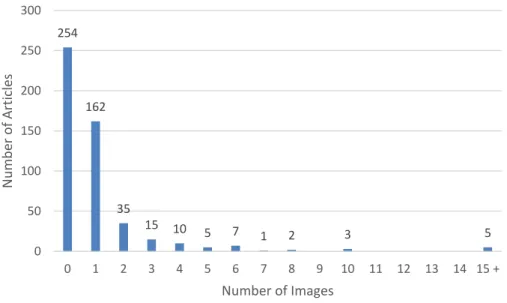
Two hundred and forty-five articles (49% of the sample) contained one or more
images, while 254 articles (51%) contained no images.
Fig. 6: Number of images per article
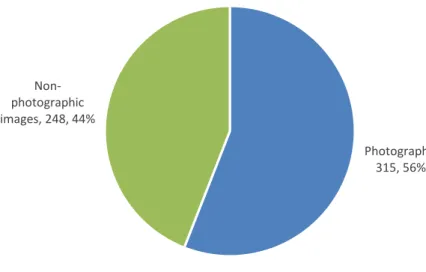
Within the 245 articles that included images, there were 563 images, 315 of which
were photographs. Over the entire sample, the average number of images per article was
1.128. When considering only the subset of articles that contain images, the average
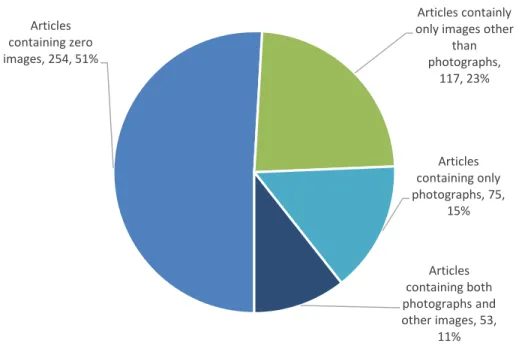
number of images per article is 2.298. In 117 articles (23% of the whole sample) there
were images present but not any photographs. 254
162
35
15 10
5 7 1 2 3 5
0 50 100 150 200 250 300
0 1 2 3 4 5 6 7 8 9 10 11 12 13 14 15 +
N
u
m
b
er
o
f Art
icl
es
Fig. 7: Sampled articles by types of images contained
Images other than photographs Images
Total 144
Range 1-10
Mean 1.231
Median 1
Mode 1
Table 2: Distribution of images in 117 articles containing images but NOT including photographs Articles
containing zero images, 254, 51%
Articles containly only images other
than photographs,
117, 23%
Articles containing only photographs, 75,
15%
Articles containing both photographs and other images, 53,
11%
All Images Photographs
Non-photographic
images Images
Total 563 315 (56%) 248 (44%)
Range 1-31 1-31 1-12
Mean 2.298 1.286 1.012
Median 1 1 1
Mode 1 0 1
Fig. 8: Types of images included in articles
Photographs
Within the 245 articles that contain images, 128 articles (52% of the subset, 26%
of the entire sample) contained photographs, either alone or alongside other types of
images, and 75 articles (31% of the subset) contain only photographs. Articles containing
at least one photograph make up approximately 26% of the entire sample set.
Only Photographs Images
Total 149
Range 1-31
Mean 1.987
Median 1
Mode 1
Table 4: Distribution of images in 75 articles containing ONLY photographs
Photographs, 315, 56%
Non-photographic images, 248, 44%
All Images Photographs
Non-photographic
images Images
Total 419 315 (56%) 104 (25%)
Range 1-31 1-31 1-12
Mean 2.298 1.286 1.012
Median 1 1 1
Mode 1 0 1
All Images Photographs Non-photographic images Images
Total 270 166 (61%) 104 (39%)
Range 2-31 1-28 1-12
Mean 5.094 3.132 1.962
Median 3 2 1
Mode 2 1 1
Table 5: Distribution of images in 53 articles containing BOTH photographic and non-photographic images.
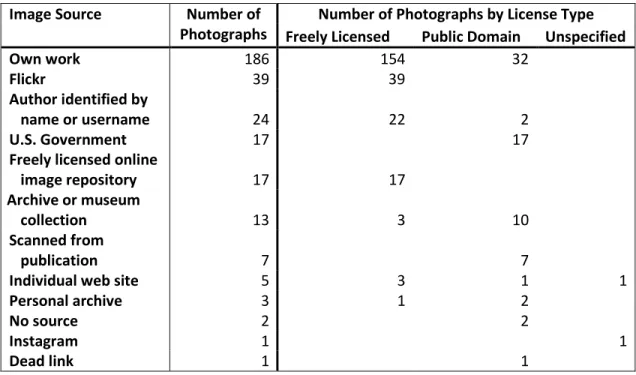
The most common source for photographs at 59% was ‘own work,’ or
contemporary photographs taken and uploaded by a Wikipedia editor. Twelver percent of
photographs cited links to Flickr, an online community for sharing digital photographs,
while 8% cited an individual person by name or username, but did not claim to be ‘own
work.’ Both United States Government sources and freely licensed online image
repositories each contributed 5% of the photographs. U.S. Government sources include
NASA, the Navy, Army, Air Force, Department of Agriculture, and the White House.
Examples of freely licensed online image repositories include geograph.org.uk, dedicated
to photographs of locations and landmarks in Great Britain and Ireland; antweb.org, a
database of images and information on ants; and mushroomobserver.org, a website
dedicated to photographs of and information about fungi. A mere 4% of photographs
came from archival collections. Two photographs lacked any source information, and one
cited a URL that no longer functions. One contemporary photograph’s author was left
Image Source Number of Photographs
Number of Photographs by License Type
Freely Licensed Public Domain Unspecified
Own work 186 154 32
Flickr 39 39
Author identified by
name or username 24 22 2
U.S. Government 17 17
Freely licensed online
image repository 17 17
Archive or museum
collection 13 3 10
Scanned from
publication 7 7
Individual web site 5 3 1 1
Personal archive 3 1 2
No source 2 2
Instagram 1 1
Dead link 1 1
Table 6: Sources of photographs, broken down by usage license
Of the 315 photographs in the sample, 74 were in the public domain (23%), 239
were licensed using a Creative Commons License or GNUFDL (76%), and two did not
have a specified license (<1%).
Historic Photographs
“Historic photographs” comprised 34 of the 315 photographs, or 11%. These
images were embedded in 26 individual articles, or 5% of the whole sample. Seven of
these images (21% of all historic photographs) were scanned from books or newspapers,
and as a result are generally not very high quality images. Eleven of the sources (32% of
the historic photographs) are specific citations to identify the item within a cultural
heritage institution, while ten of them (29%) simply cite the parent institution but provide
Table 7: Sources of historic photographs Article Title Number of Historic Photographs Image
Year Source Permission
Ichirō Fujiyama 1 Ca. 1930s
Scanned image: from Mainichi Newspaper company (google translate), nonspecific citation
Public Domain
Jane Loftus, Marchioness of
Ely
1 Before 1890
Scanned from book: Buckle, Letters of Queen Victoria (pub. 1930)
Public Domain
Christ myth
theory 3
Ca. 1870s
Scanned from newspaper: Die Gartenlaube, Nr. 4 /1908, S. 83 (Rudolf Krauß: David Friedrich Strauß / Zu seinem hundertsten Geburtstage)
Public Domain
Ca. 1900 Library of Congress, specific
citation; scan of glass negative Public Domain Before
1980s
Author’s collection: Scanned
Image Freely licensed
Sachiko Saito 1
20 February
1967
Dutch National Archives, specific
reference Freely licensed
List of aqueducts in the Roman
Empire
1 Ca. 1996 Private archive, author identified,
permission in email archive Freely licensed
Dobi-III 1 1924 Lithuanian Aviation Museum:
Dead link Public Domain
George Morris (Australian
politician)
1 1939 State Library of Queensland,
nonspecific citation Public Domain
Air Force Systems Command
5
1990 National Museum of the US Air
Force: Dead link Public Domain 1944 United States Air Force,
nonspecific citation Public Domain 1947 United States Air Force,
nonspecific link Public Domain Ca.
1950s
National Museum of the US Air
Force, nonspecific citation Public Domain
1960
United States Air Force, nonspecific citation, third-party link
Public Domain
Fritz Römer 1 Before 1909
Scanned from book: August Brauer (ed.): Fauna Arctica, Vol. 5, 1909
Public Domain
The Holocaust in
Lithuania 1 1941
German Federal Archive, specific
citation Freely licensed
Liqui liqui 1 1930s Personal archive Public Domain Frederick Bristol 1 1918 Library of Congress, nonspecific
citation Public Domain
Konrad Tom 1 1919
Scanned from book: Wielcy artyści małych scen Ludwik Sempoliński, Czytelnik, Warszawa 1977
Public Domain
Irina Vorobieva 1 1979 German Federal Archive, specific
citation Freely licensed
James Calvin Sly 1 1840 Family History Public Domain History of
plug-in hybrids 1 1900
Source unidentified, but
permission in email archive Public Domain HMS Jutland
(D62) 1 1947
Imperial War Museums, specific
citation Public Domain
Braj Kumar
Nehru 2 1961
John F. Kennedy Presidential Library and Museum, specific citation
Table 7: Sources of historic photographs Article Title Number of Historic Photographs Image
Year Source Permission
1961
John F. Kennedy Presidential Library and Museum, specific citation
Public Domain
R.A.C. Smith 1 1900 Library of Congress, nonspecific
citation Public Domain
José Félix
Uriburu 1 1930
Archivo Gráfico de la Nación
(Argentina), nonspecific citation Public Domain John Tracy
Gaffey 1 1935
Scanned from newspaper, Los Angeles Times, January 10, 1935 (via proquest)
Fair Use
Coney Island
(1917 film) 1 1917 Third-party web site Public Domain
Savage Club 1 Ca. 1860
Library of Congress, specific citation: Wet collodion glass negative
Public Domain
Temple Lot Case 1 Ca. 1887
Scanned from book: 1946 Temple of Promise by Julius Caesar Billeter, also includes nonspecific citation from book (Courtesy, Graphic Arts Bureau, [City of] Independence [Missouri])
Public Domain
Virginia gubernatorial election, 1901
1 1913 Library of Congress, specific
citation Public Domain
Quinault people 2
1913
Northwestern University Digital Library Collections: Edward S. Curtis’s The North American Indian, specific citation
Public Domain
1912
Northwestern University Digital Library Collections: Edward S. Curtis’s The North American Indian, specific citation
Public Domain
Twenty-eight images were in the public domain, five were free to distribute under
Fig. 9: Historic photographs by year
0 1 2 3 4 5 6 7 8
N
u
m
b
er
o
f P
h
o
to
grap
h
s
Discussion
Historic photographs make up only a small portion of the many images used to
illustrate Wikipedia articles, and appeared in only 5% of the articles sampled.
Contemporary snapshots uploaded by their creator outnumber historic photographs by
more than five-to-one. This may be because editors taking their own pictures allows them
to sidestep checking permissions on someone else’s work. Incidentally, these amateur
photographers provide images that are extremely variable in quality.
Additionally, more than one-third of historic photographs in this sample lack
adequate citations to easily find where they originated and other related photographs –
the contextual information that enhances meaning of any photograph. Of the photographs
scanned from books (where they are reproduced in dot-matrix prints), only one mentions
the book’s citation for the source of the original image within a repository.
In an interesting case, the article for Anna Maria Fox contains a blurry photograph
(Figure 10) of a book, which reproduces a (probably color) painting or drawing in
black-and-white. The photographer’s thumb is holding the book open. The source of the
original image is not mentioned.
That painting, as it turns out, was made from a photograph. A high-quality
scan of the original glass negative is available under a Creative Commons License from
the Tate web site (Figure 11). In cases like this, it would take extremely little effort to use
Fig 10: Anna Maria Fox (and a thumb) (Wikipedia, 2016).
Limitations
Generalizability
The small sample size of this study in comparison to the enormous sampling
frame of over five million English Wikipedia articles, means that this study has examined
less than one-hundredth of a percent of all Wikipedia articles, and is unlikely to be
representative. However, for the purposes of this exploratory study, it has provided a
glimpse of a variety of the different photograph types and sourcing strategies that are
employed in writing collaborative encyclopedia entries.
“Random” Sampling
A true random sample requires having a complete list of items in a population,
and then using a random number generator to create a list of random numbers to select
from that list. Each item must have an equal chance of being selected, or a uniform
distribution, statistically independent of the others.
However, most random number generators are actually pseudo-random number
generators, because computers are programmed machines that behave in predictable ways
(Haahr, 2016). When researchers use the Microsoft Excel function RAND() to generate a
list of random numbers, they are in fact getting numbers from an algorithm that generates
pseudo-random numbers: numbers that appear to be random, and for most purposes serve
as random numbers, but are actually generated mathematically and therefore are not truly
“random.” Up until the 2003 version of Excel, the pseudo-random number algorithm was
only sufficiently “random” up until about a million random numbers. More recent
function in Excel,” 2011). “True” random number generators extract randomness from
physical phenomena (like atmospheric sound or radioactive decay) and use it to create
actually random numbers in a process that is less efficient than pseudo-random number
generators, and also fairly resource-intensive (Haahr, 2016).
How does Wikipedia’s Special:Random function work?
Special:Random is a “Special page”, which in Wiki software parlance means that
it is a “[page]… created by the software on demand to perform a specific function.”
(“Manual:Special pages - MediaWiki,” 2016). It does not actually exist as a fixed web
page that can be viewed and edited. According to Wikipedia’s Technical FAQ
(“Wikipedia:FAQ/Technical,” 2016), each page in Wikipedia is assigned a “random
index,” for the page_random value in the database (“Manual:page table - MediaWiki,”
2016). This is a number selected by combining two 31-bit words from a Mersenne
Twister, a pseudo-random number generator.1 When a user clicks the “random article”
link, the Special:Random feature chooses a double-precision floating-point number (a 64
bit number format with a wide range of values) and returns the first article with a random
index greater than the selected number.
This is done using MediaWiki’s (the software that Wikipedia uses) wfRandom()
function (“MediaWiki: includes/GlobalFunctions.php File Reference,” n.d.) which is
described in the documentation simply as “Get a random decimal value between 0 and 1,
in a way not likely to give duplicate values for any realistic number of articles.”
However, their Manual provides more information: the wfRandom() function can avoid
duplicate values up to approximately 4,611,686,014,132,420,609 articles.
(“Manual:Random page - MediaWiki,” 2016). Selection is limited to the Main/Article
namespace, so it will not bring up pages from the User namespace, Wikipedia namespace
(which contains pages about Wikipedia) or others (“Wikipedia:Namespeace,” 2016;
“Wikipedia:Random,” 2016).
Does this sampling method yield a true random sample?
No, but neither would the pseudorandom number generator available in Microsoft
Excel. I accept the results as “random enough,” considering the immense sampling frame,
and the practicalities of performing research as an individual.
While I cannot confirm a statistically representative sample of Wikipedia articles
in their entirety, I consider this a representative sample of what users might access by
browsing the random feature for pleasure or to learn something new.
In order to generate a statistically-rigorous random sample, a researcher would
need to have a fixed version of Wikipedia from which to generate a sample frame, and
then select articles using random numbers. This can be done by downloading Wikipedia’s
regular backups, or “dumps,” and creating a local version.
Reliability
Reliability in content analysis is usually bolstered by measuring inter-coder
agreement on assigning categories, ensuring that any other researcher attempting to
replicate the study with the same methods would have the same results (McMillan, 2000;
Riffe et al., 2014). However, in this instance, all coding was done by myself without
latent content: presence or absence of a type of image, and the number of any present. I
hope that the obvious nature of the data will lend itself to sound results, regardless of the
lack of cross-coding.
Further Research
Similar studies could be greatly facilitated by automating some or all of the data
collecting. The limiting factor on this study was the time involved in manually collecting
data. However, a “bot,” or software tool, could easily scrape data from specific parts of
articles and generate spreadsheets.
Besides automation, the incorporation of other variables (“stub” classification,
number of edits, presence of a request for an image on an article’s talk page, or perhaps
articles within certain subject areas) would allow researchers to determine if there are any
particular factors that correlate to “lacking illustration.” If correlations do exist, this
would make it possible to identify articles suitable for incorporating archival materials
without having to view them manually.
Implications for practice
Despite the work already done by archives sharing their content with Wikipedia,
there are still many spaces in Wikipedia where archivists can engage: roughly half of all
articles in this study lacked any illustrations at all, and only thirteen photographs used in
articles originated in special collections. Even fewer provided adequate citations to the
collection that contains them. Archivists contributing photographs would improve the
quality of articles by including primary source information, increase the number of
users to engage more deeply by following the references to additional resources, and
increase traffic to their own collections in the process.
There is room for other types of archival materials as well, such as maps. In this
sample, they were the second-most frequent illustration type after photographs. Most
maps included in articles were generated using software, either by editors or bots.
Digitized historic maps (none of which were encountered in this study) are a rich
resource that could be used to enhance Wikipedia articles with aesthetically pleasing
illustrations that put our current understanding of geography in perspective to the past.
This lack of historic images, or gap in Wikipedia’s content, is an opportunity for
cultural heritage institutions to reach out and connect with new users while improving the
quality of information available on the most used reference resource. Individual historic
images embedded in Wikipedia articles can introduce users to archival materials within a
context that they are already familiar with and already have some interest in. Visually
interesting and relevant content in combination with accurate source citations can lead
References
Alexa: Wikipedia.org Traffic, Demographics and Competitors. (n.d.). Retrieved April 2,
2017, from http://www.alexa.com/siteinfo/wikipedia.org
Anderson, M., Hitlin, P., & Atkinson, M. (2016, January 14). Wikipedia at 15: Millions
of readers in scores of languages. Retrieved from
http://www.pewresearch.org/fact-tank/2016/01/14/wikipedia-at-15/
Anna Maria Fox. (2016, November 15). In Wikipedia. Retrieved from
https://en.wikipedia.org/w/index.php?title=Anna_Maria_Fox
Belden, D. (2007, May 29). Are you using Wikipedia to draw users to your online
materials? Message posted to
http://www.library20.com/group/governmentdocuments/forum/topic/show?id=51
5108%3ATopic%3A29392
Belden, D. (2008). Harnessing Social Networks to Connect with Audiences: If you build
it, will they come 2.0?. Internet Reference Services Quarterly, 13(1), 99–111.
https://doi.org/10.1300/J136v13n01_06
Boles, F. (2005). Selecting & appraising archives & manuscripts. Chicago: Society of
American Archivists.
Burke, P. (2012). A social history of knowledge: Volume II: From the Encyclopédie to
Combs, M. (2011). Wikipedia as an access point for manuscript collections. In Theimer,
K. (Ed.), A different kind of web: New connections between archives and our
users (pp. 139-147). Chicago: Society of American Archivists.
Darby, R. R. D. (ca. 1890). Huntley & Palmers biscuit tin on a Congo trading steamer,
Upper Congo River [still image]. The Huntley & Palmers Collection, Reading
Museum. Ref: REDMG : 1997.82.518 Retrieved December 16, 2017, from
https://commons.wikimedia.org/wiki/File:Huntley_%26_Palmers_biscuit_tin_on_
a_Congo_trading_steamer,_Upper_Congo_River,_c._1890.jpg
de la Peña McCook, K. (2014, July). Librarians as Wikipedians: From library history to
“librarianship and human rights.” Progressive Librarian, (42): 61-81.
Description of the RAND function in Excel. (2011, September 18). Retrieved December
14, 2016, from https://support.microsoft.com/en-us/kb/828795
Fenton, R. (1855). The valley of the shadow of death [still image]. Library of Congress
Prints & Photographs Online Catalog. Retrieved April 2, 2017, from
http://www.loc.gov/pictures/resource/ppmsca.35546
Elder, D., Westbrook, R. N., & Reilly, M. (2012). Wikipedia lover, not a hater:
Harnessing Wikipedia to increase the discoverability of library resources. Journal
of Web Librarianship, 6(1), 32–44.
https://doi.org/10.1080/19322909.2012.641808
Ellis, S. (2014): A history of collaboration, a future in crowdsourcing: Positive impacts of
cooperation on British librarianship. Libri: International Journal of Libraries &
Evans, S., Mabey, J., & Mandiberg, M. (2015). Editing for equality: The outcomes of the
Art+Feminism Wikipedia edit-a-thons. Art Documentation: Journal of the Art
Libraries Society of North America, 34(2): 194-203.
Galloway, E., & DellaCorte, C. (2014). Increasing the discoverability of digital
collections using Wikipedia: The Pitt experience. Pennsylvania Libraries:
Research & Practice, 2(1), 84–96. https://doi.org/10.5195/palrap.2014.60
Giles, J. (2005, Dec. 15). Internet encyclopaedias go head to head. Nature, 438(7070):
900-901.
Glass negatives of Anna Maria Fox of Penjerrick [still image], Photographer Unknown
[c.1897] – Tate Archive. Retrieved April 4, 2017, from
http://www.tate.org.uk/art/archive/tga-9019-1-4-4-3/gotch-tuke-glass-negatives-of-anna-maria-fox-of-penjerrick
Gray, A., & Klein, M. (2013). Wikipedia in the library. Refer: Journal of the ISG, 29(2):
6-10.
Griffis, P., Costello, K., Del Bosque, D., Lampert, C., & Stowers, E. (2007). Discovering
places to serve patrons in the long tail. In L. Cohen (Ed.), Library 2.0 Initiatives
in Academic Libraries (1-15). Chicago: Association of College and Research
Libraries.
Haahr, M. (2016). RANDOM.ORG - Introduction to Randomness and Random Numbers.
Retrieved December 14, 2016, from https://www.random.org/randomness/
Head, A. J., & Eisenberg, M. B. (2010, March). How today’s college students use
Wikipedia for course-related research. First Monday, 15(3). Retrieved from
Incrovato, T. A. (2007, November). The digital library @ Villanova University and
Wikipedia. Compass: Falvey Memorial Library Newsletter. Retrieved from
http://newsletter.library.villanova.edu/220
Jaschik, S. (2007, January 26). A stand against Wikipedia. Inside Higher Ed. Retrieved
April 2, 2017 from http://www.insidehighered.com/news/2007/01/26/wiki
Kathleen de la Peña McCook. (2017, February 15). In Wikipedia. Retrieved April 2, 2017
from https://en.wikipedia.org/wiki/Kathleen_de_la_Pe%C3%B1a_McCook
Keller, J. (2011, June 16). How Wikipedians-in-residence are opening up cultural
institutions. The Atlantic. Retrieved April 2, 2017 from
https://www.theatlantic.com/technology/archive/2011/06/how-wikipedians-in-residence-are-opening-up-cultural-institutions/240204/
Krippendorff, K. (1980). Content analysis: An introduction to its methodology. Beverly
Hills: Sage Publications.
Lally, A., & Dunford, C. E. (2007, May/June). Using Wikipedia to extend digital
collections. D-Lib Magazine, 13(5/6). doi:10.1045/may2007-lally
Lally, A. (2009, May 18). Using Wikipedia to highlight digital collections at the
University of Washington. The Interactive Archivist: Case Studies in Utilizing
Web 2.0 to Improve the Archival Experience. Retrieved from
http://interactivearchivist.archivists.org/case-studies/wikipedia-at-uw/
Lawrence, K., & Costello, D. (2014, November). Analyze this: Usage and your collection
– Google and Wikipedia: How they form expectations for digital discovery.