IMPROVING THE EDUCATION AND TRAINING OF STATE AND LOCAL ENVIRONMENTAL HEALTH PRACTITIONERS
By James H. Bowles
March 29, 2003
A Master's paper submitted to the faculty of the University of North Carolina at Chapel Hill in partial fulfillment of the requirements for the degree of Master of Public Health in
the School of Public Health, Public Health Leadership Program.
ABSTRACT
Since the publication of the Institute of Medicine report The Future of Public Health in 1988, much of the effort to improve the public health infrastructure in the United States has focused on improving the knowledge, skills and abilities (KSA's) of the public health workforce. The first step in workforce development has been to define the competencies or KSA's needed by public health workers. Competencies have been defined in three
categories: basic knowledge of public health: core competencies; and technical, or discipline-specific competencies. The next step is to develop curricula to address the gap between KSA's needed and the KSA's required by public health workers. The
environmental health segment of the workforce has been included in public health workforce development efforts. The Public Health Faculty/Agency Forum, the National Environmental Health Association, the Centers for Disease Control and Prevention, and others have defined the competencies needed by this discipline. Development efforts for this segment of the public health workforce face unique challenges: environmental health practitioners be employed by a variety of public agencies and current environmental health practitioners enter the profession with a variety of academic backgrounds. For the most part, these sets of competencies reflect expert opinion with little review and input from state and local
practitioners. However, state and local agencies can use these competencies as a framework for improving the education and training of their environmental health practitioners, building on initial efforts that encompass the general public health workforce.
'
4---i__
t
.
In May 2002 the Center for Disease Control and Prevention (CDC) published A Strategy to Revitalize Environmental Health Services in the United States. This publication presents a consensus statement by representatives of a variety of public health organizations, academic programs, and practitioners and is intended to address the perceived gap in the ability of the public health infrastructure to deal with the environmental factors of disease. The strategy outlines six broad objectives:
I. build the capacity for environmental health services at all levels of government; 2. support research to define effective approaches to enhance environmental health
semces;
3. foster strong leadership;
4. improve communication and marketing of environmental health issues and strategies;
5. promote the development of a competent and effective workforce; and, 6. create strategic partnerships among stakeholders.
These six objectives are inter-related, but the development of a competent and
effective environmental health workforce might be considered the foundation upon which the others will necessarily be built. That is, the ability to define effective approaches to
The CDC paper lists five proposed activities to accomplish in order to meet the objective for workforce development: enumeration of the environmental health service workforce, definition of a set of environmental health performance standards, defining the training and continuing education needs of the environmental health workforce, supporting a National Health Service Corps or fellowship program, and expanding efforts to improve the recruitment and retention of competent and effective practitioners. While all of these activities are important, and will contribute to improving the environmental health
J.--workforce, efforts to improve the skills of currently employed environmental health practitioners seems likely to provide the most return for the effort.
Improving the training and education of environmental health practitioners requires defining the target population, determining the competencies required by that population, and determining the gaps between the necessary competencies and those already possessed by environmental health practitioners. These tasks should be completed prior to designing programs to improve the competency of practitioners, in order to ensure efficiency and effectiveness oftraining and education programs. Once the questions of what training is required, and to whom that training will be delivered are answered, the further questions of who will design and deliver training and how it will be delivered must be addressed.
L
The environmental health segment of the nation's public health workforce is not the only target for workforce development. Improving the knowledge, skills and abilities of the public health workforce in general, and of the various disciplines that make up that
workforce, has been a focus of public health since at least the early 1990's. The majority of the work completed to date has been associated with the "universal competencies for public health professionals", which are considered to apply to the environmental health workforce, as well as to other public health disciplines. As discussed below, that work can serve as a model for future efforts to validate and apply the discipline specific environmental health competencies to workforce development efforts. There are some complexities, inherent in workforce development efforts for environmental health practitioners, which are less problematic for other public health disciplines such as nursing.
Universal Public Health Competencies
The publication 15 years ago of the Institute of Medicine (IOM) report entitled The Future of Public Health (1988) may be considered a watershed event for public health in the United States, in that it has led to an enormous effort on the part of public health academics and practitioners to assess and improve the public health infrastructure. The report painted a rather grim picture of the nation's public health system being in disarray and not well
L
The IOM report made several recommendations for addressing the educational needs
of public health professionals. These recommendations focused primarily on the
organization and content of educational programs offered within professional schools of
public health. The report said little about the need to provide additional training to those
already working in the public health workforce, stating simply, "In view of the large numbers
of personnel now engaged in public health without adequate preparation for their positions,
the schools of public health should undertake an expanded program of short courses to help
upgrade the competence of these personnel" (p. 158).
The schools of public health responded to the IOM report by instituting a number of
changes, including re-organizing curricula to coincide with the I OM's "three major functions
of public health" (assessment, assurance, and policy development), by attempting to
strengthen the ties to public health agencies, and by expanding educational opportunities for
already employed public health practitioners. By 2002, a number of the schools offered
certificate programs, which provide an opportunity to complete a limited program of
graduate education in less time and for less cost than the masters program; summer institutes,
offering the opportunity to complete courses in a matter of days; executive education
programs, which allow students the opportunity to remain employed while completing degree
programs during periods of self-study or distance education interspersed with periodic, brief,
attendance on campus; and web-based distance learning opportunities (Gebbie, Rosenstock,
& Hernandez, 2003). These efforts have certainly increased the number of working public
health professionals with some formal training in public health. As an example, 600 persons
from Georgia, North Carolina, South Carolina and Virginia have enrolled in the Management
Academy for Public Health, a 1 0-month executive training program established in 2000 on
Public Health, n.d.). However, the CDC recently estimated 80 percent of the nation's L
500,000 frontline public health workers "lack the basic skills to respond to current and
emerging public health threats" (CDC, 2000a, p.l ).
It seems obvious that the educational and training needs of the majority ofthe public
health workforce will not be met through formal educational programs of the schools of
public health. A new report from the Institute of Medicine (Gebbie, Rosenstock &
Hernandez, 2003) apparently recognizes this fact when suggesting that the schools of public
health renew their focus on "preparation of individuals for positions of senior responsibility
in public health practice, research and teaching" (p. 104). While the authors of the report
envision a continued role for the schools of public health in providing basic public health
r
education and training to frontline workers, they see that role as one of "assurance" ratherthan as sole, or perhaps even primary, direct provision of training.
As described in the report, the schools of public health would carry out their
assurance role by working with other academic programs to assure that students are provided
some basic information about public health, and by working with public health agencies to
provide training to the current workforce. As proposed in the report, all medical and nursing
schools would incorporate basic public health training into their curricula. Thus, graduates
of these programs, whether employed directly in public health or not, would be familiar with
the basic concepts of public health, especially those directly applicable to their disciplines.
Over time, this approach may significantly improve the competency of the overall public
health workforce.
There remains, however, the immediate need to improve the knowledge, skills and
abilities of the currently employed public health workforce. The public health community in
organize its services around the three "core functions" and the 10 "essential services" defined L for public health. Actually achieving a shift to integration of this approach to the
organization and delivery of public health requires that employees have the understanding and the ability to incorporate the approach into their work. Evidence shows that public health workers currently lack the competencies required to adapt to new roles and responsibilities with an emphasis on assessment, planning and policy development, and assurance (Gale, Reeder & Conratt, 1998; Gebbie & Hwang, 1998; Jacobs, Herbst, & Simmer, 2001). The CDC and the Agency for Toxic Substances and Disease Registry (ATSDR) concluded that the public health workforce possesses the skills to carry out "traditional" tasks, but an inability to perform newer community -based activities
(CDC/ATSDR, 2000). Perhaps emblematic of that is the current nation-wide effort to recruit and train workers for the programs associated with bioterrorism-an area new for public health, but which will largely be implemented using the basic framework of assessment, policy development, and assurance.
workforce (Bureau of Health Professions, 2001). Concurrent efforts to determine the necessary competencies for public health workers have met with greater success.
The CDC/ATSDR Strategic Plan for Public Health Workforce Development (CDC/ ATSDR, 2000) examined the knowledge, skills and abilities that the public health workforce should possess, and described three basic competency categories to be contained in a planned curriculum. Basic competencies are those that provide "a fundamental
understanding of what public health is, what it does, and how it achieves its mission" (p. 7). These basic competencies are those that should be possessed by all professional staff, and ideally by other public health staff was well. Content areas, as proposed by the
CDC/ATSDR Workforce Development Initiative, include history of public health, core values of public health, core functions, essential services, description of necessary
competencies needed, and other content as determined by local agencies' need and focus and by the roles and responsibilities ofthe individuals receiving the training. Essentially, the training associated with these competencies would be an introduction to the concepts and tasks of public health, or "Public Health 1 01."
some minor modification, these are essentially the same core competencies defined by the Public Health Faculty/Agency Forum (Sorenson & Bialik, 1993).
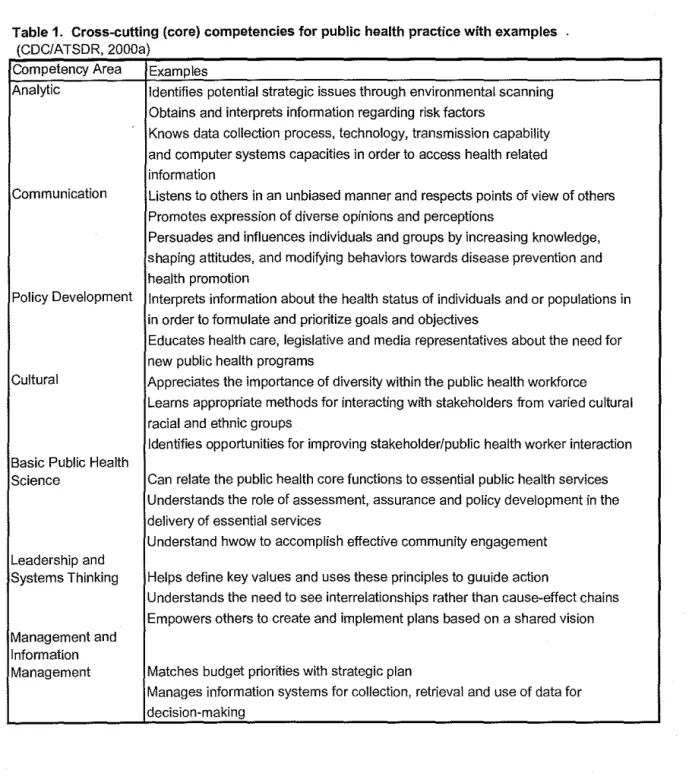
The core competencies proposed by the Faculty/ Agency Forum have been revised somewhat and arranged into eight domains: analytic assessment skills, policy development/program planning skills, communication skills, cultural competency skills, community dimensions of practice skills, basic public health sciences skills, financial plauning and management skills, and leadership and systems thinking skills (Council of Linkages Between Academia and Public Health Practice, 2001). Each domain includes a list of three to eleven specific competencies. For each specific competency, the level of ability (awareness, knowledge, or proficiency) necessary for each of three stafflevels (frontline, senior, and
supervisory/management) has been listed. The Council on Linkages developed this list of competencies by compiling suggested competencies from various sources and cross-referencing with the essential public health services. The list was reviewed by over 1,000 public health professionals from a variety of backgrounds during a comment period, and feedback on the proposed list was received from focus groups, work sessions at professional conferences, and a project website. The thorough review prior to final adoption implies that this document represents a valid consensus of public health professionals on what should be considered the core competencies of the profession and that this list of competencies would be an appropriate foundation for developing education and training curricula.
Table 1. Cross-cutting {core) competencies for public health practice with examples (CDC/ATSDR 2000a) '
Competency Area Examples
Analytic Identifies potential strategic issues through environmental scanning Obtains and interprets information regarding risk factors
Knows data collection process, technology, transmission capability and computer systems capacities in order to access health related information
Communication Listens to others in an unbiased manner and respects points of view of others Promotes expression of diverse opinions and perceptions
Persuades and influences individuals and groups by increasing knowledge, shaping attitudes, and modifying behaviors towards disease prevention and
health promotion
+--Policy Development Interprets information about the health status of individuals and or populations in
in order to formulate and prioritize goals and objectives T--Educates health care, legislative and media representatives about the need for
new public health programs
Cultural Appreciates the importance of diversity within the public health workforce Learns appropriate methods for interacting with stakeholders from varied cultural racial and ethnic groups
Identifies opportunities for improving stakeholder/public health worker interaction Basic Public Health
Science Can relate the public health core functions to essential public health services
I
Understands the role of assessment, assurance and policy development in thedelivery of essential services
Understand hwow to accomplish effective community engagement Leadership and
Systems Thinking Helps define key values and uses these principles to guuide action
Understands the need to see interrelationships rather than cause-effect chains Empowers others to create and implement plans based on a shared vision Management and
Information
Management Matches budget priorities with strategic plan
Manages information systems for collection, retrieval and use of data for
prevention, environmental health, or genetic testing. Although these competencies may build
upon the basic and core competencies, the target audience may include both professional and
non-professional staff. These competencies may be considered more specifically
task-oriented than the core competencies; the curricula for this category would be based on
categorical program objectives and may not be transferable to other programs or work
settings.
The Environmental Health Workforce
The environmental health segment of the public health workforce needs for education
and training similar to other segments. Many of the findings and conclusions reached about
workforce development needs of the general public health workforce are applicable to the
environmental health discipline. However, the environmental health organizational and
workforce infrastructure has some important differences that must be considered in
evaluating the need for and developing a system for workforce development of this particular
public health discipline. These differences are related to the various pathways by which
environmental health practitioners enter the discipline, and to the organization of
environmental health in the United States. The complexities inherent in addressing the
competency needs of this discipline are discussed below. Although the 1988 IOM report and
subsequent efforts to define and address the need for improving the competency of the public
health workforce have included the environmental health discipline, less progress has been
made toward defining the needs and responding to the needs of this segment of the
workforce. Addressing the workforce development needs of environmental health should be
difficulties not inherent in addressing the workforce development needs of other public
health disciplines.
In The Future of Public Health, the environmental health infrastructure in the United
States was characterized as one with "fragmented responsibility, lack of coordination, and
inadequate attention to the health dimensions of environmental problems" (IOM, 1988, p.
12). The report noted the movement of environmental protection programs out of traditional
public health organizations and into new, independent agencies, separating the
"responsibility for identification, education and modification of important environmental
f--L
factors that increase the risk of illness and premature death" (p. Ill) from other public health
functions, leading to lack of coordinated assessment and policy development efforts. The
l
£
drinking water protection, lack the visibility and broad support of the "newer" programs such
i
report also noted that the "traditional" environmental health programs, like food safety andas air pollution. In 1990, the Environmental Protection Agency concluded that the
organization ofthat agency's programs for the enforcement of specific laws had led to
viewing environmental problems as separate entities, and that resources devoted to specific
programs had little to do with the relative public health risk of the problems addressed by
each program (EPA, 1990). The EPA report noted a shortage of personnel adequately trained
to address, in an integrated and comprehensive manner, the multiple environmental
protection and health problems faced by the nation. In 1993, a report to the National
Environmental Health Association (NEHA) (Davis eta!., 1993a & 1993b) supported the
earlier conclusions ofthe IOM and the EPA, stating, "The nation does not have an
environmental health and protection system, but has a confusing patchwork of often
overlapping and competing agencies having different and sometimes conflicting missions
In response to the concern about the fragmentation ofthe environmental health services, HRSA, in the mid-1990's, funded a study of the state level organization of
environmental health and protection services. The authors of the final report (Bmke, Tran & Salute, 1995) were somewhat more optimistic than the previous reports, concluding that "the 'environmental fragmentation' ... may be more appropriately termed 'environmental
diversification.' That is, the traditional roles of health agencies in environmental health are alive and well, but ever increasing regulatory requirements have lead to a multi-agency diversification ... " (p. 44). The study identified 163 different state agencies responsible for one or more environmental health and protection core functions. Other conclusions of the report include a continued trend toward decreasing environmental responsibilities for state
eight states at the time of the report; the acknowledgement that the majority of state
i
health agencies, with the health department being the lead agency for environmental health inenvironmental health professionals were no longer employed by traditional public health agencies; and a need for re-evaluation of the methods used to educate and train
environmental health professionals. Only seven state public health agencies are designated as the primary environmental health organization in the state (Gebbie, Rosenstock & Hernandez, 2003), although most of the state health departments still have some environmental health responsibilities (Bmke, Tran & Shalauta, 1995).
People 2010 (US Department of Health and Human Services, 2000) that are related to environmental health as evidence ofthe importance of this area to the overall field of public health. The document contains seven objectives related to food safety, a traditional
responsibility of environmental health. Thirty objectives are listed in the category of "environmental health" which, separately from food safety, focuses on a broad array of issues including exposure to air pollution, substandard housing and sanitation. A number of additional objectives, addressing issues such as water fluoridation are directly or indirectly related to environmental health. The document includes the environment in the primary four factors affecting human health.
Describing the importance of environmental health, however, requires more than simply listing the objectives that are typically assigned to that sector of public health. Addressing the environmental health needs of the nation, just as addressing the other public health needs, requires an interdisciplinary approach. The Pew Environmental Health Commission (2000), referred to "environmental health" as the most fragmented and poorly defined area of public health, and described the lack of coherent environmental/public health effort as a major factor that hampers efforts to reduce the burden of both acute and chronic diseases. A companion report (Pew Environmental Health Commission, 2001) asserts that there is "a serious lack of the trained personnel and modern technology dedicated to responding to the very real environmental health threats that face our communities" (p. 3). The CDC has noted the large number of ongoing public health problems, such as lead poisoning, and emerging public health problems, such as West Nile virus, that are intimately linked to the environment (CDC/ATSDR, 2000b). The report also notes, as have others (I OM, 2001 ), the link between enviromnental health and other public health concerns such as lack of recreational opportunities, brownfields, and urban sprawl.
=
L
The problem of urban sprawl can be used as an example of the importance of
environmental health in addressing a myriad of public health problems not typically
associated with traditional environmental health programs. Urban sprawl, with the
associated decrease in recreational opportunities and increase in use of automobiles, has been
linked to health problems like obesity and the resulting increase in risk for cardiovascular
disease (University of North Carolina, 2002). An obvious and direct link of urban sprawl to
a traditional environmental health problem is the increase in air pollution and a possible
increase in asthma and other respiratory disease. Less obvious, perhaps, is the
inter-relationship between regulation of sewage disposal, another traditional environmental health
program, and the effect of sewage disposal regulations on the development patterns that lead
~--·-to urban sprawl. There is some concern that urban sprawl is related not only ~--·-to physical
i
p
health, but to elements of the social and mental health of the population, as well (IOM,
2001). As the example illustrates, public health problems are multidimensional, and public
health programs that on the surface appear to be unrelated may have a great effect on the
success or failure of other programs.
Recognition of the multidimensional factors of health, and the inter-relationship of
the many disciplines necessary to address contemporary public health problems, has resulted
in a recommendation that public health adopt an "ecological approach" (Gebbie, Rosenstock
& Hernandez, 2003). The ecological model of health seeks to describe the determinants of
health and disease and to develop approaches to eliminate or ameliorate disease, by
examining the influences and interplay of individual behavior; social, family and community
networks; living and working conditions; and broad social, economic, cultural, health, and
environmental conditions and policies. The importance of the environment and
obviously require persons with training and expertise in all of the traditional public health
disciplines, as well as in disciplines not typically linked directly to public health. Just as
importantly, it will require that public health professionals are able work together in a
cross-disciplinary environment. In turn, this will require an appreciation and basic understanding of the broad concepts public health, as well as expertise within one's specific discipline.
Unfortunately, it has been noted that there is currently a lack of coordination among agencies
working toward related goals, an environmental health workforce with an insufficient
understanding of public health concepts (as well as a public health workforce with an
insufficient understanding of environmental health), and a "widening of the rift between
agency roles and responsibilities with regard to environmental health, environmental
protection, and public health activities" (Schwartz, 1999). While improved education and
training of the environmental health workforce is not a solution to all of these ills, it is
unlikely that they will be solved without better-trained environmental health professionals.
A task of primary importance in defining and responding to the workforce
development needs ofthe environmental health discipline is to reach a consensus on what
constitutes "environmental health" and what segment of the workforce should be targeted
with these efforts. This task has proven to be extremely difficult not only for the public
health establishment in general, but even for persons who may consider themselves part of
the environmental health workforce. One approach is to define the workforce on the basis of
the traditional services provided; for example those persons employed in "preventing or
addressing problems with potable water, sewage systems, food safety, and vector control"
(CDC, 2002). However, such a definition is problematic, in that any attempt to list the
services that constitute environmental health will be incomplete, and because, like much of
E
'
L
approach. For example, food safety is typically considered to be an environmental health
service, but when an outbreak of food borne illness occurs, is the epidemiologist providing an
environmental health service and therefore defined as part of the environmental health
workforce? Most public health practitioners would conclude that the epidemiologist would
not be considered an environmental health practitioner based solely on the particular type of
outbreak to which he is applying his particular expertise.
A consensus definition, adopted by the NEHA of "environmental health" is:
"Environmental health and protection refers to protection against
environmental factors that may adversely impact human health or the ecological
balances essential to long term human health and environmental quality, whether in
the natural or human-made environment. These factors include but are not limited to
air, food and water contaminants, radiation, toxic chemicals, wastes, disease vectors,
safety hazards, and habitat alterations" (Davis, eta!., 1992a).
While this definition emphasizes that the domain of environmental health may encompass a
wide range of concerns and activities, it suffers somewhat from the inclusion of
"environmental protection" which may be construed as including many activities (e.g.,
forestry) that, while ultimately linked to human health, are not directly concerned with
human health impacts. To some extent the problem of over-broadness of the definition is
solved by referring to the workforce as either "environmental health professionals" or
"professionals in environmental health" (Davis eta!., 1992b). According to this
classification, "environmental health professionals" are persons who have been educated in
environmental health science and protection technical components, as well as basic public
health science, in either accredited environmental health programs or in schools of public
biologists, chemists, engineers, and attorneys, who do not meet the definition of environmental health professionals, but whose primary work focus is on environmental health and protection.
The classification scheme is somewhat overly simplistic, however. The 23 accredited environmental health degree programs, and the environmental health programs in the schools of public health are not supplying a sufficient number of qualified graduates to fill the need for front-line environmental health practitioners (CDC, 2002), a majority of which enter the environmental health workforce with an undergraduate background in one of the natural sciences, but are employed to provide one or more environmental health services for which their academic background does not provide specific preparation. Further complicating this is the fact that, although credentialing is available on a national basis through NEHA, and a few states conduct their own state-level registration program for environmental health professionals, only 18 states require registration. Also,· some states require a minimum of a Bachelor degree; a few require only a high school diploma or equivalent for environmental health specialists. Thus, unlike nurses and physicians, who enter public health with at least some common educational background with others in their discipline, environmental health specialists do not bring a readily defined, shared set of knowledge, skills and abilities to the discipline.
Environmental health competencies
educational curricula to the knowledge, skills and abilities needed by environmental health professionals practicing in public health agencies. However, because they represent expert opinion about the baseline competencies applicable to environmental health practitioners, they must be considered in any attempt to define the educational and training needs of the currently employed environmental health workforce.
Perhaps the earliest contemporary list of environmental health competencies was published by the Faculty/Agency Forum (First et al., 1992), which defined required
competencies for several specific disciplines as well as the core competencies discussed .
h
above. Table 2 lists the competencies along with a brief description. These competencieswere loosely associated with the public health objectives published in Healthy People 2000, and the authors definitely intended that these competencies were not to "stand alone" but that
'
environmental health practitioners should possess the core competencies as well as the discipline specific competencies. The inclusion of risk communication and economic
competencies within the discipline specific competencies indicates the importance placed by the authors on knowledge, skills and abilities other than those associated solely with the scientific basis for public health and the regulatory role of public agencies.
Table 2. Environmental health competencies defined by the Public Health Faculty/Agency Forum (First et al, 1992).
Risk Assessment Skills
Develop a risk assessment and critique those developed by others
Risk Management Skills
Understand the strengths and weaknesses of technical and behavioral interventions to reduce environmental risks
Risk Communication Skills
Describe risk assessments to a wide variety of groups, including the lay public and the scientific/technical community
Epidemiology of Acute and Chronic Diseases Associated with Environmental Stresses
Understand epidemiological study design and the strengths and weaknesses of specific studies
Biostatistics
Be familiar w~h descriptive and analytical statistics used to describe environmental data sets and their limitations
Basic Sciences
Understand the principles of toxicology, chemistry, physics, physiology, and microbiology
Communicable Disease/Chronic Disease
Understand the detenminants of disease, the principles of sanitation, and public health interventions
Introduction to Economic Considerations
Understand cost/benefit analysis, economic impact on health status, cost acceptance, and cost effectiveness as they relate to environmental public health, and public attitudes toward these matters
Familiarity with Environmental Law
Understand the requirements of the major environmental statutes appropriate to his/her responsibilities and the uncertainties of methodologies to demonstrate compliance
l_
practitioners. The list includes all of the competencies developed by the Faculty/Agency Forum, plus managerial and organizational behavior skills; analytical skills; communication and marketing skills; policy development and implementation skills; cultural awareness skills; strategic planning skills; financial planning and management skills; environmental health and protection planning (land-use planning, energy production, resource utilization, transportation methodologies); knowledge of federal, state and local environmental
organizations; ability to understand the net impact of proposed actions; and data collection and analysis skills. The committee stressed that although academic programs need to ensure that their graduates have the appropriate competencies, it is essential that "incumbent
personnel be 'retreaded' with these skills through effective continuing education mechanisms" (p. 45).
The issue of precisely which members of the environmental health and protection workforce requires the listed competencies is somewhat confused by the distinction made in the report between "environmental health professionals" and "professionals in environmental health". The committee defined the former group as "those who have been adequately educated in the various environmental health science and protection technical components". The committee included in the later group "other essential personnel" like chemists,
biologists, geologists, engineers, planners, sociologists, and attorneys. This distinction is important, in that at least the majority of"professionals in environmental health" bring to their work specific professional competencies that do not need to be supplemented by an in-depth command of the listed environmental health competencies. On the other hand, the concept does not address the issue that many, or perhaps most, environmental health
field with academic backgrounds in one of the natural sciences, rather than in environmental health.
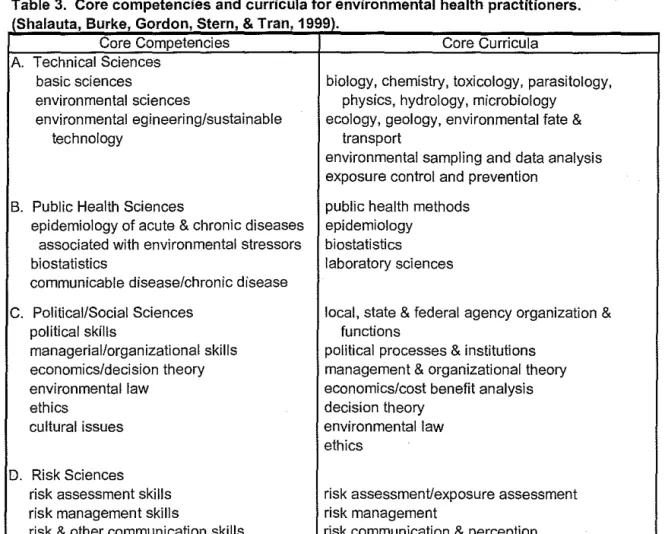
Shalauta, Burke, Gordon, Stem, and Tran (1999) reported the results of a colloquium that developed a list of competencies that is essentially a refinement of the list developed by the Faculty/ Agency Forum. This colloquium included representatives of national and state agencies as well as those from academia and private foundations. It is notable that this group included representatives from state agencies other than the designated public health agencies, including the California Environmental Protection Agency and the Oklahoma and Arizona Departments of Environmental Quality. The inclusion ofthese agencies indicates
acknowledgement that the need for environmental health competencies extends to personnel not associated with designated public health agencies. This work group developed not only a list of core competencies divided into four areas, but also a list of "core curricula" associated with area (see Table 3). This list of competencies was not intended to be associated with a separate set of universal competencies, and while it tends to emphasize basic and
environmental sciences, it does include basic public health sciences, as well as ethics and cultural issues. While this list targets primarily academic environmental health programs, the authors of the report note that many currently employed environmental health and protection practitioners may be quite competent in the specific sciences and technologies required by their current positions, they frequently lack a broader understanding of public and
environmental health. The authors emphasize the need to provide training to the currently employed workforce through methods such as on-the-job training and continuing education.
Table 3. Core competencies and curricula for environmental health practitioners. 'Shalauta, Burke, Gordon, Stern, & Tran, 1999).
Core Competencies Core Curricula
A. Technical Sciences
basic sciences biology, chemistry, toxicology, parasitology, environmental sciences physics, hydrology, microbiology
environmental egineering/sustainable ecology, geology. environmental fate &
technology transport
environmental sampling and data analysis exposure control and prevention
B. Public Health Sciences public health methods epidemiology of acute & chronic diseases epidemiology
associated with environmental stressors biostatistics
biostatistics laboratory sciences
communicable disease/chronic disease
C. Political/Social Sciences local. state & federal agency organization &
political skills functions
managerial/organizational skills political processes & institutions economics/decision theory management & organizational theory environmental law economics/cost benefit analysis
ethics decision theory
cultural issues environmental law
ethics
D. Risk Sciences
risk assessment skills risk assessment/exposure assessment risk management skills risk management
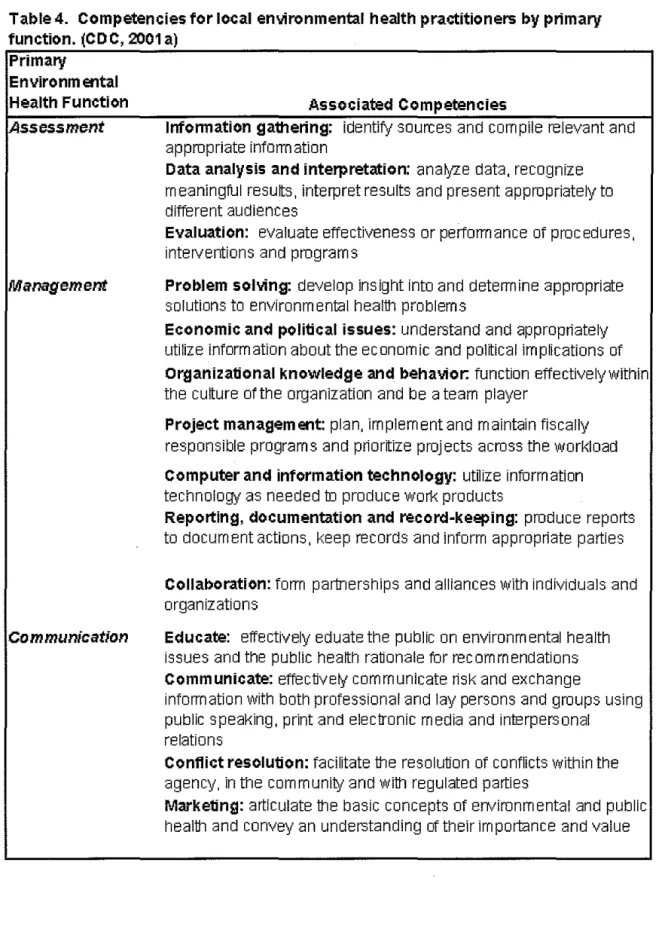
represents the consensus opinion of experts from 13 national environmental health organizations. The competencies are divided into the three general areas that were considered by the panel to be the primary functions of environmental health programs: assessment, management and communication (see Table 4). The published report contains an extensive list oftasks that exemplify each of the listed competencies. The report also notes that, while the panel considered "cultural sensitivity" to be important to the
effectiveness of environmental health practitioners, it was ultimately decided that this was not a specific competency.
In compiling the set of competencies, the group assumed that environmental health
practitioners will have the necessary technical competencies for the discipline, as outlined by the earlier NEHA for the Future of Environmental Health Committee list, and that the NEHA examination for the Registered Environmental Health Specialist is a valid measure of those technical competencies. The group further assumed that the environmental health
practitioners will have an understanding of basic public health principles, of the
interdisciplinary nature of environmental health, and of basic governmental functions and will have an appreciation and understanding of different cultures found in the institutions and communities in which they work.
The Environmental Health Competency Project, in addition to building on previous efforts to define environmental health competencies, was the first effort to target the needs of environmental health practitioners working in local health departments. The
Table 4. Competencies for local enllironmental health practitioners by primary function. (CDC, 2001 a)
Primary Environmental Health Function Assessment M;magement Communication
Associated Competencies
lntonnation gathering: identify sources and com pile relevant and appropriate information
Data analysis and interpretation: analyze data. recognize meaningful resu~s, interpret results and present appropriately to different audiences
Evaluation: evaluate effectiveness or performance of procedures, interventions and programs
Problem sollling: develop insight into and determine appropriate solutions to environmental health problems
Economic and political issues: understand and appropriately utilize information about the economic and political implications of organizational knowledge and behallior: function effectively within the cu~ure of the organization and be a team player
Project management: plan, implement and maintain fiscally responsible programs and prioritize projects across the workload
computer and information technology: utilize information technology as needed to produce work products
Reporting, documentation and record-keeping: produce repotts to document actions, keep records and inform appropriate patties
Collaboration: form partnerships and alliances with individuals and organizations
Educate: effectively eduate the public on environmental health issues and the public hea~h rationale for recommendations Communicate: effectively communicate risk and exchange
information with both professional and lay persons and groups using public speaking, print and electronic media and intierpersonal
relations
Conflict resolution: facilitate the resolution of conflicts within the agency, in the community and with regulated patties
Marketing: articulate the basic concepts of environmental and public health and convey an understanding of their importance and value
j__
perhaps some continuing education should possess. Further, the list of competencies is intended to apply to line staff, and competencies that the panelists agreed would apply primarily or solely to management staff-for example, strategic planning and personnel management-were not included in the list. The report deals nicely with the question of "environmental professional" vs. "professional in environmental health" by choosing to use the term "environmental health practitioner", defined as "a person working in an
environmental health position in a LHD [local health department] who has at least an
undergraduate degree with one to four years of experience" (p. 5). Although this definition is somewhat limiting, it is quite likely, as noted by the authors of the report, that these
competencies will apply to environmental health and protection staff in other settings as well, particularly since the competencies listed represent a synthesis of previous work that was intended to have broader application.
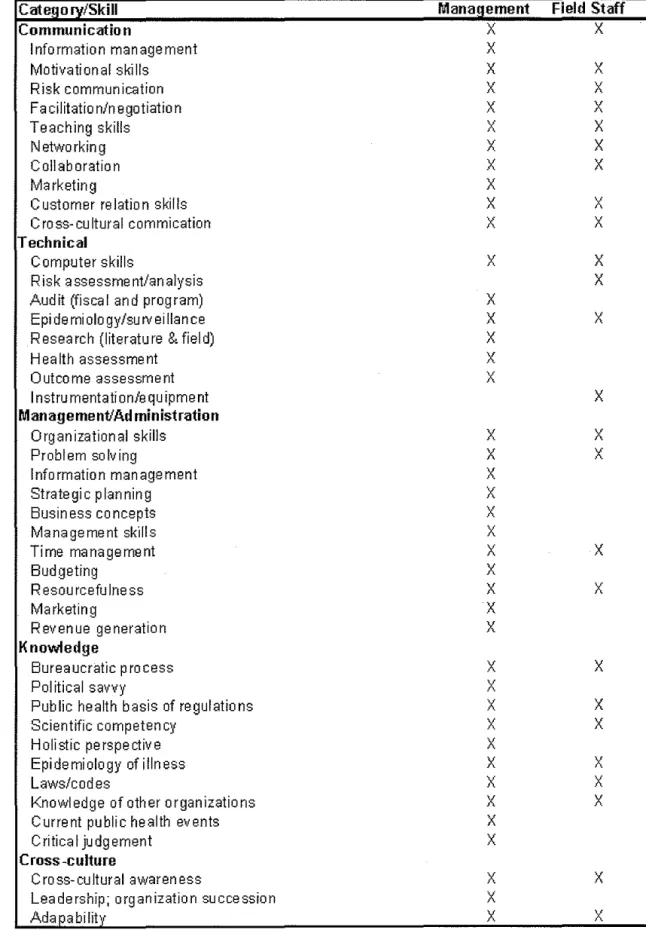
Table 5. Skills for currently practicing public heakh environmental professionals (Bloom
& Gebbie, 1998).
Cateqo JV/Skill Communication
Information management Motivational skills Risk communication Fa cilitatio n/n e gotiatio n Teaching skills
Networking Coil ab oralio n Marketing
Customer relation skills Cross-cultural commication
Technical
Computer skills
Risk assessment/analysis Audit (fiscal and program) Epide mi olo gy/sutv ei llance Research (literature & fie I d) Health assessment
Outcome assessment Instrumentation/equipment
Management/Ad ministration
Organizational skills Problem solving
Information management Strategic planning Business concepts Management skills Time management Budgeting
R esou rcefulne ss Marketing
Revenue generation
Knowledge
Bureaucratic process Political savvy
Public health basis of regulations Scientific competency
Holistic perspective Epidemiology of illness Laws/codes
Knowledge of other organizations Current public health events Critical judgement
Cross-culture
Cross-cultural awareness
Leadership; organization succession Adapability Manaqement X X X X X X X X X X X X X X X X X X X X X X X X X X X X X X X X X X X X X X X X X
Field Staff
Most of the competencies listed by Bloom and Gebbie (1998) support the need of
environmental health personnel for specific competencies listed by the Environmental Health
Competency project and others, either as universal public health competencies or as
competencies specific to environmental health. For example, "cross cultural
communication" is included in nearly every list of universal competencies, and risk
assessment and communication skills have been listed as a necessary environmental health
competency since the Agency/Faculty report in 1992. Notably, however, among the
competencies listed in the Bloom and Gebbie report as those that currently practicing
environmental health professionals need to gain, are networking, time management, and
"creating a customer/business friendly environment." The last competency may be
associated, at least in part, with cultural competency; however, it may simply reflect a
perceived need to improve customer or client service. All three of these competencies,
however, should be considered to be competencies that apply not only to the public health
workforce but also to workers in all organizations. If workers do not bring these skills with
them to the workplace the employer must teach them, in order for the employee and the
organization to reach a level of maximum effectiveness. The point is that efforts to
strengthen the public and environmental health competencies of the workforce must not be at
the expense of improving the most basic competencies necessary for the success of all
workers in all organizations.
Applying the Competencies to Training Needs
The effort to define the competencies needed by public health and environmental
health practitioners has been a lengthy process. It represents only one of the first steps in
learning system" envisioned by CDC (CDC/ATSDR, 2001 ), includes six elements: monitoring workforce composition, identifying competencies/developing a curriculum, designing an integrated learning system, using incentives to assure competency, conducting evaluation and research, and assuring financial support. Efforts are currently underway, primarily by federal agencies and academic centers, to address all of these elements. The effort by HRSA to enumerate the public health workforce has been mentioned above (HRSA, 2000). The survey suffered from a number of problems, including lack of standard
definitions, and incomplete reporting. For example, in Virginia, only 61 public health nurses and one environmental specialist are reported, along with 2156 public health specialists with "unspecified title" (p. 87). Additionally, the survey targeted only the designated public
employed by other agencies impossible. Several deficiencies were noted by HRSA, and
i
health agencies in each state, making any enumeration of environmental health professionalsfuture surveys are likely to produce better information.
Identifying the competencies needed by the workforce has been thoroughly discussed above. The identified "universal competencies" have been thoroughly reviewed, and may be considered to represent somewhat of a consensus, although not necessarily universal
agreement. Those currently included by the Council of Linkages have been divided into competencies needed by entry level, senior staff, or management staff. The environmental health competencies have not yet been subjected to the same level of review, and cannot be said to represent a consensus opinion of practitioners.
=
Currently, however, efforts to develop an integrated curriculum, particularly for L environmental health practitioners, are still in the early stages, and represent primarily the
development of topic-specific training. The lllinois Public Health Preparedness Center (University of Illinois at Chicago), currently offers a set of competency-based courses, available as "any time, any where" learning via the Internet. The seven "41 0 series" courses are designed to meet the identified need for an introduction to public health for all public
health workers. Other courses include a series of five environmental health courses, l___ l_ including "What is Environmental Health" and "Environmental Health Risk
L
Communication." A large variety of courses, many developed based on a public health competency framework are available from the Public Health Foundation. The offerings include "Principles of Public Health" targeting the need for a broad, cross-disciplinary introduction to public health principles (Public Health Foundation, 2003). Eventually, these efforts may combine to represent a continuum of educational opportunities appropriate for the public health/environmental health workforce at all stages oftheir careers.
Efforts to undertake the last three steps are more difficult to identify. At the national level, some discussion of credentialing the public health workforce as a means of assuring and rewarding attainment ofbasic competencies has been discussed for several years, but has not come to fruition (Sommer and Akhter, 2000). Some states, including Illinois and New
l
Jersey, have credentialing requirements for specific public health practitioner categories, like
L
local health department administrators (New Jersey Department of Health and SeniorCDC/ATSDR model, a life-long learning system for its own personnel (State of Colorado,
2001). In Kentucky, the legislature appropriated $2 million over two fiscal years, for the
"Kentucky Transition Training Initiative" a program to provide training in the core
competencies to professional personnel in all 55 local health departments (Kentucky
Department for Public Health, n.d.).
The final step in the CDC/ ATSDR plan is "conducting evaluation and research." So
far, research for which results have been published has focused primarily on developing the
sets of competencies and on developing methods of delivering courses to the workforce.
Two essential focuses of research will be evaluating content of curricula and evaluating
learning outcomes in terms of workforce improvement and, consequently, program
improvement. However, the workforce development efforts are so new that research in these
areas is unlikely to bear much fruit. There is still a need to validate the competencies
delineated, particularly those for the enviromnental health workforce, prioritize training
needs, and determine the most effective and efficient means of delivering the training.
Several studies have been conducted to identify the specific training needs and
preferred delivery methods among state and local health department employees. Although
these studies do not address in any detail the training needs of enviromnental health
practitioners specifically, they are important examples ofthe "view from the frontlines" of
public health agencies. An early survey of self-identified training needs among public health
workers was conducted in Washington State (Gale, Reeder & Conratt, 1998; Reder, Gale &
Taylor, 1999). The survey identified communication skills, including interpersonal
communication, cross-cultural communication, electronic communication, and participatory
teaching/training, as the primary training needed across disciplines and settings for the state
skills" was rated as the primary training need, with electronic communication second and teaching skills third. Other training identified by environmental health staff as being high on the needs scale, were health and risk communication and data analysis and utilization. A study based on the Washington State study and conducted among several local health departments in Virginia found similar results. The top five training topics identified by participants as being those that would be most helpful in their work included group
facilitation, cross-cultural communication, participatory teaching/training skills, electronic communication, and quality improvement and assurance strategies (Jacobs, Herbst & Simmer, 2001).
Although Washington and Virginia surveys were not based on delineated public health competencies, it is possible to relate the specific training needs identified in the surveys to those competencies. The communication skills obviously are related to the
communication competencies, while the "cross-cultural communication" is also related to the cross-cultural competency, and the "electronic communication" training need may also be tied to the universal competency of information management. The need for training in enviromnental health may be tied to "basic public health science" in the universal competencies, or may be an indication that the enviromnental health practitioners who responded to the survey perceive a need for greater technical training within their discipline.
skills (Northwest Center for Public Health Practice, 2000). Again, these needs can be readily
associated with several of the universal competencies for public health professionals.
The Northwest Center for Public Health Practice has helped to facilitate training
needs assessments in Idaho, Montana, Oregon, and Wyoming, in addition to the previously
mentioned work in Washington State. The states represent a variety of organizational
schemes, from very autonomous local health departments to one in which the state agency
has almost total authority. These assessments used a variety of methodologies, including key
informants, focus groups, and surveys. A meta-analysis of these surveys, however, indicates
that the results were fairly similar (Northwest Center for Public Health Practice, 2002).
Regionally, the top four unmet training needs ofthe public health workforce were identified
I
as communications, administrative skills/management/supervision, computer training/use and
technology, and "public health 101." To some extent, these results may be seen as validation
of the need to train the public health workforce in the universal competencies.
One research project that evaluated the use of the universal competencies for
evaluating training needs and designing a curriculum was conducted using a two-phased
approach (Potter, Pistella, Fertman & Dato, 2000). In the first phase, 78 public health
supervisors from agencies in six northeastern states selected the competencies that they
considered as training priorities for the persons whom they supervised, participated in group
sessions to review the selected competencies and discuss the adequacy of the framework, and
finally selected the competencies most needed for the largest professional category over
which each had supervisory control. During the second phase, two groups of professionals
including senior agency personnel, academicians, and representatives from national
should be included in a model training agenda. Included in the findings of this project were the following:
I. public health nurses, health educators, and administrators were the most frequently identified professional groups identified as priorities for training; 2. the identified competency needs varied among the supervisors and among
agencies in phase one;
3. supervisors considered the universal competencies to be an incomplete framework
'f.--for identifying training needs;
4. some supervisors asserted the need for training topics that were agency-specific. The model training agenda developed in phase two included topics from six of the universal competencies. The specific topics were appropriate use of data and statistical methods, making relevant inferences from data, communicating effectively, presenting accurate and effective data, program monitoring and evaluation, developing and adapting cross-cultural approaches, basic public health research methods, basic public health sciences, and
monitoring program performance. The training agenda also included "orientation to public health", which included those topics that the participants in phase one did not believe were addressed in the competency framework (e.g., legal basis of public health and public health ethics and values).
was listed, their perception of their own ability to apply the knowledge or skills associated with that competency in their daily work, and their perception of their own need for training in the competency. Results were reported as the percent of the possible maximum score (i.e., the maximum score is equal to the number of respondents for an item times the highest rating on the scale). Although there was some variation among the states and among the various disciplines included in the survey, the findings confirmed that the competencies are
necessary to provide the essential services, and that a need for training in the competencies is high among the respondents. As a group, the respondents rated their ability to apply the competencies fairly high, with percent-maximum score of 50 to 60 percent, but the perceived need for the competencies and the perceived need for training both scored higher for every
In addition to defining the competencies, and translating them into a curriculum, the
I
essential service except "inform, educate and empower people about health issues."successful implementation of a policy or plan to improve the competencies of currently employed environmental health practitioners, will need to address how training will be delivered and by whom, as well as evaluating the success ofthe program. Shalauta et a!. (1999) listed several approaches to improving continuing education for environmental health practitioners, including short courses, symposia, distance learning, internships, executive degree programs, and certificate programs. As mentioned above, the graduate schools of public health, over the past several years, have extended their program offerings in certificate programs and executive degree programs, as well as increasing the availability of graduate education available by distance learning. These programs are important, and are likely to be the best source of well-rounded public or environmental health education available to
It would appear then, that any approach to increase training and education among the current workforce will require short courses, delivered preferably as part of an integrated curriculum. Surveys of the public health workforce, in fact, indicate that the majority of workers would prefer non-degree, non-certificate continuing education to meet their training needs (Jacobs, Herbst & Simmer, 2001). Such training may be delivered either as
"in-person" training or via distance learning. However, surveys have shown that the members of the public health workforce indicate a distinct preference for on-site training over computer-based, two-way audio-video conferencing or satellite broadcast distance learning (Jacobs, Herbst & Simmer, 2001; Reder, Gale & Taylor, 1999).
Training courses may be developed by, and already are available from, a number of entities, including state and federal agencies, schools of public health, professional
L
State level agencies, therefore, would seem to play a pivotal role in improving the competencies of the environmental health workforce. States are likely to be in the best position to identify, among the many agencies employing environmental health practitioners, those workforce members who would benefit from training and education, to assess the existing skills of those workers, and to assess the opportunities for providing training, especially when the same training may be beneficial to employees of multiple agencies. In
the current budget crises facing many of the states, funding training may be a low priority, l----but from a practical viewpoint, the cost of training may be considered an investment that
should produce better and more efficient public health services.
The state of Montana may be cited as an example of how a state health department
assistance of Northwest Center for Public Health Practice, has undertaken to develop a
I
can initiate and organize a public health workforce development effort. Montana, with theL
Conclusions and RecommendationsThe CDC initiative to revitalize environmental health in the United States has several objectives (CDC, 2002) aimed at improving the infrastructure of environmental health. The knowledge, skills and abilities of the workforce are foundation upon which other
improvements to the practice of environmental health will rest. The CDC strategy targets, specifically, environmental health professionals in public health agencies, and does not define "public health agency." The organization of environmental health in the U.S. makes it
*--imperative that all environmental health practitioners be included in the effort to improve workforce competencies. Given the interrelationship of factors that bear on individual and population health, designated public health agencies should not ignore the fact that achieving a high level of public health in the nation is dependent upon the ability of practitioners
representing a variety of disciplines and a variety of agencies to work together. It is therefore in the interest of the "official" public health agencies to encourage and support improved training and education for environmental health professionals across all agencies.
The core competencies for public health professionals and those identified for
environmental health practitioners provide a framework for that training and education. The core competencies have been subject to fairly extensive review by both key informants and by practitioners. The validity of need for education and training in these competencies is
supported by the surveys conducted among front-line among health workers.
l
The environmental health competencies need further validation. The set ofenvironmental health competencies currently proposed by the Environmental Health
and administrators--persons who are somewhat removed from the day-to-day front line work
L
of environmental health. The proposed competencies should be subjected to further reviewby a broad spectrnrn of public health and environmental health practitioners. This can be accomplished using the same methods as was used by the Council on Linkages (2001):
increasing awareness of the competency set among practitioners at meetings and through
L
professional organizations, gathering feedback from small groups of practitioners, andthrough a website dedicated to publicizing and gathering feedback on the competencies. It is not strictly necessary for state and local agencies to await further validation of the competencies at a national level before beginning to use the framework of the
competencies to begin building training programs for environmental health practitioners. However, at least some questions need to be answered at these levels prior to designing a curriculum or starting training. First, although much attention has been given to defining the necessary competencies for environmental health, less attention has been given to
determining the competencies possessed by those currently practicing in environmental health. Although the evidence indicates that environmental health practitioners do not currently possess all of the competencies necessary to carry out the essential functions of public environmental health, it is not reasonable to assume that all practitioners need training in all of the competencies.
The training needs of currently employed staff are likely to vary among localities,
L requirements. On the other hand, management staff and policy makers may have a better
sense of the "big picture" and the need for particular competencies to support program
changes or other future efforts. A dual approach to defining the training needs of current
environmental health staff is recommended. The approach used by Chauvin, Anderson and
Bowdish (2001 ), in which respondents were asked to rate not only their perceived need for
education, but also the applicability of the competency to their job as well as their perceived
ability to use the competency, should be used to survey environmental health staff. The
results can be used to determine specific training needs and priorities for specific segments of
the workforce. Such a survey should be supplemented by supervisory and policy-making
staff opinion of the competencies most needed by subordinate staff. The second approach is
that used by Potter eta!. (2000). Especially for environmental health practitioners, in many,
or even in most states, these needs assessments should include not only the designated public
health agencies but also other agencies with responsibilities in environmental health and
protection. Because state agencies are in the best position to identify those other agencies,
this task will be best carried out at that level.
After training priorities are established, a training curriculum based on those priorities
must be developed and delivered. Currently, a number of efforts to establish topic-specific
training modules for environmental health practitioners exist or are being developed. These
modules may be incorporated into new or existing training efforts by state and local agencies.
However, as noted by Reynolds and Leahy (2002), the goal of efforts to develop training
based on defined competencies is not to simply conduct a series of training sessions on
public health topics. Rather, the goal is to create an integrated curriculum (or curricula) to
provide a continuum of training to address the needs of workers at various stages in their
-I
'work (Shalauta eta!., 1999). Many agencies will lack the expertise to undertake the task of
curriculum development. It is recommended that the HRSA-funded Centers for Public
Health Practice (HRSA, no date), associated with schools of public health, be considered a
primary resource for curriculum development by state and local agencies. In addition to
having access to faculty expertise, the centers are in a position to coordinate efforts among
various states. Coordinating training efforts across individual agencies and across individual
states should reduce the overall cost. States should also develop partnerships with the L
accredited academic programs in environmental health in order to obtain subject matter
expertise for training.
Incorporating distance learning as a method of delivering training may also reduce
costs. Distance learning can reduce the costs of travel and of time away from normal work
duties. Survey results cited above indicate that public health practitioners do not rate
distance learning highly a preferred method of learning. However, distance-learning
methods such as satellite training and web-based training are still evolving as methods of
delivering training in the public health arena. Responses to earlier surveys may be colored
by less than satisfactory experiences of learners during early attempts at using
distance-learning technology, or may indicate lack of familiarity with the technologies. However, it
should be recognized that the delivery of training using distance-learning technology
involves a different, or additional, skills than delivering classroom-based learning.
Therefore, it is essential that trainers become trained in using such technology if distance
learning is to be a successful option.
Employing agencies will need to provide incentives to employees to learn and apply
the environmental health competencies. At the national level, discussion is ongoing about