Scientia Iranica B (2019) 26(4), 2356{2368
Sharif University of Technology
Scientia IranicaTransactions B: Mechanical Engineering http://scientiairanica.sharif.edu
Finite element modeling and design of
pH/temperature-sensitive hydrogel based biphasic
twisting actuators
M.R. Bayat, M. Baghani
, and H. Shahsavari
School of Mechanical Engineering, College of Engineering, University of Tehran, Tehran, Iran. Received 25 February 2017; received in revised form 14 February 2018; accepted 23 June 2018
KEYWORDS Self-twisting; Bilayer;
pH/temperature-sensitive hydrogel; Actuator;
Finite element method.
Abstract. In this article, a pH/temperature-sensitive hydrogel based biphasic twisting actuator is presented and studied in various environmental conditions. The actuator consists of a neutral incompressible elastomeric phase attached to pH/temperature-sensitive hydrogel phase, which twists when subjected to pH/temperature variation. The deformation of the actuator depends on the cross-section of the actuator as well as geometrical and environmental parameters. To have a guideline for the design of the biphasic twisting actuator, a nite element model of the mentioned structure was developed. A thermodynamic based constitutive model was used to describe the behavior of the hydrogel. The nite element method was applied for resolving the homogeneous and inhomogeneous swelling of the pH/temperature-responsive hydrogel to check the validity of the method. Finally, how various parameters aected the torsional behavior of the actuator was investigated in detail. According to the results, to get the maximum twisting angle, it is recommended to use the actuator with the square cross-section. Also, the twisting angle can even increase more by decreasing the hydrogel size as well as increasing the length of the actuator.
© 2019 Sharif University of Technology. All rights reserved.
1. Introduction
Elastomeric hydrogels are exible, covalently cross-linked, three-dimensional network polymers, which can go through large and reversible desired deforma-tion with dierent external stimuli such as tempera-ture [1,2], pH [3,4], mechanical load [5,6], light [7,8], electric elds [9,10], and ionic and salt concentra-tion [11]. Owing to this fascinating feature, hydrogels are attractive materials for both sensor and actuator
*. Corresponding author. Tel.: +98 21 61119921 E-mail addresses: [email protected] (M.R. Bayat); [email protected] (M. Baghani); [email protected] (H. Shahsavari)
doi: 10.24200/sci.2018.20603
fabrications [12,13], which have a promising future in microuidics [14,15], biomedical devices [16,17], drug delivery [4,18], superabsorbent [19,20], tissue engineer-ing [21], and soft robotic [21,22] applications.
Nowadays, compact and lightweight actuators, which are capable of creating a wide range of motion, are needed. Although several approaches are avail-able for the design of actuators, the ones based on the stimuli-responsive hydrogels draw more attention, because the traditional actuators usually are not able to produce complex motions and have a non-continuous and discrete deformation. Moreover, the ability of hydrogel based actuators to act in aqueous media makes them suitable for applications where other types of actuators are not desirable. Because of their inter-esting properties, stimuli-responsive hydrogels deserve particular attention in fabricating actuators capable
M.R. Bayat et al./Scientia Iranica, Transactions B: Mechanical Engineering 26 (2019) 2356{2368 2357
of complex continuous deformations such as bend-ing [12,23-25], twistbend-ing, and foldbend-ing [26,27]. Tools like Finite Element Method (FEM), as one of the most powerful ones in designing actuators, based on a convenient constitutive model for investigating the hydrogel behavior under complicated thermo-chemo-mechanical loadings are required for optimum utiliza-tion of hydrogels in such applicautiliza-tions.
Constitutive modeling of hydrogels has been de-veloped in dierent frameworks [28]. Thermody-namic equilibrium is the most common framework for swelling theories, which is based on the additive decomposition of the Helmholtz free energy density, which was initially presented by Flory [29]. As a pioneering work, Hong et al. [30] developed a theory of coupled diusion and large deformation in polymeric gels. Subsequently, Hong et al. [31] implemented the inhomogeneous swelling of a gel in equilibrium with a solvent and mechanical load in the nite element package, ABAQUS, using the UHYPER subroutine. The UHYPER subroutine can be used to dene large deformation of a hyperelastic material of which the energy function and its derivatives are determined. Once a constitutive model is implemented as UHYPER subroutine, it can be used to analyze any structural problem, including 3D and 2D problems. Lately, UHY-PER has commonly been used in order to study the behavior of hydrogels, numerically [31-34]. Recently, the coupled nonlinear behavior of these materials has attracted much attention [35,36]. Particularly, Maza-heri et al. [37] developed a model to predict coupling behavior of pH/temperature-sensitive hydrogels. In this model, 4 separate energy terms, each describing a specic mechanical or chemical energy, formed the Helmholtz free energy density. The model was modied to avoid numerical instability and implemented in ABAQUS/Standard software via a user subroutine UHYPER, providing a useful tool for FE analysis of pH/temperature-responsive hydrogel structures.
As discussed, smart hydrogels can be utilized to achieve structures with complex deformations, such as bending, twisting, and folding, as a result of neous swelling/shrinking. One way to attain inhomoge-neous deformation inside a structure is to consider two hyperplastic phases with dierent swelling/shrinking properties subjected to a homogenous eld [38]. The geometric distribution of the two phases and the cross-section of the structure specify the resultant motion. Turcaud et al. [39] proposed a rod with dierent geom-etry and asymmgeom-etry, and simulated the deformation employing FEM. They showed that for constant cross-sections, planar bending or twisting was possible.
In this paper, a three-dimensional pH/ temperature-sensitive hydrogel (namely PNIPAM) based biphasic twisting actuator is modeled and designed using FEM. The model is implemented
in ABAQUS via user subroutine UHYPER. A thermodynamic based constitutive model is used to capture the temperature and pH-sensitive behavior of the hydrogel. A structure with inhomogeneous material distribution is subjected to a homogenous led, resulting in a continuous twisting deformation. In order to optimally design the twisting actuator, a parametric study is carried out and the eect of actuator cross-section, geometrical parameters, and environmental conditions on the twisting behavior of the actuator is studied, numerically.
The article is organized as follows. First, in Section 2, the geometry of the model is introduced and the constitutive model employed to simulate the pH/temperature-sensitive hydrogel is briey explained; afterwards, free swelling of hydrogel as well as shell and core problems is solved using the constructed model, and the results are compared with the experimental and analytical data found in the literature in order to verify the FE procedure presented in this work. There-after, a parametric study of the proposed actuator is presented in Section 3 and the results are discussed. Finally, a summary is presented in Section 4 and then, a conclusion is drawn.
2. Modeling and formulation
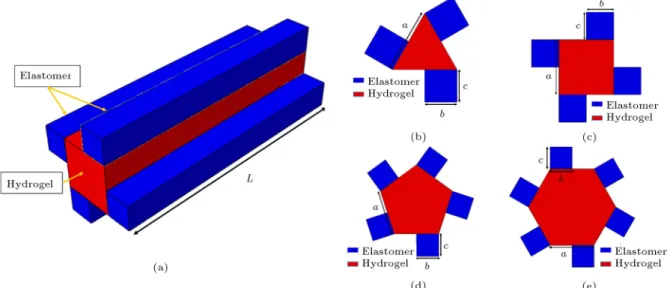
Following the geometrical model for biphasic twisting actuators proposed by Turcaud et al. [39], a smart pH/temperature hydrogel based twisting actuator is modeled in this article. The schematic of the Twisting Biphasic Actuator (TBA) and cross sections of 4 dierent types of TBAs are illustrated in Figure 1. Geometric parameters can signicantly aect the de-formation of TBAs. Therefore, a parametric study is carried out in the next section using FEM, in order to better understand the behavior of TBA.
In order to numerically model the behav-ior of a TBA, the swelling constitutive model of pH/temperature-sensitive PNIPAM hydrogels pro-posed by Mazaheri et al. [37] is implemented as a UHYPER subroutine in the ABAQUS, a commer-cial FEM software. In this constitutive model, the Helmholtz free energy density is used to formulate the swelling phenomenon. The Helmholtz free energy of pH/temperature-sensitive hydrogels consists of 4 dierent contributions, which are functions of defor-mation gradient (F ); temperature (T ); and nominal concentration of hydrogen ions (CH+), counter-ions
(C ), and ions (C+) as follows:
W =Welastic(F; T ) + Wmix(F; T )
+ Wion(F; T; CH+; C ; C+)
2358 M.R. Bayat et al./Scientia Iranica, Transactions B: Mechanical Engineering 26 (2019) 2356{2368
Figure 1. (a) The schematic of biphasic twisting actuator. Cross sections of (b) triangular, (c) square, (d) pentagonal, and (e) hexagonal biphasic twisting actuators.
where the free energy due to the elastic deformation, mixing of the solvent and the network chain, mixing of ions, and dissociation of the acidic groups are repre-sented by Welastic, Wmix, Wion, and Wdiss, respectively.
The elastic deformation of the network is modeled employing a neo-Hookean model and expressed in terms of the deformation as:
Welastic= 12NKT (I1 3 2 log(J)) ; (2)
in which I1 is the rst invariant of the right
Cauchy-Green deformation tensor C, and J is the deformation gradient determinant. In addition, the density of the polymer chains in the reference state and Boltzmann constant are represented by N and K, respectively. Also, T is the absolute temperature and the term NKT is the elastic modulus [35]. Moreover, the mixing part of the free energy density, based on the Flory-Huggins theory [40,41], which was modied to avoid numerical instabilities by Mazaheri et al. [42], is as follow:
Wmix KT
s (J 1)
J 1 J 1 2J2 1 3J3 ; (3)
where the interaction parameter of the network is assumed to be a function of the temperature, expressed as follows:
= 0+ 1= A0+ B0T + (A1+ B1T ); (4)
in which A0, B0, A1, and B1 are material parameters
adopted from the experiments reported by Afroze et al. [43] as listed in Table 1. In addition, is the polymer volume fraction, assumed to be = 1=J, for the temperature-sensitive PNIPAM hydrogels [37].
Table 1. The material parameter of the network [43]. A0 () B0 (K 1) A1 () B1 (K 1)
-12.947 0.04496 17.92 -0.0569
Finally, the free energy due to the mixing of ions and dissociation of the acidic groups are [35]:
Wion= KT
CH+
ln
CH+
cref H+J
1 + C ln C crefJ
1 +C+ ln CH+
cref + J 1 ; (5)
Wdiss= KT
CA ln
CA
CA + CAH
+CAHln
CA CA + CAH
+ CA ;
(6) in which the variables used have well been introduced in [37].
As discussed in [31], when the hydrogel is dry, the free energy density given in Eq. (1) is singular, which causes problems in numerical calculations. Therefore, the dry state cannot be chosen as the reference con-guration. To overcome this problem, following [31], a state in which the hydrogel is swollen under no mechanical loads (i.e., free swelling) is considered as the reference state.
In order to verify the FE procedure employed in this article, two benchmark problems (namely free swelling of hydrogel, and core and shell problem) are
M.R. Bayat et al./Scientia Iranica, Transactions B: Mechanical Engineering 26 (2019) 2356{2368 2359
Figure 2. (a) Comparison between the FEM results and the experiments reported by Guo and Gao [44] for free swelling of PNIPAM hydrogel at pH = 7:4. (b) Comparison between FEM and analytical results presented by Mazaheri et al. [37] for inhomogeneous swelling of PNIPAM pH/temperature-sensitive hydrogel shell on a rigid pillar with temperature variation.
re-solved using the developed FE framework. The results are compared with the experimental [44] and the analytical [37] data found in the literature. As shown in Figure 2, the swelling behavior of pH/temperature-sensitive hydrogel is well qualitatively predicted using the discussed constitutive model. Also, the numer-ical and analytnumer-ical results are in good agreement. Therefore, validity of the FEM solution is veried successfully.
The inert elastomers are assumed to be incom-pressible rubbers. The elastomers are perfectly bonded to the hydrogel. Also, normal contacts between elastomers are considered to avoid penetration dur-ing the twistdur-ing. In this study, the elastomers are treated as hyperplastic materials and modeled utilizing a Helmholtz free energy with only the elastic energy. Therefore, the free energy density of elastomers is only a function of deformation gradient tensor, F . Also, the Neo-Hookean model is used to express this energy:
Welastomer=12NKT (I1 3 2 log(J)) : (7)
3. Results and discussion
In this section, the eect of various parameters such as hydrogel cross section and size, elastomer cross section, total length of actuator, and environmental conditions on the twisting behavior of actuator is studied, numerically. Also, the inhomogeneous twisting of the actuator is investigated and compared with the homogeneous twisting of the same actuator. An 8-node linear brick element, namely C3D8 of ABAQUS, is used to simulate the behavior of the actuator. The employed element type does not have rotational DOF. In order
to measure the magnitude of rotation, a reference point with rotational DOF is attached to the end face of the actuator. Also, the mesh independency test is employed to nd the proper mesh size of the actuator. 3.1. Hydrogel cross section
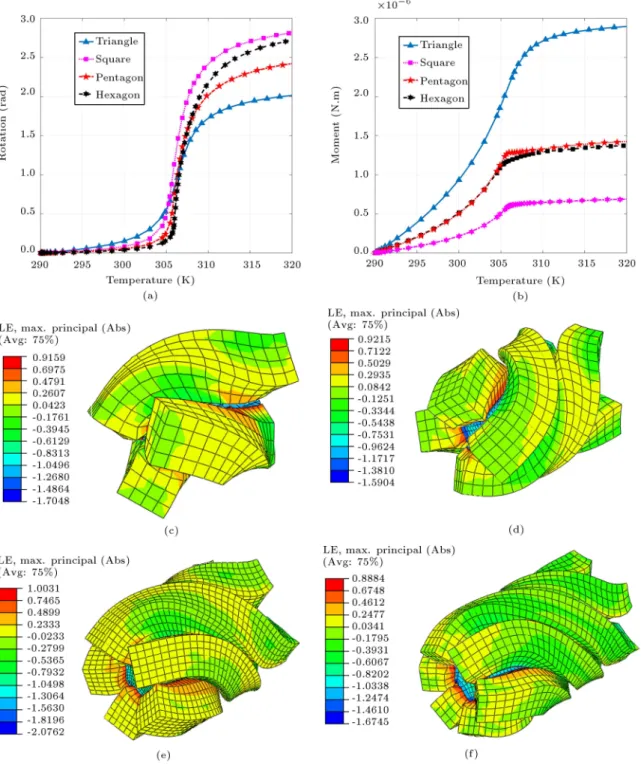
In this section, the rotating behaviors of 4 types of self-twisting hydrogel actuators with triangular, square, pentagonal, and hexagonal hydrogel cross sections are presented and compared. In order to have a valid comparison, the volume of the hydrogel is chosen to be constant in all types of actuators and the elastomer is chosen to be square; moreover, the length of the elastomer edge is half the hydrogel edge. pH is assumed to be 2.0 and temperature varies from 290 to 320 K. One end of the proposed actuator is xed and as the temperature increases, the hydrogel shrinks and makes the actuator twist. As the total number of elastomeric layers of the actuator increases, the twisting angle is expected to increase; however, increasing the number of elastomeric layers may stien the structure of the actuator and decrease the twisting angle, consequently. As one may observe in Figure 3(a), the twisting angle increases signicantly, changing from the triangular hydrogel cross section to the square one, as expected; however, adding more elastomeric layers (i.e., pentago-nal and hexagopentago-nal hydrogel cross sections) decreases the twisting angle. The rate of twisting increases suddenly at 305 K due to the sudden shrinkage of the hydrogel. The magnitude of twisting moment acting on one elastomeric layer is plotted versus temperature in Figure 3(b), which shows an acceptable magnitude order in micro-structures. Also, the maximum amount of twisting moment acting on the elastomeric layer
2360 M.R. Bayat et al./Scientia Iranica, Transactions B: Mechanical Engineering 26 (2019) 2356{2368
Figure 3. Rotational behaviors of 4 types of self-twisting bilayer strips with dierent hydrogel shapes: (a) Rotational displacement versus temperature, (b) moment versus temperature; logarithmic strain contours of (c) triangular, (d) square, (e) pentagonal, and (f) hexagonal cores.
belongs to the actuator with triangular hydrogel cross section due to the largest edge length. Logarithmic strain contours of the mentioned actuators at pH = 2:0 and T = 320 K are presented in Figure 3(c)-(f). 3.2. Hydrogel size
As discussed earlier, the hydrogel shrinkage causes the actuator to twist. In this section, the eect of hydrogel size on the rotating behavior of the actuator is
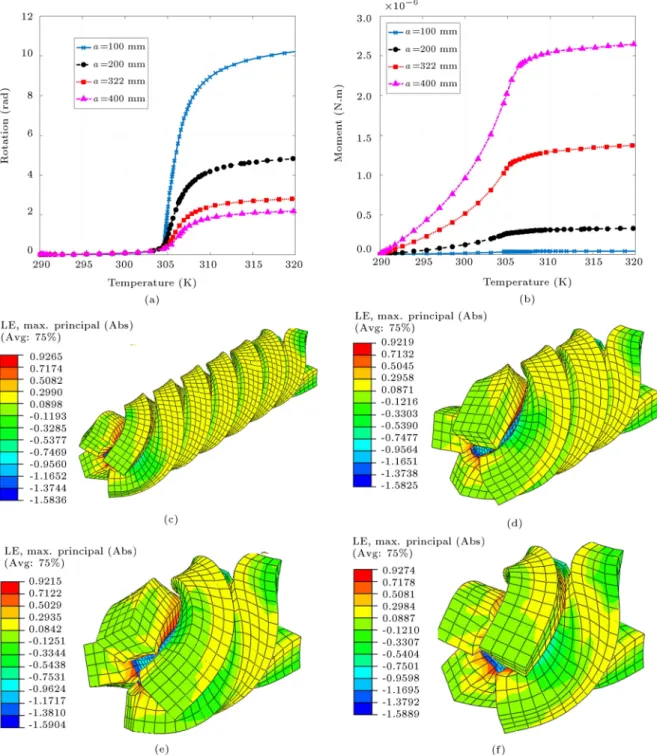
examined. For this purpose, 4 types of actuators with the same length, but a = 100, 200, 322, and 400 m edge lengths, are subjected to temperature eld varying from 290 to 320 K at pH = 2:0. It should be noted that the geometrical parameter, namely a, stands for hydrogel cross section edge length, which is depicted in Figure 1. The results are presented in Figure 4(a)-(f). Rotation was expected to increase as the hydrogel size increased; however, actuators showed a totally reversed
M.R. Bayat et al./Scientia Iranica, Transactions B: Mechanical Engineering 26 (2019) 2356{2368 2361
Figure 4. Eect of hydrogel size on the rotational behavior of strips: (a) Rotational displacement versus temperature, (b) moment versus temperature; logarithmic strains of actuators with (c) a = 100 m, (d) a = 200 m, (e) a = 322 m, and (f) a = 400 m.
behavior, which was due to the length to cross section ratio, i.e., the actuator with smaller cross section had larger length to cross section ratio. Obviously, the larger cross section resulted in a larger amount of rotational moment, which is visible in Figure 4(b). 3.3. Elastomer cross section
The elastomer was chosen to be square with edge lengths of half those of the hydrogel in the previous
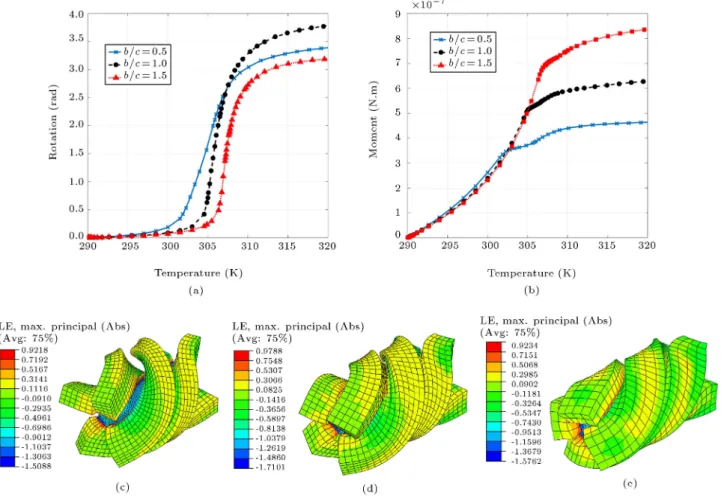
sections. In this section, the eect of elastomer cross section aspect ratio on the rotational behavior of actuator is studied. Rotational behaviors of 3 types of actuators with b=c = 0:5, 1.0, and 1.5 subjected to temperature eld varying from 290 to 320 K and pH = 2:0 are presented and compared. Other geometric parameters are taken to be the same. As discussed earlier, actuators start twisting at T = 305 K; however, as shown in Figure 5(a), the actuator with b=c = 0:5
2362 M.R. Bayat et al./Scientia Iranica, Transactions B: Mechanical Engineering 26 (2019) 2356{2368
Figure 5. Eect of elastomer aspect ratio on the rotational behavior of strips: (a) Rotational displacement versus temperature, (b) moment versus temperature; logarithmic strain contours of actuators with (c) b=c = 0:5, (d) b=c = 1:0, and (e) b=c = 1:5.
starts twisting at temperatures lower than 305 K, while the actuator with b=c = 1:5 begins to twist at temperatures higher than 305 K. This is because the elastomer with lower b=c can be bent easier than that with higher b=c, due to its lower second moment of area about the axis parallel to the hydrogel edge. Also, Figure 5(b) shows that the actuator with b=c = 1:5 tolerates higher moments than others because of its stronger elastomers against bending (i.e., elastomers with higher b=c ratio). Also, contours of logarithmic strains of the three discussed strips are presented in Figure 5(c)-(e).
3.4. Actuator length
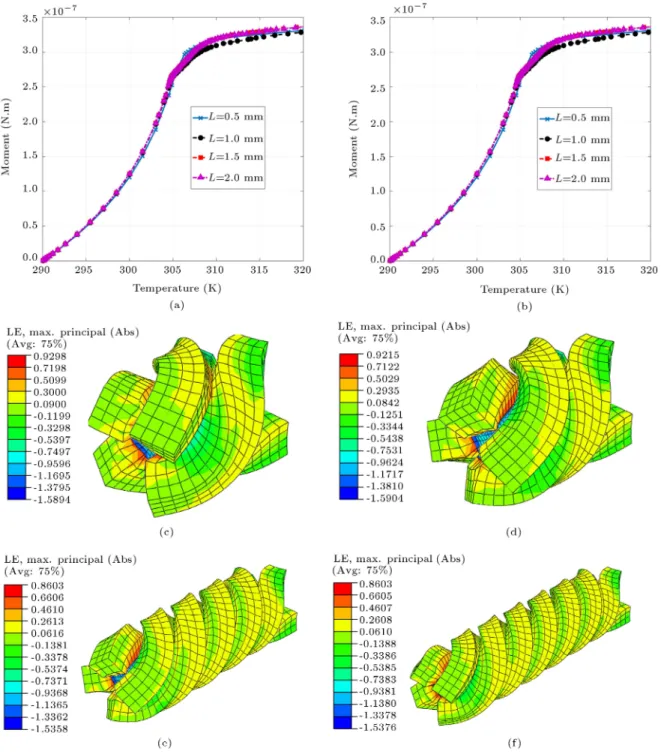
Four strips with dierent lengths, namely L = 0:5, 1.0, 1.5, and 2.0 mm, with similar other geometric parameters are examined in this section, to determine the eect of actuator length on its rotational behavior. It is clear that longer actuators twist more; however, this section quanties the increase in the rotation due to longer length. Actuators are subjected to temperature eld varying from 290 to 320 K at pH = 2:0; the rotational displacement and moment versus
temperature are shown and compared in Figure 6(a)-(b). As depicted in Figure 6(b), the length of the strip does not considerably aect the torsional moment acting on the elastomer cross section. In addition, logarithmic strain contours of the actuators are shown in Figure 6(c)-(f).
3.5. Inhomogeneous twisting
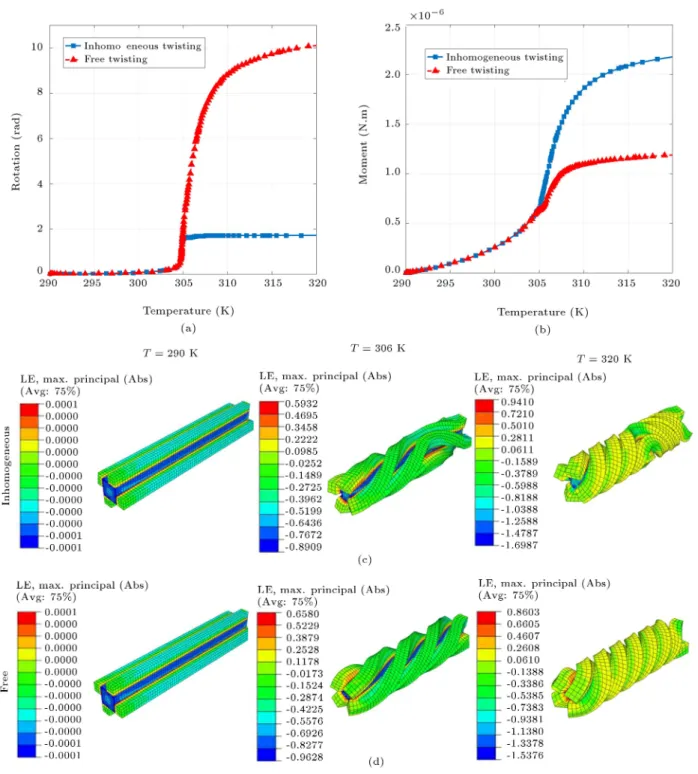
In order to simulate the inhomogeneous twisting of the actuator, the actuator is allowed to twist freely up to 90 degrees as the temperature increases. Then, the free end of the actuator is xed and the temperature is increased up to 320 K. The results are compared with the free twisting behavior of the same actuator and presented in Figure 7. The rotation and moment at the end of both actuators are the same up to 305 K (i.e., 90 degrees rotation). After that, the rotation of the inhomogeneous twisting actuator is kept constant and the moment at the end of the actuator is higher than that of the free twisting actuator, which is due to the constrained shrinkage of the hydrogel. Also, as shown in Figure 7, in inhomogeneous twisting, because
M.R. Bayat et al./Scientia Iranica, Transactions B: Mechanical Engineering 26 (2019) 2356{2368 2363
Figure 6. Eect of actuator length on the rotational behavior of strips: (a) Rotational displacement versus temperature, (b) moment versus temperature; logarithmic strain contours of actuators with (c) L = 0:5 mm, (d) L = 1:0 mm, (e) L = 1:5 mm, and (f) L = 2:0 mm.
of the xed ends and hydrogel shrinkage, the elastomers give wavy deformation.
3.6. Environmental conditions
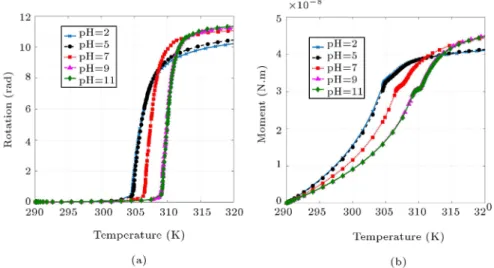
In this section, a coupled pH/temperature analysis is carried out on the strips. In Figure 8, the be-haviors of multi-layer strips are compared in various environmental conditions. As the pH increases, not only strips respond to temperature later, but also the
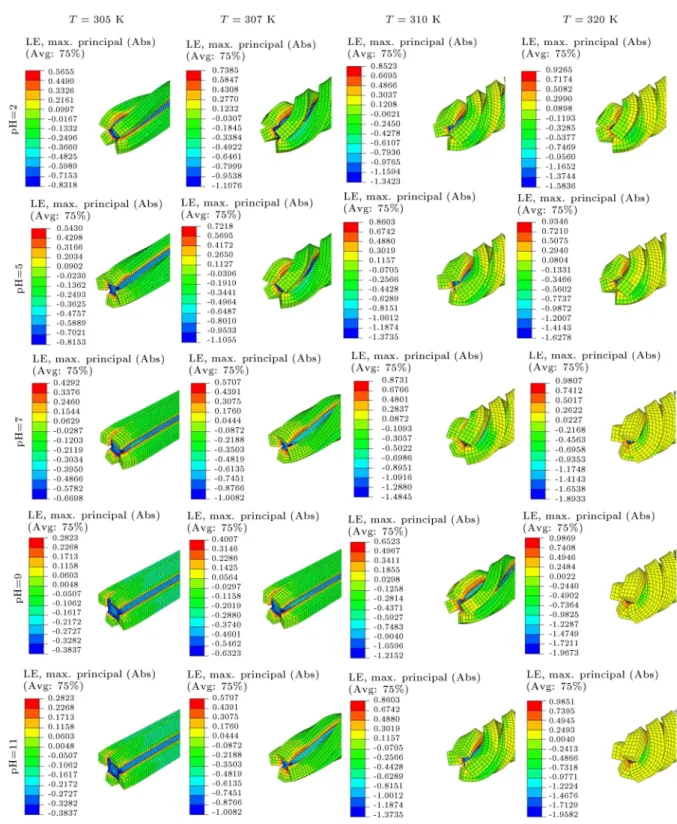
twisting angle as well as the torsional moment acting on the elastomer increases. The rate of twisting grows slightly at high pH values. Logarithmic strain contours are displayed in Figure 9. In this gure, the left-to-right columns show the results at the temperatures of T = 290, 305, 307, 310, and 320 K, respectively; moreover, the top-down rows are the results for pH = 2, 5, 7, 9, and 11.
max-2364 M.R. Bayat et al./Scientia Iranica, Transactions B: Mechanical Engineering 26 (2019) 2356{2368
Figure 7. Comparison of inhomogeneous and free twisting behaviors of the actuator: (a) Rotational displacement versus temperature, (b) moment versus temperature; logarithmic strain contours of (c) inhomogeneous and (d) free twisting actuators at dierent temperatures.
imum moment acting on elastomer cross sections of various studied actuators are listed in Table 2. The presented pH/temperature-sensitive actuator can be useful in biomedical and microuidic applications.
4. Summery and conclusions
In this work, a nite element model was developed to
investigate the twisting behavior of pH/temperature-sensitive hydrogel based biphasic actuators. The actuator was made of two bonded phases: One phase was made of an inert incompressible elastomer and the other of pH/temperature-sensitive PNIPAM hydrogel. The actuator twisted in response to the environment pH/temperature change as a result of hydrogel shrink-age. A UHYPER code according to a thermodynamic
M.R. Bayat et al./Scientia Iranica, Transactions B: Mechanical Engineering 26 (2019) 2356{2368 2365
Figure 8. (a) Rotational displacement versus temperature, and (b) moment versus temperature of hydrogel self-twisting multi-layer strips at dierent environmental conditions.
Table 2. Maximum twisting angles and maximum moments acting on elastomer cross sections of various studied actuators. Hydrogel cross
section a (m) b=c L (mm) pH
Max. twisting angle (rad)
Max. moment (N.m)
Triangle 490 1 1 2 2.017 2.896
Square 100 1 1 2 10.230 0.004
Square 100 1 1 5 10.460 0.004
Square 100 1 1 7 11.070 0.004
Square 100 1 1 9 11.240 0.004
Square 100 1 1 11 11.350 0.005
Square 200 1 0.5 2 2.193 0.033
Square 200 1 1 2 4.837 0.329
Square 200 1 1.5 2 7.489 0.034
Square 200 1 2 2 10.120 0.034
Square 250 0.5 1 2 3.394 0.046
Square 250 1 1 2 3.787 0.063
Square 250 1.5 1 2 3.194 0.084
Square 320 1 1 2 2.817 1.375
Square 400 1 1 2 2.193 2.650
Pentagon 290 1 1 2 2.424 1.426
Hexagon 200 1 1 2 2.720 6.903
based constitutive model was developed for implement-ing in ABAQUS in order to simulate the twistimplement-ing actuator problem. Two benchmark problems were re-solved to validate the nite element procedure.
Results showed that a twisting actuator with square cross section would experience higher twisting
angle than the ones with triangular, pentagonal, and hexagonal cross sections. Also, the eect of the hydrogel size on the twisting behavior of the actuator was studied, and it was concluded that the actuator twisting angle increased as the hydrogel size decreased due to the length to cross section ratio. Moreover, the
2366 M.R. Bayat et al./Scientia Iranica, Transactions B: Mechanical Engineering 26 (2019) 2356{2368
Figure 9. Logarithmic strains of pH/temperature-sensitive self-twisting multi-layer strips at various conditions. Columns and rows show temperature and pH variation, respectively.
behavior of the actuator at dierent pH values demon-strated that the actuator responded to temperature later at high pH values.
References
1. Mazaheri, H., Baghani, M., Naghdabadi, R., and
Sohrabpour, S. \Inhomogeneous swelling behavior of temperature sensitive PNIPAM hydrogels in micro-valves: Analytical and numerical study", Smart Mater. Struct., 24(4), p. 045004 (2015).
2. Go, G., Choi, H., Jeong, S., Ko, S.Y., Park, J.-O., and Park, S. \Selective microrobot control using a thermally responsive microclamper for microparticle
M.R. Bayat et al./Scientia Iranica, Transactions B: Mechanical Engineering 26 (2019) 2356{2368 2367
manipulation", Smart Materials and Structures, 25(3), p. 035004 (2016).
3. Arbabi, N., Baghani, M., Abdolahi, J., Mazaheri, H., and Mosavi Mashhadi, M. \Finite bending of bilayer pH-responsive hydrogels: A novel analytic method and nite element analysis", Compos. Part B: Eng., 110, pp. 116-123 (2017).
4. Li, H., Go, G., Ko, S.Y., Park, J.-O., and Park, S. \Magnetic actuated pH-responsive hydrogel-based soft micro-robot for targeted drug delivery", Smart Materials and Structures, 25(2), p. 027001 (2016).
5. Doi, M. \Gel dynamics", Journal of the Physical Society of Japan, 78(5), pp. 052001-052001 (2009).
6. Chester, S.A. and Anand, L. \A coupled theory of uid permeation and large deformations for elastomeric materials", Journal of the Mechanics and Physics of Solids, 58(11), pp. 1879-1906 (2010).
7. Ahn, S.-k., Kasi, R.M., Kim, S.-C., Sharma, N., and Zhou, Y. \Stimuli-responsive polymer gels", Soft Matter, 4(6), pp. 1151-1157 (2008).
8. Kargar-Estahbanaty, A., Baghani, M., Shahsavari, H., and Faraji, G. \A combined analytical-numerical investigation on photosensitive hydrogel micro-valves", International Journal of Applied Mechanics, 9(07), p. 1750103 (2017).
9. Attaran, A., Brummund, J., and Wallmersperger, T. \Modeling and simulation of the bending behavior of electrically-stimulated cantilevered hydrogels", Smart Materials and Structures, 24(3), p. 035021 (2015).
10. Jabbari, E., Tavakoli, J., and Sarvestani, A.S. \Swelling characteristics of acrylic acid polyelectrolyte hydrogel in a dc electric eld", Smart Materials and Structures, 16(5), p. 1614 (2007).
11. Hong, W., Zhao, X., and Suo, Z. \Large deformation and electrochemistry of polyelectrolyte gels", Journal of the Mechanics and Physics of Solids, 58(4), pp. 558-577 (2010).
12. Abdolahi, J., Baghani, M., Arbabi, N., and Mazaheri, H. \Analytical and numerical analysis of swelling-induced large bending of thermally-activated hydrogel bilayers", International Journal of Solids and Struc-tures, 99, pp. 1-11 (2016).
13. Xia, C., Lee, H., and Fang, N. \Solvent-driven poly-meric micro beam device", Journal of Micromechanics and Microengineering, 20(8), p. 085030 (2010).
14. Backer, M., Raue, M., Schusser, S., Jeitner, C., Breuer, L., Wagner, P., Poghossian, A., Forster, A., Mang, T., and Schoning, M.J. \Microuidic chip with integrated microvalves based on temperature-and pH-responsive hydrogel thin lms", Physica Status Solidi(a), 209(5), pp. 839-845 (2012).
15. Domachuk, P., Tsioris, K., Omenetto, F.G., and Kaplan, D.L. \Bio-microuidics: Biomaterials and biomimetic designs", Advanced Materials, 22(2), pp. 249-260 (2010).
16. Jones, D.S., Lorimer, C.P., McCoy, C.P., and Gor-man, S.P. \Characterization of the physicochemical, antimicrobial, and drug release properties of thermore-sponsive hydrogel copolymers designed for medical device applications", Journal of Biomedical Materials Research Part B: Applied Biomaterials: An Ocial Journal of The Society for Biomaterials, The Japanese Society for Biomaterials, and The Australian Society for Biomaterials and the Korean Society for Biomate-rials, 85(2), pp. 417-426 (2008).
17. Guenther, M., Gerlach, G., Wallmersperger, T., Avula, M.N., Cho, S.H., Xie, X., Devener, B., Solzbacher, F., Tathireddy, P., and Magda, J.J. \Smart hydrogel-based biochemical microsensor array for medical diag-nostics", Advances in Science and Technology, 85, pp. 47-52 (2013).
18. Baghani, M., Dolatabadi, R., and Baniassadi, M. \Developing a nite element beam theory for nanocom-posite shape memory polymers with application to sus-tained release of drug", Scientia Iranica, Transactions B, Mechanical Engineering, 24(1), pp. 249-259 (2017).
19. Soleymana, R., Bardajeeb, G.R., Pourjavadic, A., Varamesha, A., and Davoodia, A. \Hydrolyzed salep/gelatin-g-polyacrylamide as a novel micro/nano-porous superabsorbent hydrogel: Synthesis, optimiza-tion and investigaoptimiza-tion on swelling behavior", Scientia Iranica, 22(3), pp. 883-893 (2015).
20. Pourjavadi, A., Soleyman, R., Bardajee, G.R., and Seidi, F. \[gamma]-Irradiation synthesis of a smart hydrogel: Optimization using taguchi method and in-vestigation of its swelling behavior", Scientia Iranica, Transactions C, Chemistry, Chemical Engineering, 17(1), pp. 15-23 (2010).
21. Ahadian, S., Sadeghian, R.B., Yaginuma, S., Ramon-Azcon, J., Nashimoto, Y., Liang, X., Bae, H., Naka-jima, K., Shiku, H., and Matsue, T. \Hydrogels con-taining metallic glass sub-micron wires for regulating skeletal muscle cell behaviour", Biomaterials Science, 3(11), pp. 1449-1458 (2015).
22. Kwon, G.H., Park, J.Y., Kim, J.Y., Frisk, M.L., Beebe, D.J., and Lee, S.H. \Biomimetic soft multifunctional miniature aquabots", Small, 4(12), pp. 2148-2153 (2008).
23. Arbabi, N., Baghani, M., Abdolahi, J., Mazaheri, H., and Mosavi Mashhadi, M. \Finite bending of bilayer pH-responsive hydrogels: A novel analytic method and nite element analysis", Composites Part B: Engineering, pp. 116-123 (2017).
24. Bayat, M.R., Kargar, A., and Baghani, M. \A semi-analytical solution for nite bending of a functionally graded hydrogel strip", Acta Mechanica (2019).
25. Shojaeifard, M., Bayat, M.R., and Baghani, M. \Swelling-induced nite bending of functionally graded pH-responsive hydrogels: A semi-analytical method", J Applied Mathematics and Mechanics, (2019).
26. Guo, W., Li, M., and Zhou, J. \Modeling pro-grammable deformation of self-folding all-polymer
2368 M.R. Bayat et al./Scientia Iranica, Transactions B: Mechanical Engineering 26 (2019) 2356{2368
structures with temperature-sensitive hydrogels", Smart Materials and Structures, 22(11), p. 115028 (2013).
27. Yoon, C., Xiao, R., Park, J., Cha, J., Nguyen, T.D., and Gracias, D.H. \Functional stimuli responsive hydrogel devices by self-folding", Smart Materials and Structures, 23(9), p. 094008 (2014).
28. Liu, Z., Toh, W., and Ng, T.Y. \Advances in mechan-ics of soft materials: A review of large deformation behavior of hydrogels", Intl. J. Appl. Mech., 7(5), pp. (2015).
29. Flory, P.J. \Thermodynamics of high polymer solu-tions", The Journal of Chemical Physics, 10(1), pp. 51-61 (1942).
30. Hong, W., Zhao, X., Zhou, J., and Suo, Z. \A theory of coupled diusion and large deformation in polymeric gels", Journal of the Mechanics and Physics of Solids, 56(5), pp. 1779-1793 (2008).
31. Hong, W., Liu, Z., and Suo, Z. \Inhomogeneous swelling of a gel in equilibrium with a solvent and mechanical load", Int. J. Solids Struct., 46(17), pp. 3282-3289 (2009).
32. Ding, Z., Toh, W., Hu, J., Liu, Z., and Ng, T.Y. \A simplied coupled thermo-mechanical model for the transient analysis of temperature-sensitive hydrogels", Mech Mater, 97, pp. 212-227 (2016).
33. Yang, Q.S., Ma, L.H., and Shang, J.J. \The chemo-mechanical coupling behavior of hydrogels incorporat-ing entanglements of polymer chains", Int. J. Solids Struct., 50(14-15), pp. 2437-2448 (2013).
34. Yi, C., Zhang, X., Yan, H., and Jin, B. \Finite element simulation and the application of amphoteric pH-sensitive hydrogel", Intl. J. Appl. Mech., 9(5), pp. (2017).
35. Marcombe, R., Cai, S., Hong, W., Zhao, X., Lapusta, Y., and Suo, Z. \A theory of constrained swelling of a pH-sensitive hydrogel", Soft Matter, 6(4), pp. 784-793 (2010).
36. Zimmerman, J.A., Nguyen, T.D., and Xiao, R. \Mod-eling the coupled chemo-thermo-mechanical behavior of amorphous polymer networks", (No. SAND2015-1359R). Sandia National Lab. (SNL-CA), Livermore, CA (United States) (2015).
37. Mazaheri, H., Baghani, M., Naghdabadi, R., and Sohrabpour, S. \Coupling behavior of the pH/temperature sensitive hydrogels for the inhomo-geneous and homoinhomo-geneous swelling", Smart Materials and Structures, 25(8), pp. (2016).
38. Abdolahi, J., Baghani, M., Arbabi, N., and Mazaheri, H. \Finite bending of a temperature sensitive hydrogel tri-layer: An analytical and nite element analysis", Composite Structures, 164, pp. 219-228 (2017).
39. Turcaud, S., Guiducci, L., Fratzl, P., Brechet, Y.J., and Dunlop, J.W. \An excursion into the design space of biomimetic architectured biphasic actuators",
International Journal of Materials Research, 102(6), pp. 607-612 (2011).
40. Flory, P.J. and Rehner Jr, J. \Statistical mechanics of cross-linked polymer networks II. Swelling", The Journal of Chemical Physics, 11(11), pp. 521-526 (1943).
41. Huggins, M.L. \Some properties of solutions of long-chain compounds", The Journal of Physical Chem-istry, 46(1), pp. 151-158 (1942).
42. Mazaheri, H., Baghani, M., and Naghdabadi, R. \Inhomogeneous and homogeneous swelling behavior of temperature-sensitive poly-(N-isopropylacrylamide) hydrogels", Journal of Intelligent Material Systems and Structures (2015).
43. Afroze, F., Nies, E., and Berghmans, H. \Phase transitions in the system poly (N-isopropylacrylamide)/water and swelling behaviour of the corresponding networks", Journal of Molecular Structure, 554(1), pp. 55-68 (2000).
44. Guo, B.-L. and Gao, Q.-Y. \Preparation and prop-erties of a pH/temperature-responsive carboxymethyl chitosan/poly (N-isopropylacrylamide) semi-IPN hy-drogel for oral delivery of drugs", Carbohydrate re-search, 342(16), pp. 2416-2422 (2007).
Biographies
Mohammad Reza Bayat obtained his BS degree in Mechanical Engineering from Zanjan University, Iran, in 2013, and his MS degree in Mechanical Engineering from the Department of Mechanical Engineering at Tehran University, Tehran, Iran, in 2015. His research interests include computational mechanics, solid me-chanics, and smart materials constitutive modeling. Mostafa Baghani received his BS degree in Mechan-ical Engineering from University of Tehran, Iran, in 2006 and his MS and PhD degrees in Mechanical Engi-neering from the Department of Mechanical Engineer-ing at Sharif University of Technology, Tehran, Iran, in 2008 and 2012, respectively. He is now an Assistant Professor in the School of Mechanical Engineering at University of Tehran. His research interests include solid mechanics, nonlinear nite element method, and shape-memory materials constitutive modeling. Hamid Shahsavari obtained his BS degree in Me-chanical Engineering from Amirkabir University of Technology, Iran, and his MS degree in Mechanical Engineering from the Department of Mechanical En-gineering at Sharif University of Technology, Tehran, Iran, in 2016. His research interests include solid mechanics, computational mechanics, continuum me-chanics, and constitutive modeling.
![Figure 2. (a) Comparison between the FEM results and the experiments reported by Guo and Gao [44] for free swelling of PNIPAM hydrogel at pH = 7:4](https://thumb-us.123doks.com/thumbv2/123dok_us/8367689.2222362/4.892.135.786.150.467/figure-comparison-results-experiments-reported-swelling-pnipam-hydrogel.webp)