Retail Curriculum
Framework
Stage 6 Syllabus
Part A
for implementation from 2000
Retail Operations (240 indicative hours)
Retail Operations (120 indicative hours)
Retail Operations – General Selling (60 indicative hours)
Retail Operations – Fresh Food Selling (60 indicative hours)
Retail Operations – Clerical Administrative (60 indicative hours)
to show / hide navigation
available to download.
Acknowledgement
Units of competency from the Retail Training Package in Part B of this syllabus are © Australian National Training Authority (ANTA). Reproduced with permission. The following copyright warning applies to the material from the Training Package: All rights reserved. This work has been produced initially with the assistance of funding provided by the Commonwealth Government through ANTA. This work is copyright, but permission is given to trainers and teachers to make copies by photocopying or other duplicating processes for use with their own training organisations or in a workplace where the training is being conducted. This
permission does not extend to the making of copies for use outside the immediate training environment for which they are made, nor the making of copies for hire or resale to third parties. The views expressed in this version of the work do not necessarily represent the views of ANTA. ANTA does not give warranty nor accept any liability.
Material on p 7 from Securing Their Future © NSW Government 1997.
The Board of Studies owns the copyright on all syllabuses. Schools may reproduce this syllabus in part or in full for bona fide students or classroom purposes only. Acknowledgement of the Board of Studies copyright must be included on any reproductions. Students may copy reasonable portions of the syllabus for the
purposes of research or study. Any other use of this syllabus must be referred to the Copyright Officer, Board of Studies NSW. Ph: (02) 9367 8111; fax (02) 9279 1482.
© Board of Studies NSW 1999
Published by
Board of Studies NSW GPO Box 5300
Sydney NSW 2001
Tel: (02) 9367 8111
Internet: http://www.boardofstudies.nsw.edu.au ISBN 07313 4296 8
1 Introduction to Industry Curriculum Frameworks ...5
2 Documentation Associated with Industry Curriculum Frameworks...6
3 The Higher School Certificate Program of Study...7
4 Vocational Education and Training (VET) in the NSW Higher School Certificate...7
4.1 The National Training Framework ...7
4.2 Industry Curriculum Frameworks ...8
5 Rationale ...9
6 Aim ...9
7 Retail Curriculum Framework...10
7.1 Training Package Qualifications ...10
7.2 Units of Competency Included in the Retail Curriculum Framework ...11
8 Course Structures ...13
8.1 Courses Within the Retail Curriculum Framework ...13
8.2 Allocation of Hours for Unit Credit in the HSC ...13
8.3 Retail Operations (240 Indicative Hours)...15
8.4 Retail Operations (120 Indicative Hours)...16
8.5 Retail Operations Extension Courses (60 Indicative Hours) ...17
9 Outcomes and Content ...19
9.1 Units of Competency ...19
9.2 Course Delivery — Training Programs, Learning Materials, Resources and Teacher Qualifications ...20
10 Work Placement...21
11 Assessment Requirements and Advice ...22
11.1 Competency Based Assessment...22
11.2 Training Package Requirements ...23
11.3 Competency Record Book (Student Log)...24
11.4 HSC Examination — Retail Operations (240 Indicative Hours) ...25
11.5 HSC Examination Specifications ...25
12 HSC Requirements and Certification...27
12.1 Course Completion Requirements...27
12.2 Preliminary and HSC Unit Credit ...27
12.3 Higher School Certificate Record of Achievement ...27
13 Other Information ...29
13.1 Providing for all Students ...29
13.2 Key Competencies ...30
13.3 Links between the Retail Curriculum Framework and Other HSC Courses...30
13.4 Articulation to Further Training...31
14 AQF Levels...33
15 Key Competencies — Levels of Performance ...35
1
Introduction to Industry Curriculum Frameworks
Industry curriculum frameworks have been developed to provide students with the opportunity to gain credit towards the NSW Higher School Certificate and credit towards national vocational qualifications under the Australian Qualifications Framework (AQF).Industry curriculum frameworks are based on national training packages. They specify the range of industry developed units of competency from the relevant training packages that have been identified as suitable for the purposes of the Higher School Certificate. They also define how units are arranged in HSC vocational education and training (VET) courses for the purpose of gaining unit credit for the Higher School Certificate. Wherever possible, VET courses in industry curriculum frameworks are aligned to national vocational qualifications.
This industry curriculum framework incorporates all HSC Retail VET courses, including:
• courses delivered by schools
• courses delivered by TAFE colleges
• courses delivered by other Registered Training Organisations (RTOs) on behalf of schools or TAFE colleges.
2
Documentation Associated with Industry Curriculum
Frameworks
The documentation associated with industry curriculum frameworks has been written to assist teachers and trainers develop teaching and assessment programs and to help in the management of competency achievement of Higher School Certificate candidates.
The purpose of Part A of the Retail Curriculum Framework Stage 6 Syllabus is to describe how students may achieve unit credit towards the Higher School Certificate and credit towards a vocational qualification. It contains general advice about the Retail Curriculum Framework and describes course structures and requirements, including work placement. This document should be used as the first reference when planning the implementation of VET courses for the Higher School Certificate. The set of documents associated with the curriculum framework is illustrated in Figure 1.
Figure 1: Industry Curriculum Framework Documentation Retail Curriculum Framework Stage 6 Syllabus
6 Syllabus
Part A Course Structures
and Requirements
Syllabus Part B Units of Competency
and HSC Requirements
Competency
3
The Higher School Certificate Program of Study
The purpose of the Higher School Certificate program of study is to:• provide a curriculum structure which encourages students to complete secondary education;
• foster the intellectual, social and moral development of students, in particular developing their:
– knowledge, skills, understanding and attitudes in the fields of study they choose
– capacity to manage their own learning
– desire to continue learning in formal or informal settings after school – capacity to work together with others
– respect for the cultural diversity of Australian society;
• provide a flexible structure within which students can prepare for: – further education and training
– employment
– full and active participation as citizens;
• provide formal assessment and certification of students’ achievements; • provide a context within which schools also have the opportunity to foster
students’ physical and spiritual development.
4
Vocational Education and Training (VET) in the NSW
Higher School Certificate
4.1
The National Training Framework
All accredited VET programs, including those for HSC students, must meet the requirements of the National Training Framework (NTF).
The key components of the national training framework are:
• The Australian Qualifications Framework (AQF)
Under the AQF, VET qualifications in each industry area are standard across Australia. To facilitate this, the award of a particular AQF Diploma, Certificate or Statement of Attainment depends on the person who seeks a qualification meeting specified industry competency standards. Competency standards have been developed by industry to reflect the real requirements for employment and effective work performance in the relevant industry and are expressed in
national industry training packages. • National Training Packages
All training packages contain three mandatory or ‘endorsed’ components on which AQF VET qualifications in the relevant industry are based. These are: – units of competency, which express the industry competency standards and
include elements of competency, performance criteria, a range of variables and an evidence guide
– assessment guidelines, which set out conditions for establishing that competency has been met
– qualifications, which explain the qualifications and relationships between them.
Training packages may also contain a range of materials designed to assist with training and assessment. These are not mandatory and are known as ‘non-endorsed components’.
• The Australian Recognition Framework (ARF)
Because training packages and AQF qualifications are standardised across Australia, they are also recognised in all parts of Australia. This is assured by the ARF, which ensures that the quality of training and assessment is consistent and reliable.
Under the ARF, an organisation wishing to provide training, assess competencies and issue VET qualifications under the AQF, must be a Registered Training Organisation (RTO). It is the responsibility of an RTO, whether it is a school or school system, a TAFE college or other training provider, to ensure that quality assurance requirements are met. These requirements include access to
adequate resources and appropriately qualified staff in order to deliver and/or assess training programs that lead to the achievement of qualifications (or individual units of competency) that have been identified in the RTO's scope of registration. As part of its registration, each RTO must agree to recognise AQF qualifications issued by any other RTO.
4.2
Industry Curriculum Frameworks
Industry curriculum frameworks have been developed to satisfy the requirements of the National Training Framework and the purposes of the NSW Higher School Certificate. An industry curriculum framework describes the range of units of competency from the relevant training package that is endorsed by the Board of Studies for inclusion in the NSW Higher School Certificate. It also describes the groupings of units of competency that define specific HSC VET courses. These are determined largely by the qualifications available in the relevant training package and their suitability for school students attempting the Higher School Certificate. An industry curriculum framework must also meet a set of industry and school related criteria developed to promote the strengthening and extension of VET in the Higher School Certificate. Units of competency are the components against which assessment and reporting occur for the purpose of gaining credit towards an AQF qualification. They are also the focus of courses within an industry curriculum framework. In this sense, the elements of competency, which collectively define the outcomes of each unit of competency, also define the outcomes and determine the content of HSC VET courses within each framework.
Retail Curriculum Framework Stage 6 Syllabus
5
Rationale
Employment in the retail industry accounts for a large and growing proportion of the Australian workforce. The industry is by far the largest employer of young people, with the retail, wholesale and personal services industries accounting for nearly 50 per cent of 15–19 year old employment in NSW and Australia wide. The majority of these employees are part-time or casual workers, including secondary and tertiary students but the industry also offers long-term career opportunities.
In the past, training for many occupations in the retail industry was predominantly on the job without recognised industry wide qualifications. However, industry bodies, employer associations, unions and major employers have adopted an approach to formalised training and recognition based on national competency standards and qualifications and the establishment of recognised career pathways.
The Retail Curriculum Framework has been developed in response to the needs of the industry and to provide training and education opportunities for the full range of Higher School Certificate students. It is based on units of competency in the National Retail Training Package. Qualifications available to students who achieve competence in the appropriate units of competency and who successfully complete integrated competency assessment for those units are the AQF Certificates I and II in Retail Operations. Students who do not qualify for Certificates I or II may be eligible for an AQF Statement of Attainment showing partial completion of these certificates. The inclusion of industry recognised courses in retail in the HSC course will allow students to access both long-term and short-term employment opportunities. Certificates I and II are recognised qualifications for employment in the retail industry at an operational level but also lead on to further qualifications in supervision, specialist occupations and management in the industry. They also provide students with skills and experience that are useful in a range of personal contact and personal service occupations and are relevant to a number of related professional careers, including business management, marketing, advertising and finance.
The knowledge, skills and attitudes acquired by students in undertaking courses within the Retail Curriculum Framework will also be of value in future study and daily life.
6
Aim
The Retail Curriculum Framework is designed to provide students with appropriate learning opportunities that will enable them to acquire a range of technical, personal and interpersonal skills valued both within and beyond the workplace. They will also acquire underpinning skills and knowledge related to functional areas within the retail industry. Through study in this subject, students will gain experience that can be applied to a range of contexts, including work, study and leisure and that can be used in making informed career choices.
Retail Curriculum Framework Stage 6 Syllabus
10
7
Retail Curriculum Framework
7.1
Training Package Qualifications
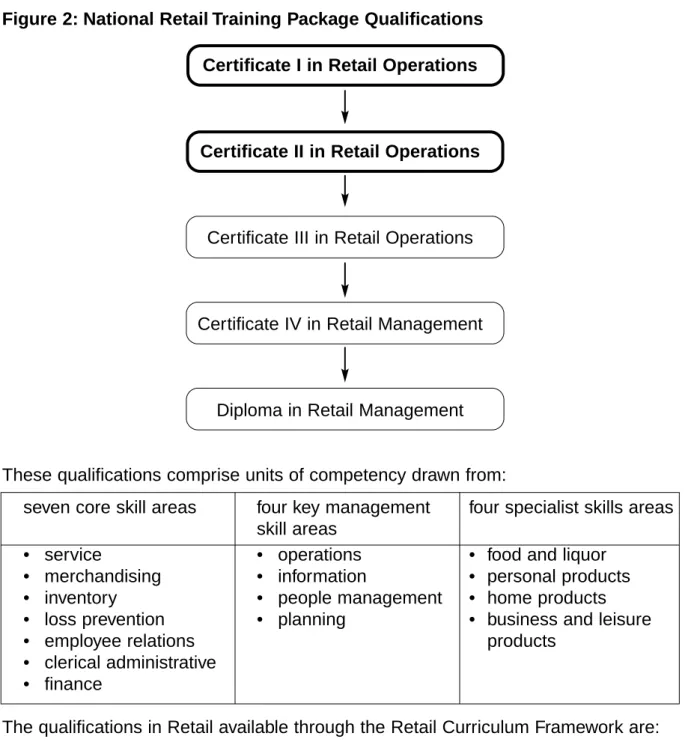
The Retail Curriculum Framework is based on the National Retail Training Package. This training package incorporates five nationally recognised qualifications ranging from AQF Certificate I to Diploma, based on the National Retail Competency Standards. These qualifications are shown in Figure 2.
Figure 2: National Retail Training Package Qualifications Certificate I in Retail Operations
Certificate II in Retail Operations
Certificate III in Retail Operations
Certificate IV in Retail Management
Diploma in Retail Management
These qualifications comprise units of competency drawn from:
seven core skill areas four key management four specialist skills areas
skill areas
• service • operations • food and liquor
• merchandising • information • personal products
• inventory • people management • home products
• loss prevention • planning • business and leisure
• employee relations products
• clerical administrative • finance
The qualifications in Retail available through the Retail Curriculum Framework are: • Certificate I in Retail Operations
• Certificate II in Retail Operations.
7.2
Units of Competency Included in the Retail Curriculum
Framework
The Retail Curriculum Framework includes all of the units of competency that make up Certificates I and II in Retail Operations. These are drawn from the seven core skills areas and one specialist skill area (Food and Liquor).
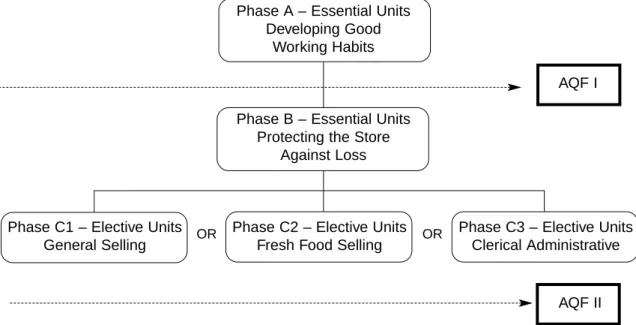
Certificate I is designed as a prevocational qualification and includes five core units of competency. These units are equivalent to Phase A in Certificate II in Retail Operations. Certificate II is the standard entry-level qualification for the retail industry. It is
divided into three phases: Phase A, which includes five core units of competency and is equivalent to Certificate I; Phase B, which includes five core units of
competency; and Phase C, which includes elective units of competency in one of three elective streams.
Figure 3 describes the pattern of training for Certificates I and II in Retail Operations. Figure 3: Certificates I and II in Retail Operations
Phase A – Essential Units Developing Good
Working Habits
AQF I Phase B – Essential Units
Protecting the Store Against Loss
Phase C1 – Elective Units Phase C2 – Elective Units Phase C3 – Elective Units
General Selling Fresh Food Selling Clerical Administrative
AQF II
The course structure in the Retail Curriculum Framework adheres to this pattern: • Retail Operations (240 indicative hours) is based on the units of competency
that make up Phases A and B and one Phase C unit of competency
• Retail Operations (120 indicative hours) is based on the units of competency that make up Phase A (Certificate I)
• Retail – General Selling extension (60 indicative hours) is based on the units of competency that make up Phase C1
• Retail – Fresh Food Selling extension (60 indicative hours) is based on the units of competency that make up Phase C2
• Retail – Clerical Administrative extension (60 indicative hours) is based on the units of competency that make up Phase C3.
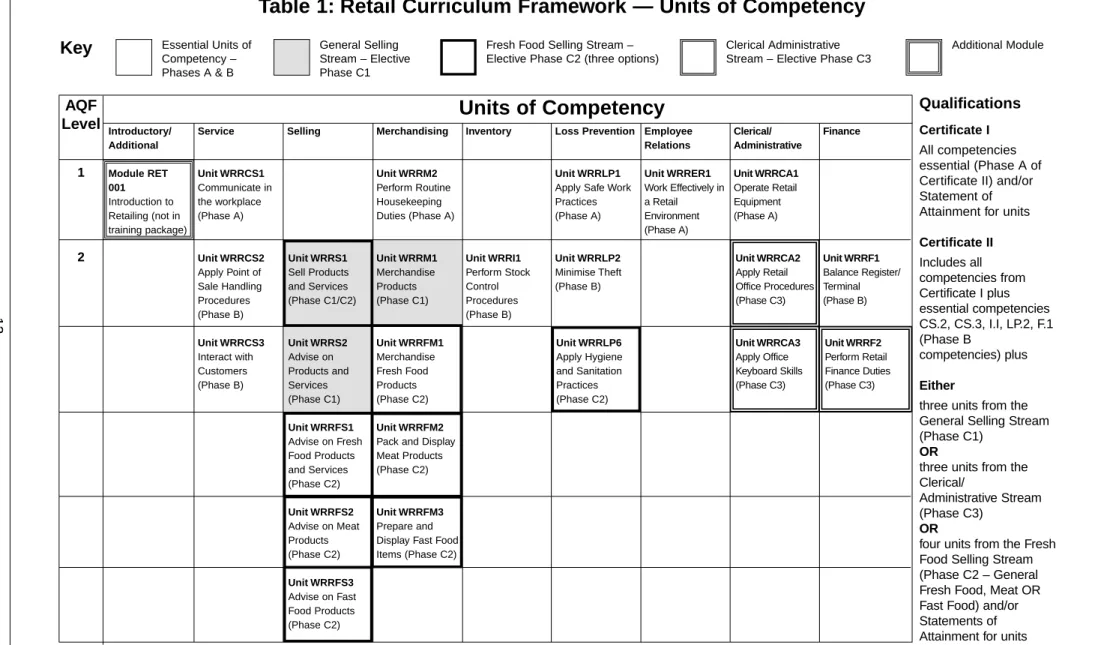
Table 1 shows the individual units of competency from the Retail Training Package that are included in the Retail Curriculum Framework for the HSC.
Retail Curr iculum F rame w o rk
Stage 6 Syllab
us
12
Table 1: Retail Curriculum Framework — Units of Competency
Units of Competency
Key Essential Units of Competency – Phases A & B
General Selling Stream – Elective Phase C1
Fresh Food Selling Stream – Elective Phase C2 (three options)
Clerical Administrative Stream – Elective Phase C3
Additional Module Introductory/ Additional Module RET 001 Introduction to Retailing (not in training package) Service Unit WRRCS1 Communicate in the workplace (Phase A) Unit WRRCS2
Apply Point of Sale Handling Procedures (Phase B) Unit WRRCS3 Interact with Customers (Phase B) Selling Unit WRRS1 Sell Products and Services (Phase C1/C2) Unit WRRS2 Advise on Products and Services (Phase C1) Unit WRRFS1
Advise on Fresh Food Products and Services (Phase C2)
Unit WRRFS2
Advise on Meat Products (Phase C2)
Unit WRRFS3
Advise on Fast Food Products (Phase C2) Merchandising Unit WRRM2 Perform Routine Housekeeping Duties (Phase A)
Unit WRRM1 Merchandise Products (Phase C1) Unit WRRFM1 Merchandise Fresh Food Products (Phase C2) Unit WRRFM2
Pack and Display Meat Products (Phase C2)
Unit WRRFM3
Prepare and Display Fast Food Items (Phase C2)
Inventory Unit WRRI1 Perform Stock Control Procedures (Phase B) Loss Prevention Unit WRRLP1
Apply Safe Work Practices (Phase A) Unit WRRLP2 Minimise Theft (Phase B) Unit WRRLP6 Apply Hygiene and Sanitation Practices (Phase C2) Employee Relations Unit WRRER1
Work Effectively in a Retail Environment (Phase A) Clerical/ Administrative Unit WRRCA1 Operate Retail Equipment (Phase A) Unit WRRCA2 Apply Retail Office Procedures (Phase C3) Unit WRRCA3 Apply Office Keyboard Skills (Phase C3) Finance Unit WRRF1 Balance Register/ Terminal (Phase B) Unit WRRF2 Perform Retail Finance Duties (Phase C3) AQF Level 1 2 Qualifications Certificate I All competencies essential (Phase A of Certificate II) and/or Statement of Attainment for units
Certificate II
Includes all competencies from Certificate I plus essential competencies CS.2, CS.3, I.I, LP.2, F.1 (Phase B
competencies) plus
Either
three units from the General Selling Stream (Phase C1)
OR
three units from the Clerical/
Administrative Stream (Phase C3)
OR
four units from the Fresh Food Selling Stream (Phase C2 – General Fresh Food, Meat OR Fast Food) and/or Statements of Attainment for units
8
Course Structures
8.1
Courses within the Retail Curriculum Framework
The industry curriculum framework for the Higher School Certificate describes the range of units of competency that have been identified as being suitable for the purposes of the Higher School Certificate. Units of competency within the Retail Curriculum Framework are shown in Table 1.
Each course within the framework lists the available units of competency that must be addressed to gain units of credit towards the Higher School Certificate.
The Retail Curriculum Framework includes the following courses: • Retail Operations (240 indicative hours)
• Retail Operations (120 indicative hours) • three 60 indicative hour extension courses
– Retail Operations – General Selling (60 indicative hours) – Retail Operations – Fresh Food Selling (60 indicative hours) – Retail Operations – Clerical Administrative (60 indicative hours)
8.2
Allocation of Hours for Unit Credit in the HSC
Units of competency drawn from industry training packages are not defined in terms of duration. The amount of time required by individual students to achieve
competency will vary according to their aptitude and experience. Where a training program is designed for delivery by an RTO, the RTO will specify the length of the training program according to the curriculum resources/delivery strategies chosen. However, for the purposes of the Higher School Certificate, courses must be described in terms of their indicative duration. Courses are 240 indicative hour courses, 120 indicative hour courses or (in the case of extension courses) 60 indicative hour courses.
For this reason, indicative hours for unit credit towards the Higher School Certificate have been assigned to each unit of competency within the framework. It is
emphasised that the assignment of indicative hours does not imply that all students will fulfil all requirements for a unit of competency within these hours. RTOs may determine that additional or fewer hours are required for the achievement of particular competencies. It is also expected that students will need to spend
additional time in practising skills in a work environment and in completing projects and assignments in order to fulfil industry assessment requirements.
In the case of Retail, in order to obtain AQF qualifications, students must
Retail Curriculum Framework Stage 6 Syllabus
14
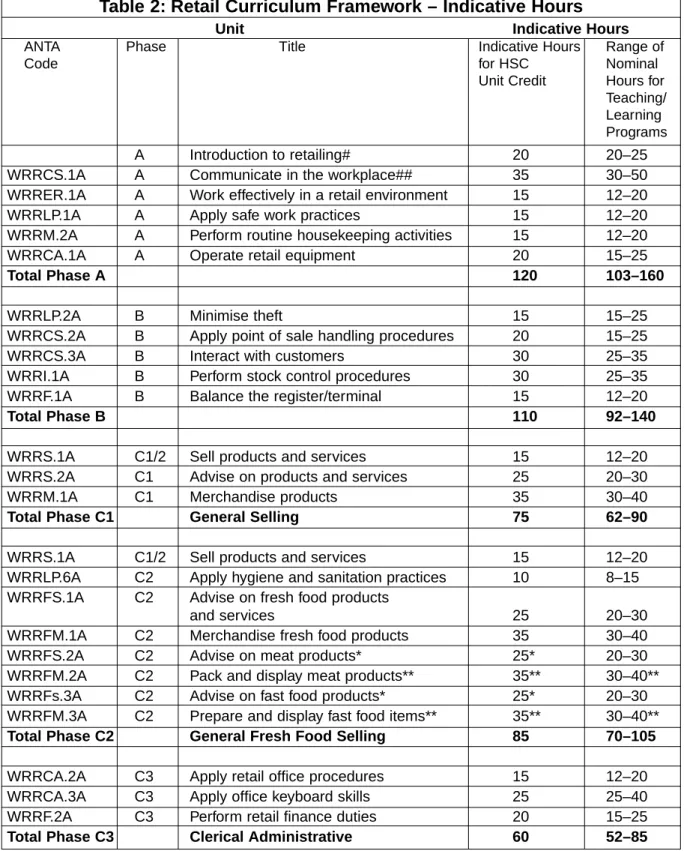
Table 2 lists the indicative hours for unit credit towards the Higher School Certificate assigned to each unit of competency included in the Retail Curriculum Framework. This table also lists the range of nominal hours that RTOs might allocate to the delivery of teaching and learning programs that address these units of competency.
Table 2: Retail Curriculum Framework – Indicative Hours
Unit Indicative Hours
ANTA Phase Title Indicative Hours Range of
Code for HSC Nominal
Unit Credit Hours for Teaching/ Learning Programs
A Introduction to retailing# 20 20–25
WRRCS.1A A Communicate in the workplace## 35 30–50
WRRER.1A A Work effectively in a retail environment 15 12–20
WRRLP.1A A Apply safe work practices 15 12–20
WRRM.2A A Perform routine housekeeping activities 15 12–20
WRRCA.1A A Operate retail equipment 20 15–25
Total Phase A 120 103–160
WRRLP.2A B Minimise theft 15 15–25
WRRCS.2A B Apply point of sale handling procedures 20 15–25
WRRCS.3A B Interact with customers 30 25–35
WRRI.1A B Perform stock control procedures 30 25–35
WRRF.1A B Balance the register/terminal 15 12–20
Total Phase B 110 92–140
WRRS.1A C1/2 Sell products and services 15 12–20
WRRS.2A C1 Advise on products and services 25 20–30
WRRM.1A C1 Merchandise products 35 30–40
Total Phase C1 General Selling 75 62–90
WRRS.1A C1/2 Sell products and services 15 12–20
WRRLP.6A C2 Apply hygiene and sanitation practices 10 8–15
WRRFS.1A C2 Advise on fresh food products
and services 25 20–30
WRRFM.1A C2 Merchandise fresh food products 35 30–40
WRRFS.2A C2 Advise on meat products* 25* 20–30
WRRFM.2A C2 Pack and display meat products** 35** 30–40**
WRRFs.3A C2 Advise on fast food products* 25* 20–30
WRRFM.3A C2 Prepare and display fast food items** 35** 30–40**
Total Phase C2 General Fresh Food Selling 85 70–105
WRRCA.2A C3 Apply retail office procedures 15 12–20
WRRCA.3A C3 Apply office keyboard skills 25 25–40
WRRF.2A C3 Perform retail finance duties 20 15–25
Total Phase C3 Clerical Administrative 60 52–85
#Additional Module not in Retail Training Package ## Includes Retail Calculations
*Alternative to WRRFS.1A **Alternative to WRRFM.1A
8.3
Retail Operations (240 Indicative Hours)
Purpose
The purpose of this course is to provide students with a range of skills and
knowledge suitable for employment in the retail industry and also for university and other tertiary study. Students may achieve significant credit towards the AQF
Certificate II in Retail Operations. Course Structure
This course addresses all units of competency in Phases A and B and one unit from Phase C1 of the AQF Certificate II in Retail Operations.
The course is not divided into Preliminary and HSC components and may be delivered in an integrated way. However, it is recommended that all Phase A units are delivered in the preliminary year so that students exiting the course after the Preliminary year have an opportunity to gain the AQF Certificate I in Retail Operations.
This course is accredited for a total of four Preliminary and/or HSC units. Course Requirements
Students must attempt all units of competency and complete a minimum of 70 hours of work placement.
An external written Higher School Certificate examination will be conducted for this course. This examination will be optional. Students undertaking the course will nominate during the HSC year whether or not they will undertake the external written examination.
Retail Operations (240 indicative hours) Attempt all units
Code Unit Title
Phase A
RET 001 Introduction to retailing 20
WRRCS.1A Communicate in the workplace 35
WRRER.1A Work effectively in a retail environment 15
WRRLP.1A Apply safe work practices 15
WRRM.2A Perform routine housekeeping activities 15
WRRCA.1A Operate retail equipment 20
Phase B
WRRLP.2A Minimise theft 15
WRRCS.2A Apply point of sale handling procedures 20
WRRCS.3A Interact with customers 30
WRRI.1A Perform stock control procedures 30
WRRF.1A Balance the register/terminal 15
Phase C 1
WRRS.1A Sell products and services 15
Total 245
Indicative Hours for HSC Unit Credit
Retail Curriculum Framework Stage 6 Syllabus
16 Qualifications
To receive AQF qualifications, students must meet the assessment requirements of the Retail Training Package. Assessment must be conducted by a qualified
assessor.
• Students successfully completing integrated competency assessment for Phases A and B will be eligible for an AQF Statement of Attainment showing partial completion of the Certificate II in Retail Operations.
• Students assessed as competent in some or all individual units of competency in Retail Operations (240 indicative hours) will be eligible for an AQF Statement of Attainment showing partial completion of Certificate II.
• Students successfully completing integrated competency assessment for Phase A will be eligible for the AQF Certificate I in Retail Operations.
Further information on assessment is included in Section 11 and in Part B of this syllabus.
8.4
Retail Operations (120 Indicative Hours)
Purpose
The purpose of this course is to provide students with basic skills and knowledge as preparation for entry level employment in the retail industry.
Course Structure
This course addresses all of the units of competency in the AQF Certificate I in Retail Operations. This is equivalent to Phase A of Certificate II.
This course is accredited for a total of two Preliminary and/or HSC units. Course Requirements
Students must attempt all units of competency and complete a minimum of 35 hours of work placement.
Retail Operations (120 Indicative Hours) Attempt all units
Code Unit Title
Phase A
RET 001 Introduction to retailing 20
WRRCS.1A Communicate in the workplace 35
WRRER.1A Work effectively in a retail environment 15
WRRLP.1A Apply safe work practices 15
WRRM.2A Perform routine housekeeping activities 15
WRRCA.1A Operate retail equipment 20
Total 120
Qualifications
To receive AQF qualifications, students must meet the assessment requirements of the Retail Training Package. Assessment must be conducted by a qualified assessor.
Indicative Hours for HSC Unit Credit
• Students successfully completing integrated competency assessment for Phase A will be eligible for the AQF Certificate I in Retail Operations.
• Students assessed as competent in some or all individual units of competency in Retail Operations (120 indicative hours) will be eligible for an AQF Statement of Attainment showing partial completion of Certificate I or II.
Further information on assessment is included in Section 11 and in Part B of this syllabus.
8.5
Retail Operations Extension Courses (60 Indicative Hours)
Purpose
The purpose of these courses is to provide students with the opportunity to gain a full AQF Certificate II in Retail Operations. They are available to all students
undertaking the Retail Operations (240 indicative hours) course but are intended especially for students who are also part-time contracted retail trainees.
Course Structure
Each of these courses addresses units of competency contained in a particular
elective stream of Phase C (Phase C1 OR Phase C2 OR Phase C3) of the Certificate II in Retail Operations. Note that one unit from Phases C1 and C2 — WRRS1.A Sell Products and Services — is addressed in the 240 indicative hour course.
Each of these courses is accredited for a total of one Preliminary or HSC unit. Course Requirements
An extension course may only be undertaken in addition to Retail Operations (240 indicative hours). Only one 60 indicative hour extension course may be
attempted. Students must attempt all units of competency in the relevant course and complete a minimum of 14 hours of work placement.
Retail Operations – General Selling Extension (60 Indicative Hours)
Code Unit Title
WRRS.2A Advise on products and services 25
WRRM.1A Merchandise products 35
TOTAL Phase C1 General Selling 60
(plus WRRSI.A)
Indicative Hours for HSC Unit Credit
Retail Operations – Fresh Food Selling Extension (60 Indicative Hours)
Code Unit Title
WRRS.1A Sell products and services*** 5
WRRLP.6A Apply hygiene and sanitation practices 10
WRRFS.1A Advise on fresh food products and services 25
WRRFM.1A Merchandise fresh food products 35
WRRFS.2A Advise on meat products* 25*
WRRFM.2A Pack and display meat products** 35**
WRRFS.3A Advise on fast food products* 25*
WRRFM.3A Prepare and display fast food items** 35**
TOTAL Phase C2 General Fresh Food Selling 75
*Alternative to WRRFS.1A **Alternative to WRRSFM.1A
***This unit is addressed in Retail Operations (240 indicative hours). Five hours of HSC credit is allowed in this course to allow for contextualisation in Fresh Food Selling
Retail Operations – Clerical Administrative Extension (60 Indicative Hours)
Code Unit Title
WRRCA.2A Apply retail office procedures 15
WRRCA.3A Apply office keyboard skills 25
WRRF.2A Perform retail finance duties 20
TOTAL Phase C3 Clerical Administrative 60
Qualifications
To receive AQF qualifications, students must meet the assessment requirements of the Retail Training Package. Assessment must be conducted by a qualified
assessor.
• Students successfully completing integrated competency assessment for Phases A, B and for either Phase C1 or Phase C2 or Phase C3 will be eligible for an AQF Certificate II in Retail Operations.
• Students assessed as competent in individual units of competency in one of the extension courses relating to Phase C will be eligible for an AQF Statement of Attainment showing partial completion of this certificate.
Further information on competency assessment is included in section 11 and in Part B of this syllabus.
Retail Curriculum Framework Stage 6 Syllabus
18
Indicative Hours for HSC Unit Credit
Indicative Hours for HSC Unit Credit
9
Outcomes and Content
9.1
Units of Competency
Details of individual units of competency included in the Retail Curriculum
Framework for the Higher School Certificate are contained in Part B of this syllabus. The units determine the content and define the outcomes of learning for courses within the framework.
The text for each unit included is identical to that in the National Retail Training Package. For each unit of competency, the:
• elements of competency
• performance criteria • range of variables and • evidence guide, including:
– critical aspects of evidence
– underpinning knowledge and skills
– relationship to key competencies
– context and method of assessment
– resource implications
are included as stated in the training package.
Accompanying each unit of competency in Part B is an additional section entitled ‘HSC Requirements and Advice’. This section prescribes the scope of learning expected of Stage 6 students undertaking HSC courses including the unit.
It also describes the range of resources that teachers might use in developing and delivering teaching and learning programs addressing the unit, possible teaching and assessment strategies and the relationships between the unit and learning outcomes in other HSC courses.
The units of competency may also be accessed in the National Retail Training Package and the National Training Information Service (NTIS) website
(www.ntis.gov.au).
The units of competency that can be addressed in training programs and assessed by a particular training organisation are determined by the scope of registration of the RTO. Teachers and trainers should check the scope of registration before determining which units of competency will be addressed in their teaching and assessment programs. Every RTO must be able to provide documentary evidence defining their scope of registration and this should be sought wherever a school student is accessing learning and assessment through an external provider other than a TAFE college.
For guidelines as to the delivery of training programs by RTOs other than schools or TAFE colleges, teachers and principals should consult the Board of Studies’
Assessment, Certification and Examination (ACE) Manual or relevant Board of
9.2
Course Delivery – Training Programs, Learning Materials,
Resources and Teacher Qualifications
It is the responsibility of the RTO to determine the learning materials that will be used to deliver courses within the Retail Curriculum Framework.
In many cases, it is expected that RTOs will choose to use the National Retail Training Materials — Curriculum, a non-endorsed component of the Retail Training Package. This curriculum has been developed in parallel with the endorsed
components of the Retail Training Package and (with the exception of the first three modules) modules correspond to units of competency on a one to one basis. RTOs may also use the Learner’s Guides and Workplace Coach Guides that correspond to this curriculum.
Alternatively, RTOs may develop their own training materials or use a combination of in-house and commercially produced curriculum resources.
Further advice on curriculum materials that may be used to support the delivery of courses within the Retail Curriculum Framework is contained within the ‘HSC
Requirements and Advice’ section attached to each unit of competency in Part B of the syllabus and in the Retail Curriculum Framework support document. This
information is provided as a guide to RTOs and teachers delivering HSC courses within the curriculum framework. The use of the listed modules and other training materials is not mandatory.
It is also the responsibility of the RTO to determine the resources required for course delivery and the qualifications required by teachers and trainers delivering courses on behalf of the RTO.
Separate advice on: • learning materials
• resource requirements
• teacher qualifications
is available from school system authorities.
Retail Curriculum Framework Stage 6 Syllabus
10
Work Placement
The courses in the VET industry curriculum frameworks have been designed to deliver specified units of competency. The units of competency have been drawn from the industry training packages. They have associated indicative hours to guide schools and other deliverers.
Work placement is a mandatory HSC requirement of each course within this framework and indicative hours have been assigned to the work placement requirement for each course.
Learning in the workplace will enable students to:
• progress towards the achievement of industry competencies • develop appropriate attitudes towards work
• learn a range of behaviours appropriate to the industry
• practise skills acquired off the job in a classroom or workshop
• develop additional skill and knowledge, including the key competencies.
The mandatory work placement requirements for courses in this framework are not intended to indicate the time required for the achievement of units of competency. The amount of workplace learning required for competency achievment will vary from student to student. Assessment of the units of competence is to be undertaken by a qualified assessor(s) either in a work placement or in classroom delivery. Work Placement Requirements
Students are required to complete the following mandatory work placement: • Retail Operations (240 indicative hours)
– a minimum of 70 hours in a retail workplace • Retail Operations (120 indicative hours)
– a minimum of 35 hours in a retail workplace
• Retail Operations (60 indicative hours) all extension courses – a minimum of 14 hours in a retail workplace
It is the responsibility of the school or other RTO to determine how course outcomes are best to be achieved and to structure delivery accordingly. If additional work placement or classroom time is required to enable individual or class groups of students to achieve the competencies this will be determined by the deliverer. Further information and advice on the implementation of work placement is contained in policy statements or guidelines available from the relevent school system authority/RTO.
Part-time Work
Under some circumstances, students’ part-time work in the retail industry may be used to fulfil work placement requirements. For further details, teachers and principals should consult the Board of Studies’ Assessment, Certification and
Retail Curriculum Framework Stage 6 Syllabus
22
11
Assessment Requirements and Advice
Assessment is the process of gathering information and making judgements about student achievement for a variety of purposes. In the Higher School Certificate, those purposes include:
• assisting student learning
• evaluating and improving teaching and learning programs • certifying satisfactory achievement and completion of courses • reporting achievement in the Higher School Certificate.
For VET courses, they also include assessment for the purpose of achieving AQF qualifications and Statements of Attainment.
The information in this section relates to the Board of Studies’ requirements for assessing and reporting achievement in the Higher School Certificate. In this context, assessing refers to competency based assessment and to external examinations. Reporting refers to the documents used by the Board and RTOs to report both measures of achievement.
11.1 Competency Based Assessment
The courses within the Retail Curriculum Framework are competency based courses. The Board of Studies and the Vocational Education and Training Accreditation Board (VETAB) require that a competency based approach to assessment is used and that a record be held by the RTO of the competencies achieved.
In a competency based course, assessment of competencies is criterion referenced. This means that a participant’s performance is judged against a prescribed standard — not against the performance of other participants.
The purpose of assessment is to judge competence on the basis of performance against the performance criteria set out under each element of competency. A participant is judged either competent or not yet competent. This judgement is made on the basis of evidence, that may be in a variety of forms.
Competency based assessment is based on the requirements of the workplace. Competence incorporates all aspects of work performance, including problem-solving and the capacity to apply skills and knowledge in both familiar and new situations. Assessment of competence involves the assessment of skills and knowledge combined. It is not necessary, nor is it desirable, for individual performance criteria to be
demonstrated separately for assessment purposes. Rather, assessors should
adopt an integrated or holistic approach to assessment. This means that a number of elements of competency or even several units of competency are assessed
together. This method of assessment is encouraged in line with the concept of competence as the integration of a wide range of skills, knowledge and attitudes and is emphasised in the Retail Training Package.
11.2 Training Package Requirements
To achieve an AQF Certificate or Statement of Attainment, a student or worker must be assessed as competent according to the requirements set out in the national training package. The assessment must be conducted by a qualified assessor through the auspices of the RTO that is to issue the qualification.
Assessment Guidelines
The assessment guidelines of a training package are, along with qualifications and units of competency, one of the three endorsed components (mandatory
components) of the package.
The role of the assessment guidelines is to provide principles and guidance to ensure that assessment is fair, valid, consistent and to industry standard.
The assessment guidelines of the National Retail Training Package are as follows: • The assessment system overview, including benchmarks for assessment, the
role of RTOs and assessment pathways
• assessor qualifications and using qualified assessors • guidelines for designing assessment materials
• guidelines for conducting assessment • sources of information on assessment.
The assessment guidelines are included in volume 1 of the National Retail Training Package and on the National Training Information Service (NTIS) website
(www.ntis.gov.au)
Integrated and Unit Assessment
To facilitate the assessment process within each qualification in Retail Operations, units of competency have been grouped into phases of interrelated units. Each phase is assessed through an integrated competency assessment activity to assure that appropriate holistic assessment occurs for each group of interrelated units of competency.
To be eligible for Certificate I in Retail Operations, participants must successfully undergo integrated competency assessment for all units within this certificate (Phase A of Certificate II). To be eligible for Certificate II in Retail Operations,
participants must successfully undergo integrated competency assessment for each of the three phases (Phases A, B and C) within Certificate II.
Assessment may also be conducted for individual units of competency. Candidates assessed as competent in one or more individual units will be eligible for a Statement of Attainment showing partial completion of the relevant Certificate. In the case of unit assessment, evidence is also most relevant when provided through an holistic
In addition to the assessment guidelines, the Retail Training Package sets out detailed assessment requirements — the evidence guide — for each unit of competency and for integrated competency assessment for the relevant phase, within the text of the unit itself. These requirements are set out within
the text of each unit of competency included in Part B of this syllabus.
Assessment exemplars, both for unit assessment and for integrated competency Assessment, are available in the Guide to Assessment Activities for Certificate II in Retail Operations, which is a non-endorsed component of the National Retail Training Package.
Using Qualified Assessors
The assessment guidelines in the Retail Training Package specify that assessment must be conducted by a qualified assessor.
There are three components of assessor qualification. These are: • a minimum qualification as a workplace assessor
• a minimum level of technical competence based on knowledge of and experience in the retail industry
• demonstrated knowledge and understanding of requirements for assessing retail competencies.
These requirements are set out in detail in the assessment guidelines of the Retail Training Package.
It is important to note that the three components of assessor qualification need not be met by one individual. The ‘qualified assessor’ may consist of an assessment team in which one partner has assessor qualifications and knowledge and the other has technical competence in retail.
11.3 Competency Record Book (Student Log)
The competency record book (student log) forms a permanent record of all units and elements of competency demonstrated by students undertaking courses within the Retail Curriculum Framework.
Achievement of elements of competency and units of competency should be progressively recorded in the record book. It should be noted that:
• all performance criteria need to be met to demonstrate the achievement of an element of competency
• all elements of competency must be achieved in order to demonstrate the achievement of a unit of competency.
However, it is emphasised, as stated in section 11.1, that elements and performance criteria need not (and should not) be assessed individually.
Retail Curriculum Framework Stage 6 Syllabus
11.4 HSC Examination — Retail Operations (240 Indicative Hours)
The Higher School Certificate examination in Retail Operations (240 indicative hours) is optional. It will consist of a written examination. Students will nominate during the HSC year to undertake the optional examination.
The examination is independent of the competency based assessment undertaken during the course and has no impact on student eligibility for AQF qualifications.
11.5 HSC Examination Specifications
The examination in Retail Operations (240 indicative hours) is a 2 hour written paper and is worth 100 marks. The paper is marked out of 80. The total marks gained are then converted to a final mark out of 100.
The paper will be based on three areas.
1 Units of competency addressed in Retail Operations (240 indicative hours), including:
– elements of competency
– performance criteria
– critical aspects of evidence
– underpinning knowledge and skills. These units are:
RET 001# Introduction to retailing
WRRCS.1A Communicate in the workplace
WRRER.1A Work effectively in a retail environment
WRRLP.1A Apply safe work practices
WRRM.2A Perform routine housekeeping activities
WRRCA.1A Operate retail equipment
WRRLP.2A Minimise theft
WRRCS.2A Apply point of sale handling procedures
WRRCS.3A Interact with customers
WRRI.1A Perform stock control procedures
WRRF.1A Balance the register/terminal
WRRS.1A Sell products and services
# RET 001 is a module rather than a unit of competency and is also examinable.
2 Minimum prescribed learning contained in the Higher School Certificate requirements for each unit of competency (see Retail Curriculum Framework, Part B), including:
– minimum learning for the Higher School Certificate
– key terms and concepts.
3 Associated key competencies.
The paper will consist of THREE sections.
Section I (15 marks)
• There are 15 multiple-choice questions. • All questions in this section are compulsory. • All questions are of equal value.
Section II (35 marks)
• The questions in this section are short response items in parts. • All questions in this section are compulsory.
• Question parts will range in value. Section III (30 marks)
• The questions in this section are extended response items. • Students must attempt TWO of the three questions.
• All questions are of equal value.
Retail Curriculum Framework Stage 6 Syllabus
12
HSC Requirements and Certification
12.1 Course Completion Requirements
For a student to be considered to have satisfactorily completed a course within the Retail Curriculum Framework, there must be sufficient evidence that the student has: • followed the course as specified by attempting the required units of competency • demonstrated that they have applied themselves to the set tasks and
experiences with diligence and sustained effort
• undertaken the mandatory workplacement
• achieved some or all of the course outcomes.
12.2 Preliminary and HSC Unit Credit
To facilitate flexibility of VET in the Higher School Certificate, courses within the Retail Curriculum Framework may be delivered as Preliminary units, as HSC units or as a combination of Preliminary and HSC units.
12.3 Higher School Certificate Record of Achievement
Courses within the Retail Curriculum Framework will be listed on the Higher School Certificate Record of Achievement, together with the unit value of the course. No mark will be listed for the achievement of competency but the Record of
Achievement will refer to the AQF Certificates and Statements of Attainment, which will be issued separately. The issuing of AQF Certificates and Statements of
Attainment is subject to the requirements in section 11.2.
For students enrolled in Retail Operations (240 indicative hours) and who undertake the written Higher School Certificate examination, a scaled examination mark out of 100 will be recorded on the Higher School Certificate Record of Achievement. No school-based assessment mark will be recorded.
12.4 AQF Qualifications
Students who undertake the following HSC courses may be eligible for AQF certification as described below:
Retail Operations (240 indicative hours) plus one Extension Course (60 hours) Students who successfully complete integrated competency assessment for Phases A, B and C will be eligible for the AQF Certificate II in Retail Operations WRR20197. Students assessed as competent for all or some individual units of competency in Certificate II in Retail Operations (Phases A, B or C) will be eligible for an AQF Statement of Attainment showing partial completion of Certificate II.
Retail Operations (240 indicative hours)
Students who successfully complete integrated competency assessment for Phases A and B or who are assessed as competent for all or some individual units of
competency in Phases A and B will be eligible for an AQF Statement of Attainment showing partial completion of Certificate II in Retail Operations WRR20197.
Students who successfully complete integrated competency assessment for Phase A will be eligible for an AQF Certificate I in Retail Operations WRR10197.
Retail Operations (120 indicative hours)
Students who successfully complete integrated competency assessment for Phase A will be eligible for an AQF Certificate I in Retail Operations WRR10197.
Students achieving some units of competency in Phase A will be eligible for an AQF Statement of Attainment showing partial completion of the AQF Certificate II in Retail Operations WRR20197.
In some instances, AQF qualifications and Statements of Attainment may be issued by the Board. In other instances, they may be issued by the relevant RTO.
Retail Curriculum Framework Stage 6 Syllabus
13
Other Information
13.1 Providing for all Students
Students with Special Education Needs
Courses within the Retail Curriculum Framework are available to all students, including those with special education needs. Students following an HSC Special Program of Study may be allowed additional unit credit towards the Higher School Certificate for courses within the framework.
Courses within industry curriculum frameworks will provide students with special education needs with access to pathways between school and work.
Successful participation in these courses for such students is dependent on: • transition planning to meet individual needs
• prevocational preparation
• appropriate methods for course delivery and assessment
• ongoing partnerships between schools, students, parents, teachers, employers and others in the community.
To develop competency to industry standard, students with special education needs may require extended time and additional support off the job and in the workplace. Careful planning is needed to ensure that students can maintain and apply the competencies being developed. Close links between school and work placement may also be necessary.
Further advice on the implementation of the Retail Curriculum Framework for students with special education needs will be contained in the industry curriculum framework support document for students with special education needs developed by the Board of Studies.
Gender and Cultural Considerations
Industry curriculum frameworks have been developed to address the needs of a broad range of students. Teaching and assessment programs in the Retail
Curriculum Framework should be developed to minimise any gender or cultural bias. Case studies, illustrative examples and other materials used for teaching and
assessment should be selected on the basis that they do not reinforce gender or cultural stereotypes.
Trainees
The Retail Curriculum Framework includes provision for part-time contracted
trainees to fulfil their off-the-job learning requirements and gain an AQF Certificate II in Retail Operations.
Trainees who are seeking credit towards the Higher School Certificate for their off-the-job training should undertake the 240 indicative hour course and one of the 60 indicative hour extension courses within the Retail Curriculum Framework.
Further information on requirements and arrangements for part-time traineeships in the retail industry is available from school system authorities, the Department of Education and Training and New Apprenticeship Centres.
13.2 Key
Competencies
The employment related key competencies have been identified as the transferable abilities that people need to effectively participate in work and life in general. They focus on the capacity to apply knowledge and skills in an integrated way in work situations. Key competencies are generic in that they apply to work generally, rather than being specific to particular occupations or industries. Key competencies are not only considered essential for effective participation in work, but in further education and in adult life more generally.
The key competencies have been consciously integrated with the units of competency in National Training Packages.
Each unit of competency included in the Retail Curriculum Framework and reproduced in Part B of the syllabus identifies the key competencies and the performance level (1, 2 or 3) related to the unit. Achievement of the unit of
competency indicates that a student has also achieved related key competencies. Difficulty in achieving the unit of competency may indicate that the related key competencies need further development.
In designing learning and assessment programs, thought must be given to ways in which key competencies will be addressed.
Further information on the key competencies is included in Section 15.
13.3 Links between the Retail Curriculum Framework and Other
HSC Courses
Links exist between courses within the Retail Curriculum Framework and other parts of the HSC curriculum. These links can be used to enhance student opportunities.
Students may draw on skills and knowledge acquired in the study of general
education HSC subjects to develop competencies in Retail. Learning in English, for example, will contribute to the development of communication and team
competencies, learning in Business Studies will contribute to enterprise
competencies and learning in Legal Studies to competencies related to occupational health and safety, selling and service. Conversely, skills and knowledge acquired through learning and experience in Retail courses may assist students in achieving the learning outcomes of general education HSC courses.
Retail Curriculum Framework Stage 6 Syllabus
Where students are undertaking VET courses in more than one industry curriculum framework, similar competencies may be required. In these cases, learning in one area may contribute significantly to learning in another. In particular, parts of the Retail Curriculum Framework have strong links to the curriculum frameworks in Business Services (Administration), Tourism and Hospitality and Information Technology.
Students may also use work completed in general HSC subjects, or competencies achieved through other industry curriculum frameworks, as partial evidence of competency for assessment in Retail courses. However, it is emphasised that such evidence must be acceptable to and judged by a qualified assessor as part of Retail competency assessment. Students should be informed of the links between courses within the Retail Curriculum Framework and other courses that they are studying and of possible assessment opportunities.
However, learning activities undertaken as part of the HSC course or to achieve AQF qualifications should not be unnecessarily duplicated. Where individual units of competency within curriculum frameworks or in other HSC VET courses are very similar, for example, a unit drawn from one training package and contextualised to another, the Board of Studies may place exclusions on a student undertaking both units for the purpose of obtaining HSC credit.
Under these circumstances, additional, appropriate units of competency could be included in the student’s program of study in one or the other industry area to make up indicative hour requirements for HSC unit credit. Alternatively, provided assessment requirements are met, the student could meet requirements for an AQF Certificate or Statement of Attainment within a fewer number of HSC units than specified in the Retail Curriculum Framework.
Further advice on these matters is contained in the Retail Curriculum Framework support document and in the Assessment, Certification and Examination (ACE)
Manual, published by the Board of Studies.
.
Examples of links between individual units of competency and other general
education and VET courses are also included in the HSC Requirements and Advice section attached to each unit of competency in Part B of this syllabus.
13.4 Articulation to Further Training
Students achieving AQF Certificates and Statements of Attainment within this industry curriculum framework will receive advanced standing in further training in this industry area under the Australian Recognition Framework.
Students who have achieved the AQF Certificate II in Retail Operations are eligible for entry to Certificate III in Retail Operations and to training courses delivered by RTOs (including TAFE) that are based on this certificate.
Students who have achieved the Certificate I in Retail Operations or a Statement of Attainment listing units of competency towards Certificate I or II are eligible for advanced standing in Level II training courses delivered by RTOs.
Students and teachers should study the qualifications within the Retail Training Package to identify possible training pathways.
Students may also be eligible, under individual arrangements, for advanced standing in related courses offered by some universities. These arrangements are often
negotiated at a local level and information on them may be available from school careers advisers or school principals.
Students who proceed to higher level VET courses at TAFE or through other RTOs may be eligible for advanced standing in related university courses under
arrangements between RTOs and universities.
Students seeking to gain credit towards AQF qualifications in other industries may use the qualifications gained in Retail as partial evidence of competency for related units of competency in other National Training Packages.
Retail Curriculum Framework Stage 6 Syllabus
14
AQF Levels
The various levels of AQF VET qualifications reflect levels of performance and degrees of responsibility for one’s own output and the output of others in a workplace context. The level of a qualification thus provides an indication of the standard of achievement expected, which is comparable across industries and provides a context for assessment.
Industry curriculum frameworks relate to VET sector AQF Levels I to III. A brief description of AQF Levels I, II and III, adapted from The Australian Qualifications
Framework Implementation Handbook1, is provided below. AQF Level I
Work is likely to be carried out under direct supervision. Breadth, depth and complexity of knowledge and skills would prepare a person to perform a defined range of activities, most of which would be routine and predictable.
An individual demonstrating competencies at this level would be able to: • demonstrate knowledge by recall in a narrow range of areas
• demonstrate basic practical skills, such as the use of relevant tools • perform a sequence of routine tasks given clear direction
• receive and pass on messages/information. AQF Level II
Work is likely to be carried out under direct supervision. Breadth, depth and
complexity of knowledge and skills would prepare a person to perform in a range of varied activities or knowledge application where there is a clearly defined range of contexts in which the choice of actions required is usually clear and there is limited complexity in the range of options to be applied.
An individual demonstrating competencies at this level would be able to: • demonstrate basic operational knowledge in a moderate range of areas • apply a defined range of skills
• apply known solutions to a limited range of predictable problems
• perform a range of tasks where choice between a limited range of options is required
• assess and record information from various sources
• take limited responsibility for one’s own outputs in work and learning.
1Australian Qualifications Framework (AQF) Advisory Board, The Australian Qualifications Framework Implementation
AQF Level III
Breadth, depth and complexity of knowledge and competencies would cover
selecting, adapting and transferring skills and knowledge to new environments and providing technical advice and some leadership in resolution of specific problems. This would be applied across a range of roles in a variety of contexts with some complexity in the extent and choice of options available.
An individual demonstrating these competencies would be able to:
• perform a defined range of skilled operations, usually within a range of broader related activities involving known routines, methods and procedures
• exercise some discretion and judgement in the selection of equipment, services or contingency measures
• operate within known time constraints • take some responsibility for others
• participate in teams, including group or team coordination.
AQF Statements of Attainment and Certificates are ONLY issued on the basis of successful achievement of competency as determined by a qualified
assessor.
Retail Curriculum Framework Stage 6 Syllabus
15
Key Competencies — Levels of Performance
Each unit of competency included in this industry curriculum framework identifies the relationship between the unit and the key competencies. This relationship is represented by a performance level (1 to 3). The following provides a brief description of the performance levels.
Performance Level 1
Describes the competence needed to undertake activities efficiently and with sufficient self-management to meet the explicit requirements of the activity and to make judgements about quality of outcome against established criteria.
Performance Level 2
Describes the competence needed to manage activities requiring the selection, application and integration of a number of elements and to select from established criteria to judge quality of process and outcome.
Performance Level 3
Describes the performance needed to evaluate and re-shape processes, to establish and use principles in order to determine appropriate ways of approaching activities, and to establish criteria for judging quality of process and outcome.
Key competencies are integral to each of the units of competency and therefore consideration must be given to the ways in which they can be addressed when designing learning activities and assessment instruments.
Retail Curriculum Framework Stage 6 Syllabus
36
16
Glossary
ANTA Australian National Training Authority
AQF Australian Qualifications Framework – the AQF is a
comprehensive policy framework defining all qualifications recognised nationally in post-compulsory education and
training within Australia. The qualification level depends on the depth, complexity and the degree of autonomy involved in the work. The Australian Qualifications Framework comprises guidelines that define each qualification together with principles and protocols covering articulation, issuance of a qualification and transition arrangements.
ARF Australian Recognition Framework – the ARF is a
comprehensive approach to national recognition of vocational education and training (VET). It is based on a quality assured approach to the registration of providers that assess
competency outcomes and issue qualifications. It includes mutual recognition, processes for registering training
organisations and quality assurance. It replaces the National Framework for the Recognition of Training and is part of the National Training Framework.
assessment The requirements of the assessment system in the industry’s
guidelines training package. This component is mandatory and needs to
be read in conjunction with the assessment requirements of each competency standard.
AVETMISS Australian Vocational Education and Training Management
Information Statistical Standard
competency The specification of knowledge and skill and the application
standards/units of that knowledge and skill to the standards of performance
of competency required in the workplace, expressed as a competency
standard. They provide a description of the skills, knowledge and attitudes required to perform particular kinds of work. Competency standards also define the outcomes for training delivery, assessment and the issuance of qualifications and Statements of Attainment under the Australian Recognition Framework.
Units of competency are composed of elements of
competency. They include performance criteria (which specify the required level of performance), the range of variables (which indicates the context for performance) and the evidence guide (which indicates the context for assessment).
Competencies are developed nationally as an endorsed component of training packages or, where no relevant training package exists, as the basis for defining the learning outcomes of an accredited course.
compliance A systematic and independent external assessment
assessment administered by a State Training Authority/State Recognition
Authority to determine whether a Registered Training
Organisation is operating effectively within its registered scope.
element of The basic building blocks of the unit of competency. Elements
competency of competency break down a unit of competency into
workplace related tasks.
ITAB Industry Training Advisory Body – ITABs are independent
incorporated associations or companies. The state ITABs work directly with industry enterprises and providers to implement training arrangements and assist with the development of training programs. The national ITABs are also concerned with the development of national training packages.
mutual recognition This encompasses Registered Training Organisations, qualifications and training products:
• Registered Training Organisations – acceptance by a State Recognition Authority/State Training Authority enabling a Registered Training Organisation to operate within its jurisdiction on the basis of its primary registration • qualifications – acceptance by a Registered Training
Organisation of the recognition of decisions of other Registered Training Organisations/State Recognition Authorities relating to the issuing of qualifications and
Statements of Attainment, enabling individuals to receive full recognition of their achievements, including credit transfer where appropriate
• training products – acceptance of recognised training products available in the training market. This includes endorsed training packages, training programs for training packages and accredited courses.