Community Page
The Marine Microbial Eukaryote Transcriptome
Sequencing Project (MMETSP): Illuminating the
Functional Diversity of Eukaryotic Life in the Oceans
through Transcriptome Sequencing
Patrick J. Keeling1,2*, Fabien Burki1, Heather M. Wilcox3, Bassem Allam4, Eric E. Allen5, Linda A. Amaral-Zettler6,7, E. Virginia Armbrust8, John M. Archibald2,9, Arvind K. Bharti10, Callum J. Bell10, Bank Beszteri11, Kay D. Bidle12, Connor T. Cameron10, Lisa Campbell13, David A. Caron14, Rose Ann Cattolico15, Jackie L. Collier4, Kathryn Coyne16, Simon K. Davy17, Phillipe Deschamps18, Sonya T. Dyhrman19, Bente Edvardsen20,
Ruth D. Gates21, Christopher J. Gobler4, Spencer J. Greenwood22, Stephanie M. Guida10, Jennifer L. Jacobi10, Kjetill S. Jakobsen20, Erick R. James1, Bethany Jenkins23,24, Uwe John11, Matthew D. Johnson25, Andrew R. Juhl19, Anja Kamp26,27, Laura A. Katz28, Ronald Kiene29, Alexander Kudryavtsev30,31, Brian S. Leander1, Senjie Lin32, Connie Lovejoy33, Denis Lynn34,35, Adrian Marchetti36, George McManus32, Aurora M. Nedelcu37,
Susanne Menden-Deuer24, Cristina Miceli38, Thomas Mock39, Marina Montresor40, Mary Ann Moran41, Shauna Murray42, Govind Nadathur43, Satoshi Nagai44, Peter B. Ngam10, Brian Palenik5, Jan Pawlowski31, Giulio Petroni45, Gwenael Piganeau46,47, Matthew C. Posewitz48, Karin Rengefors49, Giovanna Romano40, Mary E. Rumpho50, Tatiana Rynearson24, Kelly B. Schilling10, Declan C. Schroeder51, Alastair G. B. Simpson2,52, Claudio H. Slamovits2,9, David R. Smith53, G. Jason Smith54, Sarah R. Smith5, Heidi M. Sosik25, Peter Stief26, Edward Theriot55, Scott N. Twary56, Pooja E. Umale10, Daniel Vaulot57, Boris Wawrik58, Glen L. Wheeler51,59, William H. Wilson60, Yan Xu61, Adriana Zingone40, Alexandra Z. Worden2,3*
1Department of Botany, University of British Columbia, Vancouver, British Columbia, Canada,2Canadian Institute for Advanced Research, Integrated Microbial Biodiversity program, Canada,3Monterey Bay Aquarium Research Institute, Moss Landing, California, United States of America,4School of Marine and Atmospheric Sciences, Stony Brook University, Stony Brook, New York, United States of America,5Marine Biology Research Division, Scripps Institution of Oceanography, University of California, San Diego, La Jolla, California, United States of America,6The Josephine Bay Paul Center for Comparative Molecular Biology and Evolution, Marine Biological Laboratory, Woods Hole, Massachusetts, United States of America, 7Department of Geological Sciences, Brown University, Providence, Rhode Island, United States of America,8School of Oceanography, University of Washington, Seattle, Washington, United States of America,9Department of Biochemistry & Molecular Biology, Dalhousie University, Halifax, Nova Scotia, Canada,10National Center for Genome Resources, Santa Fe, New Mexico, United States of America,11Alfred Wegener Institute Helmholtz Center for Polar and Marine Research, Bremerhaven, Germany,12Institute of Marine and Coastal Science, Rutgers University, New Brunswick, New Jersey, United States of America,13Department of Oceanography, Department of Biology, Texas A&M University, College Station, Texas, United States of America,14Department of Biology, University of Southern California, Los Angeles, California, United States of America,15Department of Biology, University of Washington, Seattle, Washington, United States of America,16University of Delaware, School of Marine Science and Policy, College of Earth, Ocean, and Environment, Lewes, Delaware, United States of America,17School of Biological Sciences, Victoria University of Wellington, Wellington, New Zealand,18Unite´ d’Ecologie, Systematique et Evolution, CNRS UMR8079, Universite´ Paris-Sud, Orsay, France,19Department of Earth and Environmental Sciences and the Lamont-Doherty Earth Observatory, Columbia University, New York, New York, United States of America,20Department of Biosciences, University of Oslo, Oslo, Norway,21Hawaii Institute of Marine Biology, University of Hawaii, Hawaii, United States of America, 22Department of Biomedical Sciences and AVC Lobster Science Centre, Atlantic Veterinary College, University of Prince Edward Island, Charlottetown, Prince Edward Island, Canada, 23Department of Cell and Molecular Biology, The University of Rhode Island, Kingston, Rhode Island, United States of America,24Graduate School of Oceanography, University of Rhode Island, Narragansett, Rhode Island, United States of America,25Woods Hole Oceanographic Institution, Woods Hole, Massachusetts, United States of America,26Max Planck Institute for Marine Microbiology, Bremen, Germany,27Jacobs University Bremen, Molecular Life Science Research Center, Bremen, Germany,28Department of Biological Sciences, Smith College, Northampton, Massachusetts, United States of America,29University of South Alabama, Dauphin Island Sea Lab, Mobile, Alabama, United States of America, 30Department of Invertebrate Zoology, Saint-Petersburg State University, Saint-Petersburg, Russia,31Department of Genetics and Evolution, University of Geneva, Geneva, Switzerland,32Department of Marine Sciences, University of Connecticut, Groton, Connecticut, United States of America,33De´partement de Biologie, Universite´ Laval, Que´bec, Canada,34Department of Integrative Biology, University of Guelph, Guelph, Ontario, Canada,35Department of Zoology, University of British Columbia, Vancouver, British Columbia, Canada,36Department of Marine Sciences, University of North Carolina, Chapel Hill, North Carolina, United States of America,37University of New Brunswick, Department of Biology, Fredericton, New Brusnswick, Canada,38School of Biosciences and Biotechnology, University of Camerino, Camerino, Italy,39School of Environmental Sciences, University of East Anglia, Norwich, United Kingdom,40Stazione Zoologica Anton Dohrn, Naples, Italy,41Department of Marine Sciences, University of Georgia, Athens, Georgia, United States of America,42Plant Functional Biology and Climate Change Cluster (C3), University of Technology, Sydney, Australia,43Department of Marine Sciences, University of Puerto Rico, Mayaguez, Puerto Rico, United States of America,44National Research Institute of Fisheries Science, Kanagawa, Japan,45Department of Biology, University of Pisa, Pisa, Italy,46CNRS, UMR 7232, BIOM, Observatoire Oce´anologique, Banyuls-sur-Mer, France,47Sorbonne Universite´s, UPMC Univ Paris 06, UMR 7232, BIOM, Banyuls-sur-Mer, France,48Department of Chemistry and Geochemistry, Colorado School of Mines, Golden, Colorado, United States of America,49Department of Biology, Lund University, Lund, Sweden,50Department of Molecular and Cell Biology, University of Connecticut, Storrs, Connecticut, United States of America,51The Marine Biological Association of the United Kingdom, Plymouth, United Kingdom,52Department of Biology, Dalhousie University, Halifax, Nova Scotia, Canada,53University of Western Ontario, London, Ontario, Canada,54Moss Landing Marine Laboratories, Moss Landing, California, United States of America,55Section of Integrative Biology, University of Texas, Austin, Texas, United States of America,56Los Alamos National Laboratory, Biosciences, Los Alamos, New Mexico, United States of America,57UMR714, CNRS and UPMC (Paris-06), Station Biologique, Roscoff, France,58Department of Microbiology and Plant Biology, University of Oklahoma, Norman, Oklahoma, United States of America,59Plymouth Marine Laboratory, Plymouth, United Kingdom,60NCMA, Bigelow Laboratory for Ocean Sciences, East Boothbay, Maine, United States of America,61Princeton University, Princeton, New Jersey, United States of America
Microbial ecology is plagued by prob-lems of an abstract nature. Cell sizes are so small and population sizes so large that both are virtually incomprehensible. Nich-es are so far from our everyday experience as to make their very definition elusive. Organisms that may be abundant and critical to our survival are little under-stood, seldom described and/or cultured, and sometimes yet to be even seen. One way to confront these problems is to use data of an even more abstract nature: molecular sequence data. Massive envi-ronmental nucleic acid sequencing, such as metagenomics or metatranscriptomics, promises functional analysis of microbial communities as a whole, without prior knowledge of which organisms are in the environment or exactly how they are interacting. But sequence-based ecological studies nearly always use a comparative approach, and that requires relevant reference sequences, which are an ex-tremely limited resource when it comes to microbial eukaryotes [1].
In practice, this means sequence data-bases need to be populated with enormous quantities of data for which we have some certainties about the source. Most important is the taxonomic identity of the organism from which a sequence is derived and as much functional identifica-tion of the encoded proteins as possible. In an ideal world, such information would be available as a large set of complete, well-curated, and annotated genomes for all the major organisms from the environment in question. Reality substantially diverges from this ideal, but at least for bacterial molecular ecology, there is a database consisting of thousands of complete ge-nomes from a wide range of taxa, supplemented by a phylogeny-driven ap-proach to diversifying genomics [2]. For eukaryotes, the number of available ge-nomes is far, far fewer, and we have relied much more heavily on random growth of sequence databases [3,4], raising the question as to whether this is fit for purpose.
The Wrong Biases
Compared with those of prokaryotes, nuclear genomes are large and dispropor-tionately difficult to analyze, and this means that eukaryotic genomics have been even more strongly affected by ‘‘prioritization.’’ This results in acute taxonomic biases in the
nuclear genomes chosen for sequencing, with a large proportion of them being derived from organisms of particular biomedical or biotechnological signifi-cance. Specifically, the great majority of nuclear genomes come from animals, fungi, and plants, and from parasites that infect animals [3,4]. For marine systems, this makes for a weak reference database, because these organisms are collectively a poor representation of eukaryotic life in the seas. Indeed, the marine organisms that maintain Earth’s atmosphere, fuel the world’s fisheries, and sustain the historical (pre-anthropogenic) global car-bon cycle, as well as major chemical and nutrient cycles in the ocean, fall outside these groups. The lack of appropriate reference sequences risks erroneous con-clusions as we compare marine ecological sequence data to references too phyloge-netically distant and, therefore, too bio-logically different.
Each sequenced genome of an aquatic unicellular eukaryote has provided a bevy of new and unexpected insights (e.g., [5–13]). However, because nuclear genomes can be difficult to sequence and assemble, and gene modeling is not always straightforward, our immediate needs require an alternative way to generate a reference database, the most obvious being transcriptomics [1]. Large-scale sequencing of an organism’s mRNA allows the rapid and efficient characterization of expressed genes without spending sequencing resources on the large intergenic regions, introns, and repetitive DNA so common to eukaryotes, while at the same time eliminating many problems with assembly as well as gene prediction and modeling. As a first step, transcriptomes from pure cultures are suitable building blocks to begin to assemble reference databases for eukaryotic microbial ecology. This approach generates a large number of coding sequences (in the form of assembled contigs) from a known organism.
The availability of transcriptomic data from an organism should not be viewed, however, as a substitute for sequencing its genome. The two approaches have differ-ent strengths and weaknesses and are better viewed as complementary rather than ‘‘either/or.’’ Indeed, nuclear genome sequencing generally requires substantial transcript sequencing to inform gene prediction algorithms. As sequencing and computational methods grow increasingly powerful, many of the challenges to genome sequencing are being reduced. Nevertheless, until more genomes are available, transcriptomes from a sufficient number of representative species from a given environment could provide a valu-able benchmark against which environ-mental data can be analyzed.
MMETSP—The Right Stuff
The Marine Microbial Eukaryotic Transcriptome Sequencing Project, or MMETSP, aims to provide a significant foothold for integrating microbial eukary-otes into marine ecology by creating over 650 assembled, functionally annotated, and publicly available transcriptomes. These transcriptomes largely come from some of the more abundant and ecologi-cally significant microbial eukaryotes in the oceans. The choice of species, strain, and physiological condition was based on a grassroots nomination process, where researchers working in the field nominated projects based on phylogeny, environmen-tal and ecological importance, physiolog-ical impact, and other diverse criteria. The data have been assembled and annotated by homology with existing databases (see Text S1), providing baseline information on gene function. Because the majority of transcriptomes were sequenced from cul-tured species, they are also taxonomically well defined. Most organisms are available from public culture collections and,
Citation:Keeling PJ, Burki F, Wilcox HM, Allam B, Allen EE, et al. (2014) The Marine Microbial Eukaryote Transcriptome Sequencing Project (MMETSP): Illuminating the Functional Diversity of Eukaryotic Life in the Oceans through Transcriptome Sequencing. PLoS Biol 12(6): e1001889. doi:10.1371/journal.pbio.1001889 PublishedJune 24, 2014
This is an open-access article, free of all copyright, and may be freely reproduced, distributed, transmitted, modified, built upon, or otherwise used by anyone for any lawful purpose. The work is made available under the Creative Commons CC0 public domain dedication.
Funding:This project was funded by the Gordon and Betty Moore Foundation (GBMF; Grants GBMF2637 and GBMF3111) to the National Center for Genome Resources (NCGR) and the National Center for Marine Algae and Microbiota (NCMA). The funders had no role in study design, data collection and analysis, decision to publish, or preparation of the manuscript. Authors apart from NCGR and NCMA affiliates, FB and HMW (who performed 18S rRNA gene analyses), are community members who submitted samples for sequencing, including members of the advisory committee, but did not receive GBMF funds directly in support of these efforts. Competing Interests:The authors have declared that no competing interests exist.
* Email: [email protected] (PJK); [email protected] (AZW) The Community Page is a forum for organizations
and societies to highlight their efforts to enhance the dissemination and value of scientific knowledge.
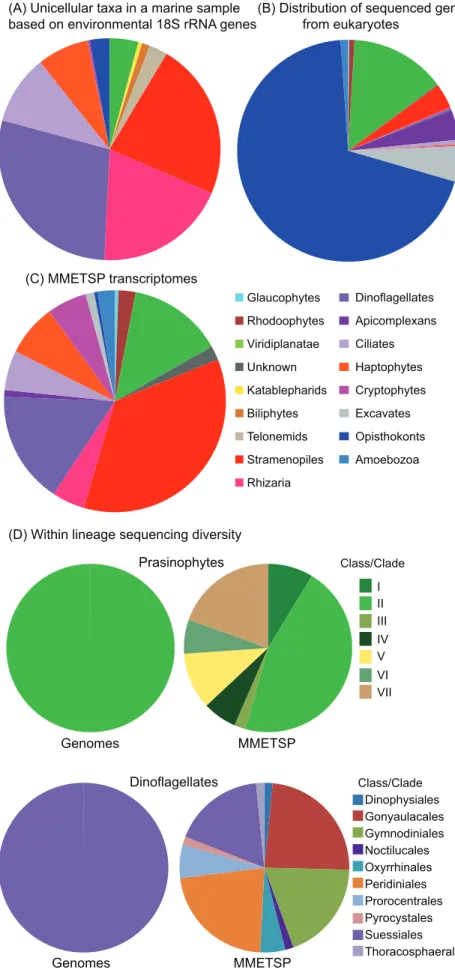
therefore, can be further investigated based on hypotheses derived from the transcriptome data. The project as a whole will go a substantial distance towards fulfilling the two criteria for relevant reference sequences noted above. This is not to say these data solve all our problems: new biases have been intro-duced (see below), and Illumina-based transcriptomes can be challenging to assemble and work with. In addition, there is an apparently universal problem of low levels of contamination—some from other species living with the target organism in culture, others possibly from the process of library construction and sequencing. Im-portantly, however, the taxa from which these data are derived on aggregate conform much more closely to our under-standing of marine eukaryotic diversity from sequence surveys than do the current reference databases, which are the result of ad hoc sequencing priorities that do not fit
(A) Unicellular taxa in a marine sample based on environmental 18S rRNA genes
(B) Distribution of sequenced genomes from eukaryotes
(C) MMETSP transcriptomes
Prasinophytes
Genomes MMETSP
Class/Clade (D) Within lineage sequencing diversity
Dinoflagellates
Genomes MMETSP
Class/Clade VII VI V I II III IV Glaucophytes
Apicomplexans Dinoflagellates
Rhizaria Stramenopiles Telonemids Biliphytes Katablepharids Unknown Viridiplanatae Rhodoophytes
Ciliates
Opisthokonts Excavates Cryptophytes Haptophytes
Amoebozoa
Noctilucales Gymnodiniales Gonyaulacales Dinophysiales
Oxyrrhinales
Suessiales Pyrocystales Prorocentrales Peridiniales
Thoracosphaerales
Figure 1. Comparing the diversity of microbial eukaryotes at one marine site with that represented in genome data and the MMETSP project. (A) Taxon assignments for 930 Small Subunit (SSU) rRNA gene sequences from environmental clone libraries built using DNA from three size fractions in sunlit surface waters of the North Pacific Ocean. Four hundred and five se-quences corresponding to Syndiniales (non-photosynthetic members of the dinoflagellate lineage, often referred to as MALV1 and MALV2) were excluded for visualization pur-poses. Syndiniales are not represented in any complete genome data or the MMETSP, and the vast majority are only known as sequenc-es from uncultivated taxa that often dominate clone libraries [22,31]. Filter size fractions were 0.1 to,0.8mm, 0.8 to ,3mm, and 3 to,20mm. This graph is only intended to give a snapshot of one marine sample; relative distributions vary based on distance from shore and depth, and several studies provide more detailed reviews of available SSU rRNA gene sequence surveys, see e.g., [21,32]. (B) Taxonomic diversity of eukaryotes with complete genome sequences, as sum-marized in the Genomes Online Database (GOLD: http://genomesonline.org). Note that multicellular organisms are included (unlike in A or C); animals, land plants, and multicellular rhodophytes are included in the opisthokont, viridiplantae, and rhodophyte categories, respectively. (C) Taxon breakdown of the MMETSP sequencing project, collapsed at the strain level (for some strains, cells were grown under multiple conditions and these have been counted only once). (D) Compar-ison of currently available complete genomes and MMETSP transcriptomes by Class for two diverse and well-studied groups of algae, prasinophytes [14] and dinoflagellates [15,16]. For both lineages, genomes are broken down by Class on the left and MMETSP transcrip-tomes on the right.
those of marine ecology (Figure 1A–1C). Indeed, digging deeper into the taxonomy of the more abundant and generally better-studied groups such as prasino-phytes [14] and dinoflagellates [15,16] shows this to be true at multiple levels (Figure 1D).
For the MMETSP data to achieve maximum impact, the transcriptomes have been made readily available through the CAMERA [17] Data Distribution Center (http://camera.crbs.ucsd.edu/mmetsp/), in which all MMETSP data have been automatically deposited. In addition, all data is in the Sequence Read Archive (SRA) under BioProject PRJNA231566, giving access to the raw trace data through GenBank. Given that library construction is not as robustly consistent as one might hope and that Illumina RNAseq assembly (in the absence of a sequenced genome) is not a completely solved problem, it is
helpful that all of this work occurred at a single sequencing center where the proto-cols used for the.650 transcriptomes were similar (see Text S1 for a full description of methods). This approach not only broad-ened the types of participating labs (i.e., not just those with experience in genomics) but also maximized comparability of the data-sets without the user feeling obliged to reassemble contigs, or to re-predict protein sequences for consistency. At the same time, the availability through the SRA allows for re-analysis of particular datasets.
More Than a Reference Database
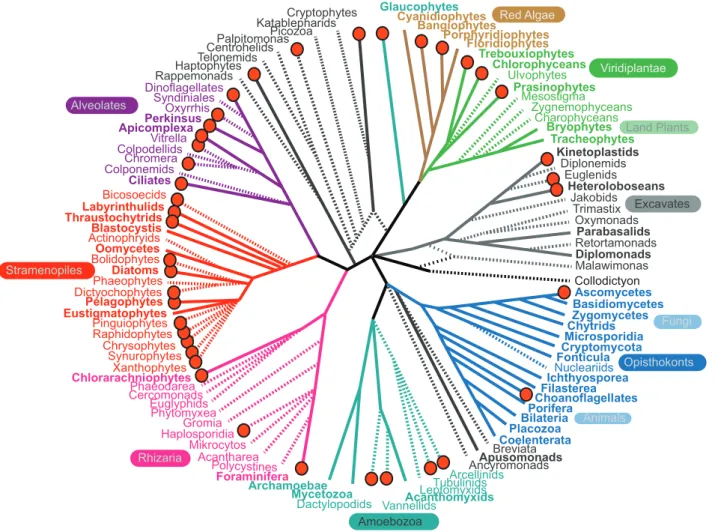
The more than 650 transcriptomes will have far-reaching impact beyond the field of marine science. The diversity of taxa represented in the database is impressive, even when held up to the enormous
diversity of microbial eukaryotes as a whole (Figure 2). In some cases, these data provide the first glimpse of the genome of an important group of microbial eukary-otes, such as parasitic haplosporidia, several amoebozoans, and the enigmatic heterotrophic flagellate Palpitomonas. In other cases, they provide genomic data from a diverse selection of taxa within a lineage where only sparse genomic data previously existed from a few distant relatives (such as the ciliates [18–20]). Experience has shown that such data can transform our understanding of the basic biology and function of these organisms. In the past, we have described a protistan lineage for which there is a single genome sequence as being ‘‘well studied.’’ Thus, even for those that are comparatively ‘‘well studied,’’ the MMETSP data facil-itates new directions. It opens the door to comparative genomics within lineages and between related lineages in major
Malawimonas Jakobids
Acantharea Dinoflagellates
Oxyrrhis Perkinsus Colpodellids Apicomplexa
Chromera Ciliates
Nucleariids Choanoflagellates
Trimastix Retortamonads Oxymonads Diplonemids Kinetoplastids
Heteroloboseans
Parabasalids
Phytomyxea
Foraminifera Gromia
Cercomonads Euglyphids
Polycystines Phaeodarea
Labyrinthulids Thraustochytrids
Bicosoecids Blastocystis
Diatoms Phaeophytes
Chrysophytes Dictyochophytes
Raphidophytes Chytrids
Ascomycetes Basidiomycetes
Cryptomycota Zygomycetes
Fonticula
Porifera Cyanidiophytes
Bangiophytes
Floridiophytes
Chlorarachniophytes
Bilateria Coelenterata Apusomonads Ancyromonads Syndiniales
Glaucophytes
Archamoebae
Breviata
Mycetozoa Tubulinids
Arcellinids
Euglenids Prasinophytes
Bryophytes Charophyceans
Tracheophytes Zygnemophyceans Trebouxiophytes
Ulvophytes Chlorophyceans
Oomycetes
Placozoa Mesostigma Katablepharids
Centrohelids
Cryptophytes
Haptophytes
Picozoa
Telonemids
Collodictyon Bolidophytes
Actinophryids
EustigmatophytesPelagophytes Pinguiophytes Colponemids
Vitrella Rappemonads
Palpitomonas
Diplomonads
Ichthyosporea Filasterea
Leptomyxids Acanthomyxids Vannellids
Dactylopodids Haplosporidia
Amoebozoa
Microsporidia
Mikrocytos
Porphyridiophytes
Rhizaria
Red Algae
Viridiplantae
Alveolates
Stramenopiles
Synurophytes Xanthophytes
Excavates
Opisthokonts
Animals
Fungi Land Plants
Figure 2. A schematic of the major lineages in the eukaryotic tree of life, showing the relationships between lineages for which genomic resources are currently available and those that have been targeted by the MMETSP.Lineages with complete genomes according to the GOLD database, as summarized in [3], are indicated by a solid line leading to that group, whereas lineages with no complete genome are represented by a dashed line. Lineages where at least one MMETSP transcriptome is complete or underway are indicated with a red dot by the name. Major lineages discussed in the text have been named and color-coded, but for clarity, some major lineages have not been labeled. doi:10.1371/journal.pbio.1001889.g002
protistan groups, including foraminifera, cryptophytes, and several groups of red algae and stramenopiles. Digging further, other cases will allow us to ask population genomic-level questions by providing data from multiple strains of a single species (or even asking whether the ‘‘multiple strains’’ do indeed belong to the same species!). Examining the diversity between sister species or members of the same species can help identify functionally important genes, genes under selection, recent gene family expansions and contractions, or other significant changes like horizontal gene transfer—of course, with recognition that absence from a given transcriptome assembly does not necessarily represent absence from the genome. In other cases, the same isolate has been analyzed under different physiological conditions to devel-op testable hypotheses on environmental controls. For example, it should be possible to gain first molecular insights into how photosynthetic algae alter their immediate surroundings, the so-called phycosphere [21], by comparing sequenc-es from the luminsequenc-escent dinoflagellate Lingulodinium polyedrum that is co-cultured with different bacteria, or cultured on its own. Likewise, growth controls and as-pects of niche differentiation should be-come clearer for many major phytoplank-ton groups.
A Fast Start and a Long Way to Go
The MMETSP is a significant step in recognizing that purpose-built reference databases from ecologically key biomes are essential for all domains of life. Nevertheless, it is only the beginning, and important biases remain that should be addressed. The MMETSP relies primarily on cultured organisms, and this introduces a different set of biases, most obviously, favoring organisms that are photosynthetic. Eukaryotic heterotrophs have critical eco-logical roles but are under-represented. Indeed, the natural diversity of eukaryotic heterotrophs is huge in general (Figure 1A), and the four most commonly recovered sequences retrieved in environmental sur-veys of marine samples worldwide corre-spond to lineages for which most members are uncultivated (e.g.,Marine Stramenopiles (MAST) and Marine Alveolates (MALV) [22–24]). These are probably heterotrophs, but we lack a solid biological definition for most of these cells and have become adroit at ignoring heterotrophs in general. Simi-larly, organisms from the open ocean are underrepresented. Culture-independent methods for generating transcriptomes and
genomes and, in some cases, transcrip-tomes and genomes from single cells will be essential to moving beyond this problem. Methodologies for population [25–27] and single-cell genomics and transcriptomics are advancing rapidly [4,28–30], transitioning from techno-logical feats to something we should expect to work routinely. This transition holds great promise for filling the rather substantial gap in our knowledge imposed by uncultivated protists, as well as allowing us to carry out condition-specific analyses of expressed genes in difficult-to-work-with systems. The MMETSP program foreshadows this development by sequenc-ing a small set of culture-independent samples.
The MMETSP dataset serves as an example of how purpose-built reference databases focused on a particular niche or environment can be established relatively quickly and efficiently. This database will allow us to address eukaryotic sequences from nature in a robust manner for the first time. Because the strength of the MMETSP project is precisely its focus on the marine environment, it will not serve as a universal database of eukaryotic diversity that can be easily applied to other environments. While the taxonomic diversity included in the project is amazing (Figure 2), it is also immediately clear that many major groups of eukaryotes are not covered by MMETSP transcriptomes. In some cases, this is because these lineages are not abundant in the oceans (e.g., many excavates), but in others it is simply because members of the lineage are difficult to cultivate and are generally poorly represented in molecular data (e.g., most rhizarians), even if they are abundant and important in the ocean. For other major environments (e.g., freshwa-ter, soil) similar databases could be developed in a focused manner, but all such efforts rely on a detailed knowledge of what lives in that environment, which is not always adequate. To remedy these gaps in our knowledge, we advocate a taxonomy-based approach similar to the Genomic Encyclopedia of Bacteria and Archaea (www.jgi.doe.gov/programs/ GEBA/) [2,4]. This undertaking will require a focus on developing the neces-sary tools for gaining access to the transcriptomes and genomes of unculti-vated organisms and would represent a major advance for all aspects of the study of microbial eukaryotes. We look for-ward to the many creative analyses and results enabled by the MMETSP and the minds of the broader scientific commu-nity; the new insights to be gained in
ecology, physiology, and evolution of unicellular eukaryotes will significantly advance understanding of marine eco-systems and eukaryotic microbial biology as a whole. The MMETSP illustrates the power behind such a community activity and bodes well for a future Genomic Encyclopedia of Microbial Eukaryotes.
Supporting Information
Text S1 The supplementary methods file contains a referenced description of the standardized methods used for tran-scriptome sequencing, assembly, and anal-ysis used for all MMETSP projects. (DOC)
Acknowledgments
MMETSP sequence data is available at NCBI under BioProject PRJNA231566. We are deep-ly grateful to the many technicians, students, post-doctoral scientists, and other collaborators and colleagues who contributed to growing cultures and preparing RNA. The number of people involved in this project at all levels was too great to allow all to be included in the author list, but in recognition of their tremen-dous efforts and their position as part of this community, we would like to thank Suzanne Strom (WWU), Mark Hildebrand (SIO); David Moreira, Purification Lopez Garcia (Universite´ Paris-Sud); Adrian Reyes-Prieto (UNB); Bryn-dan P. Durham, Vanessa Varaljay (UGA); Behzad Imanian, Juan Saldarriaga, Jan Janous-kovec, Greg Gavelis, Naoji Yabuki, Yingchun Gong (UBC); Charles Bachy, Sebastian Sudek, Hank Yu (MBARI); Chloe Deodato (UW); Chris Brown, Christien Laber, Kim Thamatra-koln, Brittany Schieler (Rutgers); Ida Orefice, Deepak Nanjappa (Stazione Zoologica Anton Dohrn); Roberto Sierra (University of Geneva); Rebecca Gast, Virginia Edgcomb, Sheean Haley, Harriet Alexander, David Beaudoin, Robert J. Olson (WHOI); Hollie M. Putnam, Michael P. Lesser (UH); Sheri Floge, Michael Preston (NCMA); Dreux Chappell, Amanda Burke, Gang Chen, Kelly Canesi, Andrea Drzewianowski, Joselynn Wallace, LeAnn Whit-ney, Kerry Whittaker, Amanda Montalbano (URI); Karen Pelletreau, Yunyun Zhuang, Huan Zhang, Yunyun Zhuang, (UCONN); Scott Lawrence (VUW); Min Park (LANL); Behzad Imanian, Jan Janouskovec, Juan Sal-darriaga, Erick James, Greg Gavelis, Thierry Heger, Yoshihisa Hirakawa (UBC); K. Fraser Clark, Adam Acorn, Richard Cawthorn (UPEI); Raffaela M. Abbriano, Javier Paz Yepes, Christine N. Shulse (SIO); Kimberly deLong, Harry Masters (UNC-CH); Tom Savage (CSUS); Kendra Hayashi, Raphael Kudela (UCSC); Marianne Potvin, Andre´ Comeau (U Laval); Ewelina Rubin (SBU); Matthew Ash-worth (UT Austin); Miguel Frada (Weizmann Institute of Science); Sandra Pucciarelli (Uni-versity of Camerino); Dianna L. Berry, Mat-thew J. Harke, Yoonja Kang (SBU); Julia F. Hopkins, Eunsoo Kim, Naoko T. Onodera, Goro Tanifuji, Tommy Harding, Andrew
Roger (Dalhousie University); Wei-Shu Hu (U Minnesota); William Rosado (U Puerto Rico); Jessica Grant, Dan Lahr (Smith College); Robert Molestina (American Type Culture Collection); Fran Van Dolah (NOAA); Anke Stu¨ken, Russell Orr (U. Oslo); Simon Dittami (UiO); Sara Bender, Colleen Durkin, Gwenn Hennon, Julie Koester, Rhonda Morales, Irina Oleinikov, Micaela Parker, Francois Ribalet, Megan Schatz, Helena van Tol (UW); Robert Sanders (Temple); Karla Heidelberg (USC);
Ramiro Logares (ICM, Barcelona); Anke Kremp (SYKE, Finland); Frederic Verret (IMBB); Vittorio Boscaro, Michele Castelli, Graziano Di Giuseppe, Fernando Dini, Gra-ziano Di Giuseppe, Roberto Marangoni, Letizia Modeo (University of Pisa); Ian Probert, Pris-cillia Gourvil, Florence Le Gall (RCC); Marcus V. X. Senra (Federal University of Rio de Janeiro); Federico Buonanno, Claudio Ortenzi (University of Macerata); Susanna Theroux (JGI); Sophie Sanchez-Ferandin (UPMC);
Sheree Yau (CNRS); Philipp Assmy, Sa´ra Beszteri, Fabian Kilpert, Christine Klaas, Jan Meyer (AWI); Gurjeet Kohli (UTS); Sarah D’Adamo, Robert Jinkerson, Huiya Gu (CSM). We also thank the Gordon and Betty Moore Foundation for supporting the growth and preparation of a subset of strains through the National Center for Marine Algae and Microbiota and funding sequencing, assembly, and preliminary annotation at the National Center for Genome Resources.
References
1. Worden AZ, Allen AE (2010) The voyage of the microbial eukaryote. Curr Opin Microbiol 13: 652–660.
2. Wu D, Hugenholtz P, Mavromatis K, Pukall R, Dalin E, et al. (2009) A phylogeny-driven genomic encyclopaedia of Bacteria and Archaea. Nature 462: 1056–1060.
3. Burki F, Keeling PJ (2014) Rhizaria. Curr Biol 24: R103–107.
4. del Campo J, Sieracki ME, Molestina R, Keeling PJ, Massana R, et al. (2014) The others: our biased perspective on eukaryotic genomes. Trends Ecol Evol 29: 252–259.
5. Armbrust EV, Berges JA, Bowler C, Green BR, Martinez D, et al. (2004) The genome of the diatomThalassiosira pseudonana: ecology, evolution, and metabolism. Science 306: 79–86. 6. Derelle E, Ferraz C, Rombauts S, Rouze P,
Worden AZ, et al. (2006) Genome analysis of the smallest free-living eukaryote Ostreococcus tauri unveils many unique features. Proc Natl Acad Sci U S A 103: 11647–11652.
7. Palenik B, Grimwood J, Aerts A, Rouze P, Salamov A, et al. (2007) The tiny eukaryoteOstreococcusprovides genomic insights into the paradox of plankton speciation. Proc Natl Acad Sci U S A 104: 7705–7710. 8. Bowler C, Allen AE, Badger JH, Grimwood J, Jabbari K, et al. (2008) ThePhaeodactylumgenome reveals the evolutionary history of diatom ge-nomes. Nature 456: 239–244.
9. Worden AZ, Lee JH, Mock T, Rouze P, Simmons MP, et al. (2009) Green evolution and dynamic adaptations revealed by genomes of the marine picoeukaryotesMicromonas. Science 324: 268–272. 10. Gobler CJ, Berry DL, Dyhrman ST, Wilhelm
SW, Salamov A, et al. (2011) Niche of harmful alga Aureococcus anophagefferens revealed through ecogenomics. Proc Natl Acad Sci U S A 108: 4352–4357.
11. Nichols SA, Roberts BW, Richter DJ, Fairclough SR, King N (2012) Origin of metazoan cadherin diversity and the antiquity of the classical cadherin/beta-catenin complex. Proc Natl Acad Sci U S A 109: 13046–13051.
12. Curtis BA, Tanifuji G, Burki F, Gruber A, Irimia M, et al. (2012) Algal genomes reveal evolution-ary mosaicism and the fate of nucleomorphs. Nature 492: 59–65.
13. Read BA, Kegel J, Klute MJ, Kuo A, Lefebvre SC, et al. (2013) Pan genome of the phytoplank-ton Emiliania underpins its global distribution. Nature 499: 209–213.
14. Marin B, Melkonian M (2010) Molecular phy-logeny and classification of the Mamiellophyceae class. nov. (Chlorophyta) based on sequence comparisons of the nuclear- and plastid-encoded rRNA operons. Protist 161: 304–336. 15. Fensome RA, Taylor FJR, Norris G, Sarjeant
WAS, Wharton DI, et al. (1993) A classification of living and fossil dinoflagellates. Hanover (Penn-sylvania): Sheridan Press. 351 p.
16. Saldarriagaa JF, Taylor FJR, Cavalier-Smith T, Menden-Deuer S, Keeling PJ (2004) Molecular data and the evolutionary history of dinoflagel-lates. Eur J Protist 40: 85–111.
17. Sun S, Chen J, Li W, Altintas I, Lin A, et al. (2011) Community cyberinfrastructure for Ad-vanced Microbial Ecology Research and Analysis: the CAMERA resource. Nucleic Acids Res 39: D546–D551.
18. Aury JM, Jaillon O, Duret L, Noel B, Jubin C, et al. (2006) Global trends of whole-genome dupli-cations revealed by the ciliateParamecium tetra-urelia. Nature 444: 171–178.
19. Eisen JA, Coyne RS, Wu M, Wu D, Thiagarajan M, et al. (2006) Macronuclear genome sequence of the ciliate Tetrahymena thermophila, a model eukaryote. PLoS Biol 4: e286.
20. Swart EC, Bracht JR, Magrini V, Minx P, Chen X, et al. (2013) TheOxytricha trifallaxmacronuclear genome: a complex eukaryotic genome with 16,000 tiny chromosomes. PLoS Biol 11: e1001473. 21. Amin SA, Parker MS, Armbrust EV (2012)
Interactions between diatoms and bacteria. Mi-crobiol Molec Biol Rev 76: 667–684. 22. Massana R, Pedros-Alio C (2008) Unveiling new
microbial eukaryotes in the surface ocean. Curr Opin Microbiol 11: 213–218.
23. Guillou L, Viprey M, Chambouvet A, Welsh RM, Kirkham AR, et al. (2008) Widespread occurrence and genetic diversity of marine parasitoids belonging to Syndiniales (Alveolata). Environ Microbiol 10: 3349–3365.
24. Lopez-Garcia P, Rodriguez-Valera F, Pedros-Alio C, Moreira D (2001) Unexpected diversity of small eukaryotes in deep-sea Antarctic plankton. Nature 409: 603–607.
25. Cuvelier ML, Allen AE, Monier A, McCrow JP, Messie´ M, et al. (2010) Targeted metagenomics and ecology of globally important uncultured eukaryotic phytoplankton. Proc Nat Acad Sci U S A 107: 14679–14684.
26. Monier A, Welsh RM, Gentemann C, Weinstock G, Sodergren E, et al. (2012) Phosphate transporters in marine phytoplankton and their viruses: cross-domain commonalities in viral-host gene exchanges. Environ Microbiol 14: 162–176.
27. Vaulot D, Lepere C, Toulza E, De la Iglesia R, Poulain J, et al. (2012) Metagenomes of the picoalga Bathycoccus from the Chile coastal upwelling. PLoS ONE 7: e39648.
28. Cameron Thrash J, Temperton B, Swan BK, Landry ZC, Woyke T, et al. (2014) Single-cell enabled comparative genomics of a deep ocean SAR11 bathytype. ISME J. E-pub ahead of print. doi:10.1038/ismej.2013.243
29. Rinke C1, Schwientek P, Sczyrba A, Ivanova NN, Anderson IJ, et al. (2013) Insights into the phylogeny and coding potential of microbial dark matter. Nature 499: 431–437.
30. Wu AR, Neff NF, Kalisky T, Dalerba P, Treutlein B, et al. (2014) Quantitative assessment of single-cell RNA-sequencing methods. Nat Methods 11: 41–46. 31. Massana R, Karniol B, Pommier T, Bodaker I, Beja O (2008) Metagenomic retrieval of a ribosomal DNA repeat array from an uncultured marine alveolate. Environ Microbiol 10: 1335– 1343.
32. Not F, Gausling R, Azam F, Heidelberg JF, Worden AZ (2007) Vertical distribution of picoeukaryotic diversity in the open ocean. Environ Microbiol 9: 1233–1252.