Sharif University of Technology
Scientia IranicaTransactions D: Computer Science & Engineering and Electrical Engineering www.scientiairanica.com
SCW+: A service-oriented framework for cloud
workow systems
M. Torkashvan and H. Haghighi
Department of Computer Science and Engineering, Shahid Beheshti University G. C., Tehran, P.O. Box 1983963113, Iran. Received 22 October 2014; received in revised form 16 August 2015; accepted 14 December 2015
KEYWORDS Cloud workow; Cloud computing; Cloud framework.
Abstract. Cloud workow is a special type of cloud computing systems which mainly concentrates on workow management. One of the major issues with cloud workow systems is automatic multi-cloud workow management. This paper proposes a service oriented framework for cloud workow management which integrates heterogeneous multi-cloud platforms to provide integrated applications for users by minimizing the human intervention as far as possible. The proposed framework involves a language to dene some basic entities for environments and uses these denitions to integrate applications and services in a cloud workow. This framework has already been implemented. In addition, its main operations have been evaluated by a case study and the results show that the framework works properly as a cloud integrator and main activities of the framework are done automatically with a reasonable performance.
© 2016 Sharif University of Technology. All rights reserved.
1. Introduction
There are some types of service platforms which facili-tate the execution of distributed applications like work-ow management systems. A workwork-ow management system denes, manages, and executes workows on computing resources [1]. According to this denition, there can be many platforms as computing resources, such as grid computing [2] and cloud computing, to run workow management systems. Cloud workow systems are those workow management systems which are executed based on cloud computing as their un-derlying infrastructure. When the unun-derlying layer consists of more than one cloud provider, the notion of multi-cloud workow management emerges.
Although some cloud workow platforms have been introduced, one of the main issues in this eld is still heterogeneous multi-cloud workow management.
*. Corresponding author. Tel.: +98 21 29904190; E-mail addresses: [email protected] (M. Torkashvan); h [email protected] (H. Haghighi)
Heterogeneity in this context refers to dierent cloud platforms serving as a unied platform from dierent cloud providers, that is, each of these cloud platforms can advertise dierent services, and thus, a particular user may need a workow whose atomic services are spread across various cloud platforms. Another issue in workow management systems is to reduce the human intervention. While some existing systems do not need human intervention in their managerial operations, they are not practicable enough to be used by end users (i.e., they need skilled users to dene ontologies, entities, and some other parts related to the workow management). In order to conquer the aforementioned issues and, in other words, to provide an easy-working and heterogeneous multi-cloud workow management with the least possible human intervention, this paper proposes a service-oriented framework for cloud work-ows. This framework is named SCW+ that stands for Service-oriented Cloud Workow + Ontology and Semantic web.
SCW+ is a framework with ve essential layers each having access to the provided services from its
1196 M. Torkashvan and H. Haghighi/Scientia Iranica, Transactions D: Computer Science & ... 23 (2016) 1195{1216
lower layer. To achieve the goals of SCW+, this paper denes one environment for each customer of SCW+ (although some customers may share their environ-ments). Each environment has four major entities: Event, Task, Abstract service, and Concrete service operation. SCW+ utilizes an ontology language, which is called ETAS (Event, Task, and Abstract Service), for dening these entities and their relationships. ETAS provides a unied language and ontology for SCW+ which helps SCW+ to step toward unifying heteroge-neous service provider as its underlying layer.
The rest of this paper is organized as follows: Section 2 discusses the related work; Section 3 shows an abstract view of SCW+; Section 4 gets deep into the most signicant layer of SCW+; Section 5 provides some descriptions about the implementation of SCW+; Section 6 evaluates SCW+; Section 7 gives a comparison of SCW+ with other similar platforms; and nally Section 8 concludes the paper.
2. Related work
A lot of works have been done in the context of workow management and its related areas, such as service composition and semantic web services. On the other hand, there are some cloud platforms which support workow management. In this section, some backgrounds on service composition and workow management are introduced, and then some cloud platforms, which support workow management, are reviewed.
With the emergence of SOA (Service Oriented Architecture) [3], many workow applications have been implemented using web services. One of the main benets of SOA is reusing services; semantic web [4,5] has improved reusability by accessing the content of web services. Some languages, such as WSDL-S [6] and SA-WSDL [7], have enriched WSDL through semantic concepts; also, some descriptive languages, such as OWL-S [8], WSMO [9], and SWSO [10], have provided a semantic description based on IOPE (Input, Output, Precondition, and Eect). Since web service composition is needed to execute business processes and workows, various languages have been designed to support service composition, such as BPMN [11], WFF [12,13], BPEL [14], XLANG [15], WSFC [12,13], and YAWL [16]; they are used by various workow management systems and service composition frame-works.
SODIUM [17] and OPUCE [18] introduce two frameworks including a set of languages and tools needed for creating and executing business processes based on heterogeneous services. Unfortunately, using these frameworks, business process modeling is done manually. There are some other frameworks, such as SOA4ALL [19], MashArt [20], CRUISe [21], and
MacroFlow [22], for service orchestration and workow execution. The main problem with SOA4ALL is that input/output is dened manually through data ow models; MashArt, CRUISe, and MacroFlow all support dynamic service composition, but none of them support multi-provider service composition.
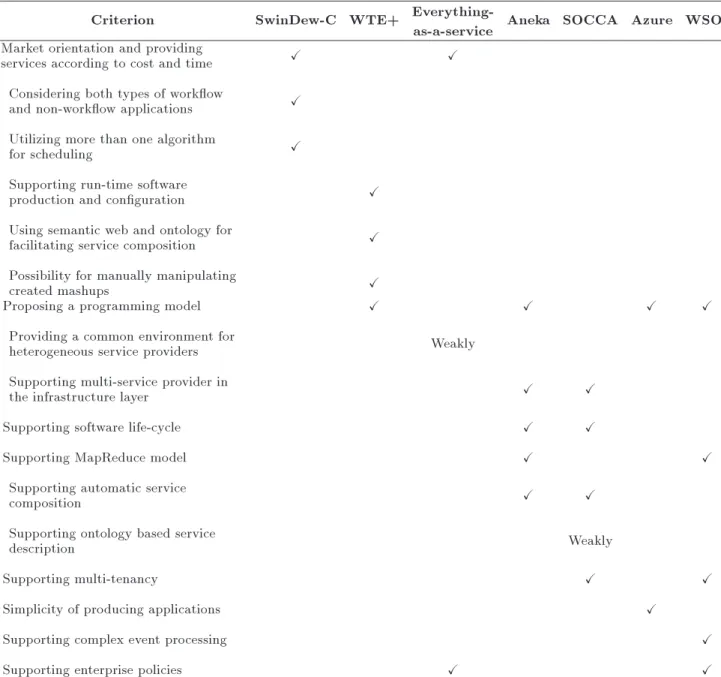
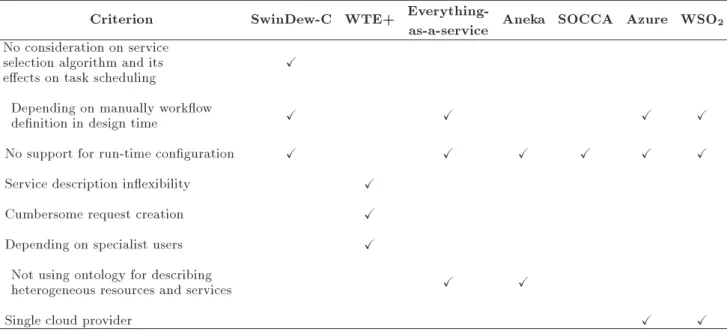
In this section, we have compared SCW+ with ve other cloud platforms: SwinDew-C [23], WTE+ [24], Everything-as-a-service platform [25], Aneka [26-28], and SOCCA [29]. There are other known cloud platforms which support workow management, such as Microsoft Azure and WSO2 Stratos. Tables 1 and 2 show the main strengths and weaknesses of the mentioned platforms, respectively. The meanings behind the given items or criteria (from both tables) are explained here:
Market orientation and providing services according to cost and time: Cost and time are the most important parameters for selecting services which make a platform market-oriented. For ex-ample, according to the user request, a platform may select a composition of services with the lowest possible price;
Considering both types of workow and non-workow applications: Some applications have one or more specied workows which can be per-formed by the composition of web services; on the other hand, some other applications do not have specic service-based workows and they perform some duties in a functional manner;
Utilizing more than one algorithm for scheduling: There are many options for selection of the underlying web services so as to compose and execute the nal workow. This item refers to the platforms which do not rely on only one algorithm for service selections;
Supporting run-time software production and conguration: This item addresses the platforms which give users the ability to dene workows dynamically and add new functionality (or congure an existing functionality) in their systems during runtime;
Possibility for manually manipulating the created mashups: Since a mashup consists of some services in a proper manner to perform a specic job, in some platforms there is a facility for users to change these mashed-up services or the way the services are related to each other;
Proposing a programming model: Does the platform prefer a new programming model or it just needs the developers use the platform APIs and deploy their applications?
Providing a common environment for hetero-geneous service providers: This item species if
Table 1. Cloud platform strengths.
Criterion SwinDew-C WTE+
Everything-as-a-service Aneka SOCCA Azure WSO2 Market orientation and providing
services according to cost and time X X
Considering both types of workow
and non-workow applications X Utilizing more than one algorithm
for scheduling X
Supporting run-time software
production and conguration X
Using semantic web and ontology for
facilitating service composition X
Possibility for manually manipulating
created mashups X
Proposing a programming model X X X X
Providing a common environment for
heterogeneous service providers Weakly
Supporting multi-service provider in
the infrastructure layer X X
Supporting software life-cycle X X
Supporting MapReduce model X X
Supporting automatic service
composition X X
Supporting ontology based service
description Weakly
Supporting multi-tenancy X X
Simplicity of producing applications X
Supporting complex event processing X
Supporting enterprise policies X X
a platform provides a common (shared) environment for some service providers so as to integrate them;
Supporting multi-service provider in the in-frastructure layer: It species whether a cloud framework uses other clouds to provide the service composition or not. Then, it shows that the cloud framework can act as a cloud integrator;
Supporting software lifecycle: This parameter species if a cloud framework can support the entire software development lifecycle (analysis, architec-ture, design, implementation, test, and deploy-ment);
Supporting map-reduce model: This item refers to a platform that provides users with a built-in
map-reduce infrastructure (such as Hadoop) such that the users can develop applications interacting with this infrastructure;
Supporting automatic service composition: Does the platform compose services automatically or it needs the user to select them?
Supporting ontology-based service descrip-tion: This parameter usually appears in cloud frameworks, which provide service composition au-tomatically, and species whether the cloud frame-work regards some semantic data in web service de-scription. This data, which can appear as ontologies, facilitates the process of service composition;
com-1198 M. Torkashvan and H. Haghighi/Scientia Iranica, Transactions D: Computer Science & ... 23 (2016) 1195{1216
Table 2. Cloud platform weaknesses.
Criterion SwinDew-C WTE+
Everything-as-a-service Aneka SOCCA Azure WSO2 No consideration on service
selection algorithm and its
eects on task scheduling X
Depending on manually workow
denition in design time X X X X
No support for run-time conguration X X X X X X
Service description inexibility X
Cumbersome request creation X
Depending on specialist users X
Not using ontology for describing
heterogeneous resources and services X X
Single cloud provider X X
mon resources by dierent users and providing isolation for these users;
Supporting complex event processing: Event processing is the analysis of information streams [30] and concluding from them. CEP (Complex Event Processing) is an event processing that combines data from multiple sources [31] to infer patterns that suggest more complicated situations to identify meaningful events [32] and respond to them as quickly as possible. This characteristic species whether the cloud framework supports CEP or not;
Supporting enterprise policies: Does the plat-form consider (and have the ability to dene) user (or enterprise) policies so as to aect the service selection process?
No consideration for service selection algo-rithm and its eects on task scheduling: This item refers to the platforms that do not have any specic strategy for service selection and the user marshals services, together, manually;
Dependence on manual workow denition in design time: In service-oriented software develop-ment processes (like SOMA), service composition is usually addressed in design time and, in most of the cases, this is done manually. Many platforms strongly depend on this type of service composition;
No support for run-time conguration: This item addresses the platforms which do not give users the ability to add new functionality (or congure an existing functionality) in their systems during runtime (in opposite to the \Supporting run-time software production and conguration" item);
Service description inexibility: Many of the platforms rely only on one or some specic service description languages (like WSDL); this item refers to platforms that are not exible in service descrip-tions and can just accept some specic languages;
Cumbersome request creation: In some plat-forms, the user (or the client-side application) needs to generate a request in a complex manner (like SOAP protocol) so as to trigger a workow, whereas there are other platforms by which the user can trigger a workow only through a simple message;
Dependence on specialist users: Normally, service composition is not a common job for anyone to do and it should be performed by a software engineer with a great background and experience; after that, the process of system maintenance (like service/workow conguration) must be done by these engineers. In this way, many platforms need system engineers to interact with each other, which are addressed by this item. It is not a weakness per se; yet, in comparison to the platforms that attempt to automatize most parts of the service composition (in design-time and even run-time), such as service selection and work ow generation, it can be referred to as a weakness;
Not using ontology for describing heteroge-neous resources and services: This item is in opposition to the mentioned \Supporting ontology-based service description" item in the strength criteria;
Single cloud provider: In opposite to the men-tioned \Supporting multi-service provider in the infrastructure layer" item in the strength criteria;
Simplicity of producing applications: This item refers to platforms that provide a simple programming model for the developers. In these platforms, developers can focus on the main con-cerns and they are not supposed to be worried about messaging, communicating with services, triggering the workows, and so forth.
Remarks:
1. \Providing a common environment for heteroge-neous service providers" is considered \weak" for \Everything-as-a-service" because it has not men-tioned any details about service level and task level scheduling algorithm;
2. \Supporting ontology-based service description" is considered \weak" for \SOCCA" because it has not mentioned its utilized ontology language;
3. \Service description inexibility" is considered for \WTE+" because it merely depends on OWL-S. In addition, \Depending on specialist users" is considered for \WTE+" because describing services through OWL-S needs special skills;
4. \Cumbersome request creation" is considered for \WTE+" because its messages should be in the XML format.
Considering strengths and weaknesses of the related work, the main goal of SCW+ is to integrate het-erogeneous cloud platforms while diminishing the need for skilled users and human agent involvement (through providing automatic workow management). So, SCW+ is aimed as a framework for cloud workow with the following strength points:
Multi-cloud support;
Automatic service composition (with considering QoS) through a special service-level scheduling al-gorithm;
Automatic task workow design;
Supporting enterprise policies;
Complex event processing support;
Ontology-based entity description;
No mere dependency on a particular service descrip-tion;
Ease of work in user-side.
SCW+ has also some weaknesses which are as follows (we try to overcome them in our future work):
No support for map-reduce programming;
Proposing a special task-level scheduling algorithm;
No support for multi-tenancy in the resource level.
3. SCW+
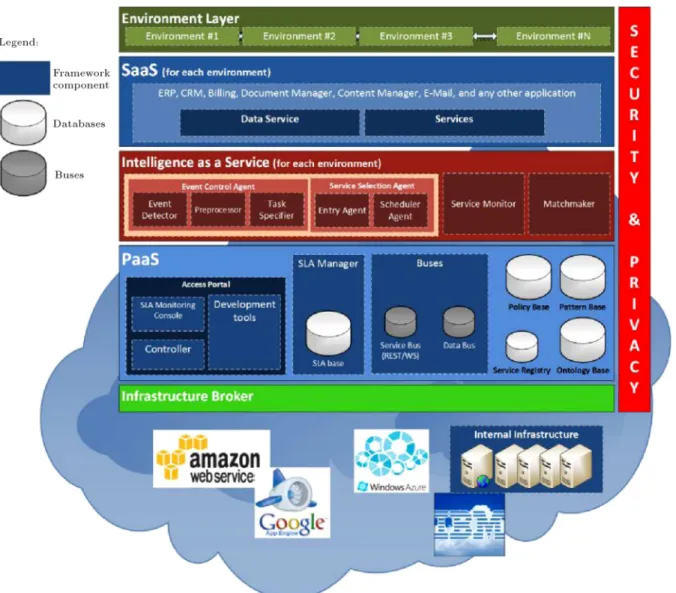
Since SOA is an appropriate approach to develop cloud-based software applications [30], this paper proposes SCW+ as a service-oriented framework for cloud work-ow management systems. Inputs for SCW+ are dened as events: Every occurrence in the environment will be sent to SCW+ as an event and will be pro-cessed according to event processing denitions [31,32]. SCW+ proposes four essential entities (Figure 1) for each enterprise or environment on which the cloud is deployed: Event, Task, Abstract service, and Concrete service operation. These entities are dened for the system through ontology; they help the system to nd what tasks can meet the goals of an event and what abstract services can meet the goals of a task. Finally, a concrete service composition will be generated to provide actual results. An abstract service is the container of concrete service operations which realize the functionality of that abstract service. We propose an ontology and XML-based language to describe all of the mentioned entities. This language is named ETAS (stands for Event, Task, and Abstract Service) and is described in [33].
3.1. SCW+ layers
This section discusses dierent layers of SCW+. In ad-dition to three conventional layers, i.e. Infrastructure-as-a-Service (IaaS), Platform-Infrastructure-as-a-Service (PaaS), and Software-as-a-Service (SaaS), SCW+ proposes two novel layers, named INtelligence-as-a-Service (INaaS) layer and Environment layer.
3.1.1. Environment layer
This is the topmost layer in SCW+ which provides an abstract environment for the users of its underlying layers. Each customer has at least one environment, but more than one customer may have a common environment. An environment may be an enterprise, a cloud, or any external application. The only matter is that the administrator must dene connection channels between environments. The only communication path among dierent clouds and costumers is via environ-ments; each environment can access the entities of another cloud (such as services, tasks, etc.) through the environment of that cloud if permitted.
The data which can be interchanged between two environments depends on the type of environments. For instance, if both environments are clouds which have been built based on SCW+, all entities can be interchanged between environments (if permitted); however, if one of them is based on some other cloud platform (such as Azure), or it is an external application or enterprise, it is possible to access its service repository and extract its web services (service extraction is the responsibility of the Service Monitor component that will be described later).
1200 M. Torkashvan and H. Haghighi/Scientia Iranica, Transactions D: Computer Science & ... 23 (2016) 1195{1216
Figure 1. SCW+ architecture.
3.1.2. SaaS layer
In this layer, environments can access web services and data services. Every application such as ERP, CRM, and SCM can be utilized by the user through this layer. The abstraction level which is provided through the environment layer along with this layer realizes multi-tenancy characteristic for SCW+ in the application (service) level (since more than one costumer can have common environments and utilize the software and re-sources in those environments), but not in the resource level (because we do not focus on resource sharing and isolation). Software systems in this layer are web-based and can be implemented by any programming language. The only requirement is that the developer must use a user development kit which proposes an event-driven programming model to connect to the cloud and invoke events. Events occur through this layer and are sent to the lower layer (INaaS) to be processed.
3.1.3. INaaS layer
This layer is the heart of SCW+ and performs the main functionality of SCW+ described before. Therefore, INaaS is in charge of automatizing the procedure of mapping goals to the composed services. The main portion of this paper is to describe how INaaS does this job.
3.1.4. PaaS layer
This layer provides services and tools which are re-quired to develop software systems. PaaS provides users with a graphical interface to connect to their environments and dene events, event relationships and transformations, tasks, goals, policies, SLAs, and so forth. Signicant components in PaaS are as follows: To refuse repetitive operations, Pattern Base is a repository which helps Event Control and Service Selection Agents (in INaaS) to remember the last task or service composition which has been selected for a particular event. Service base stores a list
of existing concrete web services and their related properties supposed to be extracted by Service Monitor (in INaaS). Ontology base is the place where goals, categories, events, tasks, abstract services, and their relationships are maintained. SLA Manager works based on CSLA (Cloud Service Level Agreement) framework described in [34]; SLA base stores the agreed documents between consumers and providers about service level agreements. There are also two types of buses: service bus and data bus. The data bus is used by internal components when they need to access some data from the existing bases; the service bus can be used by both internal components and external users to utilize the existing services. Access Portal interacts with privileged users directly; it provides abilities to develop services, congure SLAs, dene events and tasks, and provide monitoring information and SLA denitions.
3.1.5. Interface broker
This layer stands on virtual machines and infrastruc-ture resources to provide a virtual access to resources. Requests to access low-level resources, such as web services, les, and databases, are sent to this layer. A request will be compiled according to the target infrastructure type (e.g., IBM cloud and Amazon EC2) and the result will be sent to the requester (i.e., the layer component which has triggered the request). Requests are sent to the broker from PaaS which itself receives requests from INaaS; INaaS requests are triggered by events from SaaS. There is not an IaaS layer in SCW+, because instead of dedicating a particular layer SCW+, along with its infrastructure broker, is designed in a way that it can use any other clouds or infrastructures as the physical layer.
3.2. XML-based languages
Two XML-based languages, i.e. ETAS and BEF, used in INaaS layer, are introduced. The main purpose of ETAS is to dene business entities from the highest level to the lowest one; and BEF (Business Entity Flow) is an XML-based language whose main purpose is to describe a composition of business entities (generated automatically). The entire INaaS layer acts as a knowledge management system (including an ontolog-ical model and an inference mechanism) in a way that ETAS and BEF are the ontological descriptions of the environment, and the main operational components of INaaS (Section 4) form the inference part of the system. We have used an ontological model because the main job of the system is to nd out which services can make a \good" t for the intended goal of the user. The \goodness" can be decided based on the price, time, or any other user's objective of the selected services; ETAS and BEF both provide the INaaS layer components with the required data so as to make a
proper decision. In [33] we have elaborated on ETAS and BEF in more depth.
3.3. Dynamic view on SCW+
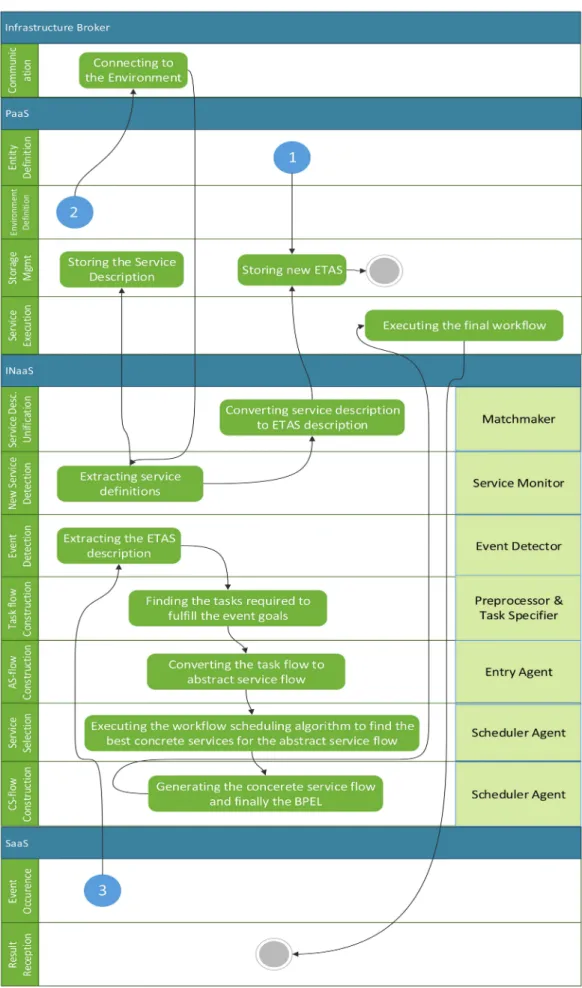
SCW+ has a general view on everything that can pro-vide services, such as other cloud services, applications, enterprises, and so forth. Therefore, Infrastructure Broker provides the communication with these dierent environments. There are many managerial operations such as workow denition, service denition, SLA denition, event denition, monitoring the operations, and so forth which are provided for cloud users with dierent access limitations in the PaaS layer. SCW+ is event-driven, that is events which are dened in the PaaS layer may occur in the user-side, and served by SCW+ in the server-side. Responding to events starts from the INaaS layer to construct proper work-ows for the occurred events by Event Control Agent; then, SCW+ selects appropriate services to execute the constructed workows by Service Selection Agent. INaaS continuously searches for new services in the dened environments by Service Monitor component and attempts to convert descriptions of the found services into the unied service description languages of SCW+ by matchmaker component. These unied languages provide the ability for SCW+ to manage services from dierent cloud providers. SaaS layer is the most concrete layer in SCW+ which contains the applications that are using services from SCW+ provider. These applications are typically workow-based and trigger events which are served by the INaaS layer. The topmost layer is called Environment layer which provides a logical view for each dierent dened environment to have its own view on SCW+ and its applications. Figure 2 shows the main activities in SCW+ such as event denition, service monitoring, matchmaking, event detection, service selection, and execution.
Note that in Figure 2, AS-ow refers to abstract service ow and CS-ow refers to concrete service ow. Figure 2 depicts three main scenarios in SCW+, which are numbered from 1 to 3, on the point where they start (The numbered circles refer to the number of dierent scenarios at the start point.) Scenario 1 refers to entity denition by the user (mainly, administrator users); to do so, the user works with utilities provided in PaaS layer to dene the entities and PaaS stores them on ontology base. Scenario 2 refers to environment denition and what happens after that. It shows that SCW+ connects to the dened environments through its infrastructure broker, then the service monitor component tries to nd new service descriptions from those environments to store them in service repository (in PaaS) and convert them into ETAS description and store them on ontology base. Scenario 3 shows what happens when an event occurs in SaaS layer from behalf
1202 M. Torkashvan and H. Haghighi/Scientia Iranica, Transactions D: Computer Science & ... 23 (2016) 1195{1216
Figure 3. A sample of e-touring company.
Figure 4. E-tour company workow.
of an application. It shows that when INaaS detects an event, it tries to extract ETAS description of the event and, according to its goals, SCW+ nds the required tasks, abstract service ow, concrete service ow, and so forth to provide the appropriate results for the occurred event.
3.4. Running example
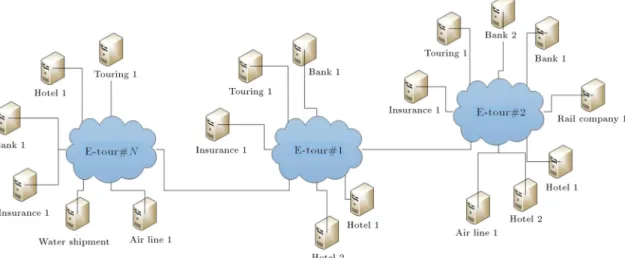
In the remaining of the paper, we get deep into INaaS layer and follow its dierent components and concepts along with a real world case to elucidate them. The case is an e-touring company with so many customers. This company is connected to many other touring companies to coordinate tours in dierent places; it, also, is in connection with many hotel and restau-rant services. This company uses various banking services to do nancial operations. In addition, it is in relation with many road traveling companies, airlines, shipment companies, and rail road companies to transfer passengers. If it is required to post any document, the company communicates with dierent
post companies. Finally, the company may need some insurance services. Obviously, there are many connections and services from many service providers to plan a tour for customers (Figure 3). The tour planning workow is depicted in Figure 4.
4. Elaborating on INaaS layer
Figure 5 shows the components of INaaS and the relationships among them. INaaS consists of four main components: Event Control Agent, Service Selection Agent, Service Monitor, and matchmaker. Table 3 represents the operations of INaaS.
The input for INaaS is provided through Event Detector (from Event Control Agent). Steps 1 and 2 are done by Task Specier. Step 3 is done by Entry Agent (from Service Selection Agent) and Sched-uler Agent. Entry Agent performs Step 4. In the proceeding, Service Monitor will be discussed rst. Then, matchmaker, Event Control Agent, and Service Selection Agent will be elaborated; however, an overall
1204 M. Torkashvan and H. Haghighi/Scientia Iranica, Transactions D: Computer Science & ... 23 (2016) 1195{1216
Figure 5. INaaS architecture. Table 3. INaaS operations. INaaS operation
Input: Event occurrence from the user side, ontology base
Output: BPEL le with the most suitable composition of services to gain the nal result
INaaS operations
Step 1: A list of tasks is gathered that have the same goals and categories in comparison to the occurred event (the ontology base is searched for).
Step 2: A BEF le is made for each of the above tasks according to its preconditions and eects.
Step 3: Regarding all tasks, the most suitable abstract service composition is selected and described by a BEF. Step 4: The BEF description of the selected abstract service
composition is converted to a BPEL le.
overview of INaaS components can be found in the following:
INaaS: Generating a BPEL with the most suitable composition of services for an occurred event;
{ Service monitor: Extracting web services (and their operations) from connected environments;
{ Matchmaker: Finding or creating an abstract service for each extracted web service operation;
{ Event Control Agent: Generating task level BEFs which fulll an occurred event;
* Event detector: Receiving an event, search-ing in pattern base if there is a BEF for that
event or not, and executing event precondi-tions;
* Task specier: Finding tasks that fulll an occurred event and generating task level BEFs for them;
* Preprocessor: Executing preprocesses of an occurred event.
{ Service Selection Agent: Mapping the found task level BEFs into abstract service composi-tions (described via abstract service level BEFs), selecting the most suitable service composition, and generating its corresponding BPEL le;
* Entry agent: Selecting the most suitable abstract service composition and mapping it into a BPEL le;
* Scheduler agent: Mapping a task level BEF into an abstract service composition.
4.1. Service monitor
The Service Monitor and matchmaker components facilitate the integration of heterogeneous service providers. The main purpose of Service Monitor is to extract web services which are dened in other connected environments. These services along with
their needed information (input, output, service goal, service category, service precondition, service eect, QoS information, and price) will be sent to matchmaker to be assigned to an appropriate abstract service. Op-erations of the Service Monitor component are shown in Table 4.
There is no constraint for the service description language (it can be WSDL, WSDL-S, SA-WSDL, OWL-S, and WSMO) and Service Monitor extracts the needed information according to the type of descrip-tion. Table 5 shows what information can be extracted from a service description.
After extracting the required information, it will be sent to the matchmaker component which is de-scribed in the next subsection.
4.2. matchmaker component
This component benets from an algorithm that is used for generating abstract services. As mentioned before, an abstract service contains a group of web service operations with the same functionality; nd-ing or creatnd-ing suitable abstract services for concrete web service operations is the main purpose of the matchmaker algorithm. matchmaker does its duty by
Table 4. Service monitor operations. Service monitor operations Input: Web service description
Output: Set of (input, output, goal, category, precondition, eect, QoS, price) As a service is found (from
the connected environments) by service monitor
Step 1: Required information finput, output, goal, category, precondition, eect, QoS, priceg is extracted according to the type of service description. Step 2: The extracted information is sent to matchmaker Table 5. Extractable information from web service descriptions.
Required information Web service description parts Input Web service data contract
Output Web service data contract
Goal
When there is not enough annotation (such as WSDL): name of the service operation in the web service operation contact
It is particularly specied when there is enough annotation (such as OWL-S)
Category When there is not enough annotation (such as WSDL): name of the web service It is particularly specied when there is enough annotation (such as OWL-S) Precondition It is specied if the language is IOPE-based (such as OWL-S and WSDL-S) Eect It is specied if the language is IOPE-based (such as OWL-S and WSDL-S) QoS QoS data elds are addressed either directly in the description or its annotation Price Price is addressed either in the description or in the annotation
1206 M. Torkashvan and H. Haghighi/Scientia Iranica, Transactions D: Computer Science & ... 23 (2016) 1195{1216
Table 6. Matchmaking algorithm operations. matchmaker algorithm
Input: Service operation (input, output, goal, category, precondition, eect, QoS, price) Output: An abstract service
As the input is received
Step 1: A list of existing abstract services is gathered. Step 2: An abstract service with the same or similar goal,
category, precondition and eect as input values is found; if not found, a new abstract service is created. Step 3: Service operation name is appended to the set of concrete
services of the found/created abstract service.
Step 4: Service operation input parameters are added to the abstract service input set, and service operation output parameters are added to the abstract service output set.
Step 5: The Min SLA parameter eld of the abstract service is modied (if needed).
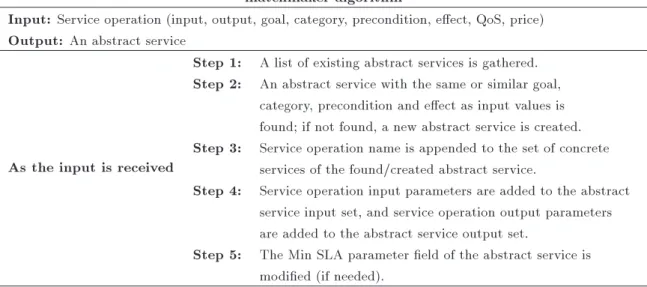
receiving input, output, goal, category, precondition, eect, QoS, and price information related to a service operation. Table 6 shows the main operation of the matchmaker algorithm.
A summary of the matchmaker algorithm is de-picted in Figure 6. Suppose that AS is an Abstract Service and I is the received concrete service operation. AS will be selected as a matched abstract service if:
SimilarityOf(I:Category; AS:Category) = 1:0 ^ SimilarityOf(T oString(I:Effect); T oString(AS:Effect))
=1:0 ^ SimilarityOf(T oString(I:P reCondition);
T oString(AS:P reCondition))
= 1:0 ^ SimilarityOf(I:Goal; AS:Goal) = 1:0: SimilarityOf() is a function which has two input ar-guments and checks whether these two arar-guments are lexically similar or not (in our implementation, we have used WordNet.Net project which measures the similar-ity according to the WordNet lexical database [35]). The result of this function is an integer number showing how similar are two inputs (in the range of 0.0 to 1.0 where 1.0 means two inputs are the same). ToString() is used to convert PreCondition and Eect into a text string (Step 1 and 2).
If the above condition is not met, a new abstract service must be generated and then the following steps will go on. In Step 3, I.OperationName is appended
Table 7. BEF les which meet event goal, category, input, and output are generated. Event control agent
Input: Event, ontology base, pattern base Output: A set of task level BEF les
As an event is received by the agent
Step 1: Event ETAS description is extracted.
Step 2: Event precondition is executed: going to the next step if the precondition is met; otherwise, replying an error message.
Step 3: Pattern base is investigated to nd a pattern for the event; jumping to the Service Selection Agent, if the pattern exists (pattern base keeps found task level BEFs for events in past).
Step 4: Event preprocesses are executed if exists. Step 5: Existing tasks are extracted from ontology base. Step 6: BEF les which meet event goal, category, input
and output are generated. Table 8. Task specier operations.
Task specier
Input: Event input, event output, event goal, event category, and ontology base. Output: A set of task level BEFs.
As an input is received from event detector
Step 1: A list of existing tasks is gathered from ontology base. Step 2: Tasks that have the same or similar goal and category in comparison to the input event, and their inputs cover the event inputs are selected.
Step 3: A ow of tasks is constructed for each of the selected tasks from Step 2, according to their preconditions and eects.
Step 4: A BEF le is generated for each task selected in Step 2 according to its ow constructed in Step 3.
to AS.ConcreteServiceOperations. In Step 4, I.Input parameters are added to AS.Input parameter. I.Output parameters are also added to AS.Output parameters.
AS:Input = AS:Input [ I:Input; AS:Output = AS:Output [ I:Output:
In Step 5, AS.MinSLA is modied (if needed); rst, I.QoS is normalized; then, the normalized value is compared with normalized AS.MinSLA. A conven-tional normalization function is the following one:
Normalized value = X
(1im)
Qi Wi:
Qi indicates the value of the ith quality parameter
in the SLA, Wi corresponds to the weight of this
parameter, and m is the number of these parameters.
4.3. Event control agent
The main purpose of this agent is to detect events and nd appropriate tasks to handle the detected events.
Event Control Agent contains three components: Event Detector, Preprocessor, and Task Specier. Event Detector detects events occurring through SDK described later. In addition, Steps 1, 2, and 3 in Table 7 are performed by this component; the Preprocessor component is in charge of Step 4; nally, Steps 5 and 6 are done by Task Specier which constructs task ows for the detected events. At the end, Event Control Agent prepares one or more than one task-level BEF and sends them to Service Selection Agent to nd the most suitable service composition. Table 8 shows the main operations of Task Specier.
In Step 2 of Table 8, we select those tasks that are consistent with the input event. Suppose (I, O, G, C, L) is an input for Task Specier in which I, O, G,
1208 M. Torkashvan and H. Haghighi/Scientia Iranica, Transactions D: Computer Science & ... 23 (2016) 1195{1216
C, L are event input, event output, event goal, event category, and ontology base, respectively. Task T can be selected in Step 2 under the following condition.
SimilarityOf(T:Goal; G)
= 1:0 ^ SimilarityOf(T:Category; C) = 1:0 ^ InputSetOf(T )supportsI;
P1 Supports P2, 8p2: P2:9p1: P1:(T ypeOf(p1)
= T ypeOf(p2)) ^ (SimilarityOf(NameOf(p1);
NameOf(p2)) = 1:0):
For two sets P1 and P2, P1 Supports P2 if for each
parameter in P2 there is at least one parameter in P1
with similar name and type.
Step 3 must construct the ow structure for the task found in Step 2 considering both task precondition and task eect sections. These two sections are investigated in two opposite directions and according to the needed invocations in them, the ow structure is constructed; this bidirectional investigation is shown in Figure 7.
As shown in Figure 7, there is a set of tasks that should be connected to the found task so as to construct the task ow. The following relation is needed to be met so that two tasks t1 and t2 get connected to each
other: (t1! t2)
, (t1 isinvokeddirectlyinP reconditionOf(t2)
_ 9i : OutputSetOf(t1):
i iscalledinP reconditionOf(t2))
_ (t2isinvokeddirectlyinEffectOf(t1)
_ 9i : InputSetOf(t2):
i iscalledinEffectOf(t1)):
At rst, this relation must be checked for the initially found task t. When some tasks are determined to be connected to t, the above relation will be applied to these tasks as well; this process will keep on iteratively until every remaining task has no tasks to be connected to. Now, the issue is how to generate the workow plan. There are some main ow structures in a workow plan, such as Sequence, Parallel, Join, Switch Case, and Loop. Also it is possible to invoke another task or assign a value to a variable. The proper workow structure is generated according to the connected tasks. A parallel structure is made when an OR operator exists in the eect section of the considered task. A Loop structure is required when the precondition of task t invokes another task whose eect section invokes t, too. Switch Case structure will be required when one or more comparisons are needed in the precondition and/or eect of a task. If more than one task invoke a particular task in their eect section, Join structure is considered. At last, based on the selected ow structures, the workow plan will be generated. Since it is possible that more than one plan are generated for each event, after plans are ready, we have proposed an algorithm which nds the most suitable service composition and will make it executable as a BPEL le. Due to the space limitation, we have not discussed the algorithm in this paper and the algorithm can be found in [36].
4.4. Service Selection Agent
This agent constructs an abstract service composition for each input task-level BEF received from the Event Control Agent and then selects the most suitable composition among them. Finally, the service-level BEF of the selected composite service is converted into BPEL (Table 9).
Service Selection Agent consists of two
Table 9. Service Selection Agent operations. Service Selection Agent
Input: A set of task level BEFs, ontology base, pattern base, and service base Output: A BPEL le
As BEF les are received from the event control agent
Step 1: An abstract service composition is found for each BEF. Step 2: The most suitable composite abstract service is selected. Step 3: The service level BEF of the selected composite service
is converted into BPEL.
nents: Entry Agent and Scheduler. Entry Agent is in charge of Steps 2 and 3; scheduler performs Step 1. Figure 8 shows a hierarchical view for the operations of Service Selection Agent. Entry Agent disperses
Figure 8. Hierarchical view for operations of Service Selection Agent.
task-level BEFs among Scheduler instances to nd an abstract service composition for each BEF. After that, the most suitable abstract service composition will be selected according to the total weight of compositions. Selecting the most suitable service composition is done by the service-level scheduling algorithm whose detailed description can be found in [36].
5. SCW+ implementation
SCW+ has been implemented and deployed in two sides, server and client sides that are discussed in the following subsections, separately.
5.1. Server-side deployment
SCW+ has been implemented as a back-end server. A portal application has been developed for permitted users to administer and congure SCW+; see Figure 9. This application provides permitted users with some fa-cilities to connect to SCW+ and dene events and tasks
1210 M. Torkashvan and H. Haghighi/Scientia Iranica, Transactions D: Computer Science & ... 23 (2016) 1195{1216
along with required relationships. Every VM in the server, which is allocated to an environment, deploys an instance of SCW+ core which itself contains PaaS, INaaS, and SaaS. Every environment can include one or more than one VM, and more than one environment can have common VMs.
5.2. User-side deployment
SCW+ has three types of roles: system adminis-trators, service developers, and consumers. System administrators work with the portal application and are able to use every capability which is provided by the portal. Service developer is an independent role who develops web services and deploys them on any type of infrastructures (an internal infrastructure or other clouds). Consumer is an application that invokes events or can be informed about the occurrence of events. Consumers utilize an SDK (Software Devel-opment Kit) which has been provided for the proposed framework; see Figure 10.
This SDK provides an event-driven programming model for users to develop software applications such as ERP and CRM. The proposed model is a two-tiered model which allows the developer to concentrate only on his/her user interface tier without any concerns about data and control tiers. An under-developing software just needs to use this SDK to subscribe available events for ring them and retrieving their results. For the rst step, the software must be authenticated for the cloud; once the authentication is completed, and the user is known as a permitted one, SDK acts as a middleware to retrieve a list of accessible events for this user and sets them forth. These events are then accessible to be used same as the other events in. Net framework. Then, the user subscribes an event if he/she wants to get its responses; the user can also call the event to re it.
6. Evaluation
To evaluate SCW+, we rst investigate how the tar-geted goals and sub-goals for SCW+ are obtained in SCW+. Then, we evaluate the most important components of the framework using the e-tour case; this evaluation shows that not only SCW+ is applicable, but also it provides acceptable performance.
6.1. Goals review
As stated before, SCW+ attempts to meet three main goals: supporting heterogeneous multi-cloud, minimiz-ing human involvement, and omittminimiz-ing the need for skilled users. To meet these goals, some sub-goals are required to be met which are listed and described as follows:
Heterogeneous multi-cloud support: This goal is provided through Service Monitor, matchmaker, and infrastructure broker. Aside from the type of the environment, every existing service from every cloud is extracted by Service Monitor; extracted services are classied in abstract services by match-maker. This abstraction provides SCW+ with the possibility of mapping workow plans to abstract service compositions. Hence, this abstraction is the key point of supporting heterogeneous multi-cloud services;
Minimum human involvement: Omitting or minimizing human involvement requires some im-portant factors, such as automatizing the process of workow planning through web service composition, which are met by the following sub-goals:
{ Automatic task workow design: According to the system design and what happens in the INaaS layer, as an event occurs, one or more appropriate tasks will be found and according to their preconditions and eects, some workow
plans will be dened; all of these stages are done automatically by Event Detector and Task Specier components;
{ Automatic service composition: Our service-level scheduling maps workow plans to service compositions automatically.
No need for skilled user: Working with SCW+ in both server and client sides is not a cumbersome task. Some other sub-goals that realize this goal are mentioned below:
{ Supporting enterprise policies: Enterprise policies are dened as preprocesses of events and preconditions and are automatically handled by Event Control Agent;
{ No mere dependency on a particular ser-vice description: The system does not rely on a particular web service description language and Service Monitor translates every description to ETAS to provide a unied language. This uni-cation helps the system for further automaticity;
{ Ease of work from user-side: SDK enables users to connect to SCW+ easily, invoke events, and receive results.
6.2. SCW+ components evaluation
To evaluate applicability and performance of SCW+, we applied the e-touring case to the essential compo-nents of this framework. To do our experiments, we produced dierent sample web services with various functionalities (banking, insurance, hotel, etc.) and with dierent dependency lengths (based on precondi-tions and eects) from 0 to 4 (each web service could be sequentially dependent on 0 to 4 other services). Each of the web services had two quality parameters: time and cost. Time values were between 1 and 7 and cost values were between 10 and 35. We did random service generation tests for 10 times with dierent numbers of services.
As the rst criterion, we evaluated matchmaker performance. As the second evaluation criterion, we tried to compare our service composition approach, which is the main part of Service Selection Agent, with an ant-colony-based approach to show its performance and its result optimality. Finally, we evaluated the crucial part of SCW+ (i.e., the INaaS layer) which includes event detection, task specication, workow (BEF) generation, and nally nding the best service composition to be executed. Table 10 shows the conguration of 10 dierent stages of the experiment. In this random experiment, in addition to web services, tasks and events were also generated automatically with dierent characteristics in dierent stages. Every task and event had from 1 to 6 input parameters and from 1 to 4 output parameters. Similar to web services, preconditions and eects of tasks were dened
Table 10. Automatically generated events, tasks, and web services.
Events # Tasks # Concrete services #
Exp 1 8 18 50
Exp 2 16 36 100
Exp 3 24 54 150
Exp 4 32 72 200
Exp 5 40 90 250
Exp 6 48 108 300
Exp 7 56 126 350
Exp 8 64 144 400
Exp 9 72 162 450
Exp 10 80 180 500
Table 11. The number of abstract services in dierent experiments.
Abstract service #
Exp 1 6
Exp 2 36
Exp 3 40
Exp 4 74
Exp 5 79
Exp 6 112
Exp 7 113
Exp 8 148
Exp 9 146
Exp 10 185
Figure 11. Spent time for creating or nding one abstract service (in sec).
automatically and randomly in such a way that made dependency length from 1 to 4 tasks.
6.2.1. Evaluating the matchmaker component
We executed the matchmaker component for 10 times, and it generated a dierent number of abstract services in each of the 10 stages (Table 11).
Figure 11 depicts how much time is needed to nd or create one abstract service in dierent experiments. Figure 12 shows the total time to nd or create all web services.
1212 M. Torkashvan and H. Haghighi/Scientia Iranica, Transactions D: Computer Science & ... 23 (2016) 1195{1216
Figure 12. Spent time for matchmaking all web services (in sec).
Figures 11 and 12 show that creating and nding abstract services are done in a reasonable time manner. For example, in experiment #10, with 500 web services, the matchmaking time is 396.831 seconds, and this time will be 0.793 for each web service; therefore, matchmaking time consumption is also small. Since Monitoring and Matchmaking components are pro-posed by SCW+, and there is not any equivalent component for them in other platforms, we cannot provide a comparison of these two components with other works.
6.2.2. Evaluating the service composition algorithm ACO (Ant Colony Optimization) is one of the most common approaches to target multi-objective opti-mization [37]; hence, in order to evaluate our approach to service composition, we compared this approach with an ant-colony-based approach described in [37]; formulation of the main variables was in the way mentioned in [37].
Figure 13 represents the spent time for the ex-ecution of two under-comparison service composition approaches. As Figure 13 shows, our approach has much better time consumption; this is because it nds the composition on the rst iteration and does not need any more iteration. More details are available in [36].
Figure 13. Spent time for service composition (in sec) for ACO approach and ours, when both are working based on abstract services.
6.2.3. Performance evaluation of INaaS
This section evaluates the performance of INaaS, which includes event detection, task specication, workow (BEF) generation, and nally nding the best service composition to be executed. The service composi-tion part was evaluated in the prior seccomposi-tion; instead, Figure 14 covers both Event Control and Service Selection (i.e., from event detection to the nal service composition) Agents and presents the average spent time according to ten experiment runs. As this gure shows, the range of spent time from 50 concrete services to 500 concrete services is approximately between 2 and 5 seconds (in addition, this time will be cut back to some extent using the pattern base, because the pattern base refuses repetitive operations); it enables SCW+ to make fast decisions, for example, in environments, such as mobile computing, that decision-making speed is critical.
Like Figures 11 and 12, these results are not compared with any other existing method, because INaaS, as the heart of SCW+, has no equivalent in other works so as to compare its performance with. 7. Discussion
Now, we intend to present a brief comparison be-tween some cloud computing frameworks which can support both workow management and user-side programming with ours based on some qualitative characteristics acquired from [38,39]. Most of these characteristics were described in Section 2 and the others were described as follows:
Workow support: This characteristic species whether the cloud framework supports business process design and execution or not. The platform must support a workow designing language (such as BPMN) and execution language (such as BPEL);
Policy registry: Policy registry stores business policies and helps the cloud framework to compose
Figure 14. Average time for INaaS main process execution (in sec).
those services that are under the dened policies. This parameter species if a cloud framework has a policy registry;
Integration with on-premise software devel-opment tools: This characteristic refers to the issue concerning how much the cloud framework supports working with dierent software develop-ment tools, such as analysis tools, UML design tools, IDEs, and so forth. Basically, this characteristic species the variety of tools.
Table 12 shows that SCW+ has many positive features against other similar frameworks. Some comparison results are discussed as follows:
Automatic service composition: SCW+ com-poses services, automatically, by using ETAS and
our service composition approach. SOCCA has a SOA layer on the top which is in charge of service-oriented operations, such as service composition, that are done automatically in this framework;
Multi-cloud service composition: As stated before, SCW+ provides this facility by using envi-ronments, Service Monitor, and infrastructure bro-ker. Moreover, SCW+ uses ETAS to unify dierent services from heterogeneous providers. SOCCA uses ontology to unify underlying resources and then treats these resources similarly;
Policy registry: SCW+ and WSO2 have a policy
registry involved in service selection. SCW+ denes these policies as events preprocesses and precon-ditions which are handled automatically by Event Control Agent;
Table 12. Framework components.
SCW+ SOCCA Aneka Azure WSO2 Stratos
Service type Iaas, Paas Paas Paas Paas Paas
Deployment Model Public, private Public, private Public Public Public, private
Workow support Yes Yes Yes Yes Yes
Automatic service
composition Yes Yes No No No
Multi-cloud service composition (Multi-infrastructure support)
Yes Yes No No No
Ontology-Based
service provision Yes No No No No
Policy registry Yes No No No Yes
Automatic task
template generation Yes No No No No
Integration with on-premise software development tools
Medium - Low Medium Low
Programming model Event-driven/
web service Web service
Task/
thread model Web service
Message passing/ web service Programming language
support (user-side)
.Net framework
(till now) - .Net Framework .Net framework Java Multi-tenancy Yes (mediocre) Yes (poor) No Yes (poor) Yes (poor)
Complex event processing Yes No No No Yes
1214 M. Torkashvan and H. Haghighi/Scientia Iranica, Transactions D: Computer Science & ... 23 (2016) 1195{1216
Automatic task template generation: SCW+ generates workow templates according to task preconditions and eects, automatically; but other frameworks require manually designed workows;
Integration with on-premise software devel-opment tools: Since no document exists about SOCCA implementation, we cannot say anything about this framework. Aneka has a particular web service type, so integration with other software development tools in Aneka is cumbersome. WSO2
has its special development tools as well. Azure is fully consistent with Visual Studio development environment, but it is limited to. Net tools. SCW+ development is based on both event management and web services; but, at the moment, SCW+ is based on. Net; therefore, it supports Azure development tools at least;
Multi-tenancy: As mentioned in [40], there are two types of multi-tenancy patterns in the applica-tion level: Multiple applicaapplica-tion instance and single application instance. SOCCA tries to combine these two patterns to support multi-tenancy in a balanced way. Azure and WSO2 also provide an ability by
which multiple users can utilize common resources and run multiple application instances; then, they support the multiple-application instance pattern. In SCW+, more than one environment can contain common VMs, so it supports multiple application instance patterns. SCW+ also provides a new type of multi-tenancy because it considers events, tasks, and abstract services as resources, and dierent environments can share these resources among one another;
Complex event processing: In essence, com-plex event processing is implemented through event process networks [31] dened by event-level ETAS descriptions and provided through Event Control Agent in SCW+;
Map-Reduce: Aneka and WSO2 (limitedly) sup-port this type of programming.
8. Conclusion
In this paper, we proposed a service-oriented frame-work, named SCW+, for cloud workow systems. The main components of SCW+ were evaluated by regard-ing a familiar case study. We discussed, deeply, the main components of the system and the underlying on-tological languages for describing the environment for the system to work in. After all of these architectural and design concepts, we talked about the deployment view of the proposed framework and evaluated it with some dierent range of inputs. The evaluation implies that SCW+ is applicable and provides acceptable
performance. In future, we are going to support Map-Reduce and extend SCW+ to support mobile cloud computing. Moreover, we are planning to implement infrastructure broker to support the integration of SCW+ with Amazon EC2, Azure, etc.
References
1. Van der Aalst, W.M.P. and van Hee, K.M., Workow Management: Models, Methods, and Systems, MIT Press, Cambridge, MA, USA (2002).
2. Yu, J. and Buyya, R. \A taxonomy of workow management systems for grid computing", Journal of Grid Computing (2006). Doi: 10.1007/s10723-005-9010-8
3. Beisiegel, M., Blohm, H. and Booz, D. \Service component architecture: Building systems using a service oriented architecture, SAP", http:// www.sybase.com/sb content/1038547/SCA White Paper1 09.pdf, Accessed February 2013 (2005).
4. Hawke, S., Herman, I. and Prud'hommeaux, E. \Semantic web, providing a common framework that allows data to be shared and reused across application, enterprise, and community bound-aries", http://www.w3.org/2001/sw/, Accessed Febru-ary 2013 (2001).
5. Berners-Lee, T. and Hendler, J. \The semantic web. A new form of web content that is meaningful to computers will unleash a revolution of new possibili-ties", Scientic American Magazine, 299(4), pp. 34-43 (2001).
6. Akkiraju, R., Farrell, J., Miller, J., Nagarajan, M., Schmidt, M., Sheth, A. and Verma, K. \WSDL-S, web service semantic", http://www.w3. org/Submission/WSDL-S/, Accessed February 2013 (2005).
7. Verma, K. and Sheth, A. \Semantically annotating a web service", IEEE Internet Computing, 11(2), pp. 83-85 (2007). Doi: 10.1109/MIC.2007.48
8. Martin, D., et al \OWL-S, semantic markup for web services", http://www.w3.org/Submission/OWL-S/, Accessed February 2013 (2005).
9. Roman, D., Keller, U., Lausen, H., de Bruijn, J., Lara, R., Stollberg, M., Polleres Feier, C., Bussler, C. and Fensel, D. \Web service modeling ontology", Applied Ontology, 1(1), pp. 77-106 (2005).
10. Battle, S., Bernstein, A. and Boley, H. \SWSO, semantic web services ontology", http://www.w3. org/Submission/SWSF-SWSO/, Accessed February 2013 (2005).
11. OMG \Business Process Model and Notation (BPMN), version 2.0", Object Management Group, Technical report (2011).
12. Peltz, C. \Web services orchestration and choreog-raphy", Computer, 36(10), pp. 46-52 (2003). Doi: 10.1109/MC.2003.1236471
13. Aalst, W.V.D., Dumas, M. and Hofstede, A.T \Web service composition languages: old wine in new bot-tles?", Proceeding of the 29th EUROMICRO Con-ference: New Waves in System Architecture, IEEE Computer Society, Los Alamitos, pp. 298-305 (2003). Doi: 10.1109/EURMIC.2003.1231605
14. OASIS (WSBPEL) \Web services business process execution language version 2.0", Technical Report, Organization for the Advancement of Structured In-formation Standards (OASIS) (2007).
15. Thatte, S., XLANG Web Services for Business Process Design, Microsoft Corporation (2001).
16. Aalst, W. and Hofstede, A. \YAWL: Yet another Workow Language", Information Systems, 30(4), pp. 245-275 (2005).
17. Tsalgatidou, A., Athanasopoulos, G., Pantazoglou, M., Pautasso, C., Heinis, T., Grnmo, R., Ho, H., Berre, A.-J., Glittum, M. and Topouzidou, S. \Developing scientic workows from heterogeneous services", SIGMOD Record, 35(2), pp. 22-28 (2006).
18. Yelmo, J.C., Trapero, R., del Alamo, J. \User-driven service lifecycle management -adopting internet paradigms in telecom services", Fifth International Conference, Vienna, Austria, pp. 342-352 (2007). Doi: 10.1007/978-3-540-74974-5 28
19. Lecue, F., Delteil, A. and Leger, A. \Towards a seman-tic state transition system for automated generation of data ow in web service composition", Int. J. Semantic Computing, 3(4), pp. 499-526 (2009). Doi: 10.1142/S1793351X09000896
20. Daniel, F., Casati, F., Benatallah, B. and Shan, M.-C. Hosted Universal Composition: Models, Languages and Infrastructure, in mashArt, in Alberto, Springer, pp. 428-443 (2009). Doi: 10.1007/978-3-642-04840-1 32
21. Pietschmann, S. \A model-driven development process and runtime platform for adaptive composite web applications", International Journal on Advances in Internet Technology, 2(4), pp. 277-288 (2009).
22. Daniel, F., Soi, S., Tranquillini, S., Casati, F., Heng, C. and Yan, L. \From people to services to UI: Distributed orchestration of user interfaces, in Richard Hull Business Process Management, Springer Berlin Heidelberg, pp. 310-326 (2010). Doi: 10.1007/978-3-642-15618-2 22
23. Yang, Y., Liu, K., Chen, J., Liu, X., Yuan, D. and Jin, H. \An algorithm in SwinDeW-C for scheduling transaction-intensive cost-constrained cloud workows", 4th IEEE International Conference on E-Science (e-Science08), pp. 374-375 (2008). Doi: 10.1109/eScience.2008.93
24. Hristoskova, A., Volckaert, B. and Turck, F.D. \The WTE+ framework: automated construction and run-time adaptation of service mashups", Automated Soft-ware Engineering (2011). Doi: 10.1007/s10515-012-0105-8
25. Li, G. and Wei, M. \Everything-as-a-service platform for on-demand virtual enterprises", Journal of Inf. Syst. Front (2012). Doi: 10.1007/s10796-012-9351-3
26. Vecchiola, C., Chu, X. and Buyya, R. \Aneka: A software platform for .Net-based cloud computing", High Speed and Large Scale Scientic Computing, IOS Press (2009).
27. Sukumar, K., Vecchiola, C. and Buyya, R. \The Structure of the new it frontier: aneka platform for elastic cloud computing applications", Strategic Facilities Magazine, 25(6), pp. 599-616 (2010).
28. Chu, X., Nadiminti, K., Jin, C., Venugopal, S. and Buyya, R. \Aneka: next-generation enterprise grid platform for e-science and e-business applications", 3rd IEEE International Conference on e-Science and Grid Computing, pp. 10-13 (2007). Doi: 10.1109/E-SCIENCE.2007.12
29. Tsai, W.T., Sun, X. and Balasooriya, J. \Servi-ce-oriented cloud computing architecture", Seventh International Conference on Information Technol-ogy: New Generations (ITNG), pp. 684-689 (2010). Doi:10.1109/ITNG.2010.214
30. Huang, Y., Kumaran, S. and Chung, J.Y. \A service management framework for service-oriented enterprises", International Conference on E-Commerce Technology, pp. 181-186 (2004). Doi: 10.1109/ICECT.2004.1319732
31. Etzion, O. and Niblett, P., Event Processing in Action, Manning, Stanford, US (2011).
32. Marechaux, J. \Combining service-oriented architec-ture and event-driven architecarchitec-ture using an enterprise service bus", IBM Journal, 2, pp. 66-69 (2006).
33. Appendix, Available at: http://ticksoft.sbu.ac.ir/? page id=5116 (2015).
34. Torkashvan, M. and Haghighi, H. \CSLAM: A frame-work for cloud service level agreement management based on WSLA", Sixth International Symposium on Telecommunications (IST), pp. 577-585 (2012). Doi: 10.1109/ISTEL.2012.6483055
35. Wordnet, Lexical Data Base, Princeton University, http://wordnet.princeton.edu/, Accessed May 2013 (2013).
36. Torkashvan, M. and Haghighi, H. \A greedy approach for mapping workows to service compositions in cloud workows", Sixth International Symposium on Telecommunications (IST), pp. 929-935 (2012). Doi: 10.1109/ISTEL.2012.6483119
37. Zhang, W., Chang, C. and Feng, T. \QoS-based dynamic web service composition with ant colony optimization", IEEE 34th Annual Computer Software and Applications Conference, pp. 493-502 (2010). Doi: 10.1109/COMPSAC.2010.76
1216 M. Torkashvan and H. Haghighi/Scientia Iranica, Transactions D: Computer Science & ... 23 (2016) 1195{1216
38. Peng, J., Zhang, X., Lei, Z., Zhang, B., Zhang, W. and Li, Q. \Comparison of several cloud computing platforms", Second International Symposium on Infor-mation Science and Engineering, pp. 23-27 (2009). Doi: 10.1109/ISISE.2009.94
39. Rimal, B.P., Choi, E., Lumb, I. \A taxonomy and survey of cloud computing systems", Fifth Interna-tional Joint Conference on INC, IMS and IDC, IEEE Computer Society, Washington, DC, USA, pp. 44-51 (2009). Doi: 10.1109/NCM.2009.218
40. Huang, Y., Su, H., Zhang, J.M., Guo, C.J., Xu, J.M., Jiang, Z.B., Yang, S.X. and Zhu, J. \Framework for building a low-cost, scalable, and secured platform for web-delivered business services", IBM Journal of Research and Development, 54(6), pp. 1-14 (2010). Doi:10.1147/JRD.2010.2065891
Biographies
Milad Torkashvan is graduate of Information Tech-nology from the University of Shahid Beheshti, Tehran, Iran. He also took his bachelor degree from University of Bahonar, Kerman. He has written some papers about service-level agreement in cloud computing, ser-vice composition, and mobile cloud computing. His main research interests are cloud computing and Sys-tem security.
Hassan Haghighi is an Assistant Professor in Com-puter Science and Engineering Department, Shahid Beheshti University, Tehran, Iran. He received his PhD degree in Computer Engineering-Software from Sharif University of Technology, Iran, in 2009. His main research interests are formal methods, software testing, and service-oriented architecture.