Is it fair to assess group work for students on
undergraduate programmes of study?
Narrative
reflections on a collaborative project at Level 5.
Andrew Smith & Julie Jones
University of Northampton
Corresponding author:
[email protected]
Abstract
Undergraduate students on the Foundation Degree in Learning and Teaching study a compulsory module exploring issues relating to ‘Inclusion’. Assessment is through a group small-scale research project undertaken in their own workplaces and a personal diary with reflective statement. Concern arose relating to students not working equitably during the group project. This prompted a review of the module assessment strategy and its ability to support a grade which fairly represented the achievement of individuals. Tutor guidance was recognised as a major contributor to high student achievement but with concern whether this high input further
exacerbated some student non-engagement – were students being led rather than empowered?. To explore equitability summative research was undertaken to discover if the consequences of assessment weightings had any positive effect on the inter-personal dynamics and motivation within the groups. The research
established that the new assessment weightings and the level of Tutor input made a positive impact on fair task sharing, within the group(s), ownership of the project and understanding of the assessment process. However, their existing professional experience as Teaching Assistants in schools engaging in group working, proved to have a far more significant impact on the successful outcomes of their assessed group work project. The exploration of this factor led the researchers generating some key questions on the validity of assessed group working with students who do not have this level of professional experience.
Key Words:
Assessed group work, Equitability, Student ‘voice’Introduction and Background
Students’ experience of assessed group work presents issues in terms of the values and ethics of good assessment practice. This case study focuses upon challenging practice in how well the assessment and grading of group work fairly represents the achievement of individual students. It is important that those grading group work assignments have confidence that the assessment system accurately measures
individual student achievement. It is essential that those responsible for deciding assessment strategies evaluate the basis upon which they make their judgements regarding the equity of the process and the perceptions they have of the student experience. A focus of the research is the understanding that educators operate through making assumptions although they may not always be aware of having made those assumptions. The intention is that the research follows principles outlined by Elliott (2007) involving tutors in identifying and clarifying ethical challenges in their own teaching and then evaluating solutions based on values. This model of ‘action research’ supports the examination of evidence which will serve to acknowledge and challenge our assumptions.
The research identifies two main areas for consideration: (i) The structure of the assessment strategy in empowering students to demonstrate their individual achievement via assessed group work. (ii) The role of the tutor in facilitating the student experience.
The research examines how groups operate in an environment which enables them to present assignments which fairly demonstrate their capabilities and contribution to a group effort. Findings from this small-scale study contribute towards an understanding of the sensitivity of issues which impact upon the assessment of group work. Although the scale of the study dictates that conclusions are tentative, some clear evidence was obtained; the research revealed the diversity of the ‘group-working experience’ for students and the need for tutors to challenge their
perception of students’ understanding of the assessment process. Although cautious, it draws conclusions related to the symbiotic nature of the relationship between tutors and students and the need to understand the impact of this on the assessment process.
Key literature sources identified aspects of practice which impacted upon an understanding of the issues regarding fairness, justice and reliability of group work (Maguire and Edmondson 2001, Barnfield 2003, Knight 2004 and Skinner et al 2004). Awareness of the motivational factors implicit in group work assessment including the effect of rewarding the group product or the individual contribution were considered in relation to Chapman (2002) and with regard to the inter-relationships in groups, Arango (2007).
Context of the research
As a part of Year 2 (Level 5) of the Foundation Degree in Learning & Teaching (FDLT) at the University of Northampton all students engage in a module dedicated to exploring key issues relating to inclusion in their own schools and educational settings (all the students being employed as Teaching Assistants in local/regional schools). The module assessment piece is in the form of a group project together with a record of the individual’s involvement in the project via a project diary and reflective statement. The module builds on the knowledge, skills and understanding acquired through the students’ previous study in Year 1 (Level 4) and their own professional practice in their workplaces.
The nature of the group research project
Study on this module is designed to provide each student with further insights into the learning, social and support needs of pupils with special educational needs
and/or disabilities. In addition it is also used as initial practice in generating research aims/questions and in practising the skills of being an inside-researcher conducting action research in their own settings. A benefit of engaging in this school-based, group research is the generation of key data, advice and recommendations for personal professional and school improvement/development. Whilst the emphasis is placed upon the students developing their understanding of issues relating to inclusion, there is also emphasis on learning to work collaboratively and developing skills as reflective practitioners.
The group project in action – structure & progress
In the first taught session ideas and issues within the wide area of ‘inclusion’ in the school community are raised and discussed. Information is presented on the strengths and potential difficulties of collaborative working and the method of
assessment. Over the next taught sessions the students consider the range of topics and form groups of three to four. These are not ‘friendship’ groups as they are based on an agreed area of ‘interest’ relating to inclusion.
Tutor input and guidance is considerable in terms of advising, directing and teaching research skills; particularly the structure of the collaborative research project, how to manage research methods and the management of being an inside researcher in their own work-place. Key discussion concentrates on how communication within each group can be self-managed and how to take collegiate responsibility for ensuring the success of their project.
For all the following time-tabled sessions the module tutor is available for
consultation (the tutor is also available ‘on-line’); the groups are expected to meet out of session time as frequently as they perceive necessary and to keep
communication channels open between them. All groups are self-sufficient at this point and continue in this way until project submission.
Assessment Strategy
The project is dependent upon a successful group approach; however, within this the students can demonstrate their individual contribution through two elements: (1)The diary is designed to be used to keep a record of all the work a student undertakes for the group project e.g. contribution in group meetings, collecting information in school, reading relevant materials, trialling materials in school, discussions with other school staff, meetings with the tutor & school-based mentor, preparing the documented project. In order to maintain the integrity of their work each group member counter-signs the diaries of the other members in order to agree that the individual input of each member is an accurate account.
(2)The Personal Reflective Statement is an analytical discussion of the mode of working and the research outcomes. Students are advised to structure this in three sections: (i) What they have gained in terms of their own professional knowledge through engagement with the research and how this will impact on their own work in schools (ii) what their schools/settings might gain from the research and (iii) how they found the whole process of collaborative group working – did their view
change? How difficult or easy was it? If they used this method again would they change anything? The Reflective Statement is not read by the other members of the group
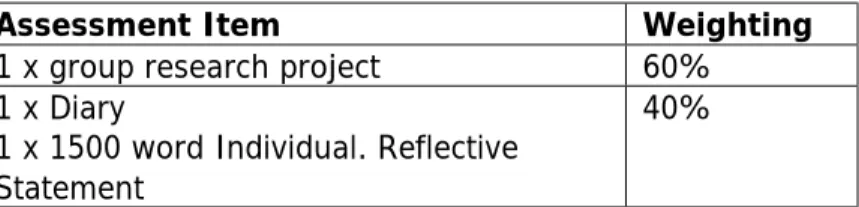
Each student is awarded two grades; one for the project (all members of the group receive this grade) and a personal grade for the individual (Diary/Statement) element. These two grades are combined and, according to the assessment weightings, an overall personal mark is awarded for this module (see Table 1 below).
Table 1 Assessment Weightings
Assessment Item Weighting
1 x group research project 60% 1 x Diary
1 x 1500 word Individual. Reflective Statement
40%
Although previous student module evaluations (2006/7) had not indicated opposition to the nature of the joint project mark or the integrity of the process, a minority of students stated there were colleagues who took a ‘back seat’ during the group research period and others who, through forceful personalities, ‘took over’ the group. As a result some students felt that their work would receive an unfair grading. This is a well documented problem identified by others including Ransom (1997), Parsons (2002), Hand (2001), Cheng and Warren (2000) and Woodhead (2008) who states that, “‘Group coursework should be banned’. In addition, a comparative review of module grade outcomes indicated that the module assessment strategy did not sufficiently discriminate between students as a significant proportion achieved very high grades. Thus the decision was taken to review the assessment weightings with a view to increase the individual element of the assessment in order to provide a more equitable process. Whilst the principal planned action was to adjust the assessment item weightings, it was also identified that further knowledge was required in order to ascertain the extent of the issues identified by students and whether there were other factors to be addressed in relation to securing a process of assessment which ensured equity within the group work element.
Research aim and methodology
The 2006-07 module review caused the researchers to reflect upon whether the tutor’s support of students was a factor in the high grades awarded. This led to the further question of whether a high level of tutor support could cause lack of
engagement in some students by allowing them to be led rather than, as was intended, empowering them to develop their own projects?
Tutor input when setting up the projects is very high with continuing extensive tutor support available through time-tabled sessions and by e-mail contact. This led to the questions:
• How much of this group work project is influenced by the tutor – in short, who really has ‘ownership’ of the project?
• Do students consider they have extensive guidance? How far does this contribute to student groups maintaining their cohesion and direction?
• Do the assessment grading weightings discriminate against some students as the majority of their overall marks remain for the group project?
• Would it be better to further reduce the weighting for the group project to 50% (and increase the individual element to 50%) or keep the project as the major assessment piece due to the particular professional background of the students who are perceived to be working in collaborative situations in their workplaces as a matter of course?
The focus of the research is therefore to discover the key elements which contribute to the effective collegiate management of the group, including an exploration of the support mechanisms employed by the group, the communications systems adopted, the factors affecting motivation in the group and the extent to which these elements influence the students’ sense of a successful and equitable experience. Central to this is the consideration of the tutor role and whether there is a conflict between the tutor view and the student view of the role and its influence in determining the group’s grade.
Methodology
This qualitative research was designed to generate critical narrative reflections to under-pin strategies for improving the practice of group work assessment.
The research was in two stages:
Stage one focussed upon the experience of the 2006/07 student cohort who were able to reflect upon their impression of the process having had time to associate their learning to their final year studies (Year 3, Level 6). This data was already available through the University’s own formal student evaluation system
Stage two investigated the more immediate experience of the 2007/08 cohort and their on-going perceptions of the process.
The research methodology was intended to provide data which, after analysis, would inform tutors’ understanding of:
• The students’ perception of fairness with regard to the assessment
weightings for the individual and group elements of assessment
• Ethical dilemmas surrounding the tutor’s role in guiding and facilitating the
group work in respect of this having potential to affect the group grade The initial research aims therefore sought to explore:
• Whether students had an awareness of the detail of the assessment
weightings in the assessment strategy.
• If so, what was their level of understanding of this and to what extent did
they perceive it to be fair and a reliable reflection of their achievement as a group and as an individual.
• The effect of the level and nature of tutor facilitation on group dynamics in
intra-group communication, task-sharing, empowerment and ownership. Throughout the process of developing the research methodology it has been important to reflect upon the limitations of any findings within the context of the relatively small numbers sampled from two distinct cohorts from two different academic years, 2006/7 and 2007/8.
Key to this research is that interpretations of events within the module made by the module tutor and course leader may be based on different understandings from those of the students. This is a pertinent value within the research in that the tutor and course leader should not make assumptions of having knowledge about the understanding and perspectives of the students. This is fundamental to the approach in investigating the values inherent within the construction, delivery and assessment of the module.
The approach was to use mixed methods in order to support triangulation of the evidence and the differing perspectives in order to add validity to findings (Coleman and Briggs, 2002). The researchers used:
• The analysis of reflective statements from the 2006-07 cohort (assignment 2) • The analysis of the 2007/08 students’ reflective statements (assignment 2) • A questionnaire on collaborative working and the tutor role to 2007/08
students
• Interviews with a focus group of 2007/08 students
Group interviews with the 2007/08 cohort involved representatives from each of the project/research groups from that academic year. The interviews were
semi-structured, providing opportunities for reflection and encouraging free flowing debate. Interviews with the group occurred at the outset and on completion of their group project.
Discussion of findings
Phase One
(i) Narratives from the 2006/07 cohort obtained from the assignment 2 reflective statement (n = 20 students):
The analysis provided findings that indicated:
A mainly positive experience of collaborative working existed. They demonstrated an enthusiasm for group working.
An awareness amongst the students of the need to be supportive of those experiencing difficult personal circumstances during the project (n = 4).
A minority of students who commented there were some who took a ‘back seat’ during the group research period and some students who, through forceful personalities, ‘took over’ the control and direction of the group (n = 2).
Groups became focussed and worked together in order to meet deadlines: A varied means of communication was used by students to ensure the success of the group (e.g. e-mail, meetings in local library, meetings at each others’ homes and in other locations.). Where a group identified that at times not everyone contributed fairly, the group dealt with this satisfactorily and did not apportion blame. Groups shared the workload and were committed to doing their individual best. One group found gaining initial focus difficult but resolved this via additional discussion within the group and seeking some comment from the tutor
These responses suggest the students have a professional maturity in their approach to group work and a degree of confidence and experience which enables them to manage the group dynamics and overcome difficulties in the interest of achieving a successful group project. However, it also indicates that the students are involved in problem-solving throughout the process and some found the issue of individual personalities and unequal contributions difficult to manage.
Specific comments with direct relevance to the research questions:
(a) Significance and fairness of the assessment weighting
Students tended to demonstrate their acceptance of the requirements of the module and the approach to assessment. The comments indicated that students tended to measure the weighting via the amount of work they put in and that they are aware the two assignments enable them to demonstrate different learning outcomes. Some students acknowledged that the ability to work in a group is part of the module learning outcomes (as a ‘Key Skill’). However, most had not considered the
assessment weighting and approached the task (group project and diary/statement) by being unquestioning and by putting in their best effort for both items. Initially most students did not attach significance to the weighting of the assignments, once prompted to reflect they tended to assume fairness within the assessment strategy. This raised issues for the FDLT Course Team in maintaining an ethically sound stance in ensuring students fully understand the significance of the assessment weightings.
(b) Sense of achieving a fair grade for the group project
Comments from students tended to demonstrate their commitment to producing a high quality group project. There was a strong sense that the students would
endeavour to ensure fairness by managing the equitable sharing of tasks within their own groups. It was also evident that the students considered they were drawing upon their professional work-based practice in their understanding of the need to be aware of the importance of successful teamwork. This is demonstrated in the
following comments:
“May not be fair if group didn’t gel and not all effort was equal, but groups needed to co-operate and compliment each other’s
strengths.”
“We all wanted a good grade and so we supported each other for the sake of the project.”
“It worked because our group had strong team ethics. ‘Fairness came from the project being about teamwork and that’s part of our professional practice.”
“We signed each others’ diaries so we knew the marking of the individual effort would be fair.”
(Individual reflective statements June 2007) Limitations to this however, were noted where the students identified:
“In a very small group it wasn’t possible to share the workload evenly if one student was particularly weak”.
“Students new to the cohort felt difficulty in fitting into a group” (Individual reflective statements June 2007)
This may be an indicator of where tutor influence in establishing groups is vital at the outset of the project and can be a major factor in supporting students’ avoidance of potential issues in relation to fairness.
(c) Influence of the tutor
There was no evidence that students felt the tutor was dominating their decision-making or hindering their exploration of ideas. The students valued the tutor as a point of contact; someone who was able to oversee the progress of the project and provide support if needed.
(d)Aspects of the project which supported or inhibited a sense of the assessment being a valuable experience
The students did not make any comment which indicated the experience was made less valuable as a consequence of the assessment including a group grading. In all cases their focus was entirely upon the positive aspects of completing the project. When prompted, however, students were able to make suggestions which might indicate they could identify aspects which were inhibiting, although they did not do this overtly. One group used an evaluation sheet of the groupwork process for individuals to comment on the contributions of others, although the students also identified this hinged on subjective perceptions of what seems fair to one may be different from what seems fair to another. Most individual students appeared to acknowledge both parts of the assessment strategy equally, although a small
number (n=3) went on to state that this would not reflect time spent on the project.
Phase Two
(ii) Initial interview responses 2007/08 focus group (n = 6 students)
This semi-structured focus group interview took place at the end of the group ‘forming’ stage of the module in mid-November 2007 (at the end of session 4). It was designed to discover initial impressions of how their engagement with their research will increase their professional knowledge, their working preferences, the level of support from the tutor so far and any emerging difficulties. This was a very limited exercise in that only a single group took part, thus the findings can only be tentative and not indicative of the whole cohort of students.
All group members felt that their engagement with their chosen area of research would have a significant impact on their own professional role in their
schools/settings
Some students were unsure about group working (n = 3). They work in groups in their professional role in schools but had worries about engaging in research with ‘research partners’. This was solely based on their own fear of ‘exposure’ as being,
“not as clever as the others in my group” (student ‘A’) or of having to face potential conflict, “It gives me the chance to share ideas but I often prefer to work on my own particularly when ideas conflict and it’s hard to reach agreement.” (Student ‘C’). Other students (n = 3) welcomed the opportunity to work in a group, “I have enjoyed it so far. It is nice to be able to bounce ideas off the others, clarify them and generally debate. It also makes me get on with the work as I feel that I may let the others down if I don’t.” (Student ‘B’) The need to support the others in the group and to play a full part in the project was a particularly strong motivating factor for all students.
All of the students reported that they had just the right amount of support from the tutor; no student stated that the tutor gave too much support or ‘over-directed’ the group.
Each student had expressed areas of difficulty relating to the time management of the research project as it had to be undertaken at the same time as they were studying on other FDLT modules and completing other tasks/assignments (in addition to performing their professional employment role back in their schools).
(iii) ‘Exit’ questionnaire responses 2007/08 cohort (n = 32 students)
This was a brief questionnaire completed by all cohort members, in class, on the day that the final group projects were submitted for assessment (April 2008). It was designed to discover the students’ beliefs into who was responsible overall for managing the group, on their experience of receiving tutor support and their opinion on the fairness of the 60/40 assessment weighting.
The analysis provided findings that indicated thatthe majority of students (n= 27) believed the group as a whole was totally responsible for managing the group in terms of establishing tasks, creating/maintaining the communication framework, directing and executing the school-based research, utilising key texts/sources and writing up/compiling the project in a ‘corporate’ style. A few students (n = 4) stated that it was a joint responsibility shared between the group and the tutor – with the tutor taking responsibility for dealing with any disagreements/difficulties arising within the group dynamics or with any difficulties generated through the school-based research.
The majority of the students (n = 30) believed the role of the tutor in the module was to help them interpret the assignment brief and direct them during the initial ‘set up’ phase of choosing the area of research and their groups; after this, to support them with issues/queries relating to study/research skills, their reading and with any specific school-based issues arising out of their insider research. Two students were unsure of the tutor’s role.
The majority of students (n= 22) stated that they used the available tutor support only moderately after the initial set up phase. A significant number (n = 8)
completed the project with only using tutor support sparingly while a small number (n= 2) did not seek any tutor support.
In accessing tutor support the most frequently used method was through face-to-face communication in the given ‘taught’ sessions (n = 28). Four students did not take up this option and did not attend the taught sessions after the initial set up phase of the project. A small number of students accessed the tutor through e-mail (n = 8). No students used the telephone or accessed tutorial support outside of the taught session times. The tutor was perceived to be most influential during the planning stage of the project with their influence being less in establishing group roles and concluding and collating the research.
The majority of the students (n=29) said that the assessment weighting was ‘appropriate’. Three students disagreed:
“It seems slightly wrong that one person’s degree marks rely on the input of others. Although it was an interesting way to work, there are problems.”
“This may be difficult if some people do not have the same impact or an input to the final piece of work. The diaries do not
necessarily reflect this.”
“This is hard to comment on as the 60% means that all group members benefit from the final grade on the project. In our case one member contributed very little, although this was because she had dyslexia and found the work hard; we helped her and she did do some useful stuff for the project but not on the same level as the rest of us – particularly all the research and the analysis. 40% for the individual element is fair enough as this gives individuals the opportunity to prove their worth. Perhaps a 50/50 split is the best.”
(Exit questionnaire responses April 2008)
(v) Analysis of 2007-08 students’ reflective statements (n = 10 diaries as a representative sample across the cohort)
There was a clear similarity between the statements from the 2006/7 group and the 2007/8 group. Without exception all of the 2007/8 students stated how their engagement with the school-based research combined with extensive reading had made an effective impact on their professional knowledge and practice and how their individual schools/educational settings are (or will be) benefiting from the outcomes of their group research projects. Comments relating to the students’ experience of group working were illuminating, particularly those who freely
expressed their ‘feelings’ and their growing skills in being able to work with others in a pressurised environment:
“I found it hard to ‘let go’ of the whole project, having to
team. I struggled to adjust to the ‘limited autonomy’ in a group project and had to ensure that I listened to and valued everybody’s contribution. I felt that I tended to naturally take the lead and had to be aware of this and not be ‘controlling’”
Student ‘J’ “The project overall was nerve wracking having to work with other students instead of by myself, I don’t mind working in a team but knowing that my input effected every one’s grade put pressure on me and I realise that this affected how the rest of the group distributed the workload. The others helped me a lot with the use of correct language, writing skills and also tuning my
concentration, but I do feel that this took away my own personal skills as an ‘academic student’ at times. My colleagues should have discussed their problems over working with me as this affected the consistency of the group work, the others contacted each other separately at times and disregarded my need for the same information.”
Student ‘L’ “When working in group situations I am usually the most assertive or dominant character, often the one elected to lead or represent the others if required; in this group that was not the case and I found that to work successfully I had to compromise and sometimes take a ‘back seat’. I found it quite frustrating at the beginning if I didn’t get my own way; I went home a few times feeling quietly anxious. Over the course of the project I feel that I have become more tolerant and tactful towards others. Engaging in the group project has been a valuable experience although not one I’ve always enjoyed!”
Student ‘A’ “My experience of group work was positive, informative and enriching. I felt supported and encouraged by my colleagues as we shared ideas and respected each other. In any group work all participants need to have the confidence and skills to be willing and able to participate. One member of the group made no
contribution to the literature side of the project – although this was difficult I decided to encourage her in the areas she felt able to contribute with. This experience has made me accept that group work can present you with unexpected challenges but for the benefit of the project it was advantageous to proceed positively with the task in hand and to discuss difficulties openly.”
Student ‘W’
The ‘professional maturity’ identified in the reflective statements from the 2006/7 cohort was evident here along with the supportive nature of the groups and individual members, although the experience of one student (Student L) was significant in that she felt disempowered by her own group who by trying help her with academic writing skills left her feeling devalued in terms of her academic input which was then compounded by leaving her out of their communication ‘loop’; this is
in marked contrast to the overall positive experience of other students who
commented on their own evolving tolerance, discussion and collaborative skills. In all the diaries examined, no student commented on how they thought their ‘supportive gestures/acts’ might have impacted on the self-esteem of the colleague they were trying to help – this is significant in relation to some of the statements from students at the beginning of the project where some were concerned as to their ability to engage in research and in collaborative working and they didn’t want to ‘let the group down’.
(vi) Exit interview with 2007-08 focus group (n = 6 students)
This was in the form of a semi-structured group interview and had its focus on presenting how the group maintained ‘fairness’ and the working relationship
between the group and the tutorthroughout the life of the project. These were the same respondents who provided data for the initial focus group interview responses in November 2007. This ‘exit interview’ took place after completion of the exit questionnaire.
The analysis provided findings which indicated that ‘fairness’ and equitability was established through the group members working strictly according to the guidelines and protocols set by the tutor in the initial planning stages of the project. Set meeting times were arranged in both the available taught sessions (where the tutor was available) and in a series of additional meetings outside of the taught sessions at locations/times agreed by all group members. Minutes were kept and an ‘action point’ list was made for the next meeting. In addition to these formal meeting times the group established a ‘wiki’ discussion board so that information could be shared electronically. An e-mail and telephone communication network was created. That within the group, discussion was initially focused on each individual member’s strengths in terms of existing knowledge and skills in small scale/school-based research and the area of study. Tasks/activities were agreed and distributed according to level of expertise and emerging interest.
All group members stated that they understood the nature of the assessment weightings and the need to work collectively in order to achieve a high grade by producing a high quality research project in a ‘corporate style’. This was a major motivating factor although, after engaging in the research, the majority of the group viewed the assignments as being totally separate pieces of work with the weightings becoming irrelevant; as a result they put in a full effort in each assignment piece (group project and diary/statement).
Group members frequently read through each other’s contributions and suggested improvements, links, directions to supportive literature/sources and encouragement. This was a key motivating factor within the group and maintained the
collegiate/corporate ethos.
There developed, over time, a strong team and work ethic where group members were not afraid to admit mistakes/show weakness or share good work. This contributed to a learning community where any disagreement over approaches or project content/presentation was amicably and swiftly resolved.
All group members understood that their individual contribution to the project would be registered through the research diary which would then be read and agreed by all the other group members prior to submission for assessment. This further
motivated individual group members (‘not letting the group down’) and provided a transparent method of showing fair contribution.
The tutor was helpful throughout the project ; particularly in the early phase where key information on the nature and rationale behind the project, discussion on areas of research focus/interest, direction on how to manage the school-based research, protocols on school-based work and warnings about potential ‘pitfalls’/difficulties in group working and school-based research was presented.
The tutor directed the group if they asked specific questions and helped them to limit the scope of the research but generally let the group develop their own area of interest, questions and direction of the research. The tutor did suggest ‘ways forward’ when asked.
“We didn’t have too much help – it was a stepping-stone or
scaffolding approach where he bought the focus back for us if we’d gone too wide or off the mark.”
Student ‘C’
This was the first time the students had been given this level of autonomy in an assessment (a non-prescriptive assignment); there was a level of fear “…of the unknown” however the students felt that they were not ‘led’ by the tutor:
“There was no loss of ownership, we were just helped to know how to achieve a particular level.”
Student ‘B’ “The tutor encouraged us to achieve more as he had high expectations but we were not spoon-fed.”
Student ‘A’ “I can’t think of an incident when we were provided with resources – we were given direction/help but it was our responsibility to find resources.”
Student ‘D’ “We would clarify things with him and then go away and work on it”
Student ‘C’ (Exit interview April 2008)
Conclusion and emerging questions on validity
Curtis & Curtis (1995) state that it is accepted practice in many work places and organisations to place people in teams and to give people something to relate to and to work for, other than their own task. Fiedler and Garcia (1987) define a ‘group’ as a set of individuals who are interdependent and who interact to achieve a particular purpose. They share a common fate so that an event that affects one also affects
other group members (i.e. they may jointly share rewards or suffer punishment). In short, these two views apply to the students who undertake the group research project.
From the analysis of the gathered data it can be said that, overall, most students had a positive experience of group working with the success of the project depended on the group and that the group is entirely responsible for the grade received. However, there is still a small number of students who have concerns relating to the concept of having a shared ‘group mark’ when there is a weaker student in their group but in this case they still agree that the group shares the responsibility to manage this situation (with tutor support/guidance if required).
There is a strong awareness amongst the students of being supportive to other group members – however, the experience of one student who felt disempowered by her own group was significant in that the perceived ‘supportive’ actions of her group mates had a negative affect upon her self-esteem and her identity as an
‘academic researcher’.
Generally the students felt a need to ‘not let their groups down’ – this was a strong motivating factor throughout
Time management and maintaining close communication remained a difficulty for a number of groups (distance and availability due to other work pressures being the most cited). However, those groups who managed a tight process of structured meetings with a fair distribution of tasks and a varied means of communication (e-mail, telephone, out of session meetings) created a corporate/collegiate work culture which proved to be exceptionally supportive and effective in terms of managing the school-based research and project collation/completion. This was particularly
evidenced by the ‘focus group’ (2007/8 cohort) who established an inclusive working environment and positive group self-esteem by following a tightly structured model of operation underpinned by a strong communications system (including the setting up a ‘Wiki’ for group communications).
The students’ engagement with their research focus/area of study and their wider reading has made a positive impact on their own professional knowledge and
practice and in their development as ‘teacher-researchers’. They recognise how their group research work will have (or, in a number of cases, is already having) a
positive impact on their schools’ provision for pupils with special educational needs and disabilities.
In terms of the influence of the tutor there was no reportage of the tutor dominating the students’ decision making process or overly influencing their exploration of ideas with the tutor being seen as a facilitator and a guide, particularly in terms of subject knowledge and in the management of school-based research. The tutor did
emphasise the assessment strategy and weightings but a proportion of the students did not fully understand the significance of the weightings and relationship between the group and individual work gradings.
These key points generate some important areas for discussion by the course team responsible for the Foundation Degree in Learning & Teaching:
As the current assessment strategy (60/40 weightings) appears not to create
the nature and level of the work required, should it be maintained for the next academic year or should a further increase in weighting to 50% for the individual assessment pieces further establish an equitable and fair assessment system? Would it actually make a difference? It appears not to. Further work on raising student awareness of the weightings system and how this influences their grades is required, although this is identified as a whole programme of study issue and not a project issue alone.
In terms of the ethics of having a potentially tutor-dominated group research module, negative aspects have not emerged. The influence of the tutor is a significant one in setting up the research projects and providing on-going support but there has been no indication, from the students, of the tutor being overly prescriptive. The students felt motivated, challenged and supported not
disempowered. This is a key finding as it contrasts with the initial course team view. It challenges those responsible for assessment strategies to ensure they do not make assumptions about what is in the students’ best interest; it significantly strengthens the need for tutors to consider the issues and actively seek student opinion. Perhaps the most important factor to highlight in this case is the actual nature of the students themselves; they are mature students who are educational practitioners with at least three year’s experience working in schools/educational settings. As previously stated, they are used to working collaboratively and cooperatively in order to solve problems, create products and share ideas as a required part of their professional employment. It is this vital background which creates the solid foundation for this school-based project; group work is not ‘new’ to them and they naturally undertake it. Their assessed group research project is within their experience, although due to its particular demands many students do discover some pertinent personal strengths and weaknesses in their ability to work in
collaboration with others. The main foundation for success in this project is the unique professional expertise and experience of the students, without this factor and with a more traditional year 2 undergraduate cohort of students, the project would have serious ethical flaws in terms of equity and content as there is no given time to explore the experience of , or to practice, collaborative working techniques prior to embarking on the small-scale school-based research thus existing group work experience and expertise is a pre-requisite.
If this is the case then there is a major issue emerging over the validity and fairness of using assessed group work with a shared grade for students who do not have this level of experience. Is it actually possible to make such a process fair for those students who don’t have extensive previous experience in successful (un-assessed) group working? Should we only engage in assessed group work in the final year of a student’s course/programme of study when they have experienced this way of working earlier? If so, is this fair particularly as the last year of an undergraduate student’s course carries so much emphasis in terms of their final grading and classification? Having a percentage of this final grading dependent on the work of others would prove to be a very unpopular assessment strategy. Is the answer to only include the valuable process of group working in a student’s course if it doesn’t impact upon any assessment item, or only use it in the first year of a two or three year course so that the assessed group work doesn’t have such a significant impact on the student’s overall grade/classification? In that case, is there really any point in using this approach at all? Perhaps there might be substance after all to the view of Woodhead (2008) and should group coursework be banned?
References
Arango, R. (up-dated 2007) Group Projects and Group Grading: Work in Progress
http://www.evergreen.edu/washcenter/resources/acl/b5.html - 08/02/2007 Barnfield, l. R. (2003) Students’ Perceptions of and Satisfaction with Group grades and the Group Experience in the College Classroom. Assessment andEvaluation in Higher Education, Vol.28, (4). Pub: Carfax Publishers - Taylor and Francis Ltd: ISSN 0260-2938 print/ISSN 1469-297X
Chapman, E. (2002) Effects of Social Cohesiveness and Cooperative Initiatives on Small Group learning Outcomes. Current Research in Social Psychology, Vol. 7 (17). The University of Sydney
Cheng, W. and Warren, M. (2000) Making a Difference: using peers to assess individual students’ contributions to a group project. Teaching in Higher Education,
Vol. 5 (2)
Curtis, S., Curtis, B. (1995) Behaviour at Work (2nd ed). London. Pitman Publishing
Elliott, J (1991) Action Research for Educational Change. Philadelphia. Open University Press
Fiedler, F., Garcia, J. (1987) New Approaches to Effective Leadership. New York. John Wiley
Hand, L. (2001) Freeloading in Group Work. Paper: Department of Accounting, Nottingham Business School, The Nottingham Trent University. Learning and Teaching Journal, Vol. 5.
Knight, J., (2004) Comparison of Student Perception and Performance in Individual and Group Assessments in Practical Classes. Journal of Geography in Higher
Education, Vol. 28, (1), pp. 63-81, March 2004. Pub: Carfax Publishers - Taylor and Francis Ltd: ISSN 0309-8265 print/ISSN 1466-1845.
Maguire, S., Edmondson, S., (2001) Student Evaluation and Assessment of Group Projects. Journal of Geography in Higher Education, Vol. 25, (2), pp. 209-217. Pub: Carfax Publishers - Taylor and Francis Ltd: ISSN 0309-8265 print/ISSN 1466-1845
Parsons, D. (2002). Justice in the Classroom: Peer Assessment of Contributions in Group Projects. Department of IT and Electrotechnology, Otago Polytechnic, Dunedin, NZ. [email protected]
Ransom, L.S. (1997). Grading Group Projects – a ‘group’ discussion Pub:
http://research.umbc.edu/~korenman/wmst/group_grading.html 08/02/2007
Skinner, V.J.; Winning, T.A.; Braunack-Mayer, A.; Mullins, G.; Peterson, R. (2004) PBL Groups: What are they doing? A student work in progress. The First Phase of a PhD Study: The Graduate School, University of Adelaide Dental School (UADS), Medical Education Unit, South Australia.
Woodhead, C. (2008) Danger of group coursework. The Sunday Times. 15 June (Review Pg 9)