ISSN 1479-4403 79 ©ACPIL
Study
Thashmee Karunaratne
Department of Computer and Systems Sciences, Stockholm University, Kista, Sweden
[email protected]
Abstract: The thesis component of a degree program is vital since the quality of it contributes to the quality of the whole degree. Maintaining the quality of the degree programs and handling the constantly increasing numbers of students entering higher education simultaneously is a challenge for many higher educational institutions. This paper presents a study of how ICT can be used to improve the quality and effectiveness of the thesis projects at Bachelors and Masters Levels. Further, how the blended model of supervision supports solving the issues of managing supervisor time efficiently
and providing a quality guidance for thesis “ ICT
process are captured via interviews. Statistics about the completed theses and the user log data of the ICT system are triangulated to complement supervisor perceptions. Results revealed that the supervisors take advantage of the functions in the system to support improving the quality and the quantity of the theses, and the blended supervision model adapted in the thesis process support the supervisors to have a better collaboration with the students.
Keywords: Thesis, higher education, blended supervision, quality improvement
1.
Introduction
In higher education, completing a thesis project is compulsory or preferred by any degree program, since it reflects analytical skills, decision making, organizing and delivery of innovative content. However, for many students, the path to success of thesis work is quite a lonely and tiresome task. Irrespective of whether on campus or distance, thesis work is a very much isolated and individual activity compared to the other courses in the degree program (Aghaee, 2015). Many students never complete their thesis works. From those who complete, only a few students manage to finish within the stipulated period and achieve a thesis of good
quality. B B M
of thesis attrition (dropout) was identified as a major problem at the largest department of computer and systems sciences in the Nordic countries (Allen, et al., 2008). It has been shown in many studies including (Allen, et al., 2008; McGaha & Fitzpatrick, 2005; Nicpon, et al., 2006)that the inability to complete a thesis mainly contributes to increasing dropout rates in many degree programs. On the other hand, failures in the
the tasks in the thesis process. Physical limitations to exchange ideas with supervisors and peers; lack of continuity of assessment of the quality of work; missing important information about the thesis project and the process; lack of chances for comparison of performance with peers due to isolation; lack of infrastructure or academic support from the institutional perspective, and so on may also be contributing to hinder the success (Aghaee, 2015; McGaha & Fitzpatrick, 2005; Nicpon, et al., 2006).
How to maximize the throughput of the theses in universities has been a topic of investigation for many years, as performance rate of thesis projects is important in maintaining the reputation of the academic institution. The quality and completion rate of the theses at universities can be increased by improving the quality of the thesis process, increasing supervision hours, increase of group projects, changing evaluation procedures, student counselling, including courses for how to conduct research work into curriculum, meta supervision, engaging the students in the ongoing and practical projects, encouraging close ties with the industry so that the students get the motivation to complete and continue working in the same industry, and so on (Karunaratne, et al., 2017). Among the other factors, interaction plays a major role according to (Aghaee, 2015). There can typically be three types of interaction, student content, student-student, and student supervisor (Goodyear & Ellis, 2008). Student supervisor interaction is the central among other interactions, as supervisors agreement is a major factor for the success of the thesis (Soares da Costa , 2016). However, the student supervisor interaction is individualistic and driven by the preferences and specific styles of supervision (Hansen & Hansson, 2016). Literature provide categorizations of supervision styles based on their nature of supervision. E.g. Dysthe (2002) identifies three types of supervisors. Supervising as a teacher, where , resembles the conventional form of teaching. A friendly atmosphere with more distributed responsibility is created in the partnership model. The
third model Dysthe (2002) brings in is the model of apprenticeship, where the student is in a partnership that is influenced by the authority of the supervisor. Seven different types of supervisors are listed in (Soares da Costa , 2016), namely, the know-it-well, absent, the perfectionist, very hands-on, the pessimist, the friend, and the coach. The differences of the supervision models are based on how the supervisor instructs the students, how do they deal with the guidance to writing, resource discovery, and sharing, frequency and forms of supervisor meetings, etc, (Karunaratne, et al., 2017). Accordingly, supervision styles in general are influenced by the individual preferences of the supervisors when deciding on when to meet, how often, and where and how to communicate (face-to-face, forum, voice conferences, etc.). Some supervisors prefer ad hoc meetings, that is, scheduling a meeting when students have problems or when they request for a meeting. Other supervisors prefer regular and pre-planned face-to-face meetings individually and/or in a seminar form with fellow students. Some supervisors rely solely on distance technology in supervision due to many reasons including demographic distance. However, many of the related studies have pointed out the relation between the flows of supervision and student drop out from thesis projects (Dysthe, et al., 2006; de Kleijn, et al., 2012). Automated systems that support student and course management have been in use in education for many years. The efficiency and effectiveness of these systems, especially when scaling up of the programs to meet the increasing demand for education, are shown in many related studies. For example, the IT-system for thesis support, SciPro (Supporting the Scientific Process) (Hansson, et al., 2009) manage hundreds of students on
B “
students) and the rest are M nternational students). They interact with approximately fifty supervisors who also present themselves, their research topics and preferred mode of supervising in the system. The system provides support for matching between students and supervisors, accessing supervisor /student information, querying from thesis and supervisor support facilities, referring and sharing learning content such as video films and other related materials, booking seminars, use of the peer and supervisor discussion forums, managing the milestones in the thesis process, etc. (Karunaratne, et al., 2017). The support provided by such an ICT system could complement the thesis supervision process in such a way that the supervisor need not necessarily be avaialble for many parts of the thesis process, yet the student receive all the support needed to fulfill his or her tasks.
This study investigates how does the blending of ICT complement thesis process. Therefore it explores the effect of the IT support system in reducing the issues in thesis supervision and retention of dropout students. The Department of Computer and Systems Sciences (DSV), Stockholm University and the thesis support system SciPro is taken as the case to investigate. Thereby an effort is taken to demonstrate a case of blended supervision and how it bridges the gap of the student supervisor communication problems.
The rest of the paper is organized as follows. The next section focuses on the domain in focus and the use of blended supervision at DSV. Section three describes the methods we adopt to investigate how blended supervision affects the quality and the number of theses produced at the department, followed by the results and the discussions and finally, conclusions drawn from this investigation and possible further works.
2.
Background and the domain in focus
At the Department of Computer and Systems Sciences (DSV), students at Bachelors level take a thesis worth of 15 credits during the final term of the third year of the program. Masters level thesis work carry 30 credit points. As stated above, in 2008, a large-scale evaluation about education conducted at the department suggested improving the quality and the number of thesis projects at the department. An ICT support system has been introduced in the department to support the thesis process with the aim of addressing the following issues:
Students struggle in finding a supervisor, resulting in delays in starting the thesis project
Supervisors spend most of their supervision time for management of the thesis leaving very fewer opportunities for students to get feedback and coaching in the actual research work
Quality control of the thesis is difficult due to the complexity of collaboration with the supervisor, reviewer, peers, thesis opponents, as well as active participants in the final seminar.
Communication with the supervisors is difficult since planning supervisor meetings require contacting them personally to agree on supervision times. Students may need to knock the door to see the availability of the supervisor or communicate many times via emails, etc.
Supervision process is not transparent, therefore, if there is any issue related to supervision, the student become isolated, and get lost in the process
Planning the final defense is difficult as it involves many parts, such as reserving the time of the participants and reserving a venue, submitting the thesis and controlling for plagiarism, managing the opponent and active participants, etc.
Difficulty in tracking the resources used or discussed during the thesis period, and, managing and providing feedback for the thesis draft at different levels.
Finding relevant information for thesis work, including general and specific literature, thesis templates, and other required resources
Supervision and management of students taking thesis in distance programmes
2.1
Thesis process at the Department of Computer and Systems Sciences (DSV)
The thesis process at DSV is structured as illustrated in Figure 1 below.
Figure 1: Thesis process at DSV (Source: https://thesisinfo.dsv.su.se/thesis-process)
The complete thesis process at DSV consists of five phases, 1) preparation, 2) research question and method, 3) results and discussion, 4) final seminar and 5) thesis examination. What functions the students and supervisors perform during each phase is listed in Table 1.
Table 1: Student and Supervisor tasks in the thesis process
Phase Student Supervisor
Initiation Students fulfill prerequisites for writing the thesis Supervisors are allocated a quota of students for the term
Phase 1 Find a thesis topic (idea) or choose from available ideas from supervisors
Hold the first meeting with the supervisor to agree upon/ refine the topic and plan the research
Create/modify a project proposal
Submit ideas at least to fulfill the allocated quota, or pick an idea from students
First meeting with the student to plan the research
Feedback/ approve the project proposal (can be iterative)
Phase 2 Create the research questions and methods
Improve the thesis draft based on feedback from the supervisor
In the case of supervisor/reviewer reject the draft of the thesis, upgrade it until its approved
Make the thesis draft available for other peers to review
Review two other student theses at the same level
Advice and re-evaluate research question and methods (this can be iterative)
Approve the draft of the thesis and send to a reviewer (another professor at DSV) (this can be iterative until the reviewer approves the draft)
Phase 3 Conduct the empirical study/ experiment/data collection
C
available for 2nd peer review
Review two other thesis drafts
Advice and guide student/ provide feedback
Phase 4 Finalize the thesis draft
Submit the thesis in the platform once the supervisor finalizes the final seminar arrangement
Be an opponent for another final seminar and actively participate in two other final seminars (register in the platform)
book a date and room for a final seminar
assign the numbers of active participants to the final seminar
Plagiarism control of the submitted thesis
Host the final seminar Phase 5 Upgrade the thesis draft based on the feedback received in the
final seminar
Submit the final draft
Evaluate the final draft and grade the thesis
Check if all the peer reviews and oppositions are completed
Coordinate with the panel of examiners for finalizing the grade
Report the grade obtained and achieve the thesis
The thesis process at DSV is complex and requires extensive collaboration among not only the student and the supervisor, but also the co-supervisors if any, the reviewers, and the examination board as well as fellow students who participate in peer reviews. The thesis support system SciPro takes care of many of the activities in the thesis process as discussed in (Karunaratne, et al., 2017; Larsson & Hansson, 2013; Larsson & Hansson, 2011). The main information and communication channels of the thesis process is presented in Figure 2.
Figure 2: information and communication channels in the thesis process (ref: Karunaratne, et al., 2017) In a thesis project, students interact with content (thesis draft), with peers and with supervisors. At each of these interactions there exist questions to answer. Table 2 gives a summary of those interactions.
Table 2: Interactions in thesis process (ref: (Karunaratne, et al., 2017))
Entity Interaction
Self-assessment Checklists:
First meeting: 9 questions Project plan: 11 questions Rough draft: 9 questions
Result and discussion: 11 questions A complete thesis version 1: 22 questions A complete thesis, revised: 22 questions Grading criteria: 18 aspects
Peer review online (peer review 1 and 2)
Project plan: 11 questions Rough draft: 9 questions
Result and discussion: 11 questions Peer review in final seminar
(Opponent 1)
Written opposition report aligned with the grading criteria (18 aspects) Oral presentation and discussion
Peer review in final seminar (Opponent 2)
Written opposition report aligned with the grading criteria (18 aspects) Oral presentation and discussion
Peer review seminar: Active participants
5-15 oral questions
Reviewer Rough draft approval: 6 aspects
Reviewer Final seminar manuscript approval: 18 aspects
Reviewer Grading: 18 aspects
Supervisor Oral and written feedback throughout the whole process, including validation, summaries and comments of feedback listed above: individual supervision, seminars, and online forums. Estimated: feedback aligned with grading criteria: 18 aspects x 6 times
Supervisor Grading: 18 aspects
Examiner Grading and reporting: 18 aspects
2.2
Blended approach for thesis supervision
Blended learning is ubiquitous in education, especially with the rapid evolvement of ICTs in education. As a result, tools and technologies that can be used to blend traditional classroom teaching and learning process have been emerging in recent years (Garrison & Kanuka, 2004). However, the blended form of thesis supervision has gained comparatively less attraction. Some examples of blended supervision can be found in the field of medical and health sciences, specifically in laboratory experiments, practicing medical surgeries, simulations of the body, visualizing natural phenomena and so on (Ingham & Fry, 2016). Blended forms of supervision by a group of supervisors, with the focus of the effect of integrating the expertise of supervisors of different areas of strengths together by efficient collaboration using ICT tools, is discussed in (Donnelly & Fitzmaurice, 2013),.
ICT can be supportive for blended supervision such that important information, guidelines, and related resources could be structured into the thesis support system to allow students access without the guidance of
the supervisor. Such a facility saves
students s/he supervises (Hansen & Hansson, 2016). The ability to organize virtual meetings cuts down traveling times for physical meetings, and allows having the meetings at flexible times. The space for synchronized and asynchronized communication via an online forum reduces communication gaps (Aghaee, et al., 2013). Table 3 shows which supervision tasks can be offered using ICT.
Table 3: The blended model of supervision
Supervisors tasks Mode and method of performing
Supervisors are allocated a quota of students for the term Information is present in SciPro. Submit ideas at least to fulfill the allocated quota, or pick an idea
from students
Upload to the idea/s section of the SciPro system. Check available ideas
Filling the quota of students by selecting student ideas or student pick from the entered ideas by the supervisor
The system automatically matches the idea once selected and create a thesis project in SciPro.
Arrange first meeting with the students matched Booking the meeting is done via SciPro. Research plan is created together with the student Create in SciPro.
Advice on the research topic /provide feedback Face to face or online meeting.
Summary of the discussion and resources exchanged can be archived in SciPro.
Approve the project proposal Via SciPro.
Advice and re-evaluate research question and methods Literature is in Thesis info pages in SciPro Send the first draft to a reviewer (another professor at the
department)
Via SciPro (Interaction with reviewer) Reviewer communication with supervisor for clarifications etc. if
needed
Via SciPro (Interaction with reviewer) Advice and guide student/ provide feedback during the empirical
study/experiments
Face to face and/or via SciPro
Approving the final draft Via SciPro
Check requirement for final thesis, i.e., if all the peer reviews are completed
Information are already in SciPro after the task is fulfilled
Book the final seminar Via SciPro
Plagiarism control for the submitted thesis Automatically done in SciPro
Host the final seminar Face to face or online
Grade the thesis Grading criteria is in SciPro; supervisor fills in the relevant parts of it. The final grade is automatically calculated
Coordinate with the panel of examiners for finalizing the grade Communiation via SciPro
Report the grade obtained and achieve the thesis Grade is automatically sent to the student management system from SciPro
It is pointed out that the new and developed criteria for improving the quality of the thesis process at DSV would be nearly impossible to perform without increasing the supervision hours accordingly unless ICT support is present (Aghaee, et al., 2013).
3.
Data and methods
As stated above, this study investigates the effect of the ICT support system used at the Department of Computer and Systems Sciences and thereby try to answer the questions of 1). What problems in the thesis process have been solved by blending of ICT in thesis process 2). How the SciPro system does supports blended supervision and 3). How has the quantity and quality of the theses improved over the years at DSV. The strategy followed in the study include both explorative (qualitative) and quantitative approaches.
3.1
Data and data collection methods
Qualitative data: The data collection strategy chosen in this study is the survey methodology. Interviews are conducted to investigate the issues related to the thesis process at the department, To study the blended supervision process, and how ICT smooths out the supervision process, four supervisors are selected randomly, and their perceptions were captured via deep interviews. The interview also aimed at understanding the challenges the department faced in offering the thesis projects at Masters and Bachelors levels before the SciPro system is implemented. I
experience and practices before the reforms to the thesis process. 2) challenges of supervision, and, 3) the experience and practices after the reforms and ICT is introduced.
Quantitative data: Data accumulated in the SciPro system is the quantitative data used in the study. The complete dataset consists of the information about completed theses at DSV since 2008. There are 2609 entries in the dataset which each instance correspond to information of a student who completed theses during seven years from 2008. Altogether there are six attributes, namely, Thesis ID, Student Name, Supervisor Name, Thesis topic, Date completed, and Grade obtained. Thesis ID is of type numeric, and date completed has the data type Date. The rest of the attributes are of type string. The user logs dataset consists of a set of user click logs of the system in the period from 2013 January to 2015 May. This log data is pre-processed into attribute-value form with 21 attributes of the functions listed in Table 3. The data set consists of 43500 entries.
3.2
Data analysis methods and tools
Both qualitative and quantitative data analysis methods are used. A triangulation approach (Bogdan & Biklen, 2006) is followed where the interview data are triangulated with the quantitative data. Maxqda (MAXQDA, 1989-2016) is used for transcribing and analyzing the interviews. The visualizations and summarisations of the quantitative data are carried out using R (R Core Team, 2014).
4.
Results and discussion
This section presents the results of the empirical study
4.1
What problems in thesis process has solved by blending of ICT in thesis process.
Starting the thesis: Results from the transcribed interview data revealed that the main bottleneck in the thesis projects at DSV in the pre- SciPro era was regarding the matching of student thesis topics with suitable supervisors. The coordinator of the thesis projects explains
I had to knock the doors to request if the supervisors are willing to take those (students) who are struggling to find a supervisor
“ome supervisors tend to quickly pick the good students (who were performing better in the courses).
I (myself) had to supervise more than ten students with lower grade point averages (per term).
There was no systematic allocation of students for supervisors.
The matching of students to supervisors happened throughout the year, making it very difficult to provide orientation facilities for students starting thesis work.
I is natural that some students waste weeks of their study time trying to find a supervisor.
SciPro matching of supervisors to students is autonomous, and the log data of SciPro shows that the matching has been done well ahead of the official start of the thesis process. This allows students to utilize a complete 20 or 10 weeks to engage in conducting their study. Figure 3 is a plot of the number of days between the
actual start of the thesis and the student finds a supervisor during the period of January 2013 to February 2015.
Figure 3: number of days from finding a supervisor to the official start of thesis project
Figure 3 shows that most of the thesis projects at DSV nowadays start on time, and by the time of start all the students have supervisors for their thesis projects. The dots of the scatter plot in Figure 3 around January corresponds to the date of start of both Bachelors and Masters Theses. Bachelors thesis of 15 credit points starts in April and October as well.
Supervision time and communication with the student: According to the outcome of the interviews, communication between the supervisor and student was problematic without the support from the ICT system.
Complaints from students about communication issues with the supervisors were not surprising
Coordinator receives many emails per day about not knowing the deadlines, and various other missing information
I had to repeat the same information to many students, and still there could be a chance that I missed one student
I and many of my colleagues find it difficult to manage with student communication especially when I
am traveling abroad for longer periods. I I over flowing
mailbox
The threads of the communications I had with my students is not easy to trace, so sometimes I am not sure what we agreed previously
SciPro focuses mainly on clear communication and providing structured information. SciPro thesis information pages include all the required information in a structured way so that any student can find them very easily (Aghaee, et al., 2013). The interviews justified this fact as follows:
I am no more worried about students miss information. Instructions are provided to students in the beginning
In the back seat of a bus in rural Africa with my roaming broadband I could provide feedback to my students
In a day during the period of reporting the grades myself and many other supervisors were in a presentation and at the same times SciPro is opened in our laptops
SciPro functions that allow collaboration among the students and supervisors include Forum, which is the messaging service of SciPro and the Files, which is the file archive in SciPro. These facilities have become popular with the time as can be seen by the log data analysis results in Figure 4. Figure 4 (top) shows the frequency of using the Forum function each day of the year. High frequency of usage corresponds to the active period of the thesis. Similar pattern exists in the usage pattern of uploading files (bottom figure) as well. The usage also increases each year.
Figure 4: Usage of Forum and Files function
Communication among the student, supervisor, and reviewer: Communication among the stakeholders in the thesis project had many gaps, due to delays in responses, but communication via SciPro is transparent which motivates supervisors and reviewers to respond timely. For example
W I I
can respond even without login into SciPro. The discussion is saved in Forum so the thread of
I myself to respond quickly since the delay is visible otherwise
The role of a reviewer is introduced to the thesis process from the year 2014 onwards. The functions of communication with the reviewer have been evolved during the time as well according to Figure 5. These to functions are used only two times per thesis. So one may not expect high frequencies here compared to that of Figure 4.
Figure 5: Communication with the reviewer
4.2
How does the SciPro system support blended supervision
As illustrated in Table 3 many supervision activities are completely delegated to SciPro system. Some other activities, such as managing student queries, etc. has become efficient. The interviews justified how it becomes easy and efficient for the supervisors. E.g., Supervisors state:
I A , it saves lots of my time
I I (in the thesis process) I “ P
I I “ P
T “ P “ I
“
“
I I I “ P
O of
T “ P
A I
I
“ I
Supervisor perceptions justify the success of the blended supervision model adapted in the SciPro system. Further, the quantitative data shows that the number of available supervisors has not been increased in the department proportionately to the number of students enrolled in (and completing) the thesis at the department. Figure 6 shows the number of supervisors involved each year and the number of students completed the thesis project during 2008-2014.
Figure 6: Number of supervisors and number of completed thesis at the department during 2008-2014
Thesis completion at the department was increased from 59 to 557 during a seven period as shown in Figure 6. However, the rate of increase of the number of supervisors are less than that of students, i.e., from 20 to 112, which has resulted in an average of twice as many students are supervised now by supervisors at the department compared to 2008. This increase in the throughput was in parallel with improving the quality of the thesis. This justifies that the blended supervision model allow supervisors handle more students than before.
4.3
How did the quantity and quality of the theses improved over the years at DSV?
Figure 6 above showed the increase of the numbers of completed theses from 2008, but how has the quality changed over time? A thesis at Bachelors or Masters Level receives a grade in A-E scale. There is no fail in the thesis, which means if the thesis is not up to the standard of a pass (Grade E) then the thesis is not completed. In Figure 7 completed theses are categorised into three groups (excellent, good and fair) and shows the number of excellent (A, B) grades, good (C) and fair (D, E) grades obtained by the completed thesis during 2008-2014. The improvement of the number of excellent grades and the respective drop of the number of fair grades justifies the quality improvement of the thesis process. With the moderate increase of the good grades, it can be assumed that some of the theses that could end up fair grades were able to raise for good grades and good to the excellent.
Figure 7: Number of Excellent, good, and fair theses at DSV during 2008-2014
5.
Summary and Discussion
The results of this study showed the impact of using an ICT system during the whole thesis process with respect to the supervisor perspective. It showed the improvement of information accessibility, communication and collaboration. Hence, the activities that impact most in the supervisors point of view are summarised as follows.
Thesis Administration:
Matching with suitable supervisors and students
Allocating peers and reviewers
Allocating venue and composition for final seminar/ public defense of thesis
Controlling the thesis for plagiarism
Administrating the grading and reporting Thesis Supervision:
Scheduling/conducting meetings and activities
Delivery/exchange of relevant information
Punctuality in providing feedback and other necessary information
Transparency in communication Collaboration:
Self-
Peer interaction
Reviewer interaction
Further, the blended supervision model presented in Table 3 is shown to be effective, since it has enabled the department to implement the improved thesis process, which contributed to enhancing the quality of the theses produced at the department. Neither were additional hours required to be allocated to supervisors, nor was the number of supervisors increased to facilitate the increasing numbers of students. Therefore, both the quality and the quantity of theses at DSV has been improved by the support of the ICT system and blended supervision model.
6.
Concluding remarks
To support a comprehensive thesis process aiming to solve the issues related to Masters and Bachelors theses, the Department of Computer and Systems Sciences introduced a blended form of supervision. How the use of ICT helped in improving the quality and quantity of the theses at the department and how the blended supervision model facilitated are investigated in this study. The supervisor's perceptions of blended supervision practiced in the department were captured via interviews. The descriptive data about the completed theses and the log data of the SciPro thesis support system are used to complement
perceptions. The results showed that the use of ICT system has enabled an efficient and effective thesis process. The blended model of supervision helped supervisors for enhanced collaboration and efficient management of the thesis project, resulting in an improvement in the thesis quality and quantity over the time. This study, however, did not cover if there are any differences in the perceptions or the use of the ICT support system, concerning different supervisor types. Such a study would be a future extension of this work. Furthermore, use of ICTs creates an internal digital divide among the users, which has not been investigated here and left for further studies.
References
Aghaee, N., 2015. Finding Potential Problems in the Thesis Process in Higher Education. Education and Information Technologies, 20(1), pp. 21 -36.
Aghaee, N., Hansson, H. and Drougge, U., 2013. Facilitating Autonomous Learning in Higher Education. European Journal of Open and Distance Learning.
Allen, J., Robbins, S. B., Casillas, A. and Oh, I. S., 2008. Third-year college retention and transfer: Effects of academic performance, motivation, and social connectedness. Research in Higher Education, 49(7), pp. 647 - 664. Bogdan, R. C. and Biklen, S. K., 2006. Qualitative research in education: An introduction to theory and methods. Allyn &
Bacon. s.l.:s.n.
de Kleijn, R. A. M. et al., 2012. Master's thesis supervision: relations between perceptions of the supervisor student relationship, final grade, perceived supervisor contribution to learning and student satisfaction. Studies In Higher Education , pp. 925-939.
Donnelly, R. and Fitzmaurice, M., 2013. Development of a Model for Blended Postgraduate Research Supervision in Irish Higher Education. Emerging Issues in Higher Education III, From Capacity Building to Sustainability, pp. 1-18. Dysthe, O., 2002. Professors as mediators of academic text cultures: An interview study with advisors and masters degree
students in three disciplines in a Norwegian university. Written Communication,, pp. 485-536 .
Dysthe, O., Samara, A. and W K M M
supervision practices in higher education. Studies In Higher Education, pp. 299-318.
Garrison, D. R. and Kanuka, H., 2004. Blended learning: Uncovering its transformative potential in higher education. The Internet and Higher Education, pp. 95-105.
Goodyear, P. and Ellis, R. A., 2008. University studen Distance
Education, 29(2), pp. 141-152.
Hansen, P. and Hansson, H., 2016. Optimizing student and supervisor interaction during the SciPro thesis process concepts and design. Lecture Notes in Computer Science (including subseries Lecture Notes in Artificial Intelligence and Lecture Notes in Bioinformatics), p. 245 250.
Hansson, H., Collin, J., Larsson, K. and Wettegren, G., 2009. Open and flexible ICT-support for student thesis production - Design concept for the future. The Cambridge International Conference on Open and Distance Learning .
Ingham , G. and Fry, J., 2016. A blended supervision model in Australian general practice training. Australian family physician, pp. 343-353.
Karunaratne, T., Hansson, H. and Aghaee, N., 2017. The effect of multiple change processes on quality. Assessment in Education: Principles, Policy & Practice,, pp. 1-17.
Larsson, K. and Hansson, H., 2011. The challenge for supervision: Mass individualization of the thesis writing process with less recourses. Berlin, Online Educa .
Larsson, K. and Hansson, H., 2013. Anti-plagiarism strategies How to manage it with quality in large scale thesis productions. Educational Integrity, 9(2), pp. 60-73.
MAXQDA, 1989-2016. Software for qualitative data analysis. Berlin: Sozialforschung GmbH.
McGaha, V. and Fitzpatrick, J., 2005. Personal and social contributions to dropout risk for undergraduate students. Collage student Journal, 39(2), p. 287.
Nicpon, M. F. et al., 2006. The relationship of loneliness and social support with college freshmen's academic performance and persistence. Journal of College Student Retention: Research, Theory and Practice, 8(3), pp. 345 -358.
R Core Team, 2014. R: A language and environment for statistical computing, Vienna, Austria: R Foundation for Statistical Computing.
ISSN 1479-4403 91 ©ACPIL
Adriana Huertas-Bustos
1, Omar López-Vargas
2and Luis Sanabria-Rodríguez
21
School of Education, Universidad Antonio Nariño, Bogotá, Colombia
2School of Technology, Universidad Pedagógica Nacional, Bogotá, Colombia
[email protected]
[email protected]
[email protected]
Abstract: The objective of the research was to determine the effect that a metacognitive scaffolding for Web information searches exercises on the development of school students, through a general chemistry course in a blended learning modality. One hundred and four students from a school of the city of Bogotá D.C.-Colombia participated in the study. The research followed a quasi-experimental design with a pretest and posttest. Three tenth-grade groups, previously established, worked with a b-learning environment with three versions: the first group worked with a fixed scaffolding, the second with an optional scaffolding, and the third group interacted with a b-learning environment without any type of scaffolding whatsoever. The Metacognitive Awareness Inventory (MAI) test was used to measure metacognitive abilities before and after data treatment. To analyze the data, a Multivariate Analysis of Covariance (MANCOVA) was conducted, which showed that the fixed scaffolding favors the development of metacognitive abilities, especially those related to procedural knowledge, planning, organization, monitoring, and evaluation. This tool, possibly based on the analysis and reflection of their own performance in task development, allowed students to consolidate structured strategies in Web information searches. In contrast, the use of the optional scaffolding did not exhibit the expected results since it was not used by a high percentage of students. These findings, among others, are discussed in the study.
Keywords: Scaffolding, information search, metacognitive ability, b-learning environment, secondary education.
1.
Introduction
It is evident that the use of the Internet is becoming increasingly frequent in school environments due to the availability, diversity, and accessibility of information that is found in this communication medium (Marhan, Saucan, Popa and Danciu, 2012; Saito and Miwa, 2007; Spink, Park and Koshman, 2006). In spite of the generalized use of the Internet in the completion of learning tasks, the quality of the assignments submitted by students is not as expected; consequently, the learning outcome derived from this process is not the one desired by teachers (Arango, Bringué and Sádala, 2010; Chli and Wilde, 2006; Li and Lim, 2008; M. Zhang and Quintana, 2012).
This issue could indicate that students neither perform effective information web searches, nor do they engage in a reflection process about their own knowledge construction based on the searches conducted through this medium (Sun, Ye, and Hsieh, 2014). Regarding this question, some authors assert there are three possible causes why students do not perform effective information Web searches: one refers to the poor efforts made to read and understand the results of their searches, limiting themselves to only copying and pasting the information found (Li and Lim, 2008; Wallace, Kupperman and Krajcik, 2000).
A second reason relates to how easily students become disoriented on the Web due to the large quantity of information available therein (Dias, Gomes and Correia, 1999) and, finally, one related to lacking the skills to monitor, evaluate, and regulate online information search (Quintana, Zhang and Krajcik, 2005; M. Zhang and Quintana, 2012; W. Zhang, Hsu, Wang and Ho, 2015).
In view of this problem, the community of information technologies applied to education proposes, designs, and validates scaffoldings aimed at favoring
tasks in Web environments and, thus, facilitate the acquisition of information search skills, improve learning processes, and propose strategies for the development of metacognitive abilities, among others (Molenaar, Van-Boxtel and Sleegers, 2010; Quintana et al., 2005; Valencia-Vallejo, López-Vargas and Sanabria-Rodríguez, 2018; Zhang and Quintana, 2012; Zohar and Barzilai, 2013).
In this field of work, different researchers have designed and implemented, in computational scenarios, fixed and optional scaffoldings to support students in task development. Fixed scaffoldings permanently support the
student through a series of pop-up messages, which are oriented toward guiding and focusing task development. The messages are always shown intentionally so that in this way, the student always takes them into account during the progress of the learning activity (Kim and Hannafin, 2011). To this extent, when the
(Chang, Sung and Chen, 2002; Lee and Songer, 2004; Greene and Azevedo, 2009; Wang and Lin, 2007; Wecker, Kollar, Fischer and P
O tool T
novice is informed about said tools and he decides when to use it (Lakkala, Muukkonen and Hakkarainen, 2005). In that regard, Cagiltay (2006) proposes it be the student who decides whether to use or not to use the scaffolding in task development, obeying their individual differences and learning needs. In accordance to the foregoing, it is evident that not all students require the same type and intensity of the support through the scaffolding. In addition, it is feasible that these aids fade over time as the student acquires the skills and abilities developed with these pedagogic and/or didactic tools.
From this discussion, it is possible to identify a contradiction between the benefits that may result from the use of fixed or optional scaffoldings, when students individually learn in computer-based learning environments. For this reason, it is necessary to conduct other studies aimed at understanding and explaining what is the most effective manner of supporting students when interacting with this type of scenarios (Chang, Sung and Chen, 2002; Lakkala et al., 2005). Taking into account this issue, the following research question is posited:
What is the effect generated by a b-learning environment that contains within its structure a fixed scaffolding or, an optional scaffolding, and another, without any type of scaffolding whatsoever, on the development of cognitive abilities in high school students when they perform Web information searches?
The foregoing research questions posits as the hypothesis of interest in the present study, if the use of a metacognitive scaffolding of an optional type for a Web information search, available in a b-learning environment, significantly favors the development of metacognitive abilities in comparison to those students that use a fixed scaffolding in the same b-learning environment.
2.
Literature Review
2.1
Metacognition in Learning
Flavell (1979) coined the term of metacognition and defines it as the knowledge that a person has about his or her own cognitive processes and the control they can exercise on these. It refers to the ability that individuals have to manage and regulate their own learning processes. Research findings in the educational context systematically show that individuals that deploy metacognitive abilities have high probabilities of reaching the learning goals and improving their academic performance, in comparison to those that exhibit a deficit in this type of abilities (Hacker, Dunlosky, and Graesser, 2009). Similarly, findings indicate that metacognition is a
( Bromme, Pieschl and Stahl, 2010; Desoete, Roeyers and De Clercq, 2003; Hacker et al., 2009; Thiede, Anderson and Therriault, 2003).
In general, a novice that possesses metacognitive abilities in their own learning process may be defined as a student that is able to formulate concrete learning goals for themselves, plan activities to reach them, systematically monitor their performance during the execution of said activities, continuously self-evaluate themselves according to the set goals, make the necessary adjustments as a function of the goal, and finally, assess the result of their learning (Pintrich, 2004; Zimmerman, 1986).
2.2
Metacognitive Scaffoldings
The concept of scaffolding was defined based on the Zone of Proximal Development (ZPD) posited by Vygotsky, in his sociocultural theory of learning and it refers to the assistance an adult can provide a child with
(Tuckman, 2007; Wood, Bruner and Ross, 1976; Wu and Pedersen, 2011). A scaffolding is a type of aid that is provided to the student to successfully develop a learning task (Wood et al., 1976). Metacognitive scaffoldings favor planning, monitoring, self-evaluation, and control of cognitive processes, in a conscientious manner, during the development of learning tasks in computational
environments (Kim and Hannafin, 2011; López-Vargas, Ibáñez-Ibáñez and Racines-Prada, 2017; Zhang and Quintana, 2012).
In that regard, Quintana et al. (2005) and Molenaar et al. (2010) state that metacognitive scaffoldings are characterized by managing and regulating cognitive processes. This type of scaffoldings helps the student: (1) plan what they want to learn; in other words, it proposes defining learning goals and planning the necessary activities to achieve them, (2) execute and monitor the progress in the proposed goals and activities, and (3) evaluate the results obtained with the purpose of reviewing the planning and adjusting the strategies to achieve the learning goals. This process lets the student gain knowledge on their way of learning and, in this sense, it allows them to make decisions on choosing the most effective and efficient strategies to achieve the desired learning, among others (Azevedo, 2005; Hederich-Martinez, López-Vargas and Camargo-Uribe, 2016; Molenaar et. al., 2010; Quintana et al., 2005).
Among metacognitive scaffoldings, those of a fixed-type are proposed, which offer the student permanent support during task development. This scaffolding is intentional and evident within the computer-based learning environment. It is displayed in the form of pop-up windows directed toward guiding task development
learning characteristics and needs (Kim and Hannafin, 2011).
In contrast to the fixed scaffoldings, are the optional scaffoldings, which are characterized by being available in the computational environment in the form of help tools, on which students have been previously informed so that they use them according to their learning needs. These tools have the capability of respecting individual differences and in theory, they empower the student so that they decide when to use them or not (Cagiltay, 2006; Lakkala et al., 2005).
There is no consensus among the academic community regarding the use of scaffoldings of a fixed or optional-type, providing contradictory results in the studies. Some assert that fixed scaffoldings favor to a greater extent the development of different cognitive abilities in students; while others, report that optional scaffoldings may be ignored by students in some cases and, thus, they do not achieve the desired learning (Chang et al., 2002; Lakkala et al., 2005). Other investigations show that fixed scaffoldings do not significantly benefit the development of desired cognitive abilities (Renkl and Atkinson, 2003).
Faced with the contradictory results on the effectiveness of fixed and optional scaffoldings, it is necessary to investigate, in greater depth, the use of these two types of scaffoldings when they support students in achieving different cognitive abilities.
Regarding the foregoing, different studies propose the use of metacognitive scaffoldings to support students in the classroom when interacting in computational scenarios. Li and Lim (2008) researched the impact of two types of scaffoldings: one fixed and the other adaptive, which provided support to students when they performed information Web searches. The study was conducted with seventh-grade students.
In the fixed scaffolding, novices used a template that guided the information search. It contained explicit instructions to perform searches. The template allowed the student to choose the search topic through keywords. Similarly, it offered appropriate search engines to perform the search; thus, it got the student to provide an answer to the assigned task. On the contrary, in the adaptive scaffolding, the search was guided by an expert teacher who allowed the students to work in pairs to solve the task. The obtained results showed that the fixed scaffolding offered better results in the development of information search tasks than the adaptive scaffolding since working in pairs hindered the structured synthesis of information.
In another study, Zhang and Quintana (2012) designed and validated a metacognitive scaffolding of a fixed-type, with the purpose of supporting information Web search processes. The scaffolding was tested with 16 sixth-grade students, which were divided into two groups. The first group performed information searches with the help of the scaffolding independently and the second group searched for information on the Internet in the traditional manner without teacher supervision. The results of the implementation were gathered through videos and conversations between students. Based on these evidences, it was concluded that the use of scaffoldings improved the efficacy of information Web searches since students easily saved and recovered information, systematically conducted their searches, and focused their attention on task development;
situation that probably allowed avoiding distractors and developed their metacognitive abilities (Zhang and Quintana, 2012). (Graesser et al., 2007)
Regarding critical thinking, studies exist that show the impact of scaffoldings on critical views and metacognitive abilities. For example, Graesser, Wiley, Goldman, O R J McDaniel (2007) researched the impact of a Web tutor called SEEK on the development of critical views through planning, monitoring, and reflection in university students. Students had to explore different Web pages in order to inquire the causes of a volcanic eruption during approximately two hours of work. T
have a positive impact on the development of critical thinking or on planning, monitoring, and reflection. Researchers concluded that due to the short interaction time with the Internet, the desired results were probably not found; therefore, they propose improving the scaffolding in terms of training, quality, and interaction quantity; thus, evidencing significant changes related to the development of critical views in students in science-specific subjects.
In a more recent study, Kuo, Chen, and Hwang (2014) designed a fixed computational scaffolding called Meta-Analyzer. It implemented an information Web search strategy. Eighty university students, which were randomly assigned to one experimental and another control group, participated in the study. The experimental group searched for information with the support of the scaffolding and the control group searched content in a conventional manner. Based on the results, it was possible to establish that the experimental group students exhibited better performances in task achievement, while at the same time developing structured abilities to perform Web searches, in comparison to the control group. According to the study, novices that interacted with Meta-Analyzer developed critical thinking abilities. (Kuo, Chen and Hwang, 2014)
In sum, the presented studies allow concluding that the design of metacognitive scaffoldings for information Web searches constitute a research field worthy of being studied in-depth since they are considered as a possible alternative when supporting information search processes in students with different schooling levels (Kuo et al., 2014; Lee, 2005).
3.
Method
3.1
Design
The research follows a quasi-experimental design with three groups of tenth-grade students, previously established, from a private school of Bogotá D.C. Colombia. A -earning environment with three values: one group that interacted with a b-l-earning environment that included a fixed Metacognitive Scaffolding for Information Search (MSIS), another group worked with the b-learning environment, where MSIS use was optional, and a third group that interacted with the b-learning environment without any type of scaffolding whatsoever.
T was the development of metacognitive abilities, which has two values: 1) metacognitive knowledge (declarative knowledge, procedural knowledge, and conditional knowledge) and 2) metacognitive regulation (planning, organization, monitoring, control, and evaluation). As co-variable, is the metacognitive ability pretest. T MANCOVA B
contrast. Both tests were performed through the Statistical Package for the Social Science (SPSS) 20.0 software.
3.2
Participants
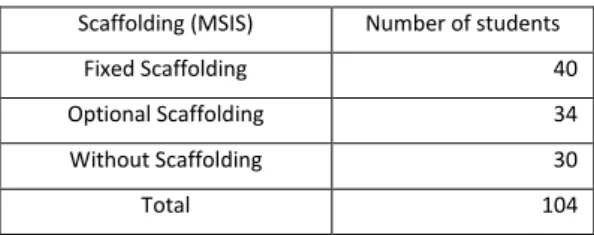
The research was conducted with a sample of 104 students (61 women and 43 men) from the tenth grade of a private school of the city of Bogotá D.C., located in the locality of Engativá. The ages ranged between 13 and 17 years (Mean=15.11 years, Standard Deviation=0.72). The number of students in each one of the tenth-grade courses is shown in table 1.
Table 1: Number of students that participated in each one of the courses
Scaffolding (MSIS) Number of students
Fixed Scaffolding 40
Optional Scaffolding 34
Without Scaffolding 30
Total 104
3.3
Instruments
3.3.1 Metacognitive Awareness Inventory (MAI)
T MAI was employed (Schraw and Moshman, 1995). The
, distributed in two components, namely: metacognitive knowledge and metacognitive regulation.
Metacognitive knowledge refers to the knowledge that a subject has on his or her own knowledge. This component has three subcategories: declarative knowledge, procedural knowledge, and conditional knowledge. On the other hand, the second component, that is to say, metacognitive regulation, refers to the activities that allow controlling learning. It has five subcategories: planning, organization, monitoring, control, and evaluation.
Planning relates learning goal and necessary resource assignment as a function of the desired goal. On the other hand, organizing considers the abilities and strategies that a person uses efficiently when developing learning tasks. Regarding monitoring, this refers to the level of supervision that the novice performs on their learning process or, of the strategies used during task development. Control has to do with the process through which the subject identifies learning weaknesses and adjusts the strategies to improve their performance and the effectiveness of the strategies implemented after a lesson.
MAI is a self-report questionnaire with a Likert scale using the following statements: 1. Strongly disagree, 2. Disagree, 3. Neither agree nor disagree, 4. Agree, and 5. Strongly agree. This instrument is validated in the Spanish language with Colombian students and evidences a good level of internal consistency, with a
C (Huertas, Vesga, and Galindo, 2014). In the present research the instrument had a
C
3.3.2 Metacognitive Scaffolding for Information Search (MSIS)
MSIS was developed in Hypertext Preprocessor (PHP) 5.3.26 language, it used a MySQL 5.5.37 database, and it was installed in a Web Apache 2.2.25 server. The interface was elaborated with HTML5, CSS3, and Jquery. The video aids were created in mp4 format, characteristics that allow the tool to adapt to virtual learning
M T ilt based on the elements proposed by
Hadwin and Winne, in their self-regulation learning model, which has a high metacognitive component (Hadwin and Winne, 2001) .
The scaffolding was designed and implemented within the structure of a hypermedia scenario, which was used
in the blended I
classroom and face-to-face classes. This modality is a hybrid educational system, in other words, it combines aspects of face-to-face education and information technologies-based instruction (Chafiq et al., 2014; K 2010; P and G ). The hypermedia environment contains theoretical elements, examples, and exercises on general chemistry. Additionally, it has technological resources, such as: videos, animations, and photographs, among others. The software consists of eight learning modules and was built in the Moodle platform.
M“I“ Web searches. Following this line of
thought, the scaffolding has structured guidelines based on metacognition for the development of search tasks (Hadwin and Winne, 2001; Kim and Hannafin, 2011). The different stages that make up the metacognitive scaffolding are described below.
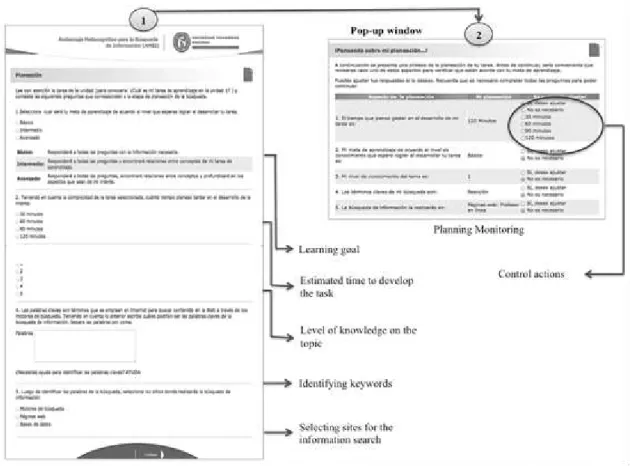
Stage 1. Knowledge Judgments: In this stage, the scaffolding introduces the student to the information Web search task with the purpose of getting them to reflect on and A their prior knowledge on the topic of query (declarative, procedural, and conditional knowledge). Similarly, it performs a detailed description of the stages of the information search process, which correspond to planning, execution, and evaluation (figure 1) (Kwon, Hong and Laffey, 2013; Li and Lim, 2008). This information allows the student to reflect on the state of their current knowledge and prepares them for the next stage.
Figure 1:Reflection and knowledge judgment stage
Stage 2. Search Planning: During this stage, the novice designs a work plan for the information Web search based on the following aspects: choosing a learning goal that guides their actions and acts as a reference point. Time spent on the information search process, for which the scaffolding offers the student four options: one of 30 minutes, others of 60, 90, and 120 minutes. It also questions them on their prior knowledge of the subject of the search task, for which the student is requested to indicate on a scale their level of knowledge.
On the other hand, the scaffolding offers the student five keywords on the search subject and presents them with three options to perform the information query. These options are: search engines (Google, Bing, and Yahoo), Web pages (Online teacher, Biology hypertexts, and Icaro), and finally, open access databases (Network of Scientific Journals of Latin America and the Caribbean-Redalyc and Directory of Open Access Journals-DOAJ) (Yelland and Masters, 2007; M. Zhang and Quintana, 2012).
T T
designed. There, the scaffolding, presents a synthesis of the planning and requests the novice to indicate if they agree with or want to modify the established items. This situation leads the student to reflect on the planning done.
As observed, planning has the objective of preparing the student, conscientiously, for the development of the information search task in an organized and structured fashion and, at the same time, it favors the capacity of monitoring, evaluating, and controlling the aspects proposed in this stage. Once this process has been completed, the student must face the next stage, which corresponds to search execution (Kim and Hannafin, 2011; Molenaar et al., 2010; Poitras, Lajoi, and Hong, 2012) (figure 2).
Stage 3. Search Execution: This stage begins with the information search of the chosen sites (search engines, Web pages, and databases) (Stronge, Rogers and Fisk, 2006; Thatcher, 2006). The scaffolding requests the novice to choose three reliable pages in accordance with the information search objective. If the pages contain the desired information, the scaffolding saves the Uniform Resource Locator (URL). Otherwise, it indicates that they must consult a new source of information. This aspect corresponds to the actions of monitoring and control that the scaffolding offers the novice with the objective of creating, in them, attitudes of reflection and control regarding their actions (figure 3).
Figure 2: Planning of and reflection on the information Web search
Once the process of choosing the search sites has been completed, the student analyzes and synthesizes the information found in order to answer the task (Mannheimer, 2010; M. Zhang and Quintana, 2012). This information search stage has a text editor for the student to synthesize the selected content and answer the search task.
At the end of the synthesis of information, the scaffolding offers the student the possibility of performing
metacognitive monitoring of th “ , which
has the objective of identifying the level of comprehension and depth reached in the revised content. If the student considers that they did not achieve the purpose, they can perform a new information Web search in order to reach a greater level of comprehension of the concepts studied (figure 4).
Finally, the scaffolding presents a series of metacognitive questions, which must be evaluated based on an established scale. According to the score obtained, the scaffolding offers feedback and proposes control
resources such as drawings or graphs that improve subject matter comprehension as a function of the achievement of learning goals (Fund, 2007; Scherer and Tiemann, 2012).
Figure 4: Synthesis of selected content
Stage 4. Evaluation of Search Results: this stage has the intent of getting the student to reflect on the progress so far in answering the learning task. In this sense, the student is forced to reflect on the achievement of the learning goal according to their expectations. Similarly, they evaluate if the time established to perform the search was enough; finally, they question if the selected strategy for the information search was effective (see figure 5).
Likewise, in this stage the MSIS allows the student to download the learning task and send it to the teacher for their corresponding evaluation. Once the teacher has revised the task, the feedback and observations are sent
s email so that they take actions guided towards improving the next information search.
Figure 5:Evaluation of Search Results
3.4
Procedure
For the development of m with the
project, they allowed the implementation of the research with the tenth-grade students. Subsequently, students were invited to participate in the study by
cceptance; in addition, parents were requested to authorize their
, at the same time, that the results would be managed confidentially and were for research purposes.
Before the start of the study, users and passwords were created so that students could access the Moodle platform. While conducting the research, weekly face-to-face meetings were carried out with the novices and teachers during chemistry period.
During the face-to-face classes, the teacher explained to students conceptual aspects of the different chemistry topics through examples and exercises. In these sessions, students browsed through the scenario implemented on the Web. At the end of the class, the teacher assigns the task to be completed by the students, which should be completed through information Web search. This task was worked on during out-of-class schedules and was available on the Moodle platform. Tasks completed by the students were sent weekly to the teacher through the same platform.
Once the teacher received the task, its corresponding evaluation was conducted and feedback was provided Similarly, in the next class, the teacher made observations according to
To monitor the study, a private domain was acquired (http://aulavirtual.adrianahuertas.co), which was used by students during the academic semester. The Moodle platform contained three courses in which the students enrolled. Each course presented the same educational resources, but differed in the scaffolding to be used. To that effect, a group of students had a fixed-type scaffolding, which was permanently showed to students through the platform and during the Web information search. Another group had an optional scaffolding,
w
choose whether to use it or not. A third group corresponded to the control group, which did not use MSIS.
4.
Findings
A MANCOVA was applied to the results obtained from the research. From this analysis, it was established that in the category of metacognition knowledge the resulting models have a high level of prediction of the different observed variables. The model expl I
L is found
a 57.1% of the total variance.
The results show that the declarative knowledge co-variable (pretest) has a significant association only with declarative knowledge (posttest); (F(1,98) = 120.05; p 2=0.551). The procedural knowledge co-variable (pretest) has a statistically significant effect on procedural knowledge (posttest); (F(1,98) = 55.65; p
0.001; 2=0.362). The conditional knowledge co-variable (pretest) has an effect on procedural knowledge (posttest); (F(1,98) = 75.38; p 2=0.435). Finally, it can be observed that the independent variable MSIS has a significant effect only on procedural knowledge (F(2,98) = 3.22; p=0.044; 2=0.062).
Regarding the resulting models in the metacognitive regulation category, the variable that has greater variance explained which achieves predicting 82.9%. In second place, , with a 77.0% of the total variance. In third place with a 74.4% of the total variance. In fourth place, , with a 73.3% of the total variance. L al variance.
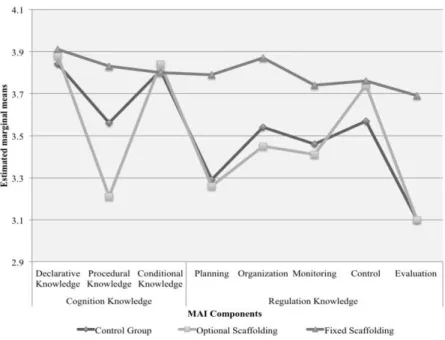
The results of the metacognitive regulation category show that all the co-variables exhibit significant associations with the final state of the same variable. Regarding the independent variable MSIS, it could be established that it has a significant effect on planning (F(2,96) = 30.04; p 2 =0.385), organization
(F(2.96) = 13.17; p 2=0.215), monitoring (F(2,96) = 8.81; p 2=0.155), and evaluation (F(2.96)
= 14.68; p 2=0.234).
The results of the MANCOVA analysis are shown in figure 6, where it can be observed that the independent variable MSIS has a significant statistical effect on the development of categories of the MAI instrument (procedural knowledge, planning, organization, monitoring, and evaluation).