Eect of Operation Conditions on the Catalytic
Performance of the Co/Mn/TiO
2
Catalyst for
Conversion of Synthesis Gas to Light Olens
F. Shayegh
1;2, C. Ghotbi
1;, R. Bozorgmehry Boozarjomehry
1and D. Rashtchian
1Abstract. The eect of operation variables, such as the H2/CO molar feed ratio, gas hourly space
velocity (GHSV), temperature, and pressure, on the catalytic performance of the Co/Mn/TiO2 catalyst
prepared at the Research Institute of the Petroleum Industry (RIPI) was investigated, and optimum reactor conditions were obtained to produce the maximum amount of light olens. The catalyst was prepared by co-precipitation of Co and Mn phases in the presence of commercial TiO2 with maximum selectivity
for ethylene and propylene production. It was found that the [H2]/[CO]=2/1, space velocity (GHSV)
of 1800 h 1, 280C temperature and 4 bar pressure were optimum operating conditions for the modied
catalyst for the conversion of Synthesis Gas(SG) to light olens. The results were interpreted in terms of the structure of the catalyst. Characterizations of catalysts were carried out using XRD, SEM and BET specic surface area.
Keywords: Operation condition; Co-precipitation; Cobalt manganese oxide catalyst; Fischer-Tropsch synthesis; Light olens.
INTRODUCTION
An increasing demand for clean fuels and chemicals is expected to lead to an important shift from crude oil to natural gas as feedstock for chemical indus-tries. This will certainly involve the use of Fischer-Tropsch (FT) technology, which is usually dened as a type of surface catalyzed polymerization reaction in which hydrocarbons are produced according to the ASF (Anderson-Schulz-Flory) distribution [1-3], thus limiting the yield of light olens (C2-C4). In recent years, researchers have become interested in making light olens (C2-C4) from Syn-Gas via FT synthesis, rather than the more conventional methods of catalytic cracking of naphtha and dehydrogenation of alkanes [4]. The catalysts of iron and cobalt mixed with Manganese used for conversion of Synthesis Gas to
1. Department of Chemical and Petroleum Engineering, Sharif University of Technology, Tehran, Iran.
2. Research Institute of Petroleum Industry (RIPI), Gas Divi-sion, Tehran, Iran.
*. Corresponding author. E-mail: [email protected]
Received 30 September 2009; received in revised form 14 January 2010; accepted 13 June 2010
hydrocarbons, have been extensively studied because of their characteristics, such as selective formation of light olens in the C2-C4 range [1,5-11], partic-ularly propylene [10] with a suppressed C1 product on deviating from the ASF distribution [12]. It was further found that Manganese Oxide in these two types of catalyst acted as a structural promoter that was dicult to reduce, thus leading to an increase in the specic surface area [13]. Mn has been widely used as one of the promoters of unsupported Fe-based FT catalysts, particularly in promoting the production of C2-C4 olens [14]. Numerous studies have been reported on hydrocarbon product distri-bution from Fischer-Tropsch synthesis on cobalt cat-alysts, but most of them have not taken into ac-count the reactor operating characteristics, such as H2/CO ratio, reactor temperature and pressure [15,16]. Furthermore, reports from industrial pilot plants or commercial reactors usually lack information on cat-alyst composition and operating conditions. Some investigators have reported the eect of operation parameters on product distribution from cobalt-based catalysts [7,17] and showed that the olen contents of the product spectrum decreased with increasing
pressure, which was consistent with previous investi-gations [6,18,19].
In this work, we attempt to extensively report the inuence of operating variables, such as H2/CO molar feed ratio, reaction temperature, pressure, and gas hourly space velocity (GHSV), on the catalytic per-formance of the recently developed RIPI-Co/Mn/TiO2 catalyst with optimum selectivity for olens and propy-lene in particular. We also characterized the cata-lyst precursor, as well as the catacata-lysts, using various techniques including powder X-Ray Diraction (XRD), Scanning Electron Microscopy (SEM) and BET surface area measurement.
EXPERIMENTAL Catalyst Preparation
The catalysts tested in this study were prepared using a co-precipitation procedure. Aqueous solutions of Co(NO3)2-6H2O (1.0 mol/l) and Mn(NO3)2-6H2O (1.0 mol/l) were pre-mixed in a round-bottomed ask tted with a condenser and the resulting solution heated. Aqueous Na2CO3 (1.0 mol/l) was added drop wise to the mixed nitrate solution, which was continuously stirred, whilst the temperature was 70C. The nal pH achieved was 8 0.1. This procedure took approximately 10 minutes to complete. The resulting precipitate was then left in this medium for 30 mins. The aged precipitate was rst ltered and then washed several times with warm distilled water (100C) until no further Na+ was observed in the washings, tested by ame atomic absorption. The precipitate was then dried at 120C for 16 h to give a material denoted as the catalyst precursor, which was subsequently calcined in static air in the furnace (500C, 16 h) to give the nal catalyst. For preparation of the supported catalyst, TiO2 (anatase) support has been added to the mixed solution of cobalt and manganese nitrates.
Catalyst Characterization X-Ray Diraction (XRD)
Powder X-Ray diraction (XRD) measurements were performed using a Bruker Axs Company, D8 Advance diractometer (Germany). Scans were taken with a 2 step size of 0.02 and a counting time of 1.0 s using a CuKradiation source generated at 40 kV and 30 mA. Specimens for XRD were prepared by compacting it into a glass-backed aluminum sample holder. Data was collected over a 2 range from 4 to 70 and phases were identied by matching experimental pat-terns to entries in the Diracplus Version 6.0 indexing software.
BET Measurements
The BET surface area were measured using a N2 adsorption-desorption isotherm at liquid nitrogen temperature (-196C), using a NOVA 2000 instru-ment (Quantachrome, USA). Prior to the adsorption-desorption measurements, all the samples (precursors and catalysts) were degassed at 200C in a N2ow for 3 h to remove the moisture and other adsorbents. Scanning Electron Microscopy
The morphology of catalysts and their precursors were observed by means of a Cam scan MV2300 scanning electron microscopy.
Catalyst Testing
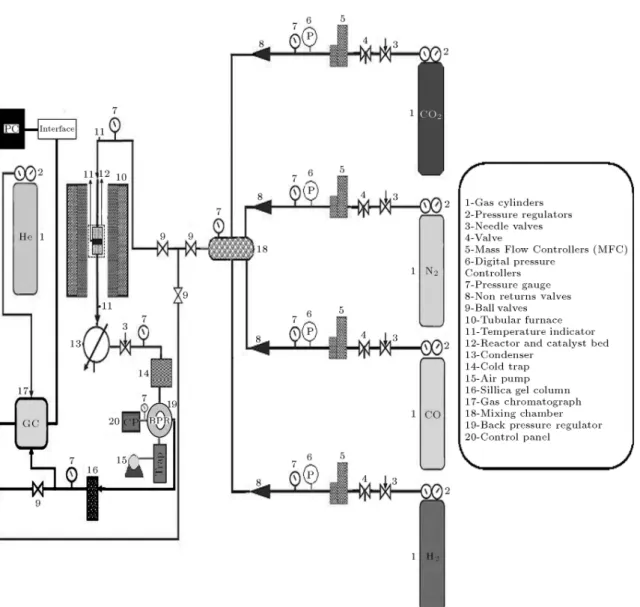
The catalyst tests were carried out in a xed bed stainless steel micro reactor under various operating conditions (Figure 1). All gas lines to the reactor bed were made from 1/400stainless steel tubing. Three mass ow controllers (Brooks, Model 5850E) equipped with a four-channel control panel (Brooks 0154) were used to adjust the ow rate of the inlet gases (CO, H2and N2 with purity of 99.99%) automatically. The mixed gases passed into the reactor tube, which was placed inside a tubular furnace (Atbin, Model ATU 150-15) capable of producing temperature up to 1300C, and controlled by a digital programmable controller (DPC). The reactor tube was constructed from 1/200 stainless steel tubing with an internal diameter of 9 mm. The catalyst bed is located at the middle of the reactor. The reaction temperature was controlled by a computer based on the temperature measurement obtained by a thermocouple inserted into the catalyst bed. The meshed catalyst (1.0 g catalyst with particle size of 250-500 m) was held in the middle of the reactor. The tube length of the reactor is 110 cm. The quartz bed of the catalyst is in the middle of the tube, which was packed with granules of quartz, and the catalyst was held over the reactor bed in the middle of the tube. The reactor tube is equated to three thermocouples that can control the temperature of the mixture before and after the reaction and also the catalyst bed reactor (during the reaction).
The studied system consists of an electronic back pressure regulator that can control the total pressure of the desired process. The catalyst was pre-reduced in situ atmospheric pressure in a owing H2 stream (ow rate = 30 ml/min) at 400C for 16 h before synthesis gas exposure. The Fischer-Tropsch reactions were carried out under dierent conditions of T = 220 400C, P = 1 8 bar, H
2/CO = 1/1-3/1 and GHSV=1200-2400 h 1. Reactant and product streams were analyzed in an on-line manner using a gas chromatograph (Varian, Model 3400 Series) equipped with a 10-port sampling valve (Supelco company, USA,
Figure 1. Schematic representation of the experimental set-up.
Visi Model), a sample loop and Thermal Conductivity Detector (TCD). The contents of the sample loop were injected automatically into a packed column (Hayesep DB, Altech Company, USA, 1/800 OD, 10 meters long, and particle mesh 100/120). Helium was employed as a carrier gas for optimum sensitivity (ow rate = 30 ml/min). The calibration was carried out using vari-ous calibration mixtures and pure compounds obtained from the American Matheson Gas Company (USA). GC controlling and collection of all chromatograms were done via an IF-2000 single channel data interface (TG Co, Tehran, Iran) in a windowsr environment. The calibrations were carried out for mixtures of olens, C2-C4 as well as alkanes and pure preeminent gases (Co, H2, N2, O2, Co2, CH4, C2H4, C2H6, C3H6, C3H8 and C4H10) obtained from the American Matheson Gas Company (USA). The molecular weight of C5+was measured using a Petrocoal-DH column and the composition of C5+ was obtained using a Carbone
balance between input and output gas ow rate. The results, in terms of CO conversion, selectivity, and yield of product, were obtained at each space velocity. The CO conversion (%) was calculated according to the normalization method:
mCO conversion(%) =
(Moles COin) (Moles COout) Moles COin 100:
The selectivity (%) towards the individual components on a carbon-basis was calculated according to the same principle:
Selectivity to product j(%) = Moles of productj
RESULTS AND DISCUSSION Eect of Operation Conditions
The eects of a range of operation variables, such as H2/CO feed gas molar ratios, space velocities (GHSV), reaction temperatures and reactor total pres-sures, on the catalytic performance of a co-precipitated Co/Mn/TiO2 catalyst prepared on RIPI, have been investigated to identify and optimize the operating conditions and, also, to examine the catalyst stability for the conversion of synthesis gas to C2-C4light olens on the Fischer-Tropsch synthesis.
Eect of H2/CO Molar Feed Ratio
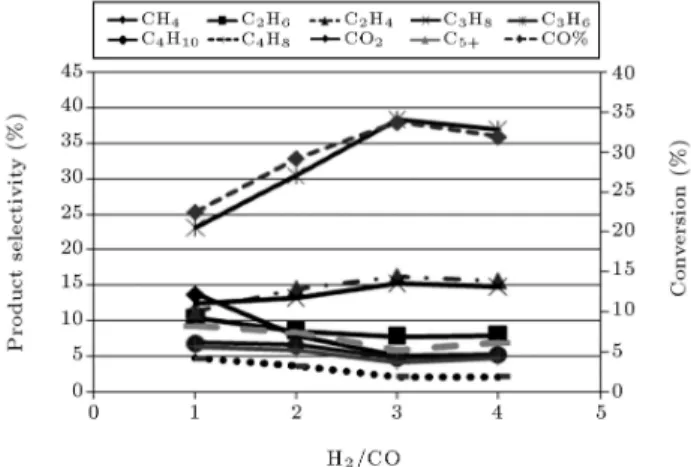
The inuence of the H2/CO molar feed ratio on the steady state performance of the cobalt manganese oxide catalyst for the Fischer-Tropsch reaction at 280C under atmospheric pressure was investigated, and the CO conversion and light olens product selectivity for dierent H2/CO molar feed ratios are presented in Figure 2. The results show that with variation in the H2/CO feed ratio from 1/1 to 3/1, dierent values for selectivity with respect to light olens were obtained. However, in the case of the H2/CO=2/1 (GHSV=1800 h 1), the total selectivity for light olens was higher, and the CH4 selectivity was lower than those obtained for other H2/CO molar feed ratios under the same temperature and pressure. It is also apparent that, for all H2/CO feed molar ratios, the RIPI catalyst shows a high selectivity toward propylene. Keyser et al. [7] have also indicated that for the Fischer-Tropsch synthesis over the Cobalt Manganese oxide catalyst, with increasing H2/CO feed molar ratio, the content of C2 and C4 olen is decreased, while the propylene content is increased. Therefore, the H2/CO=2/1 ratio was chosen as the optimum ratio for conversion of synthesis gas to light olens over cobalt manganese catalysts.
Figure 2. Eect of H2/CO feed ratio on the performance
of the RIPI catalyst, T = 280C, P = 1 atm,
GHSV=1800 h 1.
Eect of Space Velocity (GHSV)
To obtain a better understanding of the factors aect-ing the catalytic performance of the RIPI catalyst, a series of experiments were carried out for GHSV from 450 to 2700 h 1 under identical reaction conditions of 1 bar and 280C, and a H
2/CO ratio of 2. Figure 3 shows the CO conversions and product selectivity's percents as a function of GHSV. It can be noticed from Figure 3 that by increasing the GHSV to 1800 h 1, the selectivity for both C2 and C3 olens increased. The ethylene selectivity increased slightly with further increases in the space velocity. In the case of propylene, however, the maximum selectivity was obtained at GHSV of 1800 h 1. As can be seen from Figure 3, the C+
5 products selectivity decreased with increasing GHSV. The GHSV of 1800 h 1 was considered to be the optimum GHSV due to high CO conversion, high selectivity for light olens, and low selectivity for CH4 and CO2.
Eect of Reaction Temperature
The Co-based catalyst is generally not considered at high temperatures in Fischer-Tropsch synthesis, so an extensive range of temperature was studied in order to make a transition from low temperature Fischer-Tropsch (LTFT) to high temperature Fischer-Fischer-Tropsch (HTFT).The eect of reaction temperature on the performance of the RIPI catalyst was studied at a temperature range of 220 to 400C under identical conditions of H2/CO=2/1, space velocity (GHSV) of 1800 h 1 and 1 bar pressure. The results, presented in Figure 4, indicated that by increasing the operating temperature, the CO conversion increased. In addition, the maximum total selectivity for light olens was obtained at 280C in CO conversion. In general, an increase in the reaction temperature leads to enhanced selectivity for CH4and CO2, as well as the formation of large amounts of coke as an unwanted by product [20].
Figure 3. Eect of GHSV on the performance of the RIPI catalyst, T = 280C, P = 1 atm , H
Figure 4. Eect of reaction temperature on the performance of the RIPI catalyst, P = 1 atm, GHSV = 1800 h 1, H
2/CO=2/1.
Therefore, in this study, 280C was considered to be the optimum operating temperature due to the high total selectivity for light olens, low CH4 production and lack of coke formation.
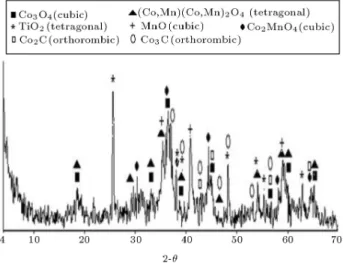
The actual phases identied in the XRD pat-tern of the catalyst at 280C were Co
3O4 (cubic), CoO (cubic), (Co,Mn)(Co,Mn)2O4(tetragonal), MnO2 (tetragonal and orthorhombic), CoMnO3(cubic), MnO (cubic), Co2C (orthorhombic) and Co3C (orthorhom-bic), as shown in Figure 5. The tested catalyst has oxidic and Cobalt carbide phases both of which are active phases in the catalyst. Oxidic phases are highly selective for the conversion of synthesis gas to olens, and carbide phases are active in the hydrogenation of CO [21,22].
The SEM observations have shown dierences in the morphology of precursor and optimum calcinated catalysts (before and after the Fischer-Tropsch reac-tion). The electron micrograph obtained from the catalyst precursor depicts several larger agglomerations
Figure 5. XRD patterns of RIPI catalyst after reaction at 280C.
of particles (Figure 6a) and shows that this material has a less dense and heterogeneous morphology. After calcination at 500C, the morphological features are dierent from the precursor sample, and this shows that the agglomerate size is greatly reduced, compared with the precursor (Figure 6b). It may be due to this reason that the calcinated catalyst surface is covered with small crystallites of cobalt and manganese oxide, which seems to be in agreement with XRD results. However, the size of these grains grew larger by agglomeration in the spent catalyst of the Fischer-Tropsch synthesis at 280C (Figure 6c), which may be due to the sintering during reactions. In order to distinguish the inuence of reaction temperature on the specic surface area of the RIPI catalyst, all the tested catalysts at dierent temperatures were characterized by BET specic surface area measurements whose results are shown in Figure 7 (with 5% accuracy). The calcinated catalyst before the test showed a higher specic surface area (136.8 m2g 1) than those of the catalysts after the test at dierent temperatures. This means that the specic surface area slightly decreases with increasing reaction temperature for the tested catalysts, which could be due to an increase in sintering that leads to the particles agglomeration. This shows that the reaction temperature should not be too high. At high reaction temperatures, a lot of coke may be formed, and also the specic surface area of the catalyst will be reduced. The results obtained from BET measurements are in agreement with the SEM study, which showed that the size of grains grew larger
Figure 6. The SEM images of calcinated RIPI catalyst. (a) Precursor. (b) Calcinated catalyst before reaction. (c) Calcinated catalyst after reaction.
Figure 7. BET results for RIPI catalysts after reaction at various temperatures.
by agglomeration in the spent catalyst, leading to a decrease in the BET specic surface area.
Eect of Total Pressure
Pressure is an important parameter for the Fischer-Tropsch synthesis, which is supposed to be operated under high pressure. An increase in total pressure would generally result in the condensation of hydro-carbons, which are normally at the gaseous state at atmospheric pressure. Higher pressures and higher carbon monoxide conversions would probably lead to the saturation of catalyst pores by liquid reaction products [23]. A dierent composition of the liquid phase in catalyst pores at high Syn-Gas partial pres-sures could aect the rate of elementary steps, and carbon monoxide and hydrogen concentrations. A series of experiments were carried out to investigate the performance of the RIPI catalyst at various total pressures in the range of 1-8 bar, under optimum reaction conditions of H2/CO=2/1, GHSV of 1800 h 1, and temperature of 280C. The eect of pressure on reaction performance is presented in Figure 8. The results indicated that at the total pressure of 1 bar, the RIPI catalyst showed a total selectivity of 58.7% for C2-C4 olen and 5.8% for C+5. It is also seen from Figure 8 that increasing total pressure in the ranges of 4 to 8 bars would signicantly increase the selectivity for C+
5 up to 23% at the pressure of 8 bars. On the other hand, as can be noticed from Figure 8, for pressures in the range of 1 to 4 bars, no signicant decrease in CO conversion was observed, while the selectivity for light olens was increased, indicating that the total pressure of 4 bar lead to the optimum performance of the catalyst at which the highest selectivity of 58.9% for C2-C4 light olens was obtained. It should be noted that the selectivity of C+
5 under this condition was about 7.2%. The results also indicated that CO conversion and total selectivity for C2-C4 olens decreased as the total pressure was increased from 5 to 8 bar. Hence, due to high CO conversion, low CH4 selectivity and selectivity for high C2-C4 olens, 4 bar pressure seems to be the optimum operating pressure.
Figure 8. Eect of total pressure on the performance of the RIPI catalyst, T = 280C, GHSV = 1800 h 1, H
2/CO
= 2/1.
Optimum Catalyst Life Testing
In order to study the stability of the RIPI catalyst, it was initially tested for 24h under 4 bar Syn-Gas pressure (H2/CO=2/1) at 280C for which it was found that over a period of 24h, no loss in activity or light olens selectivity was observed. In order to test the long term stability of the catalyst, the time interval was extended to 150h. The obtained results shown in Figure 9 indicate that during the Fischer-Tropsch synthesis, a stable trend for the catalyst was observed in a 150 h time interval. The activity of the catalyst remained constant during the Fischer-Tropsch synthesis reaction. Since the activity remained unchanged, it was concluded that the structure of the catalyst was stable. For comparing the structure of the catalyst tested for 8h and the catalyst tested for long term stability of 150h, both of these catalysts were characterized by XRD, SEM and BET methods to study their phases and morphological features and also to measure their specic surface areas. The BET specic surface area of the RIPI catalyst after 150h was found to be 133.5 m2g 1 and that of the tested
Figure 9. Eect of Time-On-Stream (TOS) on catalyst conversion.
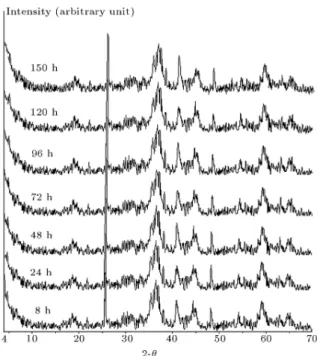
catalyst for 8h was found to be 135.2 m2g 1. These results indented that no signicant changes occurred in the specic surface area of the catalyst. Figure 10 shows that the XRD pattern of the catalyst having undergone a 150 hr test is almost similar to the XRD pattern of the catalyst having undergone an 8 hr test. The only dierence between the structures of these two catalysts after undergoing their corresponding test periods is the presence of Co3C (hexagonal), in addition to the other common phases of Co3O4 (cu-bic), (Co,Mn)(Co,Mn)2O4 (tetragonal), CoO (cubic), MnO (cubic), TiO2(tetragonal), Co2C (orthorhombic) and Co3C (orthorhombic) for the catalyst tested for 8hr. As can be seen, the XRD patterns of the calcinated catalyst after life time tests showed that the Cobalt oxide phase is an active phase in the Fischer-Tropsch synthesis. The characteristic mor-phological features of both calcinated catalysts having undergone short term and long term stability tests are presented in Figure 11. There was no signicant change in morphology between the two samples; 8h (Figure 11a) and 150 h (Figure 11b), however, as can be seen, for the tested catalyst after 150 h, there is a slight increase in agglomerate size. It, therefore, appears that longer test time enhances agglomerate size growth during reaction conditions, which may be due to the possibility of the bulk Cobalt carbides presence in Co3C (hexagonal), Co2C (orthorhombic) and Co3C (orthorhombic) forms, as detected by the XRD pattern. The existing catalyst phase strongly depends on the structure of the catalyst and the activation procedure employed. The presence of Mn
Figure 10. XRD patterns of RIPI catalyst after reaction for 8 h and 150 h time intervals.
Figure 11. The SEM images of RIPI catalyst. (a) Tested for 8 h. (b) Tested for 150 h.
enhances the carbon monoxide conversion rate and hydrocarbon selectivity, simultaneously [24-27]. Zhang et al. [28] found that the presence of Mn improved dispersion of Cobalt active phases and facilitates the formation of bridged type adsorbed CO. The presence of Manganese generally led to the formation of larger cobalt agglomerates (8-15 nm). Then, catalysts with larger Co particles (> 5 nm) and lower Co reduction displayed a higher intrinsic hydrogenation activity and a longer catalyst lifetime [29]. A signicant eect of Mn was observed on Titania-supported catalysts prepared by Morales and Weckhuysen [26]. STEM-EELS showed [30] that the oxidized catalysts contained Co3O4 and MnO2 monometallic particles, while in the deposition-precipitation sample, Mn cations were incorporated into the Co3O4structure, resulting in the MnxCo3 xO4mixed oxide phase. These mixed phases, however, could be reduced, which would give rise to a cobalt metal phase and migration of MnO particles toward the TiO2. The presence of MnO resulted in lower cobalt reducibility [25].
CONCLUSION
A titania supported cobalt manganese oxide catalyst, RIPI catalyst, which has been prepared using a co-precipitation procedure, was tested under dierent reaction conditions, and it was found that operating conditions have a great eect on the structure and catalytic performance of the catalyst. The eect of various factors, such as reaction temperature, reaction pressure, H2/CO molar feed ratio and space velocity (GHSV), were examined on the catalytic performance of the RIPI catalyst. The optimum operating condi-tions for the production of highest selectivity toward light olens were found to be at the temperature of 280C with molar feed ratio of H2/CO=2/1 under the total pressure of 4 bar and at the GHSV of 1800 h 1. The characterization of precursor and calcinated catalysts (before and after the test) was performed by powder XRD, SEM and BET surface area measurement. These results also showed that the catalyst is sensitive to operating conditions. The suggested optimum operating parameters should be
incorporated in order to achieve the highest selec-tivity toward light olens from the TiO2 supported cobalt manganese oxide catalyst, prepared using a co-precipitation procedure.
REFERENCES
1. Wang, C., Xu, L. and Wang, Q. \Review of directly producing light olens via CO hydrogenation", J. Natural Gas Chemistry, pp. 1210-16 (2002).
2. Zhang, J., Chen, J., Li, Y. and Sun, Y. \Recent tech-nological developments in cobalt catalysts for Fischer-Tropsch synthesis", J. Natural Gas Chemistry, pp. 1199-108 (2002).
3. Yang, J., Liu, Y., Chang, J., Wang, Y., Bai, L., Xu, Y., Xiang, H., Li, Y. and Zhong, B. \Detailed kinetics of Fischer-Tropsch synthesis on an industrial Fe-Mn catalyst", Ind. Eng. Chem. Res., 42, pp. 5066-5090 (2003).
4. Herranz, T., Rojas, S., Perez-Alonso, F.J., Ojeda, M., Terreros, P. and Fierro, J.L.G. \Hydrogenation of carbon oxides over promoted Fe-Mn catalysts prepared by the micro emulsion methodology", Appl. Catal. A Gen., 311, pp. 66-75 (2006).
5. Mirzaei, A.A., Habibpour, R., Faizi, M. and Kashi, E. \Characterization of iron-cobalt oxide catalysts: Eect of dierent supports and promoters upon the structure and morphology of precursors and catalysts", Appl. Cat. A Gen., 301, pp. 272-283 (2006).
6. Mirzaei, A.A., Faizi, M. and Habibpour, R. "Eect of preparation conditions on the catalytic performance of cobalt manganese oxide catalysts for-conversion of synthesis gas to light olens", Appl. Cat. A Gen., 306, pp. 98-107 (2006).
7. Keyser, M.J., Eversion, R.C. and Espirnoza, R.L. \Fischer-tropsch kinetic studies with cobalt-manganese oxide catalysts", Ind. & Eng. Chem. Res., 39(1), pp. 48-54 (2000).
8. Tao, Z. et al. \Eect of calcium promoter on a pre-cipitated iron-manganese catalyst for Fischer-Tropsch synthesis", Cat. Comm., 7, pp. 1061-1066 (2006). 9. Zhang, C.H., Yang, Y., Teng, B.-T. et al. \Study of
an iron-manganese Fischer-Tropsch synthesis catalyst promoted with copper", J. of Cat., 237(2), pp. 405-415 (2006).
10. Das, D., Ravichandran, G. and Chakrabarty, D.K., \Synthesis of light alkenes from syngas on silicalite-1 supported cobalt and cobalt-manganese catalysts", Appl. Cat. A Gen., 131, pp. 335-345 (1995).
11. Yuan, J.Y. et al. \Crystal phase and performance in supported Fe-Mn catalysts for Fischer-Tropsch synthe-sis", J. Nat. Gas. Chem., 8, pp. 339-351 (1999). 12. Jiang, M., Koizumi, N., Ozaki, T. and Yamada,
M. \Adsorption properties of cobalt and cobalt-manganese catalysts studied by in situ diuse re-ectance FTIR using CO and CO+H2as probes", App.
Cat. A Gen., 209, pp. 59-70 (2001).
13. Malessa, R. and Baerns, M. \Iron/manganese oxide catalysts for Fischer-Tropsch synthesis activity and selectivity", Ind. Eng. Chem. Res., 27, pp. 279-283 (1988).
14. Bian, G.Z. et al. \Studies with a precipitated iron Fischer-Tropsch catalyst reduced by H2 or CO", J.
Mol. Cat. A : Chemical, 186, pp. 203-213 (2002). 15. Morales, F. et al. \Eects of manganese oxide promoter
on the Co and H2 adsorption properties of
titania-supported cobalt Fischer-Tropsch catalysts", J. Cat., 246(1), pp. 91-99 (2007).
16. Li, H., Wang, S., Ling, F. and Li, J. \Studies on MCM-48 supported cobalt catalyst for Fischer-Tropsch synthesis", J. Mol. Cat. A: Chemical, 244(1-2), pp. 33-40 (2006).
17. Sun, S., Tsubaki, N. and Fujimoto, K. \The reaction performance and characterization of Fischer-Tropsch synthesis Co/SiO2 catalysts prepared from mixed
cobalt salts", Appl. Cat. A: Gen., 202(1), pp. 121-131 (2000).
18. Park, C. and Baker, R.T.K. \Carbon deposition on iron-nickel during interaction with ethylene-carbon monoxide-Hydrogen mixture", J. Cat., 190(1), pp. 104-117 (2000).
19. Kim, S.M. et al. \Eect of CO2 in the feed stream
on the deactivation of Co/Y-Al2O3 Fischer-Tropsch
catalyst", Cat. Comm., 9(13), pp. 2273-2307 (2008). 20. Gaube, J., Herzog, K., Konig, L. and Schliebs,
B. \Kinetische undersuchungen der Fischer-Tropsch-synthese zur klarung der wirkung des alkali als promo-tor in eisen-katalysapromo-toren", Chem. Ing. Tech., 58, pp. 682-683 (1986).
21. Zhang, H.B. and Schrader, G.L. \Characterization of a fused iron catalyst for Fischer-Tropsch synthesis by in-situ laser raman-spectroscopy", J. Cat., 95, pp. 325-332 (1985).
22. Shro, M.D. et al. \Activation of precipitated iron Fischer-Tropsch synthesis catalysts", J. Cat., 156, pp. 185-297 (1995).
23. Griboval-Constant, A., Khodakov, A.Y., Bechara, R. and Zholobenko, V.L. \Support mesoporosity: A tool for better control of catalytic behavior of cobalt supported Fischer-Tropsch catalysts", Stud. Surf. Sci. Cat., 144, pp. 609-616 (2002).
24. Colley, S., Copperthwaite, R.G., Hutchings, G.J., Vander Riet, M. \Carbon monoxide hydrogenation using cobalt manganese oxide catalysts", Ind. Eng. Chem. Res., 27, pp. 1339-1344 (1988).
25. Morales, F. et al. \In situ X-ray absorption of Co/Mn/TiO2catalysts for Fischer-Tropsch synthesis",
J. Phys. Chem. B., 108, pp. 16201-16207 (2004). 26. Morales, F. et al. \Mn promotion eects in Co/TiO2
Fischer-Tropsch catalysts as investigated by XPS and STEM-EELS", J. Cat., 230, pp. 301-308 (2005).
27. Morales, F. et al. \X-ray absorption spectroscopy of Mn/Co/TiO2 Fischer-Tropsch catalysts:
Relation-ships between preparation method, molecular struc-ture and catalyst performance", J. Phys. Chem. B, 110(17), pp. 8626-8639 (2006).
28. Riedel, T. et al. \Advances in the development of novel cobalt Fischer-Tropsch catalysts for synthesis of long-chain hydrocarbons and clean fuels", Appl. Cat. A: Gen., 186, pp. 201-213 (1999).
29. Zhang, J.L., Ren, J., Chen, J.G. and Sun, Y.H. \Eect of manganese promoter on the performance of Co/Al2O3 catalysts for Fischer-Tropsch synthesis",
Act. Phys. Chim. Sin., 18(3), pp. 260-266 (2002). 30. Morales, F. et al. \Combined EXAFS and
STEM-EELS study of the electronic state and location of Mn as promoter in Co-based Fischer-Tropsch catalysts", Phys. Chem., 7, pp. 568-572 (2005).
BIOGRAPHIES
Flor Shayegh is currently a Ph.D. student at the institute of Petroleum & Chemical Engineering at Sharif University of Technology. She is working in Research Institute of Petroleum and Industry (RIPI). Her research interests include study of Kinetic and Op-timization of Reactions and Development of Petroleum Processes. She contributed more than 40 research project in RIPI. She is the author of 8 papers published in Journals, 14 papers presented in the conferences and one patent.
Cyrus Ghotbi was born in 1956, in Tehran, Iran.
After graduation from the Department of Chemical Engineering at Sharif University of Technology in 1978, he continued his studies on Petroleum Engineering at the French Institute of Petroleum (IFP), Paris, and received his M.S. and Ph.D. degrees in 1981 and 1984, respectively. He then joined Sharif Uni-versity of Technology in Tehran and presently he is the Professor of Chemical Engineering at this univer-sity. His research interests include: Thermodynamics, Separation Process, and Petroleum Characterization. Professor Ghotbi is the author of about 50 papers published in international journals, and about 90 pa-pers presented at international and national confer-ences.
R. Bozorgmehry Boozarjomehry. His/her biogra-phy was not available at the time of publication. Davoud Rashtchian is currently a professor of Chemical Engineering at Sharif University of Tech-nology in Tehran, Iran. After graduation in Chem-ical Engineering at Sharif University (1976), he joined the Department as an instructor. He con-tinued his studies in University of Manchester and received his M.S. and Ph.D. degrees in 1985 and 1988, respectively. His research areas are: Pro-cess Design, Safety and Loss Prevention. Dr Rashtchian is author of many scientic papers in the related subject and has also presented many papers in the national and international confer-ences.