A Return on Investment Model for Software
Configuration Management
Lorenzo Borraci
Erasmus Department of Computer Science Lund Institute of Technology Lund University, 2005ISSN 1650-2884 LU-CS-EX: 2005-19
Department of Computer Scienze
A Return on Investment
Model for Software
Configuration Management
Candidate
Lorenzo Borracci
Supervisor
Prof. Lars Bendix
Ulf Asklund
List of Figures 5 Introduction 7 Objectives . . . 7 Thesis organization . . . 9 1 Analysis 10 1.1 SCM . . . 10 1.2 Documentation . . . 12 1.3 The 4 activities of SCM . . . 13 1.3.1 Configuration Identification . . . 13 1.3.2 Configuration Control . . . 14
1.3.3 Configuration Status Accounting . . . 16
1.3.4 Configuration Auditing . . . 18
1.4 SCM in the product development life cycle . . . 19
1.4.1 Requirements . . . 20 1.4.2 Design . . . 20 1.4.3 Coding . . . 21 1.4.4 Production . . . 21 1.4.5 Maintenance . . . 22 1.5 People involved . . . 23 1.5.1 Senior management . . . 23 1.5.2 Project management . . . 24 1.5.3 Configuration manager . . . 24 1.5.4 Designers . . . 24
1.5.5 Administrator and technician . . . 24 1
1.6.1 Measurability . . . 29
2 The Model 32 2.1 The model . . . 32
2.2 The matrix . . . 34
2.3 Parameters of the model . . . 35
2.3.1 Costs . . . 35
2.3.1.1 Tool costs . . . 36
2.3.1.2 Training costs . . . 36
2.3.1.3 Added work associated with new SCM tasks . . 37
2.3.1.4 Change process may be more complicated (cost derived by loss of time) . . . 38
2.3.1.5 Little loss of time doing the status accounting reports . . . 38
2.3.1.6 Fear of the new procedures . . . 38
2.3.2 Benefits . . . 39
2.3.3 Measurable benefits . . . 39
2.3.3.1 Decrease of the externally reported defects . . 39
2.3.3.2 Decrease of bug-fix time. Ability to trace the original product through its development . . . . 39
2.3.3.3 Save time with automated software builds . . . 40
2.3.3.4 Manage version, parallel work and automatic merge . . . 40
2.3.3.5 Traceability addresses less time for V&V and testing . . . 41
2.3.4 Partially measurable benefits . . . 41
2.3.4.1 Decrease of number of staff changes and helps to integrate new employers . . . 41
2.3.4.2 Allow us to handle very complex activities like handling variant of a product / Gain factor fix-ing bugs in different variant of a program . . . 42
2.3.4.5 Changes are planned, their impact is assessed . 43 2.3.4.6 Reducing the number of errors (given from
dou-ble maintenance, shared data prodou-blem,
simul-taneous update, working in chaos) . . . 43
2.3.5 Not measurable benefits . . . 44
2.3.5.1 Employers are happier . . . 44
2.3.5.2 SCM provides for communications and coordi-nation in the group . . . 44
2.3.5.3 Pleasure of working in stability with a baseline and the own workspace . . . 44
2.3.5.4 Home working and distributed development . . 45
2.3.5.5 Be able to bring out the work earlier, before other companies . . . 45
2.3.5.6 Decrease the time required to respond to end-user requests and inquiries . . . 45
2.3.5.7 SCM activities (in particular configuration au-dit and configuration control) assure the cus-tomer that he gets what he paid for . . . 46
2.3.5.8 Audits at the end of each phase of the devel-opment life cycle assure the consistency of the work . . . 46
2.3.5.9 Achieves a sense of organization and control instead chaos . . . 46
2.3.5.10 Provides visibility of the project . . . 46
2.4 ROI evaluation . . . 47
2.4.1 Costs . . . 48
2.4.1.1 Tool costs, licenses and maintenance cost . . . . 48
2.4.1.2 Training costs . . . 49
2.4.1.3 Cost for added work associated with new SCM tasks . . . 49
2.4.2 Benefits . . . 50 3
merge . . . 51
2.4.2.4 Traceability addresses less time for V&V and testing . . . 52 2.4.3 ROI Algorithm . . . 52 3 The method 54 3.1 GQM Analysis . . . 54 3.2 GQM application . . . 56 3.2.1 SCM Goals . . . 56
3.2.2 Goal 1: Stability of the Staff . . . 56
3.2.2.1 Questions and Metrics . . . 59
3.2.2.2 Parameters from the model . . . 59
3.2.3 Goal 2: More productivity . . . 60
3.2.3.1 Questions and Metrics . . . 61
3.2.3.2 Parameters from the model . . . 62
3.2.4 Goal 3: Quality Assurance . . . 64
3.2.4.1 Questions and Metrics . . . 64
3.2.4.2 Parameters from the model . . . 65
3.2.5 Goal 4: Punctuality . . . 65
3.2.5.1 Questions and Metrics . . . 66
3.2.5.2 Parameters from the model . . . 66
3.2.6 Costs . . . 67
3.2.7 Tool questions . . . 68
4 Discussion 70 4.1 Self-evaluation . . . 70
4.2 Validation . . . 73
4.2.1 Comparison with academic works . . . 73
4.2.2 Comparison with vendor white papers . . . 75
4.2.3 Technical validation . . . 75
4.2.4 Practical validation . . . 77
Glossary 81
1.1 CCB Process . . . 15
1.2 CSA as an information exchange system . . . 17
1.3 SCM in the product development life cycle . . . 19
1.4 SCM benefits . . . 27
1.5 Measurability . . . 30
2.1 Cost and benefit trend . . . 47
2.2 ROI Algorithm . . . 53
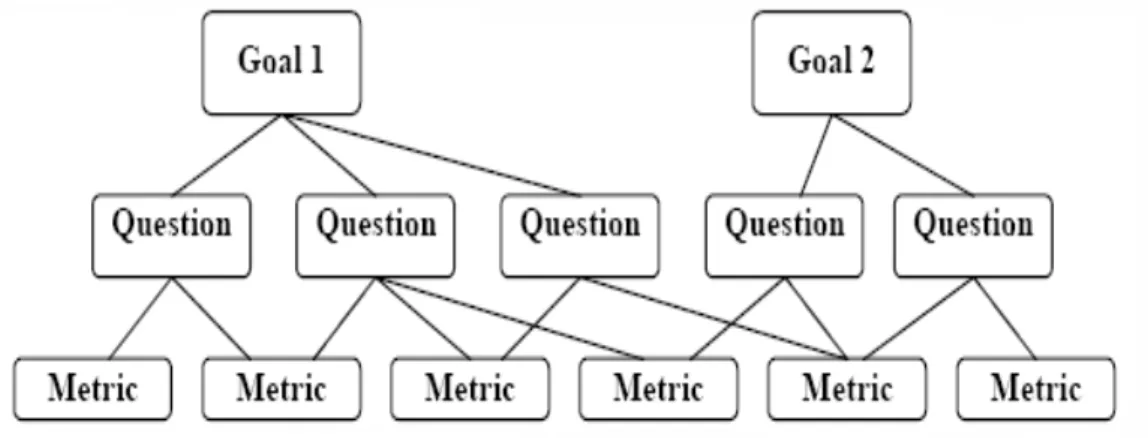
3.1 GQM Analysis . . . 55
3.2 Channel of communication . . . 57
Software configuration management (SCM) is an important discipline in profes-sional software development and maintenance. SCM has gained in importance as programs have become larger in size, longer-lasting in terms of life-cycle and increasingly mission and life critical. The growing need for product customiza-tion and the shorter time-to-market for new products and software updates have led the companies to adopt this discipline and to use SCM tools.
The main SCM objective is to control changes in large and complex software systems, to manage and track the numerous corrections, extensions, and revi-sions that are applied to a system over its lifetime.
Virtually, everyone on a software project is affected by SCM. SCM is a task that begins early in the product life cycle and is present in all the activities concerning product development, from the requirements and design all the way to the maintenance phase.
For this omnipresence in the software production cycle there are many costs and benefits associated with this discipline. Actually many of the direct bene-fits are known, but the exact quantification of costs and benebene-fits deriving from the application of SCM are not immediately evident.
There are several aspects concerning SCM that must be considered. Compa-nies can apply different levels of SCM, from a simple naming convention to a complex and integrated change process and can use many different tools, from a simple versioning tools to a complete instrument like ClearCase.
Objectives
The main objective of this study is to create a document that can clarify the costs and the benefits of SCM.
This work is addressed to product managers, to project managers and generally to the people who can take the decision of introducing SCM in the software production process. For this reason, the target of this work is to create a ROI model for calculating the payback and answering the question: ”How much?”. This ROI formula must be as complete as possible and show the economical impact of SCM in order to convince senior management to invest in it.
A few studies concerning this subject can be found in current literature, but they are either incomplete or unreliable. An example of an incomplete study is the one by J.O.Larsen and H.M.Roald’s : ”Introducing ClearCase as a Process Improvement Experiment”, where the authors focus only on some aspects of the introduction of ClearCase in a company by measuring some data pre and post-implementation of the SCM tool and process. This is the only academic study in current literature. As for unreliable studies, examples can be found in the documentation deriving from SCM tool vendors, like Merant PVCS, or Rational ClearCase both of which assure impressive benefits without demon-strating them.
This study focuses on the identification of the main arguments concerning the introduction of SCM in a company and also tries to impartially demonstrate the associated costs and benefits. In order to have a wider view, this problem is analyzed from three different points of view: the four activities of SCM, the people who are involved in SCM and the different phases of the product development life cycle.
This work presents different difficulties. First of all the great variety of aspects and parameters associated to this discipline and the difficulties to identify and quantify these parameters. This problem is caused by the subjectiveness of many SCM benefits, because they depend on how much and how much the SCM activities are implemented in a corporation. This aspect makes it very difficult to have a full vision of the impacts of SCM because many costs and especially benefits are hard to quantify.
describe the global gain deriving from the use of SCM in all the possible cases, the target of this thesis is to create not only a model but also a guide to use it and the ROI formula.
The model gathers most of the parameters associated with this discipline by organizing them in a matrix where these aspects are divided in three degrees of measurability.
The guide has been though in a way to help the potential user of the model to identify and quantify its parameters. The only parameters that are measurable are the inputs of the formula. This way the difficultly quantifiable parame-ters and the different context and company specific situations can be managed more efficiently by the use of a more complete and elastic model.
Thesis organization
The next chapter will discuss the analysis of the SCM discipline; following is a section that describes the model and the ROI evaluation. The method can be found in the fourth chapter. Chapter five presents the discussions and the thesis is concluded in chapter six with the conclusions of this work.
Analysis
Analysis is the first step towards the solution of a previously outlined problem. Breaking the problem down in different problem areas is essential for a clear comprehension of its structure. This work is initially divided in three different studies into clarify the different aspects of SCM. The discipline is analyzed from its four main activities to have a good knowledge of it. Then the changes in the phases of the product development life cycle after the introduction of SCM are studied and finally the changes in the personnel working life are considered.
1.1
SCM
Software configuration management is the organization of the components of a software system so that they fit together in a working order, never out of synch with each other.
Wayne Babich describes SCM as ”the art of identifying, organizing, and con-trolling modifications to the software being built by a programming team. It maximizes productivity by minimizing mistakes” [3]; IEEE1 defines it as the
discipline of organizing, controlling and managing the development and evolu-tion of software systems.
SCM is a SEI 2 Capability Maturity Model (CMM) level 2 key process area.
1IEEE, Institute of Electrical and Electronic Engineers 2SEI, Software Engineering Institute
The Software Engineering Institute affirms that it is necessary to establish and maintain the integrity of the software project products throughout the soft-ware life cycle.
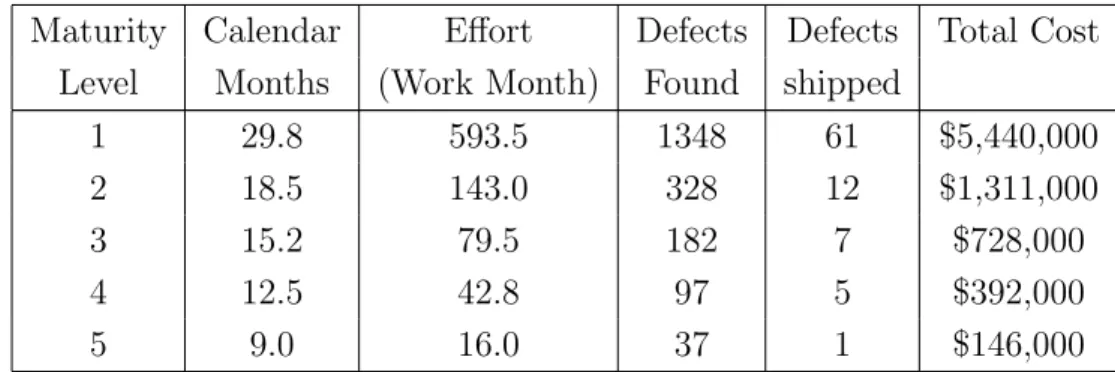
The CMM can serve as an example of how SCM brings a software quality and lowered costs improvement. Simply moving from Level 1 of the CMM to Level 2 represents significant improvements. In a SEI report (SEI 92-TR-24), data were averaged over 1233 separate projects in 261 organizations spanning 10 countries, to estimate the benefits of reaching higher maturity levels [6].
Maturity Calendar Effort Defects Defects Total Cost Level Months (Work Month) Found shipped
1 29.8 593.5 1348 61 $5,440,000
2 18.5 143.0 328 12 $1,311,000
3 15.2 79.5 182 7 $728,000
4 12.5 42.8 97 5 $392,000
5 9.0 16.0 37 1 $146,000
Table 1.1: Observed CMM Benefits
Table 1.1 shows that going from level 1 to level 2 there is a reduction of the time to market by 38%, a reduction of the defects found by 76%. At the same time the costs at level 2 are 25% of level 1 costs.
This is an enormous benefit; but how can this discipline permit to have this earning? To answer this question it is necessary to show the implication of implementing SCM in the software development production.
1.2
Documentation
The first phase of this work is the documentation and the research of informa-tion on SCM and its related economical costs and benefits. Only few works exist on this topic, this fact makes difficult to find the information. There are two main sources:
• Academic text
• SCM vendor’s documents
The first source is the more reliable one. Unfortunately there are no specific studies about this subject except for a Norwegian work [5] where the authors studied the impact of introducing ClearCase in a software company. Many theoretical papers have been studied to understand the discipline, how it can be implemented and what changes there are in the software production and in the work of the developers. In this first part of the documentation the guide lectures were the Babich’s [3] and Daniels’s [8] ones. These lectures permit to have a clear view of SCM from a technical and a managerial point of view. In literature there are some more specific documents concerning the problem of finding a ROI model for SCM, these studies are available from the SCM tool vendors only, and for this reason, there are many problems of reliability. These documents are created to sell their products and they promise impressive improvement, even if they do not demonstrate them, although for example, in Merant white paper there is a supposed reduction of software and contents error by up 90% [1]. These works are considered to find the major benefits that are associated to SCM. The impact of SCM discipline on the production process is analyzed to search the costs that this discipline implies.
To understand how SCM can be applied and what changes in the software production, it has been necessary to study this discipline from three points of view: technical, production and individual. This work is summarized in the three following paragraphs.
1.3
The 4 activities of SCM
SCM is a management discipline, thus, one of the first and important activ-ities in configuration management is the planning process. The configuration management plan is developed by the configuration management office, and it should be approved by a higher authority. It should reflect how the project is going to be developed. The plan has to fit with the organization of the company, for this reason there are different ways and degrees of SCM imple-mentations. A standard configuration management plan foresees four main activities:
• Identification • Control • Auditing
• Status Accounting
These activities must be satisfied regardless of the amount of automation within the SCM process. All of them may be satisfied by a SCM tool, a tool set, or a combination of automated and manual procedures.
1.3.1
Configuration Identification
Configuration identification is the process of recording and communicating information about the requirements, the design, or the product itself. This process is accomplished by use of documentation coupled with naming and numbering schema. This documentation defines the original approved configu-ration (the baseline) and the approved changes to this baseline. Configuconfigu-ration identification addresses traceability, it permits to be able to identify all arti-facts that compose a related configuration item(CI3).
Configuration identification divides the product in a hierarchical, top-down manner into small detailed elements (Configuration Items). The Configura-tion Items are created by the process of decomposiConfigura-tion, which starts from
3A CI is a component with associated documentation that is designated for configuration
the beginning of the project to the implementation phase. The configuration manager is responsible for the implementation and the control of naming and numbering systems, once they are established.
This activity adds some direct costs especially for the configuration manager on the requirements and design phase of the project. Extensive collaboration with the rest of the staffis needed to create proper configuration identification. For example in the case of software element naming, the configuration man-ager requires to work closely with the software engineers in developing effective naming conventions. On a large project, configuration identification could be a wasteful job depending on the automation degree and if it is possible to reuse the already existent scheme. This added work provides some inducted benefits. The traceability addressed by configuration identification helps the tester doing V&V 4. If the system is easily understood and if the numbers and
the names convey information, the maintainers have a very easy job. These benefits provide a reduction of the time spent testing and maintaining the product.
1.3.2
Configuration Control
Configuration control is the control of changes to hardware, software, firmware and documentation. In the context of SCM, ”control” means that proposed changes to a CI are reviewed and, if approved, incorporated in the software configuration.
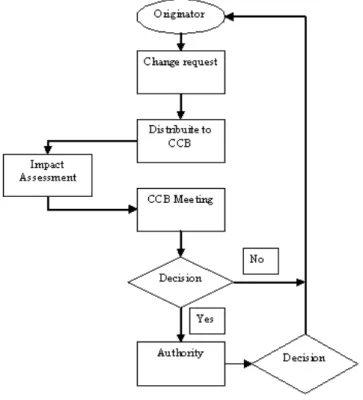
No product developer has the luxury to write code and than to forget it. Along with requirements and schedules, the software that has been developed changes in response to those other changes. Software is not static. These changes have an impact on budgets, schedules and associated changes to other components. For this reason the change process is a major element of configuration man-agement (sometimes called change manman-agement). Depending on organization and product structures, the change control process may be complicated. All the activities of the change process are regulated by the configuration control board (CCB) which is a permanently established committee of representatives of the organization. Its primary mission is to ensure complete impact
ment and analysis.
The standard CCB structure consists of:
• Chairperson: usually the program manager; it has to be someone who can make a decision affecting the program
• Secretary: usually the configuration manager
• Members: the CCB could be composed by some members of the staff
depending on the politics of the company
• Specialists: they are called to a CCB meeting on a case-by-case basis Figure 1.1 shows, with a flow diagram, a typical CCB process.
Figure 1.1: CCB Process
The procedure of configuration control adds rigidity to the software develop-ment process and some costs, to advantage of more organization and more awareness of the changes in the project. There is an increased work for all the
members of the CCB: the developer has to prepare a formal change request and has to do, when required from the configuration manager, the impact as-sessment; the configuration manager has to assist to the entire CCB meeting. There is also an inducted cost derived from the loss of developer’s time waiting for an authorization.
Configuration control and configuration identification achieve a sense of orga-nization and control instead of chaos; this fact provides stability to the project and an increased productivity of the staff, derived working in a stable devel-opers’ environment.
Another benefit of this procedure is the ability to trace the original product through its development and its growth, in order to trace the problems to their origin. This is a benefit especially in the maintenance phase. If a wrong change is made, a previous working version is available. This only capability has saved enormous amounts of time, as developers have tried out specific solutions that did not work in the product environment and were able to back up rapidly to a working version.
Configuration control permits to handle very complex activities like multi-version or multi-installation project. This characteristic helps developers to find and fix bugs in different variants or versions of a product.
Changes are planned, their impact is assessed, their costs are determined and their schedules are set and followed, this benefit is extremely important to finish the project on time and to stay in budget.
1.3.3
Configuration Status Accounting
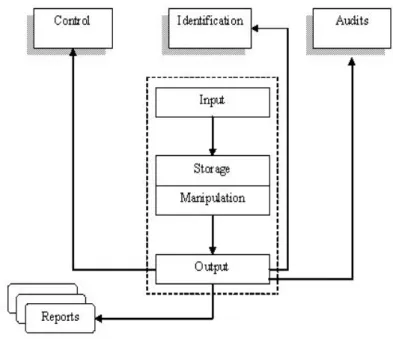
Configuration status accounting is a system of reports and records document-ing CIs and baselines throughout the product life cycle. It means to report and to record product configuration data and can be considered as an information exchange system.
The process is showed on figure 1.2. It begins with an input function; data is stored, there is a capability to manipulate stored data, and the process termi-nates with the output of the data. The input is provided by the configuration control, identification and audit activities, as data into the status accounting file. The configuration status accounting system has a manipulation
mecha-Figure 1.2: CSA as an information exchange system
nism to sort or order data as necessary. The output has two directions. One of them provides reports and archives the contents of the system. The other di-rection feeds back the upgrades to the three functions (Configuration control, identification and audit), reflecting the transition of the configuration item fromCIn to CIn+1, already considered.
The mission of Status Accounting is to support traceability. Beginning with each defined baseline, the status accounting target is to be ale to show the product’s progress to the next baseline tracing the changes.
Configuration status accounting can be made automatically with the help of a SCM tool, or manually.
Depending on the degree of automation, the accounting of status and activities work may cause some new works for the developer, as reporting and recording status of proposed changes or register configuration documentation. This loss of time can be amortized in the production phase, because the historical CIs’ reports of the can be used for the documentation of the product. This way the documentation work is done before the product is finished.
Configuration status accounting and configuration identification provides the framework and knowledge base of what has been going on during a project helping staff changes.
1.3.4
Configuration Auditing
Configuration audits verify that the approved changes have been implemented. Performance data and physical configuration are compared to documentation. Configuration audits assure both manager and the customer that requirements are reflected in the product and that the product responds to these require-ments.
There are two types of configuration audits: • Functional configuration audit (FCA) • Physical configuration audit (PCA)
The FCA verifies the functional characteristics, while the PCA verifies the form and fit of the production. The result of the FCA is a formal acknowledgment that the product performs in compliance with requirements and specifications. This performance is established by review of the test cases and test results and by tracing the documentation back to initial requirements. The PCA results in a formal acknowledgment that the product matches the physical description in its documentation.
Established the target for the audit, the first action is to perform the audit team. A chairperson is needed. Other members of the team are selected on the basis of their special interests or knowledge. Next, the audit begins with a meeting of all players of both parties; this meeting is conducted by the chairperson. After its conduct the results are published.
Configuration audits assure that the product responds to the requirements, this is a hallmark for the management and for the customer. The conduction of audits during the development assures the consistency of the work, improving the stability of the baseline. There are some added costs associated with the time spent doing the audit meeting.
1.4
SCM in the product development life cycle
SCM is an integral task, beginning in the early life cycle. Required from the beginning of the system exploration phase, the project software configuration management system must be available for the remainder of the project. There are many possible software development models which can be used by a company. A waterfall model composed of 5 principal phases (requirements, design, coding, production and maintenance) is considered to ease the research of the costs and benefits of SCM. These costs and benefits can be easily trans-lated in another product development philosophy, considering that these five phases can be found in small scale also in iterative model, like Agile software development.
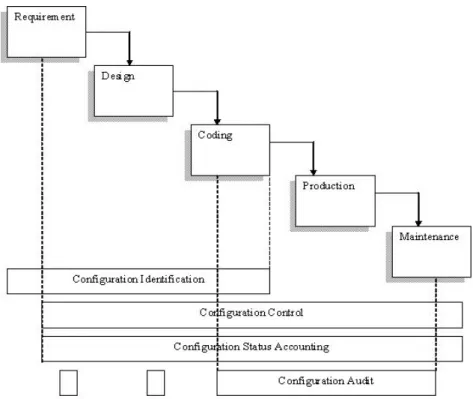
Figure 1.3 illustrates the ”when” of SCM on our full product development life cycle.
Configuration identification starts with the beginning of the project. Con-figuration control and status accounting are present in all the five phases of the product development life cycle. Audit are done at the end of each phase and are relevantly present during the final phase of the production.
Configuration Management helps individuals and interactions over processes and tools, to create documentation, to have more customer collaboration (CCB) and to have changes supporting the organization and track of changes. Con-figuration Management tool helps the continuous integration minimizing the merge conflicts. The followings paragraphs show the different benefits and costs associated with the 5 phases of the product development life cycle.
1.4.1
Requirements
The aim of the first phase of a project is to create a description of what a system should do; describing system features, properties that the system must have and limiting the development in some way, such as, defining an operating system the system must run on, or defining which programming language must be used to implement the system.
At the same time the configuration manager starts the planning process. One of the first activities is the configuration identification to divide the project in a top down manner defining configuration items. To have configuration identification on this phase helps to coordinate the workgroup with a proper division of the project in different CIs.
The requirements can be adjusted by the feedback of the change process; the CCB adds the possibility to interact directly with the customer assur-ing, through the CCB meetings, that the product will follow his requires. These activities add costs for the new tasks introduced by SCM but this added work brings more benefits especially in the late phases of the product devel-opment life cycle.
1.4.2
Design
In the design phase the architecture is established. This phase starts with the requirement document delivered by the requirement phase and maps the requirements into an architecture. The architecture defines the components,
their interfaces and behaviors.
The design may include the use of existing components, this way SCM can help the developers with software reuse support as version management tool. In this phase there is still the configuration identification work, which, simul-taneously with the design, defines the configuration items which compose the product. As in the requirement phase, the feedback from the CCB and the configuration status accounting add the possibility of changing the design doc-umentation as the project goes on. Designers’ workload is facilitated by the configuration identification by the formal definition of the CIs.
1.4.3
Coding
In this and in the next two phases, there are the most of the benefits derived from SCM discipline. The version control tool helps to handle variants of the product and to reuse software, eliminating repetitive developing efforts. When supported, the SCM tool helps developers’ parallel work with automatic merge. Depending on the tool features the building step is eased and developers are sure to work on a correct build program, with no file missing or wrong version files link.
SCM discipline provides communication between developers. This benefit pro-vides more knowledge in the development group, removing classical coordina-tion errors like the double maintenance problem, the simultaneous update and the shared data problem. These benefits bring to a reduction of errors during the development as the development time decreases.
There is an added work for CCB members; programmers are not as free as before because they have to wait for the authorization before implementing the change and the change process can be complicated. There is a loss of time and money waiting because of the authorization.
1.4.4
Production
During the production there is the validation phase, the last build, the issue of the release and the documentation production. All the SCM activities provide the ability to trace the product through its development and growth, so that the problems may be traced to the origin. This is an advantage for the testing
people, who have to conduct the validation of the final product.
Automatic build procedures, when supported by the SCM tool, can save time and money; in this phase there are less benefits than in the previews one, be-cause there is not the necessity to do frequent and quick build as development build5. The main advantage is to have the security of including in the build
all the right version files, avoiding a loss of time for developers.
Quality assurance is facilitated with configuration identification and configu-ration control. The time spent auditing, is repaid with the assurance that the customer gets what he paid for improving the relationship with him.
During the early phase of the project there is an added cost associated with configuration status accounting and configuration identification documenting and ordering all the different tasks in the project. This is a great effort during the production of the documentation.
1.4.5
Maintenance
The most of the benefits of SCM are during this phase. One of the main aims of SCM is to provide the traceability among versions, releases, and product families. The value of this benefit is enormous especially during the mainte-nance phase of the product. A classical maintemainte-nance setback happens when a problem arises in one release or product family that impacts other client releases and products. Making a change and promoting it through the entire product software base is an incredible cost savings in time, money, and client satisfaction. A lack of linkage between project events contributes to project failures, where solving a problem either aggravates a problem in another area or fails to fix the same problem elsewhere. A traceability thread allows man-agement to examine the chain of events that caused a project to encounter difficulty as an integral process within the auditing capability of SCM. Trace-ability and the improved organization given by SCM discipline are a support for the maintainers’ work, with a reduction of bug fix time.
1.5
People involved
In this section SCM is analyzed from the point of view of company roles. SCM is a discipline which is present in almost every phases of the software production; for this reason there are different people involved in it, everyone has a different goal. The SCM person this paper looks at are:
• Senior management • Project management • Configuration manager • Designers
• Administrator and Technician • Developers
• Production personnel
These categories are described in the following sections.
1.5.1
Senior management
Senior management means a distinct level of decision-makers, that must ap-prove or disapap-prove SCM investment decisions. They are interested in what goes on in the development of their products, especially in the quality of the product and the service to the customer. They take care about the financial benefits and costs.
Using SCM provides competitive advantage as to be able to bring out the product earlier or to decrease the time required to respond to the end-user requests and inquiries. All these benefits are difficultly economically quantifi-able, but they can be a hi-discriminating for the decision implementing SCM in the company. There are many direct costs to be considered by this company class, as the tool licenses costs, the training costs for all the company staff, the maintenance costs.
1.5.2
Project management
The activities of the configuration manager are concerned with successfully achieving a set of goals. It includes planning, scheduling and maintaining progress of the activities that comprise the project. He has to maintain the risk of failure as low as necessary over the lifetime of the project. SCM help him to have a clear view on the project and to keep the control of it. CCB and the impact analysis assure to finish on time and in budget.
1.5.3
Configuration manager
The configuration manager is a new character in the company; he is involved in every activity of a configuration management plan.
He is the responsible for development and implementation of a logical and a well defined configuration identification process for decomposition, naming and numbering conventions and baseline managing. The configuration manager is an advisor in the process of CI selection and decomposition; he is responsible for producing the listing of decomposition.
He is usually the secretary of the CCB; he prepares and coordinates the meeting and he is a member of the audit team.
1.5.4
Designers
This subject has already been analyzed in paragraph 1.4.2, where the design phase is described.
1.5.5
Administrator and technician
The administrator of the system and the technician are involved with new work associated with the use of the SCM tool. Depending on its complexity they will spend their time maintaining the system, creating new version views and managing and maintaining the repository. The complexity of these works depends on the dimension of the projects and on the size of the team working at the same project.
1.5.6
Developers
The job of the developers is the most influenced in the company by the in-troduction of SCM in software production, because with SCM discipline, their work changes. For this reason they could be reluctant to introduce this new discipline in their work life. If they have never used SCM before, they need training, after having learned the discipline their fear of new procedures should be facilitated.
Developers have several tools to help them to create the program. Version con-trol and refactoring tools decrease the time of development and the number of bugs. Working with a baseline and with the own workspace increase the sta-bility of the project. A developer carries out their modifications undisturbed by the activities of other developers.
Depending on the implemented philosophy of the tool, the check-out may also place a reservation (a lock) into the version group, giving the developer exclu-sive rights to a later check-in, or can implement an optimistic and merging-based like CVS philosophy. In the first case developers, wishing to modify the same original version, can only create a variant of this version and then have to merge their changes back into the original line of development. In every im-plementation of a versioning tool, SCM adds the possibility for the developers to be able to have parallel work and to develop in an isolated workspace. This two benefits permit to increase the productivity of the staff(parallel work) and of the individuals (working in isolation in the own workspace).
Developers join the benefits of SCM but on the other hand there is an improve-ment of their work, doing new tasks like writing configuration status accounting reports and participating at CCB meeting as members or specialists.
1.5.7
Production personnel
In this category there are all the people involved in the production of the final product: release manager, builder, system tester and quality assurance people. Release management deals with the formal aspects of releasing to the customer and the more informal aspects of releasing to the project. For a customer re-lease he needs to carry out a configuration audit before the actual rere-lease. This means also to verify if the produced package (application, documentation, help
files, etc) is actually installable. This procedure adds more work for the pro-duction, however it is a hallmark because everything follows the requirements. Release manager takes advantage of the traceability and the documentation achieved by SCM; his work is facilitated by version control tool.
Version management and build management tool help builder decreasing time to create a running system and are a hallmark, because it makes sure that every file is included in the build.
The traceability brought by configuration management activities helps the pro-duction personnel work. Audits guarantee that everything follows the require-ments and verify that the approved changes have been implemented. QA people are able to test accurate and consistent builds.
1.6
Conclusion
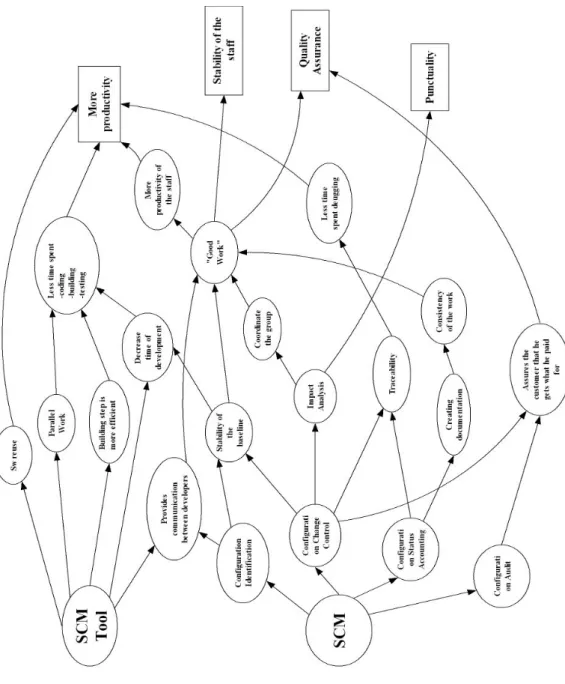
In these three studies it is evident that there are a multitude of parameters and aspects concerning the introduction of SCM discipline in the software production. The previews study is summarized in Figure 1.4
It is difficult to imagine performing any kind of configuration management without using an appropriate SCM tool, for this reason the graph is organized with two roots, which represent the two possible sources of benefits and costs:
• SCM discipline • SCM tool
SCM discipline addresses more benefits to the top part of the company hier-archy. It addresses organization of the workgroup, assuring more visibility of the project and facilitating the management. Following the four activities of SCM selected software work products are identified, controlled and available; changes to identified software work products are controlled; affected groups and individuals are informed about the status and content of software base-line.
SCM tool benefits are associated with the developers’ work. The programmers have parallel work support and can work in a stable environment; SCM tool provides communications between developers, increasing knowledge of the en-tire project. Automatic merge tool speeds the production of new code.
The related costs depend on the tool GUI6 because it is used throughout the project and not only by developers, an intuitive, and easy-to-use graphical user interface is very important. This aspect is significant also to learn the costs, a tool with a high learning curve adds many costs for its introduction in the software development process. Maintenance costs also weight on the budget of the company.
The different benefits of SCM are divided in to four categories
1. Stability of the staff
2. More productivity 3. Quality assurance 4. Punctuality
Affected groups and individuals are informed of the status and content of the software baseline mostly by the status accounting activities. SCM eliminates confusion (chaos, double maintenance, shared data problem, simultaneous up-date), providing coordination and communication in to the group. All this aspects provide stability to the group.
There are many aspects concerning the increased productivity of the company. Selected work products are identified, controlled and available providing main-tenance support. SCM helps to manage versions and variants of software, helping software reuse.
Quality assurance is mostly guaranteed with change process and with config-uration audit. With the CCB changes to identified software work products are controlled and audits assure that only the approved changes have been implemented.
With SCM discipline all the production activities are planned, providing visi-bility for the project manager assuring that the project will respect the dead-line.
The 4 benefits categories are examined in paragraph 3.2.
SCM offers tools which help the developers, and adds order and discipline to the group, it is a discipline that can be applied on different levels and different tools can be used; for this reason benefits are not univocally defined and many parameters are uncertain. The main idea of this work is to create a model which can calculate the ROI with objective and quantifiable data and a guide of the costs and benefits customizable from the different situation. For this reason three different degrees of measurability are defined.
1.6.1
Measurability
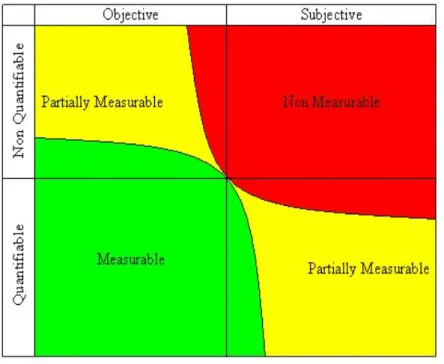
Two aspects of the parameter are considered to define the degree of measura-bility: the objectivity of the benefit/cost and how this benefit/cost is quantifi-able. Following this criteria the parameters are divided in four regions within a matrix (Figure 1.5).
As shown in Figure 1.5, those three categories of parameters are:
Figure 1.5: Measurability
• Measurable - the quantifiable data that can be objectively measured. Also those parameters that are near the border of the rectangle enter this category. This is the case of the cost associated with the added work for the configuration manager that is a parameter which depends on subjective aspects like the dimension of the project and the salary of the configuration manager. The gains associated with these parameters are constant with the context where SCM is applied. These data will be the inputs of the ROI formula.
• Partially measurable - these data are difficultly measurable, because they depend on the context where they are measured, or they are difficultly economically quantifiable. In this case the earning of SCM
implementa-tion is dependant on the contest of the company where SCM is applied; the gain is too variable to be considered in a generic formula.
• Not measurable - In this area all the parameters that are considered too much dependant on the context and intrinsically economically unquan-tifiable can be found.
This way the parameters can be divided in: those that can directly enter the formula for the ROI evaluation; the parameters that have to be elaborated because of their dependence on the context where they are applied; and those that can be relevant for the decision of using SCM even if they can not be used in a formula because they are intrinsically economically not quantifiable.
The Model
In this chapter the results of the analysis of the SCM economical impact are presented. The costs and benefits discovered during the three previews studies are summarized in a matrix. Then a detailed explanation of its entries follow. The chapter is concluded with the ROI evaluation.
2.1
The model
SCM is a discipline intrinsically dependant on the context of application. The possible benefits and the respective earning factor could vary depending on the different case of application. For this reason it is impossible to create a complete formula applicable to all the possible cases.
SCM is a subjective discipline and for this reason this work focusses on the creation of a subjective ROI model which value has to be calculated by the company itself, knowing the context where SCM is applied and how the disci-pline is implemented. It has to be the most complete model including all the aspects of SCM discipline, not only the most known and quantifiable.
The model considers most of the SCM aspects. Considering all of them, this work fits perfect for those companies which introduce for the first time SCM discipline. The model can be also used considering a particular set of param-eters, permitting to use it also from a partial to a full SCM implementation. All the possible costs and benefits related to SCM are included in a matrix where they are divided, according to the classification described at the end of
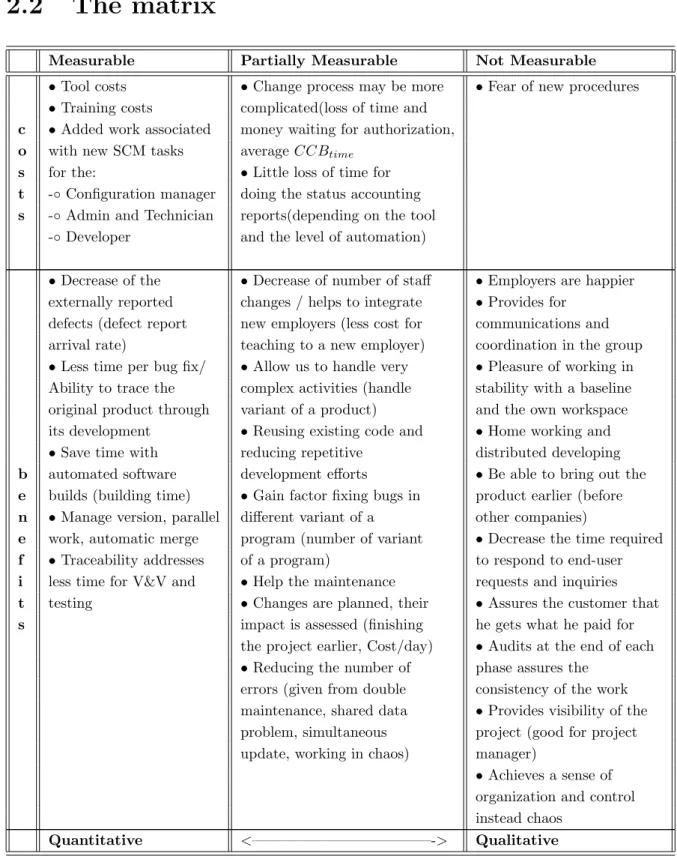
the preview chapter. Both costs and benefits are divided in three degrees of measurability1. The matrix entries are described in detail in paragraph 2.3
and, when reasonable, it is indicated the possible metrics to measure them. As it can be seen in the matrix in next paragraph, the parameters have an opposite distribution in the matrix; the most part of the costs are perfectly quantifiable and there are a lot of benefits that are partially or not measur-able. This aspect is a hallmark for the person who has to decide about SCM introduction, because the model assures to consider even the worst case. Considering the first column parameters it is shown a possible way to evaluate when the return on investment is achieved. This ROI evaluation is based on the estimation of the time that has to elapse in order that total benefits equals total costs. It does not consider the discount rate because, according to the previous studies [5] and [1], the return on the investment should come in few months. For this reason it is plausible that the contribution of the investment discount rate is irrelevant for the ROI evaluation.
According to the purpose to create an elastic model, this study includes a method to use it to facilitate the comprehension of the parameters involved in the goals of a SCM system; this part is described in the following chapter.
2.2
The matrix
Measurable Partially Measurable Not Measurable
• Tool costs •Change process may be more •Fear of new procedures • Training costs complicated(loss of time and
c • Added work associated money waiting for authorization,
o with new SCM tasks averageCCBtime
s for the: •Little loss of time for
t -◦ Configuration manager doing the status accounting s -◦ Admin and Technician reports(depending on the tool
-◦ Developer and the level of automation)
• Decrease of the •Decrease of number of staff •Employers are happier externally reported changes / helps to integrate •Provides for
defects (defect report new employers (less cost for communications and arrival rate) teaching to a new employer) coordination in the group
• Less time per bug fix/ •Allow us to handle very •Pleasure of working in
Ability to trace the complex activities (handle stability with a baseline original product through variant of a product) and the own workspace its development •Reusing existing code and •Home working and
• Save time with reducing repetitive distributed developing
b automated software development efforts •Be able to bring out the e builds (building time) •Gain factor fixing bugs in product earlier (before n • Manage version, parallel different variant of a other companies)
e work, automatic merge program (number of variant •Decrease the time required
f • Traceability addresses of a program) to respond to end-user
i less time for V&V and •Help the maintenance requests and inquiries
t testing •Changes are planned, their •Assures the customer that
s impact is assessed (finishing he gets what he paid for
the project earlier, Cost/day) •Audits at the end of each
•Reducing the number of phase assures the
errors (given from double consistency of the work maintenance, shared data •Provides visibility of the problem, simultaneous project (good for project update, working in chaos) manager)
•Achieves a sense of
organization and control instead chaos
Quantitative <————————————-> Qualitative
Depending on the level of SCM that will be implemented and the tool that will be used, the manager checks in the three columns the different benefits and costs, that he could have introducing SCM, helped by a list with the descriptions of all the entries of the matrix. For example he could be interested on the saving time using an automated software builds; in this case he fills up a form where there are the main parameters associated with the benefits using an automated builds tool, like the average personnel cost, the number of developers and builder people, the number of modules, the average time spent building.
This is the procedure for a measurable data; this kind of measure goes in input to the ROI formula. For the parameters in the partially measurable column the manager has to consider how the SCM rules are applied in the company and what is the contest of application. For example, looking for the increased costs for the change process. The time spent waiting for a decision of the CCB is strictly dependant on the organization of the CCB and the availability of the members. For what concerns the not measurable parameters, in this case it is not possible to have a valid evaluation independently from the observation. There are many benefits that are extremely subjective, in this case the manager could take a decision considering the costs/benefits that he has in his particular situation. If the manager knows that in his development team there is a lack of method, the introduction of SCM could be a very important benefit to achieve organization and control on the group and to provide for communications and coordination.
2.3
Parameters of the model
2.3.1
Costs
The different costs are mostly measurable and concrete parameters of the model. This is an important feature, because the most part of the costs are objectively considered. This way it is possible to consider the worst case of SCM introduction (the most part of costs are perfectly measurable and there are a lot of benefits that are partially or not measurable). This is a hallmark for who has to pay.
To be able to apply SCM discipline and install SCM tool, it is necessary to have a particular hardware, as a network with a server. In this study it has been supposed that these hardware units are usually present in most of the compa-nies of a certain dimension, even if they are not using SCM. For this reason the contribution of hardware costs are not considered in the total investment concerning the SCM introduction.
2.3.1.1 Tool costs
The first costs that has to be considered introducing a SCM tool are the li-censes and maintenance costs. They strictly depend on the tool used for the unitary costs and the number of licenses. An open source tool like CVS, which is free, or an expensive and complete tool like ClearCase which adds consider-able costs for the maintenance of the system can be used. This choice is taken considering the particular necessity of the company. For this field there are a lot of vendors model that support the user to calculate the cost of the tool licenses.
Another variable is the number of users. Usually the system allows sharing licenses, respecting the necessity of the developer’s staffand knowing the num-ber of programmers it is possible to calculate the necessary numnum-ber of licenses. The maintenance cost could be a percentage of the licensing price or could be variable depending on the contract with the tool vendor.
• Type of SCM tool and unitary cost per license • Number of users
2.3.1.2 Training costs
The training costs for the system administrator and the developers represent a large part of the total costs. The tool by itself can not be expected to improve the product quality, but if accompanied by a formal change management pro-cess improvements might be expected. Unfortunately this propro-cess is not free. It depends mostly on the learning curve of the tool and on how the project is large and complicated (number of modules, number of people working in parallel, number of versions and variants of the program, etc). For example,
ClearCase has a much larger command set than CVS, and therefore it has a much higher learning curve; in this case the teaching cost to use ClearCase are more expensive than VSS.
In addition to the tool training costs there are also costs associated with the training of the group to the new SCM procedures. The configuration manager has to learn about all the SCM activities, in particular how to conduct a CCB meeting, how to conduct audits and how to do configuration management. The developer has to learn how to conduct audit, how to conduct status accounting and how behave when there is a change request.
Associated to those costs, it is necessary to consider also the annual costs for training the new employers for the SCM tool.
• Learning curve of the SCM tool • Type of project
• Annual changes in the staff
2.3.1.3 Added work associated with new SCM tasks
Configuration manager The configuration manager is a partially new fig-ure in a company where SCM is introduced, because every company has to manage the changes and the versions of a program, the more formal activities require a new character who has the responsibility of imple-menting SCM in the best way. He is the responsible for development and implementation of a logical and a well defined configuration identi-fication process for decomposition, naming and numbering conventions and baseline managing. The configuration manager is an advisor in the process of CI selection and decomposition; he is responsible for the pro-duction of the list of decomposition. He is usually the secretary of the CCB; he prepares and coordinates the meeting. He is also a member of the audit team.
Administrator and technician Sometimes the tool requires dead full-time administration. These figures are responsible for the correct working of the SCM tool; for example they are responsible to maintain the system
(the SCM tool), to create new views, to manage and maintain the repos-itory. This fact depends on the dimension of the project and on the number of views (number of developers, number of versions and modules of the program and the number of the company products) and on the type of SCM tool used.
Developer The work of the developer is facilitated by the SCM tool, at the same time he has also some new tasks. The main activities he has to perform are the status accounting tasks (comments and status accounting reports) and the CCB tasks (doing impact analysis).
2.3.1.4 Change process may be more complicated (cost derived by loss of time)
The essential issue of the Change Process is the communication, it assures that the changes will be implemented to the real product after an authorized decision, no matter how complicated the process becomes. For this reason change process may add some costs. There would be a loss of time and money waiting for the authorization of the CCB chairperson. This parameter is quite difficult to estimate because of the aleatory nature of the duration of a decision and the variable number of change requests in a project.
2.3.1.5 Little loss of time doing the status accounting reports
The mission of Status Accounting is to support traceability. Beginning with each defined baseline, the target of status accounting is to be able to show the product’s progress to the next baseline by tracing the changes. Developers lose little time writing comments and reports during the development of the program. This is a difficult parameter to measure, but it’s reasonable to con-sider that this cost is not as relevant as the others. Time spent doing status accounting depends also on the assistance given from the SCM tool.
2.3.1.6 Fear of the new procedures
This is a not quantifiable cost. It is an impediment to the introduction of SCM discipline, even if training should help to decrease the fear of the new
procedures.
2.3.2
Benefits
There are many aspects concerning the benefits of using SCM discipline in software development. These aspects are described in the following sections using the division (measurable, partially measurable and not measurable) as showed in the matrix (table 2.1).
2.3.3
Measurable benefits
In this category there are the more objective benefits, which can be associated to a constant economical gain factor. These parameters go in input to the ROI formula, to estimate how long does it takes to have the return on investment.
2.3.3.1 Decrease of the externally reported defects
This is the main parameter for the ROI estimation. A decrease in the defect report arrival rate provides less time to develop and maintain the product, which means that there is a saving time on the project and a reduction on the salary paid. Developers are less disturbed by the continuous requests for bug fixing, thus they can work in a better way and more efficiently.
Larsen and Roald’s study points out that using SCM in the production of software product brings a decrease of the externally reported defects of 36% [5]. This is achieved also because there is an increment of the internally reported defects. SCM helps in to find and to fix the bugs before the production and the last release of the product.
This parameter is used to evaluate the return on investment, multiplying it with the average cost to correct one bug obtaining the total save.
• Defect report arrival rate (both external and internal)
2.3.3.2 Decrease of bug-fix time. Ability to trace the original prod-uct through its development
The documentation achieved by configuration status accounting, the version control tool and the configuration change control (with the CCB) bring to
traceability. This property renders in less time per bug fix, easing and speeding the maintenance phase. The Norwegian study of Larsen and Roald estimates that the average time spent to process and fix urgent defects goes down by 6% [5]. The total saving time can be quantified knowing the average time spent per bug fix and the number of reported defects.
• Bug fix time
• Average fixing time
2.3.3.3 Save time with automated software builds
This parameter strictly depends on the utilized tool and on the dimension of the project. An automated build procedure can save time and money. The decrease of workload associated with the build task is estimated from the Merant study between 12% and 40% depending on the type of build2
• Development build time (reproducible build, incremental build, repro-ducible build)
• Release build time
2.3.3.4 Manage version, parallel work and automatic merge
This feature can help the programmers in their work, especially in big groups of development. The degree of help depends on the characteristic of the used tool: how the check-in check-out process is managed, if an automatic merge tool is supported, if there is the possibility to lock the files, what are the meth-ods of programming, etc.
With an automatic merge tool it is possible to save much time especially if there are many changes in the program development and if there is high par-allel work.
Another characteristic of the tool that is necessary to consider is how it man-ages the branches. The key advantage of branching is parallel development and the resulting efficiencies and responsiveness. Using a version management
2The possible types of build are divided in two main categories: development build and
tool there is a time save in creating, tracking and recreating versions.
The degree of parallel work that it is possible to handle assures more produc-tivity, because there are more developers’ group working at the same time and because there is an increase of the productivity for human resources.
• Number of people working at the same project or module • Type of tool
2.3.3.5 Traceability addresses less time for V&V and testing
All four activities of SCM add benefits to the V&V phase. Configuration identification and change control defines the original approved configuration and the approved changes to this baseline, configuration audits assure that the standards have been met and configuration status accounting permit logging and tracking of incident reports. The documentation produced during the development achieves traceability and with the help of the version control tool the testers’ work is easier than before.
• Time spent testing and validating the program
2.3.4
Partially measurable benefits
2.3.4.1 Decrease of number of staff changes and helps to integrate new employers
In every companies, people get promoted, take other jobs, and leave. When this happens in the middle of a development project, not just the technology knowledge goes out the door. The long-learned knowledge of how things are done is also gone. When a replacement person is brought on board, they may know the technology, but without a documented SCM process, they will have no real idea how to do product development. SCM provides the framework and knowledge base of what has been going on before in the project. A new staff member has one place to go to learn how the organization development process goes on.
A documented SCM process facilitates the insertion of a new employer in the company. This should get proportional benefit with the average cost for
introducing a new employer.
Another benefit that is achieved by SCM is the decrease of the number of staff
changes. This is difficultly quantifiable for a ROI calculation because there are many different and independent reasons for staff changes. But it should be logic thinking that if employers are happier they would not leave they job.
• Number of annual staff changes
• Average cost for introducing a new employer in the company (cost for training and initial scant productivity )
2.3.4.2 Allow us to handle very complex activities like handling variant of a product / Gain factor fixing bugs in different variant of a program
The purpose of a professional software development project is to build a family of computer programs. SCM controls all the members of a program family, keeping multiple versions identical in ways they are supposed to be identical and different in ways they are supposed to be different. All the efforts to manage many different variants of a program are minimized by the tool and the knowledge achieved by all the documentation. If a bug is found in a module which is present in some variants of a program family it will be fixed once for all the different variant. More variants exist and more benefits the company obtain.
• Number of variant of a program
2.3.4.3 Reusing existing code and reducing repetitive development efforts
This benefit is a direct consequence of the possibility, achieved by SCM disci-pline and SCM tool, managing different version of a program. It is a difficultly quantifiable benefit because it is impossible to know how much code will be reused in a project.
2.3.4.4 Help the maintenance
All the SCM activities add order and produce documentation to a project, achieving traceability. This property helps the developers to find the problems earlier and decrease the bugs-fix time.
The version control tool helps the developers to manage the different versions of the program; the possibility to store, recreate and register the historical de-velopment of an item (document or source code) is a fundamental characteristic of a version control system. The tool keeps track of relevant information about the different versions. These characteristics, with the ordered environment as-sured by SCM, help maintainers to assist the customer and to maintain the program.
• Time spent debugging externally reported defects • Time spent maintaining system
2.3.4.5 Changes are planned, their impact is assessed
The plan with configuration identification and the impact analysis of the CCB permit that all the activities are done with the project manager overview. Changes are planned and their impact is assessed. This is a guarantee of finishing the project on time.
• Having the product before other companies • Save development money (Cost/day) • No forfeit for belated end project
2.3.4.6 Reducing the number of errors (given from double mainte-nance, shared data problem, simultaneous update, working in chaos)
On any team project, a certain degree of confusion is inevitable. The goal of configuration management is to minimize the confusion so that the produc-tivity increases. All the classical problems of working in group (like double maintenance, shared data problem, simultaneous update) are a setback for the
developers’ work. Use of SCM increases productivity for human resources. This parameter depends also on the size of the developer’s group and on how many programmers are working simultaneously on the same module.
• Degree of confusion (number of developers, how the project is divided) • Number of classical CM problem
2.3.5
Not measurable benefits
2.3.5.1 Employers are happier
This is a really subjective and qualitative measure of the benefit of SCM. This entry of the model is an index for the productivity for human resources and for the rate of changes in the staff; if the personnel is happy working in its environment it won’t change its job.
2.3.5.2 SCM provides for communications and coordination in the group
A better coordination of the group improves the productivity, minimizing the waiting time and the mistakes. Knowing how many people are involved in the production and how this people are organized permits to estimate the possible number of communication channels and the degree of assistance that SCM offers.
2.3.5.3 Pleasure of working in stability with a baseline and the own workspace
This is probably the aim of SCM. Babich says: ”It is not possible to overempha-size the importance of stability to successful software development. Nothing is more frustrating to programmers than not being in control of changes affecting the program they are trying to get working” [3].
SCM activities permit to control all the changes in a project, for this reason developers can work in a safe environment, where only the approved changes are implemented. The items in the baseline are a stable base for development.
All programmers want the database to be stable when they want it to be sta-ble and changeasta-ble when they want to make a change. This conflict is solved with the workspace, which permits to work in isolation allowing the developers to change the program any time. The benefits depend on the used tool, and on the dimension of the project (how many people are involved, in how many modules the project is divided).
2.3.5.4 Home working and distributed development
The tool can permit home working and distributed development. This is a not quantifiable benefit, but it could be a really important one; for examples the possibility to develop software in a country where the production costs are cheaper then in the country where the software company is based, permits higher earnings.
2.3.5.5 Be able to bring out the work earlier, before other compa-nies
All the different benefits of using SCM bring a shorter time for developing a software product. This is a direct economic benefit saving time and money in the software production. A more subjective is achieved if a product comes sooner on the market. This benefit is not measurable because the earning of coming first in the market is not quantifiable; the company should became the market leader if it produce a program before the others; but it can go bankrupt if it comes late than the others.
2.3.5.6 Decrease the time required to respond to end-user requests and inquiries
This is a consequence of the better organization of the group and the decrease of the time per bug fix; it is a difficult quantifiable benefit, which improves the relationship with the customer. The pleasure of the customer is none economically quantifiable parameter.
2.3.5.7 SCM activities (in particular configuration audit and con-figuration control) assure the customer that he gets what he paid for
All the four SCM activities bring traceability and the consciousness of how the project is going on; the continuous interactions with the customer through the CCB permit to know and satisfy the customers requests. All these hallmarks add costs in the production.
2.3.5.8 Audits at the end of each phase of the development life cycle assure the consistency of the work
Configuration audits assure that developers are working on a stable and ap-proved version of the product. This procedure adds some costs and in the successive phases of the software production there is a return on investment because of the improved productivity of the developers working in a stable environment.
2.3.5.9 Achieves a sense of organization and control instead chaos
The plan achieves a sense of organization and control instead chaos, helping de-velopers to work in a ”good way”. This achieves more quality and productivity of the staff.
2.3.5.10 Provides visibility of the project
Having a plan and doing status accounting and reviews provides visibility of the project, helping the work of the project manager.
2.4
ROI evaluation
The return on investment (ROI) is a calculation used to determine whether a proposed investment is wise, and when the investor could be repaid. The ROI formula is supposed to calculate how long does it take for the company to have the return on an investment in SCM field.
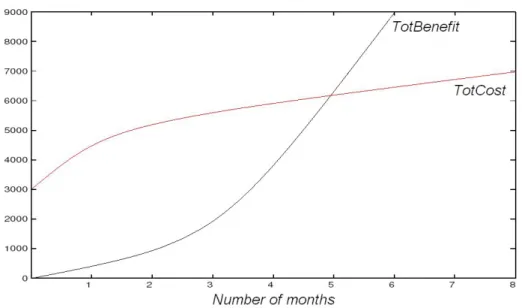
This payback is evaluated making the intersection between the trend of costs and benefits in the time; this is calculated solving the system composed by the functionsTotCost and TotBenefit in the months after SCM introduction.
!
T otCost =IC+"(M onthCost )i T otBenef it ="(Benef itM onth )i
TotCost represents the total costs function of the investment, it is the sum of the initial investment (IC) as the cost for the first training period and the licenses of the tool, and the day to day costs for maintaining the SCM system. TotBenefit is the sum of the earning associated with SCM. The function should have the trend showed in Figure 2.1