Exercises
TCP/IP Networking
Solution. With Solutions
Jean-Yves Le Boudec Fall 2010
Exercises marked with awere given at exams in the past.
1
Module 1: TCP/IP Architecture
Exercise 1.1 Elaine is setting in front of lrcpc3 and connects to machine ’ezinfo.ethz.ch’ by Telnet. A clairvoyant angel has read all the frames passing on the network. Here is the first packet resulting from this activity:
ETHER: Ether Header
---ETHER:
ETHER: Packet 1 arrived at 19:03:32.39
ETHER: Packet size = 60 bytes
ETHER: Destination = ff:ff:ff:ff:ff:ff
ETHER: Source = 0:0:c0:b8:c2:8d
ETHER: Ethertype = 0806
ETHER:
ARP: ARP/RARP Frame
---ARP:
ARP: Hardware type = 1
ARP: Protocol type = 0800 (IP)
ARP: Length of hardware address = 6 bytes
ARP: Length of protocol address = 4 bytes
ARP: Opcode 1 (ARP Request)
ARP: Sender’s hardware address = 0:0:c0:b8:c2:8d
ARP: Sender’s protocol address = 128.178.156.7, lrcpc3.epfl.ch
ARP: Target hardware address = ?
ARP: Target protocol address = 128.178.156.1, in-inr-e4.epfl.ch
1. What is this frame used for in this exchange? Solution. The frame used is an ARP request.
2. What stations receive this frame? What stations reply to it?
Solution. All the stations of this subnetwork will receive this frame. Only the router in-inr-e4.epfl.ch will answer with the MAC address that was requested with the ARP request.
3. How can we determine if a frame is an ARP frame? Solution. With the Ethernet type = 0806.
Exercise 1.2 Among the packets observed, shortly afterwards, we find the following two:
ETHER: Ether Header
---ETHER:
ETHER: Packet 2 arrived at 19:03:32.39
ETHER: Packet size = 74 bytes
ETHER: Destination = 0:0:c:2:78:36 ETHER: Source = 0:0:c0:b8:c2:8d ETHER: Ethertype = 0800 ETHER: IP: IP Header ---IP: IP: Version = 4
IP: Header length = 20 bytes
IP: Type of service = 0x00
IP: xxx. .... = 0 (precedence)
IP: ...0 .... = normal delay
IP: .... 0... = normal throughput
IP: .... .0.. = normal reliability
IP: Total length = 60 bytes
IP: Identification = 2947
IP: Flags = 0x0
IP: .0.. .... = may fragment
IP: ..0. .... = last fragment
IP: Fragment offset = 0 bytes
IP: Time to live = 64 seconds/hops
IP: Protocol = 17
IP: Header checksum = c2ba
IP: Source address = 128.178.156.7
IP: Destination address = 128.178.15.8, IP: No options
IP:
UDP: UDP Header
---UDP:
UDP: Source port = 1267
UDP: Destination port = 53 (DNS)
UDP: Length = 40
UDP: Checksum = B672
DNS: --- DNS: ---DNS:
DNS: "" DNS:
ETHER: Ether Header
---ETHER:
ETHER: Packet 3 arrived at 19:03:32.40
ETHER: Packet size = 202 bytes
ETHER: Destination = 0:0:c0:b8:c2:8d, Western Digital
ETHER: Source = 0:0:c:2:78:36, Cisco
ETHER: Ethertype = 0800
ETHER:
IP: IP Header
---IP:
IP: Version = 4
IP: Header length = 20 bytes
IP: Type of service = 0x00
IP: xxx. .... = 0 (precedence)
IP: ...0 .... = normal delay
IP: .... 0... = normal throughput
IP: .... .0.. = normal reliability
IP: Total length = 188 bytes
IP: Identification = 38579
IP: Flags = 0x0
IP: .0.. .... = may fragment
IP: ..0. .... = last fragment
IP: Fragment offset = 0 bytes
IP: Time to live = 58 seconds/hops
IP: Protocol = 17
IP: Header checksum = 3d0a
IP: Source address = 128.178.15.8,
IP: Destination address = 128.178.156.7,
IP: No options
IP:
UDP: UDP Header
---UDP:
UDP: Source port = 53
UDP: Destination port = 1267
UDP: Length = 168 UDP: Checksum = 0000 UDP: DNS: --- DNS: ---DNS: DNS: "" DNS:
1. What has happened?
Solution. Packet 2: lrcpc3 issues an UDP packet searching for the IP address of ezinfo.ethz.ch. This packet is sent to the DNS server.
Packet 3: DNS server answers with the requested IP address.
2. What is lrcpc3’s IP address? and ezinfo.ethz.ch’s? What is the source IP address of packet 3. Which is the source MAC?
Solution. lrcpc3: 128.178.156.7
ezinfo.ethz.ch is contained in the DNS part of packet 3 (not presented). It will be available in packet 4.
source IP of packet 3: 128.178.15.8
Source MAC address of packet 3: 0:0:c:2:78:36
3. What is UDP port 53 reserved for? 1267? How can a UDP packet be recognised? Solution. UDP port 53 is reserved for Name Server in DNS.
UDP port 1267 is not reserved.
A UDP packet can be recognized by the protocol field in the IP header (= 17) 4. Comment on the value of the TTL fields.
Solution. Packet 2 has TTL=64 and packet 3 has TTL=58. Assuming that DNS server issues the packet with the same TTL as lrcpc3 (that is 64), we can conclude that the routers between the DNS and lrcpc3 have reduced the TTL by 6.
5. Comment on the UDP checksum.
Solution. Checksum computation is not mandatory with UDP over IPv4; if no checksum is computed, the value 0 is written in the checksum field. This value cannot be obtained if a valid checksum is computed. We see that there was no checksum computed in Packet 3.
Exercise 1.3 The following packets are then observed. 1. What has happened?
Solution. There has been established a TCP connection between lrcpc3 and eznfo.ethz.ch. Packets 4,5 and 6 form 3-way handshake procedure.
2. What is the length of the TCP payload contained in packets 5 to 9? Solution. In packet 7. packetnumber payload 5 0 6 0 7 24 8 0 9 30
3. What will the value of the sequence and acknowledgement fields be in the next packet sent by lrcpc3? Solution. acknowledge field = 2068544031
sequence number = 2591304298
Exercise 1.4 1. Let us consider an IP packet transmitted on an Ethernet. Is it possible that the destina-tion MAC address in the packet is different from the MAC address of the destinadestina-tion?
Solution. Yes, always except in the last hop.
2. A router receives an IP packet on one of its Ethernet interfaces. How can it determine the Ethernet connected system that just sent the packet?
Solution. By the MAC address of the IP packet’s source. 3. How many IP addresses does an IP router have?
Solution. 2 or more (at least one per physical interface). 4. Does a bridge need an IP address?
Solution. No. But one could be used for management.
Exercise 1.5 At ETHZ the IP addresses are of the form 129.132.x.x and use 6 bits for the host part. Thus the prefix length is 26 bits.
1. The prefixes of theGlobiandFritzsubnets are respectively 129.132.43.128/26 and 129.132.43.192/26. For each of the following addresses, say whether they belong to theGlobisubnet , to theFritz subnet, or none.
(a) 129.132.43.213 (b) 129.132.43.25 (c) 129.132.43.150 Solution. The answer is:
(a) 129.132.43.213⇒Fritz subnet (b) 129.132.43.25⇒none
(c) 129.132.43.150⇒Globi subnet
2. What should normally be the subnet mask at every ETHZ host ?
Solution. The subnet mask at every ETHZ host should beF F.F F.F F.C0(in decimal:255.255.255.192).
3. Assume that an IP hostAon theGlobisubnet is not well configured and has a subnet mask equal to 255.255.0.0. Explain what happens when such a host wants to send an IP packet to a destination hostB(consider both cases whereB is on theGlobisubnet or not).
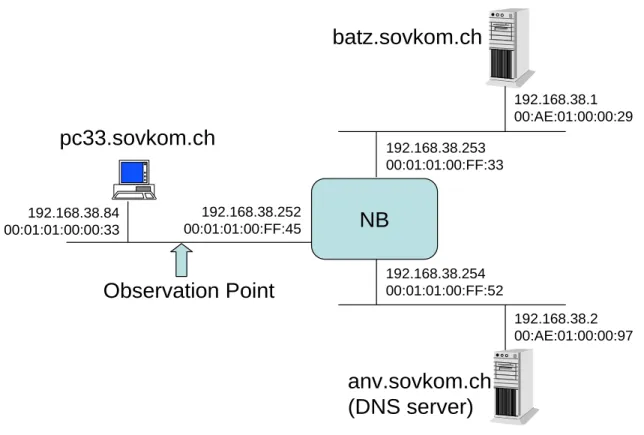
NB
pc33.sovkom.ch
batz.sovkom.ch
anv.sovkom.ch
(DNS server)
192.168.38.84 00:01:01:00:00:33 192.168.38.1 00:AE:01:00:00:29 192.168.38.2 00:AE:01:00:00:97 192.168.38.254 00:01:01:00:FF:52 192.168.38.253 00:01:01:00:FF:33 192.168.38.252 00:01:01:00:FF:45Observation Point
Figure 1: The network of Problem 1, with NB configure as bridge
• if B is actually on the Globi subnet, then, there won’t be any problem. A will send an ARP request to find B’s MAC address, B will receive the ARP request and answer with an ARP reply.
• if B is not on the Globi subnet (but B is at ETHZ), there will be a problem. Indeed, A will broadcast an ARP request with target B on the Globi subnet and A will not get any answer because B will not receive this request (remember that the ARP request are not forwarded by routers). Therefore, A will never be able to send an IP packet to B.
4. We assume that we cannot change the configuration of hostA. Propose a solution to the problem. Solution. We should implement PROXY ARP in the router on the Globi subnet. So, the router could answer on behalf ofB to the ARP requests.
Exercise 1.6 1. Consider the network in Figure 1. Only the systems shown on the figure exist in the network. The box in the middle, labeled “NB” is a multi-function network box, which can be configured either as a router or a bridge. It also runs a web server.
In this question, we assume that NB is configured to work as a bridge. Figure 1 shows the IP addresses and MAC addresses of all interfaces. The network mask on all machines is255.255.255.0.
(a) Are the IP addresses plausible, or would you change anything ? (justify your answer) (b) Does NB need IP addresses, or could we remove them ? (justify your answer)
(c) We assume that the ARP cache at machinepc33.sovkom.chis empty. We start a TCPDump somewhere on the LAN betweenpc33.sovkom.chand NB (at the place called “Observation Point”).
Then a user atpc33.sovkom.chexecutes a command, as shown below: pc33# telnet batz.sovkom.ch daytime
Trying 192.168.38.1 ... Connected to batz.sovkom.ch. Escape character is ’ˆ]’. Tue Nov 29 14:21:34 2005
Connection closed by foreign host. pc33#
(The user sends one request to the serverbatz.sovkom.chusing telnet, i.e. using TCP, to destination port 13–the port number reserved for the daytime service, obtains one answer from the server, and the TCP connection is closed. )
For each of the packets that can be observed, give the values of the following fields:
• MAC source address
• MAC destination address
• IP source address
• IP destination address
• protocol type
• if applicable, TCP or UDP source and destination ports
If some of the values cannot be determined exactly, explain what possible values would be. If two different packets give the same set of values, give it only once.
Solution.
(a) All the systems in the network belong to the same ethernet network: as all the IP addresses in the network are correct and as they belong to the same subnet, they all are correct.
(b) Nb needs at least one IP address, as it runs a web server. (c) Let’s use the following labels:
Device Address Symbol PC33 (IP) a1 PC33 (MAC) a2 DNS server (IP) b1 DNS server (MAC) b2 Batz (IP) c1 Batz (MAC) c2 NB (IP) n1 NB (MAC) n2
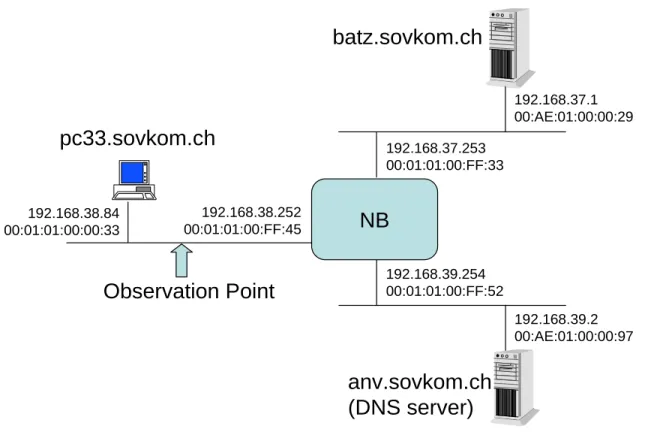
NB
pc33.sovkom.ch
batz.sovkom.ch
anv.sovkom.ch
(DNS server)
192.168.38.84 00:01:01:00:00:33 192.168.37.1 00:AE:01:00:00:29 192.168.39.2 00:AE:01:00:00:97 192.168.39.254 00:01:01:00:FF:52 192.168.37.253 00:01:01:00:FF:33 192.168.38.252 00:01:01:00:FF:45Observation Point
Figure 2: The network of Problem 1, with NB configure as router
Packet IP src IP dest MAC src MAC dst protocol type-dest port pc33−→all (a1) (b1) a2 (broadcast) ARP
DNS−→pc33 (b1) (a1) b2 a2 ARP
pc33−→DNS a1 b1 a2 b2 UDP (port 53)-dns query DNS−→pc33 b1 a1 b2 a2 UDP (local port)-dns answer
pc33−→all (a1) (c1) a2 (broadcast) ARP
batz−→pc33 (c1) (a1) c2 a2 ARP
pc33−→batz a1 c1 a2 c2 TCP (port 13)- syn batz−→pc33 c1 a1 c2 a2 TCP (local port)- syn ack pc33−→batz a1 c1 a2 c2 TCP (port 13)- ack batz−→pc33 c1 a1 c2 a2 TCP (local port)- (data, fin) pc33−→batz a1 c1 a2 c2 TCP (port 13)- ack pc33−→batz a1 c1 a2 c2 TCP (port 13)- fin batz−→pc33 c1 a1 c2 a2 TCP (local port)- ack 2. Now we assume that NB is configured as a router. The addresses are now as shown in Figure 2 Answer
the same three questions (a) to (c) as in the previous case.
Solution.
1. From the picture, the two servers and the PC33 each belong to a different ethernet network, connected each to a separate network interface of the router. Then each IP address in each ethernet network belong to the same subnet, and all are correct: then all the IP address assigned in the picture are acceptable.
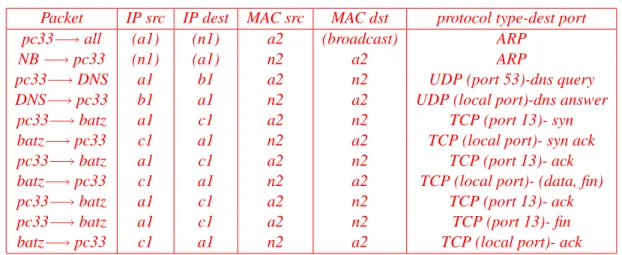
3. We use the same labels as before:
Packet IP src IP dest MAC src MAC dst protocol type-dest port pc33−→all (a1) (n1) a2 (broadcast) ARP
NB−→pc33 (n1) (a1) n2 a2 ARP
pc33−→DNS a1 b1 a2 n2 UDP (port 53)-dns query DNS−→pc33 b1 a1 n2 a2 UDP (local port)-dns answer pc33−→batz a1 c1 a2 n2 TCP (port 13)- syn batz−→pc33 c1 a1 n2 a2 TCP (local port)- syn ack pc33−→batz a1 c1 a2 n2 TCP (port 13)- ack batz−→pc33 c1 a1 n2 a2 TCP (local port)- (data, fin) pc33−→batz a1 c1 a2 n2 TCP (port 13)- ack pc33−→batz a1 c1 a2 n2 TCP (port 13)- fin batz−→pc33 c1 a1 n2 a2 TCP (local port)- ack
Exercise 1.7 Consider the configuration in Figure 3.
PCA ROUT1 BRI WP ROUT2 WSS a r1 r’1 b b’ h h’ r2 r’2 s A R1 R’1 B B’ H H’ R2 R’2 S IP addresses MAC addresses 3 3 44 www.sovkom.an 1 1 22 55
Figure 3:The configuration with web browser onP CA, web proxyW Pand web server onW SS. MAC addresses are calleda, r1, .... IP addresses are calledA, R1, ....
• PCA is a host running a web browser. WSS is a web server, responding to URL=www.sovkom.an, and with IP addressS.
• WP is a firewall acting as web proxy (application level gateway). PCA is configured to use WP by default.
• ROUT1 and ROUT2 are routers, BRI is a bridge.
• All links are Ethernet. All links between those systems are shown on the figure.
• MAC and IP addresses are shown on the figure.
• We assume that PCA already knows the IP addresses of WP and WSS. Thus, there will be no call to DNS. We also assume that ARP tables are already populated with the correct values, so there will be no ARP messages.
Assume thatP CAsends an HTTP request with target URL = www.sovkom.an in order to transfer one single file. Assume that we do a TCPDump at points 1 to 5, and we capture a copy of all packets that correspond to the transfer of the file and that travel in the direction from PCA to WSS. Give the IP and MAC source and destination addresses that can be read in the packets. Give the solution in the table below.
MAC source MAC destination IP source IP destination at1 at2 at3 at4 at5 Solution:
MAC source MAC destination IP source IP destination
at1 a r1 A H
at2 r1 h A H
at3 r1 h A H
at4 h r2 H S
at5 r2 s H S
Exercise 1.8 The following trace was captured with TCPDump. It was generated by a Web session. The S, P, and F letters indicate the corresponding TCP flags. Starting with the second packets in each direction, Sequence and Acknowldegement numbers are given by their offset from the values in the first packets. The notation 1:449(448) means that the packet sequence number is 1, it carries 448 bytes of data, and the last byte has sequence number 449 -1.
1. Explain the use of the flags. Solution.
S is the SYN flag, indicating establishment of a new connection F is the FIN flag, indicating closing of a connection
P is the PSH flag, requesting immediate data delivery (to the application) at the receiver 2. Some packets have been mis-ordered. At which lines is that visible ?
Solution. Note that by monitoring traffic by a third party, a retransmission and mis-ordering usually can’t be distinguished with certainty. The answers given here therefore only indicate what isvery likelyto have happened.
Segment 10486:10934 would have been expected at or near line 81 but is received at line 94. Note that this could also be due to a retransmission after a timeout.
Expected at line 84, segment 11382:11830 is received at line 87, i.e. 11382:11830 and 11830:12278 appear to be swapped.
3. Which lines are retransmissions ?
Solution. Segment 8246:8694 (expected at or near line 69) appears to be retransmitted at line 90. Expected at line 176, segment 23926:24374 is apparently retransmitted at line 185.
4. Show the states (from the slide ”TCP Finite State Machine”) for each of the two ends of the connec-tion, for the first and last 10 lines of the trace, after the packet has been received.
Solution.
Line lrcpc8 ezinfo
1 SYN SENT SYN RCVD 3 ESTABLISHED SYN RCVD 5 ESTABLISHED ESTABLISHED 6 ESTABLISHED ESTABLISHED 8 ESTABLISHED ESTABLISHED 9 ESTABLISHED ESTABLISHED . . . 181 ESTABLISHED ESTABLISHED 182 CLOSE WAIT FIN WAIT 1 184 CLOSE WAIT FIN WAIT 1 185 CLOSE WAIT FIN WAIT 1 187 CLOSE WAIT FIN WAIT 2 188 CLOSE WAIT FIN WAIT 2 189 LAST ACK TIME WAIT 191 CLOSED TIME WAIT
Exercise 1.9 1. Consider the transparency ”Nagle’s Algorithm: Example”. Assume that the packet at line 4 is lost in the network. Give a possible continuation of the message chart.
Solution. In the hypothesis that the override timer is bigger than the retransmission timer, we have repacketization: at the retransmission timeout the lost bits are retransmitted, together with the bits arrived in the meantime. In this case Nagle’s algorithm does not came into play.
We can well realize how it is not possible to have the override timer smaller than the retransmission timer, as we would have transmission of duplicate of the same bits even in the absence of losses.
2. Assume Nagle’s algorithm is disabled for a given connection. Is it possible that some data written by the application is still delayed ? Prove your answer.
Solution. Due to the sliding window mechanism, whenever the available window does not allow the application to send all the data that it produces, all the remaining data is buffered and therefore delayed.
Exercise 1.10 Quiz
1. true false When a multiport repeater has some bits to send on a half-duplex Ethernet interface, it should first wait until the channel is idle.
Solution. False. The repeater simply repeats bits, even if this causes a collision.
2. true false When a bridge sends a packet towards the final destination over a full duplex Ethernet interface, it should put as destination MAC address the MAC address of the next hop. Solution. False; the bridge does not modify MAC addresses.
3. true false When a bridge has a packet ready to send on a full-duplex Ethernet port, it listens to the medium and waits until the medium is idle.
Solution. False, there is no CSMA/CD over full duplex Ethernet.
4. true false Bridges are said to be “multiprotocol” because a bridged network works independently of network layer protocols such as IPv4 or IPv6.
Solution. True.
5. true false A bridge is an intermediate system for layer 2. Solution. True.
6. true false Assume host A sends an IP packet to host B via bridge X, and assume all three systems are on the same bridged network. Then the destination MAC address in the packet sent by A is the MAC address of X.
Solution. False. Bridges on Ethernet are transparent.
7. true false On a full duplex Ethernet link, there is no CSMA/CD protocol.
Solution. True. A full duplex Ethernet link uses Ethernet physical layer but is not a shared medium link.
8. true false With an Ethernet switch, there is one collision domain per port. Solution. True.
9. true false A multiport repeater separates collision domains. Solution. False.
10. true false When a bridge has a packet ready to send on a half-duplex Ethernet port, it listens to the medium and waits until the medium is idle.
Solution. True, the bridge executes CSMA/CD on all half-duplex ports.
11. true false In a bridged LAN with more than one bridge and with redundant paths, packet sequence is not guaranteed.
Solution. False. Packet sequence is guaranteed by the spanning tree algorithm, which reduces the active topology to a tree.
12. true false Assume hosts A and B are on the same bridged LAN, with one bridge X. When host A sends a packet to host B, the source MAC address is that of A, and the destination MAC address is that of the bridge
Solution. False; Bridges are transparent. The destination address is normally that of B; it may also be the broadcast address, or a multicast address.
13. true false A router is an intermediate system for layer 3. Solution. True.
14. true false Ethernet bridges do not use IP addresses when deciding where to send a packet.
Solution. True. Bridges do not look at layer 3 information and are therefore said to be multiprotocol 15. true false If an IP host A receives an IP packet with TTL=255, then A can conclude that
the source of the packet is on-link. Solution. True.
16. true false If host A at EPFL wants to send an IP packet to host B at ETHZ, and if A’s ARP cache is empty, then A sends an ARP request in order to determine the IP address of the next hop router.
Solution. False. The ARP request is to find the MAC address of the next hop router.
17. true false Assume A and B are two IPv4 hosts, and that the hosts are on Ethernet. If A and B have the same network mask and the same network prefix, then when A sends a packet to B, the packet still contains an IP destination address, equal to the IP address of B.
Solution. True.
18. true false When an IP router between two Ethernet segments forwards an IP packet, it does not modify the destination IP address.
Solution. true.
19. true false Assume that hostAhas an IP packet to send to hostB, and that the two hosts are on two Ethernet segments separated by a bridgeBR. Assume the ARP table atAis empty. Host Awill send an ARP packet in order to find the MAC address of the bridgeBR.
Solution. False. The bridge is not visible toA. The ARP is to find the MAC address ofB.
20. true false Assume A and B are two IPv4 hosts, and that the hosts are on Ethernet. If A and B have the same network mask and the same network prefix; if A has no entry in its ARP, then before sending a packet to B, A sends an ARP request with target IP address = IP address of B. Solution. True. Comment: if proxy ARP is used, a proxy ARP server may respond with another MAC address than that of B
21. true false The route indicated bytraceroutemay not be the real one because parallel paths may exist in the Internet.
22. true false In an intranet with more than one router, packet sequence is guaranteed by means of the TTL field.
Solution. False. Packet sequence is not guaranteed with IP.
23. true false When an IP router between two Ethernet segments forwards an IP packet, it does not modify the destination MAC address.
Solution. false.
24. true false Assume A and B are two IPv4 hosts on the EPFL network. Assume that host A is configured by error with a network mask equal to 255.255.0.0. When A sends a packet to another EPFL host B, if the ARP cache at A is empty, then A will send an ARP packet in order to find the MAC address of B.
Solution. True. This is not the normal configuration, but it will works because in such cases the default router for A will use proxy ARP and respond with its own MAC address
25. true false If there are some errors in the routing tables at some routers, then, with IPv4, it is possible that a packet loops for ever.
Solution. False. The packet is discarded when the TTL fields becomes 1.
26. true false When a router sends a packet towards the final destination over a full duplex Ethernet interface, it should put as destination MAC address the MAC address of the next hop. Solution. True.
27. true false The subnet mask is used by a host or a router in order to know whether it belongs to the same subnet as a machine identified by some IP address.
Solution. True.
28. true false When an application receives a block of data from TCP, the application knows that the data was sent as one message by the source.
Solution. False.
29. true false Assume hostAsends data to hostBusing TCP. In some cases, it may happen that two blocks of data generated by the application at A are grouped by TCP into one single IP datagram.
Solution. True. TCP does its own packetization.
30. true false Assume host A sends data to host B using a TCP socket. If A writes three blocks of data into the TCP socket, then there will be three packets sent to B.
Solution. False. TCP does its own packetization. There may be any number of packets, depending on how much data is written by B.
31. true false It is possible for a UDP source A to send data to a destination process P1 on host B1, using source port aand destination port b, and at the same time send (different) data to another destination processP2 on a different hostB2, still using the same source portaand destination portb.
Solution. True.
sequence data is delivered to the application. Solution. False.
33. true false When an application receives data from UDP, the application knows that the data was sent as one message by the source.
Solution. True.
34. true false Assume hostAsends data to hostBusing UDP. In some cases, it may happen that two blocks of data generated by the application at A are grouped by UDP into one single IP datagram.
Solution. False.
35. true false With a sliding window protocol and for a constant round trip time, increasing the window size increases the throughput if there is no loss, up to a certain limit.
Solution. True.
36. true false With a sliding window protocol, the window size is the maximum amount of unacknowledged data that can be sent by the source.
Solution. True.
37. true false Assume hostAsends one block of data to hostB using UDP. In some cases, it may happen that the blocks of data generated by the application atAis fragmented by the IP layer atAinto several IP packets.
Solution. True.
2
Module 2: Dynamic Routing
Exercise 2.1 1. Why do bridges have to build a spanning tree whereas routers do not ?
Solution. Bridges have to build aspanning tree because they forward packets according to MAC addresses which are not structured and they do not detect frames that loop. Routers do not have to build a spanning tree since they forward packets according to IP addresses which are structured and eventually discard packets that loop.
2. What happens to packets if there is a routing loop with bridges ? with routers ?
Solution. Packets loop indefinitely if there is a routing loop with bridges. Packets will eventually be discarded if there is a routing loop with routers because of the TTL field.
3. Is it possible for a link-state algorithm to use the Bellman-Ford algorithm ? Why or why not ? Solution. The link-state algorithm can use the Bellman-Ford algorithm (static version) for computing the shortest path to all other nodes since the Bellman-Ford algorithm requires only a partial view of the network and the link-state algorithm provides a complete topology view of the network.
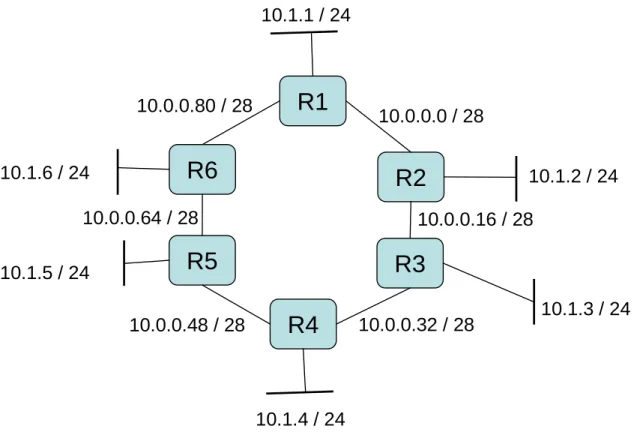
R1
R2
R3
R4
R5
R6
10.1.2 / 24
10.1.3 / 24
10.1.4 / 24
10.1.5 / 24
10.1.6 / 24
10.1.1 / 24
10.0.0.0 / 28
10.0.0.16 / 28
10.0.0.32 / 28
10.0.0.48 / 28
10.0.0.64 / 28
10.0.0.80 / 28
Figure 4: The network in Exercise 2.2.
Exercise 2.2 Consider the network in Figure 4. R1 to R6 are routers. Each of these routers has 3 (exter-nal) IP interfaces:
• two interfaces, called backbone interfaces, connect the router to neighbouring routers; the prefix length for these interfaces is 28 bits.
• one of them, callededge interface, is an interface to a set of hosts; the prefix length for this interface is 24 bits.
All routers run a distance vector routing protocol such as RIP. The costs of a link between two adjacent routers is equal to 1. The cost from a router to a directly connected network is also equal to 1.
1. What is the subnet mask at each of the router interfaces shown on the picture ? (give the answer in dotted decimal notation)
Solution. Backbone: 255.255.255.240. Edge: 255.255.255.0.
2. Give the routing table at R1, assuming the routing protocol has converged. Also assume that there is no other network connected to these routers than shown on the picture.
Solution. Let’s assume that the last two bits of the clock-wise side backbone interfaces are equal to
01and the other side backbone interfaces have the last two bits equal to10. Lets also assume that the edge interfaces are called eth0, clock-wise side backbone interfaces are called eth1 and the other side backbone interfaces are called eth2. Then the routing table is:
Destination Network Next Hop Interface Distance 10.1.1.0/24 on-link eth0 1 10.0.0.0/28 on-link eth1 1 10.1.2.0/24 10.0.0.2 eth1 2 10.0.0.16/28 −||− −||− 2 10.1.3.0/24 −||− −||− 3 10.0.0.32/28 −||− −||− 3 10.1.4.0/24 −||− −||− 4 10.0.0.48/28 10.0.0.81 eth2 3 10.1.5.0/24 −||− −||− 3 10.0.0.64/28 −||− −||− 2 10.1.6.0/24 −||− −||− 2 10.0.0.80/28 on-link −||− 1
3. Assume there exists a host M with IP address 10.0.0.24 and a host A with IP address10.1.1.23. What are the possible default routers forM andA? For each combination of cases, what is the path (=sequence of routers) followed by a packet fromM toA?
Solution. The possible default routers forM: R2andR3. ForA: R1. Case (R2, R1): the path isM−R2−R1−A.
Case (R3, R1): for the first packet the path isM −R3−R2−R1−A. Then, the redirection will happen and the pathM−R2−R1−Awill be used for the subsequent packets.
4. Assume now that, on router R2, the edge interface with network prefix 10.1.2/24 is brought down and replaced by a new edge interface, which has now prefix 10.1.7/24. Explain by which mechanisms the other routers will become aware of the change.
Solution. In the next RIP update message (sent every 30s) R2 will announce toward its neighbors the network 10.1.7 with metric 1 and will not announce the network 10.1.2 (which is equivalent to the metric∞). Bellman-Ford algorithm will cause the updates of routing tables or R1 and R3. R1 and R3 will propagate changes of their routing tables in their next update messages sent towards their neighbors. The change propagates further in the same way.
5. Assume just after this change of configuration, router R2 receives a distance vector from R1, which is based on the values before the change. Explain what will happen, assuming the routing protocol does not implement split horizon. What would happen if the routing protocolwouldimplement split horizon ?
Solution. If split horizon is not used there will be ”count to infinity” scenario: R2 will increment it’s metric toward 10.1.2/24 to 3 and tell this route to R1 and R3. R1 will increment its metric to 4 and tell to R2 and R6, and so on. In this way there is count to infinity between R1 and R2.
If split horizon is used, R2 will immediately set its metric toward 10.1.2/24 to infinity (16 in real implementation), as it sees that the route announced by R1 goes over itself (R2). then it will propagate this change toward R1, R1 will propagate it further, and so on. Similar will happen with R3 as with R2. The change propagates immediately in the case with split horizon.
6. Assume the network has converged after the changes in the previous questions. Assume we do the same manipulation on router R5, with thesamenew prefix (i.e. the edge interface with network prefix 10.1.5/24 is brought down and replaced by a new edge interface, which has now prefix 10.1.7/24, the same prefix as on router R2).
However, this was done by the network managers, maybe by mistake.
Explain the actions that the routing protocol will take, and give the routing table entries at all routers that, after convergence, have changed.
Solution. The actions: RIP update messages exchange and routing table updates according to Bellman-Ford algorithm. Only the entries toward 10.1.7/24 will change at some of the routers:
Router Destination Network Next Hop Distance changed?
R1 10.1.7.0/24 R2 2 no R2 10.1.7.0/24 on-link 1 no R3 10.1.7.0/24 R2 2 no R4 10.1.7.0/24 R5 2 yes R5 10.1.7.0/24 on-link 1 yes R6 10.1.7.0/24 R5 2 yes
7. Assume there is a host B2 connected to router R2’s edge interface, with IP address 10.1.7.2 and a host B5 connected to router R5’s edge interface, with IP address 10.1.7.5. Assume host A has a packet to send to B2 and a packet to send to B5. What is the path followed by each of these packets ? What happens at the last router on the path, in both cases ?
Solution. A→B2:A−R1−R2−B2, success.
A→B5: A−R1−R2, then ARP will fail, and the ICMP ”destination host unreachable” message will be sent by R2 to A, and the packet will be dropped by R2.
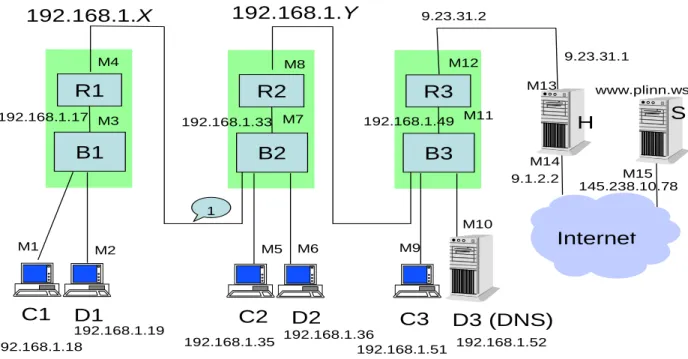
Exercise 2.3 Consider the network in Figure 5. It represents a small corporate network. The IP addresses are shown explicitly; M1 to M15 mean MAC addresses. B1, B2 and B3 are bridges; R1, R2 and R3 are routers.
D3 is the DNS server for this network. The machines C1, D1, C2, D2, and C3 are configured with DNS server address = 192.168.1.52.
The network is connected to the Internet only by means of a web proxy (the machine H is an application layer gateway).
All interfaces that have IP addresses of the form 192.168.x.y are configured with netmask = 255.255.255.240. The default gateway are configured as follows
• at C1 and D1: 192.168.1.17
• at C2 and D2: 192.168.1.33
• at C3 and D3: 192.168.1.49
1. Give a possible value for theXin the IP address of the interface M4 of router R1 (i.e. give a possible value for the address marked192.168.1.X on the figure). Justify your answer. Same question for the Y in the IP address of the interface M8 of router R2.
Solution. The M4 interface must belong to the same subnet as C2 and D2. Since the mask is over 28 bits,Xmust lie in the interval[33,46](the host partsb0000[X = 32] andb1111[X= 47] are not possible). The value must also not be already allocated. A possible value is 34. Similarly,Y must lie in the interval[49,62]; a possible value is50.
B1 R1 B2 R2 B3 R3 Internet H C1 D1 C2 D2 C3 D3 (DNS) 192.168.1.18 192.168.1.19 192.168.1.17 192.168.1.X 192.168.1.35 192.168.1.36 192.168.1.33 192.168.1.51 192.168.1.52 192.168.1.49 9.23.31.1 9.1.2.2 145.238.10.78 S M1 M2 M3 M4 M8 M12 M11 M7 M5 M6 M9 M13 M14 M15 M10 www.plinn.ws 1 192.168.1.Y 9.23.31.2
Figure 5:A small corporate network (exercise 2).
2. We assume that R1, R2 and R3 are manually configured, i.e. they do not run any routing protocol. Put in the table below the routing table entries that need to be written in these three routers. Give only the entries for destination prefixes that arenoton-link with this router.
Solution. tbd. R1 needs only default entry to 192.168.1.33
3. The user at host C1 uses a web browser to connect to the server www.plinn.ws, which is on the machine marked S on the figure. As a result, the web browser at C1 sends a DNS query to determine the IP address that corresponds to the DNS name www.plinn.ws. A packet sniffer placed at the location labelled 1 on the figure reads the DNS query and its answer. In the table below, mark the values of the fields that are read in these two packets.
4. The web browser at C1 has now received the response from the DNS server and sends an HTTP query. Same question as before for the packets that contain the HTTP query sent by C1 and for the resulting response.
5. Assume that we change (by mistake) the netmask for the interface M1 of host C1. The new mask value is 255.255.255.0. Will C1 continue to work normally ? Justify your answer.
6. Instead of manual configuration as in question 2, routers R1 R2 and R3 use now RIP. After RIP has converged, what are the routing tables at each router ? Give only the entries for destination prefixes that arenoton-link with this router.
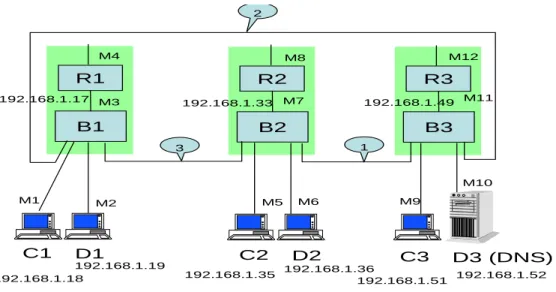
B1 R1 B2 R2 B3 R3 C1 D1 C2 D2 C3 D3 (DNS) 192.168.1.18 192.168.1.19 192.168.1.17 192.168.1.X 192.168.1.35 192.168.1.36 192.168.1.33 192.168.1.51 192.168.1.52 192.168.1.49 M1 M2 M3 M4 M8 M12 M11 M7 M5 M6 M9 M10 192.168.1.Y ?.?.?.?
Figure 6:The second network (exercise 2).
7. We now pull the wire between M12 and M13; then we change the IP address of the interface at M12 and connect M12 to bridge B1; the resulting new configuration is in Figure 6. What IP address and netmask should we give to M12 ?
Solution. An address in subnet 192.168.1.16/28, for example 192.168.1.20. The netmask should be 255.255.255.240 (i.e. the prefix is 28 bits)
Explain what RIP does immediately after the re-connection ?
In the following table, write the routing tables after RIP has stabilized. (As before, give only the entries for destination prefixes that arenoton-link with this router.)
B1 R1 B2 R2 B3 R3 C1 D1 C2 D2 C3 D3 (DNS) 192.168.1.18 192.168.1.19 192.168.1.17 192.168.1.35 192.168.1.36 192.168.1.33 192.168.1.51 192.168.1.52 192.168.1.49 M1 M2 M3 M4 M8 M12 M11 M7 M5 M6 M9 M10 1 3 2
Figure 7:The third network (exercise 2).
8. We reconfigure the network as shown in Figure 7. The interfaces at M4, M8 and M12 are not used. We change the network mask to 255.255.255.0 on all systems, the IP addresses remain the same. We do a ping from C1 to C2, C2 to C3 and C3 to C1. Packet sniffers are placed at locations labeled 1, 2 and 3 on the figure. In the table below, mark the values of the fields that are read in the ping packets corresponding to each of the ping exchanges if the packet is visible at this location. Consider only the ping packets themselves, not the replies.
Solution. One of the links must be disabled by the spanning tree, so at one of the observation points we should see nothing.
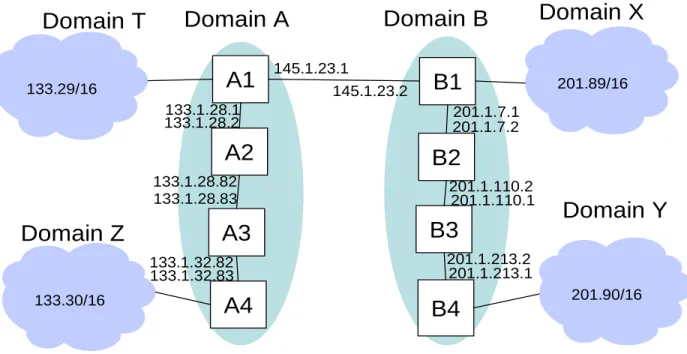
Exercise 2.4 Consider the network in Figure 8. Domain A [resp. B] is a service provider to domains Z and T [resp. X and Y]. A and B peer over the link shown in the figure. A1, A2, A3 and A4 run BGP and OSPF. B1, B2, B3 and B4 run BGP and RIP. Some of the routers (like A3 and B3) run BGP but do not have external BGP connections. Both domains A and B never redistribute BGP into their IGP. The link costs for OSPF or RIP are all equal to 1.
The decision process inside all BGP routers in domain A is such that the route selected is, by order of decreasing priority
(1) the route that has the smallest MED
(2) the route that has the shortest IGP distance from this node to the NEXT-HOP of the route
The decision process inside all BGP routers in domain B uses the reverse order, i.e., it is such that the route selected is, by order of decreasing priority
(1) the route that has the shortest IGP distance from this node to the NEXT-HOP of the route (2) the route that has the smallest MED
A1
A4
A2
B1
B4
B2
133.29/16 133.30/16 201.89/16 201.90/16 145.1.23.1 145.1.23.2 201.1.213.1 201.1.213.2 201.1.7.2 201.1.7.1Domain A
Domain B
Domain X
Domain Y
Domain Z
Domain T
133.1.28.83 133.1.28.82 133.1.28.2133.1.28.1A3
B3
201.1.110.1 201.1.110.2 133.1.32.83 133.1.32.82Figure 8:Network for exercise 2.4, step 1.
A1 to B1 133.29/16 AS-PATH = B MED = 10 133.30/16 AS-PATH = B MED = 40 B1 to A1 201.89/16 AS-PATH = B MED = 10 201.90/16 AS-PATH = B MED = 40
All BGP routers that receive announcements made over E-BGP accept them, and store them in their RIB-in with the corresponding NEXT-HOP attribute. For example, the RIB-in at A1 for the link to B1 is
RIB-in at A1 from B1
201.89/16 AS-PATH = B MED = 10 NEXT-HOP = 145.1.23.2
201.90/16 AS-PATH = B MED = 40 NEXT-HOP = 145.1.23.2
Since A1 receives only one route to 201.89/16 [resp. 201.90/16] we assume that its decision process accepts this route. We assume a similar behavior at B1.
(a) Will A4 also learn the route201.89/16 AS-PATH = B MED = 10? If so, by which proto-col ?
Solution. By I-BGP, over a TCP connection from A1.
(b) What is the routing table entry (in the forwarding table) at router A3 for destination prefix
201.89/16? at B3 for destination prefix133.29/16? Solution.
A3: destination prefix next-hop interface 201.89/16 145.1.23.2 N/A B3: destination prefix next-hop interface
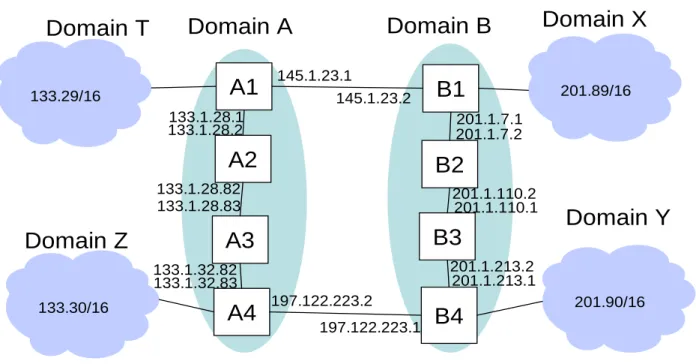
2. Assume now that an external link is opened between A4 and B4, as shown on Figure 9. The BGP
A1
A4
A2
B1
B4
B2
133.29/16 133.30/16 201.89/16 201.90/16 145.1.23.1 145.1.23.2 197.122.223.2 197.122.223.1 201.1.213.1 201.1.213.2 201.1.7.2 201.1.7.1Domain A
Domain B
Domain X
Domain Y
Domain Z
Domain T
133.1.28.83 133.1.28.82 133.1.28.2133.1.28.1A3
B3
201.1.110.1 201.1.110.2 133.1.32.83 133.1.32.82Figure 9:Network for exercise 2.4, step 2.
announcements that are made over E-BGP are the same as previously plus the following ones: A4 to B4 133.29/16 AS-PATH = B MED = 50 133.30/16 AS-PATH = B MED = 10 B4 to A4 201.89/16 AS-PATH = B MED = 50 201.90/16 AS-PATH = B MED = 10
(a) Which route does the decision process at A4 now select toward the networks 201.89/16 and 201.90/16? at B4 toward 133.29/16 and 133.30/16 ? Give the answers in the form
destination prefix / AS-path / next-hop
Solution. A4:
destination prefix AS-path next-hop 201.89/16 B 145.1.23.2 201.90/16 B 197.122.223.1 B4:
destination prefix AS-path next-hop 133.29/16 B 197.122.223.2 133.30/16 B 197.122.223.2
(b) Does this change the outcome of the decision process at A1 ? at B1 ? (justify your answer) Solution. A1: the route toward 201.89/16 does not change, as the new advertisement has bigger MED value.
A1: the route toward 201.90/16 changes, as the new advertisement has smaller MED value and will be prefered.
B1: the routes will not change as the shortest IGP route toward next hop has the highest priority and will always lead over A1.
(c) After BGP converges, assume router A3 has a packet with destination address 201.89.1.1 . To which directly connected neighbor does A3 send the packet? By which mechanisms did A3 learn where to send this packet? Same questions for B3 with a packet to send to 133.29.1.1 .
Solution. A3 forwards the packet to 133.1.28.82, determined by recursive table lookup over the next two forwarding table entries:
destination prefix next-hop interface learned by 201.89/16 145.1.23.2 N/A I-BGP from A1 145.1.23.2 133.1.28.82 eth... IGP in domain A
B3 forwards the packet to 201.1.213.1, determined by recursive table lookup over the next two forwarding table entries:
destination prefix next-hop interface learned by 133.29/16 197.122.223.2 N/A I-BGP from B4 197.122.223.2 201.1.213.1 eth... IGP in domain B
3. Assume now that the link between A1 and B1 fails. Will connectivity between domains T and X be affected and how ? Will the BGP routers be able to find new routes from T to X ? Explain what will happen, i.e. what will trigger the events, which messages (information) will be exchanged and between which routers and by which protocol, which entries will change and in which tables and at which routers?
Solution. The connectivity will temporarily be affected and the routes going over the broken link will experience the losses, until BGP detects and fixes the problem. BGP routers will be able to restore the connectivity by selecting alternate routes. A1 and B1 will detect the problem by observing periodic updates over the broken link are missing, or by detecting that the link is broken by some another means. Then, A1 and B1 will delete the entries learned over this link from their RIB-in tables, and update related entries in their forwarding tables. They will also advertise the changes (I-BGP) to other BGP routers within their domains, and similar delete in RIB-in and update in forwarding tables will take place (there will be only one BGP entry available per considered destination network, and it will be selected).
3
Module 3: Congestion Control
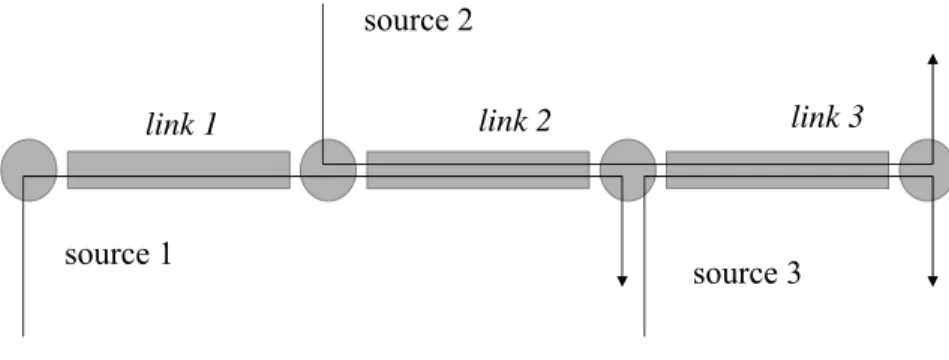
Exercise 3.1 Consider the network illustrated on Figure 10. Source 1 uses links 1 and 2; source 2 uses links 2 and 3: source 3 uses link 3. Each of the links has the same capacityc.
1. Assume that the ratesx1,x2andx3of the three sources are distributed according to max-min fairness. Compute their values.
Solution.xi = 2c by the water filling algorithm.
link 1 link 2 link 3
source 1
source 2
source 3
Figure 10:A network with3sources.
Solution. The proportionally fair allocation is obtained by maximizing the function defined forxi >0 by
J = lnx1+ lnx2+ lnx3 subject to the constraints
x1 ≤ c (1)
x1+x2 ≤ c (2)
x2+x3 ≤ c (3)
(4) The constraint (1) is redundant with the constraint (5) and can be deleted. At the optimum, the constraint (5) has to be satisfied, since, if it is not, we can always increasex1(which is not subject to other constraints). The same holds for (3). Thus we have to maximize a function ofx2only, equal to
ln(c−x2) + ln(x2) + ln(c−x2)
Elementary calculus gives the maximum forx2 = c3. The proportionally fair allocation is thusx1 =
2c
3,x2= 3c andx3= 2c3.
Exercise 3.2 1. Assume that a TCP sender, called S, does not implement fast retransmit, but does implement slow start and congestion avoidance. Assume that
• segmentsn, n+ 1, n+ 2, . . . , n+ 10are transmitted at times0,1,2, . . . ,10deciseconds (ds)
• transmission time per segment is 1 ds
• round trip time (2-way propagation plus packet transmission, ack processing and transmission) is fixed and equal to 10 ds
• segmentnis lost
• no other segment or ack is lost
• there is no misordering of segments or acks by the network
• the retransmission timer for segmentnis set to 60 ds, starting at the end of the transmission
• cwnd=twnd= 64 segments at time 0
By which means and at what time will the loss of segmentnbe detected ? Solution: Loss of segment nis detected by a retransmission timer timeout, at 61 ds.
2. Immediately after re-transmitting segmentn(due to a timeout),Shas 3 more segments ready to send (we call them segmentsn+11ton+13). At what time is the ack for segmentn+3received (assuming again that there are no losses other than that of segmentn) ? For segmentn+ 13? Solution:n+ 3 is ACK’ed at 71 ds,n+ 13is ACK’ed at 91 ds.
Segmentn+ 3is sent at 3 ds and received at 4 ds. At 61 ds, the loss of segmentnis detected and a retransmission occurs. Since the RTT is equal to 10 ds, the segmentnis ACK’ed at 71 dsalongwith segmentsn+ 1ton+ 10.
Since a loss was detected,cwndis set to 1 andtwndis divided by 2. When the ACK fornis received, cwndis set to 2.
Hence, segmentn+ 11is sent at 71 ds and segmentn+ 12is sent at 72 ds. n+ 11is ACK’ed at 81 ds. At this point,cwndis incremented and segmentsn+ 13is sent. It is ACK’ed at 91 ds.
3. Same question as before assuming now that fast retransmit and fast recovery are implemented and segmentsn+ 11ton+ 13are available for transmission at time 60. Solution: n+ 3is ACK’ed at 23 ds.
n+k+ 3is ACK’ed at 72 ds.
Segmentn+ 1is sent at 1 ds, ACK’ed at 11. Segmentn+ 2is sent at 2 ds, ACK’ed at 12. Segment n+ 3is sent at 1 ds, ACK’ed at 13. Since segmentnwas lost, the three ACKs received are identical. Hence, segmentnis retransmitted at 13 ds and ACK’ed at 23 dsalongwith segmentsn+ 1ton+ 10. Note that with fast recovery,cwndis only halved. Hence, when segmentsn+ 11ton+ 13are ready to be sent at 60 ds, they can be sent in a row at 60 ds, 61 ds and 62 ds. ACK for segmentn+ 13is received at 72 ds.
Exercise 3.3 Consider the network illustrated in Figure 11. There are three links and six flows. The flows that use one link are called “short”, the other flows are called “long”. The short flow number 1 [resp. 2,3] uses link 1, and its rate is calledx1 [resp. x2, x3]. The long flow number 1 [resp. 2,3] uses links 1 and 2 [resp. 2 and 3, 3 and 1]. All links have the same capacityc.
Case 1 Assume that the rates of the six flows are distributed according to max-min fairness. Compute their values.
Solution.xi =yi = 3c by the water filling algorithm.
Case 2 Same question assuming that the rates are distributed according to proportional fairness.
Solution. The proportionally fair allocation exists and is unique. Since the problem is symmetric (all links play the same role) the proportionally fair allocation must havex1 =x2 =x3 andy1 =y2 = y3.
(Proof of this statement: by contradiction. Assume this would not be true, say for example that we would havex1 < x2. By symmetry, the new allocation obtained by exchanging the roles of 1 and 2, thusx1 = x2, x2 =x1, would also be proportionally fair. This would contradict the uniqueness of the the proportionally fair allocation.)
Thus we are looking forxandythat maximize
x
1link 1
link 3
link 2
y
1x
3y
3x
2y
2Figure 11:A network with6flows. The short flow 1 and the long flow 1 are shown with thick lines.
subject to the constraint
x+ 2y≤c (5)
At the optimum, the constraint (5) has to be satisfied with equality, since, if it is not, we can always increasex (which is not subject to other constraints). Thus we have to maximize the function ofy only, equal to
3 ln(c−2y) + 3 ln(y)
Elementary calculus gives the maximum fory= c4. The proportionally fair allocation is thusxi = 2c andyi = c4.
Case 3 We assume now that each flow is a TCP connection. Assume that the round trip times of each short flow is equal to the same numberT, while the round trip time of each long flow is exactly2T(i.e. most of the round trip time is spent queuing and processing at the link buffers; time spent at destinations is negligible). Assume that:
• The loss ratio at the entrance to linkiisq, the same for all links, and the same for all flows that use a link. Thus the loss ratio for a flow that uses one link isq
• Loss rates are small, so that the loss ratio for a flow that uses two links is considered to be equal to2q
• All flows have the same TCP segment size
• Flows are limited only by the link capacities and overhead is negligible, so we assume that the sum of the rates of flows is equal to link capacity. For example:
x1+y1+y3=c (6)
Compute the rates achieved by all flows under these assumptions. Solution. Apply the loss throughput formula:
xi= TK√q yi = 2TK√
2q
Thusxi = 2√2yi. By Eq.(6), we obtain
yi = c
2√2+2 ≈0.207c
xi= 2√2yi ≈0.586c
Case 4 Same question assuming that the round trip times of all six flows are approximately the same (i.e. most of the round trip time is due to processing at the servers, instead of queuing and processing at the link buffers). Compare to the rates found in cases 1 and 2 and explain what you find. Also compare to the rates found in case 3 and explain what you find.
Solution. Now we find
xi = TK√q yi= T√K
2q
Thusxi =√2yi. By Eq.(6), we obtain
yi = √c
2+2 ≈0.293c
xi =√2yi ≈0.414c
Comparing to cases 1 and 2, we see that this allocation is in between (the ratiosxi/yi are 1, 2 and 1.4). This is compatible with the fact that TCP tends to distribute rates according to a utility fair-ness, intermediate between proportional fairness and max-min fairfair-ness, when all RTTs are identical. Comparing to case 3, we see that TCP has a bias against long round trip times.
Exercise 3.4 Consider the scenario in Figure 12.
A and B each transfer a very large file over a TCP connection with server S. The link rates are:
• between A and R1: 54 Mb/s in each direction
• between B and R1: 100 Mb/s in each direction
• between R1 and R2: 6 Mb/s in each direction
• between R2 and S: 1000 Mb/s in each direction
Assume there is no other traffic than these two TCP connections. The RTT for A is 1000 ms, for B it is 200 ms.
1. What would be the throughputs of A and B if they were max-min fair ? if they were proportionally fair ?
R1 R2 A
B
S
Figure 12:Network for exercise 3.4, step 1.
2. Assume we can neglect all losses except on the link R1-R2. Also assume that the two TCP connections can, together, fully utilize the link R1-R2 (i.e. the sum of their throughputs is 6 Mb/s). What are the throughputs achieved by A and B ?
Solution. By the loss-throughput formula, the throughputs are proportional to the round trip times, and their sum is 6Mb/s, thus they are: for A: 1 Mb/s; for B: 5 Mb/s
3. Assume now that the satellite link has a high loss ratio, due to transmission errors (FEC is disabled). The loss rate for the connection from A is now assumed to be fixed and equal to 0.01. We assume the RTTs stay the same, and, as before, that the two TCP connections can, together, fully utilize the link R1-R2 (i.e. the sum of their throughputs is 6 Mb/s). What are now the throughputs achieved by A and B ?
Solution. TakeL= 1500bytes andC= 1.22. For A: T a∗sqrt(0.01)L∗C = 146kbit/s; For B:6M bit/s−146kbit/s= 5854kbit/s.
4. Assume we change the configuration and introduce a transport layer gateway H, as shown on Fig-ure 13.
There is now one TCP connection from A to H, a second one from H to S (and one from B to S as before). The RTT between H and S is 200 ms, between A and H is 800 ms and between B and S 200 ms as before. We assume FEC is enabled so that there is no loss between A and H. What is the end to end throughput of A and B ? Same question if FEC is disabled, so that the loss rate between A and H is again 0.01.
Is it useful to use a transport layer gateway in this scenario ?
R1 R2 A
B
S H
Figure 13:Network for exercise 3.4, step 2.
source B. Indeed, on link A-H there is only one TCP connection, that can exploit the whole band-width. Also the connection H-S is identical to B-S, so that they will get the same bandwidth share, 3Mbit/s.
FEC disabled:
for A:0.8∗sqrt(0.01)L∗C Ra= (L/800)(C/sqrt(0.01)) = 183kbit/s; for B:6M bit/s−183kbit/s= 5817 kbit/s.
It is not very useful, as it guarantees a share of the bandwidth to the link with larger round trip delay which is only slightly higher.
Exercise 3.5 Assume that we change the code of TCP by modifiying the congestion avoidance phase as follows. For every acknowledgement received, we increase the window size as in slow start. Give the pros and cons of this modification.
Solution. This is roughly equivalent to performing multiplicative increase by a factor of 2, instead of additive increase. But we know that this is bad because it will not provide fairness.
Pros: if I am the only one doing this, I am more aggressive and will gain higher throughput, at the expense of others.
Cons: if everyone does this, the network will not distribute rates according to any form of fairness. Con-nections that have a high share (because the network was lightly loaded when they started) will continue to have a higher share than others during periods of congestion.
Exercise 3.6 Assume two hosts have a very large file to transfer, and decide to open n parallel TCP connections for the transfer.
1. Find one advantage and one drawback, for the user of the two hosts, of havingn > 1. Justify your answer.
Solution.
Advantage: We know that TCP approximatively shares the network in order to maximize a utility function close to proportional fairness. By usingnTCP connections, the user getsnshares instead of 1.
Now the result depends on where the bottleneck is, and with whom it is shared. We can distinguish two extreme cases.
On one hand, if the bottleneck is a link of large capacity, where the user uses a small fraction of the link. by increasing the number of connections from 1 ton, we have a negligible impact on this link. The fair share for every user remains the same, thus in this case we obtain approximatelyn times more throughput than before.
On the other hand, if the bottleneck is not shared, for example it is a modem line used only by this user. Every fair share will be n1 of the capacity, so there is no benefit. As we discuss later, we in fact even obtain less in this case because we have more overhead.
In summary, one advantage to the user is to obtain more of the network in the case where the limiting resource is shared with others.
Drawback: the overhead of managing thenconnections (CPU, memory) can become quickly expen-sive with a growingn.
2. Find one advantage or one drawback, for the rest of the network, of having n > 1. Justify your answer.
Solution.
Advantage: there is no clear advantage for the network.
Drawback: the user behaves unfairly and “steals” network resources.
4
Module 4
Exercise 4.1 Host redirect
1. Supposing that if a host receives (due to an error) a packet destined for an IP address that is not that of the host, that it will retransmit this packet towards the destination (”good citizen rule”). Now suppose that a computer with IP address a, following a hardware error, thinks that its Ethernet ad-dress is A= ”xFF:FF:FF:FF:FF:FF”. What happens when computers with IP adad-dresses b,c,. . .(and corresponding MAC addresses B,C,. . .) try to send IP datagrams to address a? We assume that all the computers are on the same LAN.
Solution. Station b sends an ARP request with the IP address of station a and a responds with the MAC broadcast address. Station b sends a packet to station a, which is received by all other stations. All the stations but a send this packet back to the station a (good citizen rule). Thus, the first packet
causesn−1packets and afterjturns it causes in total(n−1)j packets. This is an example of the broadcast storm.
2. Among the following rules, which ones seem to you to remove this problem:
• ICMP messages are never sent as a response to datagrams received on a link layer broadcast address;
• IP datagrams received on a layer 2 broadcast address are never forwarded;
• ARP table entries should never map to the link layer broadcast for non-multicast and non broad-cast addresses.
Solution. Either the second or the third condition can remove this problem.
Exercise 4.2 1. The Total Length field in the IP header is the length of the IP datagram (true/false) Solution. false because of fragmentation
2. Replay the ”IP Fragmentation (2)” transparency, assuming that the MTU of the network on the right is 250 (instead of 1500).
In that case router R2 will fragment datagrams larger than 250. Packet 2a and 2b are fragmented into 3 packets. For the packet 2c fragmentation is not needed.
2a.1 2a.2 2a.3 2b.1 2b.2 2b.3 2c Length 244 244 172 244 244 172 220 Identificatio 567 567 567 567 567 567 567 More Fragment Flag 1 1 1 1 1 1 0
Offset 0 28 56 75 103 131 150
8*Offset 0 224 448 600 824 1048 1200
3. Supposing that the lifetime of a packet in transit is TTL seconds at the most and that the reassembly timer is at 120 seconds at the most. What is the maximum number of IP packets per second that a system can send so as to avoid two different packets having the same Identification field, for TTL = 60 and TTL = 255?
The maximum packet rateρhas to be large enough so that packets with the same number cannot exist at the same time, which gives:
M LT ×ρ <216
whereM LT is the packet maximum lifetime (including time in reassembly). The upper bound forρ is thus:
•for TTL= 60,ρ < 60+12065536 = 364packets/second
•for TTL= 255,ρ < 255+12065536 = 174packets/second
If all packets are large Ethernet frames (IP packet size =1500 bytes), then, in the second case, the maximum rate for the source is174×1500×= 2M b/s.
(Note that in reality, the TTL fiel does not limit the lifetime, but the number of hops. The maximum lifetime of a fragment is usually bounded by 2 mn).
4. In the fragmentation algorithm, what happens ifnew(fragmentList, P0.(identification, source address), fl))returns false? How can the performance be improved, avoiding creating a list if a fragment has already been refused because it was not possible to create the list at that moment.