The process of designing and building today's dynamic Web applications comes with a host of challenges not typically solved by traditional project management methodologies. A wealth of practical resources, Real Web Project Management: Case Studies and Best Practices from the Trenches is a book of solutions for designing, managing, and delivering virtually any type of Web-based project under even the most challenging of conditions.
Based on solutions implemented from actual, real-world scenarios, this practical book offers a complete road map for navigating every facet of a contemporary Web project. Filled with tips and techniques, it provides practices to implement and pitfalls to avoid to ensure success. Beginning by outlining the responsibilities of the project manager, this complete and
comprehensive guide then covers team assembly and communication, project definition, change management, planning strategies, and workflow before moving on to the design, build, and delivery stages. The book's accessible format also provides immediate hands-on solutions for project managers seeking a quick answer to a particular problem.
Issues covered include:
• The Web project manager--definitions and responsibilities
• The project team--assembling and tips for effective collaborative communication
• The project--defining and planning, plus managing change in any type of environment
• The Workflow--processes and analysis
• The design and build phases--managing and quality control • The delivery of a completed project
All of this makes Real Web Project Management an essential reference for the working project manager, or for those new to the field. It is the most
comprehensive resource available for planning, managing, and executing successful Web-based applications.
Copyright
What Others Are Saying About Management Real Web Project Forward
Preface
Our Approach
The Use of Case Studies and Interviews Who Should Read This Book
Acknowledgments About the Authors
Chapter 1. The Project Manager: Who You Are and What You Do Who You Are
What You Do
Summary
Chapter 2. Web Team Roles Common Web Team Roles Common Team Problems
Case Study: Startup Breakdown Summary
Communication: What It Is Communication: What It Isn't Communication Best Practices
Case Study: Peeling the Corporate Onion Summary
The Voice of Experience
Chapter 4. Defining the Project The Creative Brief
Project Documentation
Case Study: Defining the Project with HTML "Shells"
Summary
Chapter 5. Managing Change
A New Perspective on Scope Classic Scope Control
Managing Scope Change Common Scope Headaches Summary
Extreme Programming
Chapter 6. The Art of Planning The Project Schedule
Infatuation with Planning Software Planning by the Numbers
Case Study: Planning Software Overload Summary
Chapter 7. Learning to Love Meetings Why Are We Here?
Common Project Meetings
Case Study: The Exploding Meeting Summary
Chapter 8. Workflow
Workflow for the Web
Creating Workflow Standards Content Production Workflow Summary
Chapter 9. Managing the Design Phase
Is Information Architecture the Designer's Job? Design Production
Design Production Phases
Internal and External Design Groups
How Technical Do Designers Need to Be? Summary
The Information Architect Role in Practice How We Manage Design
Chapter 10. The Technical Build
Model–View–Controller A Generic Technical Build Code Review Guidelines Production Challenges
Case Study: A Recipe for Disaster Summary
Chapter 11. Surviving Quality Assurance A Common Scenario
Quality Assurance for the Web What Does QA Test For?
How Does QA Test Web Sites? The Testing Process
The Politics of QA
Case Study: Burning QA Summary
Chapter 12. Getting It Out the Door The Final QA Phase
Launch Deliverables Going Live
Case Study: The Most Expensive Launch that Never Happened
Summary
Chapter 13. Leading Organizational Change The Invisible Team Member
Common Organizational Structures Early Stages of Project Management The Project Management Office
Case Study: Establishing Web Project Management at a Media Company Summary
Appendix A. Project Quick-Start Guide Brochureware
Business-to-Business Portals ("Vortals") E-Commerce Web Sites
E-Marketing Projects International Web Sites Intranets
Appendix B. Technology for the Web Project Manager What You Really Need to Know—Frameworks Object-Oriented Design
Web Services with XML
Content Management Systems Digital Rights Management
Appendix C. Useful Web Sites
Project Management Sites
Web Development and Technology Sites Graphic Design and Information Architecture
Sites
Hybrids
Recommended Reading
Copyright
Many of the designations used by manufacturers and sellers to distinguish their products are claimed as trademarks. Where those designations appear in this book and Addison-Wesley was aware of a trademark claim, the designations have been printed in initial caps or in all capitals.
The authors and publisher have taken care in the preparation of this book, but make no expressed or implied warranty of any kind and assume no responsibility for errors or omissions. No liability is assumed for incidental or consequential damages in connection with or arising out of the use of the information or programs contained herein.
The publisher offers discounts on this book when ordered in quantity for bulk purchases and special sales. For more information, please contact:
U.S. Corporate and Government Sales (800) 382-3419
For sales outside of the U.S., please contact: International Sales
(317) 581-3793
Visit Addison-Wesley on the Web: www.awprofessional.com Library of Congress Cataloging-in-Publication Data
Shelford, Thomas J.
Real Web project management : case studies and best practices from the trenches / Thomas J. Shelford and Gregory A. Remillard.
p. cm.
Includes bibliographical references and index. ISBN 0-321-11255-5 (alk. paper)
1. Web site development. 2. Project management. 3. Computer software development.
I. Remillard, Gregory A. II. Title. TK5105.888.S485 2002
005.2'76--dc21 2002026276
Copyright © 2003 by Thomas J. Shelford and Gregory A. Remillard
All rights reserved. No part of this publication may be reproduced, stored in a retrieval system, or transmitted, in any form, or by any means, electronic,
mechanical, photocopying, recording, or otherwise, without the prior consent of the publisher. Printed in the United States of America. Published simultaneously in Canada.
For information on obtaining permission for use of material from this work, please submit a written request to:
Pearson Education, Inc.
Rights and Contracts Department 75 Arlington Street, Suite 300 Boston, MA 02116
Fax: (617) 848-7047
1 2 3 4 5 6 7 8 9 10— MA— 0605040302 First printing, October 2002
Dedication
To our wives, Jackie and Kirstin, for putting up with late nights and frayed nerves as we worked on obscure project management topics of no special interest to people at cocktail parties, and to the dedicated and passionate Web development professionals with whom we have worked over the years.
What Others Are Saying About Real Web Project Management "If you're doing any kind of Web project, you need to have this book beside you. Its contents are so clearly drawn from real-world
experience of what works and what doesn't that you'd be nuts to try to do your project without it. Add to that the real-life examples and templates and it'd be hard to see why any Web project manager wouldn't want to own this book."
— Fergus O'Connell, Chairman and CEO of ETP and author of How to Run Successful Projects III: The Silver Bullet, Third Edition
"The authors achieve their implicitly stated purpose, which is to coach Web project managers on the theory, reality, and practice of their art form. The language and tone is easy to read. That makes the book approachable and nonthreatening."
— Russell Nakano, President, Navaha Inc., and author of Content Web Development
"The book is a very complete, impressive collection of insights and tips! I'd recommend this book especially to new project managers or other functional managers who want to understand how Web projects work."
— Tim Horgan, Senior Vice President/Online CXO Media Inc., an IDG Company
"After experiencing scope creep on every project I have ever worked on, it was liberating to get the project manager's perspective on how a project should be managed. Applied to my recent projects, what I've learned from Real Web Project Management has become core to the way in which I work, allowing me to liberate the other developers and actually meet deadlines with quality code. This book has become an essential part of my techie library."
— David Kitchen, Senior Developer Premium TV (NTL) Forward
I have been immersed in Web-based business initiatives for a long time.
I have worked closely with several (in fact, many) Web project managers, and I currently have the good fortune to work among the very best and brightest— Lydia Callaghan, Mike Jones, Michael Dugan, and Jeff Bauer. The role of project
manager for a Web-based business is highly complex and often very misunderstood, most notably by project managers themselves.
This book characterizes and details the various roles that contribute to successful Web projects and also coaches the reader on how best to run projects, including "how to":
• Run productive meetings
• Win the confidence of key contributors and the whole team • Deal, constructively, with conflict
• Manage expectations • Win
Real Web Project Management will prove to be a valuable book to those new to the project management job because its goal is to mentor that group of readers. It's also aimed at giving seasoned project managers an opportunity to review and
reflect on what they have already experienced while working to refine their skills in this increasingly important profession and discipline.
Our industry is reinventing itself and the limited people resources that Web projects have need to be managed judiciously. This means, simply, high
productivity and low cost. It is absolutely critical for Web-based projects to be executed with precision in order to meet their business objectives.
A person who is well trained in Web project management is essential to the success of Web-based business initiatives, and I feel that Real Web Project Management is a very useful book, written by experienced artisans about their well-developed craft.
Michael E. Smith
Chief Technology Officer Forbes.com
Preface
Like many of our fellow Web project managers, we came to the role, or rather the role came to us, suddenly and somewhat unexpectedly. Without really knowing it, we had been preparing for the role through our individual professional experiences for some time. We were familiar enough with the project lifecycle to be able to distinguish one end of a project from the other, but the more refined aspects of project management were as yet unknown when we assumed our new
responsibilities. It was time to discover just what project managers actually are and what they actually do.
The search for knowledge began with Yahoo! At the time, our search turned up only a small handful of Web sites devoted to project management but nothing Web-specific. We did discover the Project Management Body of Knowledge® (PMBOK®) from the Project Management Institute (PMI). PMBOK, and other project management books, taught us basic, traditional project managment processes and methods that had been used in other industries for years. We felt reassured with this newfound knowledge but at the same time a little uneasy because we still could find nothing specific on Web project management. "That's all right," we thought. "A project's a project— right?"
As we set out to mimic our colleagues in the more mature branches of software project management, a dark, uneasy feeling entered the pits of our stomachs at the kickoff meeting of every new project. Somehow, in spite of everything we had recently read about process and methodology, we knew we were going to end up doing the one thing we felt sure would betray the very premise of project
The disconnect between the correct process and what happens in reallife has been a source of growing unease among Web project managers. For a time, many people explained away the problem by pointing to the inexperience of the industry. It was assumed that once traditional software development processes and best practices were understood by immature Web professionals, the chaos would subside. Well, not quite. As we gained more experience, project by project, we discovered that the harder we tried to adhere to the use of the traditional project management methods, the more frustrated we became and the more chaotic the atmosphere seemed. How do you hit a hard-and-fast completion date when the specifications for the project are changed and expanded daily by the very person who is mandating the completion date? In your project plan, how do you account for the time your star developer spends getting in the mood to work by shooting minibasketball free throws for a couple of hours, followed by a donut run, and then a few quick games of UNO with the graphic designer? This was our reality. Knowing when or how to implement overengineered or seemingly inapplicable project management
techniques like "force field analysis" or "interrelationship digraphs"caused us to second guess our approach to the "science" of project management. We needed techniques and processes we could implement NOW that would garner us the greatest results in the shortest amount of time.
Because of the continued rapid growth of the Web, the constant changes to the technologies that support it, and the frenzied, media-driven expectations and mythologies that surround it, developing Web sites using only traditional project management methodologies adopted from other industries just was not enough to get the job done. Many traditional methodologies rely on the existence of a fixed scope and clear, measurable objectives. Web site design and development, however, is not like building a rocket or releasing an off-the-shelf software
product. Web teams must collaborate in a continually unfolding creative process, which is often more of an art than a science.
Traditional methods will get you part way there. Basic process building blocks can be used with great success and should be. In this book, we demonstrate some of the basic methods as they relate to Web development. But we also demonstrate where traditional methods fail and discuss how the ability to improvise and think on your feet will serve you far better than a painstakingly constructed work breakdown structure or GANTT chart.
It all boils down to this: There is no accepted, proven, documented, or foolproof process for developing Web sites or Web applications. You use what works, and
what works you glean from experience. We certainly don't think we have a patentable method, but we do have a lot of experience; and we know what has worked for us and our peers in the industry.
Our Approach
In writing this book, the goal was to spare the new project manager the pain of learning project management theories, processes, and terminology that would cause only confusion and frustration when they were applied to the Web development arena. We wanted to chronicle our experience and describe the methods and processes that have worked by showing them at work in real-world situations.
From the moment we embarked on this project, we decided that the best approach to recounting experiences was to be as lighthearted as possible without
undermining the point of the lessons. We are the first to admit that project
management for the Web, or any industry for that matter, is a pretty dry topic. We hope that a little humor mixed into the content will keep the material engaging. One thing we've learned from our experiences as project managers is that you must maintain a sense of humor— without it you will lose the ability to lead effectively, and your life at work will be tedious. By the same token, why should reading a book about your profession be tedious? Simple answer: It shouldn't.
The Use of Case Studies and Interviews
What's the use of a lot of theoretical mumbo jumbo without some illustrative material to prove or disprove the theory? In our early search for project
management knowledge, we read many books that were long on theory but short on examples of real-life application. We wanted to see an example of a "force field analysis" in action. More to the point, we wanted to see an example of a "force field analysis" in action on a Web project in full meltdown mode with only two days to go before launch. While working our way through project after project, we discovered traditional methodologies that worked and many that did not. We found other methodologies and techniques that could be tweaked to fit into the Web environment. After a couple of years, it dawned on us that the hundreds of e-mail threads, scope documents, and project plans we had drafted contained our own
project management body of knowledge. The basis for this body of knowledge was experience: the real-life projects we had managed.
As we interviewed colleagues and peers in the Web development industry for this book, we were provided with more case studies and stories that could be used to illustrate project managment methods. We found that the experiences that
resonated the most with colleagues were not the huge successes but the dismal failures. To be truly helpful and instructive, we have chosen to publish case studies and interviews that illustrate things that can and often do go wrong during a Web development project. In order to avoid any legal difficulties from sensitive
corporations and their attorneys, we have fictionalized the stories recounted here and changed the names to protect the not-so-innocent. But be assured: The stories herein are all based on real-life events; we couldn't have made up some of this stuff if we tried.
Who Should Read This Book
This book was written for people who are new to the project manager role in the Web development industry. Real Web Project Management will provide those of you who come to the role from more specialized expertise, such as programming or design, with an introduction to the world of Web development from a manager's or generalist's perspective. We also hope the book will provide a resource for fresh ideas and inspiration to veteran Web project managers who may recognize
themselves in some of the case studies and situations described in the book. Through frontline experience and during the many interviews conducted for this book, it became crystal clear that the role of the project manager in the Web development industry has come to be considered indispensable. This is true for both interactive agencies and internal Web development or IT departments. Web project management has become a crucial success factor for a huge variety of organizations. Having worked with many unfortunate companies that lack solid project management practices, we believe that reading this book will be worth your time. Please enjoy it, and send any feedback to [email protected].
Acknowledgments
The authors thank the following individuals for their support of this project.
• Tracy M. Brown, for contributing content to Chapters 6 and 8, as well as for her invaluable editorial feedback as a reviewer.
• Rich Caccappolo, for contributing content to Chapter 13.
• Alicia M. Carey, assistant editor, Addison-Wesley Professional, for her unwavering confidence in the vision and approach of this book.
• Susan Dorward, for contributing content to Chapter 13.
• Stephanie Kip-Rostan, literary agent at James Levine Communications Inc., for her advice and guidance throughout the complicated process of
publishing a quality professional reference book.
• William Webb, for contributing content to Chapter 12.
About the Authors
Thomas J. Shelford is a partner in Project Calibrate™, a project management consulting firm focused on providing best practices for Web teams
(http://www.projectcalibrate.com). Tom began his career on the Web as the technical production manager of a major content portal and has witnessed Silicon Alley's explosive dot-com lifecycle first-hand. He is also a senior consultant at SeaState Internet Solutions (http://www.seastatesolutions.com), a freelance Web development shop.
During his career, Tom has managed dozens of Web projects, including content sites, e-commerce sites, e-marketing campaigns, and internationalization efforts. These projects have led to an interest in content management systems and user interface design. Tom advocates an interdisciplinary approach to the Web, and his eclectic background includes mathematics and illustration in addition to project management.
Gregory A. Remillard has been managing Web development projects for more than five years. He was the technology manager at Parents.com and is currently a Web strategy consultant. Greg is also a partner in Project Calibrate™.
When not obsessively managing Web development projects or providing Web strategy to Fortune 500 companies, Greg can be found behind the mixing console indulging his other obsession: recording and mixing music.
Chapter 1. The Project Manager: Who You Are and What You Do
Who You Are What You Do Summary Who You Are
Project management for Web development projects is very similar to project management for other industries. The basic tasks are the same: write
documentation, create timelines, manage deliverables and milestones, facilitate meetings, manage the team, and provide a single point of contact for everyone involved in the project. These are core skills you will learn over the course of your first few projects, and many are covered in this book. But how does the Web project manager differ from, say, the software development project manager? The difference lies not so much in the basic role itself but in the dynamics surrounding a Web development project and how you understand and deal with the
expectations and situations that typically are present. What differentiates Web project managers is that they manage projects that, by their very nature, are forever in flux. The promise of the Web from a development perspective— easy to master and implement technology— can also be its biggest handicap. Client expectations still tend to be influenced by the notion that changes to specifications are simple to execute and the direction of the project can be turned on a dime.
When Moe's Construction Company builds a bridge, they work from a plan that has been engineered to a very fine level of detail. Moe knows what that bridge is going to look like and what it's going to do long before the first rivet is pounded home. If only you were as lucky as Moe. Rarely will a finished Web site or Web application resemble the final specification that was signed off at the beginning of the project. There are many factors that contribute to the huge variance in what was originally conceived and what was finally delivered. These are some of the more common factors.
• Changes in technology. Web technologies change about every six months. • Increase or decrease in the project budget. If the budget is determining the
scope of the project instead of the other way around, expect the scope to change as the client attempts to negotiate for more functionality or finds
more funding. There will also be occasions on internal projects where the budget is reduced and the scope of the project must be scaled back appropriately.
• Competition in the marketplace. If AcmeWidgets.com is your client's competition, and they just rolled out an e-commerce engine that can read minds and completes the order process without requiring a single keystroke by the user, then be ready for your client to demand the same functionality. • Personal agendas of team members. As mentioned before, advances in
technology continually allow ways to do things better, faster, or just plain differently. Part of the fun of this industry is utilizing the ever-changing tools and methods. The problem is that on occasion someone will try out a new tool or method at the expense of the client and the project.
• Changes in the business model. There are still very few concrete, irrefutable models for turning a profit online. As the public's and Wall Street's
perceptions of the Web change from positive to negative and back again, Web entrepreneurs are more apt to change their business model to match the business plan flavor of the week— even in the middle of the project build. All of these factors not only weigh heavily on your projects but also influence who you are from a professional perspective. Because of the fluid nature of these
factors, scope, expectations, and specifications will change as the project
progresses. You have to be completely comfortable with change because that, more than anything else during your career as a Web project manager, is what you will be managing most often. Change is what this industry is all about.
The Best Seat in the House
Being the project manager on a pressure-filled, high-stakes Web development project is the professional equivalent of riding an out-of-control roller coaster day in and day out for months at a time. If this analogy turns you off, keep in mind that in addition to the adrenaline-fused ups and downs that make up your work day, you are also at the center of every major decision that influences the project and
potentially the organization. You will be tapped by the decision makers to weigh in on key issues, and your opinion will be valued and constantly solicited.
At different points during the course of your projects you will have access to just about every level of your company or your client's company. In the space of half an hour you will talk business strategy with the CEO and also show the part-time HTML intern how to use style sheets. You will be trusted with sensitive
insider status you maintain affords you the best seat in the house, and the
knowledge and experience that come with this status will continually enrich your career.
What You Do
Summing up the project manager role in one tidy sentence that you can pull out at Thanksgiving to explain to Aunt Martha what you do for a living is not easy. The tasks you are charged with are widely varied and require skills ranging from the ability to write and speak well to understanding the principles of a relational database. When you tell Aunt Martha that you "manage Web development
projects," chances are she'll respond with a kindly, "That's nice, dear" and return her attention to her glass of wine. However, Uncle Dick may not let you off the hook so easily and will want to know just what this "Web development" stuff is all about. In that case, here is a short list of the tasks that comprise the Web project manager role and provide a high-level view of what you do.
• Facilitating communication among members of the team and the client. • Setting the technical, functional, and design scope of the project.
• Creating and maintaining project documentation, including creative briefs, functional specifications, and design style guides.
• Establishing and maintaining the project timeline. • Managing the project milestones.
• Facilitating meetings.
• Managing the handoff of deliverables from one resource group to another. • Managing internal and external conflicts.
• Providing motivation and leadership to the project team.
You will notice that these tasks require a widely varied range of skill sets. The Web project manager is considered a generalist with just enough knowledge of every disipline used on a Web project to be conversant with the people performing the work and the person paying for it.
These tasks require skills that are divided into two classes: hard and soft. Hard skills tend to be composed of specialized knowledge that allows you to perform a specific discipline-related task like design a user interface or write programming code. Soft skills, such as the ability to negotiate and motivate, allow you to collaborate with others and facilitate high-level performances from your team. Each chapter in this book will cover one aspect of the project manager's duties during the course of a Web development project. Each chapter will be weighted
toward a set of hard or soft skills, such as the steps involved in the technical build (Chapter 10) or managing the graphic design process (Chapter 9). What is
important to keep in mind and what this book attempts to demonstrate is that for any given task the project manager is performing, a combination of both hard and soft skills is absolutely necessary to be successful.
The Enabler
During the course of managing a Web development project you will be enabling many things, both large and small, tangible and intangible, to occur. Before the project begins you will be enabling the project sponsor or the client to picture his or her idea or concept in the finished form. You will reveal their vision by relating their idea back to them verbally in nontechnical language or through the use of a creative brief, page map, or site map. During the course of the project you will be educating the client, which will help them to better understand and articulate their expectations and better comprehend each phase of the project.
During the course of a project you will also enable the people on your team to perform their jobs effectively and relatively free of stress. Through effective
management, communication, and experience you grease the wheels of production and keep the team focused and on task. You provide the necessary answers to questions about the specification, the design, the timeline, and the client. You enable better interpersonal relationships among your peers by your ability to resolve conflict and smooth ruffled feathers.
The ability to enable others to do their jobs is an often overlooked and rarely
mentioned aspect of the project manager's role. However, this very trait is what has many companies and organizations clamoring for more and better project
management practices tailored to the Web development industry. Summary
Good project managers who are capable of efficiently delivering Web development projects are in great demand. From a development and business perspective,
project management is the most crucial determining factor of a project's success or failure. The focus on good project management in New Media and Web
development companies has become so acute that when investors and potential clients alike are analyzing a company, the first thing they try to ascertain is
whether the company has an established, mature, and utilized project management capability.
If you have just recently come to the role of Web project manager, then reading this book will hopefully save you a lot of frustration, worry, and embarrassment as you learn your craft. This book should not be used as a crutch, and it will not address every potentially difficult situation or obstacle you find yourself up
against. This is not what this book is intended for, but reading it and absorbing the lessons in each chapter and case study will give you the necessary insight into the role of the Web project manager and the fundamental skills to grow and devise methods for overcoming the unique challenges you will face.
Chapter 2. Web Team Roles Key Topics
• Web Development Team Roles
• The Producer and Project Manager Relationship • Working with Web Developers
Being a Web project manager means that you are coaching a diverse team of cross-functional experts whose talents range from banner buying to data modeling.
Success depends not only on the project manager's familiarity with each team member's deliverable but also on the ability of this diverse group to work together. Leading a disparate band of talented, well-paid, and sometimes cranky experts into the white heat of a large-scale, expensive, and difficult development project is no picnic. The team will look to the project manager for leadership, solace,
inspiration, and days off.
The project manager needs to understand everyone's job function, the contribution their deliverable makes to the project, what inspires them to perform, and their individual quirks and idiosyncrasies. The Web project manager needs to
understand his or her team on the professional, personal, and cultural level in order to be the most effective coach and manager possible.
Common Web Team Roles
The composition of most development teams is a chance occurrence, usually determined by available staff, and you will rarely, if ever, be allowed the luxury of picking and choosing the people for the team. The project kickoff meeting will be the first time the team is assembled and your first opportunity to gauge the
dynamics of this new amalgamation of talent. The internal dynamics of Web teams can be staggering in their complexity and scope. Managing the team, let alone the project itself, is an enormous task requiring energy and interpersonal skills.
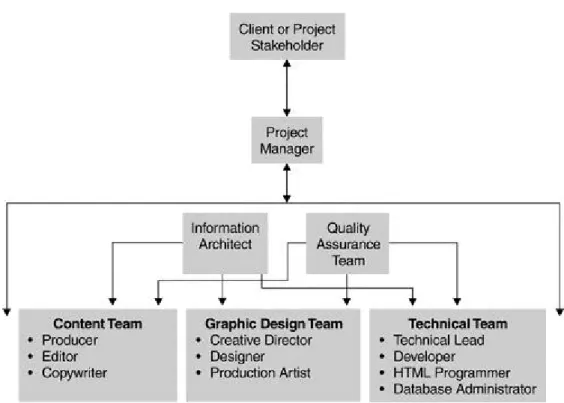
Before you can manage a Web development team you have to know the players. It's important to note that team composition is different from organization to organization, project to project, and process to process. Your Web development team may not exactly mirror the type that is described in this chapter (see the diagram in Figure 2.1), but there will undoubtedly be many similarities. The basic roles on a typical Web development team remain relatively constant and typically include the following.
• Project stakeholder (also client or business owner) • Project manager • Producer • Editor/copywriter • Information architect • Graphic designer • HTML developer • Developer • Tech lead • Database administrator • Quality assurance engineer
Figure 2.1. Diagram of a Web Development Team
The typical Web project team is divided into three distinct groups: content, graphic design, and technology. The project manager manages across all of these groups and manages the communication between the client or project stakeholder and the team. The stakeholder normally does not play a daily, hands-on role in the
development of the project but is the person responsible for initiating the project, getting the budget allocated, and wresting free the necessary resources. The project manager is the conduit of communication between the stakeholder and the team. Keeping the stakeholder or client abreast of progress on the project is one of the project manager's primary tasks.
The roles associated with the technology side of the project include tech lead, DBA, developer, and HTML developer. The roles associated with the content side of the project are producer, editor, and copywriter (who could also be the
producer). The graphic design team consists of the creative director, designers, and production artists. Two roles that cross over between both the tech and content sides of the project are the information architect and the quality assurance
engineer. The IA works closely with the developers on the site architecture and with the design and content teams on ensuring that the interfaces meet usability requirements. QA engineers are responsible for testing all the components of the product from a user perspective and generally look for both functionality and display flaws and bugs.
The Project Stakeholder
The project stakeholder, sometimes called the business owner, is the person responsible for initiating the project. This person could be from the marketing department, an external client, an editor, a producer, or even the CEO of the company. Some stakeholders are middle managers who must go to their boss for authorization of new costs. The stakeholder's deliverables could include the following.
• Project concept/idea • Budget
• Marketing plan • Page mockups
• Third-party content deals
Some of the stakeholder's deliverables are prepared with the help of the project manager. The stakeholder, when internal, is also responsible for presenting the creative brief and budget to the committee responsible for resource allocation. On internal projects the stakeholder will work with a project manager to estimate the size of the project team and the duration of the project.
Once the project is underway, the stakeholder moves on to other projects and tasks and is usually not a member of the core build team beyond attending regular
update meetings with the project manager and signing off on deliverables when required.
Very early in the project, even before the team has been put together, establish how you and the stakeholder will work together. Discuss issues such as communication, status reports, and conflict resolution. Typically you will be managing the team and the build; the stakeholder will be managing the business goals and marketing initiatives. There will be occasional overlaps during the process; but if the roles are clearly defined from the outset, your chances of success are greatly increased. You will collaborate with the stakeholder on estimating and tracking the resource costs on the project. The more business knowledge you possess, the more you will be able to help the stakeholder early in the process with establishing the business goals of the project. Being integrated in all aspects of the project will give you a better understanding of the end product, allow you to experience a greater sense of ownership, and give the stakeholder piece of mind.
The stakeholder is your customer, and your goal is to provide exceptional customer service. The stakeholder empowers you with the responsibility to turn his or her vision into reality. It's a tall order, especially when little, if any, authority comes with the responsibility.
The Producer
The Web producer has myriad tasks and responsibilities to manage during the course of a project. The Web producer role is approached and interpreted
differently and morphs from company to company and department to department. It's also important to note that the producer role may also exist on the client side in the form of a product manager. These are the typical deliverables and
responsibilities associated with the producer. • Project concept/idea • Creative brief • Page maps • Site map • Final specifications • Project timeline • Budget • Design direction • Editorial content/direction • Editorial resource management • Third-party content deals
Traditionally the producer is much closer to the content and display aspects of the project than the project manager. The producer tends to maintain the point of view of an end user or client when working on a project. Projects may be initiated by a stakeholder, but the producer gives the project its special flavor.
Working with the Producer
The producer/project manager relationship can be a delicate balancing act, a
graceful waltz, or a full-blown rumble. Because of the overlapping of tasks and the occasional redundancy in resource management, the producer/ project manager relationship can be difficult to master. You need to establish a clear understanding of who will be responsible and manage what tasks, deliverables, and resources in order to avoid problems down the road. Just as important as defining each other's roles and responsibilities is the communication of the details of the arrangement to other team members. Once the relationship has been clearly defined and
communicated to everyone, be sure to stick to the plan, or you will risk confusing the team and undermining your chances for a smooth project.
Producer and Project Manager Overlap In some companies the producer manages the entire project and all resources without the help of a project manager. In other companies the producer works on developing the concept and then turns over the project to a project manager for the build phase.
Sometimes the producer is the stakeholder, sometimes not.
In some agencies the producer works closely with the client, and in others the producer's primary tasks are internal. Good Web producers have honed their project management skills and know how to work harmoniously with a project manager. Then again there are producers who find it necessary to micromanage every aspect of the build and make the project manager feel superfluous.
The producer is a vital role and crucial to the project hitting the content mark. It's a generalist role that can on occasion overlap with the project manager role. If you find yourself in this situation, just remember the old adage "Two heads are better than one."
When a producer and a project manager align themselves behind the common goal of exceeding all expectations, the odds of success are greatly enhanced. Think of
Joe Torre and Don Zimmer winning multiple World Series, Steve Jobs and Steve Wozniak launching Apple Computers, or John Lennon and Paul McCartney
collaborating on "Sgt. Pepper's Lonely Hearts Club Band," and you should get the idea.
The Editor
Depending on the size of the company or department, editorial functions such as writing, researching stories, and copy editing may involve several people or a single person wearing all of these hats. The editorial staff is responsible for creating or acquiring stories, articles, product descriptions, headlines, and other types of copy. The editorial staff is usually tightly woven with the producer's staff and can be managed by the producer if there is no managing editor on staff. Most large, content-rich Web sites use an editorial tool to maintain the content on the site. The editorial tool allows the editorial staff to input copy and images throughout the site. Most editors will write the copy in a separate program like Microsoft Word and then transfer the copy to the editorial tool. In many cases the content entry is performed by production assistants who work on the production staff. Figure 2.2 illustrates the typical content creation workflow.
The editorial staff's deliverables include the following. • Story ideas
• Articles and stories
• Procurement of stories or articles • Product descriptions and reviews • Interviews
If there is a photo editor on staff, he or she will work closely with the editorial
department on creating or choosing images and photographs to accompany stories. The photo editor will more than likely be part of the design group.
Watch out for friction between the Web site producer(s) and the editorial staff. Turf wars between producers and editors can flare up over the ownership of
content and the responsibility for coming up with concepts and ideas. The producer may have an idea she loves, only to find stony opposition from the editor. The same situation can happen in reverse.
Also, because the production staff is often responsible for inputting the content, they depend on editorial to meet deadlines. It's the producer's job to chase down the content and hound the editors, and that can lead to confrontations.
The Information Architect
One of the most challenging and interesting roles on a Web development team is that of the information architect, or IA. The IA is the person who ensures that the Web site will be usable by human beings and ensures that the underlying structure of the Web site, including the design, content, and technology, will make sense to users. IAs come from either a technology or design background and are conversant in the finer points of both. IAs are usability experts and have logged many hours observing people interact with various types of graphical interfaces, computer hardware and software, and other objects that require quick comprehension by humans to be used successfully.
Depending on the company, IAs can wield a great deal of power on a Web
initiative. They often take part in every aspect of the project build but especially in the early design and functionality planning stages. Having an IA on board helps all groups in the build process by providing a person solely dedicated to safeguarding against bad design or whacky functionality that will eventually be deemed
unusable by the intended audience.
Working with the Information Architect
Working with an IA is always an interesting and educational experience. However, just like any other member of the team, IAs are not infallible and can make
mistakes. Trust your experience and common sense. If the IA deems a design or piece of functionality unusable, but you believe otherwise, do not be afraid to challenge the IA on the point.
Another potential area of concern is the fact that the IA's role overlaps with so many others' in the process but none more so than the designer. Watch out for turf wars between the information architect and the designer. Normally their
best design possible for the client, but the relationship can occasionally be tested by disagreements that can lead to delays.
G Information Architect
An information architect is an individual whose primary responsibility on a Web development team is to organize the Web site content or
information into an intuitive, easy-to-understand structure from a visual, navigational, and technical perspective.
The Graphic Designer
Designers breathe life into a Web site. Typography, photography, iconography, color palettes, graphics, animation— these are the tools the designer uses to establish concept, expression, message, tone, feel, and quality. Usually the first stop for a producer working on an idea or concept, the designer provides an excellent sounding board and translates crude page mockups into beautifully polished works of art. Designers are also adept at working out thorny navigation problems that crop up in the early stages of development. While normally not bona fide information architects, good designers have an excellent grasp of how users approach Web sites and will design with the user experience foremost in mind. Designers often collaborate closely with the information architect on the page maps, site map, graphical interfaces, and navigation design.
Designers have higher profiles that add responsibilities and pressures other team members are spared. Because the graphic design and page layouts are the first tangible manifestations of the project, the designer is often trotted out before the stakeholder or client, page printouts in hand, to explain why fuchsia is the "right" color for the navigation bars and what the current standard is in "cool" Web design. Good with industry buzzwords, a designer can help sell a concept or influence the client.
Designers are long on creativity and talent but traditionally short on programming skills, but that is becoming more the exception to the rule as designers realize the value of technical knowledge. Depending on experience, they can be conversant in Web technology and understand the various components that comprise the back end of a Web site. They usually have basic HTML skills and can mock up Web pages for the browser or test how a design will translate to the screen. During the
build phase the designer will work closely with the HTML resource as the final page designs are officially rendered for the screen.
Because Web design is a collaborative process, designers are good team players and understand the art of compromise. Internal clients consist of producers and stakeholders, and when working in an agency environment, they will work closely with the producer or account manager to realize the client's vision.
While being good team players and giving 100 percent on every project, designers often miss milestones and can add time to a project in their pursuit of perfection. Hovering over or badgering the designer (or any resource) as they work is not a good tactic for getting results. If a designer is consistently missing milestones and delaying projects, rather than risking an unpleasant and nonproductive
confrontation, talk to the creative director about it and let him or her handle the problem. Also keep in mind that the client or stakeholder could be the culprit for the delays by going outside the normal channels of communication and inundating the designer with tweaks and last-minute changes.
Working with the Designer
Collaborating on the Web site design can be one of the most enjoyable experiences in the project life cycle. Working with the designer to chase down ideas and work out difficult user experience problems calls on your own creativity and is always a good learning experience. But don't get carried away. During the design meetings it will be your job to keep an eye on the technical scope as ideas begin flying fast and furiously. The design phase is when the scope of the project can grow
exponentially. It's not the designer's fault— they're paid to be creative. And it's not necessarily the producer's fault— producers will push the design as far as they can and continue adding features beyond the original specifications until someone draws the line. The designer and the producer will be looking to you to speak up when things have gone too far and you suddenly find that the purple navigation bar with the four different user states has just added a week of DHTML and JavaScript programming to the project.
The HTML Developer
How many of the people working in the Web industry today cut their teeth on HTML? The most basic Web technology skill at the end of the 20th century has evolved into one of the most challenging and unsung skills at the beginning of the 21st. Where would the Web be without experts adept at table structure and style sheets? Browser compatibility, layout, alignment, frames, fonts, download time—
these are just a few of the technical and display issues the HTML developer wrestles with daily. Working closely with designers and back-end developers— often simultaneously— the HTML developer must possess good design sensibility and technical prowess. Because he or she is often at the center of heated design and layout debates, it helps if the HTML developer also possesses good negotiating skills.
The HTML developer's deliverables and responsibilities can include the following. • The HTML frameworks for all display templates
• The execution of smaller, nondynamic "flat" or HTML-only projects • HTML mockups of proposed designs
• Style sheet implementation • Image directory maintenance
The HTML developer is in constant demand in any Web company or department. Designers and back-end developers alike put great demands on the HTML
developer's time. When you are working on a project that requires many templates to pass through the HTML developer's hands, take care that he or she is not being distracted by others. Designers can take advantage of the availability and good nature of the HTML person by asking for mockups or tweaks that are neither scheduled nor necessary. When you are on deadline, it's up to you to protect your team from such interruptions. Ask the HTML developers to funnel through you all requests for work that come directly to them. That way the requests will be
channeled through the proper work request process. Working with the HTML Developer
For the HTML developers to complete their tasks, you must be sure they have the necessary deliverables from the designer. These can include printouts, mockups, optimized images, and type and color specifications. Because the HTML
developers may be working on several projects at once or just doing favors for others, be sure to track their milestones closely and when necessary intercept distracting work requests that could jeopardize the project timeline.
The Developer
The developer is your secret weapon, your go-to player and most trusted resource on the project team. He or she thrives on mental challenges, brainteasers, and puzzles— the more difficult and convoluted the better. Beyond being technically proficient, exceptional developers can also see the forest for the trees. They
quickly grasp the business goals behind the project (assuming the goals are valid) and can usually determine if the project will be a boon or a bust. And, given the opportunity, the developer can help you understand the project better as well. When you embark on a project and you are creating the early drafts of the specifications, the developer will help you crystallize and define the back-end requirements. If you are not very technical, then save yourself a lot of frustration and potentially wasted time. Block out some time with the developer and
collaborate on the technical requirements and functionality.
Watching a programmer design an application on a white board or even a scrap of paper can be a confusing but ultimately rewarding experience. With near religious zeal they will leave no stone unturned as they pepper you with questions and potential user scenarios you never thought of. They might embarrass you a little in the process by exposing the gaps in your knowledge or ideas, but the project will be so much the better for going through this exercise. After a white board session with the developer (or tech lead), you will begin to see your project from a 360-degree vantage point and will be able to go back to the producer or stakeholder and get the clarification necessary to answer questions, make suggestions, and meet their expectations.
KEY POINT
Conduct a white board session with your programmer or tech lead (preferably both) early in the project. Using the first or second round of page mockups and definitely before the design phase is underway,
diagram the application showing user inputs, decision processes, database interaction, application output, and display pages. A little bit of UML knowledge goes a long way in this exercise (see the UML reference in Appendix B). Mapping the application with the programmer will expose logic errors before they end up in the code and will provide you with a list of questions to take back to the stakeholder that should result in a better Web site.
Do your best to establish a strong rapport with your developers. Break through whatever barriers you feel may exist and forge a good working relationship. A developer's knowledge can be intimidating, but keep in mind that everyone has strengths, and while yours may not be solely in the technical area, you perform tasks on a daily basis that many people, including developers, find intimidating as well. It helps to tell your developer everything there is to know about the project: from the company objectives to background colors— hold nothing back. By divulging all the information you have about the project and asking for feedback, you are establishing a feeling of inclusion and trust.
A primary goal of establishing a solid bond with the developer is to allow for a free and clear exchange of information. You need to be able to describe the expected application behavior to the developer in language they can understand. The
developer in turn must be able to articulate to you, in language you can understand, how he or she is going to create the required functionality to arrive at the desired behavior. Some developers are better at communicating technology to nontechnical people than others. It's your job to learn to interpret your developer's technospeak into language the client or producer can understand.
You also want to establish a high degree of trust that will allow you and the developer to be completely honest with each other. During the lifecycle of a project, everyone makes mistakes, and how you handle your own and other people's errors can have a dramatic impact on your project. You have to be comfortable telling the developer that you omitted a key bit of functionality from the specs or you misinterpreted the client's instructions. The developer in turn has to be comfortable telling you that an error he made could set the project back two weeks. Regardless of who erred, you have to be able to bypass the blame game and together strategize a solution and get on with the project. It's not easy for
programmers to admit they screwed up. Create an atmosphere of trust and let them know you will back them up and not lay blame at their feet when the going gets tough.
The Tech Lead
The tech lead is your savior and friend. Cherish this person always and keep him or her close. Just as you are the bridge of communication between the technology staff and the stakeholder, the tech lead is the bridge between you and the high-voltage nether reaches of the developer's mind. Depending on the organization, the tech lead role can be a hands-on person, such as a senior developer, or a hands-off member of the technology department's managerial staff.
The tech lead is a great help during the technical design phase as you work out the backend specifications with the developer. The tech lead is also responsible for conducting code reviews and keeping developers on track during particulary thorny development projects. They are especially helpful when a junior or
inexperienced developer is assigned to the project. The tech lead can also provide a buffer between yourself and a developer who is struggling and falling behind in the schedule or is not communicative.
The tech lead's deliverables and responsibilities can include the following. • Technical specifications
• Code reviews • Staff management • Programming
If your company or department does not utilize a tech lead, it may be well worth your time to establish this role. Besides being a huge help for the project manager, the tech lead role can provide a career step for the development team. The role requires maturity and management skill and can provide a platform for acquiring both.
Working with the Tech Lead
As mentioned before, the tech lead can be your best friend in the technology department and your lifeline when things get hairy in the development phase. Keep the tech lead fully informed on the progress of the development as well as the performance of the developer. When the developer runs into trouble, give them a reasonable amount of time to work out the problem first, and then ask the tech lead to help out. This approach shows your confidence in the developer's ability to work out problems on their own and displays a healthy respect for the tech lead's time. The Database Administrator
The database administrator (DBA) is one of the more specialized members of the team and is responsible for creating, advising, and controlling all aspects of the project that involve the database. The DBA is not typically a full-time member of the project team, but his or her contribution is invaluable to the project. The developer works closely with the DBA throughout the lifecycle of the build but more so at the outset of the project. Typically, a developer will create a database schema as one of the first steps in the technical design. The developer will then present the DBA with the schema, and the DBA will analyze it to be sure it meets
the standards he enforces on the database. If the schema is not up to snuff, the DBA will consult with the developer on a more suitable schema for the project. The DBA also writes code specific to the type of database being used for processes such as stored procedures. Once again, this work is done in collaboration with the developer assigned to the project. The bulk of the DBA's time is spent maintaining the database and optimizing its performance. The DBA's typical project
deliverables and responsibilities can include • Schema implementation
• Stored procedures and other database coding • Staff management
Working with the DBA
During the course of the project your interaction with the DBA will more than likely be limited to providing milestones and following up on deliverables.
However, if the DBA takes issue with a schema or database functionality request from the developer, hear her out and trust her opinion. The DBA knows the database better than the developer and will be looking to you to intervene if the developer does not want to cooperate.
G Stored Procedure
A stored procedure is a group of database query statements that reside within the database and perform a certain task. The main advantage of creating stored procedures is that they prevent scripts from using tables directly. This keeps your database tables safe from poorly written query statements. Stored procedures are used to speed up the execution of commonly used queries and to keep the query syntax safely hidden from the business logic of an application. For example, the most commonly used operations on a product database (add a customer, delete a product, retrieve an invoice) could be coded as stored procedures.
The Quality Assurance Engineer
The QA tester is the final gateway between your project and life on the Web. Be kind to the QA department because the day will come when you will be
negotiating with them for the release of your project and every advantage helps. Depending on the organization, QA testers can be very technical and troubleshoot bugs, or they may only test for poor user experience, design imperfections, and copy errors. Usually the QA tester is familiar enough with the technology to write up a coherent bug description but does not have the time or responsibility to get under the hood and investigate the cause of the bug. The QA tester should be involved early in the project and should be invited to all kickoff meetings. The QA department, like HTML, can be a bottleneck in the build process. Be sure to get your QA tester involved early in the process to ensure that your project is in his job queue and on his radar. Even though the bulk of their tasks begin during the second half of the project (depending on the development approach), getting QA involved early gives them a preview of the moving parts and an idea of where potential design and technical flaws may occur.
The QA tester's deliverables and responsibilities can include • Bug reports
• Creation and maintenance of a QA methodology • Creation or procurement of a bug reporting tool Working with the QA Engineer
Similar to project managers, QA engineers have a great deal of responsibility but little, if any, authority. This can make for a frustrated QA tester. The QA tester will relentlessly work to expose bugs and flaws in the Web site and has a high set of standards to uphold, but the bottom line is, when it's time to go live, the
stakeholder will brush aside QA's warnings and complaints and demand launch. Guess who gets to communicate this to the QA tester? Yup, you do. When the time comes for you to more or less tell the QA tester, "Thanks, but no thanks," and you are going to launch with a bug list full of open issues, it helps if you already have a good relationship in place.
KEY POINT
Get the QA department involved early in the development of the project. Be sure they have copies of or access to all relevant documentation such as specs, page mockups, page maps, and a project plan. Be sure they understand the scope of the project so they can plan accordingly for when the project moves into their department.
Common Team Problems
This section examines the symptoms of two common team problems and recommends solutions.
Missing in Action— Become Part of the Team
Even though your little square on the company org chart may reside just above that of the people performing the actual work, don't get a big head. The primary
message you want to be sending to your teammates in both word and deed is "We are all in this together." And if this is not the message you are sending then nine times out of ten, the message you will be receiving from your team is "Get lost!" Symptoms
• You notice a consistently cool, aloof reception from team members at meetings as well as one-on-one.
• Team members are always very quick to agree with everything you say or suggest but deliver the exact opposite.
• No one on the team speaks up at meetings or provides any suggestions or solutions to issues raised.
• The majority of the project milestones are being missed, and there is a consistent nonadherence to the specifications.
Solutions
• Check your ego. Your job is to guide, coach, and support the team— not do the actual work. The people on your team have specialized skill sets and are experts in their area of endeavor. You on the other hand tend to be more of a generalist with a good understanding of each player's tasks and deliverables. Therefore, while being able to speak to each disipline, you cannot deliver the level of quality the expert can.
• Demonstrate your commitment to the team by being willing and able to pitch in when the going gets tough. If you are asking your team to work on a Saturday, you'd better show up, too, and be willing to pitch in and help where you can: code HTML, copy edit, pick up lunch— whatever it takes. • Empower each team member with the creative freedom to arrive at solutions
to problems on his or her own. You may be able to sketch a reasonable depiction of the product, but the experts on your team will be performing the actual brushwork, which will result in the final, full-color rendering.
• Form a bond of trust and open communication with each member of the team. Good team dynamics can be arrived at quicker if you take the time to get to know each member of the team one-on-one. You don't have to become everyone's best friend, but you do need to understand each person's
personality in order to better support them and give them the freedom they need to excel.
The Micromanaging Stakeholder
In the course of your career you will work with more than one project stakeholder who insists on managing every detail of the project, from concept to coding. While their heart may be in the right place, the message they send is one of mistrust and paranoia. It's very easy to recognize the micromanager— in fact, it's a frightening and annoying thing to behold. Stay cool. In just about every relationship there's always one partner who is more mature than the other. Guess which partner you are? To manage this problem correctly, you have to suck it up, take the high road, and call on those maturity genes to get you through.
Symptoms
• The stakeholder insists on attending EVERY meeting connected to the project.
• No task is too small for the stakeholder not to have an opinion on how to complete it.
• All tasks, milestones, and effort estimates in the project plan are suspect and open to question and change.
• All decisions are second guessed. Solutions
• Instead of the stakeholder attending every meeting— which can stifle creativity, open discussion, and debate— suggest a weekly or even twice weekly status meeting where you can update them on every decision and bit of project minutiae. Providing this level of service will allow the stakeholder to maintain his sense of place in the hierarchy and involvement in the
project.
• If necessary, frankly tell the stakeholder she is micromanaging. Ask her if her time might not be better spent on coordinating other business aspects of the project, like a marketing plan, instead of the nitty gritty of the build. This discussion obviously could turn into a potentially nasty confrontation, so it's important to be sure the topic can safely be raised. If you determine that a
discussion like this must occur, be sure to maintain your sense of humor and calm regardless of how the stakeholder reacts.
• Remember that the stakeholder's heart is in the right place, and he wants the project to be successful as much as anybody. Unfortunately, he may also be a control freak who doesn't understand how to delegate or collaborate. Sometimes it's up to us to educate as well as manage.
Case Study: Startup Breakdown
This case study describes one project manager's experience as he attempts to unite a Web team made up of people from very different corporate cultures, who have little Web experience, are suspicious of each other, and are charged with a nearly impossible task— all the blood, guts, and glory the Web promises in 90 days. Baby, You Can Drive My Car
Luxbaum, a multinational auto manufacturer, and Greenwood, a growing online marketing company, entered into a joint venture in 2000 with the goal of creating a Web site devoted to the various aspects of the car and driving culture. After much handwringing, soul-searching, and expensive brand consultant's input, it was decided the new site would be called iLikeToDrive.com. Luxbaum wanted to use the site as a vehicle (no pun intended) for collecting user demographic data to aid them in developing new models and ancillary brands and car-related products. The new online company would use office space, tech resources, and Web producers, all provided by Greenwood. An editorial staff was hired, and the auto company supplied the marketing team and part of the executive management.
From the outset the team never fully gelled. The auto people who were brought in from Detroit and other offices around the country had very little Web experience. The editorial people were straight from the magazine world, and this was their very first exposure to the Web environment. The Greenwood people who joined
iLikeToDrive.com had been working together for at least three years and were a close-knit group and very Web-savvy. Consequently, the editorial and marketing people felt shut out. The venture was saddled with specific metrics goals it had to attain in its first year in order to get more funding from the parent companies. Time was quickly passing, and the team was having a hard time getting started. The situation was extremely volatile and highly political. Each group competed with the other for power and attention from the board of directors, and ownership of the vision for the Web site. All three factions came from extremely different corporate