8379
AN EFFICIENT HYBRID MODEL FOR RELIABLE
CLASSIFICATION OF HIGH DIMENSIONAL DATA USING
K-MEANS CLUSTERING AND BAGGING ENSEMBLE
CLASSIFIER
1HAYDER K. FATLAWI 2ABBAS F. H. ALHARAN 3NABEEL SALIH ALI*
1,3 Information Technology Research and Development Center, University of Kufa, Iraq.
2Computer Department, College of Education for Girls, University of Kufa, Iraq.
1[email protected], 2[email protected], 3[email protected]
ABSTRACT
Data mining is playing a significant role in the digital era, and there are traditional techniques to classify, cluster the large data, etc. Today, the variety of data and its size has grown increasingly. Preprocessing of the data impose and need high computational resources due to raising the number of data attributes. Thus, attributes reduction deem a vital and significant part of the data pre-processing due to its ability to reduce the required computational resources. In this study, a hybrid model is proposed to eliminate irrelevant attributes with N number of goodness evaluation metrics by using K-Means Clustering and Bagging Ensemble Classifier. The proposed model was implanted with five different datasets. The model can minimize the number of the attributes up to (70%). Hence, the results with reduction can be increased the efficiency of the classification performance from the computation time standpoint.
Keywords:k-means clustering, Bagging classification, Attributes reduction.
1.INTRODUCTION
Data mining concerns with discovering the hidden patterns and predicting unknown values in a large amount of data [1, 2]. Techniques of data mining have been increased attention by researchers due to raises the need for large and complex data analysis [3]. According to digital universe statistics, the approximate size of the data in 2005 was 130 Exabytes and is expected to reach 40,000 Exabytes, with increasing factor 300[4]. The high dimensionality of data (i.e., the large number of attributes in data) represents a significant challenge faces data mining techniques, whereas, the increasing of attributes lead to dramatically increase in the required computing resourced [5].
On the other hands, most solutions to this challenge focused on reducing the attributes by choosing the most correlated attributes with the target of classification (or removing the most irrelative attributes) [1,6,7]. The importance of an attribute can be determined using some statistical metrics, and the selection of the most suitable parameter represents another challenge [1, 2, 6]. The difficulty of this challenge increases when several metrics are used.
In the current work, a hybrid and multi-stage model is proposed to solve the mentioned challenges due to the ability to deal with any number of metrics to minimize the attributes. The model uses a K-means clustering algorithm to discover the strength patterns of the attributes. Then, reduced the data is classified using bagging ensemble techniques to improve the accuracy of the classification.
2.LITERATURE REVIEW
Attribute selection is a method that used to eliminate undesirable and recurrent attributes from data during processing. Overlooking the un-meaningful attributes from the enormous database minimizes the complexity and time of computation, and maximizes the quality of learning [8]. Two main categories of attribute selection methods are used which are supervised and unsupervised [9]. Diverse attempts by authors are introduced unsupervised selection methods to eliminate undesirable and recurrent data attributes.
8380 classification while both accuracy and detection of four categories are increased when implemented the proposed method in the KDD CUP 99 dataset.
Besides, an attributes selection method introduced by [11]. The method combining multivariate filter model with ant colony optimization (ACO) algorithm. The selection method was produced precise results after tested via new heuristic measurement.
On the other hands, in the field of text mining, as stated in [12], both clustering and classification based selection attributes have experimented. The authors applied hierarchical clustering (hClust) and k-means clustering with various lengths (5%), (10%), (15%), (20%) and (50%). Using a genetic algorithm of the selected attributes. Two measured are used with results which are average accuracy and F-measure to evaluate the performance of hClust and compare with k-means. The results found the performance of the hClust better than K-means when the length of attributes equal to or greater than (15%).
A hybridization approach of SVR, SOFM, and filter based attribute selection have been introduced by [13] to improve the accuracy of prediction for next day price index. SVR model is constructed for each cluster generated by SOFM according to select attributes. The result proved that the proposed approach better than using only SVR with and without attribute selection.
Also, an unsupervised method for attribute selection is presented by [14]. This method is based on the salient attribute selection by discovering the nearest neighbor and farthest neighbor (FSNF) to be held for clustering (k-means and SOM). Furthermore, filter-based and wrapper-based selection methods are discussed and compared with the proposed method to demonstrate the results. Whereas the filter-based method includes three models (Max-Rel, Var. and IBNF); whilst, the wrapper-based method k-means clustering algorithm is used in the training side.
As alongside with [15] which authors proposed another unsupervised attribute selection method that depends on availing the self-representation capability of attributes. Moreover, the representative attributes matric is influenced by itself to construct regularized attributes. The discordant is reduced by using L1, 2-norm, where the selected attributes are the most affection to construct other attributes. The presented method is evaluated by three criteria classification performance, clustering performance, and the redundancy.
Likewise, [16] proposed an approach to predict early failures detection in the air pressure system of
the trunks (Scania) to reduce the cost of the maintenance process. The conducted approach used the random forest to predict the classes of features (created as histograms), and it calculates the value of each class. Data (includes 60000 rows and 171 columns) has been used for training and evaluating the performance of the discussed approach. The results prove that the product approach has reduced the main cost around (0.6) compared to the traditional case (without approach).
Furthermore, Auto-Associative Multivariate
Regression Trees (AAMRT) approach is presented by [17] for unsupervised feature selection to preserve information and reduce data. The AAMRT based on multivariate regression tree (MRT) but the original variables in AAMRT are utilized as response and explanatory variables. Besides, the approach described the MRT and Classification and Regression Trees (CART). Several experiments are applied to different datasets such as Synthetic, Viruses, Flavour, viruses and Bacteria to evaluate The AAMRT approach. The proposed method is effective in selecting and maintaining the important features and expelling the frequent and unimportant features based on their evaluation results.
Moreover, fast feature selection method based on clustering (FAST) is proposed by [18]. The proposed method includes two steps respectively, First: using a graph-theoretic clustering method to divide the attributes into clusters. Second: create the subset of attributes from collecting the most related attributes to a particular class. The Fast method has experimented on 35 datasets with different domains to measure its performance. From the feature selection effectiveness end, FAST results in the best ratio (1.18%) of attribute selection compared with five algorithms namely: FCBF, CFS, Relief, Consist, and FOCUS-SF. Also, the FAST is the faster in running with time 3573 millisecond. Besides, the outcomes of the experiment that FAST produces smaller subsets and improves the accuracy of other classifiers such as Naive Bayes, C4.5, IB1, and RIPPER.
3.METHODOLOGY
8381
3.1Attributes Goodness Evaluation
One of the most critical decisions that should be taken during classification model growing is which attribute is most suitable for splitting data? [2]. Also, the question about which is the most suitable splitting value takes a significant role in this process? [1]. Wherefore, the reduction of many attributes leads to an effective decreasing in computing recourses [5]. For more confident elimination of attributes, the evaluation of attributes quality should depend on several metrics. Each
measurement could be ranked the attributes differently from the other measure which represents another challenge to be solved.
In this step, k metrics can be applied to the raw data to evaluate the quality of the attributes. Typical and straightforward rule classification method is used to perform the measurement. With N number of attributes, the result of this step is N × K matrix contains the quality of every attribute according to all metrics, such that element i in the matrix represents the goodness of attribute N_i using K_i criterion. This matrix would be used as an input for the next step.
3.2Attributes Clustering using K-means
8382
3.3Irrelevant Attributes Removal
According to the distribution of the attributes into two clusters, the decision will be taken to remove the
subset of attributes that belong to the weak cluster. The weakness of the cluster is detected by comparing the values of the center elements of the two clusters and the cluster with the lowest values in its center that will be considered the weak cluster. Thereby, all attributes in the weak cluster will be recovered due to the irrelevant to the target in the next classification process.
3.4Bagging Classification
Instead of creating one single classification model as a result of the training process, an ensemble classifier is created based on the bagging method [2, 6, 21]. Given the reduced dataset DS which contains m attributes and n rows the training include k iterations and for iteration (i<=k), DSi is a randomly sampled subset from DS with replacement. The training process on DSi produces a classification model CMi that could be applied to classify unseen data rows. The ensemble classifier collects the votes from each single classification model CMi and assigns the class with the highest number of votes to the hidden data [20- 24].
4.IMPLEMENTATION AND RESULTS
The implementation includes applying all steps of the proposed model with a sundry and different dataset. Evaluation of classifier’s performance is performed by using five accuracy metrics inanition with computational time metric.
4.1Description of Datasets
In the current study, five different datasets from a variety and diverse fields are used to apply and evaluate the proposed model as follow: (1) bank marketing dataset which depends on phone calls, it contains (17) attributes and (45211) data rows [25]. (2) Diabetes dataset contains clinical care data of 130 US hospitals for ten years (1999-2008), there are (50) attributes and (100000) data rows including in this dataset [26]. (3) MoCap hand postures contain data of 12 users with five different types of hand postures which collected using unlabeled markers, the total number of data rows of this dataset is (78095) and (38) attributes [27, 28]. (4) KDD Cup dataset of the third international competition of knowledge discovery and data mining tools, its task was to develop a network intrusion detector to
distinguish between intrusions and standard connections. It contains (42) attributes and (4000000) data rows [29]. (5) APS Failure at Scania Trucks includes (60000) data rows and (171) attributes; also it has two classes: positive class represents failures APS system component and negative level for failures for not related APS components [30].
4.2Applying Attributes Goodness Evaluation One of the most critical issues during the growth of a classifier is evaluating of attribute’s importance [2, 6]. In each division of the data process, the most relevant attribute with the target of the classification must be chosen. Statistical measures could be used for this task such as Information Gain and Gain Ratio [1, 2]. The best attribute is such an attribute that minimizes the impurity of data. Impurity could be measured using statistical randomness measurement such us Entropy. Therefore, Information Gain is the gain of splitting operation indicates by the impurity of the class Y before and after splitting [2]. The equation (1) explains the calculation of information gain as follow,
𝐈𝐧𝐟𝐨. 𝐆𝐚𝐢𝐧 𝑰𝒏𝑮 𝑷 ∑𝒄𝒏 𝑵𝑫 𝒏𝒐𝒅𝒆 𝒊𝑵𝑫
𝒊 𝟏 𝑰𝒏𝑮 𝒏𝒐𝒅𝒆 𝒊
(……… (1)
where InG (P) is the parent node’s information gain before splitting, cn is the number of attribute‘s values, ND is the number of data row in the parent node, ND (node i) is the number of data row in node I, InG (node i) is the information gain of node i. The impurity of data is measured by Information Gain depending on the entropy which tends to select attributes with distinct high values. A high number of values led to generate more branches in each iteration. As a result of that; the number of data rows would be decreased which affects the prediction reliability. Gain Ratio represents an improvement to overcome this problem which weighted the information gain by the number of child nodes of each branch by as shown in the equation (2),
𝐆𝐚𝐢𝐧 𝐑𝐚𝐭𝐢𝐨 ∑𝐜𝐧 𝐏 𝐧𝐨𝐝𝐞 𝐢 𝐥𝐨𝐠𝟐 𝐏 𝐧𝐨𝐝𝐞 𝐢𝐈𝐧𝐟𝐨.𝐆𝐚𝐢𝐧
𝐢 𝟏 ………….. (2)
Where P (node i) is the fraction of data instances in the node i to the number of data instances in the parent node. Another three metrics are used in the implementation as follow: OneR which evaluates the goodness of an attribute by using the OneR classifier [31]. Relief Attribute Evaluator: Evaluates the goodness of an attribute by making iterative sampling a data row and considering the value of the given attribute for the nearest data row of the same
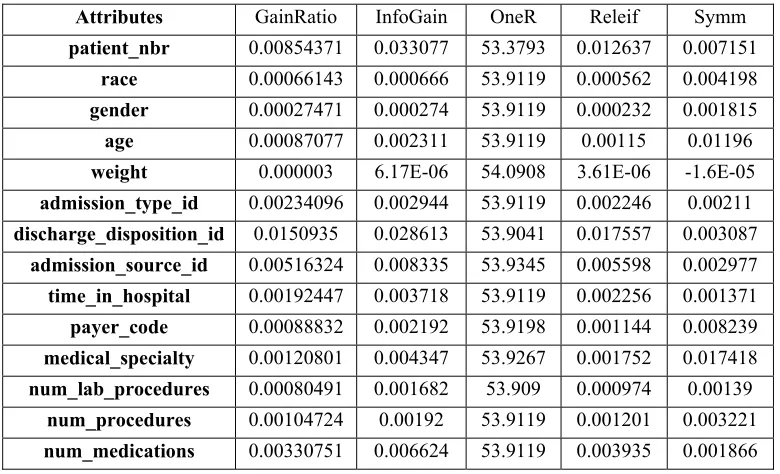
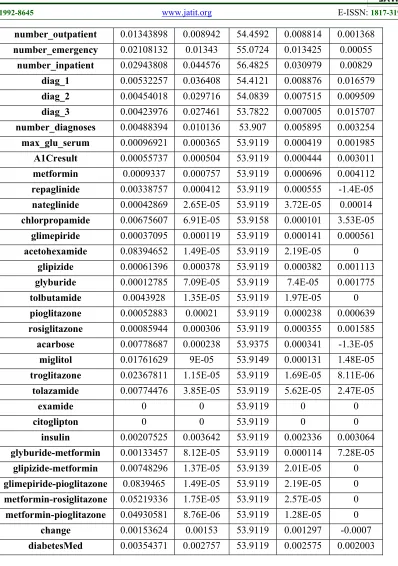
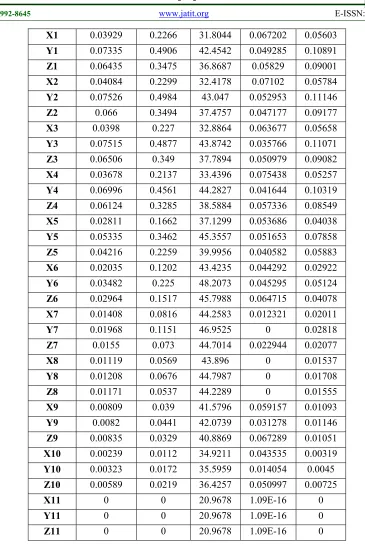
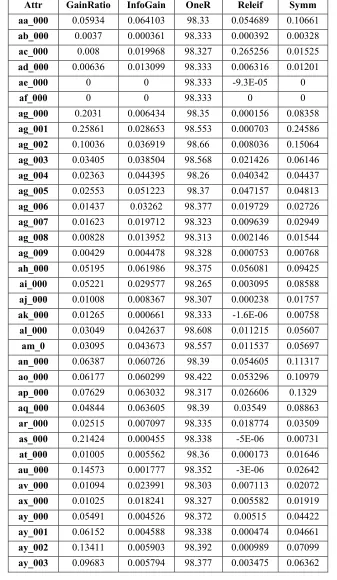
8383 and different class [32-35]. Symmetrical Uncertainty Attribute Evaluator: Evaluates the goodness of an attribute by measuring the symmetrical uncertainty for the class [36-37]. The result of applying those five mercies on five data sets is shown in Tables (1-5) in the appendix section respectively.
4.3Apply K-means Clustering on Datasets
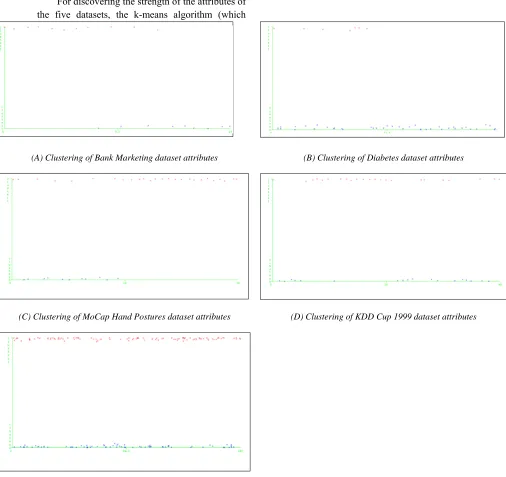
For discovering the strength of the attributes of the five datasets, the k-means algorithm (which
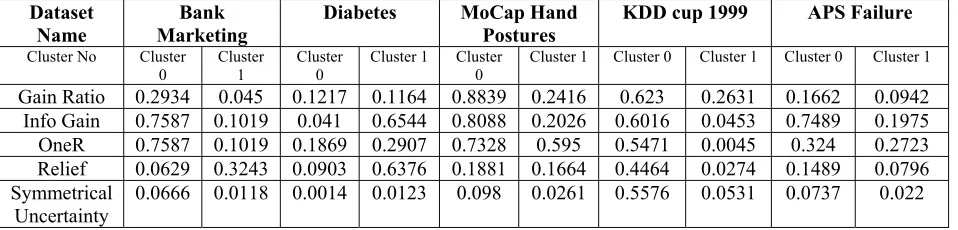
explained in Section 3.2) is applied to the data matrix that resulted from the previous step. For each dataset K-mean split the attributes between two clusters: weak and strong, the evaluation of cluster’s centroid of five datasets are shown in the Table 1 and Figure 2 present the clustering of attributes of the five datasets consecutively.
(A) Clustering of Bank Marketing dataset attributes (B) Clustering of Diabetes dataset attributes
(C) Clustering of MoCap Hand Postures dataset attributes (D) Clustering of KDD Cup 1999 dataset attributes
[image:5.612.53.559.196.673.2](E) Clustering of APS Failure dataset attributes
Figure 2: Clustering of attributes of five datasets
8384 Table 1: Evaluation of Cluster’s centroid of five datasets
4.4Apply Irrelevant Attributes Removal
Each attribute belongs to weak clusters from the previous step is removed resulting in a significant
reduction in the dimensionality of datasets. Table 2 clarifies the number of the attribute before and after applying the removal and the ration of attribute reduction.
Table 2: Ratio of Attributes Reduction in five datasets
4.5Apply Bagging Classification
Bagging classification can be characterized by
creating the number of sub-dataset from the original dataset and applying classification processes in each one which represents a heavy computational time task. Thereby, the reduction of attributes number
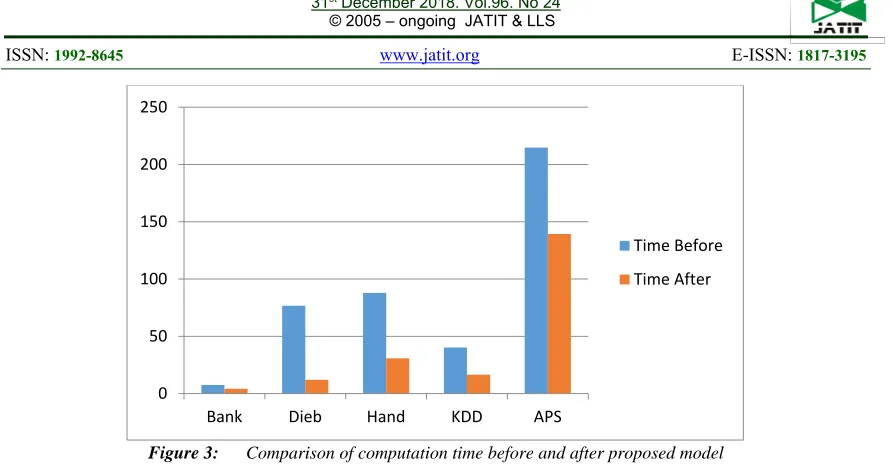
[image:6.612.69.548.376.491.2]provides the efficiency of bagging classification, especially with a big dataset. The improving of computational time on five datasets is shown in
Figure 3. Table 3 and Figures (4- 8) represent and illustrate the evaluation of bagging classification accuracy before and after applying the proposed model on five datasets.
Dataset Name Original Number of
attributes
Reduced Number of attributes Ratio of attributes Reduction
Bank Marketing 20 8 60%
Diabetes 48 41 15%
MoCap Hand
Postures 37 11 70%
KDD cup 1999 41 18 56%
APS Failure 170 71 58%
Dataset
Name Marketing Bank Diabetes MoCap Hand Postures KDD cup 1999 APS Failure
Cluster No Cluster
0 Cluster 1 Cluster 0 Cluster 1 Cluster 0 Cluster 1 Cluster 0 Cluster 1 Cluster 0 Cluster 1
Gain Ratio 0.2934 0.045 0.1217 0.1164 0.8839 0.2416 0.623 0.2631 0.1662 0.0942
Info Gain 0.7587 0.1019 0.041 0.6544 0.8088 0.2026 0.6016 0.0453 0.7489 0.1975
OneR 0.7587 0.1019 0.1869 0.2907 0.7328 0.595 0.5471 0.0045 0.324 0.2723
Relief 0.0629 0.3243 0.0903 0.6376 0.1881 0.1664 0.4464 0.0274 0.1489 0.0796
Symmetrical
8385
Figure 3: Comparison of computation time before and after proposed model
[image:7.612.52.564.341.590.2]Table 3: Evaluation the accuracy before and after applying proposed model in five datasets
Figure 4: Comparison of bagging classification accuracy of Bank Marketing dataset before and after improvement
Figure 5: Comparison of bagging classification accuracy of Diabetes dataset before and after improvement
0 50 100 150 200 250
Bank Dieb Hand KDD APS
Time Before Time After
0 0.2 0.4 0.6 0.8 1
Before
After
0 0.2 0.4 0.6 0.8 1
Before
After
Dataset Name
Bank Marketing
Diabetes MoCap Hand Postures
KDD cup 1999 APS Failure
Before After Before After Before After Before After Before After TP Rate 0.912 0.905 0.533 0.534 0.942 0.891 0.999 0.999 0.966 0.967
Precision 0.894 0.871 0.478 0.482 0.942 0.891 0.999 0.999 0.965 0.967
Recall 0.912 0.905 0.533 0.534 0.942 0.891 0.999 0.999 0.966 0.967
F-Measure 0.894 0.871 0.492 0.497 0.942 0.891 0.999 0.999 0.965 0.967
8386 Figure6: Comparison of bagging classification accuracy of MoCap Hand Postures dataset before and after improvement
Figure7: Comparison of bagging classification accuracy of KDD cup 1999 dataset before and after improvement
Figure8: Comparison of bagging classification accuracy of APS Failure dataset before and after improvement
The performance of the classifier is measured by five common metrics as follow: (1) True Positive (TP), which related to the number of the positive examples that correctly predicted (2) Precision and (3) Recall which used widely in applications where the value of the successful detection of one of the classes is more significant than the detection of the other classes. Precision measures the fraction of the data rows that belong to the positive group, and the classifier has declared as a positive class. Recall calculates the fraction of positive examples that correctly predicted by the classifier [1].
Building a model that maximizes both precision and recall is the key challenge of the classification algorithms. Precision and recall can be summarized into another metric known as the (4) F1 measure as shown in equation (3).
F1 = 2* (Recall* Precision) / (Recall+ Precision) ………… (3)
(5) A receiver operating characteristic (ROC) curve is a graphical approach for displaying the tradeoff between true positive rate and false positive rate of a classifier. In a ROC curve, the true positive
rate (TPR) is plotted along the y-axis and the false positive rate (FPR) is shown on the x-axis [1, 2].
5.RESULTS DISCUSSIONS
To shed light on the proposed hybrid model results and their significant findings among other methods and approaches that have been proposed before to improve the classifications performance and its reliability, accuracy, effectiveness, and efficiency for high dimensional data. The proposed method is compared with some prior works regarding classification accuracy and consumed time. Table 4 shows that the proposed method has better classification accuracy and time for bank marketing dataset with 90.5 and 4.23 respectively.
Table 4: classification accuracy and time consumption for Bank marketing
work Classifier Accuracy Time (s)
2015 [38] MLPNN 88.63 1767.75
0.5 0.6 0.7 0.8 0.9 1
Before
After
0.5 0.6 0.7 0.8 0.9 1 1.1
Before
After
0.95 0.955 0.96 0.965 0.97 0.975 0.98 0.985 0.99 0.995
Before
8387
2016 [39]
LT-SVDD 90 4.96
Proposed
model Bagging 90.5 4.23
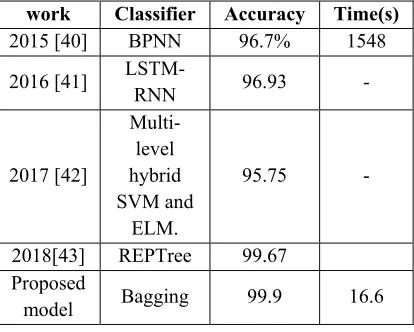
[image:9.612.88.302.73.149.2]Table 5 shows that applying the proposed method on KDD Cup 1999 dataset is superior on five works regarding classification with accuracy 99.9 and it consumes 16.6 seconds compared with the work of Shah and Trivedi, who use back-propagation neural network algorithm for classification.
Table 5: classification accuracy and time consumption for KDD Cup 1999
work Classifier Accuracy Time(s)
2015 [40] BPNN 96.7% 1548
2016 [41]
LSTM-RNN 96.93 -
2017 [42] Multi-level hybrid SVM and ELM.
95.75 -
2018[43] REPTree 99.67
Proposed
model Bagging 99.9 16.6
Table 6 demonstrate that the proposed method has an accuracy better than the work of Schlag et al. for APS Failure dataset, but the consumption time is a little more.
Table 6: classification accuracy and time consumption for APS Failure
work Classifier Accuracy Time(s)
2018 [44] LPSVM 95 110.85
Proposed
model Bagging 96.7 139.36
6.CONCLUSIONS AND FUTURE WORK
In this article, a multi-phase model is proposed to eliminate irrelevant attributes with N number of goodness evaluation metrics via using K-Means Clustering and Bagging Ensemble Classifier. The hybrid model used the K-means clustering algorithm to discover the strength patterns of the attributes as well minimized data is classified using bagging ensemble techniques to improve the accuracy of the classification ( see Tables (1-5) in the appendix). The model is evaluated with five different datasets, and
the results were efficient due to its ability to deal with any number of metrics to reduce the attributes of the huge data up to (70%) (See Tables (4-6)). In the future directions, we intend to apply more advanced clustering techniques instead of k-means as well, applying soft computing techniques for choosing a suitable number of clusters.
REFERENCES:
[1] Han, Jiawei, Jian Pei, and Micheline Kamber. Data mining: concepts and techniques. Elsevier, 2011.
[2] Tan, Pang-Ning. Introduction to data mining. Pearson Education India, 2007.
[3] Amato, Giuseppe, et al. "How Data Mining and Machine Learning Evolved from Relational Data Base to Data Science." A Comprehensive Guide through the Italian Database Research over the Last 25 Years. Springer, Cham, 2018. 287-306.
[4] Gantz, John, and David Reinsel. "The digital universe in 2020: Big data, bigger digital shadows, and biggest growth in the far east." IDC iView: IDC Analyze the future 2007.2012 (2012): 1-16.
[5] Zhu, Pengfei, et al. "Unsupervised feature selection by regularized self-representation." Pattern Recognition 48.2 (2015): 438-446. [6] Witten, Ian H., et al. Data Mining: Practical
machine learning tools and techniques. Morgan Kaufmann, 2016.
[7] Sheikhpour, Razieh, et al. "A survey on semi-supervised feature selection methods." Pattern Recognition 64 (2017): 141-158.
[8] Chen, C.-H. (2015). Feature selection for clustering using instance-based learning by exploring the nearest and farthest neighbors. Information Sciences, 318, 14-27.
[9] Gondek, C., Hafner, D., & Sampson, O. R. (2016). Prediction of failures in the air pressure system of scania trucks using a random forest and feature engineering. Paper presented at the International Symposium on Intelligent Data Analysis.
[10] Hong, S.-S., Lee, W., & Han, M.-M. (2015). The feature selection method based on genetic algorithm for efficient of text clustering and text
classification. International Journal of
Advances in Soft Computing & Its Applications, 7(1).
[image:9.612.92.299.275.441.2]8388 [12] Questier, F., Put, R., Coomans, D., Walczak, B.,
& Vander Heyden, Y. (2005). The use of CART and multivariate regression trees for supervised
and unsupervised feature selection.
Chemometrics and Intelligent Laboratory Systems, 76(1), 45-54.
[13] Ravale, U., Marathe, N., & Padiya, P. (2015). Feature selection based hybrid anomaly intrusion detection system using K means and RBF kernel function. Procedia Computer Science, 45, 428-435.
[14] Shang, R., Zhang, Z., Jiao, L., Liu, C., & Li, Y. (2016). Self-representation based dual-graph regularized feature selection clustering. Neurocomputing, 171, 1242-1253.
[15] Song, Q., Ni, J., & Wang, G. (2013). A fast clustering-based feature subset selection algorithm for high-dimensional data. IEEE Transactions on Knowledge and Data Engineering, 25(1), 1-14.
[16] Tabakhi, S., & Moradi, P. (2015). Relevance– redundancy feature selection based on ant colony optimization. Pattern recognition, 48(9), 2798-2811.
[17] Zhao, Z., He, X., Cai, D., Zhang, L., Ng, W., & Zhuang, Y. (2016). Graph regularized feature selection with data reconstruction. IEEE Transactions on Knowledge and Data Engineering, 28(3), 689-700.
[18] Zhu, P., Zuo, W., Zhang, L., Hu, Q., & Shiu, S. C. (2015). Unsupervised feature selection by
regularized self-representation. Pattern
recognition, 48(2), 438-446.
[19] Olson, David L. Descriptive data mining. Springer Singapore, 2017.
[20] Rokach, Lior, and Oded Z. Maimon. Data mining with decision trees: theory and applications. Vol. 69. World scientific, 2008. [21] Seni, Giovanni, and John F. Elder. "Ensemble
methods in data mining: improving accuracy through combining predictions." Synthesis Lectures on Data Mining and Knowledge Discovery 2.1 (2010): 1-126.
[22] Nisbet, Robert, John Elder, and Gary Miner. Handbook of statistical analysis and data mining applications. Academic Press, 2009.
[23] Altman, Naomi, and Martin Krzywinski. "Points of Significance: Ensemble methods: bagging and random forests." (2017): 933. [24] Catal, Cagatay, and Mehmet Nangir. "A
sentiment classification model based on multiple classifiers." Applied Soft Computing 50 (2017): 135-141.
[25] Moro, Sérgio, Paulo Cortez, and Paulo Rita. "A data-driven approach to predict the success of
bank telemarketing." Decision Support Systems 62 (2014): 22-31.
[26] Strack, Beata, et al. "Impact of HbA1c measurement on hospital readmission rates: analysis of 70,000 clinical database patient records." BioMed research international 2014 (2014).
[27] Gardner, Andrew, et al. "Measuring distance between unordered sets of different sizes." Proceedings of the IEEE Conference on Computer Vision and Pattern Recognition. 2014.
[28] Gardner, Andrew, et al. "3D hand posture recognition from small unlabeled point sets." Systems, Man and Cybernetics (SMC), 2014 IEEE International Conference on. IEEE, 2014. [29]
http://archive.ics.uci.edu/ml/machine-learning-databases/kddcup99-mld/
[30]https://archive.ics.uci.edu/ml/machine-learning-databases/00421/
[31] Holte, Robert C. "Very simple classification rules perform well on most commonly used datasets." Machine learning 11.1 (1993): 63-90. [32] Kira, Kenji, and Larry A. Rendell. "A practical approach to feature selection." Machine Learning Proceedings 1992. 1992. 249-256. [33] Katsifarakis, Nikos, and Kostas Karatzas. "A
New Feature Selection Methodology for Environmental Modelling Support: The Case of Thessaloniki Air Quality." Environmental Software Systems. Computer Science for Environmental Protection: 12th IFIP WG 5.11 International Symposium, ISESS 2017, Zadar, Croatia, May 10-12, 2017, Proceedings 12. Springer International Publishing, 2017.2603. [34] Kononenko, Igor. "Estimating attributes:
analysis and extensions of RELIEF." European conference on machine learning. Springer, Berlin, Heidelberg, 1994.
[35] Robnik-Šikonja, Marko, and Igor Kononenko. "An adaptation of Relief for attribute estimation in regression." Machine Learning: Proceedings of the Fourteenth International Conference (ICML’97). Vol. 5. 1997.
[36] Hall, Mark A., and Lloyd A. Smith. "Practical feature subset selection for machine learning." Computer science’98 proceedings of the 21st Australasian computer science conference ACSC. Vol. 98. 1998.
8389 [38] B. M. Shashidhara, et al., "Evaluation of
machine learning frameworks on bank marketing and Higgs datasets," in Advances in Computing and Communication Engineering
(ICACCE), 2015 Second International
Conference on, 2015, pp. 551-555.
[39] A. Rekha, et al., "Artificial Intelligence Marketing: An application of a novel Lightly Trained Support Vector Data Description," Journal of Information and Optimization Sciences, vol. 37, pp. 681-691, 2016.
[40] B. Shah and B. H. Trivedi, "Reducing features of KDD CUP 1999 dataset for anomaly detection using back propagation neural network," in Advanced Computing & Communication Technologies (ACCT), 2015 Fifth International Conference on, 2015, pp. 247-251.
[41] J. Kim, et al., "Long short term memory recurrent neural network classifier for intrusion detection," in Platform Technology and Service (PlatCon), 2016 International Conference on, 2016, pp. 1-5.
[42] W. L. Al-Yaseen, et al., "Multi-level hybrid support vector machine and extreme learning machine based on modified K-means for intrusion detection system," Expert Systems with Applications, vol. 67, pp. 296-303, 2017. [43] B. A. Tama and K.-H. Rhee, "An integration of
pso-based feature selection and random forest for anomaly detection in iot network," in MATEC Web of Conferences, 2018.
[44] S. Schlag, et al., "Faster Support Vector Machines," arXiv preprint arXiv:1808.06394, 2018.
8390
[image:12.612.145.469.156.462.2]APPENDICES
Table 1: Bank Marketing Dataset Attributes Evaluation Using PART With Five Metrics
Attribute Name GainRatio InfoGain OneR Releif Symm
age 0.011883 0.018439 0.018439 0.0198 0.017905
job 0.004773 0.014223 0.014223 0.14063 0.008156
marital 0.001562 0.002069 0.002069 0.07408 0.002258
education 0.001349 0.003448 0.003448 0.14278 0.00225
default 0.011256 0.008331 0.008331 0.04785 0.01335
housing 8.78E-05 9.97E-05 9.97E-05 0.06619 0.000121
loan 0 1.93E-05 1.93E-05 0.04517 3.02E-05
contact 0.017742 0.016801 0.016801 0.01689 0.023097
month 0.014382 0.038097 0.038097 0.04081 0.024136
day_of_week 0.0002 0.000465 0.000465 0.20365 0.000328
duration 0.03364 0.109413 0.109413 0.06741 0.058192
campaign 0.002452 0.004285 0.004285 0.00336 0.003799
pdays 0.19567 0.044484 0.044484 0.0014 0.121009
previous 0.040006 0.027733 0.027733 0.0026 0.046179
poutcome 0.064022 0.043834 0.043834 0.01801 0.073514
emp.var.rate 0.034411 0.078586 0.078586 0.00433 0.056301
cons.price.idx 0.030057 0.098004 0.098004 0.00724 0.052012
cons.conf.idx 0.032945 0.097628 0.097628 0.00701 0.05625
euribor3m 0.030647 0.10257 0.10257 0.00373 0.053218
nr.employed 0.037894 0.08963 0.08963 0.00392 0.062391
Table 2: Diabetes Dataset Attributes Evaluation Using PART With Five Metrics
Attributes GainRatio InfoGain OneR Releif Symm
patient_nbr 0.00854371 0.033077 53.3793 0.012637 0.007151
race 0.00066143 0.000666 53.9119 0.000562 0.004198
gender 0.00027471 0.000274 53.9119 0.000232 0.001815
age 0.00087077 0.002311 53.9119 0.00115 0.01196
weight 0.000003 6.17E-06 54.0908 3.61E-06 -1.6E-05
admission_type_id 0.00234096 0.002944 53.9119 0.002246 0.00211
discharge_disposition_id 0.0150935 0.028613 53.9041 0.017557 0.003087
admission_source_id 0.00516324 0.008335 53.9345 0.005598 0.002977
time_in_hospital 0.00192447 0.003718 53.9119 0.002256 0.001371
payer_code 0.00088832 0.002192 53.9198 0.001144 0.008239
medical_specialty 0.00120801 0.004347 53.9267 0.001752 0.017418
num_lab_procedures 0.00080491 0.001682 53.909 0.000974 0.00139
num_procedures 0.00104724 0.00192 53.9119 0.001201 0.003221
[image:12.612.112.502.492.729.2]8391
number_outpatient 0.01343898 0.008942 54.4592 0.008814 0.001368
number_emergency 0.02108132 0.01343 55.0724 0.013425 0.00055
number_inpatient 0.02943808 0.044576 56.4825 0.030979 0.00829
diag_1 0.00532257 0.036408 54.4121 0.008876 0.016579
diag_2 0.00454018 0.029716 54.0839 0.007515 0.009509
diag_3 0.00423976 0.027461 53.7822 0.007005 0.015707
number_diagnoses 0.00488394 0.010136 53.907 0.005895 0.003254
max_glu_serum 0.00096921 0.000365 53.9119 0.000419 0.001985
A1Cresult 0.00055737 0.000504 53.9119 0.000444 0.003011
metformin 0.0009337 0.000757 53.9119 0.000696 0.004112
repaglinide 0.00338757 0.000412 53.9119 0.000555 -1.4E-05
nateglinide 0.00042869 2.65E-05 53.9119 3.72E-05 0.00014
chlorpropamide 0.00675607 6.91E-05 53.9158 0.000101 3.53E-05
glimepiride 0.00037095 0.000119 53.9119 0.000141 0.000561
acetohexamide 0.08394652 1.49E-05 53.9119 2.19E-05 0
glipizide 0.00061396 0.000378 53.9119 0.000382 0.001113
glyburide 0.00012785 7.09E-05 53.9119 7.4E-05 0.001775
tolbutamide 0.0043928 1.35E-05 53.9119 1.97E-05 0
pioglitazone 0.00052883 0.00021 53.9119 0.000238 0.000639
rosiglitazone 0.00085944 0.000306 53.9119 0.000355 0.001585
acarbose 0.00778687 0.000238 53.9375 0.000341 -1.3E-05
miglitol 0.01761629 9E-05 53.9149 0.000131 1.48E-05
troglitazone 0.02367811 1.15E-05 53.9119 1.69E-05 8.11E-06
tolazamide 0.00774476 3.85E-05 53.9119 5.62E-05 2.47E-05
examide 0 0 53.9119 0 0
citoglipton 0 0 53.9119 0 0
insulin 0.00207525 0.003642 53.9119 0.002336 0.003064
glyburide-metformin 0.00133457 8.12E-05 53.9119 0.000114 7.28E-05
glipizide-metformin 0.00748296 1.37E-05 53.9139 2.01E-05 0
glimepiride-pioglitazone 0.0839465 1.49E-05 53.9119 2.19E-05 0
metformin-rosiglitazone 0.05219336 1.75E-05 53.9119 2.57E-05 0
metformin-pioglitazone 0.04930581 8.76E-06 53.9119 1.28E-05 0
change 0.00153624 0.00153 53.9119 0.001297 -0.0007
[image:13.612.116.514.66.632.2]diabetesMed 0.00354371 0.002757 53.9119 0.002575 0.002003
Table 3: Mocap Hand Postures Dataset Attributes Evaluation Using PART With Five Metrics
Attr GainRatio InfoGain OneR Relief Symm User 0.00723 0.025 24.8259 0.269573 0.00865
X0 0.04299 0.2575 33.4089 0.068946 0.06197
Y0 0.07679 0.5093 43.1174 0.052394 0.11377
8392
X1 0.03929 0.2266 31.8044 0.067202 0.05603
Y1 0.07335 0.4906 42.4542 0.049285 0.10891
Z1 0.06435 0.3475 36.8687 0.05829 0.09001
X2 0.04084 0.2299 32.4178 0.07102 0.05784
Y2 0.07526 0.4984 43.047 0.052953 0.11146
Z2 0.066 0.3494 37.4757 0.047177 0.09177
X3 0.0398 0.227 32.8864 0.063677 0.05658
Y3 0.07515 0.4877 43.8742 0.035766 0.11071
Z3 0.06506 0.349 37.7894 0.050979 0.09082
X4 0.03678 0.2137 33.4396 0.075438 0.05257
Y4 0.06996 0.4561 44.2827 0.041644 0.10319
Z4 0.06124 0.3285 38.5884 0.057336 0.08549
X5 0.02811 0.1662 37.1299 0.053686 0.04038
Y5 0.05335 0.3462 45.3557 0.051653 0.07858
Z5 0.04216 0.2259 39.9956 0.040582 0.05883
X6 0.02035 0.1202 43.4235 0.044292 0.02922
Y6 0.03482 0.225 48.2073 0.045295 0.05124
Z6 0.02964 0.1517 45.7988 0.064715 0.04078
X7 0.01408 0.0816 44.2583 0.012321 0.02011
Y7 0.01968 0.1151 46.9525 0 0.02818
Z7 0.0155 0.073 44.7014 0.022944 0.02077
X8 0.01119 0.0569 43.896 0 0.01537
Y8 0.01208 0.0676 44.7987 0 0.01708
Z8 0.01171 0.0537 44.2289 0 0.01555
X9 0.00809 0.039 41.5796 0.059157 0.01093
Y9 0.0082 0.0441 42.0739 0.031278 0.01146
Z9 0.00835 0.0329 40.8869 0.067289 0.01051
X10 0.00239 0.0112 34.9211 0.043535 0.00319
Y10 0.00323 0.0172 35.5959 0.014054 0.0045
Z10 0.00589 0.0219 36.4257 0.050997 0.00725
X11 0 0 20.9678 1.09E-16 0
Y11 0 0 20.9678 1.09E-16 0
[image:14.612.119.484.65.612.2]Z11 0 0 20.9678 1.09E-16 0
Table 4: KDD Cup 1999 Dataset Attributes Evaluation Using PART With Five Metrics
Attr GainRatio InfoGain OneR Releif Symm att1 0.128 0.02566 56.8012 0 0.02922
att2 0.7656 0.749869 78.0186 0.432155 0.591564
att3 0.6457 1.451671 98.5533 0.814374 0.763265
att4 0.8512 0.772744 76.7197 0.513637 0.627327
8393
att6 0.5103 0.787882 74.0475 0.000212 0.508336
att7 1 0.000327 56.8031 0.00027 0.00042
att8 1 0.002628 56.8164 0 0.003372
att9 0 0 56.8012 0 0
att10 0.4005 0.021701 56.9662 0.000645 0.026958
att11 0.3895 0.000696 56.8012 0 0.000894
att12 0.7146 0.714519 72.1516 0.502149 0.559174
att13 0.8068 0.018521 56.9747 2.82E-05 0.023463
att14 0 0 56.8012 2.86E-05 0
att15 0 0 56.8012 0 0
att16 0.0837 0.002199 56.8012 0 0.00278
att17 0.0782 0.001055 56.8012 4.77E-06 0.001344
att18 0 0 56.8012 1.91E-05 0
att19 0.084 0.002261 56.8012 0.001314 0.002857
att20 0 0 56.8012 0 0
att21 0 0 56.8012 0 0
att22 0.0818 0.001796 56.8012 0.001001 0.002276
att23 0.4221 1.377399 97.2753 0.365748 0.571693
att24 0.2411 0.870868 78.6338 0.301388 0.337019
att25 0.9196 0.747999 76.6139 0.500137 0.631441
att26 0.9121 0.715417 76.4165 0.499866 0.611424
att27 0.3496 0.07313 57.2818 0.026931 0.082869
att28 0.2555 0.057262 56.8012 0.025552 0.064344
att29 0.6087 0.744118 76.4813 0.403561 0.535693
att30 0.8348 0.752617 76.6015 0.045597 0.612545
att31 0.2221 0.245488 56.8012 0.086606 0.18451
att32 0.2735 0.457017 59.2769 0.29733 0.28327
att33 0.3934 0.752724 74.9154 0.396057 0.433954
att34 0.4369 0.761018 75.7308 0.322406 0.461578
att35 0.4044 0.741163 74.6645 0.069738 0.437476
att36 0.3965 0.910599 76.6739 0.393067 0.472727
att37 0.4206 0.431957 57.4783 0.023424 0.334491
att38 0.7876 0.752207 76.5223 0.480489 0.599183
att39 0.808 0.728052 76.4365 0.502253 0.592686
att40 0.2418 0.093149 57.1416 0.02713 0.095984
8394
Table 5: APS Failure At Scania Trucks Dataset Attributes Evaluation Using PART With Five Metrics
Attr GainRatio InfoGain OneR Releif Symm aa_000 0.05934 0.064103 98.33 0.054689 0.10661
ab_000 0.0037 0.000361 98.333 0.000392 0.00328
ac_000 0.008 0.019968 98.327 0.265256 0.01525
ad_000 0.00636 0.013099 98.333 0.006316 0.01201
ae_000 0 0 98.333 -9.3E-05 0
af_000 0 0 98.333 0 0
ag_000 0.2031 0.006434 98.35 0.000156 0.08358
ag_001 0.25861 0.028653 98.553 0.000703 0.24586
ag_002 0.10036 0.036919 98.66 0.008036 0.15064
ag_003 0.03405 0.038504 98.568 0.021426 0.06146
ag_004 0.02363 0.044395 98.26 0.040342 0.04437
ag_005 0.02553 0.051223 98.37 0.047157 0.04813
ag_006 0.01437 0.03262 98.377 0.019729 0.02726
ag_007 0.01623 0.019712 98.323 0.009639 0.02949
ag_008 0.00828 0.013952 98.313 0.002146 0.01544
ag_009 0.00429 0.004478 98.328 0.000753 0.00768
ah_000 0.05195 0.061986 98.375 0.056081 0.09425
ai_000 0.05221 0.029577 98.265 0.003095 0.08588
aj_000 0.01008 0.008367 98.307 0.000238 0.01757
ak_000 0.01265 0.000661 98.333 -1.6E-06 0.00758
al_000 0.03049 0.042637 98.608 0.011215 0.05607
am_0 0.03095 0.043673 98.557 0.011537 0.05697
an_000 0.06387 0.060726 98.39 0.054605 0.11317
ao_000 0.06177 0.060299 98.422 0.053296 0.10979
ap_000 0.07629 0.063032 98.317 0.026606 0.1329
aq_000 0.04844 0.063605 98.39 0.03549 0.08863
ar_000 0.02515 0.007097 98.335 0.018774 0.03509
as_000 0.21424 0.000455 98.338 -5E-06 0.00731
at_000 0.01005 0.005562 98.36 0.000173 0.01646
au_000 0.14573 0.001777 98.352 -3E-06 0.02642
av_000 0.01094 0.023991 98.303 0.007113 0.02072
ax_000 0.01025 0.018241 98.327 0.005582 0.01919
ay_000 0.05491 0.004526 98.372 0.00515 0.04422
ay_001 0.06152 0.004588 98.338 0.000474 0.04661
ay_002 0.13411 0.005903 98.392 0.000989 0.07099
8395
ay_004 0.03603 0.008809 98.405 0.001471 0.04804
ay_005 0.01276 0.016536 98.367 0.001761 0.02331
ay_006 0.01228 0.0177 98.332 0.01994 0.02263
ay_007 0.01706 0.034644 98.205 0.012751 0.03218
ay_008 0.04585 0.037672 98.3 0.039881 0.07982
ay_009 0.16956 0.013839 98.452 0.027207 0.13574
az_000 0.0347 0.052378 98.263 0.005495 0.06419
az_001 0.03004 0.050065 98.397 0.008983 0.05597
az_002 0.02984 0.050026 98.413 0.001489 0.05563
az_003 0.01022 0.019601 98.305 0.00305 0.01921
az_004 0.01439 0.03291 98.308 0.0141 0.02732
az_005 0.0275 0.04772 98.298 0.039267 0.05137
az_006 0.00526 0.008302 98.327 0.009957 0.00977
az_007 0.01168 0.016143 98.403 0.034495 0.02146
az_008 0.01312 0.007291 98.333 8.3E-05 0.02151
az_009 0.0203 0.004705 98.33 -9.5E-05 0.02658
ba_000 0.03624 0.051533 98.343 0.033332 0.06674
ba_001 0.0278 0.050886 98.283 0.027294 0.05212
ba_002 0.0437 0.051837 98.212 0.039741 0.07923
ba_003 0.02831 0.052333 98.38 0.031388 0.05311
ba_004 0.02873 0.051322 98.398 0.027023 0.05378
ba_005 0.02339 0.046223 98.38 0.027373 0.04405
ba_006 0.02024 0.038741 98.267 0.019439 0.03805
ba_007 0.01437 0.030778 98.287 0.025147 0.02718
ba_008 0.02335 0.029829 98.278 0.016011 0.04263
ba_009 0.02497 0.024091 98.298 0.029467 0.04433
bb_000 0.05867 0.063643 98.397 0.043317 0.10545
bc_000 0.00954 0.019603 98.297 0.016249 0.01801
bd_000 0.01116 0.027465 98.307 0.00295 0.02127
be_000 0.01158 0.023246 98.327 0.006178 0.02183
bf_000 0.00659 0.008907 98.325 0.00696 0.01209
bg_000 0.05181 0.061828 98.372 0.056242 0.09399
bh_000 0.06955 0.06131 98.308 0.031641 0.12216
bi_000 0.03628 0.055474 98.273 0.012981 0.06718
bj_000 0.06444 0.065734 98.372 0.026949 0.11509
bk_000 0.0159 0.026885 98.377 0.121054 0.02965
bl_000 0.01282 0.024102 98.31 0.132517 0.02408
bm_000 0.01971 0.032717 98.292 0.135327 0.03671
bn_000 0.02835 0.038516 98.332 0.136182 0.05201
bo_000 0.0365 0.041953 98.218 0.124863 0.06599
8396
bq_000 0.04879 0.047191 98.265 0.123496 0.08663
br_000 0.05614 0.048837 98.275 0.135879 0.09845
bs_000 0.00805 0.016204 98.315 0.07371 0.01518
bt_000 0.04907 0.063862 98.313 0.044541 0.0897
bu_000 0.05842 0.063498 98.385 0.043334 0.10503
bv_000 0.05842 0.063498 98.387 0.043334 0.10503
bx_000 0.03845 0.056801 98.345 0.04071 0.07103
by_000 0.0282 0.054189 98.383 0.04887 0.05303
bz_000 0.00445 0.009077 98.322 0.003295 0.0084
ca_000 0.01565 0.020494 98.333 0.241526 0.02863
cb_000 0.00336 0.005144 98.333 0.22544 0.00622
cc_000 0.04115 0.057691 98.382 0.048707 0.0757
cd_000 0.00733 0.000653 98.333 0.122922 0.00618
ce_000 0.0215 0.029061 98.313 0.064487 0.03943
cf_000 0.01004 0.011734 98.322 -6.8E-05 0.01818
cg_000 0.00994 0.018784 98.333 0.010246 0.01867
ch_000 0 0 98.333 0 0
ci_000 0.06587 0.065802 98.365 0.050465 0.11737
cj_000 0.02007 0.019744 98.428 0.011239 0.0357
ck_000 0.05382 0.064663 98.24 0.041375 0.09769
cl_000 0.05676 0.021218 98.293 0.002331 0.08553
cm_000 0.0118 0.022537 98.342 0.019454 0.02217
cn_000 0.11947 0.030809 98.573 0.00315 0.16208
cn_001 0.04297 0.034653 98.585 0.01532 0.07462
cn_002 0.02362 0.036825 98.352 0.022375 0.04381
cn_003 0.03459 0.048335 98.258 0.03386 0.06362
cn_004 0.03719 0.05018 98.365 0.032132 0.0682
cn_005 0.01849 0.03696 98.292 0.021867 0.03485
cn_006 0.01171 0.026223 98.257 0.012264 0.02221
cn_007 0.0117 0.027664 98.242 0.017329 0.02225
cn_008 0.01791 0.02684 98.308 0.021227 0.03312
cn_009 0.00919 0.017001 98.322 0.011429 0.01724
co_000 0.00318 0.006098 98.337 0.00423 0.00597
cp_000 0.00931 0.017557 98.332 0.00209 0.01749
cq_000 0.05842 0.063498 98.385 0.043334 0.10503
cr_000 0.0542 0.000405 98.333 1.1E-06 0.00624
cs_000 0.02061 0.040013 98.275 0.036672 0.03877
cs_001 0.02382 0.044337 98.293 0.035575 0.04471
cs_002 0.0431 0.05406 98.207 0.031969 0.07855
cs_003 0.02856 0.049523 98.222 0.016504 0.05336
8397
cs_005 0.02573 0.047213 98.322 0.036052 0.04825
cs_006 0.02329 0.020401 98.287 0.031197 0.04087
cs_007 0.00719 0.017691 98.33 0.00127 0.01369
cs_008 0.00312 0.006113 98.332 7.06E-05 0.00587
cs_009 0.03865 0.00024 98.333 -1E-05 0.00373
ct_000 0.00575 0.012877 98.328 0.01099 0.0109
cu_000 0.00806 0.016207 98.315 0.00176 0.01519
cv_000 0.01335 0.026995 98.283 0.063609 0.02518
cx_000 0.01283 0.025099 98.302 0.033665 0.02415
cy_000 0.02075 0.003221 98.328 0.002444 0.02321
cz_000 0.00304 0.005964 98.327 0.001869 0.00573
da_000 0 0 98.333 -8.3E-05 0
db_000 0.00829 0.007537 98.333 0 0.01462
dc_000 0.01395 0.027909 98.298 0.041415 0.02629
dd_000 0.02812 0.045678 98.248 0.023877 0.05231
de_000 0.02132 0.033453 98.315 0.00985 0.03956
df_000 0.20795 0.003311 98.338 0.003541 0.04791
dg_000 0.02796 0.004606 98.378 0.003945 0.03209
dh_000 0.00319 0.002165 98.333 -1.6E-05 0.00541
di_000 0.00792 0.006573 98.34 0.002364 0.01381
dj_000 0 0 98.333 -2.8E-06 0
dk_000 0 0 98.333 -7.5E-05 0
dl_000 0 0 98.333 3.88E-05 0
dm_000 0 0 98.333 1.73E-05 0
dn_000 0.05118 0.063722 98.355 0.036472 0.0932
do_000 0.01097 0.020683 98.357 0.035351 0.0206
dp_000 0.00756 0.020634 98.36 0.02892 0.01446
dq_000 0.0083 0.00836 98.315 0.011692 0.0148
dr_000 0.00817 0.009199 98.297 0.023004 0.01474
ds_000 0.0212 0.041745 98.277 0.051881 0.03991
dt_000 0.02198 0.041382 98.358 0.062894 0.04128
du_000 0.01184 0.01926 98.317 0.01844 0.02202
dv_000 0.01316 0.021831 98.305 0.005467 0.02451
dx_000 0.00672 0.008785 98.31 0.034744 0.01229
dy_000 0.00596 0.008663 98.323 0.003061 0.01099
dz_000 0.03985 0.000165 98.33 -1.9E-06 0.00261
ea_000 0.00342 0.000359 98.333 -5.8E-05 0.00316
eb_000 0.00684 0.013875 98.337 0.011118 0.0129
ec_00 0.01851 0.032031 98.338 0.018058 0.03458
ed_000 0.01843 0.034386 98.27 0.023878 0.03459
8398
ee_001 0.0219 0.04754 98.293 0.014519 0.04146
ee_002 0.0234 0.048593 98.397 0.039534 0.0442
ee_003 0.0219 0.045201 98.367 0.021799 0.04134
ee_004 0.0232 0.043646 98.328 0.02856 0.04357
ee_005 0.03075 0.048769 98.573 0.039454 0.0571
ee_006 0.01687 0.039952 98.385 0.026574 0.03209
ee_007 0.02463 0.024192 98.277 0.018198 0.04381
ee_008 0.009 0.016591 98.335 0.005648 0.01688
ee_009 0.00322 0.005551 98.323 0 0.00602
ef_000 0.02384 0.000195 98.332 1.44E-05 0.00299