ORIGINAL RESEARCH ARTICLE
DEVELOPMENT TEACHING MATERIALS OF CHARACTER EDUCATION THROUGH LEARNING
SOCIAL SCIENCES SUBJECT IN PRIMARY SCHOOL CLASS V
*Benediktus Kasa
Elementary School Teacher Studies Program, University of Nusa Cendana
ARTICLE INFO ABSTRACT
Character education is taught in schools so that students in all their attitudes and behavior reflect the value of noble character and civilized in everyday life. The facts in primary schools shows that the learning which occurs in the classroom did not show character education but more indicative of instruction. The indications are : (1) design of syllabus and lesson plan that created by teacher disposed to be centered on the teacher rather than the student, (2) teaching and learning activities that occur often not in contextual with student life, (3) methods that applied tends to singles lecture, (4) often seemed deviate behavioral attitudes from the students such as in speech, dishonest, lacking respect for teachers and fellow students, not responsible for the tasks set by the teacher, (5) and even concerned schools until now have not implemented the maximal learning about character education through learning social sciences in school. Thus it need to be examined through the research of material development of character education through learning social Sciences at St Arnold SDK Penfui, District Maulafa, Municipality of Kupang. The aim of research to produce teaching materials character education through learning Social Sciences. Results conceptual development according to the assessment / design expert feedback, expert content and teacher based of validity analysis showed the resulting product development stated very feasible to be used as teaching materials that integrated character education through learning social sciences in elementary school. From 5 students of the subject field test result mean value of 3.61 considered suitable for implementation in the fifth grade students. From 28 students subject field test result mean value of 3.72 considered appropriate to be implemented to students in class V.
Copyright © 2018,Benediktus Kasa. This is an open access article distributed under the Creative Commons Attribution License, which permits unrestricted use, distribution, and reproduction in any medium, provided the original work is properly cited.
INTRODUCTION
Character education is taught in schools is intended that the students in all their attitudes and behavior reflect the value of noble character and civilized. Based on observations and the author's experience as an instructor in the PLPG elementary school teacher activities, and when became Supervisor Activity Field Experience (PPL) students PGSD, the facts show that the trend of teaching going on in the classroom does not show character education, but more indicative of instruction. Indications that can characterize it, namely (1) the design of the syllabus and lesson plans created for teachers today tend to be centered on the teacher rather than the child, (2) learning that occurs often inappropriate for the child's life,
*Corresponding author: Benediktus Kasa
Elementary School Teacher Studies Program, University of Nusa Cendana
even verbal many to be superior teacher, (3) learning methods that do tend to be a single lecture. Children who kind either perceived as a child who listens and able to repeat what letured by teacher. Teachers consider the child as a recorder or a copy machine which should record all the teacher words. Therefore, it necessary for the development of teaching materials that are integrated character education through learning IPS. Rukiyati research results (2013) states that the character education and character development becomes a necessity because education is not only to make students become intelligent, but also must have good character and manners that its presence as a member of society becomes meaningful for him. Today we are often faced the problem of moral decadence that is very serious. Personality orientation friction that leads to a variety of moral behavior is so obvious and visible place in the middle of society. Shame, innocent and guilty of misdeeds and violations of the norms of good religious norms, legal norms,
ISSN: 2230-9926
International Journal of Development Research
Vol. 08, Issue, 07, pp.22032-22036, July,2018
Article History: Received 20th April, 2018
Received in revised form 17th May, 2018
Accepted 26th June, 2018
Published online 30th July, 2018
Key Words:
Development, Teaching Materials, Character Education
Citation: Benediktus Kasa. 2018. “Development teaching materials of character education through learning social sciences subject in primary school class
V”, International Journal of Development Research, 8, (07), 22032-22036.
moral norms no longer serve as a guide in creating a life that is responsible for maintaining societal values. According Budiastuti (2010), education considered yet characterless and have not been able to bring citizens a good quality in achievement and behavior. Meanwhile Kesuma, (2012) identify the facts show that the trend of teaching that occurs in the classroom does not show the character education but more indicative of instruction. Indicators that can characterize it are: (1) design of the syllabus and lesson plans that made by teacher tends to be centered on teachers instead of students, (2) behavior that designed on syllabus and lesson plans are stand in low level of behavior, the students are forced to remember many facts, even minimal with the understanding and application of concepts, (3) learning that occurs often not in context with the lives of learners and even verbal many to be superior teachers today, (4) most learning method is lectures single, good learners are perceived as the children who listen and able to repeat what teacher words, (5) the final evaluation is rarely done, when it is done the information from the evaluation results are rarely followed up, the cause of this is because the number of learners are quite large (40 students in class).
Based on the exposure of Kesuma (2012), it can be argued that in fact character education in schools has not so far showed the results as expected, begins with the design in the syllabus or RPP, its formulation in behavior that is designed, not contextual and especially in design of the learning which done by teacher still tend single lecture. Sanjaya (2008), suggests that teachers act in creating a learning climate that enables students can study comfortably, with good classroom management teachers can keep it conducive to the learning process of all students. Agustian (2009), emphasize that we are not overly press with intellectual learning cognitive and ignore affective factors. Therefore, it need self-mastery in child. To capture signals noble in conscience must be taught and trained. Educational challenges not only academic issues but also moral and national character (Agung, 2011). Suparno (2002), offers a learning delivery moral and character through integrated learning design that will make it easier in implant, and affective because all the teacher are involved in imparting moral values and character through subjects owned. But the reality in schools, teacher difficult to designs learning materials that integrate the values of character. So it necessary to be studied further through research "Development of teaching materials Character education through learning social Science in primary school." Whereas this research and development locations is in the Catholic Primary School St. Arnold Penfui, District Maulafa, Municipality of Kupang.
MATERIALS AND METHODS
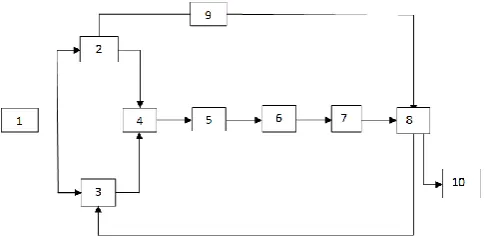
Learning model developed by researchers designed by using a reference of Dick & Carey instructional design. Dick & Carey design model was designed using a systems approach, which if using this approach will increase the chances in integrating all the variables that affect learning in instructional design (Degeng, 1997).
RESULT DEVELOPMENT
Products in this development is to produce teaching materials that integrated in planning the implementation of learning social science subjects fifth grade students in elementary
[image:2.595.310.553.90.211.2]school. Trial data presented in this research and development test results include:
Figure 1. Learning Model Approach to Model Dick and Carey
Explanation:
1. Identifying Instructional Goal
2. Conducting Instructional Analysis
3. Identifying Entry Behavior and Characteristics)
4. Writing Performance Objectives
5. Developing Criterion-Referenced Tests
6. Developing Instructional Strategy
7. Developing and Selecting Instructional
8. Designing and Conducting Formative Evaluation
9. Revising Instructional
10. Designing and Conducting Summative Evaluation
Data Results Responses / Draft Expert Assessment Planning Learning the Components of teaching materials (Phase I). The assessment is done by giving a score value to each grain questionnaire. Consider a questionnaire can be asked by some of the questions then after scores of these values inserted into the data matrix, then summed and divided according to the number of items in the scope of the component assessed. In this way it can be seen the quality of the components of teaching materials so that the feasibility of product development can be accounted. The following are the results of the descriptive analysis of the percentage of response outcome data/design expert assessment of the teaching materials that integrate character education through learning social science, as shown in the following table.
Table 1. Percentage of response outcome data/design expert assessment of the teaching materials
No Components Assessed Percentage Rate
Identification Feedback
1 Front Cover 98 % No Problem
2 Foreword 100% No Problem
3 Table of Contents 100% No Problem 4 Basic competences 98% No Problem 5 The Attractiveness 85% Still less images
associated with teaching materials.
6 Learning Scenario 90% No Problem 7 Learning Assessment 90% No Problem
Explanation:
Results Response Data / Content Expert Assessment
Subjects IPS towards Subjects (Phase II): After assessed by
draft experts and revised hereafter requested a response or an expert assessment of the content of social studies on moral education teaching material which is integrated with social science subject. Response data or content expert of social science subject in the form of qualitative data that gathered through consultations, interviews, discussions and questionnaires. From the results of expert assessment of the response or the content of social science subject, developers
got a lot of suggestions, criticisms and comments for improving the quality of the products of this development. The following are descriptive analysis and response outcome data/content expert assessment of the teaching materials as shown in the following table:
Result response data/Teacher Assessment (Phase III): The following are the results of descriptive data of percentage of teacher responses to product development as shown in the table above:
Table 2. Responses result data/content expert assessment of the product development of teaching materials
No Components Assessed Percentage Rate Identification Feedback
1 Harmony of basic competence with aspects of development teaching materials 98 % No Problem 2 Suitability indicators of competence with the development of teaching materials 90% No Problem 3 Suitability of learning activities with aspects of the values of noble character. 90 % No Problem
No Components Assessed Percentage Rate Identification Feedback
1 Basic Competencies 98 % No Problem
2 Learning Scenario 85 % Teachers have not provided a real example of honest behavior, discipline, responsible, mannered that shown by figures during the Hindu, Buddhist and Islam.
3 Suitability of learning activities with the child's age 98 % No Problem 4 Ease of children to conduct learning activities 96 % No Problem 5 The attractiveness of the learning activities for children 95 % No Problem
6 assessment of learning 90 % No Problem
Explanation:
81% - 100% = Very decent, no not need to be revised.
66% - 80% = Decent, no not need to be revised.
56% - 65% = Less Worth, need to be revised.
0% - 55% = Very less feasible, need to be revised.
Table 3. Field Trial
RATING SCALE (RESPONSE)
5 4 3 2 1
Very appropriate appropriate Appropriate enough Less appropriate Very less appropriate
Very clear Clear Clear enough Less clear Very Less clear
Very interest Interest Interest enough Less interest Very Less interest
Very easy Easy Easy enough Less Easy Very less easy
[image:3.595.62.535.407.665.2]Very Accurate Accurate Accurate enough Less Accurate Very Less Accurate
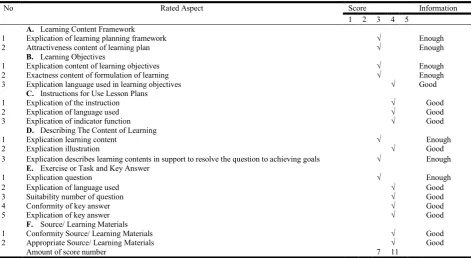
Table 4. Presentation results data of test ratings of small groups
No Rated Aspect Score Information
1 2 3 4 5
A. Learning Content Framework
1 Explication of learning planning framework √ Enough
2 Attractiveness content of learning plan √ Enough
B. Learning Objectives
1 Explication content of learning objectives √ Enough
2 Exactness content of formulation of learning √ Enough
3 Explication language used in learning objectives √ Good
C. Instructions for Use Lesson Plans
1 Explication of the instruction √ Good
2 Explication of language used √ Good
3 Explication of indicator function √ Good
D. Describing The Content of Learning
1 Explication learning content √ Enough
2 Explication illustration √ Good
3 Explication describes learning contents in support to resolve the question to achieving goals √ Enough
E. Exercise or Task and Key Answer
1 Explication question √ Enough
2 Explication of language used √ Good
3 Suitability number of question √ Good
4 Conformity of key answer √ Good
5 Explication of key answer √ Good
F. Source/ Learning Materials
1 Conformity Source/ Learning Materials √ Good
2 Appropriate Source/ Learning Materials √ Good
Amount of score number 7 11
Field Trial (Phase IV): After pass three test phase consisting of expert test design, content expert and subject teachers to the teaching materials that integrate character education through teaching social studies at St. SDK Arnold Penfui, District Maulafa, Municipality of Kupang, the last trial is a trial against the students, both small groups and large groups. To determine the extent to which the effectiveness and quality of the product development.
Presentation results data of test ratings of small groups: Data Results of Student Assessment (Small Group) toward materials of Character Education that Integrated to Learning Social Science in Primary Schools.
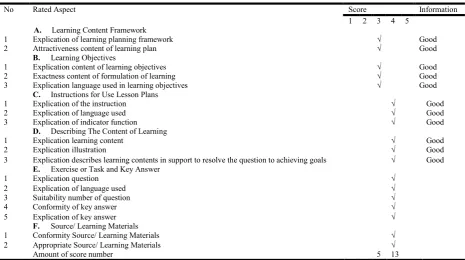
Presentation results data of test ratings of large groups: Here are presented the results of a review by a large group of students towards learning plan that is integrated in the learning
subjects Social Sciences in SDK ST. Arnold Penfui Maulafa Subdistrict Municipality Kupang. Comments and suggestions from the students to revise the learning plan development products such as in the following table.
Conclusion
[image:4.595.64.530.201.461.2]Improvement done in every stage development so was reached was reached in accordance with the results expected. The implementation of the learning execution planning design in field trials demonstrate result of learning as mastery values of character for learners in SDK St. Arnold Penfui Kupang. The stage of its development, consist of : First, the development activities carried out in primary schools begins with a preliminary study, development and implementation of studies which then produces a product development in the form of character education teaching materials that integrated in Table 5. Explanation Scale
SCORING SCALE (RESPONSE)
5 4 3 2 1
(4,1-5) (3,1-4) (2,1-3) (1,1-2) (0-1)
Very appropriate appropriate Appropriate enough Less appropriate Very less appropriate Very clear Clear Clear enough Less clear Very Less clear Very interest Interest Interest enough Less interest Very Less interest
Very easy Easy Easy enough Less Easy Very less easy
Very Accurate Accurate Accurate enough Less Accurate Very Less Accurate
Source: Authors Processed in the Field
Table 6. Presentation results data of test ratings of large groups
No Rated Aspect Score Information
1 2 3 4 5
A. Learning Content Framework
1 Explication of learning planning framework √ Good
2 Attractiveness content of learning plan √ Good
B. Learning Objectives
1 Explication content of learning objectives √ Good
2 Exactness content of formulation of learning √ Good
3 Explication language used in learning objectives √ Good
C. Instructions for Use Lesson Plans
1 Explication of the instruction √ Good
2 Explication of language used √ Good
3 Explication of indicator function √ Good
D. Describing The Content of Learning
1 Explication learning content √ Good
2 Explication illustration √ Good
3 Explication describes learning contents in support to resolve the question to achieving goals √ Good
E. Exercise or Task and Key Answer
1 Explication question √
2 Explication of language used √
3 Suitability number of question √
4 Conformity of key answer √
5 Explication of key answer √
F. Source/ Learning Materials
1 Conformity Source/ Learning Materials √
2 Appropriate Source/ Learning Materials √
Amount of score number 5 13
Source: Authors Processed in the Field
Table 7. Explanation of Scale
SKALA PENILAIAN (TANGGAPAN)
5 4 3 2 1
(4,1-5) (3,1-4) (2,1-3) (1,1-2) (0-1)
Very appropriate Appropriate Appropriate enough Less appropriate Very less appropriate Very clear Clear Clear enough Less clear Very Less clear Very interest Interest Interest enough Less interest Very Less interest
Very easy Easy Easy enough Less Easy Very less easy
Very Accurate Accurate Accurate enough Less Accurate Very Less Accurate
[image:4.595.115.484.505.585.2]primary school through learning social science subject. The values of character education are integrated through social science subjects include discipline, respect, attention (carefulness), fairness, accuracy, responsibility (responsibilities). Second, development product of character education that developed in the study is in the form of character education teaching materials prepared by the developer by integrate with social science subjects for students of class V SDK St. Arnold Penfui, District Municipality Maulafa Kupang. Third, the teaching materials developed consists of two learning activities as follows: (1) receiving the gift of the Almighty God who created man and the environment, (2) demonstrate honest behavior, discipline, responsibility, persistence as demonstrated by historical figures on the Hindu, Buddhist and Islam in contemporary life.
REFERENCES
Agung. 2011. Pendidikan Membangun Karakter Bangsa.
Jakarta: PT Basteri Buana Murni
Agustian. 2009. ESQ, Emotional Spiritual Queient. Jakarta:
Arga.
Budiastuti. 2010. Strategi Penerapan Pendidikan Karakter
Pada Pembelajaran Praktik Busana Makalah Disajikan Dalam Seminar Nasional 2010 “ Charakter Building For
Vocational Education”. Jurusan PTBB, FT UNY
Degeng. 2013. Ilmu Pembelajaran Klasifikasi Variabel Untuk
Pengembangan Teori dan Penelitaian. Bandung: Kalam
Hidup.
Dick, W. & Carey, L. 2001. The Systematic Design of
Instruction. NY: Longman INC.
Kesuma. 2012. Pendidikan Karakter: Kajian Teori dan
Praktek di Sekolah Dasar. Bandung: PT. Remaja
Rosdakarya.
Paul, S. 2002. Pendidikan Budi Pekerti Di Sekolah: Sebuah
Tinjauan Umum. Jogjakarta: Kanisius
Rukiyati. 2013. Urgensi Pendidikan Karakter Holistik
Komprehensif di Indonesia. Jurnal Pendidikan Karakter, no
2 th III 2013, LPPMP UNY. ISSN : 2089-5003.
Sanjaya, W. 2008. Strategi Pembelajaran: Beorientasi Standar
Proses Pendidikan. Jakarta: Kencana Prenadamedia Group.