Callard, Felicity and Margulies, D.S. (2011) The subject at rest : novel
conceptualizations of self and brain from cognitive neuroscience’s study of
the ’resting state’. Subjectivity 4 (3), pp. 227-257. ISSN 1755-6341.
Downloaded from:
Usage Guidelines:
Please refer to usage guidelines at or alternatively
The Subject at Rest: novel conceptualizations of self and brain from
cognitive neuroscience’s study of the ‘resting state’
Felicity Callard and Daniel S Margulies
This is a pre-copy-editing, author-produced PDF of an article accepted for publication in
Subjectivity following peer review. The definitive publisher-authenticated version Callard, Felicity; Margulies, Daniel S, Subjectivity, Volume 4, Number 3, September
2011, pp. 227-257 is available online at:
http://www.palgrave-journals.com/sub/journal/v4/n3/abs/sub201111a.html
Abstract
The neuroscientific field of ‘resting state’ research has been described as heralding a
paradigm shift in functional neuroimaging. As this new field has been central to the
development of a cognitive neuroscientific theory of inner mental life, we here map and
analyse its emergence and potential implications for conceptualizations of brain, self and
subjectivity within and beyond the neurosciences. The paper traces how the ‘the resting
state’ and ‘default mode’ became visible as objects of scientific enquiry through the
yoking together of what were initially separate research endeavours addressing different
neurophysiological and neuropsychological questions. In the process, ‘rest’ – as
signifying the cessation of movement or labour – has been transformed: the brain, inner
mental life – and potentially the self – are conceptualized by researchers in this field as
1 Introduction
In 2009, the Journal of Neuroscience commemorated the 40th anniversary of the
Society for Neuroscience by asking a number of prominent neuroscientists to reflect on
the changes within the field over the past 40 years. Marcus Raichle announced in his
paper that there had recently been nothing less than a paradigm shift in functional
neuroimaging (Raichle, 2009). Raichle contrasted two perspectives on brain function,
each of which, he contended, has had a long and complex history. According to one
perspective, the brain ‘is primarily reflexive, driven by the momentary demands of the
environment’; according to the other, ‘the brain’s operations are mainly intrinsic
involving the maintenance of information for interpreting, responding to and even
predicting environmental demands’ (p. 12729) . It is the former perspective that has
characterized much of the corpus of experimental and theoretical research within the
neurosciences. The latter perspective explicitly departs from most models of the brain
that have characterized cognitive neuroscience. For much of the last century, this
perspective was the neuroscientific underdog.
* * * * *
Over the course of the first decade of the twenty-first century, discussions
regarding the brain – both within and especially beyond the neurosciences – have
arguably been most preoccupied with and excited by three poles of research: (i) on
neuroplasticity and neurogenesis, which describe the brain's capacity to reorganize itself
the mature brain (Malabou, 2008; Rubin, 2009); (ii) a renewed focus on emotion/affect –
as a remedy for the excision of these phenomena from earlier, overly cognitive models of
brain and hence of self (see the research of Jaak Panksepp (1998), Antonio Damasio
(Moss and Damasio, 2001; 1994; Damasio, 2000; Damasio, 2004), and Joseph LeDoux
(1996; Phelps and LeDoux, 2005)); and (iii) on mirror neurons and, more generally,
social neuroscience – the neural mechanisms of shared understanding and
communications (for a review of mirror neuron research see: Rizzolatti and Craighero
(2004), and for social neuroscience see: Lieberman (2007)). In complex articulation with
these neuroscientific developments, the social sciences and humanities have been
experiencing an efflorescence of theoretical and empirical research on the self and
subjectivity that engages many of the same terms – for example, affect, empathy, and
embodiment – that are currently common currency within the neurosciences. (Indeed, it is
possible that the excitement surrounding neuroscientific research on mirror neurons and
affect has, to date, been greater in fields outside of the neurosciences than within them.)
Some of this research in the humanities and social sciences includes the creative use,
translation and reworking of research findings, as well as more general concepts, from
the neurosciences (e.g., Connolly (2002), Massumi (2002), Hansen (2004)). (For a
consideration of the potential as well as the difficulties associated with these
interdisciplinary engagements see (Cromby, 2007) and (Papoulias and Callard, 2010).) It
is our contention that the brain – as it is being conceptualized and modelled by the
neurosciences, as well as disseminated beyond them – is in the process of being reframed
by a fourth potent arm of research, that on the brain’s resting state and its default mode of
This emergent field is little more than a decade old. It comprises research on the
brain in the absence of any explicit task, termed the ‘resting state,’ or ‘default mode,’
which has given rise to interest in the ‘default mode network’ (DMN), a set of brain
regions that effectively underlie a novel core of cognitive function. In this paper, we map
and analyse this emergent research field. Our intention is twofold. First, we trace the
emergence of ‘rest’ and ‘the resting state’ as objects of scientific enquiry, and, in so
doing, indicate how such scientific constructs challenge – as well as pay certain debts to –
existing models of subject-environment interaction that are constituted within cognitive
neuroscience. Second, we reflect on potential implications of such research for
conceptualizations of subjectivity and of the self that coalesce in fields adjacent as well as
distal to the neurosciences.
Findings from this new research field are beginning to circulate through various
media channels. We write at a moment in which articles with such titles as ‘The restless
brain’ (Jarrett, 2009), ‘Devoted to distraction’ (Glausiusz, 2009), ‘Daydream achiever’
(Lehrer, 2008), ‘Perchance to daydream … and degenerate’ (Valeo, 2008) and ‘You are
who you are by default’ (Saey, 2009) are beginning to disseminate research concerning
the resting state and the default mode network to various publics. It is precisely because
processes of diffusion, dissemination and translation have only recently begun – and
hence that the paths that such diffusion and translation will take are as yet
underdetermined – that we consider it important to delineate some of the directions of
travel, the consolidation of constructs, and the openings, as well as the potential perils,
that such a field offers to those beyond its borders. The rapidity of dissemination and
experimental corpus on mirror neurons was both small and specific did not slow the
speed with which mirror neurons were incorporated into hypotheses and models being
developed in other neuroscientific fields, e.g. (Dapretto et al, 2006; Rizzolatti and Arbib,
1998; Williams et al, 2001). And it was certainly no block to the excitement with which
‘mirror neurons’ were greeted and set to work by diverse researchers within the social
sciences and humanities, e.g. (Stafford, 2007; Orbach, 2009; Thrift, 2008).
We suggest that just as was the case with mirror neurons and neuroscientific
research on affect, resting state/default mode network research is likely within the next
few years to find a ready general audience and wide cultural currency both within and
beyond academic circles. And, as with mirror neurons and affect, these movements of
concepts and scientific findings are likely to entail a creative engagement with – and
hence transformation of – the specific scientific premises and formulations exchanged by
scientists within the field itself. It does not escape our notice that we are complicit in the
wider dissemination of such research through the very writing of this paper. Our paper
comprises a cross-disciplinary collaboration between a neuroscientist within the field of
resting state functional magnetic resonance imaging (fMRI) research and a cultural
theorist with expertise in the history and living present of psychiatry. Our positions
within and to one side of the scientific field of resting state research allow us, we believe,
to offer insights, cautionary as well as enthusiastic, regarding the potential that this field
holds for reorienting some of the existing models through which subjectivity and
brain-self-environment relations have been understood.
We are also aware that some of our conjectures regarding the ways in which
somewhat speculative. Nonetheless, we believe that this speculative wager will pay off if
it encourages further critical reflection on the extent to which, and the means through
which, neuroscience might play a part in moulding conceptualizations of the self. Nikolas
Rose (Rose, 2007; Rose, 1998) and Emily Martin (Martin, 2007), amongst others, have
demonstrated intricate and two-way relationships between (neuro)scientific constructs
relating to the self and conceptualizations of the self that circulate in other domains. We
consider, in the specific context of resting state research, how such relationships are in
the very process of being forged. We leave to our readers the question of whether our
analyses adumbrate or, rather, actively intervene in this process.
2 Revolutions of a restless neuroscience
The claims now being made on behalf of resting state research – as Raichle’s
announcement of a paradigm shift (Raichle, 2009) makes clear – wish to underline its
historically revolutionary status.1 But, notably, the claims for newness and the excitement
surrounding this field are conjoined with an emphasis on its revivification of a hitherto
submerged perspective on brain function. Indeed, Raichle, in proclaiming the impending
paradigm shift, dwells on how ‘surprising discoveries’ (p. 12729) in imaging research
have opened up a new chapter in what has actually been an historically long-standing
interest in exploring the behavioural relevance of intrinsic brain activity. He leans, here,
on the genealogy presented by the eminent neuroscientist and physiologist Rodolfo
Llinás (2001). Llinás contrasts the work of William James and the famous
neurophysiologist Charles Sherrington with that of Sherrington’s disciple, T. Graham
fundamentally reflexive, in which ‘the brain is essentially a complex input/output system
driven by the momentary demands of the environment’ (Llinás, 2001, p. 6) . In contrast,
Brown argued that the spinal cord ought not to be understood as reflexological, and
indeed that movement could be intrinsically generated in the absence of sensory input:
It is therefore possible to look upon the neuraxial unit as the efferent neurone and not
as the reflex arc, and to regard as the primitive activity not the reflex but that
rhythmic phenomenon of which there still remain examples in the acts of progression
and re- spiration. (Brown, 1914, p. 45) [italics added]
Brown’s prime focus was on the rhythmic and intrinsic organization of gait: he argued
that his research demonstrated that the conditioning of rhythmic activity is largely
self-generated, such that sensory input modulates but does not determine it. He thus refocuses
our conceptual lenses away from the phenomenon of the reflex arc and towards that of
rhythmic intrinsic organization. Llinás argues that Brown’s insights on spinal cord
function may be extrapolated to the operations of the brainstem and areas of higher brain
function. On this view of the brain, sensory input ‘modulates rather than informs’ (Llinás,
2001, p. 7) intrinsic nervous system function. Such a view runs counter to many
theoretical frameworks employed by various disciplines in the course of the twentieth
century to understand and model the human brain and cognition, not least behaviourism,
orthodox cognitive psychology, and later cognitive neuroscience. Indeed, such a view
or between internal and external world – from the one familiar to us from cognitive
science.
Resting state research, in explicitly allying itself with Brown over Sherrington,
positions itself on one side of a long running duel, one whose axis centres on the
opposition between the reflexive and the intrinsic. The field is also, of course, indebted to
other scientific concepts, models and approaches. A genealogical approach to the
problematics engaged by ‘resting state’ research would need to contend with Bichat’s
formulations regarding life as a collection of processes that resist death; with research on
homeostasis in the early twentieth century by Walter Cannon and others; and with the
cybernetic models of homeostasis that were such a fertile resource for cognitive science
and systems theory.2
But how did rest and ‘the resting state’ emerge as topics of explicit scientific
enquiry within neuroscience? In this section, we provide a brief history (see also Buckner
et al, 2008), paying particular attention to some of the manoeuvring of different
neuroscientific sub-disciplines, and to the moments at which initially distinct constructs
and terms coalesced. Of particular interest are the two distinct paths – with distinct
methodologies, techniques and fields of expertise – out of which the field as we know it
today has been constituted: cognitive psychology and neurophysiology. We contend that,
over the course of the last decade, the terminology employed within this field has been
transformed – in the process moving to vocabulary that is less contentious, arguably more
2.1 History of resting state research: Lineage 1 – ‘default mode’
For cognitive psychologists and neuroscientists, a cross with arms of equal length
(Figure 1) signifies a classic condition for the control state during an experiment. It is the
state of rest, a neutral state, baseline, the moment of ‘crosshair fixation’. For cognitive
neuroscience, this state has long been on the opposing side of the cognition it aimed to
study.
***** INSERT FIGURE 1 ABOUT HERE *****
Most categories of study in cognitive neuroscience emerged from a century-old
lineage of experimental psychology. The traditional approach in neuroimaging studies,
both in positron emission tomography (PET) and continuing with fMRI, was the contrast
of a specific state (e.g. visual stimulus, sustained attention, memory retrieval) with a state
in which subjects were simply asked to rest. Depending on the experimental condition,
this ‘resting-state’ could be with eyes closed, eyes open, or fixation on a crosshair. Rest
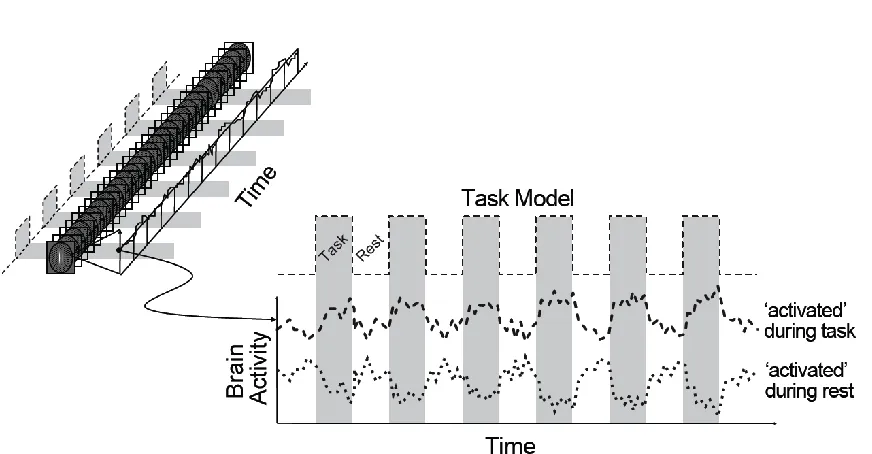
was implicitly considered a cognitive baseline against which task demands elevated brain
activity in function-specific regions (Figure 2).
***** INSERT FIGURE 2 ABOUT HERE *****
Gordon Shulman and colleagues at Washington University in St. Louis (one of the
foremost institutions in the field of cognitive neuroscience) systematically noted some
conditions. In 1997, they published their findings in the Journal of Cognitive
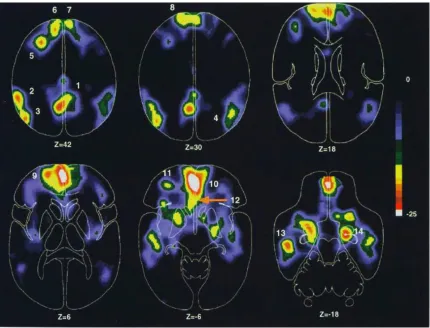
Neuroscience, showing in a meta-analysis of nine different PET studies that a distribution
of regions including the medial prefrontal, posterior cingulate / precuneus, and lateral
parietal cortex were more active when subjects were resting (Figure 3) (Shulman et al,
1997). This paper also argued that while a passive control condition in the experimental
design might for some appear to be ‘too underspecified’ to act as a reliable control, their
analysis indicated that ‘passive conditions’ across a wide variety of experiments
produced a ‘consistent set of blood flow changes’ and could thereby serve as a control
state (p. 657). Notably, Shulman and colleagues also ruminated on the blood flow
decreases caused by ongoing processes in the passive mental state, suggesting the
possibility of unconstrained verbal thought processes, monitoring of the external
environment, and monitoring of the body image. (Such constructs would, notably, return
in later attempts to theorize what is happening cognitively when the brain is ‘at rest’.)
They explicitly considered that processes in the ‘passive condition’ might have an
‘antithetical relationship’ to active task processes (as sleep is antithetical to an alert state,
a ‘general exploratory/monitoring state’ might be antithetical to a task-focused state).
This shift – which we shall term ‘The Flipping of Contrasts’ – was very simple
analytically (subtracting – or ‘contrasting’ – the task condition from rest, rather than the
standard subtraction of the resting condition from task), but it presented cognitive
neuroscience with the substantial conceptual problem of how to make sense of the data. If
a large swath of cortex is more active during a state of rest, what is happening
***** INSERT FIGURE 3 ABOUT HERE *****
The term ‘default mode’ entered the cognitive neuroscience vocabulary to describe
the functional state of rest, in the contemporary sense, with Marcus Raichle’s and
colleagues’ publication of three papers in 2001 (Gusnard et al, 2001; Gusnard and
Raichle, 2001; Raichle et al, 2001).3 Many of these task-induced decreases in brain
activity appeared to be ‘largely task independent, varying little in their location across a
wide range of tasks’. Such consistency made them consider whether there might be ‘an
organized mode of brain function that is present as a baseline or default state and is
suspended during specific goal-directed behaviours’ (Gusnard et al, 2001, p. 4259).
Through a semiotic linking of functional neuroanatomy to the regions found to be more
active during rest, several hypotheses were proposed regarding the psychological content
of the resting state. Debra Gusnard and colleagues postulated that the observed medial
prefrontal cortex activity reflected the predominance of self-referential mental activity
(also observed to implicate the medial prefrontal cortex) that occurs in the absence of
environmental demands. They furthermore tentatively proposed that such activity was
involved in the ‘processing of such representations that embodyaspectsofself’ (Gusnard
et al, 2001, p. 4263) [italics added], and linked such processing to the concept of the
autobiographical self proposed by Damasio (Damasio, 2000) and that of the narrative self
proposed by the philosopher Shaun Gallagher (Gallagher, 2000). Gusnard and Raichle’s
review in Nature Reviews Neuroscience (Gusnard and Raichle, 2001) elaborated their
theory of a default mode of brain function based in neurophysiological, as well as
internally-driven mental states. These three papers were central – and not solely in terms
of their inauguration of a new research field. For they indicated that one ‘useful way’ to
address the ‘important concept’ of the self was ‘to further explore the nature of default
state activity’ (Gusnard et al, 2001, p. 4263): in so doing, these authors established an
enduring and intimate tie between the resting state and investigation of the neural
architecture of the self.
It would take us too far afield from the central concerns of this paper adequately to
address the numerous research findings and debates regarding the default mode since
2001.What follows is a schematic outline of some themes that are most critical to the
arguments of this paper, along with brief indications of the methods employed.
(i) Goal-directedness: While activity during the default mode was initially set in
opposition to ‘goal-directed behaviour’ (Shulman et al, 1997), it was subsequently
reconceptualised as involved in long-term, goal-directed planning, as numerous studies
hypothesized its role in prospection, or future-oriented thinking (Spreng et al, 2009).
While the task paradigms for interrogating these cognitive faculties did not differ from
traditional cognitive neuroscience methodologies, it is the focus on unravelling the
function of regions within the default mode network that was novel.
(ii) Quantification of stimulus-independent thoughts and the invigoration of
research on mind-wandering: More recently, we have witnessed the coalescence of
research on the default mode network with other cross-disciplinary areas of research.
Most notably, previously dispersed research on stimulus-independent thoughts,
task-unrelated thoughts and ‘zone outs’ has been gathered together under the umbrella term of
Christoff et al, 2009; Smallwood and Schooler, 2006). Through such research,
phenomena such as mind-wandering, which have previously been marginal to the
theorisations of brain and self undertaken by cognitive science, have been installed as far
more fundamental. Mason and colleagues’ study in Science, for example, contended that
mind-wandering constitutes ‘a psychological baseline that emerges when the brain is
otherwise unoccupied’ and that is underpinned by activity in a default network of cortical
regions (Mason et al, 2007, p. 394). (That the dissemination of such research into the
public sphere is undertaken via the use of such statements as ‘Daydreaming seems to be
the default setting of the human mind’ (Fox, 2007) underlines how such research is
effecting a shift away from a model of the self oriented towards external goals so beloved
by orthodox cognitive psychology.)
In terms of methods, the study by Mason and colleagues, which aimed to address
‘the relationship between the default network and mind-wandering’ (Mason et al, 2007,
p. 394), measured the frequency of stimulus independent thoughts during auditory and
visuospatial working memory tasks, then correlated the scores with the level of
task-induced deactivation. Although the task remained the same, the analysis now focused on
the frequency of lapsed attention, rather than moment-to-moment attention. In other
words, just as with the initial ‘Flipping of the Contrasts’, such studies required no
fundamental methodological or technological breakthroughs, but rather a refocusing of
scientists’ analytical gaze on what was hitherto regarded as unworthy of specific
attention.
(iii) Self-related processing, episodic memory, social cognition and sense of
heading of default mode function, using findings from task-based studies to support the
specialized roles of the implicated regions (Spreng et al, 2009; Goldberg et al, 2008;
Schilbach et al, 2008; Moll et al, 2007). Much support has been drawn from the rationale
that the content of mind-wandering is composed of episodic memory, prospection, and
the consideration of social relationships. Given the diversity of roles attributed to the
regions of the default mode network (DMN), more recent work has attempted a
network-based rendition of the modular theory of brain function (which postulates that each
functional area of the brain has a singular role), thus subdividing the DMN in order to
accommodate the diversity of ascribed functions (Andrews-Hanna et al, 2010).
Much of this empirical and conceptual research on the default mode, it should be
emphasized, has drawn extensively on findings and formulations from a range of other
sub-domains of cognitive neuroscience. Regardless, however, of the cohesiveness of the
cognitive constructs as they were fitted within the emergent DMN model, or of the
precise spatial distribution of the responsible network, a cognitive neuroscience of inner
experience was taking form through linking the functional roles of brain regions that are
more activated during the state of rest with the psychology of unconstrained mental
activity.
2.2 History of resting state research: Lineage II – spontaneous brain activity
We have thus far focused on cognitive neuropsychology as it established the
foundations and terminology for studying the brain’s function in the psychological state
of rest. However, interest in ‘resting’ brain activity, albeit of a different sort, preceded
physicist colleagues, who were then based at the University of Wisconsin in Milwaukee,
were working under the guidance of James Hyde (a pioneer in the development of fMRI
technologies). Rather than asking the neuropsychological question posed by Shulman and
colleagues, they posed a parallel question about the role of the spontaneous activity that
was discarded as noise in analytic models.4 Instead of inquiring about a functionally
relevant psychological baseline condition, Biswal and colleagues explored the possibility
that baseline physiological activity might be functionally significant and reflect neural
organization.
That spontaneous neurophysiological activity was functionally relevant was not a
new idea,5 but it had fallen behind the hypothesis of the input-output model driving
behavioural psychology. If the brain were instead primarily driven by the requirement to
maintain its own dynamics, with environmental input only modulating, rather than
driving its function, the spontaneous endogenous dynamics would be meaningful and not
simply unconstrained noise. Biswal and colleagues addressed this question in 1995 with a
remarkably simple paradigm (Biswal et al, 1995). They began with a standard
finger-tapping task in a ‘boxcar’ design (see Figure 2), in which the task – or ‘on’ – condition
(here, ‘finger-tapping’) occurs in several experimental ‘blocks’, each of which is
separated by a period of non-task, ‘off’ time. Expectedly, the motor cortex was activated
more during tapping than during the resting-condition. Their innovation was to then take
data collected from the same subjects during a rest-only condition and to analyse the
correlation of the spontaneous fluctuations occurring between a small portion of selected
motor cortex and the rest of the brain. They found that the same areas of motor cortex
notion that spatially remote areas of the brain could be spontaneously correlated, and that
such a relationship served as a measure function-based connectivity, was not new
(Friston et al, 1993). However, the observation that ‘functional connectivity’ during a
resting-state contained similar neural organization as task-evoked patterns of activity was
indeed novel. Here, the title of their seminal article: ‘Functional connectivity in the motor
cortex of resting human brain using echo-planar MRI,’ reflects the union of fields that
was to follow almost a decade later. Thus, it appeared that the brain was functionally
coordinated into spatially consistent areas even in a task-independent state of rest.
***** INSERT FIGURE 4 SOMEWHERE NEAR HERE *****
From an analytic perspective the transition was easy, although it took almost a
decade to overcome the field’s bias. The only difference from task-based data analysis
was the derivation of the statistical model: rather than hypothesize the fMRI response
from an environmental stimulus and test which areas of the brain may be correlated, the
data themselves provide the model. The data processing tools remain largely the same,
but the statistical model shifts from externally to internally defined. The theoretical shift,
on the other hand, is from localization of functional areas to delineating connectivity and
large-scale functional networks (Van Dijk et al, 2010; Bullmore and Sporns, 2009).
Numerous publications have used functional connectivity analysis of resting state fMRI
data to map neuroanatomical systems (Margulies et al, 2007; Di Martino et al, 2008; Roy
et al, 2009; Krienen and Buckner, 2009; Vincent et al, 2008; Smith et al, 2009),
differentiate patient groups (Greicius, 2008; Fornito and Bullmore, 2010; Seeley et al,
et al, 2009; Fransson et al, 2007). The approach has been used to investigate functional
brain differences in groups and topics that would otherwise not be capable of task
participation, such as other species (Margulies et al, 2009; Vincent et al, 2007; Vincent et
al, 2010; Biswal and Kannurpatti, 2009), and different levels of consciousness in humans
(Boly et al, 2008; Horovitz et al, 2008; Fukunaga et al, 2006). Since all that is required
during data collection is that the participant remains motionless in the scanner
environment, resting state fMRI data has also opened the possibility of data-sharing
across institutions on an unprecedented scale (Biswal et al, 2010). With the recent
publication of Biswal and colleagues’ multi-site study, consisting of over 1000 datasets
(in a field which usually does not exceed a few dozen per study), the field of functional
imaging seems at the cusp of large-scale population studies, and shares the excitement
and research aspirations with which genetics entered the last decade.
2.3 Consolidating the ‘resting-state’ field of research
The links between the field of dynamic physiological properties in the resting
human brain with the field of dynamic psychological properties in the resting human
brain were not as obvious as they perhaps might now seem. Biswal’s findings were not
initially popular within the imaging community, and cognitive neuroscience did not know
how to integrate Raichle’s work. One may conjecture that the two groups were either
unaware of (or unaware of how to link) each other’s work, as no cross citations exist
prior to 2003.6
A young researcher named Michael Greicius who was working in the laboratory of
Proceedings of the National Academy of Sciences and edited by Raichle, was entitled
‘Functional connectivity in the resting brain [note the Biswal reference]: a network
analysis of the default mode hypothesis [note the Raichle reference]’ (Greicius et al,
2003). At the core of the study was the resting state functional connectivity technique
developed by Biswal: Greicius and colleagues found that the regions more activated
during the baseline state were also intrinsically correlated at rest. The unification of these
two fields, one neuropsychological, the other physiological, and both essentially a break
with the dominant model of input-output brain function, marked the beginning of what
we now know as ‘resting-state fMRI’. It was here that Greicius and colleagues coined the
functional-anatomical term that has become almost synonymous with the name of the
field itself: the ‘default-mode network’. It was this network, they argued, that
‘account[ed], in large part, for the phenomenon of task-related decreases in brain activity’
(Greicius et al, 2003, p. 256). The blending of the two fields is most exemplified by a
statement by Raichle and Snyder from a response paperpublished in 2007 in the journal
NeuroImage: ‘The important distinction is not between “rest” and “task” but rather
between intrinsic and evoked activity’ (Raichle and Snyder, 2007, p. 1088).
The yoking of the physiological and the psychological approaches to one another
has meant that, even as the ‘resting state’ research field now appears to be a unitary one,
it retains within it distinct theoretical foundations and terminologies. This theoretical
fecundity has been advantageous in terms of sparking wide-ranging empirical research as
well as giving extra impetus to model building. But it has also meant that the ‘resting
state’ and the mapping of the cognitive function of the default mode network are
through spontaneous, intrinsically-driven activity, while on the other side research is
primarily invested in characterizing the psychological state (and corresponding brain
state) during the absence of specific environmentally-driven task demands. By uniting
both fields under one banner, they flank each other to criticism directed at either side, and
offer a wider landscape of interpretation – in many cases due to the use of loose
terminology and interpretation. The creative semiotic terrain produced through the
mixing of these terminologies has aided and will, we suggest, continue to aid the
transmission of this research into other disciplinary arenas and into the public sphere.
2.4 Resisting rest
Raichle and Snyder’s insistence that the important distinction was not between rest
and task, but rather between intrinsic and evoked activity marked a distinct shift from the
call-to-research of Raichle and colleagues’ 2001 articles. Notably, Raichle and Snyder’s
formulation was not self-standing, but rather appeared as a central element in their
defence of resting state research against a stringent critique launched by two researchers,
Alexa Morcom and Paul Fletcher, who were attached to a dominant hub of cognitive
neuroimaging, the Brain Mapping Unit at the University of Cambridge. Morcom and
Fletcher’s paper (2007) – provocatively entitled ‘Does the brain have a baseline? Why we
should be resisting a rest’ – marked the first explicit challenge to the maturing field of
resting state research.7 The paper did not dispute Raichle and colleagues’ characterization
of the resting state as ‘active’, but rather attempted to undermine ‘its claim to a special
status’ [italics added] (p. 1080). Indeed, the paper used the adjective ‘special’ a number
that acknowledgement of the resting state in no way entailed a need to refocus attention
away from the task-based manipulations long familiar to cognitive neuroscience. On
Morcom and Fletcher’s account, in short, a focus on the intrinsic activity of the resting
brain carried the danger of ‘imply[ing] that it has somewhat mysterious functions not
amenable to study using “tasks”’ [italics added] (p. 1078). Since, for them, task-based
paradigms were essential for any progress to be made vis-à-vis how the brain supports
cognition, and since ‘the cognitive nature of rest is at present almost entirely a matter of
speculation’ (p. 1079), the implications were clear: the cognitive characteristics of the
resting state required investigation through the use of appropriate tasks. ‘[M]odern
systems neuroscience’ must, after all, they argued, ‘be sophisticated in cognitive, as well
as physiological and network terms’ (p.1081). Morcom continued in the same vein in
subsequent interviews, critiquing the DMN theory as ‘very unpsychological’ (Jarrett,
2009, p. 838); she was joined by Sam Gilbert, a colleague at another world-leading
cognitive neuroscience department, that of University College London (UCL), who
reiterated that ‘The DMN literature reflects ... a decognitivisation of cognitive
neuroscience’ (Jarrett, 2009, p. 838).
What is striking about Morcom and Fletcher’s critique is their need to downplay
any disturbance that the constructs of ‘the resting state’ and the DMN might be bringing
about within the established field of cognitive neuroscience. The frequency of their use of
the word ‘special’; their refusal to bestow upon the resting state ‘a privileged status’ in
the study of human behaviour; their antipathy towards granting the resting brain
‘somewhat mysterious functions’ that operate outside of the fold of task-based
cognition – and its exploration via the use of highly controlled, task-based designs – that
must remain at the heart of the neuroscientific exploration of the brain. Their paper, then,
points to an ongoing and pivotal debate surrounding the resting state field: the extent to
which its model of brain (and self) endorses orthodox cognitive conceptions and the
extent to which it departs from them.
3 Interlude: ‘rest’ and ‘default’
Before it is possible to begin to formulate a preliminary response to this question, it is
necessary to stand back from the intricacies of the manoeuvres we have been tracking in order
to reflect on the wider semantic terrain inhabited by this emergent scientific field. What, in
short, do the terms ‘rest’ and ‘default’ denote? Both are complex and polysemic. This adds to
the difficulty of discerning if and how the resting state research field fits within, or moves
beyond, the orthodox cognitivism of much of the wider neuroscientific terrain. It also adds to
the likelihood that there will be a creative multiplication of meanings and connotations as
findings and formulations are disseminated beyond academic circles.
3.1 ‘Default’
The current meaning of default – a condition that obtains in the absence of active
intervention – is etymologically very recent. The Oxford English Dictionary traces its use to
1966: to define a preselected option adopted by a computer when no alternative is specified
by the user or programmer.8 Here, the ‘default’ is something that is specifically programmed
into a system, rather than being immanent to it. But the artificiality of the system disappears
neutral state of the system – how it might act in the absence of interventions/stimuli. Such a
‘neutral state’ easily slides towards connoting the core, functional state of the system, and
from there, to what the system most ‘naturally’ returns to.
For anyone who is at all familiar with computers, a ‘default’ setting of the brain is
therefore likely to be an easy concept to grasp. There are two points to make here vis-à-vis the
close relationship that the term ‘default’ establishes between the brain and the computer. One
is the straightforward one that the dissemination of resting state/default mode research is
likely to be rendered easier by the fact that the adjective ‘default’ is part of lay terminology –
at least for those familiar with computers. The second is the more interesting: over the last
quarter century, computers have had an enormous impact on our understandings and
conceptualizations of both the brain (‘the brain as computer’) and the self (e.g. Turkle, 1995).
In other words, any influence that resting state research has on everyday conceptualizations of
the brain and self is likely to be carried on the back of the already powerful influences that the
computer and computing have on such conceptualizations.9
3.2 ‘Rest’
This term has, of course, a rich philosophical, anthropological, religious and
sociological – as well as biological and physiological – history. It is therefore
metaphorically and metonymically very rich, a characteristic that has been exploited to
the full by scientists, external commentators and critics when discussing research on the
resting state.(Those of us who are social scientists ought not to imagine that the term
‘rest’ has lain uninterrogated by those within the field. Indeed, resting state researchers –
difficulties of the term.) The etymology of ‘rest’, as described by the Oxford English
Dictionary, indicates that uses of the word have included: a natural repose or relief from
activity; the intermission of labour or exertion (hence the Sabbath as the day of rest);
freedom from distress or trouble; quiet or tranquillity of mind; an interval of silence or a
pause (in music); the cessation of motion; and continuance in the same position or place.
In this sense, rest can variously be regarded as the opposite of: activity, busyness, labour,
movement, restlessness and agitation. Hints of several of these meanings are to be found
within the scientific and popular literature on the resting state and the DMN. And, as we
shall later discuss, this literature is engaged in a substantial reconfiguration of several of
the term’s uses.
4 Paradigms contrasted: the subject (not) at rest
The previous sections have attempted to depict the complexity of the field of
transformations produced through the emergence of the resting state research field and
the proclamation of a new paradigm in functional neuroimaging. These transformations
have been not only methodological, but have been accompanied by disciplinary
disturbances as well as ontological and epistemological shifts in how the brain is
conceptualized and scientifically interrogated.
In the remainder of the paper, we analyse in greater detail some of the potential
implications of these transformations for models of brain, self and subjectivity. We start
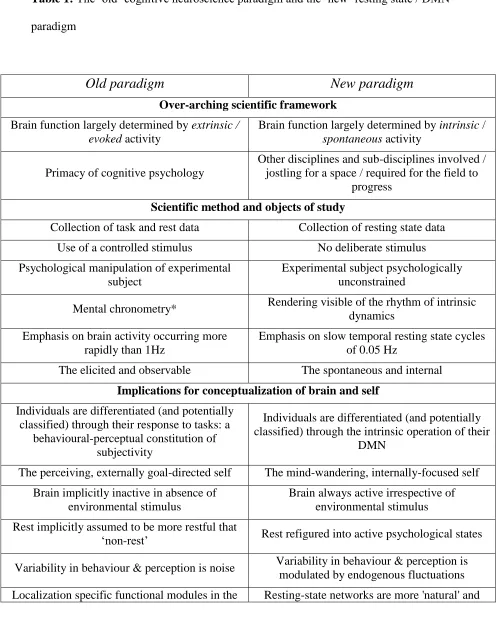
with a schematic depiction of the ‘old’ and the ‘new paradigm’ (see Table 1). The cells in
paradigms in popular literature; and our own analyses of the typifying features of each.It
is easy to critique such a bifurcation. But while the table provides an overly schematic
division of what is in actuality a much more heterogeneous field, we nonetheless believe
that it is helpful to articulate some of these differences starkly so as to gain greater
analytical purchase on what might be at stake in Raichle’s announcement of a ‘paradigm
shift’ in functional brain imaging. It is, nonetheless, important to keep in mind that the
shifts effected by the resting state/DMN field are part of a much larger and heterogeneous
series of changes in how neuroscientists are conceptualizing the brain and the self. In
other words, we should not be misled into believing that the ‘new paradigm’ has arisen
through findings, constructs and methods developed solely by resting state/default mode
researchers.
* * * * * INSERT TABLE 1 ABOUT HERE * * * * *
The final third of Table 1 indicates how the methods and objects of resting state
research specified in the second third of the table potentially catalyse a new model of
brain and self within cognitive neuroscience. The intrigue with and focus on
non-observable and unconstrained mental activity, for example, contributes to the emergence
of an account of the self grounded as much through mind-wandering and introspection as
through deliberate, goal-focused activity; the focus on the rhythm of the intrinsic and
spontaneous dynamics of the brain contributes to the emergence of an account of the self
specified through and anchored by those dynamics rather than through her responses to
the environment and the exteroceptive stimuli that impinge upon her. And the shift in
phenomenal perception, is a fortuitous by-product of using fMRI with its slow temporal
resolution to explore psychological and physiological dynamics (rather than
electroencephalography, which traditionally only addresses fluctuations faster than one
second – much closer to a time-scale of interest to neurons).
As resting state and DMN findings begin to be disseminated, it is possible to
discern already how they are being used to ground particular visions both of the self and
of the intimate tie between brain and self. The neuroscientists Susan Whitfield-Gabrieli
and John Gabrieli, for example, in an online article for Scientific American about the
default modehave suggested that the:
exciting discoveries about the resting human brain raise the question of whether
we are gaining the novel capacity to measure quantitatively our most intimate and
unique inner selves. Are you most “you” when you’re racing through work? Or
when you’re simply sitting in a chair, mind adrift, just being? (Whitfield-Gabrieli
and Gabrieli, 2010)
Raichle, himself, in a recent cover feature for the Scientific American, writes:
The brain’s default mode of function serves as a master organizer of its dark
energy. Over time neural dark energy may ultimately be revealed as the very
If, as Nikolas Rose has argued, the spaces of contemporary biomedicine and biopolitics
are opening up ‘new ideas of what human beings are’ (Rose, 2007, p. 6), then there
appear already to be indications that the resting state and the DMN might be installed as a
new foundation for the self. In the two quotations above, it is the subject ‘at rest’ that –
by dint of her default mode brain activity – potentially holds the key to subjectivity tout
court. We can see the ease with which the analytical distance between resting state data,
models of DMN activity, and claims about the nature of subjectivity can be flattened.
The explosive growth of resting state research has, then, started to make its mark
felt beyond the laboratory. In the process, ‘rest’ has been rewritten to comprise various
active, internal psychological states. The past century of experimental psychology was
built upon those aspects of cognition that it could modulate and measure externally. The
emergence of the concept of a default mode of neural and psychological activity has
impinged on the inner territory of the subject, and, in the process, has contributed to
renewed interest in developing experimental paradigms that would investigate this
territory. In little more than a decade, the ‘task induced deactivations’ noticed by
Shulman and colleagues have moved from being a complete mystery, to being configured
as a coherent network that has been described in ScienceNews as ‘one of the
hardest-working systems in the brain’ – ‘despite its laid-back name’ (Saey, 2009, p. 16). Rest – to
follow Raichle in his frequent use of a quotation from Seneca – has in this formulation
certainly become ‘far from restful’.10
We wish to comment on one particularly noticeable consequence of this
reconfiguration of ‘rest’, not least because it significantly reorients some of the previous
describe and conceptualize a self who is not engaged in deliberate and purposive activity.
It is our contention that the reconfiguration of rest has helped to consolidate a model of
the resting brain as a matrix that is constituted as perpetually productive, as intrinsically
creative, and as thrown towards the future. While many of the research findings that
ground such a model in fact existed prior to the emergence of the default mode/resting
state literature, they arguably required the compelling image of the brain as exhibiting
‘unrest at rest’ in order to circulate more widely.
Most notably, the increased focus on the importance of mind-wandering and
daydreaming in no way gainsays the brain’s industriousness. Buckner and colleagues, for
example, in describing resting state activity, speculate that: ‘Rather than let the moments
pass with idle brain activity, we capitalize on them to consolidate past experience in ways
that are adaptive for our future needs’ (Buckner et al, 2008, p. 31). Raichle and Snyder
make no bones about the fact that, for them, study of the default mode of the brain
enhances investigation of ‘the real reason we have a brain’11: ‘not to reminisce about the
past nor react in the moment but, rather, to envision the future’ (Raichle and Snyder,
2007, p. 1089). The brain, on Raichle’s account, functions as a kind of ‘Bayesian
inference engine’ through which it is able to generate predictions of the future, and to link
these predictions with its reflections on the past. Such abilities are, moreover, central to
‘the development of unique human attributes such as imagination and creativity’
(Raichle, 2006, p. 1250). Unsurprisingly, then, as this research travels through popular
science publications – and thence more broadly to a number of publics – the use of tropes
of productivity to characterize states of only apparent idleness, multiply. As Saey puts it:
self is no slacker’ (Saey, 2009, p. 16). (It is notable that resting state research employs
tropes of industriousness and the desire for ‘no-backlog’ that are of a piece with today’s
discourses regarding neo-liberalism. There remains much to be explored vis-à-vis how to
understand and interpret the often unacknowledged isomorphism between models of the
brain and models of socio-economic organization (Martin, 2007; Malabou, 2008).)
The model of mind-wandering as industriousness is in distinct contrast to those
accounts of day-dreaming and mind wandering that dominated late nineteenth and
twentieth-century philosophy and social theory. For Freud, for example, the key
conceptual term in his famous essay ‘Writers and day-dreaming’ is play; this is ‘serious
play’, certainly, but play nonetheless (Freud, 1908). Freud’s mind is one in which ‘hardly
anything is harder for a man than to give up a pleasure which he has once experienced’.
Indeed, the subject does not give something up but exchanges one thing for another, such
that as the child grows, he ‘builds castles in the air’ rather than castles made out of bricks.
The contrast between Freud’s formulation (in which subjectivity is weighted by the pull
of the past) and that of Raichle and Buckner (with the subject’s adaptive orientation to
the future, even – perhaps especially – in its consolidation of memory) could not be more
marked.12
The gap that separates some of those philosophical interrogations of memory and
subjectivity so central to modernity from current research findings associated with the
default mode can also be discerned through the repositioning of that most redolent of
symbolic objects: Proust’s madeleine. Visual neuroscientist Moshe Bar, in two articles
that address the ‘proactive brain’ (Bar, 2007; Bar, 2009), elaborates how such a brain
continuously generates predictions by ‘proactively linking’ incoming features to existing,
familiar information. Bar argues that there is a ‘striking overlap’ between the cortical
network mediating contextual associative processing and the default network. Such a
model means that for Bar there is in fact a ‘payoff’ for the brain’s investment of energy in
‘mind wandering, fantasizing and revisiting (and modifying) existing memories’ (Bar,
2009, p. 1239): what appear to be random thoughts and ‘aimless’ mental simulations
create memories. Crucially, he explicitly contrasts his model, in which acquired memory
is important for future survival and adaptation with the environment, with one of the key
loci for conceptualizations of memory in modernity:
Consequently, the cardinal purpose of memory starts to seem less for leisured
reminiscing, as in the famous example of Proust’s Madeleine, and more as a
knowledge-base that guides our lives in an increasingly more informed manner. (Bar,
2007, p. 286)
Let us set to one side Bar's unique characterization of a moment in Swann's Way in which
Proust narrates the surfacing of memory as peremptory and compelled as a moment of
'leisured reminiscence'. Instead, note how the 'pay off' that Bar reads into the brain's
investment in mind-wandering and fantasizing is one that points to a model of mental
activity in which the potential for the designless, footloose and aimless is converted into
the purposive, generative and aimful.
The reconceptualisation of rest is also contributing to the reframing of older,
which William James, for example, divided the field of consciousness was to oppose
attention to the state of absentmindedness conjured up by the French term distraction and
the German Zerstreutheit. For James, it was the abolition of the state of distraction13 that
signalled the awakening of the attention (James, 1890, pp. 404–405). In contrast, the
model of attention being developed in the DMN literature reformulates absentmindedness
or mind-wandering as a form of introspective attention. Here, network brain activity ‘at
rest’ is mapped on to the psychological category of attention, such that attention’s
opposite no longer exists. Instead, we have two types of attention – the intro- and the
extrospective. The neuroscientist Peter Fransson, in a similar manoeuvre, argues that
activity during the default mode disallows the possibility that one might, metaphorically
speaking, ‘lose track of oneself’. While he acknowledges that there is still uncertainty as
regards the ‘exact function of this core of intrinsic activity’, he speculates that:
it represents unconscious and continuously on-going processes that are necessary to
maintain a coherent neuronal representation of the “self.” We believe that irrespective
of how focused we are on a specific task [such task-based focus implies lower levels
of DMN activity] and no matter how computationally demanding that task is, we
cannot, metaphorically speaking, “lose track of ourselves”. At all times, the brain
needs to have a coherent mental model of the self. Cognitive faculties that might be
administered by this model include having a sense of who we are and where in space
Fransson’s claim that the brain's unceasing and coherent mental model of the self might
administer cognitive functions that include such fundamental subjective categories as the
'sense of who we are', conjures up a conception of the self that is unable to lose its
moorings or, in short, to unfix itself from its self. If the resting state and DMN literature
present a brain and a self preoccupied with daydreaming and fantasy, and characterised
by unconstrained mental activity, such activities should, in fact, be regarded as tethered
and directed rather than formless and indeterminate.14
5 The subject at rest moves elsewhere
We have described how resting state research, as well as disseminations of resting
state research within the popular literature, are reconceptualising models of brain and self
within – and potentially outside of – the neurosciences. While such transformations are in
certain ways building on – and committed to expanding – already established cognitivist
frameworks (e.g. note the use and extension of standard psychological constructs such as
attention), they are, we suggest, simultaneously delineating a rather different account of
the self, one which is ripe for movement into other fields. In this final section: (i) we
briefly indicate potential points of convergence between this different account of the self
and current areas of preoccupation within the humanities and the social sciences; and (ii)
speculate on the ways in which dissemination of resting state research might take place.
The animating force within the humanities and social sciences for much of the
ongoing interest in neuroscientific research is a frustration with the Cartesian subject (and
its corollary, the cognitivist self), and a search for models of the brain, the self and the
ways positions itself as departing from some of the constraints of cognitive psychology –
both in terms of its methods and its modelling of the self – is likely to increase its
attractions, therefore, to those preoccupied by the limits to cognitivism. This research
field emphasizes the phenomena of daydreaming and mind-wandering; it moves away
from the technics and analytics of stimulus and response, and towards a model in which
variability in behaviour and perception are modulated by endogenous, somatic
fluctuations (see Table 1). Such preoccupations are shared by many of those currently
working within the humanities and the social sciences on how to conceptualize, interpret
and bring to life bodily and psychological movement (e.g. (Sheets-Johnstone, 1999;
Henriques, 2010)). Undoubtedly, the attention being given within resting state / DMN
research to the delineation and interpretation of a complex internal world cannot but be of
interest to those weary of the cognitive orthodoxy in which it is the subject’s responses to
environmental stimuli that is the primary conceptual lens for analysis.
But it is apposite to consider some of the potential dangers of interdisciplinary
intersection. Resting state research is dependent on a whole series of neuroscientific
findings from numerous disciplinary specialisms. Such research therefore employs a
heterogeneous and complex set of constructs – such as ‘self’, ‘self-processing’ and
attention – that have complex genealogies even within the terrain of the neurosciences, let
alone outside of them. As the field of neuroscientific resting state research grows and
begins the process of consolidation, there is an inevitable process of black-boxing – both
of constructs and of experimental findings (Latour, 1987, p. 131). Much of the analytic
elegance as well as potency of the concept of the DMN, for example, derives from the
constructs that, we argue, characterize its function and mode of operation. Thus for
example, scientific discussions within the field operate with key distinctions being made
between: introspection/exterospection; self-related and/non-self-related; and ‘internally
focused’/‘externally focused’. It is important to understand how and with what theoretical
consequences such distinctions have been consolidated through experimental designs as
well as through model building. Consider, for example, how the following quotation
gathers together items under the umbrella category of the ‘self-referential’:
the DMN is involved in the evaluation of potentially survival-salient information
from the body and the world: perspective taking of the desires, beliefs, and
intentions of others and in remembering the past as well as planning the future (2–
4). All of these putative functions are self-referential in nature. (Sheline et al,
2009)
There is an extensive body of research within the humanities and social sciences that has
interrogated both historically and conceptually how different models of self imply very
different conceptualizations of ‘perspective taking’ (e.g. through different theories of
identification, empathy and the theory of other minds, e.g. (Leys, 1993)); of relations to
one’s body and to the world; and of how to articulate the relation between self and other,
past and present. How and in what sense ‘[a]ll … [the] putative functions’ that Sheline
describes in the quotation above are to be conceptualized as ‘self-referential’, as well as
operationalized experimentally, begs a significant analytic as well as methodological
the DMN with ‘self-referential functions’, let alone with aspects of the self per se – and
the social sciences and humanities may have much to contribute (Choudhury et al, 2009)
to ongoing debates within the already multidisciplinary resting state neuroscientific
research field.
* * * * *
It is becoming increasingly common to argue that neuroscience is reshaping
models of subjectivity and personhood in the West. On one such account, that of
Fernando Vidal, an historian of the human sciences, the human being is now 'specified by
the property of «brainhood», i.e. the property or quality of being, rather than simply
having a brain’ (Vidal, 2009, p. 5). To assess Vidal’s contention regarding ‘brainhood’ –
that to be a human being today is to ‘be a brain’ – demands that we understand what ‘a
brain’, today, is. How, in other words, is the brain that is said to underpin our personhood
being conceptualized within and beyond the neuroscientific laboratories? Brains that are
emotional, brains that are neuroplastic, and brains that are characterized by mirror
neurons are arguably beginning to make significant inroads into public discourse, and to
be themselves subjected to critical interrogation (Rubin, 2009; Rees, 2010). But while the
emergent field of resting state research is, as we have demonstrated, already making a
significant impact both empirically and conceptually within the neurosciences, it has as
yet not been subject to any sustained critical analysis from a perspective not wholly
embedded within neuroscience.
That has been the task we have set ourselves in this paper, through offering a
reconfiguring models of brain-environment relations and of the self. The field could be
characterized as one element within a larger and heterogeneous set of research practices
that are challenging and reorienting certain features of orthodox cognitive neuroscience.
The impact and extent of the field’s reorderings within as well as beyond the
neurosciences are not yet clear. What is clear is that this nascent field is both deeply
engaged with and raising to greater visibility many problematics – mind-wandering and
day-dreaming, somatic rhythms, introspection, memory and the anticipation of the future,
the consolidation and experiencing of the self – that are also topics of live debate and
enquiry within the social sciences and the humanities. Both these latter disciplinary
domains are, moreover, currently preoccupied with how to use and respond to insights
from other fields of expertise when conducting conceptual and empirical explorations of
self and subjectivity.
We have indicated how the resting state research field has reworked most of these
axes such that the resting brain is now characterized by ceaseless activity, exertion,
industriousness and movement. (The only axis that has not obviously been reworked is
the affectively freighted axis that opposes rest to agitation, distress or trouble.) We have
also seen the ease with which the focus can move between analysing a ‘resting’ state
metabolically, physiologically and psychologically. Resting state researchers’
characterizations of the ‘resting brain’ are, indeed, largely intended to be
characterizations of the brain (whether at a metabolic, physiological or psychological
level).15 Nonetheless, neuroscientific styles of thought are frequently underpinned by
what Vidal has described as a ‘brain-self-consubstantiality’ (Vidal, 2009, p. 7), such that
findings regarding the resting state and the DMN move further afield, then, it becomes
likely that the industriousness of a daydreaming brain will metonymically and
additionally become an account of the industriousness of a daydreaming subject. Such a
process will be assisted by the ease with which the concept of the ‘default’ in the default
mode literature has shifted from meaning that which is programmed into a system, to that
which is the neutral state of the system, to that which the system ‘naturally’ returns to –
and hence, perhaps, to connoting the ‘core’ of the very human subject.
What is noticeable in the rise to visibility of resting state research is the language
used to describe and conceptualize the new scientific object. Both the specialist and
popular scientific literature frequently employ tropes connoting wildness or an underside
when describing the resting state and the DMN. Raichle’s two papers (one specialist, one
popular science) entitled ‘The brain’s dark energy’ (Raichle, 2006; Raichle, 2010) point
to a fundamental and mysterious property of the brain; Jarrett (in a popular article),
comments, in a similar vein, that ‘Perhaps resting brain activity, and the mind-wandering
it gives rise to, is psychology’s very own dark matter’ (Jarrett, 2009). Others invoke the
well-worn trope of exploration: leading neuroscientist Giulio Tononi describes ‘the
discovery of a major system within the brain, an organ within an organ, that hid for
decades right before our eyes’, and comments that ‘It’s like finding a new continent’
(Tononi, quoted in (Glausiusz, 2009)). Buckner and Vincent explain that ‘We are in
uncharted territory’ (Buckner and Vincent, 2007, p. 1095). But the very moment at which
this mysterious new object comes into view is also the moment in which there is a drive
functions’ might be attributed to the resting brain (Morcom and Fletcher, 2007)), or to
render the new object co-terminous with other, more familiar knowledges and constructs.
In the course of the paper, we have argued that the ‘new continent’ of the default
mode network is – as it is ushered into the light – being mapped, filled in, and hence
reconceptualised as positivity. In the process, many of the previous characteristics and
connotations of ‘rest’, and the constructs associated with it, are being reframed and/or
overturned. In the eagerness with which ‘rest’ is being redescribed as the brain’s
industriousness, the moment of uncovering the mystery of the resting state is also,
perhaps, the moment in which its mystery is colonized. Resting state research has helped
to open up to neuroscience what was hitherto unquantifiable inner experience, and, in so
doing, has destabilized many of the assumptions built into the models of cognitive
science. For the social sciences and humanities to engage with resting state research,
then, holds open the possibility of engaging with, and contributing to the building of, a
different model of the self and of subjectivity from that one familiar to us by dint of the
dominance of orthodox cognitive psychology. But we have also argued that the resting
state field is simultaneously engaged in a reworking of cognitive constructs (such as
attention and of memory). Default mode network research is both intimate with sub-fields
within (orthodox) cognitive neuroscience and dependent upon them. The openings
beyond cognitivism could, then, also be in the process of being shut down: memory, for
example, is further dissociated from Proust and instead configured as a ‘knowledge base’
with which ‘to guide our lives’. We write at a moment in which to borrow from resting
state research enables the possibility of borrowing in a currency different from that of
different currency or, as both the resting state field and the exchanges grow, return to the
Notes:
1
It is far from clear whether the arrival of resting state research heralds a ‘paradigm shift’
in the strictly Kuhnian sense. In the wider research project – of which this paper is but
one part – we are attempting to trace in greater detail the epistemological, technological
and material contexts that surrounded the emergence of this field.
2
We thank one of our anonymous reviewers for reminding us of these precedents.
3
Buckner and colleagues (Buckner et al, 2008) note that references to 'default mode' are
first found in the literature on cognition, in other words prior to the term's appearance in
explanations of neural and metabolic phenomena.
4
For a visual example of the temporal dynamics in an fMRI dataset, see: Daniel
Margulies and Chris Sharp, Untitled (The effect of Stravinsky’s Rite of Spring and
Kant’s 3rd Critique on the human brain: a functional magnetic resonance imaging
approach) at <http://vimeo.com/9871689>, which presents real-time fMRI data of a
single individual listening to music. Similar fluctuations are also present in the absence of
any overt sensory or behavioural activity.
5
e.g., David Ingvar's research (Ingvar, 1985) on high resting blood flow in prefrontal
cortex, which he attributed to spontaneous self-generated mental activity of the resting
human brain.
6
The assertion that the research communities were independent from one another prior to
2003 can be justified by the lack of any prior cross citations. This claim is supported by
the consistency with which Raichle cites Biswal as the seminal researcher in the field in
articles and lectures appearing after 2003 (for example: