BIROn - Birkbeck Institutional Research Online
Fear, William J. (2007) Programme evaluation theory: the next step toward
a synthesis of logic models and organisational theory.
Journal of Multi
Disciplinary Evaluation 4 (7), ISSN 1556-8180.
Downloaded from:
Usage Guidelines:
Please refer to usage guidelines at or alternatively
Programme Evaluation Theory: The Next Step
Toward a Synthesis of Logic Models and
Organisational Theory
William J. Fear
Cardiff University, United Kingdom
This paper argues that the formulation of policy, at whatever level, to whatever scale or scope, is any different to the myriad of processes involved in strategic planning within and between organisations, and the attendant decision making processes that abound in such an environment (Hage, 1980; Hickson, 1987; Thompson, 1967; Weick, 1976). Those forces that impact upon organisations are precisely the same forces that impact upon policy making groups who are themselves ‘organisations’ (or institutions), whether actual or representative. This provides a startign point for considering a synthesis between various models or paradigms. The argument continues, that program theory and the program logic model can incorporate and synthesise theories from elsewhere that, in turn, usefully inform and develop programme theory and program logic. A ‘hierarchical’ model is presented to explore the linkages between the components and ‘simple’ processes of theory, programme theory, logic modelling, organisational functioning, policy, and the consequent impact. It is hoped that this model can be used as a framework to: (a) determine which components are essential to give the policy external validity, credibility, implementability, and so on; and (b) provide a common point of reference for policy makers, stakeholders, and evaluators.
t is important, in terms of summative evaluation, to inform policy makers whether or not their policy has achieved what it intended to achieve and, mutatis mutandi, whether or not the intended results were achieved despite the policy and not because of it. For the evaluator, and policy makers and other stakeholders, articulated program theory provides a frame within which the findings of evaluation can be presented while simultaneously allowing those findings to challenge shortcomings in the policy.
There seems to be no reason to assume that the formulation of policy, at whatever level, to whatever scale or scope, is any different to the myriad of processes involved in strategic planning within and between organisations, and the attendant decision making processes that abound in such an environment (Hage, 1980; Hickson, 1987; Thompson, 1967; Weick, 1976). Those forces that impact upon organisations are precisely the same forces that impact upon policy making groups who are themselves
William J. Fear
‘organisations’ (or institutions), whether actual or representative.
The above considerations were the starting point for considering a synthesis between various models or paradigms with the logic model as the pivot for these sometimes competeing and apparrently disparate models. I argue here that program theory and the program logic model can incorporate and synthesise theories from elsewhere that usefully inform and develop programme theory and program logic.
With regard to policy, programme theory was, and still is, one of the corner stones of evaluation theory. One of the problems of program theory is that it is rarely articulated (Bickman, 2000; Chen, 1990; Leeuw, 1991, 2002; Rogers, Petrosino, Huebner & Hacsi, 2000). Once program theory is articulated the results of the related policy can be framed within this theory. Of course, policy can also be considered a model or a paradigm. The point is that all policy must have a program theory to underpin it, even if this theory remains tacit and is not articulated. Therefore, the level of shared conceptual underpinning of a policy will, or should, correlate with the level of coherence of the policy (demonstrated by the evaluability of the policy) and similarly with the articulation of the program theory. This allows performance management to be further realised in relation to policy. Ironically, this approach potentially undermines itself as the contingent transparency exposes benevolent policy makers, including politicians, to hostile forces. This may, in turn be overcome by ensuring multiple accountability, for policy formulation as well as delivery, and presenting the theory in a form that is accessible to, and by, the public.
‘Theory’ is, potentially, a rather grand term for program theory. Program theory comprises a set of assumptions, beliefs and (political) ideologies woven together to produce a formula, and a statement of intent, to solve a particular problem (Bickman, 1987; Chen, 1990;
Davidson, 2000). This combination gives the policy a legitimised conceptual underpinning that the policy formulators can ‘buy into’ and ‘sell.’ Put another way, policy formulators believe a policy will deliver the intended results because they assume, and believe, that the concepts and understandings they have bought together are valid and appropriate, and because they fit with the current ‘political’ (with a big or small 'P') ideology. As such program theory sits below the level of true theory, although true theory undoubtedly contributes to policy at times, and therefore by default to program theory. Program theory also allows the policy makers to learn and take ownership of the learning. It does this by providing a frame of reference for the policy makers to relate to and respond within. This frame of reference is, by default, owned and shared by the policy actors at all levels and provides a point of departure. What varies is the level and clarity of articulation and the level of understanding of where empiricism and theory stop and belief begins; all of which, I suggest here, can be clarified using program theory as a frame.
The value of the program logic model is that it forces transparency in the chain of logical reasoning in relation to problem solving and can be used for problem identification. It allows for the intended structure of the policy to be clearly articulated and the components identified. It brings about a concrete realisation of the policy and can highlight flawed theory and reasoning very early on, as well as highlighting the allocation of resources and the effect of constraints. And, as with the program theory, it provides a powerful frame of reference both for the evaluation and for understanding the policy. For example, it can be developed retrospectively to understand a policy and this retrospective model compared to the initially proposed model. Of course, the development of program logic and, indeed, program theory, will constrain and restrict flexibility. It will also assuredly eliminate some aspects and forms of innovation (United Way, 1996; Plantz, Greenway, & Hendricks, 1997). That having been said, it will not necessarily inhibit innovative implementation of the policy. Nor will it, of necessity, inhibit the development of innovative policy. Important distinctions.
A good program theory may identify a good policy. That is, one that has external validity and is practicable and viable, regardless of whether or not it is popular or whether or not anyone 'believes' in the policy. If this program theory can be translated into program logic that has external validity then the policy may be further strengthened. Program theory and program logic can also be used to constrain the formulation of policy in the pluralistic environment. For example, when groups aim to influence policy their (re)presentation may be validated against the developing program theory, which may itself be tested, through a series of iterations, against actual theory. Once the components of theory, ideology, assumption, and belief are articulated and identified we should be able to measure the ratio of these. Ideally, the policy formulator
should be aiming for the rapid development of a program theory that has external validity and that clearly relates to a program logic model that has a similar level of external validity (which is to say that the theory and logic are rational and are underpinned by data understood in the context of valid theory).
The argument thus far is that program theory and program logic provide a valid framework both for developing and evaluating policy. Van der Knaap (2003) has given this some consideration in relation to policy development and the evaluation of policy when he noted two dilemmas faced by policy makers: that policy theory is a simple representation of complex realities, and that dialogue with those involved in the policy improves policy but the resulting policy must in turn be legitamised in a ‘democractic’ way. It is the complex realities that are the nub of concern. Precisely because these are the same concerns facing organisations and the decision-making processes within and between organisations.
http://evaluation.wmich.edu/jmde/ Articles
1 World view/philosophy
2 Empirical theory (social; economic; behavioural; psychological)
3 Program Theory (assumption; belief; ideology)
4 If…Then If…Then If…Then If…Then
5 Theories of Change Theories of Change Theories of Change Theories of Change
6 Input Action Output Impact = Outcomes (immediate (proximal); intermediate; long term (distal))
7 Means Working processes Results Problem solving impact
8 Resources AND Constraints
9 Values
10 Processes
11 Organisation/s
12 Structure/s
13 Context Mechanism Outcome
14
Resources utilised within
constraints leading to…
actions resulting in utilisable outputs…
outputs are utilised to solve problem/bring about change = outcome = impact
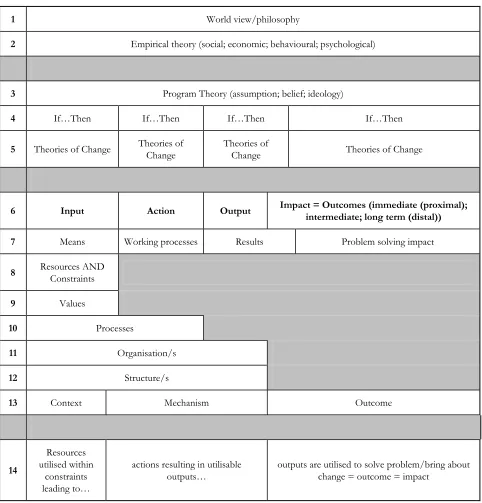
[image:5.612.67.549.105.608.2]I will briefly discuss each level of the model in turn (referenced as bold integers) and how they relate to each other. The filled grey cells between each referenced line indicate a 'break' between the family of lines.
Explanation of the Model
The first level (1) contains the ‘world views’ and philosophies that underpin disciplines and ways of thinking. They include the epistomological and ontological frameworks that policy makers and their advisors adhere to. They have had unprecedented influence across disciplines, and have both theoretical and practical implications. This level is important as it influences the way in which the other levels are interpreted and incoporated. We can see this level, in the language of the day, as the values of policy makers and their advisors. Level 2 contains the empirical theories that are more constrained and focussed on particular issues or problems. These must meet the same criteria of external validity, falsifiability and empirical testability and include the realms of the behavioural, social and economic. For example, any public policy that is charged with tackling the problem of unemployment should be based on sound behavioural, social and economic theory.
Between these levels of theory and the next level (3), program theory, there is a break, as shown by the filled grey cells. This is to indicate that a meaningful relationship between empirical theory and program theory should not be taken for granted. The level of program theory is open to assumption, belief and ideological influence and has been discussed above. (This is not to say that empirical theory is not open to the same.) Program theory is strongly related to the sub-theoretical level of cause and effect that defines the log frame. This is characterised by a set of ‘if...then’ relationships between the components of the log frame (4). These sets of causal statements are ‘hypotheses’ underpinned by the program
theory. These assumption of a causal chain may be based on as little evidence as a previous program 'working' or 'not working' according to some form of reporting, reviewing, or evaluation. That is, the causal chain is not necessarily related to empirical theory (the argument being that policy may be better off if it were more strongly related to empirical theory). Following the causal statements we have theories of change (5). A different theory of change may be applied to each sub-theoretical causal hypothesis and these may, and will, vary within and between actors at all levels. This is to be expected and has been well rehearsed, well understood, and empirically validated as a psychological concept, in a number of arenas, including organisational learning (Argyris & Schon, 1978; Taylor & Crocker, 1981; Weick, 1979)
From here we move onto the program logic model proper (6). The program logic model in its basic form breaks the program theory down into a set of components: Inputs; Actions; Outputs; Impact (Outcomes). These components are linked by the causal ‘if…then’ chain in level 4 and interpreted and understood, or framed, by the theories of change in level 5. Because different sets of actors have different theories of change their framing, and their concurrent interpretation and understanding, of level 4 and level 6 will vary. Put another way, the theories of change of different groups of actors will mediate between the program logic model proper and the assumed causal chain.
William J. Fear
components almost completely mapping together except that in the rational analytic framework we do not have the distinction between outputs and outcomes until we move to intermediate and long-term outcomes (distal outcomes).
Continuing to track down the levels we then come to resources and constraints (8). Inputs comprise both resources and constraints. This challenges the flawed reasoning that the provision of resources will start the intended causal chain and that this will then follow through to impact. The provision of, or request for, a resource without due consideration of the constraints, environmental and otherwise, is all too common. The influence (for which you could read impact) of resources and constraints at the level of input are highlighted in organisational theory (Aldrich & Pfeffer, 1976). And of course, something that is both a resource and a constraint are the values of the actors (9), which are in turn inherent in level 1. (Organisations and institutions are included as actors, whether they be commercial institutions, or organisations, producing goods/services for sale or institutions or organisations composed of the community and its traditions.) The values of the actors will impact upon the intended policy, from formulation through to evaluation, as will the values of the intended beneficiaries of the policy, at any and all levels. Similarly the values inherent in organisational culture impact on performance and delivery (Burt 1983; Dornbusch, 1995; Welch & Byrne, 2001).
We can tie this in to processes (10), as follows. The life of the organisation (11) is dictated by production of predictable outputs with regularity and consistency (read reliability); outputs that have an external validity. For example, if you produce a low quality and unreliable product in a competitive market place, yet have high production costs and therefore have a high market purchase price,
your business will likely fail.1 Even more so if
there is no market (external validity) for your product (see Ball & Unwin, 1998, for an interesting twist on pseudo-markets in relation to policies of funding for nonprofits.) Organisations achieve regular, reliable and quality assured outputs by adhering to a set of processes underpinned by a set of values. Any new policy, or change to policy—equating to anything from a change in working practice to a complete change in culture—threatens this and challenges the production of the outputs, and the production of these outputs is the raison d'etre of the organisation/s. Established processes, supported by determined shared values, will therefore be resistant to change, as they should be. In principle, the organisation/s is not primarily concerned with outcomes. Given the importance now attributed to outcomes (often now couched as ‘impact’) in policy circles we will give this issue further consideration below where we discuss the relationship between the components of the model, particularly between outputs and outcomes.
No organisation can operate or survive without structure/s to support it (12). Structures are provided by, and feed back into, the values and processes. They determine how the organisation operates both internally and in relation to its external environment. Similarly for the formulation of policy there must be structures that determine the interactions and relationships within and between policy makers and within and between policy makers and the external environment; the external environment having a momentous impact on the outcome of any policy, and indeed on the life of any organisation (e.g., in relation to structure see Blau, 1974; Ranson, Hinnings, & Greenwood, 1980; Sewell, 1992).
1 This premise can, of course, be challenged by examples
The CMO model (13) proposed by Pawson and Tilley (1997) also fits within this framework. The importance of context as both a resource and constraint is highlighted time and again by organisational theory in relation to size, technology, internal culture, national culture and the wider environment. Pawson and Tilley perhaps underestimate the range of context, but overestimate its impact. Mechanisms are actions concerned with the production of a specific output (or set of outputs). The critique of the CMO model is that it ignores outputs. If the outputs are consistent, we have at least some degree of certainty that the program was implemented as intended, to the standard intended, and so on, and we have a point of departure for improving the programme as we can build our understanding in relation to the ‘market place’ (that is, the environment and culture within which the outputs, or products, are being delivered; the size and capability of the delivering organisation; the technology available; and so on).
The relationship between the components of the model are summarised in the final line (14), and it is here that we explore the relationship between outputs, outcomes and theory more fully. Resources are utilised within the constraints of the environment, the context, according to the values and processes as determined by the organisations (and influenced by institutions, which may be organisations themselves), to perform repeatable efficient and effective actions leading to reliable and replicable outputs. To facilitate this macro-process structures are required, which themselves impose a further constraint that in the best-case scenario acts as a resource. This ‘whole’ is the ‘box’ to ‘think outside of;’ the ‘envelope’ to ‘push the edge of.’ With regard to the linear model, the ability of the organisation to control its own internal environment, and the extent to which it impacts on the external environment, is limited to the end stage of the production of outputs (beginning with the
inputs; the resources and constraints). Past this point the range and variety of exogenous variables impacting upon the outcome are increasing, unpredictable and unknown, and the chance of causally affecting the outcome (and thus the impact) reduce exponentially the further one travels from the point of delivery of the output. How much the delivery of the output will effect a desired or intended outcome, and the extent to which it will impact upon the outcome, is the realm of theory and complex short-to-long-term prediction (Hannan & Freeman, 1977; Bettman & Weitz, 1983, for false attribution of outcomes).
Crucial to the realisation of outcomes then is the utilisability of the outputs, determined in part by their qualities of timeliness, integrity, reliability, and so on, as recognised by performance management (Hannan & Freeman, 1977), and by demand in the market place. In addition:
outputs are measurable in terms of both quantity and quality;
focussing on delivering outputs allows organisations and other actors (including institutions and policy makers) to concern themselves with what they are actually able to do, and measure, not with what they are unlikely ever to be able to fully demonstrate as having achieved (that is, distal community outcomes and impact, though I accept and note that impact may be determined in some cases, particularly when the theory is sound);
focussing on outputs shortens the logic model and reduces infinite regress;2
2 The author heard this concept introduced in a
William J. Fear
outputs provide a strong focus for policy makers and, in the pluralistic policy making environment, indicates the point at which the formulation must be made concrete; and
the policy maker takes conceptual, theoretical and actual responsibility for the outcomes, including identification of outcomes. For, if the outputs are delivered but the outcomes are not achieved then clearly it is the program theory that is at fault (see paragraph below). Given that there is, in our argument, an articulated program theory and logic model and, importantly, all actors who have contributed to the program theory are identified, due accountability can be determined as opposed to naming and blaming (and shaming) a ‘fall guy.’
To summarise and reiterate this point about outcomes, if outputs are not utilisable as intended, for whatever reason, then the link to the intended outcomes will break down. How far it breaks down will depend, in part, on how flawed the outputs are. Also, the assumption that utilisable-as-intended outputs will lead to intended outcomes does not necessarily hold. Much will depend on the environment into which the outputs are delivered and the shared values of the actors (for some practical examples see Campbell, 2002; Julian, 2001; Lake, Reis, & Spann, 2000). In relation to policy we can summarise this with the repetition of the two truisms: the intended outcome may not be achieved despite the policy being valid (when the utilisable outputs are delivered); the intended outcome may be achieved despite the policy and not because of it (the delivered outputs may not actually impact at all upon the outcome).
This relationship between outputs and outcomes, in relation to organisations and their operations, is best summarised in the words of Hall (2002):
Organisations are not inert masses, even though they seem to be so at times. Even organisations that are seemingly inert have an impact by their very inertia, but that is not the point. The point is that organisations do things. They transform inputs into outputs. Those outputs have an impact on society. Individuals, groups and other organisations respond to organisational outputs. We are harmed and benefited by organisational outputs. In this sense we are the environment of organisations. Therefore, if we respond to organisations with support or opposition, and if we have power or can influence power holders, the environment responds to organisations (pg. 263).
In sum, it is the outputs that make a difference as outcomes depend upon outputs. As such, the influences, processes, and actions that affect outputs and their delivery are crucial to policy, as are the intended outputs of the policy.
The point is that through the use of appropriate modelling nested in theory the chain from inputs to outputs can be well defined, articulated and measured. The output is either present in the intended quantity at the intended quality, or it is not. Whether the outputs will be utilised, how they will be utilised, and if they will lead to the intended outcomes is the realm of theory, especially program theory as this includes the assumptions of the actors. That is, the causal link from outputs to outcomes, and indeed, the achievement of outcomes, when outcomes are equated with impact is, at very best, theoretical.3
This theoretical link is important to measurement and evaluate as if the theory has external validity and is empirically sound the point at which we measure does not matter that much as the results are predicted by the theory, not by the measurement itself. In addition, we have a framework for interpreting what would otherwise simply be a set of measures with no real validity. Thus we highlight a constraint of the role of theory, and also the importance. Consider, also, that, exceptions notwithstanding, relatively few activities, policies, programs or projects last for long enough, or have enough resource made available, to determine the actual outcomes across contexts and over time (the impact).
Using the model described above provides a frame of reference for the evaluation of policy. It should also provide anchors and pegs from which to hang the findings and recommendations of an evaluation. It provides a framework that is familiar to the policy maker, and that has had already had significant investment from policy maker/s. Couching the program theory in terms of the model allows us to latch onto the cognitive schemas of the policy maker/s and other actors and thus enables them to take immediate ownership of the evaluation findings (Geva-May & Pal, 1999).
Conclusion
The purpose of this paper was to argue for greater synthesis of theory, logic modelling and organisational theory in order to move towards a more focussed and stronger theory of evaluation per se. The paper has tended towards the realm of programme theory and policy
not advocating the abolition of outcomes. We are arguing that performance management based on outcomes is not as straightforward as it is sometimes made out to be (Rossi, Freeman, & Lipsey, 1999, for a counter to this statement). Instead, we argue that the theoretical link between outputs and outcomes is the responsibility of the policy maker and should be at least part of, and included in, their strategic focus.
evaluation as that is where the evaluation community tends to focus most of its efforts, and is the primary market for the evaluator as a professional practitioner. Nonetheless, the model, one hopes, should contain sufficient flexibility to be adapted for other fields of evaluation practice.
The expanded model presented here contributes to the development of evaluation theory and the modelling of that theory as a complete package rather than as a series of disparate competing theories. It unites several common themes and ideas and explores the links across disciplinary boundaries rather than emphasising disciplinary boundaries. Furthermore, the model should provide some insight for both practitioners and policy makers, and help them to find a common language for the discipline of evaluation.
Linking the program logic model back to levels of theory allows for evaluation findings to be framed by existing tested theories with reproducible results. Some policy areas have already taken these steps, noticeably areas such as health, health and safety, and economic policy. Evaluators of social policy can learn from these areas and can make use of this model as a framework for the application of theory to policy according to their own professional interests.
Author notes
1. Resources and constraints, values and processes, actions, and utilisability of outputs, apply to all actors including participants.
2. Outcomes have levels as well: outcomes for individuals; communities; the implementers; the policy makers.
William J. Fear
available, and before they even enter into the system, mulitple chains of (potential and actual) outcomes will be initiated by default. This relates back to Chaos Theory. For practical purposes, and in a pragmatic context, it is not always necessary to take account of this, however. What we should be continually aware of are negative or harmful consequences at any stage— deleterious outcomes—and of not falsely assigning causes to outcomes.
4. This really needs to be considered as a multi-dimensional, covariant (within and between cells and levels) iterative model. Clearly though, such models are difficult to represent other than as mathematical or statistical models.
Bibliography
Albert, K. J. (1980). Handbook of business problem solving. New York: McGraw-Hill.
Aldrich, H. E., & Pfeffer, J. (1976). Environments of organisations. Annual Review of Sociology, 2. Palo Alto, CA: Annual Reviews, Inc.
Argyris, C., & Schon, D. A. (1978).
Organizational learning: A tTheory for action perspective. Reading, MA: Addison-Wesley. Bettman, J. R., & Weitz, B. A. (1983).
Attributions in the board room: Causal reasoning in corporate annual reports.
Administrative Science Quarterly, 28, 165-183. Bickman, L. (1987). The functions of program
theory. New directions for program evaluation, 33, 5-18.
Bickman, L. (2000). Summing up program theory. New directions for evaluation, 87. 103-113.
Blau, P. M. (1974). On the nature of organisations. New York: John Wiley.
Campbell, D. (2002). Outcomes assessment and the paradox of non-profit accountability.
Nonprofit Management and Leadership, 12(3), 243-259.
Chelimsky, E. (1995). The political environment of evaluation and what it means for the development of the field. Evaluation Practice,
16(3), 215-225.
Chen, H. T. (1990). Theory-driven evaluation. Thousand Oaks: CA. Sage.
Davidson, E. J. (2000). Ascertaining causality in theory-based evaluation. New directions for evaluation, 87. 103-113
Geva-May, I., & Pal, L. A. (1999). Good Fences Make Good Neighbours. Evaluation, 5(3), 259-277.
General Accounting Office (GAO). (1990).
Prospective evaluation methods (GAO/PEMD-10.1.10). Gaithersburg, MD: Author.
Hage, J. (1980). Theories of organisations. New York: John Wiley.
Hall, R. H. (2002). Organizations: Structures, processes and outcomes. Prentice Hall, US: New Jersey.
Hannan, M. T., & Freeman, J. H. (1977). The population ecology of organisations.
American Journal of Sociology, 82, 929-964. Hickson, D. J. (1987). Decision making at the
top of organisation. Annual Review of Sociology, 13, 165-193.
Julian, D. A. (2001). A case study of the implementation of outcomes-based funding within a local United Way System: Some implications for practicing community psychology. American Journal of Community Psychology, 29(6), 851-874.
King, T (1981). Problem solving in a project environment. New York: John Wiley and Sons.
Kleindorfer, P., Kunreuther, H. C., & Shoemaker, P. J. H. (1993). Decision sciences: An integrative perspective. New York: Cambridge University Press.
Quarterly, 29(1) 41-68.
Leeuw, F. L. (1991). Policy theories, knowledge utilisation, and evaluation. Knowledge and Policy, 4(1). 73-92.
Leeuw, F. L. (2002-submitted). Reconstructing program theories: Methods available and problems to be solved.
Miles, M. B., & Huberman, A. M. (1994).
Qualitative data analysis: An expanded sourcebook. Thousand Oaks. CA: Sage Publications.
Patton, M. Q. (2002). A vision of evaluation that strengthens democracy. Evaluation, 8(1), 125-139.
Pawson, R. (2002). Evidence-based policy: In search of a method. Evaluation, 8(2), 157-181.
Pawson, R., & Tilley, N. (1997). Realistic evaluation. London: Sage.
Plantz, M. C., Greenway, M. T., and Hendricks, M. (1997). Outcome Measurement: Showing Results in the Nonprofit Sector. New Directions for Evaluation, no. 75, 15-30.
Poole, L. P., Davis, J. K., Reisman, J., & Nelson, J. E. (2001). Improving the quality of outcome evaluation plans. Nonprofit Management and Leadership, 11(4), 405-422. Ranson, S., Hinnings, B., & Greenwood, R.
(1980). The sStructuring of organizational structures. Administrative Science Quarterly, 25, 1-17.
Rogers, P. J., Petrosino, A., Huebner, T. A., & Hacsi, T. A. (2000). Program theory evaluation: Practice, promise, and problems.
New Directions for Evaluation, 87, 5-13.
Rossi, P. H., Freeman, H. E., & Lipsey, M. W. (1999). Evaluation: A systematic approach (6th
ed.). CA: Sage.
Schoennauer, A. W. (1981). Problem finding and problem-solving. Chicago: Nelson-Hall.
Scriven, M. (1991). Evaluation thesaurus (4th Ed.).
San Francisco, CA: Sage.
Sewell, W. H. (1992). A theory of structure: Duality, agency, and transformation.
American Journal of Sociology, 98, 1-29.
Taylor, S. E., & Crocker, J. (1981). Schematic bases of social information processing. In E. T. Higgins, C. P. Herman, & M. P. Zanna (Eds.), Social cognition. Hillsdale, NJ: Lawrence Erlbaum.
Thompson, J. D. (1967). Organizations in action. New York: McGraw-Hill.
United Way of America, (1996). Measuring program outcomes: A practical approach. VA. Van der Knaap, P. (1995). Policy, evaluation
and learning. Evaluation, 1(2), 189-216. Weick, K. E. (1976). Educational organisations
as loosely coupled systems. Administrative Science Quarterly, 21, 1-19.