NOTES AND QUERIES
published in Studies in Theatre and Performance, volume 28, issue 1, 2008
Actors and Emotion in Performance
Eric T. Hetzler
Keywords: Acting, emotion, emotion in performance, the actor’s experience, acting theory
Abstract
Utilising a survey conducted among actors in the USA and UK, this article examines and
challenges the historical assumption that textual-based acting in the West is concerned
primarily with the [re]creation of emotion. The idea that acting is based on the [re]creation
of emotion is supported by a brief exploration of historical notions of acting from ancient
Rome to the early twentieth century. Through the use of a questionnaire and interviews, the
author uses the words of modern actors along with the writings of their historical
counterparts to demonstrate, statistically and anecdotally, that actors do not feel that they
are [re]creating emotions but are, in fact, reacting to the given circumstances as the
character they are portraying would.
From the outside looking in, the basis of western, textually-based, character acting appears to be the reproduction of emotion, or as William Archer puts it ‘the reproduction of passion is the actor’s highest and most essential task’ (Archer: 218-19). This has been the standard view since before Archer wrote that in 1888. It is the essence of Diderot’s great ‘paradox’. But is the reproduction of emotion truly that central to the actor? Do actors really focus on emotion more than anything else? Or have the theories of acting that have dominated the past
of the actor? This article will examine these questions through the lens of history along with the results of a survey and interviews that asked the responding actors to describe their experiences of performing.
When one looks at the early historical writings of the researchers who explored the actor’s craft, they tended to focus on the idea of the reproduction of emotion as being central to being able to perform a role on stage. Joseph Roach traces this back to the theories of rhetoric put forth by Quintilian, who asked ‘how are we to generate these emotions in ourselves?’ (Roach: 24). His answer was to use the imagination to create visions that would ‘nourish’ the passions: ‘when the actor/orator has strongly ‘identified’ with such passions, his spirit has sufficient power over his body to alter its physical states, inwardly and outwardly’ (Roach: 25). The influence of the work of ancient rhetoricians on acting theory would be felt through the seventeenth century and well into the eighteenth. John Bulwer would be one of the first to attempt to systematise rhetoric in his works Chirologia and Chironomia, published in 1644. In these writings, he attempted to create a ‘modern science of gesture’ (Roach: 33). In his essay, ‘The Natural Language of the Hand’, Bulwer mapped out the many ways in which the hand can be used to signify inner feelings. His theory was that by making the correct action/gesture with the body, the correct feeling would follow. Care needed to be taken, however, to ensure that the bringing up of these ‘passions’ did not carry the actor away into madness. As Roach notes, control was a very important aspect for the performer: ‘…the esteem in which an actor was held by his public seems to have depended on the degree to which he was perceived as capable of keeping his bodily powers in check’ (Roach: 52). Thus even in the early days of acting theory, the reproduction of emotion was something well studied.
Aaron Hill would argue similarly to Quintilian that ‘the embodiment of an emotion flows effortlessly from “ideal” to physical manifestation’ (Roach: 81), which is to say, the actor should use his/her imagination to create the ideal image of the emotion which would then be called upon when needed to create a particular emotion. This idea would be supported by many actors of the time, including the great French actress Clairon who developed a role by using her imagination to create the entirety of the character. It was a kind of calculation wherein she believed the actor must ‘repeat a hundred times the same thing, in order to surmount the difficulties he meets with every step’ (Cole and Chinoy:172). As such, she was always in control of herself, avoiding the danger that emotions that might carry her away. On the other hand, there was the rival actress, Dumesnil, who believed the opposite. The actor, she felt, should have three aims: ‘To imbue oneself with great emotions, to feel them
immediately, and at will to forget oneself in the twinkling of an eye’ (Cole and Chinoy: 175). In her opinion, the actor should be carried away by the emotions of the scene. It was the disagreement between these two actresses that would form the foundation of a seminal work on acting, Denis Diderot’s The Paradox of Acting, which would, in many ways, cement the idea in the world of acting theory that the basis of acting is the recreation of emotion.
‘Any discussion of acting almost universally touches on Diderot’s famous paradox: to move the audience, the actor must himself remain unmoved’, wrote Lee Strasberg in the introduction to the 1957 edition of The Paradox of Acting. Strasberg was probably correct in his assessment, since much of modern western actor training and theory seems to come down on either side of Diderot: is acting about reproducing real emotion or appearing to do so? Diderot’s conclusion was that the best actors did not feel the emotions of their character, or as he explained:
feeling, but upon rendering, so exactly the outward signs of feeling that you fall into the trap. (Diderot: 19)
When this work was posthumously published in 1830, Diderot became such an influence that ‘to this day many acting theorists, knowingly or unknowingly, formulate their views in response to perspectives introduced in the Paradoxe’(Roach: 117).
Diderot’s work described a split in acting theory. On one side, the emotionalists or those who favoured sensibility, in terms of what an actor ought to possess in order to be considered ‘great’. Their belief was that actors needed to ‘feel’ the emotion of a scene in order to properly portray it for the audience. On the other side of the split was
anti-emotionalism. This was an approach to acting based on the notion that actors ought not to ‘feel’ the emotion of the scene, as that would carry them away and then they would lose the audience and possibly themselves. In many ways acting theory became an either/or
proposition: it was a question of whose side you were on regarding the reproduction of emotion.
‘No one has ever doubted that the actor must be able to express what he feels, or feeling will avail him nothing. The question at issue is whether he ought or ought not, to feel what he expresses’ (Archer: 140). William Archer raised this question in his work Masks or Faces in 1888. He set out to test the paradox of Diderot by means of a questionnaire sent to actors, and by further research through interviews and the reading of memoirs and
biographies of actors. Archer disagreed with Diderot, concluding that actors ‘ought’ to feel emotion. His first survey question was:
voice? Supposing that, in the same situation, you one night shed real tears and speak with a genuine ‘lump in your throat’, and on the next night simulate those affections without
physically producing them: on which occasion should you expect to produce greater affect upon your audience? (Archer: 103)
On one level this is a rather leading question, because it presumes that tears are a significant indicator of emotion. On another level, it is a very good question when trying to determine if an actor feels that he/she believes that he/she should either ‘feel’ the emotion or merely simulate. In either case, the responses Archer received convinced him that actors do experience real emotions on stage because they do shed real tears. This is in spite of the copious evidence from the actors themselves that says that while they do shed real tears, they are not letting the emotions carry them away.
He quotes Clara Morris:
As to really losing oneself in part, that will not do: it is worse to be too sympathetic than to have too much art. I must cry in my emotional roles and feel them enough to cry, but I must not allow myself to become so affected as to mumble my words, to redden my nose, or to become hysterical. (Archer: 126)
Lawrence Barrett concurs:
sometimes carry him along faster than at others, but he must always keep a strong hand over them. (Archer: 126)
These actors are quite clear that they feel emotions, but that they are in control of them. In fact, they are saying that their task is to be aware and in control of many different things in order to create the ideal performance. What is implied is that the recreation of emotion is not as significant as being in control. However, even though his own respondents seem to be implying otherwise, Archer remains convinced that emotion is the core of acting and that the conclusion of Diderot, that actors should not feel emotions, is incorrect.
The anti-emotionalists would hold sway over performing for much of the nineteenth century. This would reach its peak with the work of François Delsarte, who would become an international figure based on his laws of expression, on which he began to give public
lectures in 1839. Delsarte’s system was based entirely on gesture. Like Bulwer before him, he created specific movements and gestures that would signify to the audience the precise
approaches to psychology would have a deep and lasting effect on how theorists examined the work of the actor.
Joel Pfister asserts that it became ‘chic’ to ‘present oneself as “psychological”’ in the 1910s and ‘surely by the 1920s’ (Pfister and Schnog: 167). By this he means that the manner in which people conceived of the ‘self and its interior’ was being defined by the language of the emerging field of psychology (Pfister and Schnog: 3). During this period, the work of Sigmund Freud was being disseminated and read by people outside the field of psychology. This dissemination was led by his nephew, Edward Bernays. Originally the press agent for opera singer Enrico Caruso, Bernays got work with the US government as a propagandist during World War One. On his return, he decided that, ‘if you could use propaganda for war, you could use it for peace’.2 He essentially created public relations. In doing this, he used his uncle’s work to spread the ideas of psychology and used the ideas contained within to learn to sway crowds of people. His first great success was in convincing women that smoking was an act of challenging male dominance, calling cigarettes ‘torches of freedom’. What Bernays invented was consumer culture. It was possible, he discovered, ‘to persuade people to behave irrationally if you link products to their emotional desires and feelings…You bought things not just for need, but to express your inner sense of yourself to others’.3 It was, therefore, this P.R that made the inner life that Freud explored popular with the public at large. People were convinced that they needed to fulfil their inner needs.
Pfister notes, these ideas began to permeate society, as early as 1915, when they were glamourised by writers in magazines such as Vanity Fair and even on the American stage in works like Glaspell and Cook’s Suppressed Desires (1915).
Much of this expansion of psychology was made possible when, in 1890, William James proposed that emotions are ‘internal, physical happenings which are afterward felt as mental experiences’ (Pfister and Schnog: 217): that is, emotions precede thought:
…the bodily changes follow directly the perceptions of the exciting fact, and our feeling of the same changes as they occur IS [emphasis original] the emotion. (James: 450)
In other words, emotions are feelings which are the results of physiological changes. This is a very important theory because, as Morawski points out, it would guide emotion research for fifty years, ‘bestowing upon the new scientific psychology an organic, natural, yet
fundamentally mechanistic explanation of human emotions’ (Pfister and Schnog: 218). This theory, combined with the ideas of the subconscious mind as promoted by Freud, would have a strong influence on acting theory, as it would lead a move back towards emotionalism.
when called for?’ This seems to be what Stanislavsky was seeking to discover in his early work where he focused on French psychologist Ribot’s theories about emotion memory as a way of helping actors to find the right emotion for a particular moment on stage. By recalling an event where the emotion was very strong (you cried), then by recalling the event in all of its exactness, the needed emotion ought to be called forth in a very ‘real’ manner. However, he abandoned this in his later work, concentrating instead on his method of physical action, where the emotion comes as a result of the actor’s truthful response to the action of the scene. Unfortunately, this modification of the ‘system’ was not publicised until long after
Stanislavsky’s death (Building a Character appeared – in Elizabeth Hapgood’s controversial translation – in 1950, and a quarter of a century separates An Actor Prepares (1936) from
Creating a Role (1961)), too late to displace the influence of An Actor Prepares. The main reason why emotion memory became so influential, in the U.S.A. especially, was its adoption by Lee Strasberg at the Group Theatre, and later the Actor’s Studio. Strasberg would become the dominant acting teacher by extending Stanislavsky’s work on emotion memory and creating what he termed affective memory. Affective memory became the lynch-pin of Strasberg’s ‘method’, relegating other aspects of acting, like awareness or action, to the sidelines. In my own research, survey responses to questions regarding techniques/methods used by respondents make it clear that early Stanislavsky and Strasberg, or hybrids of the two systems/methods, are the dominant forms being taught to and used by actors in the U.S.A., Canada and the United Kingdom today.4
But there is a problem. As we move further into the twenty-first century, as
theatres, universities and individuals in the U.S.A., U.K., Ireland and Canada. In the figures included below, the ‘total’ box represents the number of respondents to that particular question. Not every question was answered by every respondent, therefore some questions have higher totals than others. There are also several questions where the data is represented by ‘score’ rather than a simple percentage. These questions asked the respondents to rank the options provided from their first choice to their last choice. The lower the score, the closer the ranking is to first. Many of the questions had comment boxes attached which allowed the respondents to write about their answers. Some of these comments appear below, as well. At the end of the survey, the respondents were invited to volunteer for follow-up interviews. Their responses are also included. Because the survey was anonymous, comments from it are attributed to the respondent’s identification number. Comments from interviews are attributed by name.
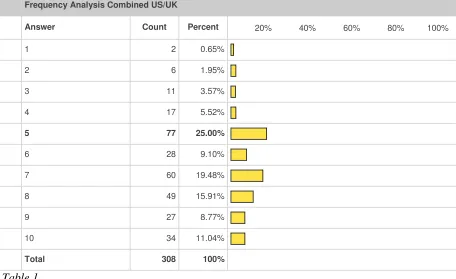
What this study demonstrates is that actors do not necessarily view acting as a question of emotion at all. The actors in this study generally see emotion as a by-product of the reaction of their character to their circumstances. As was repeatedly pointed out in the survey and follow-up interviews, the actors in this study say that the emotions they experience are ‘real’, but that they do not feel them in a personal way: they belong to the character they are portraying. Furthermore, no matter where they place themselves on the engagement or non-engagement scale provided in the questionnaire (see Table 1, below), the actors in this study do not seem to be at all concerned with reproducing emotions on stage. This is in spite of the result that a clear majority of the respondents placed themselves on the emotional engagement end of the scale – 64.30% chose ‘6’ or higher. Question 64 asked:
1 = My body is a neutral puppet operated from a conscious distance. I have no emotional engagement with my character.
5 = Depending on the circumstances, I step in and out of complete emotional engagement with my character.
10 = I have full engagement of emotion with my character. I feel what my character is feeling.
Frequency Analysis Combined US/UK
Answer Count Percent 20% 40% 60% 80% 100%
1 2 0.65%
2 6 1.95%
3 11 3.57%
4 17 5.52%
5 77 25.00%
6 28 9.10%
7 60 19.48%
8 49 15.91%
9 27 8.77%
10 34 11.04%
[image:11.595.70.526.243.522.2]Total 308 100%
Table 1
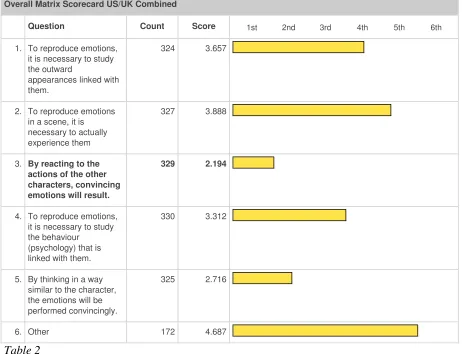
To better understand this, let us examine the survey more closely. It contained several questions that asked about emotion directly. Question 47 asked:
In dealing with the emotional content of a scene, what is more important to you? Rank the following in order of importance.
respondents did not rank the entire list of choices, so that some of the choices listed have lower count totals than others in the same list. The ‘Score’ column represents where the choice ranks from 1st to 6th. The lower the score is, the closer it is to 1st.
Overall Matrix Scorecard US/UK Combined
Question Count Score 1st 2nd 3rd 4th 5th 6th
1. To reproduce emotions, it is necessary to study the outward
appearances linked with them.
324 3.657
2. To reproduce emotions in a scene, it is necessary to actually experience them
327 3.888
3. By reacting to the actions of the other characters, convincing emotions will result.
329 2.194
4. To reproduce emotions, it is necessary to study the behaviour
(psychology) that is linked with them.
330 3.312
5. By thinking in a way similar to the character, the emotions will be performed convincingly.
325 2.716
[image:12.595.68.530.161.515.2]6. Other 172 4.687
Table 2
Later, in question 58 (Table 3), the respondents were asked to again rank a series of ideas about emotions and acting:
Please rank the following in terms of their importance to you in creating a successful character.
Overall Matrix Scorecard US/UK Combined
Question Count Score 1st 2nd 3rd 4th 5th
1. Creating the right emotions
310 2.268
2. Discovering the correct actions
3. Learning the lines correctly
309 2.364
4. Learning the blocking 305 3.479
5. Handling the props correctly
[image:13.595.69.528.69.176.2]308 4.055
Table 3
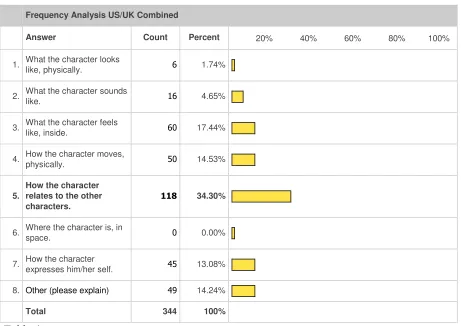
As in the previous question, the statement about creating emotion is not the first choice. Here, it is second of five. In both questions, it is the actions of the character that are the top choices for the respondents. Question 59 continues this line by asking what is most important when developing a character in rehearsal. Again, as Table 4 reveals, what the character feels like on ‘the inside’ is not the top choice:
As you develop a character in rehearsal, choose one of the following that is the most important aspect for you.
Frequency Analysis US/UK Combined
Answer Count Percent 20% 40% 60% 80% 100%
1. What the character looks
like, physically. 6 1.74%
2. What the character sounds
like. 16 4.65%
3. What the character feels
like, inside. 60 17.44%
4. How the character moves,
physically. 50 14.53%
5.
How the character relates to the other characters.
118 34.30%
6. Where the character is, in
space. 0 0.00%
7. How the character
expresses him/her self. 45 13.08%
8. Other (please explain) 49 14.24%
Total 344 100%
[image:13.595.69.530.381.707.2]The most chosen option is how the character relates to other characters. The distant second choice, by a mere three percent over the physicality of the character, is how the character feels on the inside. For this question, the fourth place response of ‘other’ is important, because it is only one response less than the third place choice with the most common comment being ‘all of the above’.
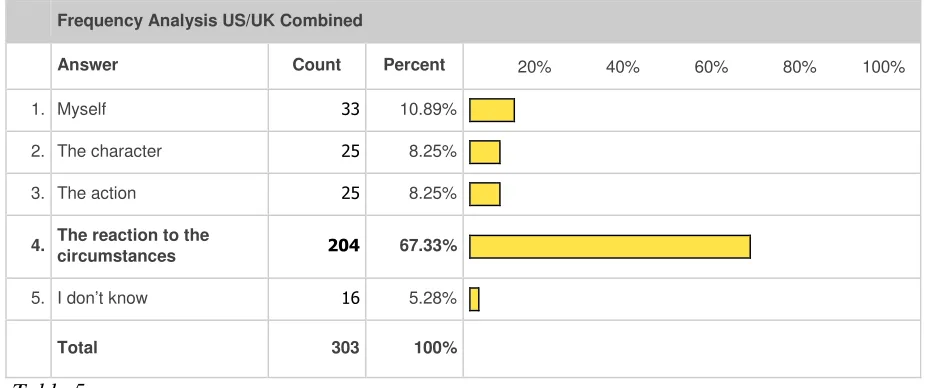
The place of emotion in performance is pressed even further in question 66 (Table 5). This is the first time the respondents are asked directly about where they think emotions on stage come from:
If your character is supposed to be angry, where does the anger come from? (choose the answer that best applies)
Frequency Analysis US/UK Combined
Answer Count Percent 20% 40% 60% 80% 100%
1. Myself 33 10.89%
2. The character 25 8.25%
3. The action 25 8.25%
4. The reaction to the
circumstances 204 67.33%
5. I don’t know 16 5.28%
[image:14.595.66.530.348.542.2]Total 303 100%
Table 5
By far the most common response was that emotions on stage come as a reaction to the circumstances. The comments provided by the respondents are quite telling.
I try to perform as much in the moment as possible. In reading the play I find the character's reason for the anger and when the performance presents the same circumstance, I, as the
character, respond accordingly. (Respondent 492571)
The circumstances always instigate the emotion. Wheather [sic] implied or actual they are the cause of the emotional state. (Respondent 849935)
Here, then, we are seeing how the actors in this study view the concept of the role of emotion in the performance. Rather than believing that they must be able to re-create an emotion, the majority of respondents are perfectly at ease allowing the circumstances of the performance to dictate how they should react. It seems quite clear that the focus of the performance is not about correctly reproducing emotions.
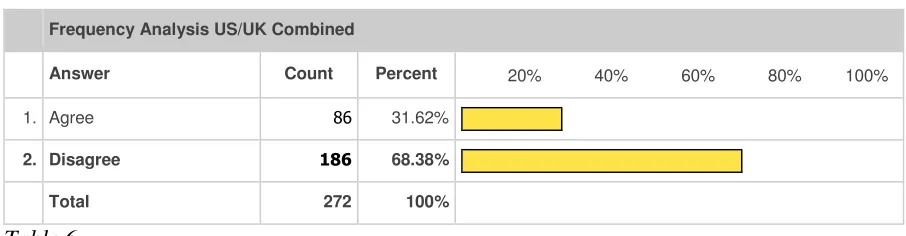
When discussing emotion, there is agreement among the respondents that the emotions are ‘real’, which might tend to favour the Strasberg/emotionalist side of the equation – emotions must be felt for real and not faked (see Table 6, below).
Do you agree or disagree with the following statement? ‘The emotions I portray onstage are not truly felt. They only need to look real.’
Frequency Analysis US/UK Combined
Answer Count Percent 20% 40% 60% 80% 100%
1. Agree 86 31.62%
2. Disagree 186 68.38%
[image:15.595.70.523.592.710.2]Total 272 100%
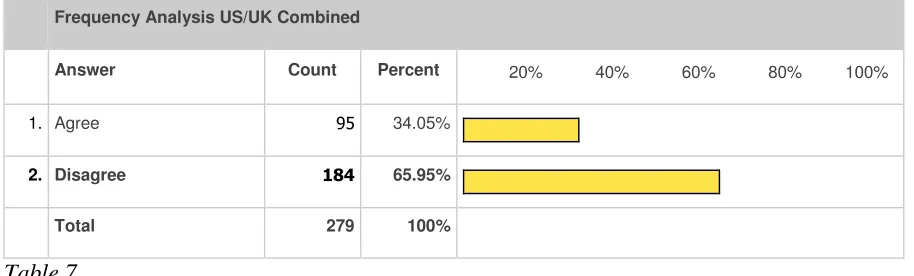
Clearly, the actors do not say that they are ‘faking’ the emotions, or, as Diderot might offer, ‘rendering’ them, thereby refuting the anti-emotionalists. However, the actors in this study explained that, while the emotions experienced in performance are very much real, they are not reproducing them from some memory of an event that triggered a similar emotion in the past. In his interview, Joel Raney said that to get angry he doesn’t need to ‘think of Dad, think of Dad, think of Dad…’, as Strasberg would suggest he should – the actors surveyed would not necessarily say that they are ‘reproducing’ anything. In fact, when asked if the anger the character is feeling is felt personally, the responses seem at odds with those to the previous question (Table 7):
Do you agree or disagree with the following statement? ‘When performing an emotion, it must be truly felt. If my character is angry, then I must be angry.’
Frequency Analysis US/UK Combined
Answer Count Percent 20% 40% 60% 80% 100%
1. Agree 95 34.05%
2. Disagree 184 65.95%
[image:16.595.70.527.404.542.2]Total 279 100%
Table 7
something in my background that connects…you must connect that to the circumstances’. This was repeated many times; the respondents draw from themselves but only as a vehicle to better understand the character.
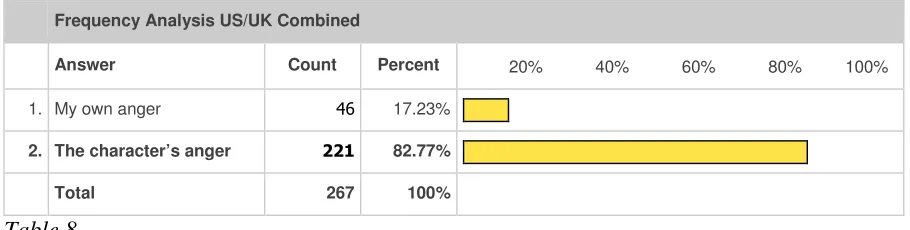
To attempt to simplify this: the actors in this study said that they know everything they do in a performance is fictional (‘I know I’m on stage’ 5), but the character they are playing doesn’t know that. As far as the character is concerned, it is all very real because they exist in a world of their own. That being the case, the actor’s job is to offer up a part of him/her self that believes in that fiction so that he/she reacts to the circumstances of the action as the character would. Therefore, this research seems to indicate that the emotions the audience sees are real; but they are not being felt by the actor. So what is going on? What the respondents seem to be saying is that the actor is not experiencing it as his/her own emotion; rather, s/he experiences it as the character’s emotion and therefore not in a specifically personal way, because they are able to separate themselves from the character. Question 96 reveals this (Table 8):
If your character is supposed to be angry, the anger present is...
Frequency Analysis US/UK Combined
Answer Count Percent 20% 40% 60% 80% 100%
1. My own anger 46 17.23%
2. The character’s anger 221 82.77%
[image:17.595.70.525.486.601.2]Total 267 100%
Table 8
In an interview with the researcher, Kate Eifrig explains it this way:
those lovers twenty-four seven, or maybe you thought it had to be, you’d go insane.
In his interview, David Coral is more succinct:
You just have to suspend your disbelief and live the life of the character that you’re portraying. Live their life. If in their life they fall in love, then that’s what you do, ON STAGE, okay? Because it’s their life, it’s not your life, it’s their life.
While on the survey, Respondent 457345 states:
While on stage I AM the character, living his life; so in that sense I am fully engaged with his emotional, physical and intellectual state -- I feel (think, do) what the character is feeling (thinking, doing) -- or rather, the CHARACTER is feeling what he's feeling. While I might be engaged, I -- the Actor -- do not become ENTANGLED with the emotional life of the character. That's HIS life, and I just happen to be living it for the moment. It's like having dual personalities that are distinct from one another. Once off-stage, I disengage almost completely.
Respondent 480516 might have said it best:
I can be extremely emotional on stage, but it is not really MY emotion. I do not feel the pain or joy. I feel it AS my character. It is the joy of acting.
The essence of Frijda’s theory distills down to viewing
emotions as expressions of the individual which fulfill a central function in reacting to the environment…When the elements contributed by the situation combine with their potential meaning for the individual, this combination may create an emotional reaction. An emotional reaction betrays the fact that interests are at stake in the situation. (Konijn: 16)
Konijn believes that, because the actors in her study seemed to indicate that they were not personally feeling the same emotion as their character, they must be feeling what she termed the task emotion – that is, they are feeling emotions, personally, about the task they are about to perform and that this is the emotion that energises them to the point that they can perform the emotion called for by the script/score. My research does tend to support this view. When asked how they feel before entering the stage the word most often chosen was ‘excited’, which seems to demonstrate that the actors are full of emotion about the task they are about to perform. When asked how they felt immediately after leaving the stage, the top choice was ‘energised’, followed closely by ‘exhilarated’. They were then asked directly about what happens when they leave the stage. In this case, 39.45% said that they were still feeling the emotions of the scene; however, their comments are quite specific about the effect of this:
There's a little ‘bleed through’ but you've gotta shake it off to get ready for the next scene. (Respondent 766569)
I get to normal pretty quickly but not immediately. (Respondent 460597)
It appears, then, that most of the actors in this study separate the emotions on stage from those off stage. When preparing to enter they are thinking about what they have to do (this is further supported by the survey6) rather than focusing on creating a particular emotion or ‘getting into character.7 Once they are on stage and interacting with the other performers, I believe that the data and interviews demonstrate that the emotions the actors in this study experience are actual responses to the action. This is precisely what Frijda’s theory says should occur: emotions happen because of ‘the interaction of the situational meanings and concerns (Frijda: 352).This is defined as follows:
Emotions are elicited by significant events. Events are
significant when they touch upon one or more concerns of the subject. Emotions thus result from the interaction of an event’s actual or anticipated consequences and the subject’s concerns. (Frijda: 6)
the character’s need for satisfaction. When the actor comes off stage, those emotions are gone because the character’s life continues on stage and the actor’s life takes over. Thus, Konijn’s assertion that actors do not experience the emotions of the character might be seen as
problematic because the actors surveyed said quite clearly that they do. Granted, they qualify this by saying that they feel emotions as the character and therefore they are not personally affected, but it is quite clear that they are experiencing real emotion in performance, and, given the theories of Frijda regarding emotion, they ought to.
This interpretation of the survey’s results points to reacting truthfully in the given circumstances rather than ‘emotion’ as the ‘core’ of the character actor’s work. This parallels David Mamet’s ideas. In True and False, he asks: ‘Now, will the outward-directed actor not be, now and again, “moved”?’, and answers, ‘Certainly, as will anyone in any circumstance, giving all of his or her attention to a task – but this emotion is a product, and a trivial by-product, of the performance of the action. It is not the point of the exercise’ (Mamet: 13). The idea that emotion is a by-product is echoed by actors in my research, and from other sources as well. Pope, in his essay ‘Redefining Acting’,says: ‘The energy expended in attempting to solve the problem of the other character(s) produced emotion as a by-product’ (cited in Krasner: 153). Nicola, in Playing the Audience, says, ‘Acting ≠ Emoting. Far more
fundamental is belief in your specific circumstances; the appropriate inner life should follow automatically. An ounce of believing is worth a ton of emoting.’ (Nicola: 84-5). Then there is also agreement from a seemingly unlikely source. Stanislavsky, in his later work, notes that emotion is a by-product of the action and that, by focusing on the action, emotions will result.8
focused on the action of the scene and the laughter coming from the house, as well as the positioning of props, the timeliness of sound cues, and the speck of fluff on their scene partner’s coat. They are feeling the emotions of the scene in what they consider to be a very real way, but they are doing so with a sense of removal that allows them to be aware of all of those other things. In fact, most of the actors in this study seem primarily interested in being ‘in the moment’, that is, fully engaged in the entirety of the performance – the action of the story as well as the reactions of the audience. Perhaps, then, acting is not about feeling the same emotion as the character, but is more about finding that state of ‘flow’ where the actor is one with the character but still focused on the task of performing. Responses to question 90 seem to bear this out – the respondents are aware of everything going on around them, which they say is the ideal state for an actor to be in.9 The comments make this clearer:
It is simply an intense focus; my brain is split into two trains of thought, and I've got to be hyper-alert. (Respondent 483192)
The cosmic tumblers fall into place - and everything works! I am totally focused - yet totally aware. I know if I hold for an extra beat I can make them cry, everything is effortless. (Respondent 519412)
When the majority of respondents placed themselves in the middle of the engagement scale, it is possible they were speaking about the need to be always shifting awareness
between the action of the story and the action of the performance: they are in control in the moment, not losing control by ‘becoming’ the character. This would add support to the concept that emotions are a by-product of reacting to the situation in the circumstances of the performance, because actors need to be engaged in the entirety of the performance, not just what the script/score says.
Is it then possible that the task-emotion, which Konijn defined, is the link between being in the moment and being self-conscious? Is the task-emotion the controller that keeps the actor from being carried away by the emotions that, as has been demonstrated, are being felt in performance? Question 73 asked if the actors’ offstage mood ever affected their performance. The overwhelming response, 71.77%, said that it had. When examining the comments, there seems to be strong support for the idea that the task-emotion is present in actors and that it affects performance, in particular if the mood is the result of a negative experience:
If I'm tired or frustrated before a performance, it can be more difficult for me to really commit to my character, and be in the moment on stage. (Respondent 457027)
I was playing a role opposite my current boyfriend...he broke up with me the day before opening night. My performances that weekend were a bit more angry than they should have been. (Respondent 781469)
What the respondents seem to be saying is that their focus is often reduced when they experience negative things prior to the performance. This fits in with Konijn’s belief that the task-emotion informs the success or failure of the performance. When the actors in this study said that they had negative emotions, their performances suffered because they were unable to keep those emotions from intruding. When they are excited by the prospect of performing and there are no negative intrusions from the outside world, they can connect better to the task and thereby be ‘in the moment’.
This brings us to the concept of dual consciousness. The actors studied perceive a distinct separation between themselves and the characters they portray. They get involved with the action of the performance, but not in such a way that they forget that they are on stage.10 This, combined with the comments from question 96, seems to put to rest the
perception that actors ‘become’ their character. They cannot do so. If they did, it would have a negative impact on the performance. This is not a new idea. As far back as the nineteenth century, the actors Henry Irving and Coquelin both published material that reflected on the idea that the actor needed to be in control of him/her self while performing. Irving noted that the actor should have:
...a double consciousness in which all the emotions proper to the occasion may have full swing, while the actor is all the time on the alert for every detail of his method. (Cole and Chinoy: 357)
The actor ought never to let his part run away with him. It is false and ridiculous to think that it is a proof of the highest art for the actor to forget that he is before the public...if you have no more consciousness where you are and what you are doing – you have ceased to be an actor: you are a madman. (Cole and Chinoy: 199)
If we look at the response of the modern-day actor, we have Jane Bass, who said in an interview:
You always have to have some reserve. If your character is emotionally distraught…if you’re still not able to bring the words across and get the story, you know, moved along in the right direction, you’re useless as an actor. I mean you may have the whole audience crying with you but then everybody might be sitting there going ‘Uh, where were we? What were we doing?’ So you have to always, I think, have some part of you that’s watching.
Even William Archer (in 1888) recognised that actors possess a kind of dual consciousness whereby they are able to separate themselves from the character in order to maintain control: what Lambert called ‘a warm heart, a cool head’ (Archer: 129). He described multiple levels of consciousness or ‘strata’ wherein the actor was able to observe him/her self and ensure that the emotions did not carry him/her away during a performance while still being deeply engaged. He quotes Fanny Kemble:
directions; for instance, in that very last scene of Mrs.
Beverley, while I was half dead with crying in the midst of the
real grief, created by an entirely unreal cause, I perceived that my tears were falling like rain all over my silk dress, and spoiling it; and I calculated and measured most accurately the space that my father would require to fall in, and moved myself and my train accordingly in the midst of the anguish I was to feign and absolutely did endure. (Archer: 185).
What I would propose is that the theorists of the pre-psychological age were very accurate in describing the experiences of actors, in that they do not need to personally feel an emotion in order to move an audience: they need to stay in control. What actors tell us, both in 1888 and 2006, is that ‘real’ emotions are being felt by the character. When the ideas and language of psychology became part of the world at large at the beginning of the twentieth century, they seem to have influenced the thinking of acting theorists to focus more on emotions and the mind. This same period also saw the creation of plays that simulated ‘real’ life, which required a different kind of acting than what was currently in vogue. No longer could an actor safely acknowledge the audience or stand centre stage and declaim. Actors had to be involved with each other, reacting to the events of the story within the boundaries created by the ‘fourth wall’. These changes led to acting theories that were based on the re-creation of emotion, because the plays required ‘truth’ in the reactions of the actors to one another, and that truth, it was believed, comes from the mind. What is interesting is that, when comparing the responses of today’s actors to questions about emotion and performance to the responses of actors in the pre-Freudian 1880s, we find that they have many similarities.
discrepancy between what the respondents say they use and what they actually experience. The majority of respondents said that they use aspects of the Stanislavsky/Strasberg family-tree of methods in their work. Yet when asked about how they experience performance, they are quite removed from the very methods they say they use. The respondents do not call up emotional events from their pasts in order to reproduce emotions. They do not ‘become’ their characters in such ways that they forget that they are on stage. But they are also not
completely detached from their roles. Very few respondents said that they were completely detached from their characters, operating as puppet-masters.11 What I believe this data is showing us is that there is a kind of synthesis of the competing antithetical views in acting theory that actors have probably always had. Western acting theory appears to have had two opposing views for much of the last 200 years. There is the side that says actors must be able to reproduce emotions in order to appear ‘natural’ to the audience. On the other side, there are the anti-emotionalists who believe that the actor should feel nothing when performing; that the emotions seen by the audience are not affecting the performer. What is of interest to me is that the actors in this study describe a kind of middle ground. As noted, they do feel emotions when they perform. There is no doubt about this. But they do not say that they are
It seems then, that the majority of the actors in this study ultimately reject many of the presumptions that acting theorists and other researchers put forth. The task for the actor is not to reproduce an emotion in a scene; rather, it entails performing multiple tasks within the scope of performing. The actor must be engaged in the scene, reacting to the circumstances while still staying in his/her light and holding for laughs. This speaks directly to the idea that actors have multiple levels of consciousness and that the reproduction of emotion is not the most significant aspect of performance for the character actor. The majority of actors in this study rejected this idea, pushing emotions into the realm of being a ‘bonus’. Yes, they feel real emotions while they are performing and they can be affected by them, but most of the time the emotions are not felt personally because they belong to the character. The separation that these actors perceive between themselves and their character allows them to ‘live
truthfully in imaginary circumstances’ (Meisner and Longwell: 87).
Notes
1
For more specifics about Delsarte and his system see Ted Shawn’s Every Little Movement or Genevieve Stebbins, The Delsarte System of Expression.
2
Quotation taken from Adam Curtis’s documentary film Century of the Self, first broadcast on BBC4 in 2002. This can be viewed at the website: http://www.informationclearinghouse.info/article12642.htm.
3
Ibid.
4
Survey question 19 asked what techniques/forms the respondents use in their current acting practice. Of the 1216 choices selected on the US and UK questionnaires, 753 or 61% were Stanislavsky based, that is, the techniques/forms or teachers listed can be traced in their decent directly from Stanislavsky.
5
Question 80 asked, ‘How aware are you of your own performance?’83.43% answered that they were aware, somewhat aware, or completely aware versus 14.57% that answered mostly unaware or completely unaware. 6
Question 70 asked about what the respondents do prior to entering. The most common choices were ‘Run my lines in my head’ - 20.29% and ‘Focused breathing’ - 20.42%.
7
Only 3 of 769 responses chose ‘get into character’.
8
See Stanislavsky’s Creating a Role. In this work he introduces the Method of Physical Action which is founded in the idea that action, not emotion, is the underpinning of acting. Also see Bella Merlin’s Beyond Stanislavsky.
9
Question 90 asked if the respondent had ever experienced an altered state of being while performing. 93.71% said ‘Yes’.
10
As noted above, more than 83% of the survey respondents said they are always aware they are onstage.
11
11.69% placed themselves on the detached end of the scale in question 64, as seen in Table 1.
Archer, William ([1888]1957), Masks or Faces, New York: Hill and Wang. Cohen, Robert (1981), Theatre, Mountain View: Mayfield Publishing Company.
Cole, Toby and Helen Krich Chinoy (1970), Actors on Acting, New York: Crown Publishers. Csikszentmihalyi, Mihaly (1990), Flow: The Psychology of Optimal Experience, New York: Harper & Row.
Curtis, Adam (director) (2002), Century of the Self,
<http://www.informationclearinghouse.info/article12642.htm>.
Diderot, Denis ([1830]1957), The Paradox of Acting, New York: Hill and Wang. Frijda, Nico H. (1986), The Emotions, Cambridge: Cambridge University Press. Grant, George (1828), The Science of Acting, London: Cowie and Strange. Hornby, Richard (1992), The End of Acting, New York: Applause Books.
Konijn, Elly (2000), Acting Emotions, trans. Barbara Leach with David Chambers. Amsterdam: Amsterdam University Press.
James, William (1890), The Principles of Psychology, Cambridge, MASS: Harvard. Krasner, David (2000), Method Acting Reconsidered, London: MacMillan Press. Mamet, David (1998), True and False, New York: Vintage Books.
Meisner, Sanford and Dennis Longwell (1987), Sanford Meisner on Acting, New York: Random House.
Merlin, Bella (2001), Beyond Stanislavsky: The Psycho-physical Approach to Actor Training,
London: Nick Hern Books.
Mowatt, Anna Cora (1854), Autobiography of an Actress, Boston: Ticknor, Reed and Fields. Nicola, James (2001), Playing the Audience, New York: Applause Books.
Pfister, Joel and Nancy Schnog (1997), Inventing the Psychological, New Haven: Yale University Press.
Stanislavsky, Konstantin (1961), Creating a Role, trans. Elizabeth Hapgood. New York: Theatre Arts Books.