University of Huddersfield Repository
Hellstrom, StenOlof
Algorithmically driven synthesis and feedback systems: an investigation into the aesthetic and technical processes in my compositional practice.
Original Citation
Hellstrom, StenOlof (2013) Algorithmically driven synthesis and feedback systems: an investigation into the aesthetic and technical processes in my compositional practice. Doctoral thesis, University of Huddersfield.
This version is available at http://eprints.hud.ac.uk/id/eprint/18069/
The University Repository is a digital collection of the research output of the University, available on Open Access. Copyright and Moral Rights for the items on this site are retained by the individual author and/or other copyright owners. Users may access full items free of charge; copies of full text items generally can be reproduced, displayed or performed and given to third parties in any format or medium for personal research or study, educational or notforprofit purposes without prior permission or charge, provided:
• The authors, title and full bibliographic details is credited in any copy;
• A hyperlink and/or URL is included for the original metadata page; and • The content is not changed in any way.
For more information, including our policy and submission procedure, please contact the Repository Team at: [email protected].
Algorithmically driven synthesis and feedback systems:
an investigation into the aesthetic and technical processes in
my compositional practice.
Sten-Olof Hellström
A portfolio of original compositions and commentary submitted to the University of Huddersfield in partial fulfilment of the requirements for the Doctor of Philosophy
Contents
Figure index 4
Acknowledgements 5
Abstract 6
List of works presented for PhD in the order of appearance in the thesis 7
Chapter 1...8
1.1 Early influences and background 8
1.2 Origins of a style 10
1.3 Feedback 10
1.4 Emergent Property 12
1.5 Algorithmically mediated interaction 13
Chapter 2 Collaborative Works...16
2.1 Collaboration with John Bowers 16
2.1.1 The Lightwork performance 16
2.1.2 Collaborations with John Bowers leading up to our performance at
GEMdays 2009 18
2.1.3 The GEMdays 2009 performance Sine Cera with John Bowers 18
2.2 Collaboration with Ann Rosén 19
2.2.1 Developing a sound based motion detection system 19
2.2.2 Sound Inserts 21
2.2.3 Conveyer 22
2.2.4 Träffas 1983-2003 22
2.3 Collaborations with Lars Bröndum 28
2.3.1 TOE (Theory of Everything) 28
2.3.2 Time 30
2.3.3 Frequency 31
2.3.4 Overall structure 31
2.3.5 Gestures 32
2.4 Collaborations with Paulina Sundin 32
Chapter 3 Individual Works...34
3.1 SEQUEL 34
3.1.1 Physical Modelling Concepts 34
3.1.2 Assembling SEQUEL: The foundation and framework 37
3.1.3 ‘Fleshing Out’ the Framework 37
3.1.4 Experimenting with the Yamaha VL-1m 38
3.1.5 SO-2 38
3.1.6 Finishing SEQUEL 39
3.2 PREQUEL 39
3.3 EQUAL 40
3.4 FLUGAN II 45
3.5 JUST 45
3.6 Ambient Edge 48
3.7 Spiral a continuation of Ambient Edge 49
3.8 In My Own Words 50
Chapter 4 conclusion...54 Notes………...56 Bibliography...58
Appendix 1 - portfolio of submitted work
Appendix 2 - Max patches, demos, video
Appendix 3 - Work that is referred to but not included in the composition portfolio
Figure Index
Figure 1.1 My first true instrument. 11
Figure 1.2 My first sound synthesis experiment with the Buchla Modular
Synthesizer. 14
Figure 2.1 Various Images of the Lightwork visual environment. 17 Copyright: John Bowers 1997-2013
Figure 2.2 Ultrasonic Motion Detectors 19
Figure 2.3 Sound Inserts 21
Figure 2.4 Sound Inserts 22
Figure 2.5 Adapted SPEAC implementation in MaxMSP 24
Figure 2.6 A graphical representation of equation 1 displaying chaotic behaviour in the darker regions of the graph where a minimal
change of r will cause x to change dramatically. 25 Figure 2.7 The part of a noise creatures ‘brain’ that determine spatial
behaviour. 26
Figure 2.8 A still from Träffas 1983-2003 27
Figure 3.1 Block diagram of Musse. 35
Figure 3.2 Contact microphones in freezing water. 52 Figure 3.3 Creating a small 3-dimensional sound world that itself could be
Acknowledgements
There are many people that deserve credit for having supported, guided and inspired me and I cannot thank them enough. Please forgive me for only mentioning a selected few people that stick out in my memory as I am writing this and they are:
Abstract
This commentary and portfolio of works documents my compositional research into algorithmically driven synthesis and feedback systems. The foundation on which all my work rests consists of self-reference, feedback, emergent properties and algorithmically mediated interaction. Feedback is the lowest common denominator in this process and is for me an essential part of evolution and life and provides a means to create organic sonic forms that generate complex behaviours and phenomena. The predominant approach taken to realise such behaviours is by means of sound synthesis. The preference for sound synthesis is also a means by which compositional elements can interact with each other in a purely sonic manner. To me working with synthesis is like working with organic and living material instead of piling static sounds on top of, or next to each other. In order to work with complex synthesis in an intuitive and direct way I have investigated and developed new methods to control the large number parameters required. To achieve this my main tool has been algorithmically mediated interaction in combination with simple input devices such as a joystick.
When sound files are utilised in a piece they are means to engender a way of working that is outside of my comfort zone. This ‘painting oneself into a corner’ is an important practical and aesthetic choice and is demonstrated in a number of documented instances in the creative portfolio.
List of works presented for PhD in the order of appearance in the thesis
Sine Cera by Hellström and Bowers (John M Bowers) 43:00 2009
D-Dist by Ann Rosén and Sten-Olof Hellström 5:45 2003
TOE by As Good as it Gets (Hellström and Lars Bröndum) 41:18 2011
SEQUEL 7:39 1995
PREQUEL 5:42 1996
EQUAL 8:26 1997
ON 8:09 1990
JUST 6:24 2007
FLUGAN II 8:04 1990
AMBIENT EDGE 7:04 2006
SPIRAL 8:55 2010
Chapter 1
1.1 Early influences and background
My earliest musical influences stem from my parent’s record collection of which I remember The Beatles, Vanilla Fudge, Ekseption, Rolf Harris (his didgeridoo, the sound effects he created with metal sheets and various items and of course his Stylophone synthesizer), Karl-Birger Blomdahl's opera Aniara (especially the electronic part Mimans sång) and a record featuring the Bell Laboratory digital synthesizer. Another possible early influence that I do not recall myself was the Swedish electronic music pioneer Bengt Hambreus who was a friend of our family. When my parents took me to symphony orchestra concerts I was completely blown away by the quality of the sound, that you could hear so many small details and that you were immersed in a fantastic and complex sound world. This was especially true when the orchestra tuned their instruments (which of course was my favourite part). Another important factor in my awakening to the ‘sonic’ world was that when I was a child and staying with my grandparents, my bed was situated next to the ventilation shaft that started behind their television. This meant that I would lie in the dark listening to sound-only versions of crime dramas, TV plays and many other programmes, using my own imagination to fill in the blanks. I also used my grandparents’ radio to create my own sounds by turning the tuning dial and the knobs controlling treble and bass.
how I remember it). He did not have the record but he wrote down the title and the composer for me, and more importantly gave me the vinyl with Kontakte1 on it. I recall it as he gave it to me as a gift but I do not remember much between getting the vinyl in my hand and actually listening to it at home. Kontakte made such an impression on me that later in life when I was in ear training class at University, I used Kontakte as an aide-memoire to recognise different musical intervals instead of the more traditional nursery rhymes and children songs.
As a teenager I turned my interest to Frank Zappa, Jimi Hendrix, Pink Floyd and Hawkwind to mention a few. In my later teens I discovered The Residents, Henry Cow, Laurie Anderson, Robert Fripp and was also introduced to the Fylkingen Institute – the most important cultural centre in Swedish musical life for over 75 years - where I was directly confronted with Harry Partch and Conlon Nancarrow. Fylkingen opened a door into a new and strange world that I am still exploring. Despite this plethora of influences, what really got me going was the music of Anthony Braxton. Lenart Nilsson, a popular science author among many other things, was at the time somewhat of a mentor to me introducing me to some of the more important things in life namely – heavy drinking, philosophy, superstring theory, Go (Asian board game), Mah Jong, poker and Anthony Braxton.
composing, two figures that influenced me immensely were Rolf Enström and Denis Smalley. Although both were at different periods, my composition teacher, their main influence came from actually hearing their music.
From the time I started to work at EMS, my music listening habits changed drastically. I started to attend and play at festivals, concerts and conferences around the world and have, ever since, been constantly confronted with new musical impulses. Thanks to festivals such as Perspectives, Sounds of Stockholm and the Norberg festival in Sweden, the Darmstadt festival and Transmediale in Germany I have had the opportunity to hear a lot of inspiring music from all kinds of genres such as noise, clicks'n'cuts, glitch, drone and also techno, ambient, dub-step, metal etc. Two artists of importance that I discovered through attending such festivals were Sunn O)))) and Sachiko M. Even though festivals continue to be a great source of listening to new music, now, most of my inspiration comes from working with others - which I will return to in more depth later.
1.2 Origins of a style
Self-reference, feedback, emergent properties and algorithmically mediated interaction all constitute the foundation for both my artistic work as well as my research. Feedback is, however, the lowest common denominator in my work and is where it all started, which is hardly unique since feedback is an essential part of evolution and life. Feedback has been a very useful tool for me to understand, describe and create complex behaviours and phenomena.
1.3 Feedback
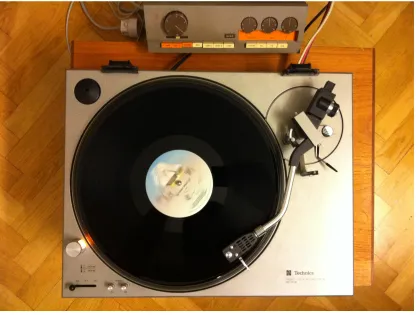
As a teenager I came to the conclusion that I would never learn to play the guitar but I eventually became quite good at creating various feedback effects. I was, up until then, completely unaware of the record player incident above. When my grandmother visited us she once remarked that my guitar playing did not seem to generate any music. In the discussion that followed she retold the story of the record player incident. This of course spurred me on to try and recreate what had happened which turned out not to be very difficult. I soon learned that I could control and alter the feedback by varying the stylus pressure or for instance manually rotating the turntable using intentionally scratched and in other ways modified vinyl records. The turntable setup, pictured below (see Figure 1.1), became the first step on my journey towards building an instrument for performance and composition.
Figure 1.1: My first true instrument. Note the loudspeaker lying flat on its side with the turntable sitting directly on top. This made it possible to create direct mechanical feedback, which I used alongside with acoustic feedback.
have a self? How do we go from meaningless symbols to symbols that refer to themselves? By talking about mathematics, art and music, Hofstadter presents a convincing explanation of how cognition and thinking emerge from well-hidden neurological mechanisms. The book provided me with a theoretical platform and introduced me to recursion, formal systems, isomorphism, chaos theory, logistic maps and emergent property.
1.4 Emergent Property
If feedback is the lowest common denominator in my work then emergent property is one of the goals for my artistic work. The concept of emergent property is fairly old. It was, for example, used by Aristotle in his Metaphysics (Book H 1045a 8-10) in which he writes that ‘the totality is not, as it were, a mere heap, but the whole is something besides the parts’, i.e., the whole is greater than the sum of the parts. The term emergent is, however, relatively new and was coined by psychologist G. H. Lewes, who wrote that:
Every resultant is either a sum or a difference of the co-operant forces; their sum, when their directions are the same -- their difference, when their directions are contrary. Further, every resultant is clearly traceable in its components, because these are homogeneous and commensurable. It is otherwise with emergents, when, instead of adding measurable motion to measurable motion, or things of one kind to other individuals of their kind, there is a co-operation of things of unlike kinds. The emergent is unlike its components insofar as these are incommensurable, and it cannot be reduced to their sum or their difference.3
The definition has been updated over the years by, among others, Jeffrey Goldstein at the School of Business at Adelphi University. The underlying message that ‘the whole is greater than the sum of the parts’ still stands as a good definition and description of emergence. An obvious example would be consciousness that could be described as an emergent property of the brain.
parameters of the models but I want the ‘heart’ of the sound model’s behaviour to come from within and not be a result of enforced and pre-programmed behaviour.
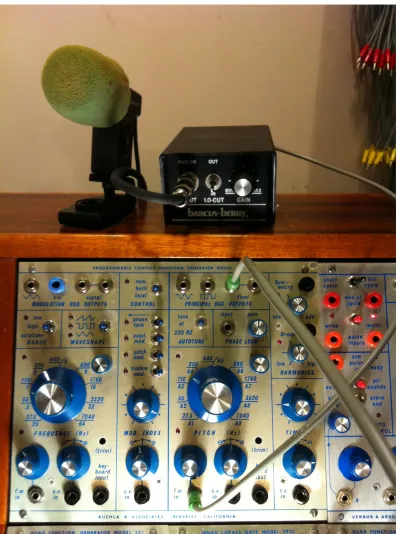
The best way to demonstrate emergent property in my work is through an early synthesiser experiment I carried out. The first synthesiser I came in contact with was an analogue Buchla modular synthesiser and once I understood how it worked I tried to recreate my record player feedback instrument by replacing the turntable with a Buchla oscillator (see Figure 1.2). After much trial and error I ended up with something that sort of worked in the way I had intended it to. I took an oscillator and fed it straight to the studio speakers. Then a microphone picked up the signal in the room, which was then fed, via a microphone amplifier, to the oscillator’s FM-input. The result was an oscillator with chaotic behaviour as an emergent property. It was possible to morph between a sine wave and white noise by varying the amplification of the signal going to the FM-input (different versions of this synthesis technique are demonstrated in the video Oscmovie and the MaxMSP patch S-O Osc demo in Appendix A2). This technique is in many ways the essence of this thesis and my work since it consists of a feedback chain and has emergent property. It can also be used as a crude algorithm for algorithmically mediated interaction. By using low frequency and a long delay (in the digital version) one input can generate two distinctively different but fully controllable outputs. Algorithmically mediated interaction is described below.
1.5 Algorithmically mediated interaction
Figure 1.2 - My first sound synthesis experiment with the Buchla Modular Synthesizer.
Chapter 2 Collaborations
2.1 Collaboration with John Bowers 2.1.1 The Lightwork performance
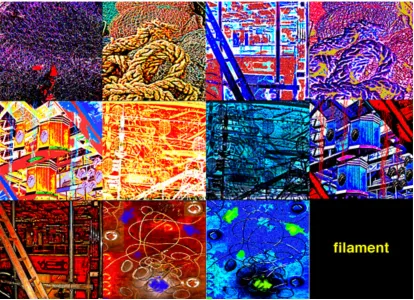
The Lightwork performance is based on virtual reality technology. Virtual reality (VR) is a term that applies to computer-simulated environments that can simulate physical presence in places in the real world, as well as in imaginary worlds. The performance consists of a number of performed visual and sonic virtual environments. The visual virtual environments were displayed on a large projection screen behind the performers and the sonic virtual environments were conveyed through a multi-speaker system surrounding the audience. Even though we were using known techniques, to our knowledge, this was the first time ever that virtual environments were generated, controlled and manipulated in real-time on stage by the performers (as opposed to performers navigating through and interacting with pre-programmed virtual environments). The Lightwork performance (see Figure 2.1) was our first collaboration and we were aided by the programmer Kai Mikael Jää-Aro (also at KTH).
Figure 2.1 - Various Images of the Lightwork visual environment. (Copyright: John Bowers 1997-2013)
It is worth noting that the performers do not directly manipulate the virtual environment content. Rather, interaction is mediated through algorithms, some constructing content, others governing the creation of virtual objects, yet others control the navigation of the viewpoint in the virtual environments. The Lightwork
[image:18.595.91.505.85.385.2]2.1.2 Collaborations with John Bowers leading up to our performance at GEM days 2009
Algorithmically mediated interaction and the development of the ‘ultimate’ set up for performance and possibly also for composition has been a common ground in our collaborations. In many ways the foundation for this work was laid during the work with the Lightwork performance presented above. Since then, we have both been striving to build our own instrument or performance set-up bouncing ideas off each other. The result of this work is documented in Chapter 2.2 and in the paper eRENA Deliverable D6.4 Tessellating Boundaries for Mixed Realities (see the appendix with the same name) where we describe our programs Geosonus (Bowers) and SO2 (mine).
SO2, or as later versions are named, SO-2 is a two-dimensional parameter space which you can move around in by, for example, using a trackpad or a joystick. SO-2
is further described in the sections below about SEQUEL and EQUAL. These sections also describe my work towards creating the optimal performance environment (set-up) or as I see it building an instrument.
2.1.3 The GEMdays 2009 performance Sine Cera with John Bowers
In our performance at the GEMdays 2009 we had both reached quite advanced stages in our work towards a performance setup or an ‘instrument’ for performance. We had both, in our own way, optimized our ideas from Lightwork and our applications
choices. Of course we had our own ideas and plans before our performance but before the event itself we agreed that as an essential part of our aesthetic for the GEMdays, we were only allowed to communicate our pre-performance ideas through our playing. The GEMdays performance was documented and is included in the submitted portfolio as Sine Cera.
2.2 Collaboration with Ann Rosén
2.2.1 Developing a sound based motion detection system.
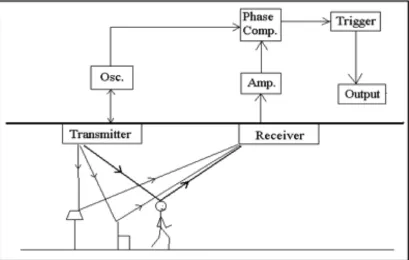
[image:20.595.94.503.475.735.2]A computer generated the sound, which was then fed into a room via high quality loudspeakers (transmitter). A microphone (receiver) at the other end of the room in respect to the loudspeakers picked up the sound and sent it back to the computer. The incoming sound was then subtracted from the outgoing sound and the resulting difference was used as a one of the parameters that controlled the outgoing sound itself. The result was a boring prototype that fulfilled our initial goals and it did, in a sluggish fashion, react to movement. Even if we did not get the prototype to work in a useful way without using ultrasound the prototype had three really interesting features.
The first interesting feature of the system was that the prototype had a self-stabilising behaviour. This meant that if there was the same sort of movement in the room over a period of time then the prototype adapted to that type of movement regarding it as the steady state resulting in a static sound. If the movement stopped the sound was altered until ‘no movement’ became the steady state once again. The second feature was a kin to memory. If there was a lot of erratic movement over a given period of time the system behaved as though the movement energy was being accumulated by the prototype causing it to continue its alteration of the output sound for some time after the movement in the room had stopped. Finally, the whole idea and setup could be described in quite an elegant way namely: The prototype is a feedback loop that starts in the virtual world where the sound is digitally generated and then past out to the ‘real world’. After travelling through the real world the sound returns to the virtual world where the resulting difference in volume and phase-shifts is measured. The result is past on, and in a way added to the sound that is being generated, thus completing the feedback loop. The sound that is heard is not merely a result of the system but is the sound of the system. The audible surface, the content driver and the technological implementation are resultant from the initial audio.
2.2.2 Sound Inserts
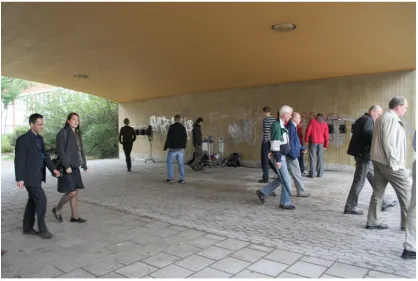
[image:22.595.91.506.329.639.2]During the summer and autumn of 2007, Ann Rosén and I were artists-in-residence at the Interactive Institute in Stockholm, Kista. Together we carried out a number of ‘sound-inserts’ with the help of a portable sound installation that we placed at different locations in Kista and Sätra. A sound-insert is a sound action that takes place in public spaces such as train platforms, parks, markets, entrances and squares. We wanted to study how people move under the influence of sound. What happens when the sound environment is changed? Will our movement and behaviour change according to the sound? The installation itself consisted of eight loudspeakers hanging on two mobile coat racks (see Figure 2.3) and our motion detection system described above.
The sounds used were derived from the actual sites and were triggered, altered, modified and spatialised by the movement of passers-by and visitors. We documented the installation and the reactions of passers-by and we also invited choreographers Ingo Reulecke, Moa Hanssen and Maija Hirvanen as observers to conduct their own on-site studies of how people reacted and behaved when they came in contact with the installation.
Figure 2.4 - By-passers interacting with Sound Inserts at one its sites.
2.2.3 Conveyer4
Our studies formed the foundation for the performance Conveyer. This work was a synthesis of live electroacoustic music, choreographed audience, dance and interactive soundscapes.
2.2.4 Träffas 1983-20035
from a sonic perspective, utilised sound objects with physical properties such as weight, shape, height, depth, width, colour etc.
We started by researching various forms of artificial intelligence in order to create an installation that was always changing and evolved. The book ‘Virtual Music’ by David Cope6, which focuses on his experiments in musical intelligence (EMI) and
computer music composing programs, turned out to be very important for us. The book was a not only a great source for inspiration in general but it also described SPEAC analysis7 which looked really interesting from our point of view. We modified and implemented SPEAC in Max/MSP (see Figure 2.5) After a lot of tweaking our modified and probably misinterpreted implementation turned out to be a perfect tool for generating the type of sound progressions we wanted.
• SPEAC analysis is based on the analysis of duration, location, vertical tension etc. SPEAC identifiers are defined as follows;
• “S = statement; stable–a declaration of material. Statements can precede or follow any SPEAC function.
• P = preparation; active–an introductory gesture. Preparations precede any SPEAC functions though more typically occur prior to statements (S) and antecedents (A).
• E = extension; stable–a continuance of material or ideas. Extensions usually follow statements (S) but can follow any SPEAC function
• A = antecedent; very active–requires a subsequent consequent (C) function. • C = consequent; conclusive–must be preceded directly or indirectly (with
intervening extensions) by antecedents (A).”
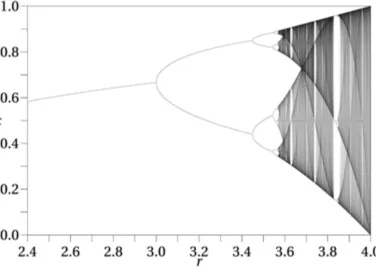
Our implementation of SPEAC was an important building block for our installation, another was a logistic map originally intended to model the insect population in a pond:
(1) xn+1 = rxn(1-xn)
xn is a number between zero and one, and represents the ratio of existing population to the maximum possible population at year n, and hence x0
represents the initial ratio of population to the maximum population (at year 0);
[image:25.595.92.504.231.466.2]r is a positive number, and represents a combined rate for reproduction and starvation.
Figure 2.5: Adapted SPEAC implementation in Max/MSP
This nonlinear difference equation is intended to capture two effects:
1) reproduction - where the population will increase at a rate proportional to the current population when the population size is small;
2) starvation (density-dependent mortality) - where the growth rate will decrease at a rate proportional to the value obtained by taking the theoretical ‘carrying capacity’ of the environment less the current population.
Figure 2.6: A graphical representation of equation (1) displaying chaotic behaviour. In the darker regions of the graph a minimal change of r will cause x to change dramatically.
The logistic map controlled the generation of sound events that were structured by our SPEAC implementation. At this early stage we had a working prototype with a few of the features implemented that we were interested in. From this point we started to experiment freely by altering and adding fragments of each other’s software code and exchanging ideas and fragments of code with each other on the fly. During this developmental stage we had no clear result in mind. As long as the prototype kept on working, in spite of us playing Dr Frankenstein with it, we were happy to investigate the potential and limits of the system.
Working with a logistic map intended, on one level, to model a small insect society made us think about our installation as a society of noise creatures with their own personality. Our wild experimentation, misinterpretation and combination of SPEAC and logistic maps actually did in the end result in a space or virtual world inhabited by noise creatures.
[image:26.595.97.473.75.347.2]• Volume variation (static, erratic, slowly pulsating, rapidly oscillating etc.) • Movement in the space (see volume variation)
• Life span
• Popularity as a mate (to generate future sound creatures)
[image:27.595.92.500.231.454.2]• A variable determining how much of their features were going be passed on to their children
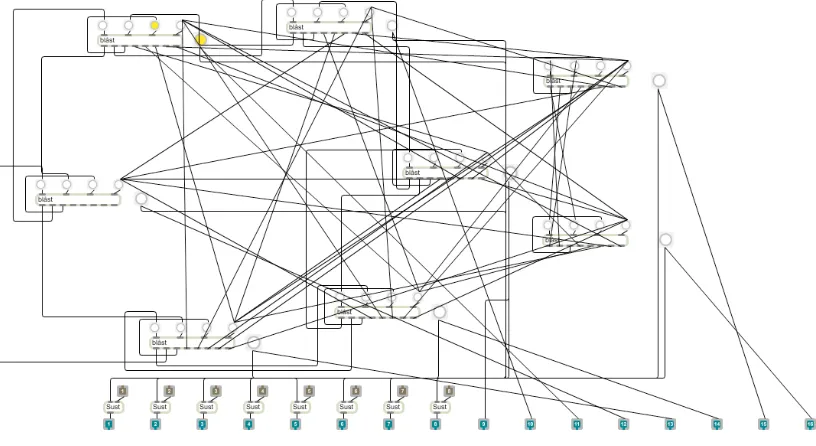
Figure. 2.7: The part of a noise creatures ‘brain’ that determine spatial behaviour. It is actually a map of the exhibit space with each rectangular ‘blåst’ box representing a loudspeaker. The six ‘blåst’ boxes, more or less in a circle, represent six speakers mounted in a circle with a 3m radius at normal ear level. The two ‘blåst’ boxes on the far right represent two speakers mounted in the ceiling.
After consulting with researchers working within the field of artificial intelligence we were informed that we had more or less developed a messy but working genetic algorithm having the following somewhat surprising features:
• A child could have any number of parents;
• If noise-creatures move together, stop in the same place at the same time more than three times in a row they were mating and giving rise to a new noise-creature;
• The noise-creatures die relatively soon after mating;
• A noise-creature learns and evolve by interacting with other noise-creatures; • The population is small and varies between 2-6.
[image:28.595.89.507.347.659.2]In the first trials of the prototype the noise-creatures interacted with visitors by responding to the visitor’s movement. However, we found that when we removed the interactive part the noise-creature’s movement in space became much less erratic. It was a lot easier to hear where in the room a noise-creature was and it became fairly easy to keep track of their movements. If you were quick, you could actually run after a noise-creature for a short while (which a lot of children really enjoyed).
Figure 2.8: A still from the installation
were interactive the visitors did not feel that they had any contact with them. This led to a situation where we dropped the interactive part altogether. Träffas was documented as a stereo recording and is called D-Dist (it is included in my portfolio of submitted works).
Another part of Ann Rosén’s and my collaborations is our joint composition work, which has resulted in the fixed media compositions Skivad and Lagrad. We also perform together under the name HR. Skivad and Lagrad and HR's performance ‘Live at Dr John’s’ are included in appendix A3.
2.3 Collaborations with Lars Bröndum
Lars Bröndum and I formed the duo As Good As It Gets as a platform for developing and exchanging ideas. We started out by discussing music theory, aesthetics and philosophy. Eventually we wanted to try out our ideas practically and we started improvising and composing together. The first outcome of this work was
Dodecachordon Phase II, which is included in appendix A3. The second outcome was TOE, which is included in the portfolio of submitted works.
2.3.1 TOE (Theory of Everything)
The Theory of Everything is a presumptive theory of theoretical physics that, if it existed, could explain and link together all existing physical phenomena. String theory and loop quantum gravity are two current candidates for the Theory of Everything title. The piece TOE takes its starting point in a music-theoretical discussion between Lars Bröndum and myself that has been on going for as long as we have known each other.
and structuring methods. We looked for the role that traditional harmony played in atonal music (as a non-present background or contrast and in some cases present residues) and searched for links between serialism, spectral music, and counterpoint etc. Basically we travelled around the world of music theory a few times without really getting anywhere and never even coming close to the TOE of music theory. However, we did gravitate to certain texts and quite often returned to ‘The Concept of Unity in Electronic Music’ by Karlheinz Stockhausen and Elaine Barkin10,
‘Formalized Music’ by Iannis Xenakis11, ‘Improvisation’ by Derek Bailey12 and Wendy Carlos’ writings regarding tonality, tuning and the supernatural scale13.
Becoming frustrated by not getting anywhere, we started to meet once a week to explore different musical concepts practically, slowly building a practice-based platform for our discussions. Even though we knew we never reached the Theory of Everything of music theory we realized that, without trying, we had built a solid ground for making music and playing together. After the hands-on exploration of various ideas and concepts one at a time, TOE had started to transform from theory in to a set of loosely defined rules for a piece.
The first set of rules:
1. All frequencies used must be derived from the dissonance curve generated by the supplied Max patch.
2. All pulses and beats must also be derived from the same dissonance curve. This means that a base pulse is decided and all subdivisions or multiplication are done by using the ratios extrapolated from the dissonance curve.
3. Just one sound and one run of the Max patch generating the dissonance-curve was allowed.
4. There is no rule 4! (We thought we needed a rule 4 but never did but for programing reasons this remain as a placeholder).
6. A fixed overall structure.
7. The piece was to consist of four parts described only by words such as anger, calm, dynamic, adaptive etc.
8. The order, length and interpretation of each part was done by each performer individually and kept secret from the other performer.
9. No samples, sound-files, prepared sounds or sequencers where allowed.
10. Avoid all comfort zones, fail rather than use favorite tricks to get out of difficult situations.
11. Avoid any ‘call-response’ behavior.
We worked for a few weeks with the above rules and used our networked laptops to share information about how we used the dissonance curve, which frequencies were to be used. A base pulse was also distributed over the network.
After a lot of experimentation and practice we found that we did not need to share information over a network Although it was useful to have the networked information as a support in the beginning, later, when we sped things up and did not stop to correct or discuss things during the process of making music, we found that we never had the time to take in and interpret all the information being sent. In addition, we had also, of course, learned what to listen for and adapt on the fly. The same thing could also be said about the rules, they were great for practicing and served as really good creative tools but they quickly became loose guidelines. When actually putting TOE
together and rehearsing for the first performance, rules 1-3 and 10-11 became our central focus again and were more or less implemented de facto in the final work.
2.3.2 Time
and decided on a base pulse beforehand and tried to implement rule 2 (above) by ear. This might sound harder than it actually was, but what happened was when we ‘failed’ we landed on the agreed ‘virtual’ grid of beats/sync-pulses and nothing was really added (no beat mismatching). It also had the added advantage that the result became more interesting since at least one of our internal/mind clocks drifted. Our ‘good’ mistakes were built into the system and added an extra dimension to the performance, whereas our ‘bad’ mistakes were more or less inaudible and passed unnoticed. In the beginning, this took quite a lot of rehearsal time to achieve because everything just sounded like a morass of sound and was unfocused. Eventually we pushed the beats produced into the background (most of the time inaudible for a listener) but it is still there and manifests itself in how the piece is structured in time.
2.3.3 Frequency
In my piece On I first created a harmonic progression or a tonal background that lasted the duration of the work. I then used this as a grid over which I placed/fitted/adjusted the actual sound material of On before removing this background sound file. This technique is somewhat reminiscent of the techniques used in TOE except that in the latter work we had one frequency grid or a set of allowed frequencies governed by rule 1. This was of course impossible to implement in actuality and we prepared a number of sounds beforehand that fulfilled the necessary requirements violating some of our predetermined rules in doing so. Having these sounds as support we could actively mismatch some aspects of each other’s sound creating some very inharmonic sounding timbres that still had quasi-harmonic properties, which meant they could be used to create consonance and dissonance.
2.3.4 Overall structure
2.3.5 Gestures
The gestures used in TOE are completely governed by a palette derived from our rehearsals. We never actually discussed this process in detail as a gestural language emerged from the beginning of the process and developed throughout successive rehearsals. We did, however, decide to (if possible) actively avoid clichés such as call and response, anacrusis etc. in order to explore the gestural palette in more considered ways.
2.4 Collaborations with Paulina Sundin
Paulina Sundin and I had both worked at EMS Stockholm for a considerable period and discovered that we shared an interest in microtonality, particularly the works of William A. Sethares and his ideas about the relationship between timbre and scale. In his book ‘Tuning, Timbre, Spectrum, Scale’14, Sethares presents a method to analyse a sound and use the analysis to derive a scale. This scale should, in theory, work with the analysed sound in much the same way as a just major scale would work together with a sound whose timbre is made up of harmonic partials. I implemented Sethares’ methods in MaxMSP and Paulina and I used this resource in our respective work. We also started to work on a composition together which resulted in the not yet finished piece The Harmony of Found Objects.
2.4.1 The Harmony of Found Objects
Chapter 3 Individual Works 3.1 SEQUEL
3.1.1 Physical Modelling Concepts
In my compositional practice I have never consciously adopted an aesthetic that has a purist approach, one that pushes things to the limit or one that refines elements beyond recognition as its goal. Nevertheless, the aforementioned approaches are important in my work. This is best illustrated in my work SEQUEL. I borrowed the term ‘sequel’ from the film world where it represents a movie that in one way or another is a continuation of an earlier movie. The structure of SEQUEL was derived from two main elements: a) the analysis of a number of movies, focusing on the story line and dramatic episodes, and b) investigating how sound was used to provide a sense of transition between scenes as well as gluing the story together. SEQUEL was composed by first making a skeletal structure. This provided a framework of the piece. Using my implementation of physical modelling, I made the sounds and gestures for the framework. The framework was then ‘fleshed out’ with sounds that I had recorded, processed, shaped, and then mixed together in the studio at EMS, Stockholm.
Physical modelling (PM) is a synthesis method where, instead of trying to imitate instruments or natural occurring sounds one tries to replicate the way the sounds are naturally generated. This is normally done with computers due to the computation involved though there are analogue and hybrid examples such as the first incarnations of the Musse synthesiser (see Figure 3.1) built at KTH in the mid 1970s and used to generate a singing human voice. Generally the term PM is used when physical phenomena are replicated in computer software (simulation of turbulence in air or water for example).
Figure 3.1 Block diagram of Musse.
In trying to create my own digital waveguide model I was influenced by a number of key articles15. I spent a lot of time assimilating the principles of PM and made many attempts to implement the examples contained in the above articles. However, in the end I constructed a model that was my own simplified description of the above. Another big difference from the methods outlined in the articles was that I used hardware delays, mixers, filters and a computer running Max (pre MaxMSP) controlling the delays. The setup consisted of:
• an Ensoniq DP4 for the bore parts of the model (four delay lines and some phase shifting);
• a Buchla 200 system (analogue modular system);
• an excitation model consisting of two Programmable Complex Waveform Generator Model 259 frequency modulating each other;
• a scattering junction consisting of two Frequency Shifter/Balanced Modulator Model 285, two Mixer/Preamplifier Model 207, one of the below mentioned Digitech effect units and a studio inline mixing desk;
• a Bell model consisting of a Quad Voltage-Controlled Lo-pass Gate Model 292 and a Programmable Spectral Processor Model 296;
• two Digitech DSP 128 multi-effect units were used, one in combination with the above mentioned frequency shifters and mixers for the scattering junction, and the other was used for modelling the reflection occurring at the mouthpiece.
• a 24 channel automated inline mixing desk for the above mentioned scattering junction and also connecting all the above mentioned equipment together;
• a MacPlus computer running Max controlling the Ensoniq DP4 and the two Digitech DSP 128
• a dedicated computer controlling the mixer;
3.1.2 - Assembling SEQUEL: The foundation and framework.
Due to this very awkward and complex setup, I had to complete each part of the piece in one go as even the slightest change to any of the parameters could result in a completely different sound. Even changing a cable could completely alter the sound. Prior to the actual composition of the work, I created a pool of material. I created approximately seventy sounds between 1-4 seconds; about one hundred sounds and sonic (music) gestures with a duration of 5-30 seconds; and finally twenty atmospheric and ambient sonic backgrounds (some of them were mixed together resulting in more foreground material). These sounds were then mixed and assembled together into a sonic foundation and framework.
3.1.3 – ‘Fleshing Out’ the Framework.
Right from the start of my work on SEQUEL I started to carry field-recording equipment in my backpack (4 kilos including extra batteries) wherever I went. This made it possible for me to record sounds outside of the studio as I encountered them - for instance straight after watching a movie or on my way home after a framework studio session. Once I had gathered a number of acoustic sounds I carefully mounted them on the framework (i.e. mixed them together with the framework). The main bulk of the sounds I recorded outside the studio could be divided into two categories: 1) spaces and environments that essentially were ‘silent’ but reacted to existing sounds by resonating, reverberating and reflecting them; 2) acoustic sounds that were fairly ‘dry’ i.e. sounds recorded in non-reverberant environments which made them fairly easy to fit together with the framework. The ambience in SEQUEL is either constructed in the studio using artificial reverb or assembled using the recorded environments as building blocks.
could never go through the same process again especially since this time around, I knew what I had ahead of me. I took a break from EMS and revisited the University of East Anglia to do a presentation and a concert. After the concert I came across the magazine Sound on Sound where Turnkey advertised that they slashed the price on a fantastic synthesiser - a monophonic digital synthesiser that even after the 70% price cut still cost as much as any polyphonic rack-mountable synthesiser-workstation. This really peaked my interest, a digital monophonic synthesiser, and an anomaly in itself, in this price range (not to mention its price tag the previous year) must be something extraordinary. I had found what I then perceived to be my holy grail, the Yamaha VL-1m, which was a digital waveguide model of a saxophone in a very practical and small box (even though today I regard it as quite heavy, extremely bulky and something I would never consider carrying anywhere outside my studio).
3.1.4 - Experimenting with the Yamaha VL-1m
The Yamaha VL-1m has a very open structure allowing the user to access an overwhelming number of parameters via MIDI. The downside is of course that if you start experimenting there are a proportionately small number of parameter settings that do not make any sound at all. In some cases there are parameters that have to vary constantly or else the VL-1m does not produce any sound. To address this I built a software controller in Max called SO-2 (see appendix eRENA Deliverable D6.4 Tessellating Boundaries for Mixed Realities chapter 2.2).
3.1.5 - SO-2
parameter behaviours when the cursor was moved across the screen letting the user navigate in a two dimensional parameter/behaviour-space.
3.1.6 -Finishing SEQUEL
The SEQUEL framework was finished using SO-2 and the VL-1m. With the VL-1m editor I constructed a giant 6m long saxophone that had an ultra-thin reed. With the right virtual air pressure (one parameter) in the mouthpiece (also of course virtual) the ultra-thin virtual reed would start to behave chaotically (which an actual reed would also do if it is thin and blown hard). This meant that I could create the low frequency and slightly chaotic sounds I needed to finish the framework for SEQUEL. I also used the VL-1m together with SO-2 to create the missing sounds to ‘flesh out’ the framework instead of using recorded sounds.
3.2 PREQUEL
Making SEQUEL was an highly intellectual process requiring careful planning, following ideas through to the end, doing things according to the score/script, learning new synthesis methods, building a software controller etc. The process of making
PREQUEL was almost the opposite - it was all about doing, spontaneous composing and solving problems on the fly. This was, however, only possible because of all the work behind SEQUEL which gave me a set of tools, sounds and musical ideas etc. It was as if the work with SEQUEL had created a giant wave and working with
PREQUEL was only a matter of surfing on this wave. ‘Prequel’ is again a term from the film world and it refers to a movie that is a follow up to an earlier movie but the story takes place in a time before the one in the earlier movie. In PREQUEL I harvested methods, tools and ideas that grew out of the work with SEQUEL.
In spirit, however, I returned to an idea for a composition I had had a long time before any ideas regarding SEQUEL had entered my mind. The idea was to base a piece purely on having fun and spontaneity. I wanted to follow the sounds wherever they would take me and at in between working on the piece I wanted to visit the Stockholm Film Festival as much as possible. So the underlying concept for
during my breaks (or maybe the other way around). PREQUEL is in fact the only piece I have composed where I followed my plan from the start to the end.
The sounds in PREQUEL consisted of the results from playful experiments with the Yamaha VL-1m and sounds that I had previously recorded. I did not tailor make or record any extra sounds for PREQUEL and I did not process any of the recorded sounds. The compositional process was one of generating sounds then composing a part that suited those sounds and so on in an iterative manner. The exception was that I did use a few of the processed sounds that were left over from SEQUEL. Since
PREQUEL was made during the ten days of the film festival, all the different parts where created in the same spirit and therefore automatically related. The assembling of the materials was therefore not particularly onerous as the different parts fitted together more or less effortlessly.
3.3 EQUAL
EQUAL is the synthesis of SEQUEL and PREQUEL - where SEQUEL is the thesis and PREQUEL the antithesis. The three pieces all relate to film in different ways and in EQUAL the use and displaying of time in movies is an important source of inspiration. When I started work on the composition of EQUAL I realised that this way of looking at time has been a part of my work from the start. Following this realisation, I read through all of my old notebooks (the oldest was from 1978) and found that the thinking behind ON, composed in 1990, could be expanded and implemented in EQUAL.
mean by time when listening to music and other time-based media – the progression of time passing.
After the first performance of ON I was made aware of Jonathan Kramer’s book ‘The Time of Music: new meanings, new temporalities, new listening strategies’16. I was
intrigued by the fact that to my understanding, his concept, which he came up with before me, was identical to mine - or to be more precise, I could not pinpoint any clear differences. The only thing I can point to is that my use of vertical time might have more of an extra musical perspective. However, when I started to make EQUAL
I found that Kramer’s book was an excellent companion to my own notes and helped me to refine my ideas.
In chapter 2 of ‘The Time of Music’ Kramer starts to define linearity and non-linearity and towards the end of the chapter he states,
Phrases have, until recently, pervaded all Western music, even multiply-directed and moment forms: phrases are the final remnant of linearity. But some new works show that phrase structure is not necessarily a component of music. The result is a single present stretched out into an enormous duration, a potentially infinite “now” that nonetheless feels like an instant. In music without phrases, without temporal articulation, with tonal consistency, whatever structure is in the music exists between simultaneous layers of sound, not between successive gestures. Thus, I call the time sense invoked by such music “vertical.” (Kramer, 1988: 55)
Throughout his book Kramer refines and updates his ‘time definitions’ which could be summarized as (compare with a summary posted by Phillip Henderson on his blog http://verticaltemporality.blogspot.se/2008/12/review-time-of-music-new-meanings-new.html)
Absolute time: There is a linear procession of moments.
Clock time: The linear procession of moments as described by the reading of a clock.
Goal-directed time: The musical events move toward foreseeable conclusions.
Non-directed time: The musical events move toward unforeseeable conclusions.
Moment-time: A point in time, a moment that is defined as a ‘self-contained (quasi-) independent section, set off from other sections by discontinuities’ (Kramer, 1988: 453). My own use of moment time refers to the perceived time within a moment (see vertical and virtual time).
Multiply-directed time: The musical movements occur in multiple directions.
Social time: The system of time organisation reliant on timetables and plans.
Vertical time: There is no differentiation between past, present and future. There may be no separate events.
Virtual time: The subjective time felt by a person absorbed in listening to a piece of music.
For my purposes I divided everything in the above list into two groups: Horizontal time and Vertical time. Horizontal time consisted of Absolute time, Clock time, Gestural time, Goal-directed time and Social time. Vertical time consisted of Non-directed time, Moment-time and Virtual time. Multiply-Non-directed time could belong to either or both groups depending on the situation, but I never used the term in my notes or in the score for EQUAL since, from my point of view it was better to use a combination of the other terms to describe different types of Multiply-directed time.
Contrast and lack of contrast has an important role in EQUAL. By using synthesised sounds and acoustic spaces I intended to generate very diverse sounds and make them appear as if they were almost the same by using spatialisation, reverb, and mixing. I also tried to make sounds that were almost impossible to separate from each other, appear as diverse as possible using the same techniques. I had an image of sound objects living in different realms or spaces being able to interact with each other because of a kinship that reaches over borders or diverse sound objects interacting with each other because of close proximity in space. My goal was to create a dualism between a completely upside-down, inside-out, chaotic sonic world and a second completely normal sound world that actually made no sense at all.
In the making of EQUAL I wanted to avoid my own compositional clichés and push myself to come up with new solutions to all the problems that emerged when composing. The structure for EQUAL can be described as a string of eleven blocks consisting of vertical time interconnected with lines of horizontal time. One of the ideas behind the vertical time blocks is that they are static versions of the whole piece. Inside a vertical time block everything slows down, freezes, the piece stops to move giving the listener the opportunity to explore the piece in their own time. The lines of horizontal time generate the forward motion in the piece, moving the listener between vertical time blocks. They resemble story lines during which musical ideas could evolve, events unfold, develop, and die out. I intended to take the listener for a ride along the horizontal time lines. When arriving at a vertical time block I would let them explore, rest and contemplate on their own for a while. Then the journey would continue along the horizontal time lines until the next block of vertical time and so on.
The working process is always important for me and I normally first make some sort of score and a plan for the work process. After a few sessions in the studio, the working process slowly changes leading to a revision of the score. In preparing
EQUAL, the score and the plan for the work process merged together into a sort of manual or set of instructions for creating EQUAL.
analysed leading to another studio session. In this session I improvised using the same tools and materials as in the previous studio session but now focusing on the development of these materials in horizontal time. In the following session the results from the previous sessions were to be fitted together by creating sounds that could bridge the gap between the materials and ‘glue’ them together or alternatively cut up the material in segments and then splice the segments together always using segments from alternating sessions (first a segment from the improvised vertical time session then a segment from the horizontal time session and so on).
In the actual working process, one studio session could consist of anything from a quarter of an actual stage up to 3 or even 4 whole stages. On some occasions I also returned and revised material from previous sessions. Even though I thought that my original instructions incorporated enough space for revision and adjustment it turned out that in order to follow the spirit of my instructions I had to do a lot of work that was not following the letter of those same instructions. The transitions that were to glue or splice together horizontal and vertical time sessions were the most problematic and often led to a number of ‘in between sessions’ where I alternated between improvising and gluing and also edited the improvised material before the splicing and gluing.
The last step in the instructions for making EQUAL was to remove excessive material without altering or in any way changing the remaining material. The idea was to carefully uncover what I hoped would be, the hidden gem beneath. To put it another way, having created a somewhat organic block of material, I intended to sculpt out a piece following the grain of the sound and utilising the structure of the material. Having adhered to the process described above the final ‘uncovering’ stage was realised on a 24-track Dyaxis system (similar to Pro-tools). I only needed two studio sessions to remove and filter out any unwanted material.
surface and a soprano voice. There were a few more but they are hardly noticeable and in my notes they are marked as acoustic ‘spice’ sounds.
3.4 FLUGAN II
From a chronological point of view Flugan II should be placed first among my individual pieces but from an aesthetic and conceptual point of view it is somewhat related to SEQUEL and EQUAL and quite close to PREQUEL. Flugan II shares some sound material with EQUAL. My work with the piece started with the creation of a sonic framework working along the lines of SEQUEL and then I ‘fleshed out’ the framework by adding improvisations on the Buchla synthesiser. As I was working in the studio I noticed a big housefly zooming around and irritating me but I tried to ignore it and carry on working. After a while the fly disappeared and I was preparing to add one of the final tracks on a 24-channel 2-inch tape. When I started the tape recorder it sounded like the pulling out of adhesive tape from a big roll. It was a horrible crackling sound and my first thought was that the back-coating of the tape was coming loose, a common problem at the time, but upon closer examination it turned out that it was the fly that had completely ruined the tape. It was actually now a very thin 235 meters long and 2 inch wide fly (I still have the tape which has been exhibited at an art gallery). Since I had a deadline, I quickly assembled the piece with little prior planning or the production of a pre-compositional score. Like PREQUEL, I worked swiftly and spontaneously allowing my intuition and ear to guide the sonic result. I was very pleased with the result and it is for many reasons one of my favorites.
3.5 JUST
enough speed you can surf up the face of the wave to the lip where you hang weightless for a few moments before going down the face again (commonly termed - ‘Hit the lip’ or ‘Off the lip’). JUST is all about hanging on to these few moments as long as possible.
I wanted JUST to be all about performance, something that could only be done on stage with my adrenaline levels peaking. After a lot of experimentation and trials I created a network of delay-lines and filters with a large number of feedback possibilities. Basically, it was a large feedback loop consisting of a lot of smaller feedback loops. None of the loops could self-oscillate together or individually without adding external energy but if a short noise burst was injected into the network the different loops could be brought to oscillation. This meant that I could mix in or out the different oscillating loops as well as retune them by altering the delay time on the delays or the cut-off/resonance frequency on the filters. If at least one of the loops were oscillating, it could be fed into another loop which, if tuned correctly, could also be brought back to life (oscillation). After a lot of practice I could keep the energy level high enough in the network, outputting sounds for approximately 6-7 minutes after the initial noise burst. It was of course possible to set up a fairly static sound by always having at least one or two loops sounding, carefully adjusting the parameters and thereby keeping the network sounding for as long as you like. The whole point of the work however, was to vary the dynamics, to use gestures and pauses. This meant that the procedure would be the following:
1. Inject a noise burst into the delay and filter network, which will automatically bring at least one or probably several of the loops into oscillation. You will then be at stage 3 or 4 in this list;
2. Direct residual energy to one loop and bring it to oscillation;
3. Use the energy created by the oscillation to get more loops oscillating;
4. Start shaping the sound by varying the volume, altering the pitch mixing the sounding loops. Eventually the energy starts to drop and you have to start at 2 again. If the energy drops too much you will not be able to bring any loops into oscillation which means that the piece has ended.
them into oscillation). If you have little energy you have to tune the receiving loop (by adjusting the delay time or cut-off frequency) to match the frequency of the incoming sound in order to make the receiving loop active (oscillating) again. There is a special case if you have too little energy to start an oscillation but you still have some residual energy left you can jumpstart an oscillation by altering as many parameters as quickly as you can except for the ones controlling the loop you are trying to jumpstart. This process causes zipper noise (due to that the relative low resolution of the control-parameters) and this in combination with the residual energy can in some cases be enough to jumpstart a loop. The zipper noise is, however, not enough on its own to bring any loops back to life. Another important factor is that the more energy you have the longer pauses you can make. To me, performing JUST is a sort of chicken race where you challenge silence. I try to make the most of what momentum I have by, for example, creating a phrase or a gesture perhaps followed by a short pause, a moment of near silence before I have to gain momentum again. A long phrase or gesture will drain momentum and a pause even more so. If there is no momentum left one cannot do anything and the piece has ended.
with my control surface where everything was placed for optimal ergonomics and playability there was lot of unused space. I thought that it would be the perfect place to implement my cracklebox that I had been working on. This turned out really well and even if I mainly use it for performing other pieces and improvisations I use it to generate the initial noise-burst in JUST. My version of the cracklebox is actually really close to Michel Waisvisz’s original design, but I have larger capacitors and some extra transistors, which in the end did not make a big difference. My goal was to be able to generate more low frequency sounds than was possible with the original model which I had some limited success in achieving. The most important difference was that I had an extra metal contact, which I added to the circuit. This extra metal contact probably changed the sound more than my carefully thought out modifications.
3.6 Ambient Edge
My collaborations with Ann Rosén has led to many spin-off projects and one of the more spectacular sound-installations we did was Spatial Silences18 - exhibited at the Royal Academy of Fine Arts in 2005. In a large room filled with noise we created a silent sphere (using active noise cancelation techniques), with a diameter of approximately 1.5 meters that floated around in the room. The visitors could either go around trying to find it or just stand in the room and suddenly be engulfed by the sphere of silence. If this happened it was quite spectacular with most people experiencing it as a very weird and strange sensation. The idea of silence and silent sounds stayed with me for a while and eventually I thought of completely reversing the process of Spatial Silences. I decided to use inaudible sounds to create a piece so that the sounds that you hear when listening to the piece are actually not the sounds on a hard drive or sounds coming from a CD or soundcard, but the interference effects from these sounds.
it just had lost all its character and was completely useless. Instead of removing this sound I animated it using a recording of water being stirred with a spoon in a glass. I synced the stirring to the pulsation and used convolution to map the volume curve and frequency content to the water sound. Then I mixed the original, the processed and the synced but unprocessed sounds together and thereby I managed to capture the spirit of the original sound in order to us it in Ambient Edge.
When I think of the process of making Ambient Edge I remember it as a very simple piece to make and I think of it as coming together in three weeks from start to finish. When I re-read my notebooks however, I realized that the idea had in actual fact been gestating for a considerable time. The only difficulty in the composition process was reanimating the sounds I really liked but could not use straight from the recording sessions (one such instance is described above). The ending, or the last ‘silent’ 30 seconds of Ambient Edge are intentional as I wanted to point out that the ending was not originally silent but consisted of sounds that were almost inaudible to the human ear, however still detectable, and one could sense that there was something present in the studio. These sounds were actually the result of inaudible sounds creating an audible interference in the room but I did not manage to record these sounds with a microphone since ventilation noise and computer fans masked them. In addition, the ‘silent’ sounds themselves were completely out of range for normal recording techniques. Even if conceptually the work necessitated sounds being ‘re-animated’, the silent ending functions as a tribute to my original idea. I do not mind if the ending is left out in concerts but for me it is important that it is still there.
3.7 Spiral a continuation of Ambient Edge
the 24 speakers and also move it in time during the three-minute loop. After having added a number of sounds to the loop I then changed the loop length and carried on in the same fashion. When I eventually ended up with a whole piece (Spiral) I made a stereo mix for portability.
3.8 In My Own Words
In one of my earliest pieces, Off the Lip (1987), I was inspired by surfing and in particular the concept of manoeuvring the surf board on the edge of a breaking wave (the lip). This is a concept that has stayed with me and in my music. I continue to explore breaking points, event horizons, metamorphosis and transition points in time and space. Related to this concept is the on-going quest I have musically to investigate the relationship between the very large and the very small alongside the very slow and the very fast. I want to explore the relationship between parallel co-existing events that are only separated by size or scale. One such example that is very important to me is the relationship between sound synthesis and composition or the smallest sine wave present in the piece and the whole composition itself.
In My Own Words is fundamentally about two things: the first is the transitions between different states such as solid and liquid; the second is the relations between the atoms in melting ice cubes and the ice-cubes themselves. I started with the idea of six ice cubes on a flat warm metal surface. The water gradually undergoes a transition from solid (ice) to liquid (water) and finally to gas (steam). The ice-cubes move around in a certain fashion as they melt, the water molecules within each ice cube have another movement pattern and the atoms yet another and the different movement patterns interact with each other even though they are separated by their size.