2017 3rd International Conference on Artificial Intelligence and Industrial Engineering (AIIE 2017) ISBN: 978-1-60595-520-9
An Effective Sensor Network for Museum Operations: The Experience
of a Pilot Implementation
Chun-Hung CHENG
*and Dorbin Tobun NG
Department of Systems Engineering & Engineering Management, The Chinese University of Hong Kong, Shatin, Hong Kong, China
*Corresponding author
Keywords: Sensor network, RFID, Museum operations, Pilot implementation.
Abstract. This work discusses a wireless sensor network to monitor exhibition halls of a museum, to preserve the high quality of artifacts and to ensure the correct handling of artifacts. The network makes use of a hybrid indoor communication framework to leverage on power line and wireless communications to facilitate a low energy data communications to support sensor data collection. In addition, it is equipped with software modules to manage all the sensors and analyze data being collected from them. Our work of applying this technology to museum operations will be presented. The user experience in two museums in Hong Kong has been very positive.
Introduction
There has been a growing interest in Wireless Sensor Networks (WSN) research and development in recent years. The advancements in the field of sensing, computing, and network communications have attracted more advanced R&D efforts and huge industrial investments. As a result, new applications of WSN have been developed.
Many market available RFID sensor tags largely are active RFID tags integrated with a single sensor. The two most commonly found integrated sensors are temperature and humidity sensors; for examples, RFID Humidity Sensor from DeltaTRAK; 2.45 GHz Active RFID Temperature Sensor Tag from GAO RFID Inc. Another sensor device on active RFID tags that can be found in the market is vibration sensor; for example, 2.45 GHz Active RFID Vibration Sensor Tag from GAO RFID Inc. Some products offer active RFID tags with both temperature and humidity sensors; for example, RFIT Temperature & Humidity Sensor Tag Pro from Radio Frequency Intelligent Technology. Given the current set of available RFID sensor products and the maturity in RFID and sensor engineering, the development of a pluggable RFID sensor devices to flexibly integrate just the needed sensors is a feasible applied research for taking on the business and application opportunities in next few years.
Other than the sensor choice issue, large-scale deployment and ad-hoc architecture are the factors affecting the overall performance or error rate because a large number of sensor nodes might be spread randomly over the deployment field [1, 2]. Besides, the lack of predetermined network infrastructure hinders the ability for WSN to provide comprehension coverage [3, 4]. Moreover, noise in WSN environment like reflection, scattering and dispersions may greatly reduce the effective radio range [1]. Given some wired cabling infrastructure either for network data or power supply pre-exists in building structure or targeted monitoring area, it is fruitful to create a hybrid network for transmitting RFID and sensor data in a large space. Network technology components and standards are available independently in the market. It is expected that an applied research in the direction of creating hybrid RFID sensor network can largely solve some coverage and cost issues on deployment sensor monitoring network.
with analysis processing and visualization widgets independently with the flexibility for creating mix-and-match mashup applications to fit different user needs. To ease the integration effort to existing business applications like ERP, there is an opportunity to develop modularized analytics processing and visualization and summarization widgets to deal with large volume of sensor data in the coming years.
According to the above analysis on the market relating to using RFID-enabled sensor systems to help monitor specific environment like exhibition halls or storages, the applied research opportunities in the three areas of RFID-enabled sensor hardware, hybrid network infrastructure, and analytics APIs are fruitful and concretely achievable in short- to medium-term. In addition, each of these three areas can be achieved independently or collaboratively. Thus, the risk of reaching the applied research goal is low because having all being achieved in the same pace is not necessary in order to realize the overall results.
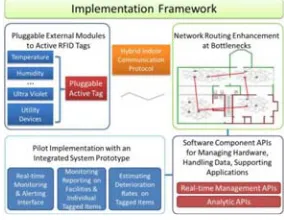
[image:2.612.182.428.279.395.2]In this work, we present a WSN framework by dealing with RFID-enabled sensor hardware, hybrid network infrastructure, and analytics APIs for museum operations. This framework (shown in Figure 1) has been implemented and used for two years in two museums in Hong Kong. The user experience has been very favorable.
Figure 1. Our museum WSN with pluggable sensors.
Implementation Framework
Figure 2 presents the overall implementation framework of the WSN project to guide the development of various technology components and the interrelationships between them. The components include: Active tag and external module design: Pluggable RFID-enabled external hardware technologies; Hybrid Network Infrastructure: hybrid wired and wireless network routing scheme to adapt to different environment factors; Real-time management and analytic APIs: A set of software components APIs providing the analytics and visualization functions ready to be consumed by other existing client applications.
Figure 2. RFID-enabled sensing and monitoring network implementation framework.
[image:2.612.234.376.547.657.2]integrated system prototype will help gain implementation and integration insight and know-how for a better preparation on going through the commercialization of the component technologies.
Active Tag and External Module Design
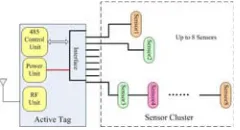
For lots of applications in a museum, some environmental parameters need to be monitored at the same time. For instance, temperature, humidity, vibration, ultra-violet and visible light may be measured during the transportation or exhibition. How to reduce the complexity of the monitoring system and also reduce the cost of the system configuration are key features. Since different types of sensor data will be collected through wireless communication, the same wireless module which is responsible for data transfer can be shared by sensor modules. Sharing the wireless module will significantly reduce the cost and system complexity. Figure 3 is a block diagram illustrating how the connection between sensors and an active tag is. Each active tag can plug in with up to 8 sensors and also act as power supply to the connected sensors. The 485 communication port is chosen as the communication interface. Communication protocol between sensors and a connected active tag supports two way communications so that sensors can be configured by the active tag and transfer sensor data back to the tag.
[image:3.612.248.368.286.351.2]
Figure 3. Wired connection between sensors and active tag Sensors.
[image:3.612.268.343.436.506.2]Sensors can be configured to different modes according to sensor types and measurement requirements. For instance, a temperature sensor can be configured to continuous measurement mode or event triggered mode. There will be three ways to configure an active tag: configure a tag through UI on a server; use handheld device to configure a tag wirelessly; and use handheld device to configure a tag by directly wired connection.
Figure 4. Architecture of an active tag.
Similar to integrating with external sensors, external utility devices such as light, speaker, display, and input devices can be connected through the interface to make use of the RF wireless communications to execute commands and receiving data. This interface design facilitates different needs of attaching various signaling, input or output devices for different operation environments.
A low profile high gain antenna (in Figure 4) will be designed to increase communication distance. Spatial diversity technology will be adopted to overcome multipath effect in an indoor environment. The Micro USB interface is for tag configuration in wired connection method. Sensor interface is designed for connection of different sensors and also provides power supply. The standardized communication protocol will be developed to support the communication between sensors and an active tag. A sensor will have its unique sensor type. A unique ID will be assigned by a connected active tag. The data packet transmitted with sensor data in application layer is shown in Table 1.
Table 1. Sensor data packet in application layer.
Tag ID Sensor ID Sensor Type Sensor Mode Sensor Parameter Sensor Data
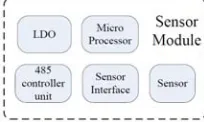
topology among sensors and a tag is chosen. A sensor will include at least the modules shown in Figure 5.
Figure 5. Architecture of a sensor.
Hybrid Communication Infrastructure
Since there are lots of sensors deployed around a museum or a large establishment, it is impossible to collect data manually or configure sensors one by one. Moreover, environment changes rapidly especially when emergency happens. Thus, the sensor system has to be able to provide sensor data in real time as well as to provide flexibility to adapt to different situations. These requirements mean that the responsible time of the monitoring system would be adjustable for power saving and reducing communication payload. Wirelessly monitoring the environment is the best way to achieve real time requirement. For most of the existing museum systems, they use low frequency (ranged from 300MHz to 500MHz) and high emission power to ensure radio signal can be received by receivers. However, due to the complexity of the indoor environment, there are always some dead spots that cannot be reached even with a high emission power. All these characteristics will lead to the following issues: The frequency band is not free. Users have to pay for the frequency license fee. It is hard to deploy globally; High emission power may consume lots of energy, which may lead to short battery life time; Lots of existing systems are only small and close systems, which do not support large scale deployment; Low communication success rate due to complex indoor radio environment such as multipath effect; Slow response time because of failure of radio communication; Lack of reconfigurable capability of the communication network; and Large antenna size due to the low frequency band.
To solve the above issues, we will leverage on ZigBee wireless communication network and low voltage power line communication network to establish a robust, scalable and reliable Hybrid Indoor Communication Network (HICN). The HICN is operating at 2.4GHz, which is used worldwide as ISM band. So the users do not need to pay any frequency license fee to maintain the system. And this wireless network is fully reconfigurable. For the museum applications, items will be moved quite often. There are always new items come so that there will have the needs to add new tags with sensors. These new tags should have the capability to discover the existing network and register and join the network automatically. The HICN will support all these functions. There are three frequency bands which are specified IEEE 802.11.15.4, which is: 868-868.6MHz (868MHz band); 902-928MHz (902MHz band); and 2400-2483.5MHz (2.4GHz band).
Only the 2.4GHz band is the ISM band used worldwide. And 2.4GHz frequency band has more bandwidth and it supports higher data rate transfer compared with the other two frequency bands. Higher data rate means the same volume of data can be transferred faster and it will occupy less time to transmit. This will be energy efficient. Furthermore, the higher the operating frequency, the smaller the antenna is. For the same size of active tags, it gives more space to develop sophisticate antenna structure to overcome multipath problem and maintain low profile as well.
emission power is not a good choice. It may cause interference to other existing systems or even violate the local frequency allocation regulations. Using relay is a practical way. The problem is you have to specifically select a right place to install the repeater. Sometimes it is hard to find the right spot to do the installation.
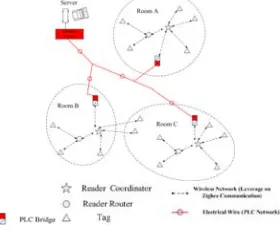
In fact, there are three types of devices in our proposed network: Reader Coordinator, Reader Router, and Tag. A Reader Coordinator is a full-function device, which establishes a personal area network and maintains the network. It has to be turned on all the time. Thus, Reader Coordinators have to be connected with AC power supply. We are taking this advantage and use the power line as the transmission medium to transmit signals; i.e., the Power Line Communication (PLC). PLC has its advantage such as: using existing electrical infrastructure to transfer data; no need to reconstruct communication cables; easy to form an in-house network; low cost; no light-of-sight problem: it can be used as complement to wireless network; support various data rate from several kbits to Mbits; low power consumption; secure: the communication range is controllable because it is a wired network; plug and play: power line are away available in a building.
Considering the characteristic of these two types of network, PLC can be a complement to a ZigBee network. In this hybrid mesh network, ZigBee will be used for communication within a short range. Each coordinator will be connected with an AC outlet. The AC outlet provides power supply to a coordinator and also acts as a data entrance to a PLC network. PLC network works as the backbone of the hybrid network. The network topology shown in Figure 6 illustrates the roles of each device in the network.
[image:5.612.236.376.387.503.2]In addition to leveraging PLC network to reduce the network infrastructure setup burden for a RFID reader network, Wi-Fi networks will be fully utilized when they have already been part of the network backbone. The design for Reader Coordinators will include the Wi-Fi module for facilitating the creation of the needed hybrid network to work with different building infrastructure.
Figure 6. Hybrid Network Topology.
Real-Time Management and Analytics APIs
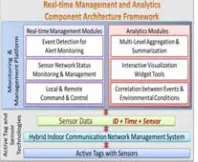
The sensor data collected through the proposal hybrid indoor communication network system will be utilized in two paradigms – real-time monitoring and management, as well as data-driven analysis and visualization for making corrective or preventive decisions. Figure 7 shows the architecture framework for including the underlying analytics components made available through APIs to facilitate the integration to different application needs. All of these components will be designed and developed based on service-oriented architecture design and will be made available through Web APIs to facilitate the future integration to other existing business applications.
The real-time monitoring and management modules will provide the following types of functions via Web APIs.
Sensor Network Status Monitoring & Management: The health and operational statuses will be monitored and managed through this module. Periodical and ad-hoc reporting capability will gather status data in XML format for client application to reveal the situation to users. Network settings can also be administrated through this module.
[image:6.612.258.357.177.258.2]Local & Remote Command & Control: Periodic and ad-hoc tag and sensor data collection processes can be controlled through this module. In addition, sensor data being logged in active tags’ memory can be retrieved with the provided commands. Furthermore, utility devices can be controlled through this module to perform real time signaling.
Figure 7. Real-time management and analytics component architecture framework.
The data-driven analytics modules will provide the following functions in Web APIs. These APIs carry important managerial implications.
Multi-Level Aggregation & Summarization: This module will provide the flexibility in selecting the appropriate levels of aggregation such as grouping data by hours, days, months, seasons, different events, or different zones for revealing the environmental conditions and the changes between different criteria.
Interactive Visualization Widget Tools: To effectively make sense of large volume of raw data, different visualization tools will be developed in this module and made available through visualization widgets for being included in other client applications.
Correlation between Events and Environmental Conditions: In order to leverage more on the tag and sensor data for planning and predicting the appropriate protective measurement or action needed for future events or even unexpected events, the capability of correlating different actual events, weather conditions, and transportation arrangements to the continuously recorded environmental conditions is critical. This module will provide the functionality for associating different events for further pattern analysis.
Pilot Implementations
Three full-scale pilot system prototypes will be deployed in Hong Kong Museum of History in Tsim Sha Tsui, and Hong Kong Film Archive in Sai Wan Ho. The two pilot implementation sites chosen under the Leisure and Cultural Services Department (LCSD) of Hong Kong represent the two main functional aspects in museum: exhibiting artifacts with aesthetic concern for visitors as well as conserving artifacts with the most suitable conditioned environment.
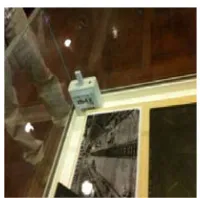
Figure 8. Relatively large logger (an old device) for temperature and humidity placing inside a sealed show case.
The old sensor devices (shown in Figure 8) have been used for many year. The old sensor devices have the following concerns and issues.
Licensing fee for operational radio frequency: The current sensor devices are operating with 458 MHz, which requires paying an annual RF license fee of HK$ 200 per device to Office of the Communications Authority (OFCA). The museums under the LCSD have close to 300 such devices. The total license fee will add up to HK$ 60,000 per year. The proposed RFID technology will use ISM Band (2.45 MHz), which does not require any RF license fee.
Limitation on routing cable or power: It is either impractical or impossible to routing extra power line or network cable in existing establishments. It is because some museum is set up in historical establishment, which itself is an artifact like other artifacts exhibiting or stored inside it. Any building work for routing conduits is either prohibited or required going through vigorous application processes. For some others in newer government buildings, it is because the need of constantly
reconfiguring the space for different exhibition environment may make the pre-configured cable routing being insufficient to set up an effective wireless network for receiving wireless sensor data. The proposed hybrid network with power line and wireless communications will leverage existing power line and wireless network infrastructure to avoid routing more cable.
Unreliable wireless connection: Because of the wireless only solution employed by the current sensor system in museums, the wireless connection is unreliable due to the existing metal gates and walls in the establishment. The proposed hybrid network solution will deal with this connection issue directly and provide a reliable connection for transmitting sensor data.
High cost on each wireless sensor device: Each of the current sensor device costs more than HK$ 2,000. The proposed solution of developing pluggable sensor modules to active RFID tag is targeted for a low cost sensor and RFID devices. From previous R&D experience in active RFID tag, the BOM cost of each tag is targeted under HK$ 50. Each sensor module is also targeted with the BOM cost between HK$ 50 and HK $100, depending on the type of sensor devices.
Large device size for being inflexible to facilitate aesthetic design: In addition to achieving artifact conservation, aesthetic concern is equally important for designing how an artifact being displayed. The current sensor device is relatively large and hard to be hidden with the concern on correctly reading corresponding sensor values, as shown in Figure 8. The proposed pluggable design on sensor and RFID devices gives the flexibility of developing small communication module to be easily hidden and small sensor module to be placed near the artifact.
Limitation on sensing capability to monitoring temperature and humidity: In order to provide better conservation monitoring, sensor capabilities of measuring ultraviolet, illuminance, infra-red, vibration, and possibly pH values in air are needed. These capabilities are not available in the current deployed technology. The proposed solution is to provide the flexibility to add needed sensors to different environment for monitoring.
flexibility in placing sufficient sensors in the ever changing exhibition environment like those showing in Figure 9.
[image:8.612.212.399.96.187.2]
Figure 9. Aesthetic design and conservation on exhibiting artifacts.
The exhibition hall of the Hong Kong Museum of History is a large space without any pre-built partition as shown in Figure 10, which allows the museum to freely design and arrange artifacts to be shown with different themes or stories. That is, the layout of the exhibition floor may be rearranged periodically. It presents a challenge of setting up an effective wireless receiver network for collecting wireless signal from all wireless devices placing in different locations at different times due to the changes in exhibition needs. This kind of large space structure without any pre-built interior partition is commonly found in exhibition centers, airport, warehouses, distribution centers, etc.
[image:8.612.221.393.305.397.2]
Figure 10. Large exhibition hall without any pre-built partition in Hong Kong Museum of History.
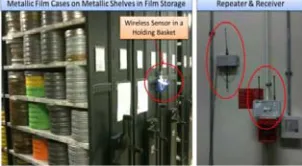
The pilot implementation in Hong Kong Film Archive (HKFA) is to demonstrate the use of the RFID enabled sensor network to collect environmental data in a constant conditioned environment such as film storage environment of 4oC and 35% relative humidity as well as paper storage environment of 16oC and 50% relative humidity. Such an environment can be generalized to wine storage, chemicals storage, medical storage, and other storage sensitive to variations to constant environmental factors.
Figure 11. Film Storage and Wireless Sensor Equipment in Hong Kong Film Archive.
In addition to the seven issues identified with the current sensor device technology deployed in HK museums, two more issues are raised in the HKFA environment.
Concern for acidic environment: An extra issue on film storage in Hong Kong Film Archive is the acidic gaseous constantly releasing from the plastic negative film to the air. Testing about the equipment performance and accuracy on the acidic condition to sensors and active tags will be conducted. In addition, suitable pH value sensor will be evaluated to be included as a sensor module for monitoring the acidic level in the atmospheric environment in film storage.
[image:8.612.230.381.502.585.2]HKFA film storage. An extra reason for using metallic wall is that concrete releases alkaline chemical substance, which may have chemical reaction with the acidic gaseous releasing from plastic negative film. The proposed hybrid indoor communication network infrastructure will be able to provide a larger (or even complete) coverage inside the film storage, as shown in the pink area highlighted in Figure 12.
[image:9.612.218.396.135.264.2]
Figure 12. Film storage and workshops in Hong Kong Film Archive.
In addition to the acidic and densely metallic environment in HKFA, it also presents a challenge of establishing an effective wireless network inside highly partitioned building. The challenge is commonly found in many different multi-story buildings. The current repeater solution requires rather high power signal strength to transmit radio signal across concrete floor. The proposed hybrid indoor communication network will provide a low-power alternative.
Conclusion
We have discussed a wireless sensor network to monitor the condition of exhibition halls of a museum, to preserve the existing quality of artifacts and to ensure the correct handling of artifacts. This network makes use of a hybrid indoor communication framework to leverage on power line and wireless communications to facilitate a low energy data communications to support sensor data collection and utility command and control. In addition, the network is equipped with software modules to manage all the sensors and analyze data being collected from them. We installed the platforms in two museums in Hong Kong in a pilot implementation and obtained very favorable response. Riding on the positive user experience, we are looking for other funding sources to support actual implementation.
Acknowledgement
This research was financially supported by Asian Institute of Supply Chain and Logistics and Innovation and Technology Fund in Hong Kong. The hardware devices used in this work are designed and developed by Professor Keli Wu from Department of Electronic Engineering of the Chinese University of Hong Kong.
References
[1] S. Gowrishankar, T.G. Basavaraju, D.H. Manjaiah, and K. S. Subir, Issues in Wireless Sensor Network, Proceedings of the World Congress on Engineering (WCE) 2008, I (2008) 176-187. [2] V.C. Gungor, and G.P. Hancke, Industrial Wireless Sensor Networks: Challenges, Design Principles, and Technical Approaches, IEEE Transactions on Industrial Electronics 56(10) (2009), 4258-4265.
[4] S. Meguerdichian, F. Koushanfar, M. Potkonjak, and M.B. Srivastava, Coverage Problems in Wireless Ad-hoc Sensor Networks, INFOCOM 2001 3 (2011) 1380-1387.
[5] J. Thomas, and J. Kielman, Challenges for Visual Analytics, Information Visualization 8(4) (2009) 309-314.