2020 4th International Conference on Modelling, Simulation and Applied Mathematics (MSAM 2020) ISBN: 978-1-60595-674-9
Debris Evolution Analysis of Breakup Events Based on Modified Space
Debris Evolution Model and Collision Factor
Zhi-ping YE
1,*, Tai-bin HU
2, Wan-xin ZHANG
1and Bo ZHAO
31China Astronaut Research and Training Center, Beijing 100094, China 2
Beijing Institute of Spacecraft System Engineering, Beijing, 100094, China
3
Beijing Institute of Control Engineering, Beijing, 100190, China *Corresponding author
Keywords: Space debris, Evolution model, Breakup events, Collision factor, Collision probability.
Abstract. Breakup events are crucial source of space debris. It is important to focus on the effect of
breakup model on space environment. In order to reveal the evolutionary mechanism of space debris environment based on breakup events, in this paper, elliptical orbits and solar radiation pressure perturbation are firstly considered to modify the altitude distribution model and orbit decay model in space debris evolution model (SDEM). Then based on the modified SDEM, the debris generation, evolution and the effects on collision probability of space environment caused by different altitude break up events are analyzed in detail. Furthermore, considering the volume that the debris sweep per unit time, collision factor is introduced to describe the effects of breakup events on collision probability, and a large value means a great influence. The results show that when breakup events happen on the low orbits, the number of debris decrease rapidly, while the high orbits break up events would cause long-term influence on space environment and the influence of collision events are more significant than explosion events. Moreover, the generation of space debris is related to the original space environment, the influence of collision events on space environment is larger than explosion events and non-functional spacecraft.
Introduction
Since the launch of Sputnik 1 in 1957, space exploration has played a crucial role in human society. However, the growth of the space debris on orbit threatens the security of the spacecraft seriously, which has been a concern to the international space community in recent years [1-2]. The main sources of the orbit debris include the mission-related objects, on-orbit break-ups and mission-terminate space systems [1]. Among the various sources of orbital debris, on-orbit break-up events, which contain the accidental break-ups such as explosion and on-orbit collisions, are tough to tackle and would generate thousands of new debris per event, as so-called Kessler syndrome proposed by Don Kessler and Burt Cour-Palais in 1978. For example, in 2009, the collision between Iridium 33 and Cosmos is a typical on-orbit break-up event, having resulted in large amounts of new debris and affected the space environment adversely.
[7]. In SDEM, the debris orbits are modeled as circle orbits. Although based on circle orbit can simplify the calculation, deviation is introduced since the debris orbits in real space are generally elliptical. Furthermore, solar radiation pressure would affect the orbit decay of debris with high orbit altitude, which is not considered in SDEM. In this paper, elliptical orbit and solar radiation pressure perturbation are introduced to modify the SDEM. Then based on the modified SDEM, the space environment considering on-orbit break-up events including collision and explosion are analyzed. Intuitively, the main factor affecting the collision probability of a debris and other space objects is the volume of space that the debris sweeps per unit time. Motivated by this, an index named collision factor is proposed to describe the change of collision probability after the break up events.
The rest of this paper is organized as follows: in Section 2, the modified SDEM considering the elliptical orbit and solar radiation pressure perturbation is introduced. In Section 3, collision factor is defined and the change of collision probability is calculated based on collision factor. In Section 4, based on the modified SDEM and collision factor, the debris generation and evolution mechanism are analyzed in detail by considering different on-orbit break-up events in different orbit altitude.
Correction of SDEM
Correction of Debris Height Distribution Calculation Under Elliptical Orbit
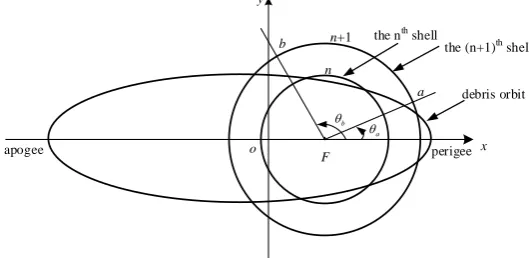
In the calculation of debris orbit in SDEM, the space in the range of (0,4000) km is divided into 800 height levels with 50km per level. In this way, the debris on the elliptical orbit would pass through multiple shells, as shown in Fig. 1, which leads to the inaccurate calculations. In order to correction this deviation, correction coefficient C is introduced, which is defined as the ratio of the running time of debris in a shell region to its whole period. Based on this correction, the problem of inaccurate calculation of debris data under elliptical orbit can be solved.
F
a
b n+1
n
perigee
apogee o
y
x
b
a
debris orbit the nth shell
[image:2.595.162.427.430.559.2]the (n+1)th shell
Figure 1. The relationship between space debris orbit and different shell levels.
The correction coefficient C can be written as:
2 ab/
C T T (1) where 2Tab is the debris flying time in the shell, T is the flying period of the debris. Consider the
initial moment is perigee, ta and tb are the moments when the debris reaches point a and b
respectively, then Tab is given as:
ab a b
T t t (2) Based on the orbit dynamic theory, ta and tb can be calculated as follows uniformly:
3 2
1 1 sin
2 arctan tan
1 2 1 cos
a e e e
t
e e
By substituting Eq. (2) and Eq. (3) into Eq. (1), the correction coefficient C can be calculated.
Correction of Debris Orbit Decay Calculation Considering the Solar Radiation Pressure
For the debris on the high orbit, Solar radiation pressure is an important issue which influences the orbit decay calculation. In this section, the solar radiation pressure perturbation is introduced to orbit calculation, considering the effects on semi-major axis and eccentricity of the debris orbit mainly.
The orbit perturbation caused by solar radiation pressure is non-gravitational perturbation, thus the change of orbit parameters considering this perturbation can be derived by Guassian equation. Based on Gaussian equation, the rate of semi-long axis change and eccentricity change can be written as:
2
2 2
2
sin 1 cos
1
1 2 cos cos
sin
1 cos
da
e T e S
dt n e
de e e e
T S
dt na e
(4)
where T and S is radial and transverse component of the perturbation acceleration in orbit plane respectively, is the true anomaly of the debris, 3
n a , is the geocentric gravitational constant. Specifically, T and S are written as:
cos sin
cos sin
T F T u S u
S F S u T u
(5) whereu , is the argument of perigee, F is the perturbation acceleration, T S, can be expressed as:
cos cos sin sin sin
sin cos cos cos cos sin cos sin sin sin
s
s s
T i
S i i i i i
(6) where is the RAAN, iis the orbit inclination, is is the angle between the ecliptic and the equator,
is solar longitude.
Perturbation acceleration caused by solar radiation pressure can be calculated as follows:
6
4.65 10 1 c A
F
M
(7)
where c is the solar pressure reflection coefficient, c=0.5, A/M is the area-mass ratio, A is the effective cross-sectional area, M is the mass of the debris.
By substituting Eq. (5) – Eq. (7) into Eq. (4), the effect on the a and e caused by solar radiation pressure perturbation can be calculated by numerical integral.
Analysis of Break-up Events on Collision Probability of Space Debris Environment
Collision Factor
Collision is a major cause of the deterioration of space debris environment in the future. The main factors that affect the probability of collision are the density of debris distribution, the relative velocity between the debris and the spacecraft, the cross-section area of the spacecraft and the in-orbit flight time. For a certain debris, its impact on collision probability mainly depends on the volume of the space swept by it per unit time. Thus, the collision factor is proposed in this paper to measure the influence on the collision probability resulting from a certain debris.
Collision factor is defined as the volume that a debris sweeping per unit time, which is written as:
/
j j j j
where, VT is the volume that a series of debris with certain size sweeping per unit time, Ljis the
orbit circumference, Nj is the number of debris, Aj is the cross-section of the debris, Tj is the orbit
period.
Collision Probability Calculation Based on Collision Factor
Consider different orbit altitude and different mass of the debris, the (0,4000)km orbit region is divided into 800 height levels with per level is 50km and the mass of debris is devided into 10 mass intervals based on order of magnitudes, then in time t, at the orbit level hj , the collision times between
mass intervals mk and ml is:
'
2 ( , ) [ ( , ) ]
( )
1
k j j i j j kl
jkl k l
kl
m h v m h V
C r r t
(9)
where j = 1, 2, …, 800, k, l = 1,2,…,10 andk l, rk is the average radius of the collision items, rlis
the average radius of the items being collided, (m hi, j)is the distribution density of debris on orbit
level hj and mass range mi, i=k, l. vj’ is the average relative velocity, Vj is the volume of the orbit
level,kl is the Kronecker delta, when k l= , kl=1 while whenkl , kl 0. From the above equation, it can be seen that when orbital factors are considered, the density of debris is closely related to the distribution of debris number.
Based on the collision factor, the collision probability after the break-up event is written as:
6
1 0 10 j
PP dt VT
(10) where P1 is the post-event probability, P0 is the prior-event probability, dt is the time interval, j is the density of different debris.For convenient of analysing, the area item in Eq. (9) is simplified, in which only the collision items are considered and the area of the items being collided is not considered. Thus, the increase of probability in reality is larger than the calculated value.
Analysis of Debris Environment Evolution Based on Spacecraft Break-up Events
The debris generation mechanism is the start of debris evolution, which mainly contains break-up events and non-break up events. Break-up events play an important role in the evolution of debris environment evolution, which is considered in this paper. There are two kinds of events in break-up events: explosion and collision. In this section, based on the SDEM and collision factor, the debris generation, debris orbit distribution and the influence on the collision probability after the break-up events are analysed in detail.
Analysis of Debris Generation and Evolution Rules Caused by Explosion Events
2010 2030 2050 2070 2090 2110 1000 3000 5000 7000 9000 th e n u m be r o f d e b ris
year 2010 2030 2050 2070 2090 2110 100 200 300 400 500 600 th e n u m be r o f d e b ris
year 2010 2030 2050 2070 2090 2110 1000 3000 5000 7000 9000 th e n u m be r o f d e b ris
year 2010 2030 2050 2070 2090 2110 100 200 300 400 500 600 th e n u m be r o f d e b ris year
[image:5.595.310.537.68.162.2](a) (b) (a) (b)
Figure 2. The generation and evolution of space debris caused by explosion events when hp=200km: (a) debris scale
[image:5.595.58.297.69.163.2]larger than 1cm, (b) debris scale larger than 10cm.
Figure 3. The generation and evolution of space debris caused by explosion events when hp=400km: (a) debris scale larger than 1cm, (b) debris scale larger than 10cm.
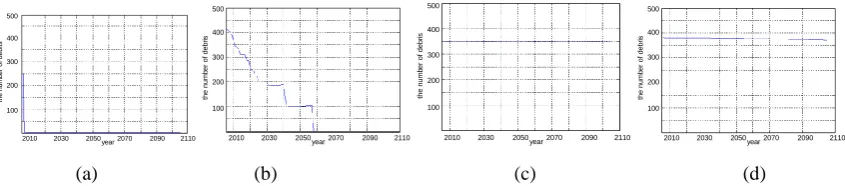
Furthermore, the long-term evolution of the collision factor is analysed. Fig. 6 shows the evolution of the debris quantity with effective collision factor. It can be seen that the change rule of the debris with effective collision factor is similar to the change of total debris quantity. When the explosion occurs in the low orbit, these debris would decay to nearly zero in 50 years, while it would hardly decay when the explosion is on the higher orbit. This phenomenon illustrated that the high-orbit explosion would increase the risk of collision between the generated debris and the other debris, leading to producing more debris.
2010 2030 2050year2070 2090 2110 100 200 300 400 500 th e n u m be r o f d e b ris
2010 2030 2050year2070 2090 2110 100 200 300 400 500 th e n u m be r o f d e b ris
2010 2030 2050year2070 2090 2110 100 200 300 400 500 th e n u m be r o f d e b ris
2010 2030 2050year2070 2090 2110 100 200 300 400 500 th e n u m be r o f d e b ris
(a) (b) (c) (d)
Figure 6. The number of debris with effective collision factor under different orbits after explosion events.
(a) hp=200km, (b) hp=400km,(c) hp=800km,(d) hp=1200km
Analysis of Debris Generation and Evolution Rules Caused by Collision Events
Similar to the analysis of explosion events, the collision scenario is set as follows: the mass of the collision object is 10kg, the orbit eccentricity and mass of the target object is 0.2 and 1000kg respectively. The collision occurs on the orbit with the perigee altitude 200km, 400km, 800km and 1200km. Based on the modified debris evolution model, the generation and evolution of the debris from year 2010 to year 2110 is shown in Fig. 7 to Fig. 10. It indicates that collision events and explosion events show a similar rule in the debris evolution. With the increase of the orbit altitude in which the event occurs, the decay rate of the debris quantity decreases obviously. However, the amount of debris that collision events produce is 3 to 4 times of the explosion events. Also, different from the explosion events, even the collision occurs on the low-orbit at 200km, the generated debris
2010 2030 2050 2070 2090 2110 1000 3000 5000 7000 9000 th e n u m be r o f d e b ris
year 2010 2030 2050 2070 2090 2110
100 200 300 400 500 600 th e n u m be r o f d e b ris
year 2010 2030 2050 2070 2090 2110
1000 3000 5000 7000 9000 th e n u m be r o f d e b ris
year 2010 2030 2050 2070 2090 2110
100 200 300 400 500 600 th e n u m be r o f d e b ri s year
[image:5.595.309.541.222.314.2](a) (b) (a) (b)
Figure 4. The generation and evolution of space debris caused by explosion events when hp=800km: (a) debris scale larger than 1cm, (b) debris scale larger than 10cm.
[image:5.595.62.291.224.319.2] [image:5.595.87.510.480.573.2]would not decay in 100 years with one sixth of debris remaining in the orbit, which indicates that debris from the collision has a greater long-term impact on the space environment.
2010 2030 2050 2070 2090 2110 0.5 1 1.5 2 2.5 3 th e n u m be r o f d e b ris year 3.5 4×10 4
2010 2030 2050 2070 2090 2110 200 400 600 800 1000 th e n u m be r o f d e b ris
year 2010 2030 2050 2070 2090 2110 0.5 1 1.5 2 2.5 3 th e n u m be r o f d e b ris year 3.5 4×10 4
2010 2030 2050 2070 2090 2110 200 400 600 800 1000 th e n u m be r o f d e b ris year
[image:6.595.307.536.108.208.2](a) (b) (a) (b)
Figure 7. The generation and evolution of space debris caused by collision events when: hp=200km (a) debris scale
[image:6.595.60.296.111.200.2]larger than 1cm, (b) debris scale larger than 10cm.
Figure 8. The generation and evolution of space debris caused by collision events when hp=400km: (a) debris scale
larger than 1cm, (b) debris scale larger than 10cm.
2010 2030 2050 2070 2090 2110 0.5 1 1.5 2 2.5 3 th e n u m be r o f d e b ris year 3.5 4 ×10⁴
2010 2030 2050 2070 2090 2110 200 400 600 800 1000 th e n u m be r o f d e b ris
year 2010 2030 2050 2070 2090 2110 0.5 1 1.5 2 2.5 3 th e n u m be r o f d e b ris year 3.5 4×10 4
2010 2030 2050 2070 2090 2110 200 400 600 800 1000 th e n u m be r o f d e b ris year
[image:6.595.307.539.262.351.2](a) (b) (a) (b)
Figure 9. The generation and evolution of space debris caused by collision events when hp=800km: (a) debris scale
larger than 1cm, (b) debris scale larger than 10cm.
Figure 10. The generation and evolution of space debris caused by explosion events when hp=1200km: (a) debris scale larger than 1cm, (b) debris scale larger than 10cm.
Furthermore, the long-term evolution of the quantity of the debris with efficient collision factor is analysed after the collision occurs, as shown in Fig. 11. The change rule of these debris quantity in different orbits is similar to that of explosion event, but the value is higher than that to explosion events. When the collision occurs on the lower orbit with hp=200km andhp=400km, although the
number of the debris does not decay in 100 years totally as shown before, these debris has no contribution to the debris with effective collision volume, the value of which would decrease to nearly zero in 50 years. When the collision occurs on the higher orbit with hp=800km andhp=1200km, the
debris with effective collision factor hardly decays, this phenomenon shows that the high-orbit collision has a probability leading to a second collision, which would lead to a further deterioration of the space debris environment.
2010 2030 2050 2070 2090 2110 500 1000 1500 2000 2500 th e n u m be r o f d e b ris
year 2010 2030 2050 2070 2090 2110 500 1000 1500 2000 2500 th e n u m be r o f d e b ris
year 2010 2030 2050 2070 2090 2110 500 1000 1500 2000 2500 th e n u m be r o f d e b ris
year 2010 2030 2050 2070 2090 2110 500 1000 1500 2000 2500 th e n u m be r o f d e b ris year
(a) (b) (c) (d)
Figure 11. The number of debris with effective collision factor under different orbits after collision events: (a) hp=200km, (b) hp=400km,(c) hp=800km,(d) hp=1200km.
Analysis of Collision Probability Based on Collision Factor
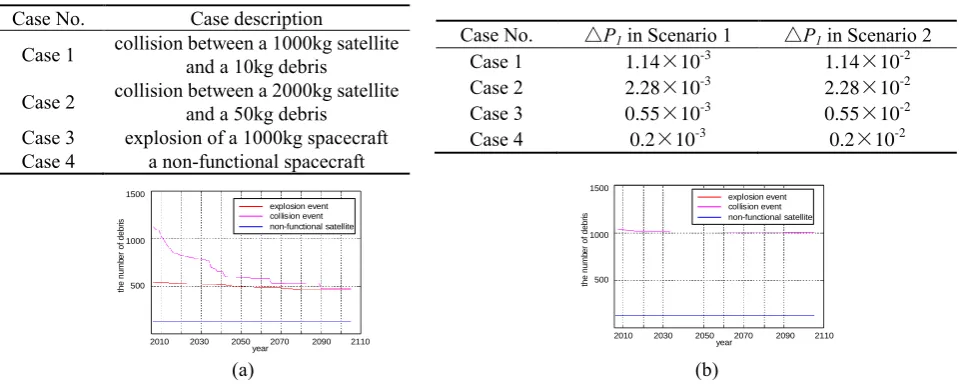
[image:6.595.61.292.263.352.2] [image:6.595.60.539.546.637.2]then according to the Eq. (10), the increase of the collision probability is listed in Table 2. From Table 2, it is seen that a higher density of the original debris distribution would lead to a higher increase on the collision probability.
Table 1. The details of the 4 Cases in two simulation scenario.
Case No. Case description
Case 1 collision between a 1000kg satellite and a 10kg debris
[image:7.595.60.540.147.340.2]Case 2 collision between a 2000kg satellite and a 50kg debris Case 3 explosion of a 1000kg spacecraft Case 4 a non-functional spacecraft
Table 2. The increase of collision probability under different conditions.
Case No. △P1 in Scenario 1 △P1 in Scenario 2
Case 1 1.14×10⁻³ 1.14×10⁻²
Case 2 2.28×10⁻³ 2.28×10⁻²
Case 3 0.55×10⁻³ 0.55×10⁻²
Case 4 0.2×10⁻³ 0.2×10⁻²
2010 2030 2050 2070 2090 2110 year
500 1000 1500
th
e
n
u
m
be
r
o
f
d
e
b
ris
explosion event collision event non-functional satellite
2010 2030 2050 2070 2090 2110 year
500 1000 1500
th
e
n
u
m
be
r
o
f
d
e
b
ris
explosion event collision event non-functional satellite
(a) (b)
Figure 12. The comparison of collision factors under different orbits.
Figure 12 shows the change of collision factor under different debris-generating events when the perigee altitudes are 600km and 1200km. It implies that in different events, the impact of collision on the future space environment is the largest, followed by the explosion, the least abandoned spacecraft.
Summary
In this paper, collision factor is proposed to describe the change of collision probability before and after the occurrence of break-up event. Based on the modified space debris evolution model SDEM and collision factors, detailed analysis is conducted on the generation and evolution of debris caused by spacecraft break-up event. The main conclusions are as follows:
(1) When the explosion event occurs in the low-orbit, the number of total debris and the debris with effective collision factor would decrease rapidly. When it occurs in the high-orbit, most of the debris would remain in space in long-term,leading to a great impact on the future debris environment.
(2) The change rule of debris quantity with efficient collision factor after collision event is similar to that of explosion event. However, when collision event occurs in low orbit and high orbit, the number of debris will not decay to 0, which may have a long-term impact on space environment. In addition, collision event produces more debris than explosion event.
(3) The impact of various events on the space environment can be expressed by collision probability factor. The impact of debris generation on the space environment is related to the original environment. With the same mass of the event object, the impact of collision on the future space environment is greater than the impact of explosion events and abandoned spacecraft.
Acknowledgement
References
[1] IADC Working Group 4, Support to the IADC Space Debris Mitigation Guidelines, no. 5.5 (2004) 1-40.
[2] ESA Space Debris Mitigation WG, ESA Space debris mitigation compliance verification guidelines, no. 1.0, (2015) 1-95.
[3] P. Y. Cui, X. Y. Ma, An evolution model space debris environment, High Technology Letters, 7 (2001) 75-78.
[4] S. B. Gong, M. Q. XU, P. Y. Cui, et al. An algorithm for the orbital evolution of space debris from breakup events, China Journal of Space Science, 25 (2005) 304-308.
[5] S. Ye, M. Q. Xu, P. Y. Cui, et al. Investigation on the method of developing mass distribution model of space debris, Flight Dynamics, 21 (2003) 62-65.
[6] S. Li, M. Q. Xu, P. Y. Cui. Small space debris environment database building, Flight Dynamic, 22 (2004) 79-82.