2016 International Conference on Electronic Information Technology and Intellectualization (ICEITI 2016) ISBN: 978-1-60595-364-9
The Congestion Control Based on Routing
Protocol in the Internet of Things
Ying Wei
ABSTRACT
The choice of routing in the internet of things becomes a challenging problem, due to the dynamic network environment and limited resources. In order to improve the efficiency of channel utilization and reduce the delay of data transmission, the protocol of “shortest-path routing” is usually used. However, the asymmetry of the wireless network may lead to the shortest path, yet not the optimum path. Our work improves the DSR routing protocol based on both “shortest-path routing” and “packet rate”. Our simulation results elucidate that the improved DSR routing protocol (DSR-s) can enhance communication performance in the internet of things and avoid congestion.
INTRODUCTION
analyzed the reason for the congestion and improved DSR(DSR-s). We also validated the effectiveness of DSR-s with simulations [1,2] .
ANALYSIS of NETWORKING CONGESTION
The Characteristics of Shortest- path Routing Protocol in The Internet of Things
There are many network structures in the internet of things. The most famous is Ad Hoc, which generally adopts “shortest-path” protocol. However, the result is not always the best by choosing the minimum hop count as the routing standard, due to the effect of MAC protocol in wireless network and its asymmetric characteristics. Furthermore, when nodes communicate with each other in the wireless ad hoc network, a node serves as a host, antenna and router. A node discovers the data storage and forwards all the work. With the expansion of network scale, the load increases. Once the local network congestion occurs, throughput will dramatically drop. If “shortest- path” protocol is adopted, the nodes in the path have to receive more and more data to store and forward. However, the node’s processing capability and link bandwidth are usually limited. The data will be waiting a long time in the queue buffer to lead to traffic congestion. With the continuous decrease in the buffer space, the data in the buffer overflow will start quickly and then a lot of data packets will be lost. If nodes do not take an effective strategy to send fewer amounts of data, the conjunction point will become a bottleneck and the network would crash.
DSR Routing Protocol Discovery and Maintenance
The DSR routing protocol works in the on-demand mode. Each node in the network sends routing request packets dependent on the needs and searches a routing to reduce the routing overhead. Generally they are divided into two stages: the routing discovery and the routing maintenance. DSR follows “shortest-path” principle in the path selection. If the source node has the routing information in the cache, they will select the minimum hop routing; if the source node does not have the routing information in the cache, the routing discovery process starts and treats the route of the earliest responding as the shortest route[3,4,5].
destination node itself will be the destination node and the node along the RREQ route will generate Route Replies(RREP)[6]. If such a route does not exist or it is not the destination node, the node will forward a RREQ.
Routing maintenance: If a junction on the path of data packet transmission fails, it will return a route error packet to the source node. The route error packet contains two node addresses of the failure linkage. The node, which receives the packet, deletes the error linkage to minimize the impact. After the source node receives a route error packet, it triggers the establishment of process of a new route.
THE IMPROVED DSR ROUTING PROTOCOL
The Strategy for the Improvement
In DSR routing protocol, which uses “shortest-path” as the judgment, the communication node serves as a router to forward a packet. If there are a large amount of communication flows in the network, the load of the nodes on the shortest path increases and the rates of sending and receiving packets become larger. When the rate of communication node packet reception is greater than sending data packets, the queue space will continuously decrease and the data packet loss will occur. Therefore the status of the node’s data transmission can be used to identify the state of congestion. If the node’s network state is good and a node sends date in a higher rate, the routing metrics can be redefined by taking into account both factors (“the node sending rate” and “shortest-path”), in order to improve DSR routing protocol. The routing metrics reaches the maximum value, when the node network sate is good, nodes have the high rate of data transmission and the ratio of the route in respect to “the shortest path” is small.
route is found and the route request packet is returned to the source node, the rate of nodes’ data transmission in the returned packet is the minimum value of all nodes on the route. The performance of the route is evaluated by the packet delivery rate and the hop count. The hop count returned is the route hop. The route is selected based on the values of hop count and data transmission rate. The route of the maximum values is chosen.[7,8].
The methodology of DSR_s
In the methodology of DSR_s, three parameters are defined: Hop Count(ri), Ptr and S. Hop Count(ri) presents the hops of the routing i; Ptr is the rate of the node’s sending the data; and S is the routing metric.
The following elaborates more details about the definition of HopCount(ri). For a routing assemble R{r0,r1,...,rm} between the source node (NS) and the destination node (ND),there are two components: ri{i,HopCount(ri)}(0≤i≤m) for the routing of i, and the numbers of the node count, HopCount(ri).
Ptr is nodes’ data transmission rate, which is estimated with the sampling of every T second. The value of Ptr changes with the state of the transmission of data packets. Ptr is calculated by using the method of exponential weighted moving average. The rate of next node to send data packets (Ptrn+1) is estimated with the rates of current node’s(Ptrn) and sample node’s(Ptr sample) by
Ptrn 1 α ∙ Ptrn 1 α ∙ Ptrsample 1
where α is set as0.3,in order to assigna high priority to Ptrsample. The sampling time is 3 seconds, i.e. T = 3 s. And the parameter, S is defined as the ratio between Ptrn and Hop Count(ri)to measure the routing by
S Ptrn
HopCount ri (2)
SIMULATION AND PERFORMANCE ANALYSIS OF DSR_S
We simulate data communication by using NS simulation software and compare network performance between DSR and DSR_s. CBR is used as a load generator. Datagram packets size is 1460 byte. Nodes have random moment in the topology space of 1000 × 1000m2.The IEEE802.11g protocol is employed. In the physical layer, maximum bandwidth is 54Mbps.The wireless transmission range of 100m and the simulation time of 600 seconds.
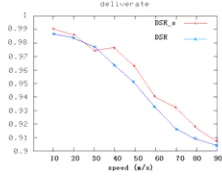
throughputs decrease with the increase of the speed of mobile nodes. Moreover, the total throughput of the DSR_s integral is observed to be greater than that of DSR. Fig 2 shows that the average delivery rate between nodes at different moving speeds for both DSR and DSR_s. The average packet delivery ratio demonstrates the reliability of network transmission: the higher rate, the more reliable. The average packet delivery rate is higher in DSR_s than that in DSR, which shows DSR_s is more reliable. Because the DSR routing protocols only considers “shortest-path”, however “shortest-path” can result in the congestion more easily by some nodes out of capability and then affects the network performance. But DSR_s chooses a route by considering both “shortest-path” and “nodes’ data transmission status”. Based on the shortest path, DSR_s chooses a route adaptively according to the nodes’ data transmission status in order to relieve the network congestion.
In Experiment 2, we investigated the packet delivery rate of DSR routing protocol and DSR_s routing protocol in different size of network, i.e. the number of nodes. Fig. 3 compares the delivery rates as a function of node number for both DSR and DSR_s. For the small size of network delivery rate decreases significantly with the increase of the node numbers for both the DSR and DSR_s, however DSR_s is found to decrease more sharply compared to DSR. Because the network bandwidth is not fully utilized initially, there is still enough room for a growth for a small size of network. If the size of the network increases further, the routing overhead increases, congestion may occur and affect the packets delivery rate. Fig. 4 shows relationship between the average end-to-end delay and the number of nodes. The average end-to-end delay of data packets increases slowly for a small network, but fast for a larger network. From the comparison above, it can be concluded that DSR_s performances better than DSR, in term of both the delivery rate and end-to-end delay. DSR_s enables to adaptively choose a route to relieve network congestion by using a strategy to take into account both “shortest-path” and nodes’ sending rate. When the data reaches a node at a rate beyond the node’s processing capacity, it retentions in the node buffer queues for transmission. When such a state lasts for a certain period of time, the node buffer overflows quickly and then the data packets drop. Eventually network congestion occurs [7,8].
CONCLSUSIONS
“node sending rate" in DSR on network performance. From the simulation experimental results, we found that DSR_s can improve the network communication performance, and make full use of the network.
[image:6.612.111.233.142.231.2] [image:6.612.313.424.143.231.2]
Figure 1. Throughput in different speeds. Figure 2. Delivery rate in different speeds.
Figure 3. Delivery rate in different number nodes. Figure 4. packets delay time in different number. nodes
ACKNOWLEDGMENT
This work was funded by Fujian young teacher education research project (Fund NO. JA13355).
REFERENCES
1. Zhang Deng-yin, Wang Jun-ling. 2010. Research on Performance Comparisonamong Improved AODV Routing Protocols [J]. Computer Technology and Development, 2010(1): 67-70.
2. Zhao Xin-wei, Zheng Hong-fei, 2011, Analysis and Simulation on Routing Protocols of Ad Hoc Networks [J], Computer Security, 2011(7): 40-43.
3. Wang Y., Zhou Y.,Yu Yet al, 2012, mAD-AODV: A improved routing protocol based on network mobility and route hops [C]//WiCOM2012: Proceedings of the 2012 8th International Conference on Wireless CommunicationsmNetworking and Mobile Computing, Piscataway: IEEE, 2012: 1 - 4.
4. Du Q., Zhu J., Zhang E., 2011, Optimized AODV routing protocol based on reverse route search in leisure time and route learning [J],Journal on Communications,2011,32( 8):64-71.
5. Li S., Li X., Feng Q., 1989, An improved AODV local repair algorithm based on delay constraint [C]//ICSP2012: Proceedings of 2012 IEEE 11th International Conference on Signal Processing. Piscataway: IEEE, 2012: 2212 - 2216.M. Young, The Technical Writer’s Handbook. Mill Valley, CA: University Science, 1989.
6. Biradar S.R., Koushik Majumder, Subir Kumar Sarkar, et al, 2010, Per formance ev aluation and comparison of AODV and AOMDV [J]. Inter natio nal Jour nal on Computer Science and Engineering, 2010, 2( 2): 373-377.
7. Yang Yang, Song GuanNan, Wei Kun, Zhang Wu Xiong, You Xiao Hu. 2015, ACK-based adaptive backoff for random access protocols [J]. Science China(Information Sciences). 2015(04).
8. Al-Mekhlafi Z.G., Hassan R. 2011, Evaluation study on routing information protocol and dynamic source routing in Ad-Hoc network. Proceedings of 2011 7th International Conference on IT in Asia (CITA). 2011.
9. Xu Zhen, Xiao Juan. 2012, Energy-aware and delay-aware QoS routing in mobile Ad Hoc networks. Proceedings of IEEE ICCP. 2012.