2017 International Conference on Computer Science and Application Engineering (CSAE 2017) ISBN: 978-1-60595-505-6
Quantum Brain Storm Optimization of GaN Power Amplifier Design
Yiwen Xia1, Jun Steed Huang2, Wen Tang3 and Di Wu4,*
1
Carleton University, 1125 Colonel By Drive, Ottawa, ON K1S 5B6
2
Southern University of Science and Technology, No 1088, Xueyuan Rd., Xili, Nanshan District, Shenzhen, Guangdong, China
3
Suqian College, Jiangsu University, 399 South Huanghe Rd., Suqian, Jiangsu, China.
4
Shanghai University of Engineering Science, 333 Longteng Road, Shanghai, China
ABSTRACT
This paper presents a novel quantum paired brain storm optimized analysis for GaN based power amplifier in 5G environment. The GaN power amplifier has a number of modeling parameters that need to be matched with the S-parameter measurement results. These parameters are from a handful small signal models. We use a quantum state brain storm optimization to fit these parameters to make sure that they are not falling into the local solution that is good for one frequency, but not good for the others. Simulation shows clearly the sensitive region of the parameters.
INTRODUCTION
Gallium Nitride (GaN) is a column III and column V (in periodic table) direct band gap semiconductor commonly used in light-emitting diodes since the 1990s. The compound material is very hard, it has a Wurtzite crystal structure, named after the mineral Wurtzite, which is a crystal structure with a hexagonal system, or 120 degree angle. Its wide band gap of 3.4 eV affords it special properties for applications in optoelectronic[1] high-power and high-frequency devices. For example, GaN is the substrate which makes violet (blue) laser diodes possible, without using of nonlinear optical frequency-multiplication.
Its sensitivity to ionizing radiation is low, making it a suitable material for solar cell arrays for deep space applications. Because GaN transistors can operate at much higher temperatures and work at much higher voltages than traditional Gallium Arsenide (GaAs) transistors, they make ideal power amplifiers at microwave frequencies today for 5G applications.
nitride metal semiconductor field-effect transistors (GaN MESFET) were experimentally demonstrated in 1993[7]and they are being actively developed all over the world.
In 2010 the first enhancement-mode gallium nitride transistors became generally available [8]. These devices were designed to replace power MOSFETs in applications where switching speed or power conversion efficiency is critical. These transistors, also called eGaN FETs, are built by growing a thin layer of GaN on top of a standard silicon wafer. This allows the eGaN FETs to maintain costs similar to silicon power MOSFETs but with the superior electrical performance of GaN.
Following are the main contents of our paper:1) A Brain Storm Application GaN Transistor For 5G; 2) Modeling The Frequency Response Functions For Power Amplifier In 5G; 3) Brain Storm Optimized Transistor.
A BRAIN STORM APPLICATION FOR GAN TRANSISTOR IN 5G
To minimize the parameter extraction error encountered during the modeling process, both the GaN small signal model and the S-parameter measurement have to be accurate; such that once the actual value is found by the optimization searching process, the final model will be good to be used as a circuit simulation library. Parameter extraction is an important part of model development. Many different extraction methods have been developed [9, 10]. The appropriate methodology depends on the model and on the way the model is used. A combination of a local optimization and the group device extraction strategy is adopted for parameter extraction.
There are two main, different optimization strategies: global optimization and local optimization. Global optimization relies on the explicit use of a computer to find one set of model parameters which will best fit the available experimental (measured) data. This methodology may give the minimum average error between measured and simulated (calculated) data points, but it also treats each parameter as a "fitting" parameter. Physical parameters extracted in such a manner might yield values that are not consistent with their physical intent.
In local optimization, many parameters are extracted independently of one another. Parameters are extracted from device bias conditions which correspond to dominant physical mechanisms. Parameters which are extracted in this manner might not fit experimental data in all the bias conditions. Nonetheless, these extraction methodologies are developed specifically with respect to a given parameters physical meaning. If properly executed, it should, overall, predict extraction strategies device performance quite well. Values extracted in this manner will now have some physical relevance.
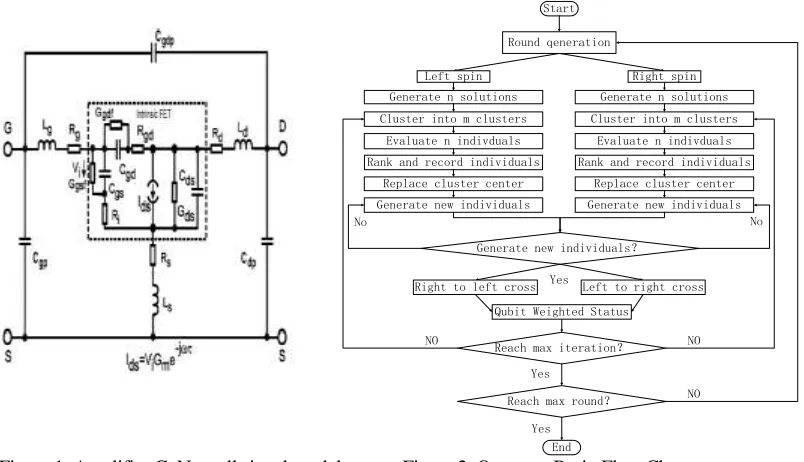
A Quantum Twin Brain Storm Optimized resource allocation structure is proposed instead of one kind for all locations, for the following reason: Each measured parameters has its own underline nonlinear functions, which are stemmed from completely different roots, by using the exact the same brain to optimize them is hard. Note that the amplifier working at for 5G and at WiFi mode will be different. A typical small signal model of GaN is shown in Figure 1.
model is too sensitive to the measurement errors. 2) The local optimization model can deal with random errors, but may not fit with the others. 3) The global optimization can fit with others, but may lose physical meaning.
Start
Generate n solutions
Cluster into m clusters
Evaluate n indivduals
Rank and record individuals
Replace cluster center
Generate new individuals No
Generate n solutions
Cluster into m clusters
Evaluate n indivduals
Rank and record individuals
Replace cluster center
Generate new individuals
Generate new individuals?
NO No
Reach max iteration?
Left spin Right spin
Left to right cross Right to left cross
Qubit Weighted Status
NO
Yes
Yes Round qeneration
Reach max round?
End
NO
[image:3.612.95.497.109.340.2]Yes
Figure 1. Amplifier GaN small signal model. Figure 2. Quantum Brain Flow Chart.
The method that can handle the above three considerations is the Brain Storm Optimization (BSO) with a quantum method as shown in Figure 2. The Quantum Brain Storm Optimized approach comes from studying of actual quantum entanglement phenomenon, where a status of particle may affect the other almost instantly.
BSO algorithm is a new and promising swarm intelligence algorithm, which simulates the human brainstorming process. Through the convergent operation and divergent operation, individuals in BSO are grouped and diverged in the search space/objective space, the group is called cluster. Every individual in the BSO algorithm is not only a solution to the problem to be optimized, but also a data point to reveal the physical landscape characteristics of the distributed parameter problem, in the sense of the data mining. Swarm intelligence and data mining techniques can be combined to produce benefits above and beyond what either method could, doing so we extend the developmental capability, using a twin brain storming process setting; such that two processes are entangled together, forming a quantum bit (qubit) status. Such that if one BSO process is in a local minimum, the others will be not falling in the same spot. In quantum words, the pair is in both spots at the same time. Fairly much like the Schrödinger's cat was both live and dead at the same time. In this way, we can move the individual in the search space on different directions of different dimensions, both below the speed of light in normal space or above the speed of light in superspace, as the entanglement does.
MODELING THE FREQUENCY RESPONSE FUNCTIONS FOR POWER AMPLIFIER IN 5G
Small-signal modeling is a common analysis technique in power amplifier which is used to approximate the behavior of containing nonlinearity with linear equations. It is applicable to circuits in which the AC signals, the time-varying currents and voltages in the circuit, have a small magnitude compared to the DC bias currents and voltages. A small-signal model is an AC equivalent circuit in which the nonlinear circuit elements are replaced by linear elements whose values are given by the first-order (linear) approximation of their characteristic curve near the bias point.
However in some electronic circuits such as radio receivers, sensors and signal processing circuits, the AC signals are "small" compared to the DC voltages and currents in the circuit. In these, perturbation theory can be used to derive an approximate AC equivalent circuit which is linear, allowing the AC behavior of the circuit to be calculated easily. If the characteristic curve of the device is sufficiently flat over the region occupied by the signal, using a Taylor series expansion the nonlinear function can be approximated near the bias point by its first order partial derivative. These partial derivatives represent the incremental capacitance, resistance inductance and gain seen by the signal, and can be used to create a linear equivalent circuit giving the response of the real circuit to a small AC signal. This is called the "small-signal model".
Scatter Parameters, also called S-parameters, belong to the group to two-part parameters used in two port theory. Like the Y or Z parameter, they describe the performance of a two port completely. Different to Y and Z, however, they relate to the traveling waves that are scattered or reflected when a network is inserted into a transmission line of a certain characteristic impedance ZL.
Therefore, S-parameters can be compared to reflection and through pass of a pair of spectacles. S-parameters are important in microwave design because they are easier to measure and to work with at high frequencies than other kinds of two port parameters. They are conceptually simple, analytically convenient and capable of providing detailed insight into a measurement and modeling problem. However, it must kept in mind that like all other two port parameters, S-parameters are linear by default, i.e., they represent the linear behavior of the two-part. In order to extract the small signal model parameters from the S-parameters measurement, we need some optimization method, to pick the parameters that are good for all frequencies, at the same time not sensitive to measurement errors.
BRAIN STORM OPTIMIZED TRANSISTOR
Both brains adopt Lorentz transfer with either traditional normal speed individual or advanced super speed based brain parameter mapping function. This application driven transistor has only one output vector scale, contains the 19 decision weights, corresponding to the extraction success rate of each GaN node. For BSO mining, the error between the application GaN Transistor output and the expected value from the field testing. The factional error variation acts as the fitness function. The population size is a hundred, depending on the adaptation from the quantum entanglement interactions of the twin, new individual probability is 0.2, and the initial positions are of zero, the range is +5 to -5. The velocity of the quantum is 0.01%. The absolute value of the quantum speed g is 9931c, c is the speed of light, calculated from g^(e/2)=c^2, where e=2.71828. The sum of error cubic root has no bottom limit until the application driven transistor is trained less than 20 iterations. It is shown that the optimization process is convergent in the course of computer simulation. Thus a BSO trained application driven Transistor module is produced to realize the nonlinear mapping relationship between the measured S-parameters of mobile in the 5G system.
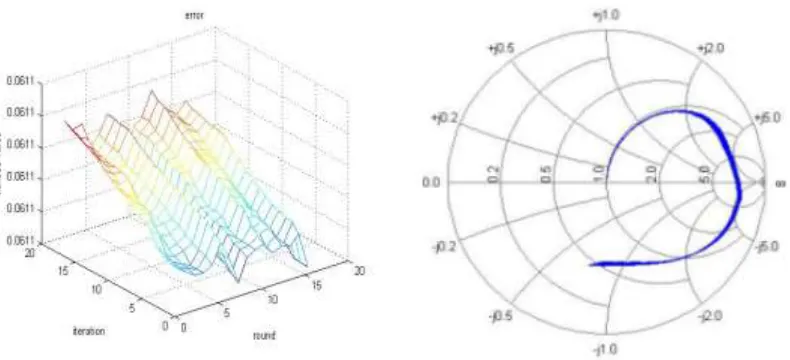
Figure 3. Target variation optimized via quantum brains. Figure 4. S-parameter sensitivity analysis.
The parameter extracting success rate of the trained application GaN Transistor module is fed with the current q-point parameters when the system is measured as well. The 5G application driven transistor output is produced by the final balance of the success rate optimized with the computer simulation by the measured S-parameters. During the training period, twin BSO algorithm searches for the best solution by making brains moving around the search space according to the resulted qubit position. But when one brain is weighted as the global best brain continuously, the other brains may still searching for the better global minimum repeatedly, which gets the brain storm out of the local optimization.
From which, we can see that the Figure 3 presents the best result, where the error is the minimum, after only a few iterations. Figure 4 shows the variations caused by the 75 ohm load imbalance, the thin part of line means the S-parameter is not sensitive to measurement error from the load change, and the thick part of line means the S-parameter is sensitive to measurement error from the load change. From above results, we see that the Quantum Brain Storm Optimized method offers the additional flexibility to fit the complicated model of situations. Due to its extra combinations of the nonlinear decision regions, it allows the search to be carried out in the 5G GaN over different loads, while single function can only fit either one load at a time, not all load situations.
CONCLUSIONS
The equations of a 5G GaN for fitting with Quantum Brain Storm Optimized Application Driven Transistor, that takes S-parameter measurement into considerations. A Power amplifier in 5G trained by brain storm optimization with Quantum entangled algorithm minimizes the impact from the measurement errors caused by load variation. The simulation shows that the proposed approach is a viable engineering solution towards the low cost high volume and precise controlling of the 5G GaN measurement system. New algorithm makes the trained decision more flexible for frequency and load customization.
ACKNOWLEDGEMENT
We would like to thank Prof. Yuhui Shi for offering BSO code and the valuable input into the final flow chart.
REFERENCES
1. Diddi, V., S. Sakata, S. Shinjo., V. Vorapipat, and R. Eden. 2016. “Broadband digitally-controlled
power amplifier based on CMOS/GaN combination,” in Radio Frequency Integrated Circuits
Symposium, pp. 258-261.
2. Jayamon, J. A., J. F. Buckwalter, and P. M. Asbeck. 2016. “A PMOS mm-wave power amplifier at
77 GHz with 90 mW output power and 24% efficiency,” in Radio Frequency Integrated Circuits
Symposium, pp. 262-265.
3. Chung, Y., C. Y. Hang, S. Cai, and Y. Qian. 2003. “AlGaN/GaN HFET power amplifier integrated
with microstrip antenna for RF front-end applications,” IEEE Transactions on Microwave Theory
and Techniques, 51(2): 653-659.
4. Khalil, I., A. Liero, M. Rudolph, and W. Heinrich. 2008. “GaN HEMT potential for low-noise
highly linear RF applications,” IEEE Microwave & Wireless Components Letters, 18(9): 605-607.
5. Fujiwara, T. K. Mukai, H. Nakamizo, S Shinjo, and J. J. Yan. 2016. “All gallium nitride
envelope-tracking multiband power amplifier using 200MHz switching buck-converter,” in
Microwave Integrated Circuits Conference, pp.125-128.
6. Levy, C. S., V. Vorapipat, and J. F. Buckwalter. 2016. “A 14-GHz, 22-dBm Series Doherty Power
Amplifier in 45-nm CMOS SOI,” in Compound Semiconductor Integrated Circuit Symposium,
pp.1-4.
7. Oda, M. J. Kikawa, A. Takatsuka, and R. Tokuda. 2015. “Vertical Schottky barrier diodes of α-Ga 2
8. Aggarwal, R., A. Agrawal, M. Gupta, and R. S. Gupta. 2011. “Improved linearity performance of AlGaN/GaN MISHFET over conventional HFETs: An optimization study for wireless
infrastructure applications,” Superlattices & Microstructures, 50(1):1-13.
9. Khan, M. A., J. N. Kuznia, A.R Bhattarai, and D. T. Olson. 1993. “Metal semiconductor field effect
transistor based on single crystal GaN,” Applied Physics Letters, 62(15):1786-1787.
10. Kanamura, M., T. Ohki, T. Kikkawa, K. Lmanishi, and T. lmada. 2010. “Enhancement-mode GaN
MIS-HEMTs with n-GaN/i-AlN/n-GaN triple cap layer and high-$ k $ gate dielectrics,” IEEE
Electron Device Letters, 31(3): 189-191.
11. Zhou, D., Y. Shi, and S. Cheng. “Brain Storm Optimization Algorithm with Modified Step-Size and
Individual Generation,” in Lecture Notes in Computer Science, pp. 243-252.
12. Hussein, A. S., and A. H. Jarndal. 2016. “Reliable particle-swarm-optimization based parameter