The London School of Economics and Political Science
From Components to Compositions: (De-)construction of
computer-controlled behaviour with the Robot Operating System
Antti Kalervo Lyyra
A thesis submitted to the Department of Management, Information Systems
and Innovation Group, of the London School of Economics for the degree
of Doctor of Philosophy.
Declaration
I certify that the thesis I have presented for examination for the MPhil/PhD degree of the London School of Economics and Political Science is solely my own work other than where I have clearly indicated that it is the work of others (in which case the extent of any work carried out jointly by me and any other person is clearly identified in it).
The copyright of this thesis rests with the author. Quotation from it is permitted, provided that full acknowledgement is made. This thesis may not be reproduced without my prior written consent.
I warrant that this authorisation does not, to the best of my belief, infringe the rights of any third party.
Abstract
Acknowledgements
I would like to express my profound gratitude to my supervisor Dr Carsten Sørensen for his continuous support, patience and motivation throughout this research. His knowledge and guidance have been of paramount importance throughout my PhD.
In addition to Carsten, I am in gratitude to the Information Systems and Innovation Group and its excellent faculty. Professor Jannis Kallinikos, Dr Will Venters and Dr Maha Shaikh have provided their valuable advice and support, and through various discussions and research seminars, I have learned to broaden my approach to research and to question many of my previous assumptions. I also thank my joyous community of PhD fellows, Kanchana Ambagahawita, Kari Koskinen, Emilio Lastra Gil, Kyung Ryul Park, Atta Addo, Florian Allwein, Gizdem Akdur, Zeynep Kaparoglu, Cody Dodd, Dana Lunberry, Rohit Nair, Andrea Paletti, Marta Stelmaszak, Erika Valderrama Venegas, Laura Zimmerman, Ceren Erdem, Rebecca Campbell, Boyi Li, Niccolò Tempini, Aleksi Aaltonen and Enrico Rossi, for stimulating discussions, friendship and support.
This PhD was funded by Liikesivistysrahasto, Emil Aaltosen Säätiö and LSE’s Research Studentship Scheme, for which I am profoundly grateful.
Table of contents
1 Introduction 14
The opening paragraph 14
Domains of digital innovation 14
Blending of digital, physical and autonomous technologies 16
1.1 Motivation and scope of research 18
1.1.1 Product architectures and organising logic of innovation 19 1.1.2 Distributedness of knowledge and control 19
1.1.3 Specificity of designs 21
1.1.4 Empirical observations 23
1.2 Problem statement and research questions 25
1.3 Research objective and approach 28
1.4 Targets for contributions 29
1.5 Structure for the dissertation 30
2 Literature review 32
2.1 Innovation and novelty in technology 34
2.2 Modularity and product architectures 38
2.2.1 Product architectures 39
2.2.2 Modularisation and task partitioning 42 2.2.3 Modularity as a property of product systems 44
2.3 Generativity and digital innovation 46
2.3.1 Digital computation 47
2.3.2 Modularity in computer systems 49
2.3.3 Generative combinations 51
2.4 Digitised products 54
2.4.1 Layered modularity architecture 55
2.4.2 Materiality and product architectures 59
2.5 Complex and digitised products 60
2.5.1 Robots and autonomous systems 60
2.5.2 Complex digitised products 64
2.6 Problematisation and research question 68
2.7 Summary 71
3 Theoretical framework 72
3.1 Thinking in systems 73
3.1.1 Complex systems 75
3.1.2 Structures of complexity 77
3.1.3 Considerations on the identification of structures 80
3.2 Operative research questions 82
3.2.1 Subsystems and combinations 83
3.3 Summary 86
4 Research design 87
4.1 A case study as an evolving inquiry 87
4.2 Thematic analysis as iteratitive abstraction of patterns 94
4.3 Role of tentative a priori concepts 97
4.4 Research design framework 98
4.5 ROS as an embedded case study 100
4.5.1 The Robot Operating System 102
4.5.2 Embedded units of analysis 104
4.6 Data collection 107
4.6.1 Documents as research data 108
4.6.2 Construction of the research database 110
4.7 Data analysis 116
4.7.1 Case description 117
4.7.2 Thematic analysis 119
4.7.3 Reporting of themes and categories 121
4.7.4 Evaluation of evidence 114
4.8 Summary 124
5 Case description 125
5.1 Three viewpoints on ROS 126
5.2 PR and Switchyard at Stanford 129
5.3 PR2 and ROS at Willow Garage 134
5.4 The wider uptake of ROS 141
5.5 From ROS 1 to ROS 2 145
5.6 Summary 147
6 Results of analysis 149
Part one 150
6.1 Summary of themes and categories 151
6.2 Robot systems and their constituent elements 159
6.2.1 Robot systems 159
6.2.2 Physical embodiments 165
6.2.3 Communication systems 171
6.2.4 Transformation systems 178
6.2.5 Visualisation and testing systems 184 6.3 Robot systems as chains of transformation 191
Part two 198
6.4 From components to compositions 199
6.4.1 ROS community and software development 199 6.4.2 Transferability of software and knowledge 203 6.4.3 Generative-integrative mode of development 208 6.5 Under specification and constructive ambiguity 212
6.6 Summary 217
7 Discussion 218
7.1 Summary of conceptual findings 218
7.2 Enfolding literature 225
7.2.1 Integrality and modularity 226
7.2.2 Generative combinations 228
7.2.3 Layered modular architecture 230
7.2.4 Complementary architectural frames 233
7.2.5 Complex products and systems 234
7.2.6 Summary 235
7.3 Application of the proposed concepts 236
7.3.1 Chains of transformation 236
7.3.2 Generative-integrative mode of development 238
7.4 Summary 243
8 Conclusions 245
8.1 Overview of the thesis and summary of the findings 245 8.1.1 Background and research questions 245
8.1.2 Approach to research 248
8.1.3 Empirical findings 249
8.1.4 Contributions to literature 251
8.2 Validity and research limitations 254
8.3 Future research 256
9 References 259
10 Appendix A 271
11 Appendix B 273
12 Appendix C 276
13 Appendix D 279
14 Appendix E 281
15 Appendix F 283
16 Appendix G 285
17 Appendix H 286
List of abbreviations
BSD – Berkeley Software Distribution
DARPA – Defence Advanced Research Project Agency DDS – Data Distributions Services standard
DRC – DARPA Robotics Challenge ERF – European Robotics Forum
ICRA – IEEE International Conference on Robotics and Automation IREX – International Robot Exhibition
LCIM – Levels of Conceptual Interoperability Model MRDS – Microsoft Robotics Developer Studio
NAO – A bipedal robot from Softbank Robotics
NASA – National Aeronautics and Space Administration NRI – National Robotics Initiative
OMG – Object Management Group Orocos – Open Robot Control Software OSI – Open Systems Interconnection model OSRF – Open Source Robotics Foundation PR – Personal Robot (Stanford)
PR2 – Personal Robot 2 (Willow Garage) ROS – Robot Operating System
ROSCon – ROS developer conference ROS-I – ROS-Industrial consortia Rqt – ROS QT user interface RViz – Robot visualiser
STAIR – Stanford Artificial Intelligent Robot
TCP/IP – Transmission Control Protocol/Internet Protocol
List of tables
Table 1: Research design framework Table 2: Summary of research database Table 3: The five phases of thematic analysis
List of figures
Figure 1: The structure of the literature review
Figure 2: An illustration of a four-level nested hierarchy
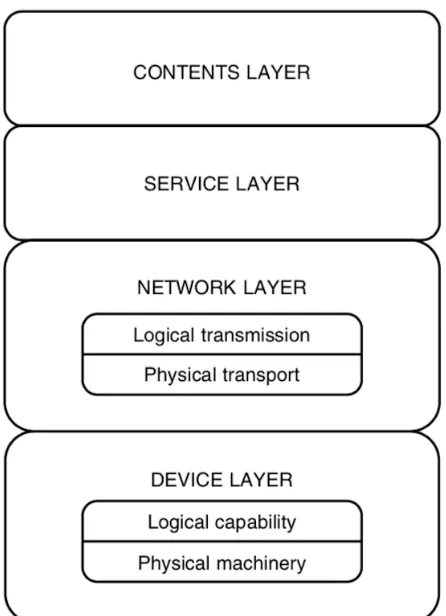
Figure 3: An illustration of functional allocation of a product architecture Figure 4: The layered architecture of digital technology
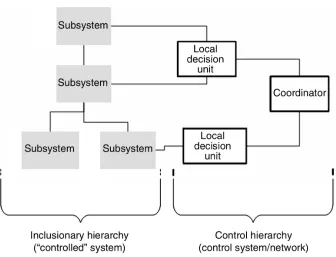
Figure 5: Illustration of the dual-product hierarchy view of complex systems Figure 6: The computational graph used in the “fetch a stapler“ demonstration Figure 7: Personal robot PR1 prototype
Figure 8: The STAIR 1 robot Figure 9: The STAIR 2 robot Figure 10: The PR2 robot
Figure 11: PR2, ROS and applications as a layered stack
Figure 12: Team Delft robot setup in the Amazon Picking Challenge work cell Figure 13: Team ViGIR's Approach to the 2013 DARPA Robotics Challenge Trials
Figure 14: Warehouse logistics robots from Fetch Robotics Figure 15: Relay, a hotel delivery robot from Savioke
Figure 16: TiM5xx two-dimensional laser range finder by SICK Figure 17: RealSense™ D435 camera package by Intel®
Figure 18: Motoman industrial robot arms, MH5F, SDA10, SIA20, by Yaskawa Figure 19: Husky, a mobile base by Clearpath Robotics
Figure 20: NAO, a bipedal robot by Softbank Robotics
Figure 21: DJI Matrice 100, a quadrotor for developers by DJI Figure 22: A ROS graph
Figure 23: Pose2D Message that expresses a position and orientation on a two-dimensional surface
Figure 24: A simple example of a ROS launch file
Figure 25: DiagnosticsStatus message for reporting the status of an individual component of the robot
Figure 26: A categorisation of connectors in terms of computing platforms and integration approaches
Figure 30: An example of an RQT visualisation dashboard
Figure 31: RViz visualisation of the kinematic structure and motion planning of robot systems
Figure 32: Sensory data processing that shows data from a laser range finger with intensity information and resulting Octomap representation
Figure 33: Simulation illustrations from Team ViGIR’s approach to Darpa Virtual Robotics Challenge
Figure 34: Use cases and target environments for Gazebo simulations
Figure 35: Simulation environments are constructed with editors from different simulation objects
Figure 36: An example that contrasts a simple block model and physical simulation
Figure 37: A conceptual model of a robot system
Figure 38: A contextually embedded model of a robot system
Figure 39: Team Delft’s implementation of MoveIt! for Amazon Picking Challenge
Glossary of key terms
This glossary outlines central concepts and key terminology used in this thesis.
Robots and autonomous systems refer to machines and systems that produce goal-directed and context-dependent behaviour to operate autonomously with limited human intervention. They have sensors and actuators and they render their behaviour from the direct interaction with the surrounding environment. For the most part, their behaviour is controlled by computers.
Artificial intelligence refers to software. In particular to computational
processes that transform between qualitatively different inputs to outputs in a way that can be viewed as advanced and sophisticated.
A robot system refers to some particular instance of robots and autonomous systems. A self-driving car or an industrial robot can be considered as a robot system.
Product architecture refers to a scheme by which the functionality of a product is allocated to its components. Can be characterised for example in terms of modularity and integrality. With modularity, functional interdependencies among components are low so that they can be separated and combined to produce product variety. With integrality, functional interdependencies among components are high so that a change in a component triggers changes in the components it interacts with.
Modularisation refers to a top-down process that partitions a product design into modules that can be separated and combined as per the design rules. Assumes centralised design agency from the part of the architect that performs the partitioning into a hierarchy of parts. Characterises coordinated product innovation.
components and systems that adhere to common standards and open interfaces. Assumes distributed design agency as the knowledge and control of digital objects and artefacts is distributed across a heterogeneous group of actors. Characterises uncoordinated digital innovation.
Specificity of complex systems refers to a dual-view of product architectures that entails the hierarchies of inclusion and control. The hierarchy of inclusion refers to a hierarchy of parts that forms the physical embodiment, and the hierarchy of control refers to the parts and systems that control the behaviour of that embodiment. As the two hierarchies are interdependent, detailed knowledge of components and their interactions is needed to produce desired functionalities.
Organising logic of innovation refers to the dynamics of combination in the context of product architectures. Modularity (modularisation), generativity and specificity (complexity) manifest different logics of combination.
Complex digital innovation is a form of digital innovation that intertwines the physical and digital worlds with computer-controlled behaviour. The organising logic of complex digital innovation is the focal point of this research.
A system is a complex of interacting elements. Systems can be differentiated between each other by the number and type of their constituent elements and their respective interactions.
The Robot Operating System (ROS) is an open-source robot software development framework. The ROS communication system, development tools and software distribution infrastructure facilitate the development of robots and autonomous systems as distributed computation, and the ROS community brings together a heterogeneous group of roboticists from academia and industry.
Thematic analysis is an iterative and interrogative method of data analysis
that seeks to identify recurring patterns that warrant categorisation, abstraction and conceptualisation of phenomena. This method of analysis consists of five phases, which are familiarisation, open coding, categorisation, thematisation and conceptualisation.
Proposed concepts
Contextually bound and embodied chains of transformation is a notion that conceptualises the structural-functional characteristics of robots and autonomous systems that explain the organising logic of innovation in the context of complex digital innovation. This seeks to highlight that the appropriateness of behaviour is context-dependent, the behaviour and computation are embodied, and that computation is composed of the processes of communication and transformation. All these factors play part in the dynamics of combination.
1 Introduction
The field of robots and autonomous systems is a prominent but understudied domain of digital innovation. Much of the innovation in the field derives from the rapid progress of the digital computing technologies, such as pervasive connectivity and increasingly sophisticated computing methods and techniques, which are often referred to as artificial intelligence and machine learning. These advances enable the design and production of robots and autonomous systems that can be deployed to carry out tasks on their own with limited human intervention. Although digital innovation researchers have examined a range of matters, such as digital infrastructures (Tilson et al. 2010), digital platforms in their different forms (de Reuver et al. 2017), digitised and connected products (Yoo et al. 2010; Henfridsson et al. 2014), social media (Alaimo & Kallinikos 2017), mobility and digital service (Barrett et al. 2015), the innovation in the field of robots and autonomous (robotics) has attracted little attention to date.
To begin to bridge this gap, this research sets out to study the organising logic of digital innovation in the context of robots and autonomous systems to explore to what the extent the current conceptualisations of organising logics apply in the field of robotics. Considering that different domains and phenomena of digital innovation are related and complementary to each other, the introduction begins by placing this research against the broader backdrop of digital innovation. Then, the notion of organising logic is discussed before outlining the motivation, research question, empirical context and objectives of this research.
forecasts their total economic impact to be somewhere between 15.2 and 36.3 trillion by 2025. Although future-looking reports are prone to be wrong in details, timelines and sometimes in fundamentals, it would be surprising if the advances in digital technologies and automation would not play a significant part in/on future economic arrangements.
Technologies, in general, are created to serve some human purpose (Arthur 2009), and digital technologies are no different in this sense. Since the introduction of the digital computer in the 1950s, Information and Communication Technologies (ICTs) have been studied, designed, developed and deployed to augment human capabilities and to replace human labour in different work organisations (Avgerou 2000). Information and communication technologies are deeply embedded in modern organisations, and it would be difficult to imagine them without bringing digital technologies into service. However, digital technologies can be used to serve a variety of purposes which go beyond the traditional management and coordination of organisations’ workflows, assets and labour through the processes of transmitting, storing and processing transactional data and information resources.
Digital and data-driven business organisations seek to transform the underlying business models (Bharadwaj et al. 2013) by developing novel ways for delivering goods and services in digitised forms and over digital networks (Tilson et al. 2010). While doing so, they also often seek to gather large data sets from diverse sources and analyse them using computational methods and tools in the hope of obtaining competitive advantage. The analysis of large data sets may provide useful insights for decision-makers, and certain knowledge-based tasks and jobs tasks that entail well-definable process of analysis and decision-making can be fully delegated to algorithms. This way, the use of computational methods can be used to support and automate knowledge work in organisations.
by the computer and software built into the car itself or by the cloud-based services that render services remotely (Svahn et al. 2017). In addition to products which can be considered as having clearly observable boundaries, such as cars, the Internet of Things combines the physical and digital aspects of products and services while blending into the physical infrastructures and environments in a ubiquitous manner (Conti et al. 2012). Broadly speaking, the Internet of Things can be described to consist of physical devices and products that can be connected to the Internet, such as thermometers, fridges and cars among many others, and of the communication networks and digital infrastructures, which facilitate and coordinate the exchange of data between different devices, products and cloud-based services (Broy et al. 2012).
The domain of robots and autonomous systems differs from other domains of digital innovation by its emphasis on the development of machines that perform goal-directed tasks in relation to the surrounding environment with limited human intervention (Siciliano & Khatib 2008; Bekey 2005). In order to loosen the coupling between the machines and their human operators, machines need to be equipped with mechanisms that are capable of producing and controlling machine behaviour in a way that is congruent with their tasks and task environments (Bissell 2009). To this end, researchers and developers of robots and autonomous systems integrate a range of digital technologies and methods and develop them further with the aim of developing computational models of behaviours that are robust and reliable (Bonsignorio & del Pobil 2015). This behavioural aspect of computation renders this domain of digital innovation extremely heterogeneous (Russell & Norvig 2010). The types and uses of robots and autonomous systems range from advanced manufacturing in production facilities and self-driving cars in public roads to Mars rovers and space exploration, to provide a few examples. The heavy reliance on digital technologies brings robots and autonomous systems into the purview of digital innovation (Nambisan et al. 2017).
control among machines, workers, developers and owners in the flux for the foreseeable future.
sensors, software and cloud-based technologies, and thereby expanding their product and service portfolios to increasingly autonomous cyber-physical systems and smart environments.
This cursory illustration shows how the boundaries between the digital, physical and autonomous technologies are becoming increasingly fuzzy and intertwined. Moreover, the number of firms and organisations investing in these technologies, in the hope of generating revenues from the work carried out by robots and autonomous systems, indicates the relevance of two underlying streams of this research. The first one of them is the amalgamation of the digital and the physical, and the second is the effort to develop products and services that exhibit increasing capabilities of goal-directed, task and context-dependent behaviour.
1.1 Motivation and scope of research
To date, the development of robots and autonomous systems has remained to a large part in the realm of well-resourced corporate and government entities that focus on specific products. However, the emergence of open-source communities that focus on robotics and artificial intelligence is challenging this by making more state-of-the-art software freely available. The ability to reuse, combine and build upon others’ work lowers the bar of participation and opens up new possibilities, thereby allowing a broader spectrum of innovative and entrepreneurial firms and organisations, large and small, to innovate on robots and autonomous systems. However, while all this opens up appealing opportunities, it also simultaneously raises a question on how to coordinate and organise these novel and multifaceted avenues of innovation.
1.1.1 Product architectures and organising logic of innovation
Products and systems are typically composed of different components, and product architecture defines the arrangement, functionality and interactions of components which in combination produce the overall functioning of a product (Ulrich 1995). Although product architectures may differ greatly from one to another, they can be characterised based on certain commonalities. Perhaps one of the most widely used characterisation of product architectures is presented along the spectrum between modularity and integrality (Ulrich 1995). This indicates the level of synergistic specificity among components and the extent to which they can be separated and recombined to produce a variety of products (Salvador 2007; Schilling 2000). A desired degree of modularity can be pursued through the centralised top-down process of modularisation (Baldwin & Clark 2000), which allocates the functionality of a product to its constituent components and specifies the design rules which govern the interconnections and interactions among components. Moreover, modular structures can be described to consist of platforms and platform complements (Baldwin & Woodard 2008); the platform consists of central and relatively stable components, whereas the complements that adhere to design rules and attach to the central components through well-specified interfaces exhibit a greater degree of variety (Salvador 2007). This way, modularisation and the specification of design rules provide the methods of partition and coordination that facilitate the distribution of design and manufacturing activities across organisational units and industrial ecosystems (Sanchez & Mahoney 1996). Subsequently, modular product architectures have come to bear significant implications in the division and organisation of innovative and productive labour in different organisations and industries (Baldwin & Clark 2000).
1.1.2 Distributedness of knowledge and control
innovative work, but it also challenges the established theories and practices of organisation and coordination.
1.1.3 Specificity of designs
Whereas the emergent and generative characteristics of digital innovation challenge the organising logic that builds on the notions of centralised design agency and modularisation, the literature on complex products and systems also challenges these notions but from a different direction. The complex products and systems literature questions the applicability of modular product architectures on the grounds of specificity of product and system designs (Miller et al. 1995), the prominent role of architectural innovation (Henderson & Clark 1990; Hobday 1998) and interdependencies among different design hierarchies (Murmann & Frenken 2006). Under competitive mass-market conditions, products tend to evolve in conjunction with customers’ conceptions towards modular design hierarchies and dominant design (Utterback & Abernathy 1975; Clark 1985), yet such dominant designs remain largely absent in the complex products and systems engineering industries (Miller et al. 1995), which produce complex and highly-specific products and systems in low volumes. The projects which engage in complex products and systems innovation often require expertise at the levels of components and product architectures (Henderson & Clark 1990; Hobday 1998) in order to manage the interdependencies among design hierarchies of inclusion and control (Murmann & Frenken 2006). The hierarchy of inclusion refers to the hierarchical and nested organisation of parts which constitute the physical embodiment of a product, whereas the hierarchy of control refers to the parts and functional logic which controls the operation and behaviour of that embodiment. The multifaceted interdependencies among of the hierarchies of inclusion and control constrain the combinability of components and call for detailed knowledge of the system architectures as well as the functioning of different components (Prencipe 2000; Lee & Berente 2012). Against this backdrop, complex products and systems literature questions to what extent innovative work can be partitioned and coordinated through the processes of modularisation and modular product architectures.
researchers, the extent to which these notions reflect the organising logic of digital innovation and complex products and systems innovation has been questioned, albeit on different grounds. Digital innovation literature does away with centralised design agency by turning into emergent and generative combinations, whereas complex products and systems innovation literature challenges the extent to which any modularisation or separation of concerns is feasible at all due to functional interdependencies that require detailed knowledge of product specific components and architectures.
This leaves organisations and researchers with a conceptual conundrum: which theoretical or conceptual logic or framework should they follow or use when thinking of and working on robots and autonomous systems? Should they draw the lessons from the domain of digital, or should the lessons learned from the domain of complex products offer a better starting point? This is not an easy question to answer since robots and autonomous systems can be viewed at the same time through the lenses of digital and complex innovation and be labelled as complex digital innovation. First, they are complex compositions of diverse sets of components which in combination are expected produce context-dependent and purposeful behaviour (Siciliano & Khatib 2008) and second, their behaviour is to a large extent controlled through the digital means, the computers and algorithms (Russell & Norvig 2010; Bekey 2005).
autonomous systems, the notion of autonomy is better understood as non-voluntarist situated actions, as a contingent behaviour which emerges from a machine’s interaction with its surrounding environment. In this view, the degree of autonomy a machine possesses can only be evaluated in relation to the degree of contextual variety the machine is able to handle while pursuing a given goal in a specific environment.
Much of the progress in the field of robots and autonomous systems derives from the development and application of a variety of computing technologies and methods and across different domains of digital innovation. Large and small companies alike are confronted with the task of making sense of multidimensional and changing technological environment and considering how to conceptualise and arrange their innovative practices that revolve around digital, physical and autonomous technologies.
But therein lies the problem. The development of robust and reliable behavioural models leaves little room for uncertainty, requiring orderly and knowledgeable integration of multiple technologies, yet, as per the organising logic of digital innovation, knowledge and control can be highly distributed among the actors and organisations that participate in the development of digital artefacts. Therefore, the organising logic of complex digital innovation appears to reside uncomfortably between the two somewhat contradicting logics of combination, thereby prompting empirical investigations to get a better grasp of the problem.
1.1.4 Empirical observations
Whereas platformisation and convergence characterise digital innovation in the context of desktop computing, mobile devices and digital business models in general, the prevailing state of affairs appears more diverse in the domain of complex digital innovation, namely, robots and autonomous systems. A cursory search reveals a few dozen proprietary and open-source platforms, software development environments and framework, which are aimed to support the development of robots and autonomous systems. Regardless of the apparent similarities in the architectural principles and functionalities they offer, they differ in implementation details and are not compatible with each other (Kramer & Scheutz 2006; Iñigo-Blasco et al. 2012). The naming of YARP, Yet Another Robot Development Platform, is presumably symptomatic of the situation. In general, endeavours such as YARP aim at improving the combinability and reusability of robotics-specific software to leverage previous efforts, yet the fragmentation and lack of interoperability among different components and sets of software are common. In addition, the manufacturers of industrial robots use proprietary software development environments and programming languages (Rossano et al. 2013; Pot et al. 2009). Moreover, advanced control systems are often embedded integrally to specific end-products, such as aeroplanes (Prencipe 2000) or self-driving cars (Thrun et al. 2006).
set of standards and tools that cater the needs of the developers of robots and autonomous systems. Despite the good intentions, business opportunities did not materialise and Microsoft shut down the robotics group in autumn 2014 (Guizzo 2014). The generative promise of well-defined interfaces and standardised protocols remained elusive even for a well-resourced corporation.
Regardless of the apparent difficulty in establishing common standards, the Robot Operating System (ROS) (Quigley et al. 2009) has gained traction among researchers and developers in academia and industry. ROS is designed to support collaborative and distributed robot software development, and ROS and the related open-source community make a range of robotics-specific software freely available while bringing together roboticists and developers from different parts of the world. This distributedness renders the boundaries of knowledge and control diffuse uncertain and porous, which is something that could be considered as anathema in the view of design and engineering efforts that seek to produce reliable, predictable and robust systems whose behaviour is well-understood.
Therefore, the interesting part here is what makes ROS successful and how it manages to resolve the tensions between the contradicting organising logics that emerge from the specificity of designs and the distributedness of knowledge and control in complex digital innovation. Thereby, this tension provides the motivation and scope for this research.
1.2 Problem statement and research questions
The previous discussion presents an understanding of the tension emerging from the specificity of designs and the distributedness of knowledge and control in innovation literature. So far, this tension has received relatively little attention, and different bodies of literature offer contradicting views. This tension is restated below as a problematisation so as to inform the research question this work seeks to answer. The principal research question and two operative research questions are presented after the problematisation.
and the development of goal-oriented, context-dependent and contingent behavioural models make extensive use of digital technologies. The literature on digital innovation theorise that novel products can be generatively combined from the components that originate from heterogeneous and distributed sources; by adhering to open standards, common interfaces and protocols, software developers can focus on their own areas of work with little regard to that what is hidden on the other side the interface. On the other hand, according to innovation literature on complex products and systems, designers and developers are expected to possess a detailed knowledge not only of the interfaces and particular components but the overall system architecture as well, due to multifaceted functional interdependencies among the hierarchies of inclusion and control. This brings up the tension between the specificity of designs and to the distributedness of knowledge and control of digital components. Furthermore, while the cursory evidence indicates the difficulty of establishing common standards in the field of robots and autonomous systems, the uptake of ROS shows that this is not entirely out of the question. These contradictions are problematic and raise a question on how complex digitised products should be conceptualised to make sense of their organising logic on innovation.
The motive of the principal research question rests on two pillars. The first one is the conceptual tension that emerges from the innovation literature, and the second is the existence and uptake of ROS, which gives a reason to assume the tension between the specificity of designs and the distributedness of knowledge and control can be resolved. However, how this is exactly done remains unclear. To this end, the following principal research question establishes the main objective of the inquiry:
How can the tension between the specificity of designs and the distributedness of knowledge and control be resolved in the development of complex and digitised products?
while simultaneously directing the researcher’s attention towards the potential areas of interest. The operative research questions are constructed upon tentative a priori concepts, which operate as sensitising devices and while remaining open in terms of what exactly should be observed.
The conceptualisation draws on Simon’s (Simon 1962; Simon 1996) theory of hierarchies, which defines complex systems as nested, recursive and nearly-decomposable structures. Drawing on the central elements of this theory, the efforts of data collection and analysis are directed to the identification of subsystems and combination and their respective characteristics. They are expected to provide a well-rounded view on the organising logic of complex digital innovation in the context of ROS.
Starting from what is there to be combined, efforts are first geared towards the identification of the typical instances of subsystems at different levels of hierarchies of inclusion and control. Therefore, the first operative research question is formulated as follows:
What are the typical instances and characteristics of subsystems, if any?
Once the typical instances of subsystems are identified, the focus is shifted to the combination of subsystems with an emphasis to explore how they are combined across and at different levels of hierarchies. Therefore, the second operative research question is formulated as follows:
What are the typical instances and characteristics of combinations, if any?
1.3 Research objective and approach
As established in the principal research question, the objective is to study the tensions between the specificity of designs and the distributedness of knowledge and control. This is done with reference to ROS, which is widely used in the research and development of robots and autonomous systems. The research is exploratory aiming to provide a foundation for further studies. With reference to Gregor’s (2006) categorisation of information systems theories, the aimed contribution can be characterised as type I theory, which seeks to describe and analyse the phenomenon. Such theories are described as follows:
“Says what it is. The theory does not extend beyond analysis and description. No causal relationships among phenomena are specified and no predictions are made” (Gregor 2006, p.620)
Theoretical contributions are presented in the form of proposed concepts (Eisenhardt 1989b), and whereas they may have a potential to shed light on where the future studies could be directed, no causal claims nor future predictions are made within the scope of this research.
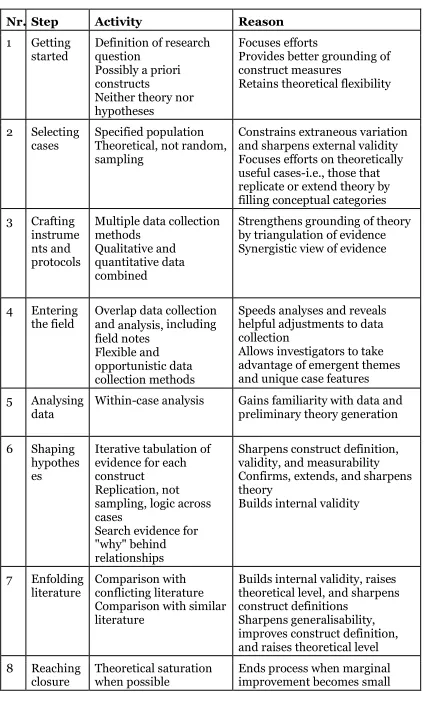
Research design follows the framework presented by Eisenhardt (1989b). Data collection and analysis are guided by tentative a priori concepts, which direct the researcher’s attention towards particular areas of interest. Furthermore, given the exploratory character of this research, data analysis and collection are partially overlapping so as to provide flexibility to pursue emerging avenues of research if and when data so suggests. The analysis of data is followed by the formulation of proposed concepts, which are then enfolded and discussed with reference to the literature on digital and complex systems and products innovation.
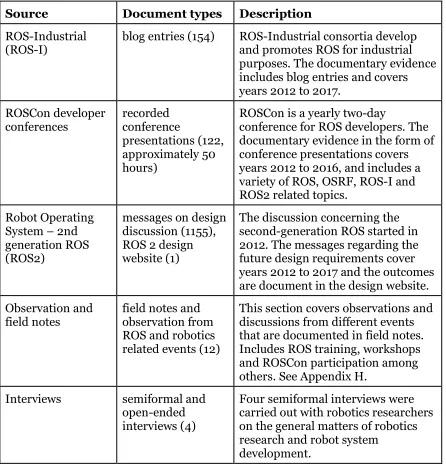
scientific papers and magazine articles and email archives. Together they cover a period from 2005 to 2016. The documentary evidence is supplemented with selected interviews and field notes.
The analysis of data proceeds in two stages. The first stage concerns with getting familiar with the context of research and case study. This stage produces the case description of ROS and develops an understanding of the language used in the field, and therefore serves as a preparatory stage before the second stage. The second stage focuses on a more detailed analysis of documentary evidence, using the method of thematic analysis to identify the themes and categories of subsystems and their respective characteristics of combination. This is done to describe and conceptualise the unfolding of the tension between the specificity of designs and distributedness of knowledge and control.
Subsequently, the proposed concepts are presented and discussed in the light of existing literature to evaluate their validity and the extent to which they are able to contribute to the literature on digital innovation.
The proposed concepts build upon the empirical evidence collected from ROS. Therefore, there are limitations to what extent the resulting conceptualisation applies to different robot software development environments. In addition, considering the complexity and open-endedness of ROS and the surrounding community, this research does not claim to be exhaustive. Therefore, there are presumably elements, which may contribute to the phenomenon but have not been considered in the analysis.
1.4 Targets for contributions
Should the objectives of this research be achieved, the following contributions to the innovation literature could be made.
software development framework for robotics and explicate its origins and organising principles.
The second area of potential contributions concerns conceptualisations which are expected to emerge from the thematic analysis. The thematic analysis is expected to reveal salient themes and properties that characterise the constitutive elements and organising logic of digital innovation in the context of ROS and in the development of robots and autonomous systems in general. This would contribute to the literature by providing conceptual tools that could potentially be of use when developing more targeted and fine-grained research designs to establish prevailing states of affairs at a greater level of detail and precision.
The third area of potential contributions is related to the innovation dynamics at the boundary of generative combinations and systems integration efforts. This is becoming increasingly relevant considering the broader uptake of technologies that are becoming more sophisticated, complex and autonomous. Therefore, developing a greater degree of understanding of the dynamics of complex digital innovation would presumably be also of practical interest for businesses and innovation and technology managers who are tasked to manage and increase the level of automation in different work environments.
Therefore, to aim at these contributions, this work proceeds to explore and examine how software development around ROS is organised, how it supports the innovation on robots and autonomous systems and what are the salient characteristics of the organising logic of innovation. The contributions of this research are discussed with reference to these objectives in the concluding chapter.
1.5 Structure for the dissertation
2 Literature review
This research explores the organising logic of complex digital innovation. Given the range of dimensions along which organisations can innovate or support innovative practices, research on innovation ranges from human creativity, technological inventions, business and management practices to economic analysis and national strategies focusing on different levels and units of analysis (Ahmed & Shepherd 2010). In this work, the organising logic of complex digital innovation is studied in the context of robots and autonomous system.
Since the 1950s, the innovation that leverages digital technologies has played an increasingly important role in the process and product development (Nambisan et al. 2017). Information systems are widely used in organisational settings (Avgerou 2000), and digital technologies have come to constitute pervasive information and communication infrastructures (Tilson et al. 2010). Furthermore, physical and digital technologies are becoming increasingly intertwined and digital technologies manifest themselves in cars (Henfridsson et al. 2014), sensor networks (Sanfeliu et al. 2008), the Internet of Things and other cyber-physical systems (Broy et al. 2012; Conti et al. 2012; Wolf 2009).
Robots and autonomous systems represent the complex end of digital innovation. Typically, robots and autonomous systems are composed of a variety of physical and digital components in an attempt to create machines that are able to operate on their own by interacting with the surrounding environment (Bekey 2005). This is to a large extent facilitated by digital computing and artificial intelligence technologies (Russell & Norvig 2010).
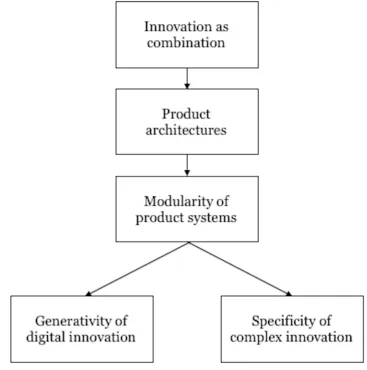
Figure 1: The structure of the literature review (own figure)
the organising logic of innovation (Prencipe 2000; Lee & Berente 2012). At the end of the chapter, the reviewed literature is brought together to present the contradicting logics of combination, which leads to the problematisation and principal research question.
2.1 Innovation and novelty in technology
Innovation literature is varied and multifaceted, yet much of it derives from the economist Joseph Schumpeter’s (1983) work published originally in 1934, which postulates that economic development emerges from novel combinations of existing resources.
The purpose of economic activity is to satisfy human wants and needs by producing goods. In turn, production is viewed as a combination of things and forces within our reach (Schumpeter 1983). Produces are then exchanged for money, and the flows of material and money circulate in opposite directions according to some established patterns of circulatory flows. Under normal conditions, these established patterns stay the same over economic periods as economic actors react routinely to changes in their outside environment. In contrast to the repeated cycles, innovation is an active attempt to alter some established pattern of material and monetary flows from-within the economy by combining existing resources in some novel way that is deemed advantageous by the markets (Schumpeter 1983). While the structural alteration of the material and respective monetary flows may prove highly beneficial to the innovators who seek to alter the flows to their advantage, these structural changes may spell a creative destruction for those who are not able to respond adequately.
innovation. Following Schumpeter (1983), innovation may unfold for example through the introduction of new goods or methods of production, the opening of a new market, the conquest of a new source of supply, or the carrying out a new organisation of an industry. This way, innovation also includes the transfer and application of existing technologies and knowledge to new product and application domains (Nambisan et al. 2017).
While Schumpeter’s (1983) theory conceptualises innovation in terms of entrepreneurial effort to cause structural alterations in material and monetary flows, it remains silent on broader social and organisational processes and mechanisms that influence the unfolding of innovation (see e.g Ruttan 1959). To fill the void, a sizeable body of literature has emerged to examine different aspects of innovation at different levels and units of analysis (Crossan & Apaydin 2009), such as new product development (Garcia & Calantone 2002), process innovation (Davenport 1993) and service innovation (Vargo & Lusch 2004), or a variety of relationships among them (Utterback & Abernathy 1975; Crossan & Apaydin 2009), to provide a few examples.
Acknowledging the variety of definitions and research streams in the innovation literature, in this research, innovation is approached from the point of view that characterises innovation as a novelty in technology that is produced through the combination of existing technologies. This view builds upon W. Brian Arthur’s (2009) work on technological innovation.
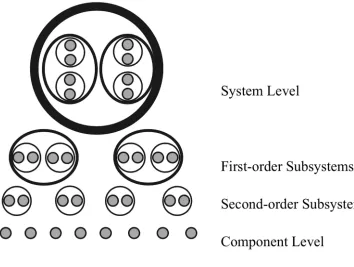
Arthur (2009) describes technologies with reference to three fundamental principles. The first two of them focus on the logical structure, presenting technologies as a combination and as recursion. The combination principle, as illustrated in Figure 2, means that “[a] technology is a combination of components to some purpose” (Arthur 2009 Chapter 2), that is, technologies as systems are combined of components, such as subsystems, components and parts, which in combination produce some overall higher-level functionality. The principle of recursion, in turn, states that the components are technologies themselves. Defined this way, technologies are made of technologies, and can, therefore, be examined and evaluated as technologies across different technological domains, levels and units of analysis – and what is deemed to count as an overall system, subsystem or component is relative to the observer’s objectives. These principles of combination and recursive organisation resonate with Herbert Simon’s (1962; 1996) theory of hierarchy which presents complex systems as nearly decomposable and nested hierarchies.
Figure 2: An illustration of a four-level nested hierarchy (Murmann & Frenken 2006)1
The third principle turns attention from the structural to the functional logic, forwarding that all technologies harness and use some effect or phenomenon, or usually several (Arthur 2009). In order to perform desired functions, technologies incorporate some conceptual basic operational principle, a method or process that outlines steps and transformations that are needed to harness some natural, social or psychological effect or phenomena to serve some human purpose. More succinctly, technologies are purposed systems and the conceptual basic principle is “the idea of an effect in action” (Arthur 2007, p.274). For example, a digital camera captures patterns of light and turns them into digitally-encoded images (Yoo, Lyytinen, et al. 2010) that can be sent as bit-strings over digital infrastructures (Tilson et al. 2010) for people to share them on social media (Alaimo & Kallinikos 2017). The modern microprocessors and image sensors which make all this possible harness the semiconductivity of silicon in digital computation (Mack 2011).
Building on these definitions, novelty in technology is said to emerge from two primary sources, from the novel combinations of existing technologies and from the harnessing of effects or phenomena (which is a process that relies on existing technologies) (Arthur 2009). Depending on human and social goals, the processes of combination can vary from relatively trivial and gradual improvements to highly complex and experimental endeavours where newly harnessed effects and phenomena are put to use on a large scale.
To examine how logics of combination differ among different types and categories of innovation, the subsequent sections take a closer look into product architectures and review the related literature in the view of modularity, generativity and complexity.
2.2 Modularity and product architectures
This section reviews the literature on product architectures and modularity. First, the use of modularity in management literature is briefly outlined, after which product architectures and modularity are further discussed in the view of modularisation and centralised design agency.
Modularity is a general and widely used concept in organisation and management literature. It has come to carry a multiple of interpretations depending on the scale, context and phenomenon it is summoned to explain (Campagnolo & Camuffo 2009; Salvador 2007; Iman 2016). Although the notion of modularity can be conceptualised along different lines, it is commonly viewed as something that contains complexity and provides organisations with flexibility and agility through the separation and combination of concerns. Modularity allows organisations to respond more readily to varying market demands, competitive situations and technological change.
implications on the formation of boundaries among firms and organisations (Schilling & Steensma 2001). Third, research into modularity in the context of organisation design seeks to explain the formation and adaptivity of organisational structures. The formation of organisational structures focuses on the existence of structural isomorphism between product architectures and development and manufacturing organisations (Brusoni & Prencipe 2006; Sanchez & Mahoney 1996; Baldwin & Clark 2000), whereas the adaptive view discusses how modularity of organisational structures provides flexibility that allows for agile responding to changes in market conditions (Ciborra 1996). This variation in definitions, measurements and contextual applications introduces ambiguity to the concept of modularity. Therefore, regardless of the apparent similarity of the underlying conceptualisation, reconciliation among different streams of modularity research remains challenging (Campagnolo & Camuffo 2009).
This diversity of views on modularity is also echoed also in literature reviews that focus on more narrow domains of research, such as service systems (Iman 2016) and product systems (Salvador 2007). The divergence of mechanisms which drive modularisation and subsequent combination in different socio-technical and technological contexts, scales and time frames appear to pose challenges to generalisation, regardless of the frequent calls for unified conceptual frameworks. The subsequent section discusses the concept of modularity in the light of product architectures.
2.2.1 Product architectures
context. A mixture of functional elements and their interconnections are combined to produce a function structure which describes the overall functioning of a product; the function structure specifies the capabilities, constraints and behavioural logic of a product. Then, functional elements are allocated to physical components which provide the material substrate and produce specified functionalities as illustrated in Figure 3 (Ulrich 1995). Physical components can be viewed as separable parts which in combination produce the overall functioning of a product (Ulrich 1995).
Figure 3: An illustration of functional allocation of a product architecture (Ulrich 1995)2
There are no definitive rules or guidelines on how functional elements should be allocated over physical components (Salvador 2007). Often, there are many different allocation schemes that could produce the same end result, that is, an equally functional end-product, and the eventual architecture result from design choices that are contingent on a variety of factors, ranging from the functional requirements to production systems and corporate strategies (Campagnolo & Camuffo 2009).
As the overall function structure is distributed over the components that constitute the end-product, individual components may come to perform a single function, be part of a composition of components which produces some single functionality or perform multiple functions simultaneously on their own (Ulrich 1995). A product architecture is called modular if there is a one-to-one
relationship between the functional elements and components and they are decoupled so that a change in one component does not require any change in the component(s) it connects to. On the other hand, product architectures are said to be integral if components implement multiple functional elements, and if components are coupled so that a change in one component requires changes in others. The detailed functional specifications of components depend on the allocation of functionality during the architectural design (Ulrich & Eppinger 2012).
When functional elements are distributed over a number of components, it is essential that the components are connected in a way that they produce the expected behaviour in combination. For this to happen, interfaces need to be located and specified in an appropriate manner. Otherwise components cannot connect to and interact with each other. To this end, interface specifications detail the necessary modalities of connection and interaction, such as protocols and physical coupling, depending on the types of connection and interaction (Ulrich 1995).
By allocating functional elements over components and establishing necessary interfaces, architectural design sets out the structural composition which produces the overall functionality of the product. As architectural design often resides at a higher level, it is complemented by more detailed specifications which provide lower-level details of different components and their respective interactions. These architectural schemes, blueprints and design documents allow for the communication of the overall vision among project teams (Hobday 1998) and facilitate the partitioning of work (Hippel 1990).
rather as a frame-dependent continuum between modularity and integrality than any general binary condition (Ulrich 1995; Yoo et al. 2010). While definitions vary, the notion of modularity is often used to refer to a degree to which components can be separated and subsequently combined (Schilling 2000).
2.2.2 Modularisation and task partitioning
As discussed above, product architectures vary along the spectrum of modularity and integrality (Ulrich 1995). At one end, a modular product architecture renders one-to-one mappings between functional elements and components, while, at the other end, an integral architecture produces intertwined and more interdependent relationships among different functional elements and components.
Modularisation is a design principle and process which seeks to decompose the overall design requirements and function structure in a manner which results in a modular product architecture (Baldwin & Clark 2000). The purpose of modularisation is to produce an overall structure, a product architecture, where modules have strong structural connections and interdependencies within the boundaries of a module, but the connections and interdependencies across the modules remain relatively weak. Subsequently, the modules which emerge from this directed and purposeful problem-solving process are often described as loosely-coupled (Schilling 2000; Parnas 1972). The loose coupling among modules brings several benefits, such as the commonality and combinability of components (Salvador 2007). The commonality allows modules to be used in different products, whereas the combinability of modules provides companies and customers with a larger variety of product variants in a cost-efficient manner since a large variety of products can be produced by arranging components in different configurations (Langlois & Robertson 1992; Schilling 2000). Moreover, companies can react to market changes in a more agile manner when they rely on modular and configurable product structure (Garud & Kumaraswamy 1995).
aspects of technological and design knowledge (Garud & Kumaraswamy 1995; Langlois & Robertson 1992). By modularising an overall design into partitions, work can be distributed over a larger group of people. This way, work can proceed in a parallel and directed fashion individually; partitioning a problem into a series of subproblems and distributing it over the specialised teams of designers and engineers, organisations can benefit from the division of labour as they can draw upon knowledge and skills of specialised workforce, increasing the speed of development and modular and architectural learning (Sanchez & Mahoney 1996). However, modularisation may not always lead to optimal product architectures, for example when the overall performance requirements are particularly high (Yoo et al. 2010; Ulrich 1995) or the synergistic specificity among modules bears influence to what extent the separability and subsequent combinability of modules is feasible (Schilling 2000).
Carrying out partitioning is costly and requires expertise and centralised planning (Baldwin & Clark 2000). To ensure that different parts work together once completed and combined, coordination among different stakeholders prior to partitioning is required (Ernst 2005; Danese & Filippini 2010). Ideally, task partitioning should follow the structure of the underlying design problem, yet it is not always straightforward to establish the relationship between the two (Alexander 1964), this especially being the case when problems are complex and multifaceted (Ethiraj & Levinthal 2004) or deviate from what went before (Sosa et al. 2004; Hippel 1990).
2.2.3 Modularity as a property of product systems
Product modularity, that is, the separability and combinability of a range of components (Schilling & Steensma 2001), tends to occur under relatively well-defined circumstances. These circumstances often revolve around central platforms (Baldwin & Woodard 2008) and design rules that derive from the process of modularisation (Baldwin & Clark 2000) that seeks to achieve particular objectives through the modularity of a product, such as the cost-effective production of a variety of products or their serviceability and recyclability. To these ends, modularisation partitions the overall design in a centralised top-down manner.
Considering that modularity often seeks to produce product variety through the combination of different but compatible components, modularity can be better understood as a property of some particular product system than as a property of an individual product or any general combinability (Salvador 2007). A modular product architecture describes the relationships, the degree of variation and the combinability of components within the boundaries of a product system where modules represent units of variation (Salvador 2007).
The overall architectural design of a product system is expected to specify design parameters that outline opportunities and limitations for modularisation in different scenarios. While this kind of arrangement is able to produce variety, it does so along the lines of well-defined design hierarchies and corresponding market concepts (Clark 1985) that leave little room for serendipitous emergence of technological novelty. Indeed, much of the literature on modularity draws its lessons from the industrial manufacturing of mass-market products, such as cars (Clark 1985), consumer electronics (Langlois & Robertson 1992) or semiconductors (Baldwin & Clark 2000), where the capability to produce cost-effective product variation and change are considered as of strategic importance (Garud & Kumaraswamy 1995).
Occasionally, as products and markets mature, the focus of innovation shifts from product innovation to process innovation (Abernathy & Utterback 1978). This crystallisation of product and market concepts and how they are best achieved give rise to dominant designs and design hierarchies (Clark 1985), which come to dominate the industry-wide organisation of firms and markets (Suarez 2004; Murmann & Frenken 2006). This brings fixity and commodified competition to technological arrangements which provide a backdrop against which technological development and economic activities unfold (Arthur 2009).
As a final note, it is also worth noting that the modularity of a product system is not invariably the same as the partitioning of design or production (Salvador 2007). Design work can be partitioned and distributed across multiple designers even if the structure of the end-product would be highly integral. On a similar note, the production of large structures, such as cruise ships, can be performed in a piecemeal manner, yet this does not indicate that the end-product would be modular in the view of the separability and combinability of components in the context of a product system.
digital products and services emerge as generative combinations through decentralised design agency. This is discussed in the subsequent section.
2.3 Generativity and digital innovation
The research into digital innovation maintains that the pervasive and increasing use of digital computers and advanced information processing technologies enables novel product architectures and organisational arrangements (Nambisan et al. 2017), which in turn are prone to generate profound changes in firms’ organising logic and innovation management practices (Yoo et al. 2010; Tilson et al. 2010; Henfridsson et al. 2014; Barrett et al. 2015). Traditionally, information systems research has focused its efforts on communication, transaction and decision-support systems in organisational contexts (Avgerou 2000), yet the increasing digitalisation across application domains and social contexts suggest that a broader lens should be adopted (Grover & Lyytinen 2015; Nambisan et al. 2017). To this end, Fichman, Dos Santos and Zheng (2014, p.329) forward “digital innovation as a fundamental and powerful concept in the information systems curriculum” while others argue that digital innovation and information systems research could serve as a reference discipline to product and service innovation management fields (Yoo 2012b).
Digital innovation revolves around the processes of digitisation and digitalisation (Tilson et al. 2010). Digitisation as a technical process refers to the development and application of techniques and technologies that render and manipulate objects and artefacts in the format of binary digits. Digitalisation, on the other hand, refers to the dynamic interplay of social and technical matters, which are related to the wider adoption and deployment of digitisation techniques in social and institutional contexts. Out of these two, the main focus of digital innovation research is on the socio-technical matters of digitalisation, whereas the socio-technical and organisational outcomes of digital innovation are often explained fully or partly in terms of digitisation.
modularity in the context of computer systems and the generative properties of digital technologies are discussed further.
2.3.1 Digital computation
In the 19th century, people as human computers created tables of precomputed values for many mathematical problems (Grier 2005). As the tables often contained errors, in the 1820s Charles Babbage started developing mechanical computers that would supersede their human competition in terms of accuracy and speed (Swade 2002). While Babbage’s creations, difference and analytical engines, never really took off, they are often regarded as early ancestors of modern computers as they rely on mechanical switches that carry out calculations and store intermediate results. About a hundred years later, in 1936, Alan Turing introduced a theoretical device to conceptualise the functioning logic of a universal computing machine (Copeland 2014). The Universal Turing Machine conceptualises the process of computing as a series of arranged and stepwise instructions that operate on and manipulate symbolic representations, which are read from and stored in memory (tape) one step at a time. A few years later, in 1945, John von Neumann, forwarded the concept of stored program computers (Copeland 2014). With programs (instructions) represented and stored in memory along with data, the functioning of a computer could be changed by equipping it with a new set of instructions, thereby leaving the fixity of earlier computer designs behind and making them readily applicable to different purposes. As both data and instructions are commonly encoded and stored in the format of binary digits (bits), they can be transferred across and processed on different computers as long as they follow the same logic of functioning, at least in principle if not always in practice. The progress from mechanical switches to ever smaller, cheaper and ever more powerful microprocessors (integrated circuits) (Mack 2011) has paved the way to increasingly pervasive and ubiquitous application of computers in various tasks and domains (Yoo et al. 2010).
general-purpose machines; in principle, they are able to process any set of data as long as both the data and the stepwise instructions to process it are represented in an unambiguous format, are congruent and effectively computable (Tilson et al. 2010). If an object or artefact can be encoded and represented in an unambiguous format of binary digits, and a set of logical operations (stepwise instructions/algorithms) can be produced to carry out necessary operations upon it, any matter may become computable. No matter if it deals with fake news, differential equations, numbers and letters on the screen, maps, long-winded decision trees, missile trajectories or data transmission protocols and procedures. However, the intractability of some computational problems and limits in memory and processing capabilities render some class