i
EXPLORING UNDERSTANDINGS OF “CHALLENGING BEHAVIOUR” IN THE CONTEXT OF PEOPLE WITH LEARNING DISABILITIES: VIEWS OF THOSE
WHO REFER AND THOSE WHO RESPOND
Jessica Walsh
A thesis submitted in partial fulfilment of the requirements of the
University of East London for the
Doctoral Degree in Clinical Psychology
August 2016
ii ABSTRACT
Challenging behaviour is a label often given to people with learning disabilities
when their behaviour challenges the system around them (Department of Health,
1993). There are numerous ways of understanding challenging behaviour. Given
the mutual dependence between community learning disability teams and
community support services in supporting people with learning disabilities, it was
considered interesting to make explicit some of the ideas and assumptions that
might enable or disable teams to work in consistent ways. This study draws on
the research of Haydon-Laurelut, Nunkoosing and Millett (2014) and Nunkoosing
and Haydon-Laurelut (2011).
Six support workers at day centres for adults with learning disabilities (referrers)
and six clinical psychologists working at community learning disability teams
(responders) took part in semi-structured interviews. The interviews asked about
their understandings of challenging behaviour in the context of making and
receiving referrals. Interviews were transcribed verbatim and analysed using
thematic analysis.
Findings suggested that the support workers and clinical psychologists had quite
similar ways of understanding challenging behaviour, which was an unexpected
finding. They both used dominant discourses to talk about their understandings,
as well as acknowledging that challenging behaviour is a social construction.
These understandings were acknowledged to occur within the system or network
around the person. Although there were shared understandings, still a schism
existed in terms of how the services viewed each other. It was considered that
something other than ‘understanding’ may be at the root of these differences and
the suggestion made that the impact of emotions and relationships not being fully
attended to and a common sense of powerlessness in the network could be
important.
Implications of the findings on an individual, service, policy and societal level
were considered as well as ideas for future research. A critical review is provided
iii ACKNOWLEDGMENTS
Firstly I am grateful to the participants who took part in this research, for their
open and insightful thoughts on challenging behaviour, also for reminding me
why I am so passionate about this field of work. Thank you to my supervisor Dr
Jenny Jim for her calm, encouraging and consistent approach, which was
invaluable. I would also like to give thanks to my family and friends, who are
eternally supportive. In particular, thanks to my Mum for her interest and expert
proof reading skills and to Dave, for putting up with the mess, reminding me of
iv ABBREVIATIONS
PWLD- People with Learning Disabilities LD- Learning Disabilities
CB- Challenging Behaviour
CLDT- Community Learning Disabilities Team CP- Clinical Psychologist
TA- Thematic Analysis
v Contents
1. INTRODUCTION……….. 1
1.1. Literature Search Strategy……….. 1
1.2. Social Construction of Learning Disabilities and Challenging Behaviour………..…………. 1 1.2.1. Construction of Learning Disabilities………. 1
1.2.2. Construction of Challenging Behaviour……… 2
1.3. Definition and Topography……….. 4
1.3.1. Definition of Challenging Behaviour……….. 4
1.3.2. Topography of Challenging Behaviour………. 6
1.4. Historical Context……….……….. 8
1.5. Understanding the Dynamic Between Staff and Clients………... 13
1.5.1. The Impact of Staff and Client Defences………. 15
1.5.2. The Impact of Emotions……….. 16
1.5.3. The Impact of Stress and Burnout………. 17
1.6. Attribution Theory and Challenging Behaviour……… 18
1.6.1 Attribution Theory and the Role of Emotions………... 21
1.7. The Referral Process and Interactions Between Referrers and Responders……….. 22 1.7.1. The Referral Form……… 22
1.7.2. Barriers and Solutions to Communication Difficulties………..…. 23
1.7.3. Maintaining a Systems Approach……….. 26
1.8. Clinical Relevance and Rationale……….. 27
1.9. Research Question……… 28
2. METHODOLOGY………. 29
2.1. Epistemological position………..…. 29
2.2. Qualitative Design………. 30
2.3. Thematic Analysis……….. 30
2.4. Researcher Reflexivity………..…. 31
2.5. Recruitment and Sample……….………. 32
2.5.1. Recruitment……….. 32
2.5.1.1. Clinical Psychologists……….. 32
vi
2.5.2. Inclusion and Exclusion Criteria……… 33
2.5.2.1. Clinical Psychologists……….……… 33
2.5.2.2. Referrers……… 33
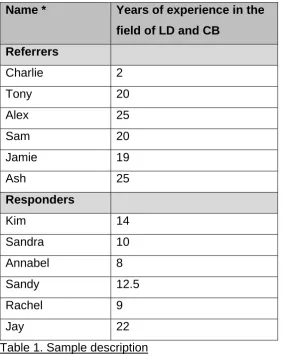
2.5.3. The Sample……….. 34
2.6. Ethical Issues………...…………. 35
2.6.1. Ethical Approval……….. 35
2.6.2. Informed Consent………. 35
2.6.3. Confidentiality……… 35
2.7. Interview Process………..……….. 36
2.7.1. Materials……… 36
2.7.1.1. Digital Audio Recorder………. 36
2.7.1.2. Interview Schedule………... 36
2.7.2. Data Collection………. 37
2.8. Data Analysis………..…….. 38
2.8.1. Transcription of Data……… 38
2.8.2. Thematic Analysis Process………. 38
3. ANALYSIS………. 40
3.1. Summary of Themes………..……. 40
3.2. Theme One: Challenging Behaviour is a Real Observed ‘Thing’…………. 42
3.2.1. Dominant Definitions of Challenging Behaviour……….. 42
3.2.1.1. Severity……….. 42
3.2.1.2. Community Access……….. 43
3.2.1.3. Risk………. 43
3.2.1.4. Complexity………. 44
3.2.1.5. Stigma……… 45
3.2.2. Long-term Cyclical Nature of Challenging Behaviour………. 46
3.3. Theme Two: Challenging Behaviour is Not a Real ‘Thing’…………..……. 47
3.3.1. Challenging Behaviour as a Social Construction……… 47
3.3.2. Challenging Behaviour as a Challenge to Others………... 49
3.3.3. Is it Challenging Behaviour or is it Something Else?... 50
3.3.4 Challenging Behaviour as a Communication/Relational Issue……… 51
3.4. Theme Three: Understanding Within the System/Network…………..…… 52
vii
3.4.2. Consistency is Key……….. 56
3.4.3. Importance of Good Relationships……… 59
3.5. Theme Four: Emotional Impact of Challenging Behaviour…………..…… 60
3.5.1. Emotions Felt in the Network………. 61
3.5.2. Importance of Reflection………. 62
3.6. Theme Five: Impact of Power in Networks……….……. 64
3.6.1. Referrers Having Less Power……… 64
3.6.2. CLDTs as Holders of Power……….….. 67
3.6.3. Clients Having Least Power……….….. 68
3.7. Summary………..……. 68
4. DISCUSSION……….…….. 70
4.1. Overview and Research Aims………..…… 70
4.2. Discussion of Themes………..…….. 70
4.2.1. Theme One: Challenging Behaviour is a Real Observed ‘Thing’…………. 70
4.2.2. Theme Two: Challenging Behaviour is Not a Real ‘Thing’……… 71
4.2.3. Theme Three: Understanding Within the System/Network……….. 73
4.2.4. Theme Four: Emotional Impact of Challenging Behaviour……… 74
4.2.5 Theme Five: Impact of Power in Networks……….. 75
4.2.6. Summary of Themes……… 77
4.3. What This Study Adds to the Diversity of the Literature………..…. 78
4.4. Recommendations for Future Research………..….. 78
4.5. Limitations……… 79
4.6. Researcher Reflexivity……….….. 80
4.6.1. Epistemological Reflexivity………. 80
4.6.2. Methodological Reflexivity……….. 81
4.6.3. Personal Reflexivity………. 82
4.6.3.1. Power……… 82
4.6.3.2. Language……….. 83
4.7. Evaluation of Research……….. 84
4.7.1. Sensitivity to Context……….. 84
4.7.2. Commitment and Rigour………. 84
4.7.3. Transparency and Coherence……… 85
viii
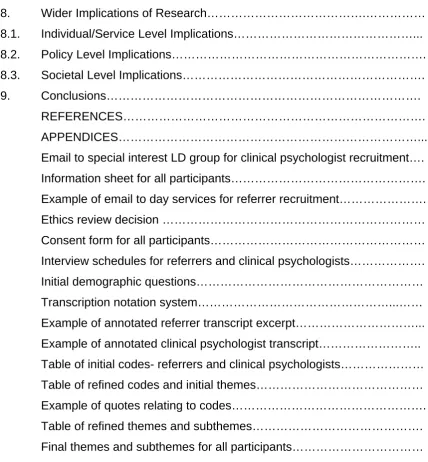
4.8. Wider Implications of Research……….……… 86
4.8.1. Individual/Service Level Implications………... 86
4.8.2. Policy Level Implications………. 87
4.8.3. Societal Level Implications………. 87
4.9. Conclusions………. 88
5. REFERENCES………. 89
6. APPENDICES………... 106
A Email to special interest LD group for clinical psychologist recruitment…. 106 B Information sheet for all participants………. 107
C Example of email to day services for referrer recruitment………. 110
D Ethics review decision ……… 111
E Consent form for all participants……… 113
F Interview schedules for referrers and clinical psychologists………. 114
G Initial demographic questions……… 118
H Transcription notation system………...…… 119
I Example of annotated referrer transcript excerpt………... 121
J Example of annotated clinical psychologist transcript……….. 122
K Table of initial codes- referrers and clinical psychologists……… 123
L Table of refined codes and initial themes……… 126
M Example of quotes relating to codes………. 129
N Table of refined themes and subthemes………. 131
[image:8.595.105.534.66.529.2]1 1. INTRODUCTION
Within this section I will review the literature on how challenging behaviour
(CB) is understood within the learning disabilities (LD) context. In
consideration of language, I will use ‘people with learning disabilities’ (PWLD),
as it is currently the most frequently used term within services in the UK.
Other terms are used internationally, and have been used historically within
the UK, and they were included in the literature search. As the understanding
of the construct of “challenging behaviour” is at the core of this research, the
use of this term will be explored fully within this chapter. I will then explore the
influence of the historical and presenting context on how CB is understood. I
will consider how the dynamic between support staff and clients, and between
support staff and Community Learning Disability Teams (CLDT’s), influences
understanding. I will also consider the relevance of attribution theory (Heider,
1958) on how support staff make sense of CB. This chapter will close with the
rationale and research question for this study, in light of the literature review.
1.1. Literature Search Strategy
For the literature review of this research, papers were searched for
electronically using EBSCOHost, (PsycINFO, PsychArticles, CINAHL Plus,
Academic Search Complete), ScienceDirect, and SCOPUS. The terms and
permutations used were learning disabilities, intellectual disabilities, mental
retardation, challenging behaviour, staff and carers. The articles found were
read and references of relevant articles and books were also reviewed, to
identify articles that were missed from the search.
1.2. Social Construction of Learning Disabilities and Challenging Behaviour
1.2.1. Construction of Learning Disabilities
Before considering CB, it is useful to have an understanding of the group of
2
already placed upon them. When using the term PWLD, it incorporates a wide
range of people with diverse abilities and needs. The most commonly used
definition of LD in services is:
“Significant impairment of intellectual functioning (usually taken as IQ < 70);
significant impairment of adaptive/social functioning; and age of onset before
adulthood”
[British Psychological Society, 2001, p.4].
This places any difficulty within the individual. Danforth and Navarro (1998)
describe how traditional constructions of LD serve to create PWLD as objects
of cultural fear, to legitimise social control and silencing of their version of
events. A definition that puts the problem with society seems to be a more
helpful way of constructing disability:
“It is not individual’s limitations...but society’s failure to provide appropriate
services and adequately ensure the needs of disabled people are fully taken
into account in its social organisation”
[Oliver, 1996, p.32].
Regardless of the definition used, one consequence of obtaining an identity of
LD is that the person often becomes subject to lifelong clinical support. These
individuals will often spend much of their lives in settings that form unique
social worlds with specified rules and ways of working. Therefore PWLD often
have a narrow range of possible ways of being available to them. By
acknowledging the term LD as a social construction, we can start to
understand how professionals and society in general have tried to codify and
construct the behaviour of PWLD in a similar way, particularly those
behaviours that do not fit in with the social norm.
1.2.2. Construction of Challenging Behaviour
Observing how language and definitions shift over time is relevant in
3
understand CB. Prior to the term ‘CB’ becoming prevalent, ‘problem
behaviour’ ‘difficult behaviour’ or ‘socially unacceptable behaviour’ were terms
that were often used. These terms seem to place the behaviour as the sole
property of the individual (Lowe, Felce & Blackman, 1995). The term CB was
introduced as a way of encompassing anyone whose behaviour presented a
challenge to services, irrespective of the cause. A person is not inherently
challenging, but services can find themselves challenged by the actions of
others. The term intended to highlight how the way in which someone is
supported is as important as a person’s individual characteristics (Department
of Health, [DoH], 1993). Jim Mansell suggested that over time there has been
an inappropriate drift towards using the term as an individualising label (DoH,
2007), for example, individuals being labelled directly as ‘CB’.
As is often the case when terms are used to define a group of individuals,
they acquire pejorative meaning over time, so new labels are created to
replace problematic terms.Ephraim (1998) offered a different way of looking
at things and suggested there is no such thing as CB, instead there is ‘exotic
communication’; the effect of a behaviour may be heard, but the message
may not be listened to or understood. People who display CB are described
as ‘the pained the unheard and the unloved’ (Ephraim, 1998, p. 210).
Many people prefer to explicitly acknowledge that CB is not something that
resides within a person, nor is it the sole responsibility of the individual. Thus
terms such as ‘behaviour that challenges others’ or ‘people who services label
as challenging’ are sometimes used. Giving a behaviour a label of challenging
does not add to our understanding of how that behaviour functions (Cullen,
1999). CB has come to be seen as part of complex social patterns, and the
term ‘interactional challenge’ has also been used to highlight it is a difficulty
with interaction between two people (Cullen, 1999). Some believe we should
abandon labels altogether:
“By abandoning labels, we shift attention from the deficiencies of the person
to those of the society and service systems. Thus, we cease to ask what is
4
services we can create…most important, when we abandon labels we are
forced to listen to those whose perspectives we have ignored and to take
what they have to say seriously”
[Bogdan & Taylor (1994), pp. 224–225].
Irrespective of how it is spoken about, there does seem to be an
acknowledgement that it is helpful to have a term that acknowledges that
some behavioural responses can result in a person being excluded from
services or experiencing a reduction in quality of life (Ingram & Lovell, 2011),
and that it is helpful to speak about it. Nunkoosing (2000) has discussed how
dominant discourses of LD and CB serve to support existing structures in care
environments. The prospect of having a label of CB can be seen as a double
bind. It can lead to specialist assessment and intervention, but it may also
lead to marginalisation and discrimination if care givers are reluctant to work
towards community participation because of the behaviour (Ingram & Lovell,
2011). Thus it is easy to see how carrying a label of both LD and CB can lead
to double stigma (Goffman, 1968). By referring to the construct of CB, it gives
services a clear idea of what or whom they might need support with and gives
CLDTs a clear remit on what they can offer in response.
For the purposes of this research I have used the term ‘CB’, holding in mind
the ideas for which the definition was originally intended, that it is behaviour
that challenges services (DoH, 1993). It is also the term used most widely in
services currently. I do, however, see it as an imperfect term that cannot
possibly catch the complexities of the individuals and environments it intends
to define, nor should it aim to.
1.3. Definition and Topography
1.3.1. Definition of Challenging Behaviour
Despite there being some ambiguity in the terminology and language, there is
little debate in the literature with regards to the definition used to describe
5
Emerson’s (1995) definition. This focuses on the physical and social impact of
CB and describes it as:
“culturally abnormal behaviour(s) of such intensity, frequency or duration that
the physical safety of the person or others is likely to be placed in serious
jeopardy or behaviour which is likely to seriously limit use of, or result in the
person being denied access to, ordinary community facilities”.
CB is often understood to be an interaction between a person and their
environment (Bell & Espie, 2002), and thus it could be seen that it is the
environment itself that is being challenged. Hastings (1997) has suggested
five causal models of CB: learned behaviour, biomedical, emotional, physical
environment and self-stimulation. Hastings (1995) found that the majority of
staff viewed CB as caused by either a communication need, the physical
environment, unhappiness or biological reasons (for example, sexual
frustration or brain damage).
Wilcox, Finlay and Edmonds (2006) discuss how the biological understanding
suggests individuals have disabilities or conditions that make CB more likely
to occur. In this view, CB is constructed as being something that has always
been there and as stable and internal to the client. Wilcox et al (2006) found
the care staff interviewed all strongly highlighted this discourse in their ideas
about CB. Campbell (2010) discusses the importance of not assuming that
behaviours that seem challenging are connected to a person’s disability.
Behaviour will always serve a function for the person, and it is the role of
people around the individual to identify what the function is. There are multiple
factors in a person’s life that might influence CB, including personal factors,
such as degree of LD, sensory ability, physical and mental health difficulties,
communication ability, life events, as well as environmental factors such as
housing, occupation and staffing (Royal College of Psychiatrists [RCP], British
Psychological Society & Royal College of Speech & Language Therapists,
2007). In order to understand CB, Ingram and Lovell (2011) suggest
6
behavioural approaches, and then combining this with a human perspective of
the interplay between an individual and their behaviour.
Hastings (1995) found staff highlighted social reinforcement as a major cause
of CB, as well as communication, a response to the environment and as an
expression of emotional states. Wilcox et al (2006) also highlighted a context
discourse when interviewing care staff, where CB was seen as an
understandable reaction to circumstances and the environment. It was not
highlighted as strongly as individual pathology, but it suggests a growth in a
broader systemic understanding of CB. This sits more within the social model
of disability (Oliver, 1990). Knowing how staff define CB is vital in
understanding their responses to it. Many will describe CB as behaviours that
are challenging to others and services (Hastings, 1995), yet still hold the view
these behaviours are to be changed or are done so intentionally. It has been
suggested that staff can be more concerned with behaviour reduction than
developing an understanding of what is happening for the person (Hastings,
1995). Hare, Durand, Hendy and Wittkowski (2012) described how staff report
considering the whole person and their history as being most relevant to
understanding CB.
1.3.2. Topography of Challenging Behaviour
Emerson, Kiernan, Alborz, Reeves, Mason, Swarbrick et al (2001) estimated
that between 10-15% of PWLD are labelled as having CB. Campbell (2010)
estimates between 5.7% and 20% prevalence in PWLD. This reported wide
variance in CB likely reflects differences in understandings in terms of what is
labelled as challenging. When considering whether the impact of gender
affects whether someone receives a label of CB, Emerson et al (2001) found
that 68% of those labelled with CB were male, but Scotti, Evans, Meyer and
Walker (1991) found that women were more likely to receive intrusive
behavioural interventions. Wilcox et al (2006) found staff understanding of CB
was influenced by gender stereotypes, for example, menstrual cycle and
7
There is some disparity in what care staff view as challenging. Lowe et al
(1995) found that inner-directed behaviours, for example withdrawal, social
avoidance or stereotypy are often ignored, even though these behaviours may
impact on the individual’s quality of life. Behaviours that are more
outer-directed, such as aggression and destruction of property, are more likely to
lead to a referral for specialist support. This is interesting, as it suggests that
CB is only attended to when it impacts on those in a position of support.
Hastings (1997) highlighted that CB is usually defined by staff as actions that
cause organisational problems. Hayden and Stevens (2004), in a study of day
centres for PWLD, found 85% of service users displayed some form of CB
over the course of a month, the most commonly reported being
‘non-compliance’. If a large number of people using a service are constructed as
having problematic behaviours, simply because they are not conforming to the
routine expected of them, this is suggestive of much wider systemic issues.
Hastings (1995) found that staff listed self-injury, aggression and destructive
behaviours as challenging, but none listed stereotyped behaviours. Allen
(1999) similarly reported that the kind of behaviours that cause the most
severe management problems were aggression, wandering away, disturbing
noises and temper tantrums.
It could be understood that when a client tries to test the power of the routine,
this resistance is seen as troublesome and constructed as CB (Nunkoosing &
Haydon-Laurelut, 2012). Within LD settings, resisting the routine is
constructed as a problem because staff do not have the authority to ensure
compliance with programmes, and so it disrupts the routine of the setting.
Wilcox et al (2006) describe how in the case of aggression, staff might be
expected to draw on wider cultural discourses about unacceptability of
aggression, as well as service specific ones to reassert the balance of power,
which may in turn have repercussions for the client.
Much of the research focuses on social CBs, such as aggression. Other
behaviours such as stereotypy, may not even be recalled or labelled as CB,
despite fitting a formal definition for CB. Hastings (1995) suggested that staff
8
as there is more focus on the impact on a service as opposed to impact on
the individual’s quality of life.
1.4. Historical Context
It is important to consider how broader understandings of CB, and
approaches to it, have changed over time, as this is likely to have an effect on
the understanding people working in the field have. Greig (2007) has
described how services have historically failed to fully respond to individuals
with CB and complex needs. It certainly seems that services have been
striving for similar goals and aspirations over the last few decades.
In the early 1960s behavioural approaches first emerged, such as the use of
positive punishment to reduce CBs. This was the first time an effective
alternative to pharmacological treatments ‘managing’ CB was considered
(Lloyd & Kennedy, 2014; Rhodes, Whatson, Mora, Hansson, Brearley &
Dikian, 2011). Prior to this, PWLD and CB were seen as ‘untreatable’ and
were removed from having a role in society, by being placed in institutions
away from social support.
In the 1970s the idea of applied behavioural analysis was introduced, and with
it the understanding that behaviour could serve operant functions. It was
thought that these behaviours were shaped and maintained by positive and/or
negative reinforcement (Carr, 1977). This changed the focus from topography
of behaviour, to the function that it served. Functions were categorised as
social positive reinforcement, for example, engaging in preferred activities;
social negative reinforcement, for example, escape from an aversive
environment, and sensory reinforcement, for example, touch (Carr, 1977).
The approach to identifying variables that maintain CB became known as a
functional behaviour assessment. The treatment suggested would be
adjusting environmental factors to alter behaviours (Carr, 1977). These ideas
9
In the 1980s there was the closure of many long stay hospitals for PWLD and
many individuals subsequently moved into community settings. There was a
need for intervention models that supported the idea of self-determination
within community settings (Rhodes et al, 2011). This was also the time of
normalisation becoming a guiding principle in services (Wolfensberger, 1983).
Treatment ideas moved to more gentle teaching and with values being
promoted around community inclusion and respect. It was starting to become
difficult to reconcile the use of aversive methods with these goals. Despite
this, there was still a trend towards the use of aversive approaches; 76% of
studies published in the 1970s and 1980s were found to use an aversive
alone or as part of a combined intervention (Matson & Taras, 1989). Other
broader models of intervention were starting to develop in the field, such as
family therapy. This considered how people live in family settings and how
interactions and relationships within the family might serve to maintain CB. CB
could be seen as a symptom of the family’s difficulty in negotiating life
transitions (Rhodes et al, 2011).
In the 1990s the Human Rights Act (1998) was implemented, which gave the
potential to have a large impact on the lives of PWLD, as it made explicit that
the rights of PWLD are inseparable from anyone else in society. The right to
not be subject to inhumane or degrading treatment (Article 3) and have a right
to liberty (Article 5) impacted on the kind of interventions that could be utilised
for PWLD and CB. The Mansell report (DoH, 1993) was also first published,
which provided guidance, predominantly to commissioners, about how
services for PWLD and CB should focus on personalisation and locally
provided support.
In the 2000s behavioural interventions evolved into multi-element approaches
that took components from cognitive behavioural therapy, mindfulness,
solution-focused and narrative models (Rhodes et al, 2011). Valuing People
(DoH, 2001) and Valuing People Now (DoH, 2009) were published, focusing
on four key principles of rights, choice, independence and inclusion. Valuing
People also stated that all public services have a responsibility towards
10
PWLD and CB are among those most at risk of service breakdown and thus
more needed to be done to improve the capacity of services to support these
individuals.
The Mental Capacity Act (DoH, 2005) also came into effect, which outlined a
person’s right to make what others perceive to be unwise decisions, unless
they are found to lack capacity, which could impact on how behaviours such
as non-compliance are viewed. It stipulated restricted criteria that must be in
place in order for restraint to be used. Guidance for a unified approach
between health professionals was also published (RCP, et al, 2007).
Behavioural principles continued to be most commonly utilised in services that
supported people with CB. The underlying idea being, that the function of the
behaviour should be identified and functionally equivalent adaptive skills
should be taught (Feldman, Atkinson, Foti-Gervais & Condillac, 2004).
Behavioural ideas are sometimes used inconsistently in settings in which
people are supported. Without formal behavioural guidelines, staff may use
more reactive, controlling and intrusive methods to control CB, in an effort to
reduce it quickly, which raises ethical concerns (Feldman et al, 2004). Policy
and governmental guidance has made a drive towards creating individualised
service responses for people with CB. Services should be based on good
knowledge of the person, strong staff/client relationships, staff training being
prioritised and a strong management structure, that aims to work towards
collaboration (DoH, 2007). The joint guidelines from health professionals
similarly spoke of the importance of staff skills and knowledge to create
‘capable environments’ (RCP, et al, 2007). It is within these environments that
complex, multi-element interventions can be implemented. Understandings of
CB should move away from concern with an individual and their immediate
environment, towards a broader concern with how the wider service is
designed (McGill & Mansell, 1995).
Despite values of respect and community involvement underpinning thinking
around PWLD at this time, it was sometimes difficult for services to put these
11
Positive Behaviour Support (PBS) was developed, which aimed towards
behaviour change, alongside enhanced community presence, participation
and respect. Behaviour change is a side effect of these ideas. PBS was
mainly designed for use for PWLD in residential services. It aims to try and
understand why, when and how behaviours occur and what function they
serve. Allen, James, Evans, Hawkins and Jenkins (2005) described the main
tools being multi-component including:
Proactive strategies-
o Altering the environment or conditions that increase chance of
CB occurring
o Changing triggers for behaviour, for example, reducing
demands, increasing choice
o Teaching new competencies to staff
o Use of non-contingent reinforcement
o Specifying changes in carer behaviour and in service delivery
o Other proactive interventions include; TEACCH (a focus on
routine and structure), Functional Communication Training
(supports acquisition of new communicative skills and more
control over social environment) and intensive interaction. Reactive strategies-
o Should be the least restrictive and intrusive and be
accompanied by a proactive plan, for example, distraction,
removing demands.
o There is an absence of restrictive strategies, such as restraint, if
used it must be legally and ethically justified.
PBS aims to train support workers and enhance interactions between staff
and PWLD with CB. Staff report PBS training to be helpful, but there is debate
about whether it changes how staff understand and respond to CBs, with
other factors, such as individual beliefs about CB, having more impact on staff
response (Campbell & Hogg, 2008). In a review of interventions utilised for
CB, despite PBS having the best evidence base, Allen et al (2005) found it
12
negative evidence were being implemented more frequently, such as,
anti-psychotic medication and restraint. These issues were actually not very
different from the challenges in the 1980s, as discussed. Possible reasons for
PBS not being utilised are that the training was not widespread enough, the
tools are more labour intensive than aversive methods, and perhaps there
was a fear that by putting very structured approaches in place, it moves away
from person centred approaches, despite this being at the core of the PBS
value base. As more than a decade has passed since this review, it would be
interesting to learn how much PBS ideas are integrated into the
understandings of CB that support staff have, or if there is something else
influencing understandings.
In the current decade, there has needed to be much of the same focus on
striving to achieve positive and proactive care. This is particularly in light of
the abuse scandal at Winterbourne View which was understood to be caused
by a culture of abuse, poor accountability, weakness in the system and
inappropriate living settings (DoH, 2012a). A major focus has been on
reducing the need for restrictive practices and moving people out of
inappropriate inpatient services to community settings, as well as improving
regulation and inspection procedures (Bubb, 2015). Part of the Transforming
Care agenda (DoH, 2012b) also includes workforce development, which
encompasses staff training and considerations about staff wellbeing. The
proposed model of care recognises that if the wellbeing of staff is not
supported, then there is an increased likelihood of high staff turnover and
absenteeism, which disrupts support for the individuals requiring it. The model
also raises the issue of societal negative attitudes about PWLD and CB,
which need to be challenged as well.
The NICE guidelines for CB (National Institute for Health and Care
Excellence, 2015) have also been published, and this has seen a broad range
of evidence being used, for example, case studies, which opens avenues for
new ideas and thinking to evolve. The National Development Team for
Inclusion (2010) has also issued a report about what is a good service model
13
individualisation, PBS and non-aversive techniques, good clinical leadership,
senior management involvement in service delivery, staff recruitment on basis
of attitude, less agency staff use and investment in training. This is not
significantly different from what has been suggested in preceding decades,
which serves to highlight how shifts in service delivery can be slow.
1.5. Understanding the Dynamic Between Staff and Clients
As discussed, the dominant causal and treatment model for CB continues to
be behavioural theory. This suggests CBs serve social functions and can be
understood using the ABC model of antecedents, behaviours and
consequences (Carr, 1977). There is an interactional nature to CB, and staff
responses are dependent on their relationships with the people they support
(Bromley & Emerson, 1995). Hastings (1997) describes a revised behavioural
model that accounts for the actions of care givers that may constitute many of
the antecedents and consequences of CB. There is a close relationship
between the person’s behaviour and the behaviour of staff. Hare, et al, (2012)
described how staff might become accustomed and accepting towards CB
because of their experience, but they also acknowledged staff might minimise
the impact of caring for this client group, due to expectations within services of
resilience. Staff may find themselves getting into ‘strange loops’ where they
find they are unable to do the ‘right’ thing (Oliver, 2004).
Drinkwater (2005) suggested that staff who support PWLD, engage in
transforming the person with LD to be assimilated into ‘normal’ life. When a
person is positioned as having CB, the person perceiving it is positioned as
having authority to seek intervention to control the behaviour (Nunkoosing &
Haydon-Laurelut, 2011). Foucault, (1977) described the discourse of a person
with LD as a possessor of an unreliable, docile and leaking body. In the case
of CB, perhaps the mind and body are not docile enough (Nunkoosing &
Haydon-Laurelut, 2011). In terms of where care workers acquire their
14
a relationship with the client, and direct knowledge of that individual, was
valued above all other types of learning.
Understanding the individuals own way of communicating is important in
obtaining insight into understanding the behaviour. Due to often having
complex physical needs, many individuals may find that using behaviour is
their only option to communicate. Carers reported having to guess what
clients are communicating, and this may lead to misunderstandings and a
resistance from trying to understand on future occasions, due to feelings of
inadequacy (Antonsson, Graneheim, Lundstrom & Astrom, 2008).
Distasio (1994) described how clients may be expressing dissatisfaction with
the following of routines, such as organised activities that are part of the
culture of an organisation. If staff fail to understand this dissatisfaction, then
the person may resort to aggression to express it. Even if the staff member
does understand, they may not feel empowered enough to make changes to
the culture of the organisation, so they may get into a cycle of responding to
the behaviour instead. Discourses around power and control can put staff in
contradictory positions. Staff are ultimately responsible for the day to day
running of the service, which can put them in a position of controlling
individuals and the environment. Discourses of self-advocacy and
person-centredness, however, can contradict this and influence how staff construct
CB. Hastings (1995) described how support staff believe they do at times
respond inappropriately to CB in the short term, rather than trying to
understand it, due to the their training focusing on managing behaviour.
Buber (2004) described different ways of relating to one another, in particular
the I-Thou relation and I-It relation. Antonsson et al (2008) illustrated this by
explaining how with an I-Thou relation, staff and clients are aware of each
other; they have respect and there exists a relationship of mutuality and
reciprocity. In an I-It relation, the staff and clients see each other as isolated
qualities that become a relationship of distance and detachment. Both ways of
15
There has been a small amount of research looking into understandings of CB
from the client’s perspectives. Griffith, Hutchinson and Hastings (2013)
conducted a review and reported clients describe poor attitude of staff,
frustration of not being listened to or feeling misunderstood and their own
aggressive behaviour as “triggers” to difficult interactions with staff. They also
reported a feeling of ‘them and us’, between the staff and clients. Stevens
(2006) found that clients felt staff were both supportive and controlling in
response to CB. They also positioned staff as powerful figures who defined
what was and was not acceptable behaviour.
1.5.1. The Impact of Staff and Client Defences
Sinason (1992) has spoken about how PWLD are very vulnerable in society
and may have had threatening or frightening experiences. As a result, they
may develop defences to protect themselves from the pain and anxiety
associated with these experiences. She refers to this as ‘secondary
handicap’, which might manifest as self-injury or aggression, and serves to
exaggerate the primary disability. Waggett (2012) discussed the relevance of
projective identification, whereby individuals defend a fragile sense of their
value, placing the more upsetting parts of themselves, for example anger or
despair, onto the workers who soak those feelings up. In terms of staff
defences, Waggett (2012) described how caring involves being emotionally in
touch with all parts of a person, including those parts we find disturbing. He
highlighted how with staff working long hours, with low pay, limited
supervision and coping with difficult situations, it would be expected to see
some defences within both themselves and their organisations. Waggett
(2012) referred to defences that enable workers to cope, for example, rotating
workers with individuals, which might appear helpful but could be harmful to
the care relationship. In Bion’s (1961) discussion of group roles, he
highlighted how people relate to work situations and pressures in individual
ways, and this will impact on how enmeshed they become with the client.
Davenhill (1998) describes ideas from older adults with dementia that could
16
and responded to satisfactorily, they may respond in aggressive or destructive
ways, as their state of mind may be too difficult to tolerate or communicate.
Staff can either transform these painful feelings or act them out and
experience similar aggressive feelings, which have an impact on the quality of
care provided. Support workers are often at the forefront in trying to make
sense of complicated communication. Davenhill (1998) states that if there is
no space where this countertransference can be processed, a valuable
source of information about the client’s possible state of mind is lost. This is
perhaps where the process of making referrals comes in, as a way of the
organisation mirroring the client’s difficult feelings. If CLDTs do not
understand or respond satisfactorily, staff teams may end up acting out in
punitive or destructive ways. Without a reflective space, there is a danger of
burn out, high staff turnover and a lessened quality of care, which is very
costly for the individuals being supported.
1.5.2. The Impact of Emotions
Contact with people displaying CB often raises strong emotional reactions
for staff. Emotions of sadness, anger, fear and disgust are common
(Bromley & Emerson, 1995), as well as annoyance and despair (Hastings
& Remington, 1995). Fallon (1993) commented that there may be initial
feelings of empathy, optimism, curiosity and fear in staff which, over time,
can change to frustration, anger, detachment and guilt. Lambrechts,
Kuppens and Maes (2009) found staff feelings of fear and anxiety linked to
client aggressive and self-injurious behaviour. Hastings (1995) noted that
staff appeared to show empathy with clients displaying CBs, and see it as
reasonable responses to the conditions they were in.
When clients are not perceived to respond emotionally or socially, this can
produce difficult emotional reactions in staff, such as guilt and anxiety
(Bradshaw & Goldbart, 2013). The risk here being that without support, staff
may view these clients as unable to engage, and in a bid to avoid further
negative emotions, they may offer them fewer opportunities to develop skills.
17
relation to self-injurious behaviours, which they found care givers believed
was used in response to difficult emotions and circumstances, such as abuse
and bereavement. Behavioural models of CB would suggest that care givers
respond to behaviour to avoid feeling negative emotions. Unpleasant
emotions can lead to staff avoiding or taking quick yet ineffective action, for
example, providing attention that might reinforce behaviour in the longer term.
Whittington and Burns (2005) noted a number of responses used by staff to
cope with difficult feelings, which included shutting out or avoiding the client
but, conversely, also getting to know the client better. They suggest that
dilemmas faced by staff be made explicit and resolved through integrative
models of training. Staff should spend more time enhancing staff/client
relationships and have space to acknowledge the emotional impact of the
work. Methods of supporting staff to cope with emotional reactions to CBs are
vital, especially if the intervention used might lead to an escalation of
behaviours in the short term (Hastings, 1995).
1.5.3. The Impact of Stress and Burnout
It is interesting to consider burnout in the context of understandings of CB.
Staff can sometimes spend a lot of time and resources trying to mentalise
what is going on for a person, which can put a lot of pressure on them. Other
psychological processes, such as splitting, with staff viewing clients in
extremes of good or bad (Carser, 1979), may also impact on burnout.
Disparate views may be formed of an individual’s behaviour, across staff
members, which can make it difficult to work in a consistent way. Maslach,
Schaufeli and Leiter (2001) conceptualise burnout out as feelings of emotional
exhaustion, a tendency to depersonalise the person being supported and
diminished feelings of personal accomplishment. Lundstrom, Granheim,
Eisemnan, Richter and Astrom (2005) found that 40% of carers accepted
violence as a natural part of daily care, which will inevitably impact on how
they understand it. They found that 30% were in the ‘danger zone’ for burnout.
Bromley and Emerson (1995) reported that the biggest source of stress
18
understanding the behaviour, unpredictability of behaviour and when there is
an absence of a way forward. When considering the views of support staff,
Campbell (2007) reported that the understanding of CB impacts on the kind of
therapeutic intervention used, how effective those inventions are and whether
a behaviour is maintained through behavioural mechanisms. Staff working
with people with CB reported being significantly more anxious than staff who
work with PWLD and no CB. They also feel less supported, were less clear
about risk and had lower job satisfaction (Jenkins, Rose & Lovell, 1997).
Mills and Rose (2011) found a relationship between CB and burnout in
support staff, which is mediated by negative emotion, in particular fear of
assault. Staff may be at higher risk of emotional burnout if they do not have
emotional support, if they self-blame or disengage from the task (Hastings &
Brown, 2002). Staff are best able to manage the emotional impact of the work,
by employing strategies such as positive re-framing, humour and making use
of emotional support (Hastings & Brown, 2002). It has also been found that
staff can develop an ‘emotional immunity’ to CB, as they gain more
experience (Hastings & Remington, 1995), that could lead to emotional
distancing from clients and a higher likelihood of burnout.
1.6. Attribution Theory and Challenging Behaviour
Much of the research in the field of CB looks explicitly at, or makes reference
to, attribution theory (Heider, 1958). The behaviour of support staff is
determined by their emotional responses and beliefs and attributions about
CB, and the people they support (Hastings & Remington, 1995). Bromley and
Emerson (1995) suggest that staff attributions about the causes of CB, affects
their responses and consequently the quality of life of PWLD. Attribution
theory assumes that when people perceive an event, they try and understand
a cause or attribute responsibility, along the dimensions of locus, stability and
controllability (Heider, 1958). This is relevant to the understanding of CB, as
staff inevitably make attributions about the behaviour of individuals they
19
Locus refers to whether the cause of a behaviour is perceived as internal or
external to an individual. Studies have shown that staff may attribute CB to
internal and controllable causes within LD settings (Cottle, Kuipers, Murphy &
Oakes, 1995; Dagnan, Trower & Smith, 1998; Sharrock, Day, Qazi, & Brewin,
1990). When a ‘fundamental attribution error’ is made, which is when
behaviour is attributed to internal and ongoing states, rather than
acknowledging the influence of the environment (Heider, 1958), staff may be
less likely to offer helping behaviours to the person. This suggests these
attributions are not helpful for the individual (Dagnan et al, 1998). Stability
refers to whether the cause is described as transient or long term. Totsika,
Toogood, Hastings and Lewis’ (2008) longitudinal study found that 79% of a
sample of PWLD still presented with serious CB, eleven years after first
identified, and thus concluded it is persistent over time. Controllability refers to
whether the person is deemed to have control over their behaviour. The idea
that CBs are intentional, relates to the belief that such behaviours are used to
achieve something in particular, and thus the view that clients ‘know what they
are doing’ (Hastings, 1995). This may result in individuals being blamed for
their actions and could lead to models of punishment being utilised to stop
behaviours occurring. Weiner (1993) distinguishes between controllability and
responsibility. Controllability is the degree of control a person has over a
cause of behaviour, whereas responsibility is a judgement as to the degree a
person can be blamed for this cause.
Sharrock et al (1990) found that staff who attributed causes of CB as being
unstable, external and uncontrollable, were more willing to help clients with
CB. Poppes, van der Putten, ten Brug and Vlaskemp (2016) found that
support staff report the biomedical model as the most plausible explanation
for CB in people with severe LD. This is possibly because this group of
individuals are seen as having less control over their behaviour, and thus staff
may see the CB as unchangeable and ‘belonging’ to the individual. Therefore,
20
Dagnan and Cairns, (2005) describe different models of understanding
behaviour. The ‘moral’ model is when a person is judged as responsible for
the development of a behaviour and responsible for the resolution.
Intervention would involve encouraging self-motivation. The ‘enlightenment’
model is when the person is seen as having responsibility for development of
the behaviour, but not for its resolution. This is associated with punitive
interventions. The ‘compensatory’ model suggests people are not responsible
for the development of the behaviour but they are for the solutions.
Interventions involve offering the person resources so that they can
implement change. Finally the ‘medical’ model is when the person is neither
responsible for development or resolution of the behaviour. This is a passive
view that leads to more of a paternalistic intervention. As these different
understandings of cause might lead to different interventions, there may be
uncertainty or disagreement from staff in how to respond (Whittington &
Burns, 2005).
In some studies staff have displayed contradictory beliefs, for example,
understanding a behaviour as socially or environmentally maintained but
delivering reactive interventions, such as stimulation or attention, which could
increase occurrence of the behaviour in the long term (Hastings, Remington &
Hooper, 1995). Whittington and Burns (2005) described the dilemmas that
care staff can experience when trying to understand CB. This can include
ambivalence about whether to see behaviour as ‘learned’, and responding
‘firmly’ (which is seen as ignoring communication needs), or to see behaviour
as ‘communication’, and responding ‘kindly’ (which is seen as reinforcing the
behaviour). Whittington and Burns (2005) also found a desire to maintain
values of kindness and respect, possibly due to values based discourses of
normalisation and social role valorisation promoted within services
(Wolfensberger, 1983). These discourses can seem to pull staff in conflicting
directions.
It has been suggested that some attributions may lead to inconsistent care or
reinforce CB (Dunne, 1994), which inevitably would have an impact on the
21
1.6.1. Attribution Theory and the Role of Emotions
Given the common emotional reactions that staff may have in response to
working with CB, it is interesting to consider the interaction between emotions
and attributions. Attribution theory has been further developed by Weiner
(1980, 1985, 1986), who asserted that the model had applicability to situations
where understanding of behaviour is an issue. The theory explains how the
emotions and cognitions that carers experience about causes of CB, can
impact on the helping behaviour and responses they give to the people they
work with.
Weiner (1986) highlighted the importance of emotions as a mediator in
determining the helping behaviour of staff. There is a suggestion that negative
emotions are a vital mediating factor between attribution and behaviour in
staff working with people who present with CB (Dagnan et al, 1998; Wanless
& Jahoda, 2002). In particular anger and sympathy are suggested to
determine the likelihood of help being offered (Weiner, 2000). Sympathy was
found to be the single biggest predictor of helping behaviour, which was
predicted by how responsible the individual was seen as being for their
behaviour (Dagnan & Cairns, 2005). If CB is perceived as intentional, under
the personal control of an individual and stable, it will cause more negative
emotions in staff and result in less helping behaviour (Hastings, Reed &
Watts, 1997). The attribution of CB being permanent was linked to feelings of
confidence, which seems to contradict Weiner’s attribution theory, with
Weiner’s model failing to capture the dynamic element of the interaction
between staff and clients (Wanless and Jahoda, 2002)
Buunk and Schaufeli (1993) have discussed the relationship between client
and care giver, and how a seeming lack of reciprocity can drain emotional
resources leading to high expressed emotion. This can result in a
deterioration of the supporting relationship, and in an attempt to rebalance
22
negative and internal attributions about the behaviour, to justify why they had
withdrawn helping behaviour.
It is interesting to consider why there is such a significant research base
focusing on attribution theory and CB, when the most commonly used
interventions currently make use of behavioural theory, such as PBS.
Attribution theory only explains why judgements might arise. It raises the
question as to whether attitudinal influences supersede behavioural ideas in
practice. For example, someone might have an individualised PBS plan in
place, but if the member of staff judges a certain behaviour to be internal or
controllable on a certain day, this may override intentions to respond
according to the plan. Thus it is important to look to the attributions and
feelings staff have.
1.7. The Referral Process and Interaction Between Referrers and Responders
With the closure of institutions for PWLD, health professionals were no longer
in direct working contact with these individuals. Teams had to adjust to
making their services available to people living in community settings, so
different dynamics were created between staff working with PWLD.
1.7.1. The Referral Form
Drinkwater (2005) spoke of how systems of power work within residential
settings; any resistance to the goals of the service are discoursed as CB, and
if any power is displayed by a person with LD, it is problematised. Nunkoosing
and Haydon-Laurelut (2011) describe the community life of PWLD, involving
constant surveillance, an unchanging rigid routine and mortification of the self,
which is the distance created between staff and clients.
The way referral forms are written in general are often problem-saturated
(White & Epston, 1990) and made on behalf of PWLD. Nunkoosing and
23
when the person’s behaviour conflicted with the routine of the staff. The
authors highlighted an absence of person-centred discourses. The systems of
power exist beyond the residential setting, with the CLDT having the power to
decide who does and does not receive the specialist input. When referrals are
made to the CLDT, people are often positioned as the problem to be solved
and in need of surveillance, and the perceiver is seen as having the authority
to seek intervention to control the person and their behaviour (Nunkoosing &
Haydon-Laurelut, 2011).
It is interesting to explore the interaction between the referrers and those who
respond at the CLDT, in regards to the referral process, as it enables us to
see how understandings are constructed. It also helps us to explore, not only
the discourses about the people who are served, but what discourses might
be generated about the services with whom they are professionally linked.
Support staff are positioned in a way whereby they have to provide the CLDT
with enough information for a decision to be made on how to support them
best. There is an attempt by support workers to highlight to professionals the
difficulties of the work they do, and making a referral makes this explicit
(Nunkoosing & Haydon-Laurelut, 2011). They found that referrals are often
made simply to confirm decisions that have already been made, acting more
as a legal safeguard. It was also noticeable in this research that it was often
managers who made referrals and thus controlled the image of the service.
The voice of direct support staff and the client, and consideration of how they
might construct the ‘problem’, was absent. Goffman (1961) spoke of the
‘inmate’ who would be excluded from knowledge about decisions regarding
their fate; staff making referrals creates distance from the people they
support. If staff could understand how they have been positioned by these
discourses, it could shift the emphasis away from changing people, to
changing the systems that disable people.
1.7.2. Barriers and Solutions to Communication Difficulties
Given the differences between teams, there are inevitably communication
24
implementing guidelines, not asking for help or making assumptions based on
prior experience (from both referrers and responders). Staff may be reluctant
to call in for help from the CLDT for a number of reasons, including not
knowing how to use the referral system, feeling as though they have failed,
not wanting outsiders to intervene with practices already in place or fear that
the ‘expert’ may focus more on organisational and managerial issues and less
on the levels of CB (Jenkins, et al, 1997). Haydon-Laurelut, Nunkoosing and
Millett (2014) found that whilst service users are under the surveillance of
support teams, the support teams can feel under surveillance themselves
from the scrutiny of CLDTs. The ability of the clinical staff to empower others
stems from their possession of power in the first case, which implies they
have the ability to transfer power. This continues the culture whereby power is
kept away from the client (Bailey, Hare, Hatton & Limb, 2006).
Support staff beliefs and feelings about CB are influential and have been
found to sometimes override pressures to follow behavioural interventions set
up by outside professionals (Hastings & Remington, 1995; Bromley &
Emerson, 1995). McKenzie, McLean, Megson and Reid (2005) found that
potential barriers to implementing guidelines from the CLDT might be practical
difficulties, such as time, or seeing guidelines as irrelevant and not fitting the
problem. Whitworth, Harris and Jones (1999) found that staff preferred
following their own informal rules around safety, rather than following more
formal guidance of outside professional interventions. Hastings (1995) found
that new staff learn their understandings of CB from the existing staff’s
behaviour, and they may be assimilated into the organisational culture before
receiving any formal training. He also found that informal agreements on how
to work with CB may achieve the same status as formal interventions, and in
this case formal interventions from external professionals are seen as
unnecessary complications, presumed not to work anyway. Lowe et al (1995)
highlighted how distinctions need to be made between ‘coping’ with an
individual and ‘serving their needs’ to achieve the best outcome for their
quality of life. This enables external professionals to plan preventative instead
of reactive strategies. For an intervention from the CLDT to be successful for
25
commitment to the individual with CB, and a willingness to adopt strategies
suggested by specialist clinical staff (Lowe & Felce, 1994).
The observed differences between support services and specialist services
can serve as a barrier to successful interventions. The support staff
interviewed by Whitworth et al (1999), refer to specialist professionals as
‘outsiders’ and describe a ‘them and us’ culture. This is reflective of Griffith et
al’s (2013) reports of clients noticing a ‘them and us’ feeling with carers, which
suggests it might be a feeling shared across the network. There was a sense
that external input led to negative feedback and not feeling valued (Whitworth
et al, 1999). External professionals should have more input into the day to day
operation of support services, to overcome the culture of mistrust and to
provide more support for staff in delivering interventions, so that there is a
sense of a ‘common cause’ when supporting people with CB.
Structures within support services can reflect the organisation culture, as
described by Schein (1996). The CPs, psychiatrists and multi-disciplinary
team are the ‘engineers’ directing from a distance, and the direct support staff
are the ‘operators’ who feel distrustful of the engineers involvement. This
would suggest there needs to be greater understanding of the interplay
between those suggesting the interventions and those delivering them. If their
understandings of CB are significantly different to one another, this could play
out in unhelpful ways.
Carnaby, Roberts, Lang and Nielsen (2011) described how support agencies
did not value having health professionals advising from a distance. They
preferred having clinical staff working alongside them and so trialled a ‘flexible
response service’ based on this idea. This model lessened the professional
distance between those who provide care support and those offering
specialist support, as the health professionals were delivering care support as
well. This may not be seen as cost effective to use clinical staff in this way but
the benefits of support staff working alongside clinical staff allows for a greater
level of modelling, reflecting and empowering, to develop dynamic
26
The Mansell report (DoH, 2007) discusses how we cannot expect support
services to have all of the necessary skills to deal effectively with CB. CLDT’s
should be aware that support services may struggle to put strategies and
ideas into practice, but, additionally, support services need to be open minded
to altering their practice. If services understand the differences between them,
it may lessen the frustrations that can be expressed when ideas are not
implemented. Hastings (1997) suggests that given the complexity of the
behaviour that people may display, services should not be relying on generic
labels such as CB. He suggests specialist services should regularly request
information about specific types of behaviours instead. This way of viewing
CB acknowledges there may be patterns and systemic issues that impact on
the prevalence of certain behaviours at different times, and is perhaps less
individualising.
1.7.3. Maintaining a Systems Approach
Using a systemic approach allows support staff to take a step back from the
complexities of working with a person with CB, in order to reflect upon
interactions and behaviours that might prevent behavioural interventions
being successful (Rhodes et al, 2011). Allen (1999) spoke about the
importance of a systems approach, when supporting people with CB, which
considers all salient personal, inter-personal and organisational variables.
Jenkins and Parry (2006) looked at how bringing together a network that may
be out of synchrony can be useful when a system is in a state of ‘stuckness’.
This way of working moves away from problems being located within the
individual, and it acknowledges how support systems can be crucial in
maintaining or alleviating difficulties.
Haydon-Laurelut and Nunkoosing (2010) describe how systemic theory can
be used to invite referrers and the referred to join together, to understand their
relationships more fully. The person with LD, who is historically excluded from
the production of knowledge, can be involved in the thinking about the
meaning of the referral. Maintaining a systemic approach is recommended
27
systems, due to the often large networks and connections PWLD have in their
lives (Baum & Lynggaard, 2006). One way of doing this is introducing new
information into a system to foster new ways of thinking. Referrals that are
made and received should be approached in a curious way to broaden the
understanding of different perspectives. When any referral is made to a
CLDT, the team and clinicians will have multiple ideas and assumptions about
why that referral has been made. This can limit the team’s ability to
hypothesise about the referral. Similarly, referrers can have many ideas about
how a referral will be received, given past experience or perhaps assumptions
made about the behaviour. Although the work carried out by the CLDT
focuses on changing the behaviour, it must also focus on changing systems,
relationships and organisations. It is essential that teams are able to
understand the perspective of one another in order to develop their
understanding of CB.
1.8. Clinical Relevance and Rationale
There is a mutual dependence between CLDTs and support services, but it is
possible that both have different ideas about the difficulty they are facing and
the support that is needed. This is where my curiosity for the study arose. As
discussed at the start of this section, CB is not an objective concept, it is
socially constructed, so we need to consider who are we serving and whether
accepted concepts of CB actually serve wider organisations rather than the
individuals. Nunkoosing and Haydon-Laurelut (2011) make reference to
‘referral careers’ of individuals. They question whether the re-referral of
people to the CLDT serves the person or maintains the continuation of the
home and CLDT. It is interesting to consider how this interaction between
support services and the CLDT exists. Ferguson (1994) spoke about how the
label ‘incurables’ justified the long stay institutions existence in society. Given
how society has changed, as well as beliefs about PWLD, it is
thought-provoking to consider whether CB justifies the existence of clinical psychology
involvement in CLDTs. If we did not use CB as a concept, would that
28
important to maintain open minded and curious systems in this field of work.
This research could make explicit some of the referrers and responders ideas
and assumptions, and this may enable or disable teams to respond in a
consistently systemic way.
In terms of adding to the research base that already exists, Haydon-Laurelut
et al (2014) recommended that further research be conducted from the
referrer’s perspective, about understandings of CB, including more diverse
support agencies. Nunkoosing and Haydon-Laurelut (2011) discuss the need
for further research with paid care staff who make referrals to CLDTs, to
consider how CB is talked about within this dynamic. The majority of research
into staff understandings has been from residential staff perspective. Looking
to different contexts, such as day services, as in the presenting study, is
important to understand constructions of CB through a different lens.
Haydon-Laurelut et al (2014) also comment that there is a need to hear the CLDT
perspective about their responses to referrals. Much of the research into the
CLDT perspective has looked to overall team values and culture (Slevin,
McConkey, Truesdale-Kennedy, Barr & Taggart, 2007). There is a lack of
research looking to how healthcare p