Munich Personal RePEc Archive
Activity-Level Externalities
enrico, baffi
2012
Online at
https://mpra.ub.uni-muenchen.de/42189/
Activity-Level Externalities
By
Enrico Baffi
1. Introduction
In the literature we find unanimous consensus on the analysis of bilateral accident models.
In bilateral accident models, indeed, it is usually held that both with the negligence rule and with strict liability with contributory negligence, the residual bearer adopts a n efficient level of precaution and efficient activity levels; the party that is not the residual bearer, on the other hand, chooses an excessive activity level since once the due precautions have been taken, they do not answer for the damage, regardless of the activity level adopted. One of the possible solutions put forward in the doctrine to achieve a first-best situation in the bilateral accident model is that of decoupling liability, in which both the parties are residual bearers: therefore, this is the idea of a Pigovian tax, under which the injurer pays the State a tax equal to the expected damage and the victim is not compensated for the damage suffered. In this way both the parties have an interest in acting diligently in order to reduce the costs which they incur and in choosing an efficient activity level.
In our view, the common doctrinal assumptions are based on an erroneous belief. By building on an idea of Coase’s that is not held in sufficient regard by the doctrine, we intend to show that the residual bearer also maintains an excessive activity level in bilateral accidents, since he does not consider the precaution costs of the counterparty. He therefore tends to act even when his benefits are greater than the total expected damage and the cost of his precautions, but lower than the total social costs, in the sense of the sum of the expected damage, the cost of his precautions and the cost of the counterparty’s precautions.
In this article we analyze a legal remedy, which consists of a system of taxation that is equal to the costs of the precautions of the other party, the adoption of which can determine greater efficiency compared to the result obtained with the customary rules of tort law or with decoupling liability.
If the residual bearer pays a tax equal to the cost of the counterparty’s precautions, he will act only when their marginal benefit is higher or the same as the total social costs resulting from the higher activity level. When their benefit is lower, they will refrain from adopting a further activity level: this a l s o entails that n o t the expected damage exists a n d secondly t h a t the counterparty does not have to take any precaution.
2 There are various ways to introduce a system of this kind of taxation; first, it can be imagined, as already highlighted by Coase, that the injurer pays a sum equal to the expected damage and the victim a tax, the amount of which is equivalent to the cost of the counterparty’s precautions.11
But it can also be proposed that the injurer should bear the expected damage thanks to a regime of strict liability and the victim pay a tax equal to the expected damage and the cost of the injurer’s precautions.
Second, there can be a symmetrical solution, in which it is the injurer who pays both the expected damage and the cost of the victim’s precautions.
Finally, there is a third possibility, in which both the parties pay a tax equal to the other’s precaution costs. This system would probably lead to both parties taking an efficient level of activity but this possibility is not examined in this paper.
This article is structured as follows: in the first section there is an analysis of the common assumptions of tort law, which analytically describes the so-called “Shavell Theorem”; the second shows that in a bilateral accident model, not only the party that is not the residual bearer, but also the residual bearer, adopt an excessive activity level; the third describes a system of taxation equal to precaution costs; finally, there are the conclusions.
2. Bilateral models of liability: the problem of the efficient activity level.
Both books and scientific articles highlighted the fact that, given a unilateral accident model, the rule of strict liability induces the injurer to adopt efficient precaution and activity levels (Shavell 1980 a and b, Miceli 1997, Cooter and Ulen 2004, Parisi and Dari-Mattiacci 2006);
In a bilateral accident model, it is said that there is no rule of tort law such as to induce the party that is not the residual bearer to completely internalize the costs of his behavior in every respect, given that the marginal cost of the damage arising from their higher activity level is de facto externalized on the residual bearer (Cooter and Ulen 2004, Miceli 1997, Shavell 1987). The above rule is defined as the Shavell Theorem, since these results were formalized by Shavell in his influential 1980 article “Strict Liability versus Negligence” (Shavell 1980a). Even with the most efficient rule, according to this theorem, only one party adopts an optimal activity level.
1
It is, therefore, useful to analyze the so-called “Shavell model”, as recently formalized by the author himself (Shavell 2006);
He considers accident models highlighting two different rules, the negligence rule and strict liability. In the first case the injurer is liable for the damage caused only when he has not adopted the efficient precaution level . In strict liability the injurer, on the other hand, in any case incurs the cost of the damage that has occurred (Shavell 1987).
The negligence rule is a rule of efficient liability, with regard to precaution costs, in that the injurer is liable only if he does not adopt the optimal level of precautions; the injurer will be diligent; accordingly the victim internalizes the expected damage and chooses the efficient level of precautions.
Let us now analyze strict liability. The victim, knowing that the injurer will in any case incur the cost of the expected damage, adopts a nil level of precautions.
It is necessary, therefore, to correct strict liability. In bilateral models, with the application of strict liability with a defense of contributory negligence, the victim is compensated for damage only if he adopts an efficient level of precautions . In this case, a rational victim will always assume the efficient level, given that the cost of such precautions is certainly lower than the cost of the expected damage which the victim must incur when he is negligent. The injurer, on the other hand, will always tend to assume an efficient level of precautions, since in this way he minimizes the private costs of the accident
As can be readily imagined, strict liability with a defense of contributory negligence and the negligence rule are two symmetrical and mirror rules in which there is a subject who is the residual bearer, while the counterparty can be compensated for damage only if it is diligent.
It is now possible to consider the activity level of the parties too.
According to Shavell, in a bilateral accidents with a regime of strict liability and a defense of contributory negligence , the injurer takes an efficient level of activity. We can see this in Shavell’s table (Shavell 1980b, p.23):
Shavell’s Table
Activity level Total utility from activity
Total costs of care
Total expected accident losses
Social welfare
0 0 0 0 0
4
2 60 6 20 34
3 69 9 30 30
4 71 12 40 19
70 15 50 5
Shavell states that (Shavell 1980 b, p.23): “More directly, injurers will choose the optimal level of care because doing so will minimize the expected cost they bear each time they engage in their activity. And they will choose the optimal level of activity because they will wish to engage in the activity only when t h e extra utility they derive exceeds their cost of care plus their added expected liability payment for accident losses caused”. With this way of thinking the conclusion is that in the Shavell Table the injurer will take level 2. In Shavell’s argument, the cost of precaution of the other party, in this case the victim , which increases with the increase in activity level, is never considered. In the literature it has been said that it is not possible to have both efficient precaution and activity levels (Cooter and Ulen 2004, Miceli 1997, Posner 2011, Shavell 1987, Dari-Mattiacci 2003). The “Shavell Theorem” highlights that no liability rule can maximize social welfare, since the non- residual bearer party tends to adopt an excessive activity level, given that once the due precautions have been taken, he is not liable for the damage. But according to t h e Shavell Theorem, at least one party chooses an efficient level of activity.
The bilateral accident model, therefore, creates a dilemma for law-makers in choosing which party is the residual bearer. Generally speaking, it is held that it is efficient that the costs fall on the party whose activity most increases the cost of the expected damage.
According to Shavell, in fact, “(w)hich form of liability, negligence or strict liability (with the defense of contributory negligence), is better will implicitly reflect whether it is more important to
control victims’ or injurers’ level of activity; if injurers’ level of activity is more important to
control, strict liability will be superior, otherwise the negligence rule will be preferred” (Shavell1980b).
Therefore, it can be stated that the most efficient rules of liability are not capable of ensuring that both the parties adopt an efficient activity level; however, at least one party, the residual bearer, acts up to an optimal level.
An alternative and different solution to the normal rules of liability is decoupled liability, in which both the injurer and the victim are residual bearers (Polinsky and Che 1991).
subjects to internalize the social costs that follow their own activities. In the absence of compensation for damage, in fact, there is a negative externality, in other words a cost which falls on the victim, due to the activity of the injurer, without there having been any negotiation between the injurer and the victim and without the victim being able to receive any compensation. There is, therefore, a divergence between the social cost and the private cost of the injurer, which is resolved as a Pigovian tax. In this case, in fact, the injurer does not have to pay a sum of money to the victim, but can undertake their own activity and has to pay a tax, the total of which is equal to the expected damage. By doing so both subjects are the residual bearer; both therefore act only if the benefits deriving from a h i g h e r activity level are g r e a t e r than the amount of the expected damage and the cost of the precautions (Parisi and Dari-Mattiacci 2006). In other words, if it is true that the residual bearer adopts an efficient level of precautions and a n efficient activity level, the result is a minimization of the social costs in a system of Pigovian taxation, where both subjects incur the cost of the expected damage.
3. The activity level of the residual bearer
In our view, the traditional assumptions regarding the rules of liability in a bilateral accident model are based on a mistaken reconstruction.
The literature shows that, in a bilateral accident model, the residual bearer always adopts both the efficient level of precautions and the efficient activity level. It is usually held in fact that when applying strict liability with a defense of contributory negligence, the injurer adopts a f u r t h e r activity level only if the marginal utility is higher than the sum of the cost of their precautions and of the expected damage, thus adopting an efficient activity level; where such a condition does not occur, it would be optimal for them not to act. Likewise, under the negligence rule the victim acts only if their benefit is higher than the cost of their precautions and the cost of the expected damage, thus ensuring in this case too that their activity level is optimal.
In the case of decoupling liability both the parties adopt an efficient activity level, since they bear the cost of the precautions and the expected damage (Schäfer and Ott 2004) ).
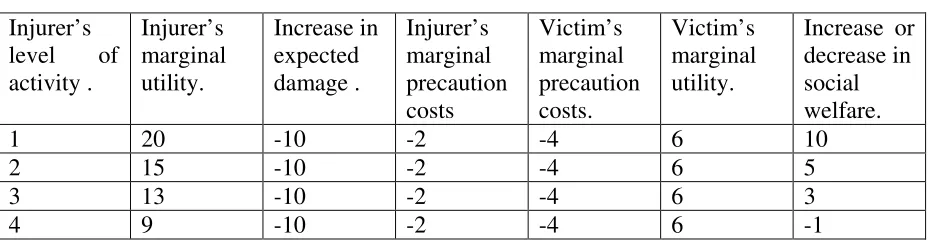
6 Let us start from the idea of strict liability with a defense of contributory negligence and let us imagine that there are two subjects: a mother with her child and a dog-owner. Both go to the park. Let us imagine that both can choose how long to stay in the park, taking the relative precautions. For reasons of simplicity, let us imagine that the victim’s marginal benefit is always constant (Table 1)
Table 1 Injurer’s level of activity . Injurer’s marginal utility. Increase in expected damage . Injurer’s marginal precaution costs Victim’s marginal precaution costs. Victim’s marginal utility.
Increase or decrease in social welfare.
1 20 -10 -2 -4 6 10
2 15 -10 -2 -4 6 5
3 13 -10 -2 -4 6 3
4 9 -10 -2 -4 6 -1
Activity level 3 could be considered as optimal since, as shown previously, according to the traditional assumptions of economic analysis of the law, it is efficient to adopt a f u r t h e r activity level as long as the residual bearer’s marginal utility is higher or equal to the expected damage and to his precaution costs.
Applying a rule of strict liability with a defense of contributory negligence, the dog-owner obtains a marginal benefit of 13 but must pay the cost of his precautions (2) and the expected damage (10). In our example therefore the costs of the dog-owner (12) are lower than his marginal benefits (13). At activity level three the utility that the mother enjoys from taking her child for a walk (6) is also higher than the costs (4). The efficient level, therefore, is 3.
[image:7.596.57.522.187.309.2]Despite this, if we also consider that the cost of the mother’s precautions is 4, we can see that the total costs (16) are higher than the injurer’s marginal utility. Therefore, there would be a first-best solution if the dog-owner refrained from adopting his activity, leaving the mother the possibility of walking in the park alone with her child.
Table 2. Injurer’s level of activity Injurer’s marginal utility Increase in expected damage Injurer’s marginal precaution cost Victim’s marginal precaution cost Victim’s marginal utility
Increase or decrease in social welfare
1 20 -10 -2 -4 6 10
2 15 -10 -2 -4 6 5
It is true that the dog-owner would not obtain the marginal utility arising from their activity; despite this, there would be no damage and, in addition, neither the dog-owner nor the mother would adopt the due precautions. Social welfare therefore would be equal to the marginal utility of the victim at activity level 3. It follows that if the dog-owner does not take the dog for a walk, there is a change in social utility of 6, higher than the change in social utility (3) which is obtained if the dog-owner decides to fulfill activity level 3 (Table 2).
We can follow a similar way of thinking in regard to the negligence rule. In this light we can reconsider the previous example of the mother and the dog-owner, assuming, however, again for the sake of simplicity, that the injurer’s costs and benefits are constant for every activity level (Table 3)
Table 3.
Victim’s level of activity
Victim’s marginal utility
Increase in
expected damage
Victim’s marginal precaution cost
Injurer’s marginal precaution cost
Injurer’ marginal utility
Increase or decrease in social welfare
1 20 -10 -4 -5 6 7
2 18 -10 -4 -5 6 5
3 16 -10 -4 -5 6 3
4 15 -10 -4 -5 6 2
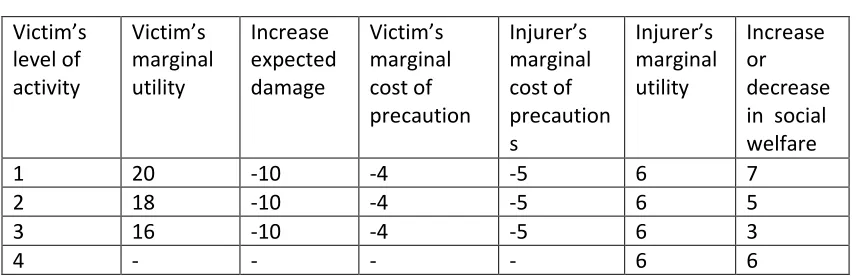
According to the standard analysis, in this case the injurer has an incentive to adopt a non-optimal activity level, since, under the negligence rule, he does not internalize the costs of the expected damage. The potential victim, on the other hand, would have an incentive to adopt an efficient activity level. In our example, therefore, if the parties walked for 4 hours, the mother would have a benefit of 15 compared to a social cost given by the sum of the expected damage (10) and the precautions she has taken (4). The mother would therefore have a marginal benefit of 1, while the change in social welfare would be 2 (Table 3).
8 fourth hour of the day, the dog-owner, in the example shown, could go to the park with his animal without adopting precautions and we would have the following situation (Table4)
Table 4.
Victim’s level of activity
Victim’s marginal utility
Increase expected damage
Victim’s marginal cost of precaution
Injurer’s marginal cost of precaution s
Injurer’s marginal utility
Increase or decrease in social welfare
1 20 -10 -4 -5 6 7
2 18 -10 -4 -5 6 5
3 16 -10 -4 -5 6 3
4 - - - - 6 6
In this case, therefore, the change in social welfare would coincide exactly with the private welfare of the injurer. The ensuing situation represents a more efficient result, compared to the previous case in which both the dog-owner and the mother take a walk during the fourth hour, since if only the dog-owner acts, the change in social utility is 6, while if both act, the change in social utility is 2.
We therefore believe, contrary to the common doctrinal opinion, that a Kaldor-Hicks efficiency improvement is obtained if the legal rules discourage the residual bearer from adopting a further activity level in the case in which his marginal benefits are higher than the sum of the expected damage and the cost of his precautions, but lower than the sum of the expected damage, the cost of his precautions and the cost of the counterparty’s precautions. In this case, if the residual bearer does not act and therefore there is none of the expected damage and there is no need to adopt precautions, there will be an increase in social utility. For this reason it’s possible to speak of “activity-level externalities”.
4. Pigovian taxation and double taxation
We feel, on the other hand, that such an approach does not pay due attention to the weaknesses of the Pigovian tax system which have already been highlighted in the literature by Coase.
To tell the truth, influential criticism of the Pigovian tax system was made by Buchanan and Stubblebine (1962) for different reasons from those considered in this paper. According to those authors, an efficient Pareto situation is in fact only obtained when the marginal cost that falls on the agent is equal to the marginal benefit that the other party obtains. The idea is that for the agent the marginal benefit in adopting a particular activity is lower than the marginal cost of the party that suffers the externality. In such a situation, the victim would be willing to pay a given amount of money to induce the injurer to reduce his activity level. However, the parties do not always decide to remove the externality since it is by no means certain that further activity by the injurer will establish a marginal cost for the victim; nor can it be argued a priori that the marginal cost that the victim suffers is always higher than the injurer’s marginal benefit.
Without the possibility of resolving the conflicting claims of the parties through negotiation, State intervention is necessary, but such intervention must aim to make the agents incur the complete internalization of the costs arising from their actions.
With the introduction of a Pigovian tax, in fact, the victim obtains a benefit without having incurred any cost; it would therefore be possible for the parties to negotiate further and the victim could pay the injurer in order to adopt a lower activity level. In other words, according to Buchanan and Stubblebine, with the introduction of a Pigovian tax an optimal activity level is obtained but it is not a situation of equilibrium, since the parties, by means of subsequent negotiation, could determine a different level of inefficient activity, thus reducing the welfare of the community as a whole.
For the purposes of this article, however, we wish to highlight that the solution proposed by Buchanan and Stubblebine is similar to the remedy considered by Coase: according to Buchanan and Stubblebine, in fact, if the victim too pays a tax equal to the benefit that he obtains, the parties will not have any incentives to undertake further exchanges; the situation obtained, therefore, with the introduction of a Pigovian tax would not only represent a first-best situation, but would also be a situation of efficient balance, i.e. a situation in which there is no interest on the part of the parties to change. With the introduction of a double tax, therefore,
“Not only must B's behavior be modified so as to insure that he will
take the costs externally imposed on A into account, but A's behavior
must be modified so as to insure that he will take the costs " internally
" imposed on B into account. In such a double tax-subsidy scheme, the
10
Pareto equilibrium in the case of marginal externalities cannot be
attained so long as marginal externalities remain, until and unless
those benefiting from changes are required to pay some "price" for
securing the benefits”.
Buchanan and Stubblebine’s reasoning has significant analogies with the solution described by Coase in 1960. Despite this, we believe that the latter’s argument is more relevant to the thesis set out in this article, since he expressly considers the parties’ precaution costs and activity levels, and enables understanding of the limits of the traditional assumptions on civil liability. According to Coase, in fact, an externality can be defined as a situation of conflict between the interest of the injurer and the interest of the victim in using the same resource: given a clear definition of the proprietary rights and in the absence of significant transaction costs, in fact, regardless of the initial allocation, the resource would be allocated, following negotiation, to the party which gives it a higher value. If the bargaining between the parties is, however, not possible, in Coase’s view it is correct to define a priori the injurer as the party who must suffer the cost of the expected damage, since it is otherwise necessary to consider both the level of utility and the precaution cost of both parties.
We consider it necessary, for the purposes of this analysis, to set out the famous example mentioned by Coase. There is a factory which emits harmful smoke in a particular location at a cost of 100; the factory, however, could avoid the damage by adopting precautions at a cost of 90. According to the standard analysis, the Pigovian tax would be efficient because it would encourage a situation in which the social cost and private cost coincide, thus eliminating the externality. The factory, therefore, as it has to pay a tax equal to the expected damage, would have an incentive to adopt the necessary precautions.
case in which the precaution costs are lower than the costs chargeable to the producer, people would adopt adequate measures to avoid the damage or, alternatively, would not stay in the region. Given a tax only on the producer, on the other hand, the factory’s neighbors would have no incentive to adopt the efficient precaution and activity levels to minimize the expected social cost. Coase highlights that this result could be avoided if the tax was calculated without reference to the damage in concrete terms but to the fall in value of production in a broad sense following the emission of smoke. This however, Coase adds, is not possible since judges cannot observe every variable which influences the social cost.
We consider it interesting to compare the solution proposed by Coase with the traditional assumptions of tort law..
As already highlighted, the rules of liability considered identify a party who does not suffer the cost of the expected damage and a residual bearer. Under strict liability with a defense of contributory negligence, the injurer is the residual bearer if the victim pays the due level of precautions; under the negligence rule, on the other hand, the victim is the residual bearer if the injurer is diligent. The main characteristic of the Pigovian tax, on the other hand, is that the situation of the parties is symmetrical. The injurer, besides incurring the cost of his precautions, pays the State and not the victim a tax, the total of which is equal to that of the expected damage; the victim, on the other hand, is not compensated for the losses suffered and must also adopt his own precautions. Therefore, with the system of the Pigovian tax, both the injurer and the victim are residual bearers.
Coase infers that, even with the introduction of a Pigovian tax, the parties do not internalize all the social costs resulting from their activity. In other words, in Coase’s reasoning it seems clear that the residual bearer, although suffering the expected damage, does not consider the cost of the counterparty’s precautions and can adopt an excessive activity level, in contrast with the traditional assumptions of the “Shavell Theorem” and of the system of decoupling liability. In the aforementioned example, an excessive number of inhabitants could establish their residence near the factory, or an excessive number of people could adopt their own activity thus increasing the size of the expected damage. Coase’s intuition, in our view, also consists in having foreseen an original and satisfying solution to the problem, the system of double taxation, which will be analyzed below.
5. The Pigovian tax and the cost of precautions.
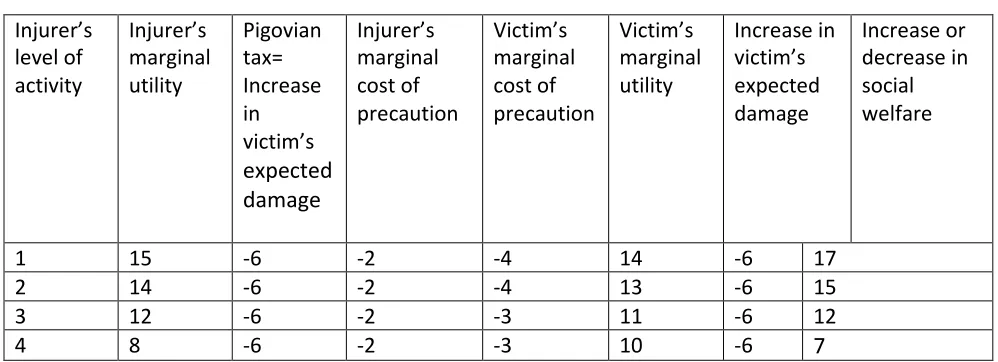
12 will analyze the situation in which the cost of the counterparty’s precautions falls on the injurer and not on the victim; second , we consider the case where the victim pays a tax equal to t h e c o s t o f t h e injurer’s precautions, at the end we will examine the case in which both the parties, besides incurring the cost of the expected damage, also pay the State an amount equal to the counterparty’s precautions. For now let us focus our attention on the case in which it is the victim who pays for the precautions, by looking again at the example of the mother and the dog-owner who go for a walk in the park.(Table 5)
Table 5. Injurer’s level of activity Injurer’s marginal utility Pigovian tax= Increase in victim’s expected damage Injurer’s marginal cost of precaution Victim’s marginal cost of precaution Victim’s marginal utility Increase in victim’s expected damage Increase or decrease in social welfare
1 15 -6 -2 -4 14 -6 17
2 14 -6 -2 -4 13 -6 15
3 12 -6 -2 -3 11 -6 12
4 8 -6 -2 -3 10 -6 7
Let us analyze what happens in the case of a Pigovian tax.
Both the dog-owner and the mother suffer the cost of the expected damage of 6: both also would go for a walk for four hours running; from the fourth hour in the park the mother would obtain a utility of 10, having however to pay, besides the expected damage (6), also the cost of the precautions (3). The dog-owner, on the other hand, would obtain a benefit of 8 given the payment of a tax equal to the expected damage (6); they should also incur the cost of their own precautions (2). According to the framework used by classical economists, the change in social welfare would be 7.
The mother, however, in choosing activity level 4 does not consider the cost of the precautions incurred by the dog-owner. In fact it can be seen that in reality, the mother’s benefit from the fourth hour of walking (10) is below the total social costs, understood as the total of the expected damage (6), the cost of the dog-owner’s precautions (2) and the cost of the precautions of the mother herself (3). If, as imagined by Coase, the mother should pay a tax equal to the dog-owner’s precautions, she would then abstain from adopting her own activity. In this case the expected damage would be zero and the dog-owner should not take any precautions (Table 6)
Injurer’s level of activity Injurer’s marginal utility Pigovian tax= Increase in victim’s expected damage Injurer’s marginal cost of precaution Victim’s Marginal cost of precaution Victim’s marginal utility Increase in victim’s expected damage Increase or decrease in social welfare v
1 15 -6 -2 -4 14 -6 17
2 14 -6 -2 -4 13 -6 15
3 12 -6 -2 -3 11 -6 12
4 8 - - - 8
Social utility would fully coincide with the welfare of the dog-owner.
In our opinion, however, given that the situation of the parties is symmetrical, we can imagine an inverse solution to that put forward so far. In other words, we can also obtain an increase in efficiency in the case in which it is the injurer and not the victim who abstains from acting. In the example now put forward we obtain an improvement in social welfare where the dog-owner and not the mother abstains from walking in the park for four hours running. If it is true that the position of the parties is symmetrical, since both are residual bearers, it can be imagined that the costs of the counterparty’s precautions may fall not on the victim but on the injurer. The victim, therefore, would not pay a tax but will bear the expected damage and his cost of precaution. The injurer would pay a tax equal to the victim’s precaution cost.
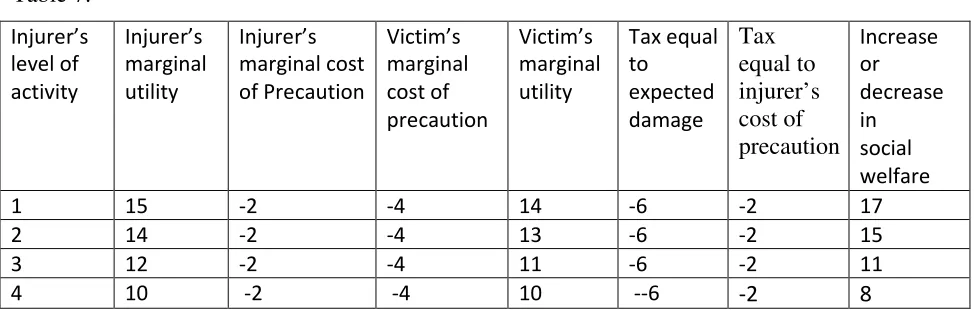
It can also be underlined Coase’s model can be modified by the use a single tax. Indeed we can imagine that .according to the legal system, the liability regime of the dog’s owner is strict liability. In this situation he bears the costs of his precautions and the expected damage. In order to have an efficient level of activity on the part of the victim it is necessary to introduce a tax equal to the expected damage and the injurer’s cost of precaution. With this tax the victim will choose an optimal level of activity. But this solution has some aspects of great complexity. Indeed the victim would receive the compensation for the expected damage from the injurer and should simultaneously pay an identical amount in the form of tax. The solution with two taxes seem more practical.
14 In the alternative hypothesis there is a regime of strict liability, so the injurer bears the expected cost, and the victim bears his cost of precaution and a tax equal to the expected damage and the injurer’s cost of precaution. So the victim will have a cost of precaution (4) a tax equal to the expected damage (-6) and a tax equal to the injurer’s cost of precaution (-2). His total cost is -12 and he will stop at level 2. The two systems of rules produce the same result, but it seems more simple to use the first.
Table 7.
Injurer’s level of activity
Injurer’s marginal utility
Injurer’s marginal cost of Precaution
Victim’s marginal cost of precaution
Victim’s marginal utility
Tax equal to
expected damage
Tax equal to injurer’s cost of precaution
Increase or decrease in social welfare
1 15 -2 -4 14 -6 -2 17
2 14 -2 -4 13 -6 -2 15
3 12 -2 -4 11 -6 -2 11
4 10 -2 -4 10 --6 -2 8
If the dog-owner abstains from adopting his own activity, the mother would take her child for a walk without worrying that during the fourth hour of activity damage might occur and without having to take any precautions. The change in social welfare would coincide with the mother’s marginal utility (10) and once again we would obtain a result that is better than the idea of a simple Pigovian tax..
The result which follows is in any case superior – in terms of efficiency – to the forecast for a simple Pigovian tax, since at a particular activity level it is socially desirable for a party not to act, thus allowing the counterparty to adopt their own activity without having to worry about adopting precautions and without having to suffer the cost of the expected damage.
Obviously it is not possible to establish a priori which of the two solutions can be considered most efficient. In the example given, it would be efficient for the mother to be the one to act, since her benefit is greater than the dog-owner’s benefit.
efficient, therefore, for the person who acts to make the most detailed assessment of the possibility of undertaking a particular activity.
In truth, we could also imagine a third solution as an alternative to mere Pigovian taxation, envisaging that both the parties must incur the cost of the counterparty’s precautions. The results of such a mechanism however might be optimal. Indeed it could produce the result that both parties choose an efficient level of activity. But there could be a problem: the injurer, concerned that the victim may also act, could abstain from adopting their own activity; the victim, in turn, could reason along the same lines. There would therefore be an inefficient sub-optimal level of activity.
It must be acknowledged that such a solution has not been adequately looked into by academics and certainly deserves further analysis.
6. Conclusion
According to common doctrinal opinion, in a bilateral accident model, both strict liability with defense of contributory negligence and the negligence rule ensure that at least one party adopts an efficient activity level: this party is the residual bearer.
In our view, this arrangement is reductive since it does not consider that residual bearers also tend to adopt their activity excessively. As shown in this article, in fact, the residual bearer does not internalize all the social costs, since he does not suffer the cost of the counterparty’s precautions: he therefore acts even when his marginal benefit is lower than the sum of the expected damage, the cost of their precautions and the cost of the counterparty’s precautions.
The soundness of our reasoning is shown by the fact that if the different doctrinal opinions were all- encompassing, the problem of the excessive activity level could be resolved by introducing a Pigovian taxation system, since in this way both the injurer and the victim suffer the expected damage. It should therefore be presumed that both the parties have the right incentives to behave diligently and to minimize the social costs2.2
2
16 In reality, Pigovian taxation also fails to minimize the social costs, since the injurer does not take
into account the victim’s precaution costs, just as the victim does not consider the injurer’s precaution costs. It is therefore efficient to introduce a system of taxation in which either the injurer or the victim must incur the cost of the counterparty’s precautions. De facto it is not possible to abstractly define which of the two solutions is more efficient, since it is necessary to check in concrete terms whether it is preferable to provide incentives to act to the injurer or the victim.
The double taxation system has greater weaknesses, being a system in which both the victim and the injurer must bear the cost of the counterparty’s precautions, since such a mechanism could induce both economic agents not to act, thus determining a sub-optimal level of activity. This situation, which has not been adequately analyzed by the doctrine and also in this article, will certainly be the subject of further detailed research.
References
Buchanan Jams M.& Craig M., Stubblebine, (1962), Externalities in Economica New Series, Vol. 29, No. 116. 371-384.
Coase, Ronald H. (1960), ‘The Problem of Social Cost’, 3 Journal of Law and Economics, 1-44.
Cooter, Robert D. & Thomas S. Ulen, (2004), Law and economics, 4th ed., Reading, Massachusetts, [etc.]: Addison-Wesley.
Dari-Mattiacci Giuseppe, Tort Law and Economics (2003). Utrecht University Working Paper. Available at SSRN: http://ssrn.com/abstract=347801 or http://dx.doi.org/10.2139/ssrn.347801
Dari-Mattiacci, Giuseppe & Francesco Parisi (2006), The Economics of Tort Law: A Precis. THE ELGAR COMPANION TO LAW AND ECONOMICS (2nd ed.), Edward Elgar Publishing; George Mason Law & Economics Research Paper No. 03-49. Available at SSRN: http://ssrn.com/abstract=458701 or http://dx.doi.org/10.2139/ssrn.458701
Miceli, Thomas J. (1997), Economics of the Law: Torts, Contracts, Property, Litigation, Oxford, Oxford University Press.
Polinsky, A. Mitchell & Yeon-Koo, Che, (1991), ‘Decoupling Liability: Optimal Incentives for Care and Litigation’, 22 Rand Journal of Economics, 562-570.
Posner Richard (2011), Economic Analysis of Law, (8th ed) (Aspen Publishers:)
Schäfer Hans-Bernd & Claus Ott, (2004), The Economic Analysis of Civil Law, Northampton: Edward Elgar Publishing Ltd; New edition
Shavell, Steven (1980a), ‘Strict Liability versus Negligence’, 9 Journal of Legal Studies, 1-25. ID (1980b),Economic Analysis of Accident Law, Cambridge (Mass.).
ID (1987), Economic Analysis of Accident Law, Cambridge (MA): Harvard University Press.
ID (2006), Liability for Accidents. HANDBOOK OF LAW AND