Comparison of SCS and Green-Ampt Methods in Surface
Runoff-Flooding Simulation for Klang Watershed in
Malaysia
Reza Kabiri, Andrew Chan, Ramani Bai
Faculty of Engineering, University of Nottingham Malaysia Campus, Kajang, Malaysia. Email: [email protected]
Received January 4th, 2013; revised February 5th, 2013; accepted February 14th, 2013
Copyright © 2013 Reza Kabiri et al. This is an open access article distributed under the Creative Commons Attribution License, which permits unrestricted use, distribution, and reproduction in any medium, provided the original work is properly cited.
ABSTRACT
The main aim in this research is comparison the parameters of some storm events in the watershed using two loss mod-els in Unit hydrograph method by HEC-HMS. SCS Curve Number and Green-Ampt methods by developing loss model as a major component in runoff and flood modeling. The study is conducted in the Kuala Lumpur watershed with 674 km2 area located in Klang basin in Malaysia. The catchment delineation is generated for the Klang watershed to get
sub-watershed parameters by using HEC-GeoHMS extension in ARCGIS. Then all the necessary parameters are as-signed to the models applied in this study to run the runoff and flood model. The results showed that there was no sig-nificant difference between the SCS-CN and Green-Ampt loss method applied in the Klang watershed. Estimated direct runoff and Peak discharge (r = 0.98) indicates a statistically positive correlations between the results of the study. And also it has been attempted to use objective functions in HEC-HMS (percent error peaks and percent error volume) to classify the methods. The selection of best method is on the base of considering least difference between the results of simulation to observed events in hydrographs so that it can address which model is suit for runoff-flood simulation in Klang watershed. Results showed that SCS CN and Green-Ampt methods, in three events by fitting with percent error in peak and percent error in volume had no significant difference.
Keywords: SCS Curve Number; Green-Ampt; Loss Method; GIS; HEC-Geo-HMS; HEC-HMS; Runoff; Flood
Modeling
1. Introduction
Usual methods of runoff and flooding estimation are costly, time consuming along with error because of having various variables contribute in the watershed. As such, using Geographic Information System (GIS), to develop hydrology model through the sub-watershed data in water resources management and planning seem to be critical. There are various methods to simulate surface runoff and flooding by using different loss model methods in HEC- HMS which some of them consist of the SCS Curve Number model [1], CASC2D [2], TOPMODEL [3], GIUH [4], University of British Columbia Watershed Model (UBCWM) and Geomorphological Instantaneous Unit Hy- drograph (GIUH). Among the methods, the SCS (Natural Resources Conservation service Curve Number method (NRCS-CN)) method is widely used. Many studies have been conducted by [5-9] who have applied the GIS tools
to estimate runoff CN value to make an empirical runoff estimation and also many researches was implemented by [10-13] to demonstrate SCS application in hydrological studies. This method is based on a rainfall-runoff model that was created to quantify direct runoff. In fact it pre-sumes an initial abstraction according to curve number value. Curve numbers used in this study is according to USDA National Engineering Handbook [14]. To estimate the direct runoff (excess rainfall) the major components of a watershed which contribute to runoff are the data such as land use, soil data and antecedent moisture conditions (AMCs) which are designed to estimate the loss and run-off volume [15].
in-filtration equation and requires the homogeneous soil characterizations such as hydraulic conductivity, wetting front soil suction head, moisture contents and impervious value. Some studies have been conducted on the per-formance of CN to Green-Ampt [17-19]. These studies demonstrate that results of direct runoff modeled are similar and state to be user friendly application of SCS- CN method compare the Green-Ampt. Wilcox et al. (1990) expressed that CN and Green-Ampt models leave the results close to where the scope of the study was on six small catchments in USA.
In this study, SCS Curve Number and Green-Ampt equations are applied to determining loss model as a major component in runoff and flooding modeling. The objec-tive of this study is to compare the results of SCS-CN and Green-Ampt model to estimate runoff and flooding in Klang watershed on some rainfall event data. It is impor-tant to mention that mapping watershed modeling is done using HEC-GeoHMS extension in ArcGIS which is able
to produce the catchment delineation automatically and also acts as an interface between ArcGIS and HEC-HMS software.
2. Material
2.1. Study Area
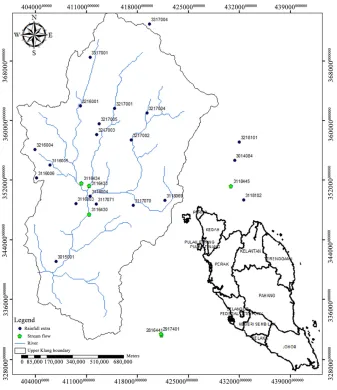
This study was conducted in the Klang watershed,
lo-cated in Kuala Lumpur, Selangor province in Malaysia given in Figure 1. The scope lies between 101˚30' to
101˚55' E Longitudes and 3˚N to 3˚30'N latitude. The area of Klang watershed is approximately 674 km2. The
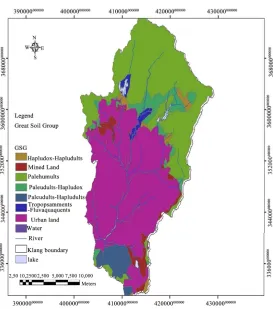
elevation ranges from 10 to 1400 meter above mean sea level and the mean annual precipitation is about 2400 mm. About 50% of Klang watershed has occupied by urban areaand much of it is perched on susceptible land to flooding. The Figures 2 and 3 illustrate the major
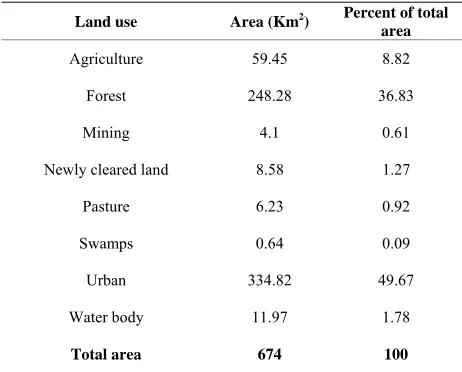
landuses and soil in the studyarearespectively. Table 1
[image:2.595.141.478.329.719.2]address most cover types that are commonly encountered in Klang watershedareas.
Figure 2. Land use/cover map of the Klang watershed.
[image:3.595.163.436.411.720.2]Table 1. Land use/cover classes present in the Klang wa-tershed (from DID, 2002).
Land use Area (Km2) Percent of total
area
Agriculture 59.45 8.82
Forest 248.28 36.83
Mining 4.1 0.61
Newly cleared land 8.58 1.27
Pasture 6.23 0.92
Swamps 0.64 0.09
Urban 334.82 49.67
Water body 11.97 1.78
Total area 674 100
2.2. Data Sources
The Landuse, Soil, rainfall data and hydrometric data (Hourly discharge) were obtained from Department of Irrigation and Drainage of Malaysia (DID). Digital Ele-vation Model (DEM) obtained from the Shuttle Radar Topography Mission (SRTM) with the resolution of 90 meters per pixel. 18 rainfall gage stations were selected in the scope of study which contributes to process of areal rainfall mapping. The Table 2 given the geogra-
phical coordination of 18 rainfall gage stations located in the study area. Figure 1 shows the spatial map of all the
rainfall station.
2.3. Software Used for Data Processing
ArcGISversion 9.3.1 powerful Geographical Information System (GIS) software with the HEC-GeoHMS exten-sion used for creating hydrological maps. The extenexten-sion is a hydrological tool developed by US Army Corps of Engineers, Hydrologic Engineering Center, 2003 and also HEC-HMS software is used for Runoff and flooding analysis.
3. Methodology
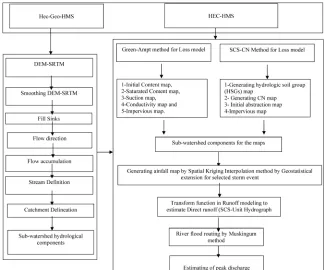
According to the Figure 4, there has been created
cat-chment delineation for the Klang watershed to make the sub-watershed parameters by using HEC-GeoHMS ex-tension in ARCGIS as an input into HEC-HMS. In this regard, there has been attempt to reproduce all the spatial maps such as initial content, saturated content, suction and conductivity maps extracted from soil data for Green-Ampt method and also other necessary maps for SCS-CN method such as Hydrological soil groups (HSGs), CN and initial abstraction maps. In addition,
spatial impervious map developed by overlaying the DEM and landuse map by cross function in ArcGIS. To enter the precipitation data in HEC-HMS for each sub- watershed, there has been made an aerial rainfall data interpolation for the rainfall event used in the modeling using geostatistical extension in ArcGIS. Since the lan-duse map in this study is devoted to 2002, therefore re-levant flood events are extracted from the year of 2002. The rainfall events with the simple hydrograph shape selected which seem to be appropriate in runoff-flooding modeling by HEC-HMS. The events of 11 June and 21 Dec. are used for validation. Muskingum method is run and finally Muskingum method has been run to enter the channel characterization for flood hydrograph setup in HEC-HMS.
To add the point, that there are two reservoirs in Klang watershed (Batu dam and Klang gate dam). According to its characterization a storage-discharge relationship was run in HEC-HMS to determine the detention impact of the reservoirs.
3.1. Loss Model to Determine Excess Precipitation (Direct Runoff)
3.1.1. SCS-Curve Number Method
The SCS-CN method is used in runoff volume calcula-tion using the values related to landuse and soil data so that integration of these data determine CN values for the watershedto consider amount of infiltration rates of soils. The CN values for all the types of land uses and hydro-logic soil groups in Klang watershed are adopted from Technical Release 55 [14]. In this regard, Soils are cate-gorized into hydrologic soil groups (HSGs). The HSGs consist of four categories A, B, C and D, which A and D is the highest and the lowest infiltration rate respectively. To create the CN map, the hydrologic soil group and land use maps of the Klang watershed are combined by cross function in ARCGISto get a new map integrated of both the land use and soil data.
3.1.2. Green-Ampt Method
Green and Ampt method is also used to calculate the infiltration and loss rate in runoff modeling. The Green Ampt Method is an acceptable loss model and is a sim-plified representation of the infiltration process in the field [20]. It is a function of the soil suction head, poros-ity, hydraulic conductivity and time. The general formula of Green-Ampt method is given below [21].
1
d
F t t
o F F oK td
(1)Figure 4. Flowdiagram of flood modeling using Hec-Geo-HMS.
Table 2. Rainfall station used in the study.
Number Station ID Longitude Latitude Number Station ID Longitude Latitude
1 3216005 101.65 3.26 10 3317001 101.7 3.33
2 3015001 101.66 3.08 11 3117002 101.72 3.25
3 3117070 101.75 3.15 12 3217003 101.7 3.24
4 3116004 101.7 3.16 13 3016001 101.6 3.02
5 3217002 101.75 3.23 14 3216004 101.63 3.22
6 3217004 101.77 3.26 15 3317004 101.77 3.37
7 3116006 101.63 3.18 16 3116003 101.68 3.15
8 3116074 101.7 3.15 17 3117101 101.7 3.1
9 3117104 101.75 3.13 18 3016102 101.41 3.05
The soil texture is important component due to it im-pacts soil physical properties which are used in Green- Ampt method to calculate the loss parameters. In order to estimate soil properties in the Kland watershed it is categorized into USDA soil texture classification. There- fore, the values suggested by [22] have been adapted in soil characterizations.
3.2. SCS-Unit Hydrograph
The curve of runoff changes in terms of time is called hydrograph. It is able to prepare the maximum runoff,
volume and the amount of retention of flooding in a wa-tershed. In this study, SCS Dimensionless Hydrograph has been used to generate unit hydrograph for the selected event rainfall. This method has been by USDA on the various watersheds in US. It based on the converting time
[image:5.595.53.540.402.588.2]time factors affecting the hydrograph shape are constant [14]. The parameters used in SCS dimensionless unit hydrograph are Time of concentration, Lag time, Dura-tion of the excess Rainfall, Time to peak flow, Peak flow. The relevant equations listed below:
25400 254
S CN
(2)
20.2 0.8 P S Q P S
(3)
1000 10
S CN
(4)
where,Q is direct runoff (mm), P is accumulated rainfall (mm), S is potential maximum soil retention (mm), and
CN is Curve Number.
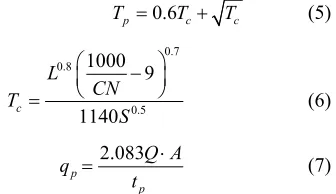
The unit hydrograph for any regularly shaped water-shed can be constructed once the values of Qp and Tp are
defined. The time to peak, time of concentration and is defined as:
0.6 c
p c T
T T (5)
0.7 0.8 0.5 1000 9 1140 c L C T N S
(6)
2.083 p p Q q A t
(7)
where, Tp is Time to peak (min), Tc is Time of
concentra-tion (hr.), L is hydraulic length of watershed (ft), S is average land slope of the watershed (percent), qp is peak
flow
m s3
, Q is direct runoff (cm), A is area ofwa-tershed (Km2). t
p is Time to peak (hr.)
The standard lag time is defined as the length of time between the centroid of precipitation mass and the peak flow of the hydrograph. The time of concentration is de-fined as the length of time between the ending of excess precipitation and the first milestone on descending hy-drograph.
3.3. Flow Calculation in Reach
There are some methods to consider the flow hydrograph in HEC-HMS. According the available data of the Klang watershed, Muskingum method is run to determine the
effect of detention of the river on flood hydrograph. Reach element conceptually represents a segment of stream or river. The general formula of Muskingum de-veloped by US Army Corps of Engineers.
1
m d m d
i
S xkQ x kQo (8) where, S is the amount of storage , Qi and Qo is
inflow and outflow
m3
m s , m and d are the constant 3
values which express the logarithmic relationship be-tween storage and elevation.
K is called to storage coefficient having dimensions of time and expressing the ratio of storage to outflow level and can be considered as travel time through the reach element. X is a constant coefficient specifying the relative influence of inflow (Qi) and outflow (Qo) levels which
ranges from 0.0 up to 0.5 with a value of 0 results in maximum attenuation and 0.5 results in no attenuation (HEC-HMS tutorial). In this study due to having the most urbanization areas occupied in Klang watershed,
value of coefficients has been taken as 0.5.
4. Results and Discussion
4.1. Generating Hydrological Watershed Characterization
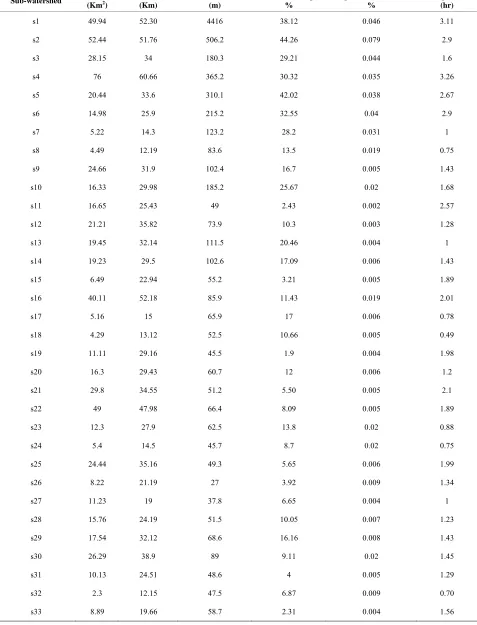
Once downloading the DEM from SRTM site, it is run some processes on it to generate the sub-watersheds and relevant hydrological characterization. The smoothing and filling function are applied by HEC-Geo-HMS to remove the null and noise of DEM. Flow direction, flow accumulation and stream definition functions are run to reproduce the drainage network of DEM. Finally “cat-chment delineation” function in HEC-Geo-HMS gener-ated 33 sub-watersheds. The Figure 5 displays generated
sub-watersheds and Table 3 presents morphological cha-
racterization of Klang watershed derived from DEM.
4.2. Generating HGSs and CN Maps
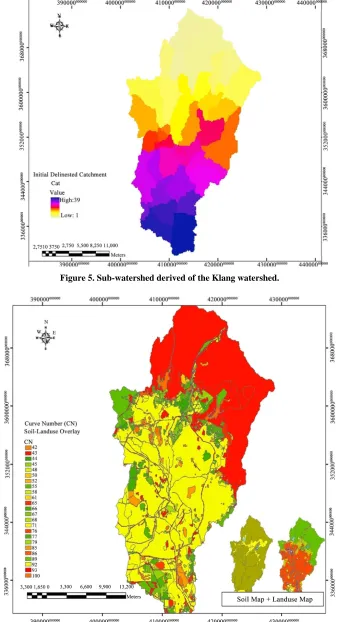
Three hydrologic groups including A, B and D were found in the Klang watershed. 32, 11.6 and 55.5 percent of soil placed in group A, B and D, respectively. Figure 6 illustrates CN map. And also Table 4 presents CN
values obtained by overlaying the land use and soil maps. It is founded that the lowest CN value was found to be 30 in forest and industrial area with the highest CN value was found to be 93 (except the water body which CN equal to 100).
Next step is to make average for each sub-watershed which has been delineated already. The GIS Cross func-tion is employed to generate sub-watershed CN and Green-Ampt maps using Equation (9):
Soil Soil i sub i i A cod Cod A
(9)where: SoilCodsub is weighted average soil parameter
for sub-watershed; Soilcodi is the parameter value and
i
A is area inside the specified sub-watershed.
[image:6.595.122.290.342.439.2]Table 3. Sub-watershed parameters derived of Klang watershed.
Sub-watershed Area (Km2)
Perimeter (Km)
Mean elevation (m)
Watershed Slope %
Slope of main channel %
Lag time (hr)
s1 49.94 52.30 4416 38.12 0.046 3.11
s2 52.44 51.76 506.2 44.26 0.079 2.9
s3 28.15 34 180.3 29.21 0.044 1.6
s4 76 60.66 365.2 30.32 0.035 3.26
s5 20.44 33.6 310.1 42.02 0.038 2.67
s6 14.98 25.9 215.2 32.55 0.04 2.9
s7 5.22 14.3 123.2 28.2 0.031 1
s8 4.49 12.19 83.6 13.5 0.019 0.75
s9 24.66 31.9 102.4 16.7 0.005 1.43
s10 16.33 29.98 185.2 25.67 0.02 1.68
s11 16.65 25.43 49 2.43 0.002 2.57
s12 21.21 35.82 73.9 10.3 0.003 1.28
s13 19.45 32.14 111.5 20.46 0.004 1
s14 19.23 29.5 102.6 17.09 0.006 1.43
s15 6.49 22.94 55.2 3.21 0.005 1.89
s16 40.11 52.18 85.9 11.43 0.019 2.01
s17 5.16 15 65.9 17 0.006 0.78
s18 4.29 13.12 52.5 10.66 0.005 0.49
s19 11.11 29.16 45.5 1.9 0.004 1.98
s20 16.3 29.43 60.7 12 0.006 1.2
s21 29.8 34.55 51.2 5.50 0.005 2.1
s22 49 47.98 66.4 8.09 0.005 1.89
s23 12.3 27.9 62.5 13.8 0.02 0.88
s24 5.4 14.5 45.7 8.7 0.02 0.75
s25 24.44 35.16 49.3 5.65 0.006 1.99
s26 8.22 21.19 27 3.92 0.009 1.34
s27 11.23 19 37.8 6.65 0.004 1
s28 15.76 24.19 51.5 10.05 0.007 1.23
s29 17.54 32.12 68.6 16.16 0.008 1.43
s30 26.29 38.9 89 9.11 0.02 1.45
s31 10.13 24.51 48.6 4 0.005 1.29
s32 2.3 12.15 47.5 6.87 0.009 0.70
Figure 5. Sub-watershed derived of the Klang watershed.
Table 4. Curve number of different land use and Hydrologic soil groups (HSGs) in Klang watershed.
Landuse HSGs CN Area (m2)
A 67 11410612.3
Agriculture B 77 27203033.8
D 87 20830361.9
A 30 210,681,253
Forest B 55 26414983.3
D 77 11109115.4
A 30 2752165.6
Pasture B 58 2115919.59
D 78 1,324,609
A 48 7368539.92
Urban B 66 22636343.6
D 86 304,775,190
Mining areas B 88 315852.11
D 93 3786944.33
A 39 1401685.1
Newly cleared land B 61 6403586.91
D 80 771857.73
Swap and water body 100 12,614,850
Table 5. Infiltration parameters in Green-Ampt method for each sub-watershed in Klang area.
Sub-watershed Hydraulic conductivity (mm/h) Wetting from suction(mm) Saturated water content Initial water content Impervious (Km2) impervious % CN
1 27.084 64.676 0.42 0.289 0.03 0.07 46
2 29.9 61.3 0.437 0.312 0.16 0.37 43
3 18.103 114.612 0.469 0.241 0.85 1.33 64
4 23.245 86.053 0.439 0.268 0 0.00 45
5 27.626 72.132 0.441 0.299 0 0.00 43
6 25.836 80.438 0.446 0.288 0.49 0.96 51
7 11.021 153.757 0.466 0.202 1 1.39 72
8 2.779 195.299 0.476 0.154 1.75 2.19 80
9 7.714 171.469 0.467 0.183 8.58 11.00 78
10 19.006 116.075 0.45 0.249 2.76 4.31 64
11 3.251 194.358 0.471 0.158 11.8 13.26 89
12 1.163 207.91 0.464 0.147 9.6 10.91 88
13 8.945 166.36 0.462 0.191 6 7.50 80
14 12.569 145.764 0.465 0.211 7.15 9.66 74
15 1 208.8 0.464 0.146 1.65 1.81 91
16 5.005 187.663 0.462 0.169 16.98 21.23 80
17 1 208.8 0.464 0.146 1.67 1.96 85
18 1 208.8 0.464 0.146 1.82 2.09 87
19 1 208.8 0.464 0.146 6.12 6.65 92
20 1 208.8 0.464 0.146 5.65 6.49 87
21 1 208.8 0.464 0.146 14.99 17.43 86
22 1.882 198.9 0.463 0.148 12.25 14.41 85
23 1 208.8 0.464 0.146 4.77 5.36 89
24 1 208.8 0.464 0.146 3.7 4.07 91
25 1 208.8 0.464 0.146 20.33 23.37 87
26 1.76 203 0.469 0.149 5.6 6.59 85
27 1 208.8 0.464 0.146 6.5 7.65 85
28 4.077 185.304 0.485 0.16 2.19 2.61 84
29 7.913 162.656 0.49 0.181 0.9 1.14 79
30 2.665 200.249 0.463 0.156 16.18 18.39 88
31 3.284 196.869 0.463 0.159 7.8 9.18 85
32 1 208.8 0.464 0.146 2.7 3.10 87
[image:9.595.59.539.339.737.2]4.3. Generating Green-Ampt Maps els run according to flood event of 6 May 2002. Green-Ampt has essential parameters for flood-runoff
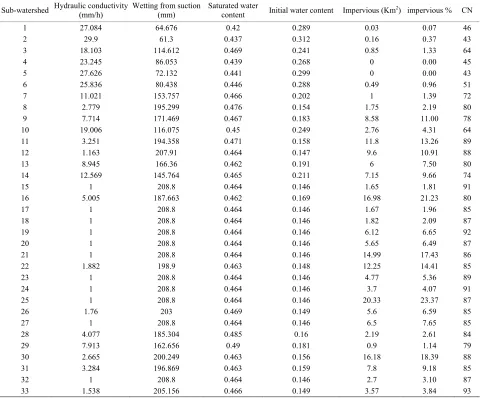
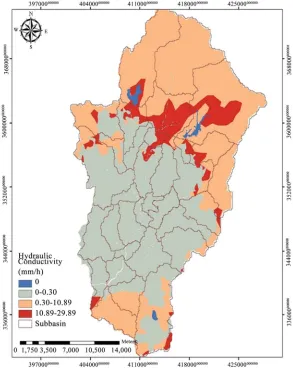
modeling. To make Green-Ampt parameters at first all the relevant infiltration values adapted from Rawls and Brakensiek (1983) were assigned into soil texture map in GIS. And then it is attempted to make an average value of the infiltration parameters according to sub-watershed boundary by HEC-Geo-HMS to estimate the loss model maps such as hydraulic conductivity, suction and initial maps and also the percentage of impervious map. Figure 7 is hydraulic conductivity map as an illustration of
Green-Ampt component. Table 5 presents all the Green-
Ampt parameters for each sub-basin.
5. Conclusion
In order to determine the efficiency and suitability of methods used there has been attempted to make a com-parison on the results by some correlation coefficients and error indices such as Mean Square Error (RMSE), Mean Absolute Error (MAE), coefficient of determina-tion (R2), correlation coefficient (r), Nash-Sutcliffe
effi-ciency (NSE) where as RMSE and MAE values of 0 in-dicate a perfect fit. R2, r and NSE values of 1 indicate
perfect correlation. Model for each methods run and the results are presented in Table 6. A comparison is
con-ducted on the results of Green & Ampt to SCS-CN loss methods for estimation of runoff losses (Table 7). And
also the selection of best method is on the base of con-sidering least difference between the results of simulation to observed events in hydrographs so that it can address which model is suit for runoff-flood simulation in Klang watershed (Table 8). The comparison indicates that the
4.4. Generating Direct Runoff and Peak Discharge
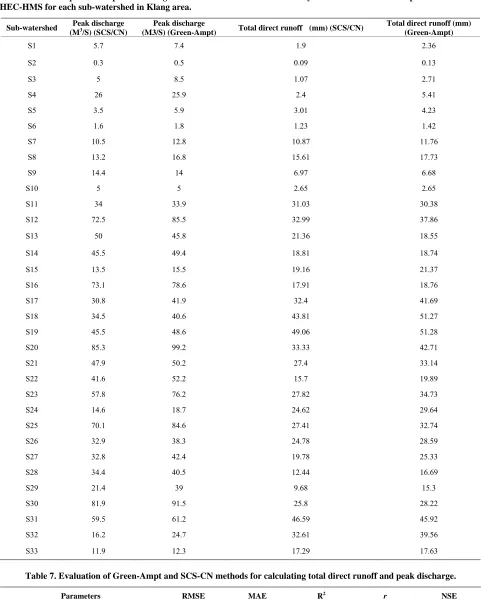
[image:10.595.153.446.347.717.2]Once all the parameters were setup in HEC-HMS for the both loss models (SCS-CN and Green-Ampt), the models run to obtain the direct runoff and peak discharge for each sub-watershed. Table 6 displays the output of mod-
Table 6. The comparison of peak discharge and total direct runoff modeled by SCS-CN and Green-Ampt loss methods in HEC-HMS for each sub-watershed in Klang area.
Sub-watershed Peak discharge (M3/S) (SCS/CN)
Peak discharge
(M3/S) (Green-Ampt) Total direct runoff (mm) (SCS/CN)
Total direct runoff (mm) (Green-Ampt)
S1 5.7 7.4 1.9 2.36
S2 0.3 0.5 0.09 0.13
S3 5 8.5 1.07 2.71
S4 26 25.9 2.4 5.41
S5 3.5 5.9 3.01 4.23
S6 1.6 1.8 1.23 1.42
S7 10.5 12.8 10.87 11.76
S8 13.2 16.8 15.61 17.73
S9 14.4 14 6.97 6.68
S10 5 5 2.65 2.65
S11 34 33.9 31.03 30.38
S12 72.5 85.5 32.99 37.86
S13 50 45.8 21.36 18.55
S14 45.5 49.4 18.81 18.74
S15 13.5 15.5 19.16 21.37
S16 73.1 78.6 17.91 18.76
S17 30.8 41.9 32.4 41.69
S18 34.5 40.6 43.81 51.27
S19 45.5 48.6 49.06 51.28
S20 85.3 99.2 33.33 42.71
S21 47.9 50.2 27.4 33.14
S22 41.6 52.2 15.7 19.89
S23 57.8 76.2 27.82 34.73
S24 14.6 18.7 24.62 29.64
S25 70.1 84.6 27.41 32.74
S26 32.9 38.3 24.78 28.59
S27 32.8 42.4 19.78 25.33
S28 34.4 40.5 12.44 16.69
S29 21.4 39 9.68 15.3
S30 81.9 91.5 25.8 28.22
S31 59.5 61.2 46.59 45.92
S32 16.2 24.7 32.61 39.56
S33 11.9 12.3 17.29 17.63
Table 7. Evaluation of Green-Ampt and SCS-CN methods for calculating total direct runoff and peak discharge.
Parameters RMSE MAE R2 r NSE
Total Direct Runoff (Runoff Depth) 4.15 5.63 0.96 0.98 0.90
Table 8. The comparison of direct runoff and peak discharge by use of objective functions.
Rainfall Event Direct Runoff (MM) Peak Flow (M3/S)
Date Green-Ampt Method SCS_CN Method Green-Ampt Method SCS_CN Method
Simulated Observed Simulated Observed Simulated Observed Simulated Observed
06-May-2002 12.31 10.47 11.46 10.47 360.1 361 359.3 361
21-Dec.-2002 9.12 8.42 8.94 8.42 122.6 121.5 121.8 121.5
11-Jun-2002 23.12 25.6 23.1 25.6 447.7 448.9 449.3 448.9
Green-Ampt and SCS-CN loss methods in three events have no significant difference in results of runoff and flood studies in Klang watershed.
REFERENCES
[1] USDA-SCS, “National Engineering Handbook, Section 4-Hydrology,” USDA-SCS, Washington DC, 1985. [2] M. Marsik and P. Waylen, “An Application of the Dis-
tributed Hydrologic Model CASC2D to a Tropical Mon- tane Watershed,” Journal of Hydrology, Vol. 330, No. 3-4, 2006, pp. 481-495.
[3] K. Warrach, M. Stieglitz, H. T. Mengelkamp and E. Ra- schke, “Advantages of a Topographically Controlled Run- off Simulation in a Soil-Vegetation-Atmosphere Transfer Model,” Journal of Hydrometeorology, Vol. 3, No. 2, 2002, pp. 131-148.
doi:10.1175/1525-7541(2002)003<0131:AOATCR>2.0.C O;2
[4] R. Kumar, C. Chatterjee, R. D. Singh, A. K. Lohani and S. Kumar, “Runoff Estimation for an Ungauged Catchment Using Geomorphological Instantaneous Unit Hydrograph (GIUH) Model,” Hydrological Process, Vol. 21, No. 14, 2007, pp. 1829-1840. doi:10.1002/hyp.6318
[5] A. Pandey and A. K. Sahu, “Generation of Curve Number Using Remote Sensing and Geographic Information Sys- tem,” 2002. http://www.GISdevelopment.net
[6] T. R. Nayak and R. K. Jaiswal, “Rainfall-Runoff Model- ling Using Satellite Data and GIS for Bebas River in Madhya Pradesh,”Journal of the Institution of Engineers, Vol. 84, 2003, pp. 47-50.
[7] X. Zhan and M. L. Huang, “ArcCN-Runoff: An ArcGIS Tool for Generating Curve Number and Runoff Maps,” Environmental Modelling and Software, Vol. 19, No. 10, 2004, pp. 875-879. doi:10.1016/j.envsoft.2004.03.001 [8] M. L. Gandini and E. J. Usunoff, “SCS Curve Number
Estimation Using Remote Sensing NDVI in a GIS Envi- ronment,” Journal of Environmental Hydrology, Vol. 12, 2004, p. 16.
[9] G. De Winnaar, G. Jewitt and M. Horan, “GIS-Based Approach for Identifying Potential Runoff Harvesting Sites in the Thukela River Basin, South Africa,” Physics and Chemistry of the Earth, Vol. 32, 2007, pp. 1058-1067. doi:10.1016/j.pce.2007.07.009
[10] C. Michel, A. Vazken and C. Perrin, “Soil Conservation Service Curve Number Method: How to Mend a Wrong
Soil Moisture Accounting Procedure,” Water Resources Research, Vol. 41, No. 2, 2005, pp. 1-6.
[11] L. E. Schneider and R. H. McCuen, “Statistical Guide- lines for Curve Number Generation,” Journal of Irriga- tion and Drainage Engineering, Vol. 131, No. 3, 2005, pp. 282-290.
[12] S. Mishra, R. Sahu, T. Eldho and M. Jain, “An Improved IaS Relation Incorporating Antecedent Moisture in SCS- CN Methodology,” Water Resources Management, Vol. 20, No. 5, 2006, pp. 643-660.
doi:10.1007/s11269-005-9000-4
[13] R. K. Sahu, S. K. Mishra, T. I., Eldho and M. K., Jain, “An Advanced Soil Moisture Accounting Procedure for SCS Curve Number Method,” Hydrological Processes, Vol. 21, No. 21, 2007, pp. 2872-2881.
doi:10.1002/hyp.6503
[14] US Department Agriculture, Soil Conservation Service, “Urban Hydrology for Small Watersheds SCS Technical Release 55,” US Government Printing Office, Washing- ton DC, 1986.
[15] S. K. Mishra, M. K. Jain, R. P. Pandey and V. P. Singh, “Catchment Area-Based Evaluation of the AMC-Depen- dent SCS-CN-Inspired Rainfall-Runoff Models,” Journal of Hydrological Process, Vol. 19, No. 14, 2005, pp. 2701- 2718. doi:10.1002/hyp.5736
[16] B. P. Wilcox, W. J. Rawls, D. L Brakensiek and J. R. Wight, “Predicting Runoff from Rangeland Catchments: A Comparison of Two Models,” Water Resources Re- search, Vol. 26, No. 10, 1990, pp. 2401-2410.
[17] X. C. Zhang, M. A. Nearing and L. M. Risse, “Estimation of Green-Ampt Conductivity Parameters: Part I. Row Crops,” Transactions of the ASAE, Vol. 38, No. 4, 1995, pp. 1069-1077.
[18] X. C. Zhang, M. A. Nearing and L. M. Risse, “Estimation of Green-Ampt Conductivity Parameters: Part II. Peren- nial Crops,” Transactions of the ASAE, Vol. 38, No. 4, 1995, pp. 1079-1087.
[19] M. A. Nearing, B. Y. Liu, L. M. Risse and X. Zhang, “Curve Numbers and Green-Ampt Effective Hydraulic Conductivities,” Journal of the American Water Resources Association, Vol. 32, No. 1, 1996, pp. 125-136.
doi:10.1111/j.1752-1688.1996.tb03440.x
[20] S. T. Chu, “Infiltration during Unsteady Rain,” Water Re- sources Research, Vol. 14, No. 3, 1970, pp. 461-466. [21] R. G. Mein and C. L. Larson, “Modeling Infiltration dur-
No. 2, 1973, pp. 384-394. doi:10.1029/WR009i002p00384
[22] W. J. Rawls and D. L. Brakensiek, “A Procedure to Pre-