Essential Oils
Eman M. Elgendy
1*, Hoda S. Ibrahim
2, Hanaa F. Elmeherry
1, Amal G. Sedki
1, Faten U. Mekhemer
31Department of Home Economy, Faculty of Specific Education, Mansoura University, Mansoura, Egypt
2Department of Nutrition and Food Science, Faculty of Home Economics, Helwan University, Cairo, Egypt
3Department of Home Economy, Faculty of Specific Education, Tanta University, Tanta, Egypt
Abstract
Cinnamon and lemon are the oldest plants which possess a rising popularity due to their therapeutic potential from centuries. Cinnamomum zeylanicum and lemon (Citrus lemon L.) have been subjected to extensive research. Their essential oils were extracted by steam distillation from selected plants and their chemical compositions were determined by the GC-MS system. Cinnamon and lemon essential oils were examined for antioxidant activity by ABTS method which showed the ability to inhi-bit lipid per-oxidation. On the other hand, in antimicrobial investigations, cinnamon and lemon essential oils have inhibitory effect against Gram positive bacteria ( Sta-phylococcus aureus) and Gram negative bacteria (Escherichia coli) using Muller Hinton agar medium. The essential oils of cinnamon and lemon showed antifungal effects which were tested against (Candida albicans). The volatile oil of cinnamon bark has been found to be highly effective against all the tested bacteria and fungi. However, lemon peel essential oil has shown medium inhibition for Gram positive bacteria(Staphylococcus aureus). On the other hand, the cytotoxic activities of the essential oils were tested on hepatocellular carcinoma and colorectal carcinoma. Es-sential oils have shown good activities on the cell lines. EsEs-sential oil of cinnamon showed more inhibition rate than essential oil of lemon. This study reported the im-portance of both cinnamon and lemon volatile oils and recommends that cinnamon and lemon can be used as an active therapy for humans.
Keywords
Cinnamon, Lemon, Essential Oil, Cinnamaldehyde, Limonene
1. Introduction
Many pathways have been done to keep our food healthy. One pathway to inhibit food
How to cite this paper: Elgendy, E.M., Ibrahim, H.S., Elmeherry, H.F., Sedki, A.G. and Mekhemer, F.U. (2017) Chemical and Biological Comparative in Vitro Studies of Cinnamon Bark and Lemon Peel Essential Oils. Food and Nutrition Sciences, 8, 110- 125.
http://dx.doi.org/10.4236/fns.2017.81008 Received: December 21, 2016
Accepted: January 17, 2017 Published: January 20, 2017 Copyright © 2017 by authors and Scientific Research Publishing Inc. This work is licensed under the Creative Commons Attribution International License (CC BY 4.0).
http://creativecommons.org/licenses/by/4.0/
spoilage is adding preservatives such as antioxidant, antifungal and antimicrobial sub-stances to food. Artificial preservatives, is one of the oldest techniques which play an important role as antimicrobial, antifungal and antioxidant, but have adverse effects on health [1].
Natural additives are widespread due to health problems caused by different artificial preservatives [2] [3].
Using plants and materials of plant origin such as essential oils, is a suitable way to increase safety, quality and nutritional values for food products [4] [5]. Essential oils obtained from plants are used in many foodstuffs to increase their shelf-life [6]. Essen-tial oils are mixture of volatile compounds with intense scent that are synthesized in several plant organs, including flowers, leaves, fruits, or bark, and stored in epidermis cells [7] [8]. These volatile compounds act as protective substances against microor-ganisms and herbivores [9]. Essential oils are used as carminative, stomachic, stimulant, aromatic, antiseptic [10] and as a flavoring agent in beverages, foods, cosmetics, and household products [11]. Phenolic compounds and terpenes are the main biologic con-stituents in the volatile oils [12] [13] [14].
Cinnamon, essential oil is obtained from Cinnamomum zeylanicum (Lauraceae), plant. The important constituents of cinnamon essential oil are cinnamaldehyde (60-70%), eugenol (5% - 10%), benzaldehyde, cuminaldehyde [15] [16]. Lemon essen-tial oil (Citrus lemon L.) from fruit peel contains limonene, beta pinene and gama ter-pinene [11]-[17]. Our study has prompted us to describe the chemical composition of cinnamon and lemon essential oils, to explore and compare their antioxidant, antifun-gal, antibacterial, antifunantifun-gal, antioxidant and anticancer activities.
2. Materials and Methods
2.1. Plant Materials
Cinnamon, Cinnamomum zeylanicum Nees (Lauraceae) and Lemon Citrus limonum L. were bought from a native market in Egypt. Plant materials consisted of stem bark (cinnamon) and fruit peel (lemon).
Chemical reagents: All the chemicals and solvents were of pro-analysis purity and were obtained from Sigma (Sigma–Aldrich GmbH, Sternheim, Germany). Gram posi-tive bacteria (Staphylococcus aureus), Gram negative bacteria (Escherichia coli) and (Candida albicans) fungi were obtained from department of pharmacology, Faculty of Pharmacy, Mansoura University. Hepatocellular carcinoma (HePG-2) and colorectal carcinoma (HCT-116) cell lines were obtained from ATCC via Holding company for biological products and vaccines (VACSERA), Cairo, Egypt. The reagents RPMI-1640 medium, MTT, DMSO and 5-fluorouracil (Sigma Co., St. Louis, USA), Fetal Bovine serum (GIBCO, UK).
2.2. Separation of Essential Oils
280˚C. Ionization of sample components was performed in the EI mode with (70 eV).
2.4. Components Identification
The components of essential oil were identified on the basis of comparison of their re-tention indices and mass spectra with published data [18] [19] and computer matching with WILEY 275 and National Institute of Standards and Technology (NIST 3.0) libra-ries provided with computer controlling the GC–MS system. The results were also con-firmed by the comparison of the compounds elution order with their relative retention indices on non-polar phase reported in the literature [18]. The retention indices were calculated for all volatile constituents using a homologous series of n-alkanes C8 - C16.
2.5. Determination of Antioxidant Activity with the
2,2’-Azino-Bis(3-ethyl benzthiazoline-6-sulfonic acid)
(ABTS) Assay
ABTS solution (2 mL of 60 mM) was added to each of the two essential oils then MnO2
solution (25 mg/mL of 3 M) in phosphate buffer (pH 7, 0.1 M). The blend was shaken,
centrifuged, filtered. The absorbance (A control) of the resulting green-blue solution (ABTS radical solution) was regulated at ca. 0.5 at l 734 nm. Then, 50 ml of (2 mM) so-lution of the two oils in spectroscopic grade MeOH/phosphate buffer (1:1) was added. The absorbance (A test) was measured and the lowering in color sharpness was ex-pressed as % inhibition. The % inhibition for each oil is calculated from the following equation [20].
(
)
%Inhibition= A control−A test A control 100×
Ascorbic acid (vitamin C) was applied as standard anti-oxidant (positive control). Blank sample was take place without ABTS and using MeOH/phosphate buffer (1:1) instead of sample. Negative control sample was carried out with MeOH/phosphate
buf-fer (1:1) instead of oil.
2.6.
In Vitro
Anti-Microbial Activity Evaluation
as standard for anti-bacterial and anti-fungal activities, respectively. The lowest con-centration of each essential oil under study, which did not show any growth of tested microorganisms after macroscopic evaluation was determined as the minimal inhibito-ry concentration (MIC) of this oil.
2.7.
In Vitro
Cytotoxicity Activity Evaluation
Hepatocellular carcinoma (HePG-2) and colorectal carcinoma (HCT-116) cell lines were used to determine the inhibitory effect of each essential oil under study on cell growth using the 3-(4,5-dimethylthiazol-2-yl)-2,5-diphenyl tetrazolium bromide (MTT) assay. The MTT method was conducted according to the colorimetric method of Mos-mann (1983) [22]. 5-Fluorouracil was used as a standard anticancer drug for compari-son. The relative cell viability in percentage was calculated as follows:
(
)
Relative cell viability %
Absorbance of treated cells Absorbance of untreated cells 100
= ×
IC50 value of tested essential oil is the concentration of the tested essential oil that would result in the death of 50% of the cells.
2.8. Statistical Analysis
Statistical analysis was done using GraphPad Prism version 3.0 for windows (GraphPad Prism, 1999) [23]. The majority of the data presented in this study reflect the means ± deviation (SD). One way analysis of variance (ANOVA) and the Tukey’s Multiple Comparison Test were used to determine the differences among the means. The signif-icant difference was set at P < 0.05.
3. Results and Discussion
3.1. Phytochemical Analysis
Phytochemical analysis of Cinnamomum zeylanicum L. bark essential oil demonstrates the presence with high percent of phenols and terpenoids. Whereas, analysis of Citrus lemon L. fruit peel essential oil proved the presence of, terpenoids with high percent
[24]. Essential oils are naturally volatile substances, existing in different parts (flowers, leaves, seeds, roots, bark) of all plants with strong aroma. The amount of essential oils in plants different from very small amounts (0.05% - 0.1%) in one while in other up to 20% [25].
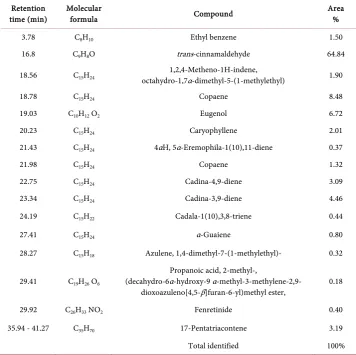
Cinnamon bark essential oil obtained by steam distillation. Its yield was found to be 1.5%. The gas chromatography technique of Cinnamon essential oil detected the pres-ence of many substances which could be identified. It has been found main peak at re-tention time (RT) 16.80 min. with a relative abundance of 64.84% and the molecular formula C9H8O and molecular weight (M.wt = 132.16). The expected substance is
trans-cinnamaldehyde (Figure 1). Trans-Cinnamaldehyde [3-phenyl-propenal, II] is the major component of essential oil of cinnamon and its fragments are 132 (M)+, 131
(M-1)+, 115 (M-1-O)+, 103 (M-CHO)+, 91 (M-C
2HO)+ and 77 (C6H5)+, with base peak
Figure 1. Chromatogram of the main component (trans-cinnamaldehyde) of cinnamon essential oil by GC-MS.
Table 1. Chemical composition of cinnamon essential oil.
Retention
time (min) Molecular formula Compound Area % 3.78 C8H10 Ethyl benzene 1.50
16.8 C9H8O trans-cinnamaldehyde 64.84
18.56 C15H24 octahydro-1,7α-dimethyl-5-(1-methylethyl) 1,2,4-Metheno-1H-indene, 1.90
18.78 C15H24 Copaene 8.48
19.03 C10H12 O2 Eugenol 6.72
20.23 C15H24 Caryophyllene 2.01
21.43 C15H24 4αH, 5α-Eremophila-1(10),11-diene 0.37
21.98 C15H24 Copaene 1.32
22.75 C15H24 Cadina-4,9-diene 3.09
23.34 C15H24 Cadina-3,9-diene 4.46
24.19 C15H22 Cadala-1(10),3,8-triene 0.44
27.41 C15H24 α-Guaiene 0.80
28.27 C15H18 Azulene, 1,4-dimethyl-7-(1-methylethyl)- 0.32
29.41 C19H26 O6
Propanoic acid, 2-methyl-,
(decahydro-6α-hydroxy-9 α-methyl-3-methylene-2,9-
dioxoazuleno[4,5-β]furan-6-yl)methyl ester, 0.18 29.92 C26H33 NO2 Fenretinide 0.40
35.94 - 41.27 C35H70 17-Pentatriacontene 3.19
Total identified 100%
Elgendy and Khayyat, 2014 have been proved that trans cinnamaldehyde can act as antioxidants. It was trapped the reactive oxygen species (ROS) to give the intermediated epoxides and hydroperoxide derivatives [26].
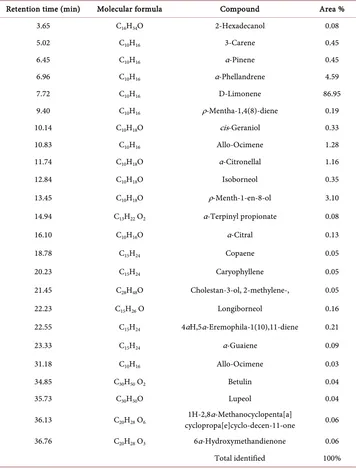
[image:5.595.195.552.290.645.2]The gas chromatography technique of Lemon oil discovered the presence of many sub-stances which could be identified. It has been found main peak at retention time (RT) 7.72 min, with a relative abundance of 86.95% and the molecular formula C10H16 and
molecular weight (M.wt = 136.24) (Figure 2). The expected substance is d-Limonene (1-methyl-4-(1-methylethenyl)-cyclohexene IV), is the major component of Lemon es-sential oil, and its fragments are 136 (M)+, 121 (M-CH
3)+, 107 (M-C2H5)+, 93 (M-
C3H7)+ and 79 (C6H7)+, with base peak 93 m/z. The complete list of the ingredients and
their relative abundances are presented in Table 2.
Elgendy, 1998 has been proved that Limonene can act as antioxidants. It was trapped the reactive oxygen species (ROS) to give the intermediated hydroperoxide derivative
[image:6.595.197.553.268.737.2][27].
Table 2. Chemical composition of lemon oil.
Retention time (min) Molecular formula Compound Area % 3.65 C16H34O 2-Hexadecanol 0.08
5.02 C10H16 3-Carene 0.45
6.45 C10H16 α-Pinene 0.45
6.96 C10H16 α-Phellandrene 4.59
7.72 C10H16 D-Limonene 86.95
9.40 C10H16 ρ-Mentha-1,4(8)-diene 0.19
10.14 C10H18O cis-Geraniol 0.33
10.83 C10H16 Allo-Ocimene 1.28
11.74 C10H18O α-Citronellal 1.16
12.84 C10H18O Isoborneol 0.35
13.45 C10H18O ρ-Menth-1-en-8-ol 3.10
14.94 C13H22 O2 α-Terpinyl propionate 0.08
16.10 C10H16O α-Citral 0.13
18.78 C15H24 Copaene 0.05
20.23 C15H24 Caryophyllene 0.05
21.45 C28H48O Cholestan-3-ol, 2-methylene-, 0.05
22.23 C15H26 O Longiborneol 0.16
22.55 C15H24 4αH,5α-Eremophila-1(10),11-diene 0.21
23.33 C15H24 α-Guaiene 0.09
31.18 C10H16 Allo-Ocimene 0.03
34.85 C30H50 O2 Betulin 0.04
35.73 C30H50O Lupeol 0.04
36.13 C20H28 O6 cyclopropa[e]cyclo-decen-11-one 1H-2,8α-Methanocyclopenta[a] 0.06
36.76 C20H28 O3 6α-Hydroxymethandienone 0.06
Figure 2. Chromatogram of the main component (Limonene) of lemon essential oil by GC-MS.
3.2. Antioxidant Activity of Essential Oils
It is recognized that free radicals are implicated in the lipid per-oxidation reactions and represent a major role in many chronic diseases such as heart and cancer diseases [28]. Therefore, the capability to scavenge free radicals is an important antioxidant feature to decrease cell damage. In many studies in vitro the essential oils exhibited noticeable an-tioxidant activity [29] [30].
Choice of the Method for Determination of Antioxidant Activities
Estimation of antioxidant activity needs use of different methods [31] [32]. ABTS, RANCIMAT and TBARS can be quoted as comparatively simple methods that can be used to gauge the antioxidant activity of essential oils [33]-[39].
TBARS assay cannot evaluate the antioxidant activity of cinnamon essential oil, be-cause trans-cinnamaldehyde is the main component of oil, which strongly interacted with the thiobarbituric acid used in the assay, developing a yellow color [40].
On the other hand, although the RANCIMAT test is commonly used in the food in-dustry and governmental analytical laboratories [41] [42], RANCIMAT test is not con-venient for such measurement, because air inserted inside hot systems (oil) during measurement evaporates essential oils samples formerly and retards measurements.
3.3. Anti-Oxidant Activity Screening Assay ABTS
Antioxidant activities of essential oils from redolent plants are due to the active or ma-jor constituents, in them. This may be also, due to the minor constituents among them
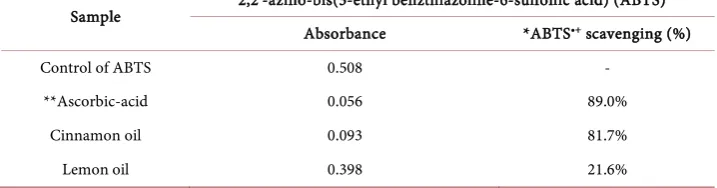
[43]. In this study, the antioxidant activities are determined. It has been suggested that the two essential oils, i.e., cinnamon and lemon, could be used as a prospective origin of natural antioxidants with wide applications in food products. The antioxidant activity of cinnamon and lemon essential oils are mainly due to the high content of cinnamal-dehyde and limonene respectively. The Stronger activity is indicated by a higher anti-oxidant index determined by ABTS method. Cinnamon and lemon essential oils were examined for antioxidant activity which showed the ability to inhibit lipid per-oxidation. They proved powerful anti-oxidative activity in the lipid per-oxidation test. The results are summarized in Table 3.
Figure 3. Anti-oxidant activity screening of the essential oils under study by ABTS method.
Table 3. Anti-oxidant activity screening of the essential oils under study by ABTS method.
Sample 2,2'-azino-bis(3-ethyl benzthiazoline-6-sulfonic acid) (ABTS) Absorbance *ABTS•+ scavenging (%)
Control of ABTS 0.508 - **Ascorbic-acid 0.056 89.0%
Cinnamon oil 0.093 81.7% Lemon oil 0.398 21.6% * ABTS•+ scavenging (%) = (1 − absorbance of sample at 734 nm/absorbance of control at 734 nm) × 100%;
**Ascorbic acid (vitamin C) was used as standard anti-oxidant (positive control).
3.4. Antimicrobial and Antimycotic Activities in Terms of MIC (µg/mL)
Anti-Microbial Activity Evaluation in Vitro
Essential oils of cinnamon and lemon submit the potential not only to resist infec-tion, but also to prevent the outgrowth of microbe.
Cinnamon bark essential oil has cinnamaldehyde as a major ingredient was chosen for this study due to its various chemical compositions. Lemon citrus peel essential oil has limonene as a major ingredient was chosen for comparative study between them. According to Inouye et al., essential oil of cinnamon bark has antibacterial effects on major respiratory pathogens such as Streptococcus pneumoniae and Streptococcus pyogenes[44] [45].
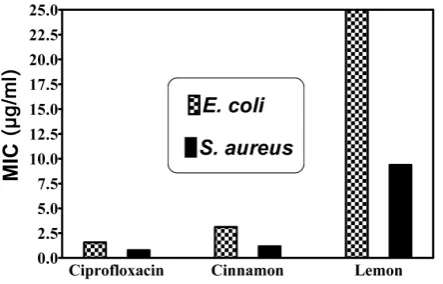
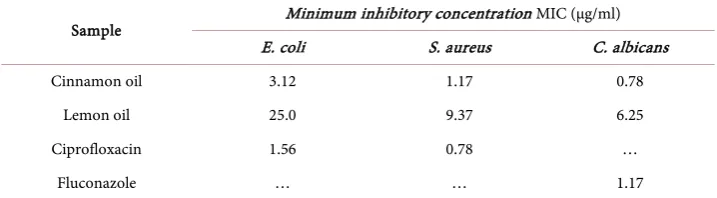
Cinnamon and lemon essential oils have strong inhibitory effect against Gram posi-tive bacteria (Staphylococcus aureus) and Gram negative bacteria (Escherichia coli) using Muller Hinton agar medium (Oxoid) [46]. On the other hand, The essential oils of cinnamon, and lemon showed antifungal effects which were tested against (Candida albicans). The lowest concentration of each essential oil under study, which did not show any growth of tested microorganisms after macroscopic evaluation, was deter-mined as the minimal inhibitory concentration (MIC) of this oil.Comparative study has been done of the antimicrobial activities of cinnamon and lemon essential oils. The results were obtained in Figure 4 and Figure 5.
Cinnamon essential oil demonstrated larger effect than lemon. Lemon peel essential
Ascorbic-acid Cinnamon Lemon
0 10 20 30 40 50 60 70 80 90 100
Ascorbic-acid Cinnamon
Lemon
ABT
S
•+ s
c
av
en
g
in
g
(
%
[image:8.595.195.554.298.392.2]Figure 4. Effect of the essential oils under study on Escherichia coli and Staphylococcus aureus.
Figure 5. Effect of the essential oils under study on Candida albicans.
oil has shown good inhibition only for Gram positive bacteria (Staphylococcus aureus).
Ciprofloxacin and Fluconazole were used as standard for anti-bacterial and anti-fungal activities, respectively (Table 4).
Cytotoxicity Assay
Hepatoprotective Activity Evaluation in Vitro: Cell Cultures and Anti-Proliferative Activity Assay
A great feature of essential oils if they used on a long-term, is not associated with genotoxic risk. Some of them have antimutagenic activity that could well be connected to an anticarcinogenic activity [47].
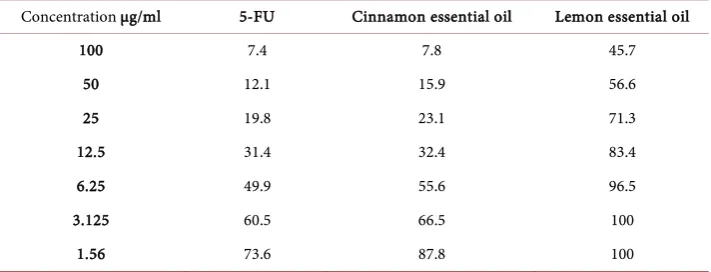
Hepatocellular carcinoma (HePG-2) and colorectal carcinoma (HCT-116) are peren-nial cell line used in scientific study. They are the most popular applied human cell lines [48] [49]. The cytotoxic activities of the essential oils were tested on Hepatocellu-lar carcinoma and colorectal carcinoma. Essential oil submitted good activities on the cell lines. Essential oil of cinnamon showed more inhibition rate than essential oil of lemon (Tables 5-7 and Figures 6-9).
The IC50 values against HePG2 indicated that the cytotoxicity of each essential oil decreased when their concentration increase. IC50 value of cinnamon essential oil was very strong whereas, IC50 value of lemon essential oil was moderate. On the other hand, The IC50 values against HCT-116 indicated that it was very strong in case of cinnamon essential oil, whereas, in case of lemon essential oil, it was weak (Table 8 and
Figure 6. Effect of the essential oils under study on relative viability % of hepatocellular carci-noma cell line (HePG-2).
Figure 7. Effect of the essential oils under study on relative viability % of colorectal carcinoma cell line (HCT-116).
Figure 8. Effect concentration of cinnamon essential oil on relative viability % of hepatocellular carcinoma cell line (HePG-2) and colorectal carcinoma cell line (HCT-116).
Figure 9. Effect concentration of lemon essential oil on relative viability % of Hepatocellular car-cinoma cell line (HePG-2) and colorectal carcar-cinoma cell line (HCT-116).
0 10 20 30 40 50 60 70 80 90 100 0
10 20 30 40 50 60 70 80 90 100
5-FU Cinnamon Lemon
Concentration 礸/m l
R
el
at
ive
vi
ab
il
it
y %
0 10 20 30 40 50 60 70 80 90 100 0
10 20 30 40 50 60 70 80 90 100
5-FU Cinnamon Lemon
Concentration 礸/m l
R
el
at
ive
vi
ab
il
it
[image:10.595.303.448.419.539.2] [image:10.595.303.448.583.704.2]Figure 10. Cytotoxic activity of the essential oils under study against colorectal carcinoma (HCT- 116) and hepatocellular carcinoma (HePG-2) cell lines. IC50 (µg/ml): 1 - 10 (very strong), 11 - 20 (strong), 21 - 50 (moderate), 51 - 100 (weak).
Table 4. Antimicrobial activity of the tested essential oils.
Sample Minimum inhibitory concentration MIC (µg/ml) E. coli S. aureus C. albicans Cinnamon oil 3.12 1.17 0.78
Lemon oil 25.0 9.37 6.25 Ciprofloxacin 1.56 0.78 …
Fluconazole … … 1.17
Table 5. Relative viability % of hepatocellular carcinoma cell line (HePG-2) and colorectal carci-noma cell line (HCT-116) after treating by the tested essential oils.
Concentration µg/ml
5-FU Cinnamon oil Lemon oil HePG-2 HCT-116 HePG-2 HCT-116 HePG-2 HCT-116 100 8.6 7.4 8.1 7.8 36.1 45.7
[image:11.595.198.555.574.720.2]Table 6. Relative viability % of hepatocellular carcinoma cell line (HePG-2) after treating by the tested essential oils.
Concentration µg/ml 5-FU Cinnamon essential oil Lemon essential oil 100 8.6 8.1 36.1
[image:12.595.198.554.297.433.2]50 17.1 16.4 48.2 25 24.0 22.5 63.0 12.5 33.1 38.3 74.7 6.25 56.8 57.2 93.6 3.125 70.6 73.8 100 1.56 88.7 94.2 100 5-FU: 5-Fluorouracil was used as a standard anticancer drug for comparison.
Table 7. Relative viability % of colorectal carcinoma cell line (HCT-116) after treating by the tested essential oils.
Concentration µg/ml 5-FU Cinnamon essential oil Lemon essential oil 100 7.4 7.8 45.7
50 12.1 15.9 56.6 25 19.8 23.1 71.3 12.5 31.4 32.4 83.4 6.25 49.9 55.6 96.5 3.125 60.5 66.5 100 1.56 73.6 87.8 100 5-FU: 5-Fluorouracil was used as a standard anticancer drug for comparison.
Table 8. Cytotoxic activity of essential oils against human tumor cells.
Compounds In vitro cytotoxicity IC50 (µg/ml)• HePG2 HCT-116 5-FU 7.9 ± 0.28 5.3 ± 0.31 Cinnamon 8.6 ± 0.49 7.2 ± 0.72 Lemon 48.2 ± 3.10 72.6 ± 4.16
•IC50 (µg/ml): 1 - 10 (very strong). 11 - 20 (strong). 21- 50 (moderate). 51 - 100 (weak) and above 100 (non-cyto- toxic); •5-FU = 5-fluorouracil.
4. Conclusion
[image:12.595.196.551.481.558.2]by Plant Essential Oils and Smoke Antimicrobials. Food Microbiology, 22, 273-292. https://doi.org/10.1016/j.fm.2004.08.006
[4] Lean, L.P. and Mohamed, S. (1999) Antioxidative and Antimycotic Effects of Turmeric,
Lemongrass, Betel Leaves, Clove, Black Pepper Leaves and Garcinia atriviridis on Butter
Cakes. Journal of the Science of Food and Agriculture, 79, 1817-1822.
https://doi.org/10.1002/(SICI)1097-0010(199910)79:13<1817::AID-JSFA443>3.0.CO;2-L
[5] Nielsen, P.V. and Rios, R. (2000) Inhibition of Fungal Growth on Bread by Volatile
Com-pounds from Spices and Herbs, and the Possible Application in Active Packaging, with
Special Emphasis on Mustard Essential Oil. International Journal of Food Microbiology, 60,
219-229. https://doi.org/10.1016/S0168-1605(00)00343-3
[6] Bagamboula, C.F., Uyttendaele, M. and Debevere, J. (2004) Inhibitory Effect of Thyme and
Basil Oils, Carvacrol, Thymol, Estragol, Linalool and ρ-Cymene towards Shigella sonnei
and S. flexneri. Food Microbiology, 21, 33-42. https://doi.org/10.1016/S0740-0020(03)00046-7
[7] Franz, C. and Novak, J. (2010) Sources of Essential Oils. In: Baser, K.H.C. and Buchbauer,
G., Eds., Handbook of Essential Oils: Science, Technology, and Applications, CRC Press/ Taylor & Francis Group, Boca Raton, 39-82.
[8] Bakkali, F., Averbeck, S., Averbeck, D. and Idaomar, M. (2008) Biological Effects of
Essen-tial Oils—A Review.Food and Chemical Toxicology, 46, 446-475.
https://doi.org/10.1016/j.fct.2007.09.106
[9] Teixeiraa, B., Marquesa, A., Ramosa, C., Nengc, N.R., Nogueirac, J. M.F., Saraivab, J.A. and
Nunesa, M. L. (2013) Chemical Composition and Antibacterial and Antioxidant Properties of Commercial Essential Oils. Industrial Crops and Products, 43, 587-595.
https://doi.org/10.1016/j.indcrop.2012.07.069
[10] Karpinska, M., Borowski, J. and Danowska-Oziewicz, M. (2001) The Use of Natural
Anti-oxidants in Ready-to-Serve Food. Food Chemistry, 72, 5-9. https://doi.org/10.1016/S0308-8146(00)00171-0
[11] Rao, J. and McClements, D.J. (2012) Impact of Lemon Oil Composition on Formation and
Stability of Model Food and Beverage Emulsions. Food Chemistry, 134, 749-757.
https://doi.org/10.1016/j.foodchem.2012.02.174
[12] Noorolahi, Z., Sahari, M.A., Barzegar, M., Doraki, N. and Badi, H.N. (2013) Evaluation
An-tioxidant and Antimicrobial Effects of Cinnamon Essential Oil and Echinacea Extract in Kolompe. Journal of Medicinal Plants, 12, 14-28.
[13] Lin, Y.T., Labbe, R.G. and Shetty, K. (2005) Inhibition of Vibrio Parahemolyticus in
Sea-food Systems Using Oregano and Cranberry Phytochemical Synergies and Lactic Acid.
In-novative Food Science and Emerging Technologies, 6, 453-458. https://doi.org/10.1016/j.ifset.2005.04.002
[14] Mathew, S. and Abraham, T.E. (2006) Studies on the Antioxidant Activities of Cinnamon
(Cinnamomum verum) Bark Extracts, through Various in Vitro Models. Food Chemistry,
[15] Pattnaik, S., Padhan, D.K. and Jana, G.K. (2010) Evaluation of Cinnamon Oil, Peppermint
Oil, Cardamom Oil & Orange Oil as Antimicrobial Agents. Journal of Pharmacy Research,
3, 414-416.
[16] Donald, G. and Barceloux, M.D. (2008) Medical Toxicology of Natural Substances: Foods,
Fungi, Medicinal Herbs, Toxic Plants, and Venomous Animals. John Wiley & Sons, Hobo-ken, 39-43.
[17] Rozzaa, A.L., Moraesb, T.M., Kushimab, H., Tanimotoa, A., Marquesc, M.O.M., Bauabd,
T.M., Hiruma-Limab, C.A. and Pellizzona, C.H. (2011) Gastroprotective Mechanisms of
Citrus lemon (Rutaceae) Essential Oil and Its Majority Compounds Limonene and
β-Pinene: Involvement of Heat-Shock Protein-70, Vasoactive Intestinal Peptide,
Gluta-thione, Sulfhydryl Compounds, Nitric Oxide and Prostaglandin E2. Chemico-Biological
In-teractions, 189, 82-89. https://doi.org/10.1016/j.cbi.2010.09.031
[18] Adams, R.P. (2007) Identification of Eessential Oils Components by Gas
Chromatogra-phy/Quadruple Mass Spectroscopy. 4th Edition, Allured Publishing Corporation, Carol Stream.
[19] Massada, Y. (1976) Analysis of Essential Oils by Gas Chromatography and Mass
Sepectro-metry. Wiley, New York.
[20] El-Gazzar, A.B.A., Youssef, M.M., Youssef, A.M.S., Abu-Hashem, A.A. and Badria, F.A.
(2009) Design and Synthesis of Azolopyrimidoquinolines, Pyrimidoquinazolines as
An-ti-Oxidant, Anti-Inflammatory and Analgesic Activities. European Journal of Medicinal
Chemistry, 44, 609-624. https://doi.org/10.1016/j.ejmech.2008.03.022
[21] Hawkey, P.M. and Lewis, D.A. (1994) Medical Bacteriology—A Practical Approach. Oxford
University Press, Oxford, 181-194.
[22] Mosmann, T. (1983) Rapid Colorimetric Assay for Cellular Growth and Survival:
Applica-tion to ProliferaApplica-tion and Cytotoxicity Assays. Journal of Immunological Methods, 65,
55-63. https://doi.org/10.1016/0022-1759(83)90303-4
[23] Graph Pad Prism Version 3.00 for Windows (1999) Graph Pad Software, San Diego.
[24] Kalaba, V. and Kalaba, D. (2014) Comparative Effects of Essential Oils on Growth of
Escherichia coli Carpathian. Journal of Food Science and Technology, 6, 5-8.
[25] Popovic, G. and Milosevic, D.D. (2008) Effects of Ester Oil on Growth of Escherichia coli.
Proceedings of Scientific Conference on “Ecological Truth” with International Participa-tion, Sokobanja, 1-4 June 2008, 612-615.
[26] Elgendy, E.M. and Khayyat, S.A. (2014) Epoxide and Hydroperoxide Derived from
Natu-rally Cinnamaldehyde and Its Schiff Base Derivatives. Asian Journal of Chemistry, 26,
6571-6574.
[27] Elgendy, E.M. (1998) Photooxygenation of Natural Limonene. Journal of Chinese
Pharma-ceutical Sciences, 50, 225-231.
[28] Halliwell, B. and Gutteridge, J.M.C. (2000) Free Radicals in Biology and Medicine. Oxford
University Press, Oxford.
[29] Abd El-Baky, H.H. and El-Baroty, G.S. (2008) Chemical and Biological Evaluation of the
Essential oil of Egyptian Moldavian Balm. International Journal of Essential Oil
Therapeu-tics, 2, 76-81.
[30] Anwar, F., Ali, M., Hussain, A.I. and Shahid, M. (2009) Antioxidant and Antimicrobial
Ac-tivities of Essential Oil and Extracts of Fennel (Foeniculum vulgare Mill.) Seeds from
Pa-kistan. Flavour and Fragrance Journal, 24, 170-176. https://doi.org/10.1002/ffj.1929
[31] Frenkel, E.N., Huang, S.W., Kanner, J. and German, J.B. (1994)Interfacial Phenomena in
the Evaluation of Antioxidants: Bulk Oils vs Emulsions. Journal of Agricultural and Food
Chemistry, 42, 1054-1059. https://doi.org/10.1021/jf00041a001
https://doi.org/10.1080/10412905.1998.9700989
[35] Baratta, M.T., Dorman, H.J.D., Deans, S.G., Figueiredo, A.C., Barosso, J.G. and Ruberto, G.
(1998)Antimicrobial and Antioxidant Properties of Some Commercial Essential Oils.
Fla-vour and Fragrance Journal, 13, 235-244.
https://doi.org/10.1002/(SICI)1099-1026(1998070)13:4<235::AID-FFJ733>3.0.CO;2-T
[36] Ruberto, G., Baratta, M.T., Deans, S.G. and Dorman, H.J.D. (2000)Antioxidant and
Anti-microbial Activity of Foeniculum vulgare and Crithmum maritimum Essential Oils. Planta
Medica, 66, 687-693. https://doi.org/10.1055/s-2000-9773
[37] Dorman, H.J.D., Figueiredo, A.C., Barroso, J.G. and Deans, S.G. (2000)In Vitro Evaluation
of Antioxidant Activity of Essential Oils and Their Components. Flavour and Fragrance
Journal, 15, 12-16.
https://doi.org/10.1002/(SICI)1099-1026(200001/02)15:1<12::AID-FFJ858>3.0.CO;2-V
[38] Ruberto, G., Baratta, M.T., Sari, M. and Kaâbeche, M. (2002) Chemical Composition and
Antioxidant Activity of Essential Oils from Algerian Origanum glandulosum Desf. Flavour
and Fragrance Journal, 17, 251-254. https://doi.org/10.1002/ffj.1101
[39] Tomaino, A., Cimino, F., Zimbalatti, V., Venuti, V., Sulfaro, V., De Pasquale, A. and Saija,
A. (2005) Influence of Heating on Antioxidant Activity and the Chemical Composition of
Some Spice Essential Oils. Food Chemistry, 89, 549-554. https://doi.org/10.1016/j.foodchem.2004.03.011
[40] Politeo, O., Juki, M. and Milo, M. (2006) Chemical Composition and Antioxidant Activity
of Essential Oils of Twelve Spice Plants. Croatica Chemica Acta, 79, 545-552.
[41] Frenkel, E.N. (1993) In Search of Better Methods to Evaluate Natural Antioxidants and
Oxidative Stability in Food Lipids. Trends in Food Science & Technology, 4, 220-225. https://doi.org/10.1016/0924-2244(93)90155-4
[42] Pajero, I., Viladomat, F., Bastida, J., Rosas-Romero, A., Saavedra, G., Murcia, M.A.,
Jime-nez, A.M. and Codina, C. (2003)Investigation of Bolivian Plant Extracts for Their Radical
Scavenging Activity and Antioxidant Activity. Life Sciences, 73, 1667-1681. https://doi.org/10.1016/S0024-3205(03)00488-0
[43] Abdalla, A.E. and Roozen, J.P. (1999) Effect of Plant Extracts on the Oxidative Stability of
Sunflower Oil and Emulsion. Food Chemistry, 64, 323-329.
https://doi.org/10.1016/S0308-8146(98)00112-5
[44] Inouye, S., Takizawa, T. and Yamaguchi, H. (2001) Antibacterial Activity of Essential Oils
and Their Major Constituents against Respiratory Tract Pathogens by Gaseous Contact.
Journal of Antimicrobial Chemotherapy, 47, 565-573. https://doi.org/10.1093/jac/47.5.565
[45] Inouye, S., Yamaguchi, H. and Takizawa, T. (2001) Screening of the Antibacterial Effects of
a Variety of Essential Oils on Respiratory Tract Pathogens, Using a Modified Dilution
As-say Method. Journal of Infection and Chemotherapy, 7, 251-254.
https://doi.org/10.1007/s101560170022
[46] Lopez, P., Sanchez, C., Batlle, R. and Nerin, C. (2005) Solid and Vapor Phase Antimicrobial
Strains. Journal of Agricultural and Food Chemistry, 53, 6939-6946. https://doi.org/10.1021/jf050709v
[47] Yan, H.C., Hong, P., Yu, Z.Z. and Jing, S. (2010) Evaluation of Antioxidant and Antitumor
Activities of Lemon Essential Oil. Journal of Medicinal Plants Research, 4, 1910-1915.
[48] Denizot, F. and Lang, R. (1986) Rapid Colorimetric Assay for Cell Growth and Survival.
Journal of Immunological Methods, 89, 271-277. https://doi.org/10.1016/0022-1759(86)90368-6
[49] Mauceri, H.J., Hanna, N.N., Beckett, M.A., Gorski, D.H., Staba, M.J., Stellato, K.A.,
Bige-low, K., Heimann, R., Gately, S., Dhanabal, M., Soff, G.A., Sukhatme, V.P., Kufe, D.W. and Weichselbaum, R.R. (1998) Combined Effects of Agiostatin and Ionizing Radiation in
An-titumour Therapy. Nature, 394, 287-291. https://doi.org/10.1038/28412
Submit or recommend next manuscript to SCIRP and we will provide best service for you:
Accepting pre-submission inquiries through Email, Facebook, LinkedIn, Twitter, etc. A wide selection of journals (inclusive of 9 subjects, more than 200 journals)
Providing 24-hour high-quality service User-friendly online submission system Fair and swift peer-review system
Efficient typesetting and proofreading procedure
Display of the result of downloads and visits, as well as the number of cited articles Maximum dissemination of your research work
Submit your manuscript at: http://papersubmission.scirp.org/