http://www.scirp.org/journal/cmb ISSN Online: 2165-3453
ISSN Print: 2165-3445
Application of Graph Entropy in CRISPR and
Repeats Detection in DNA Sequences
Dipendra C. Sengupta, Jharna D. Sengupta
Department of Mathematics & Computer Science, Elizabeth City State University, Elizabeth City, NC, USA
Abstract
We analyzed DNA sequences using a new measure of entropy. The general aim was to analyze DNA sequences and find interesting sections of a genome using a new formulation of Shannon like entropy. We developed this new measure of entropy for any non-trivial graph or, more broadly, for any square matrix whose non-zero ele-ments represent probabilistic weights assigned to connections or transitions between pairs of vertices. The new measure is called the graph entropy and it quantifies the aggregate indeterminacy effected by the variety of unique walks that exist between each pair of vertices. The new tool is shown to be uniquely capable of revealing CRISPR regions in bacterial genomes and to identify Tandem repeats and Direct re-peats of genome. We have done experiment on 26 species and found many tandem repeats and direct repeats (CRISPR for bacteria or archaea). There are several exist-ing separate CRISPR or Tandem finder tools but our entropy can find both of these features if present in genome.
Keywords
CRISPR, Graph Entropy, Tandem Repeats, DNA Sequences
1. Introduction
Deciphering the enormously long nucleotide sequences that are being uncovered in the human genome is one of the major challenges in our days. Along with serious ethical issues, we encounter a series of tremendously hard scientific problems. These problems mainly arise from the fact that although sequencing techniques are almost completely automatic controlled the analysis of the sequenced data is not. Hence, the major goal of the Human Genome Project is the extraction of biologically and medically relevant in-formation from almost automatically sequenced DNA and RNA molecules. In prin-How to cite this paper: Sengupta, D.C. and
Sengupta, J.D. (2016) Application of Graph Entropy in CRISPR and Repeats Detection in DNA Sequences. Computational Mole-cular Bioscience, 6, 41-51.
http://dx.doi.org/10.4236/cmb.2016.63004 Received: January 24, 2016
Accepted: October 23, 2016 Published: October 26, 2016
Copyright © 2016 by authors and Scientific Research Publishing Inc. This work is licensed under the Creative Commons Attribution International License (CC BY 4.0).
http://creativecommons.org/licenses/by/4.0/
ciple, biochemical methods are able to do this job, but since they are extremely expen-sive and time consuming, there is a high demand for alternative approaches to extract the information hidden in genome [1]. In this situation, concepts and techniques from information theory turned out to be welcoming tools to handle the problem of extract-ing valuable information from biosequences such as DNA, RNA, or amino acid chains. The main goal of our work is the presentation of a concept and method derived from information theory that will apply to problems of analysis of DNA.
The motivation for this study is to analyze DNA sequences to determine interesting sections of genome that has repeating features using information theory tool.
In many organisms, the genomic DNA is highly repetitive accounting for close to 5% of the genome size [2] [3]. Repetitive DNA sequences are a major component of euka-ryotic genomes and may account for up to 90% of the genome size [4]. The human ge-nome itself has over two-thirds of the sequence consisting of repetitive elements [5]. The identification of repeats has proven to be of significance, as they provide insight into the functional and evolutionary roles of various organisms [6] [7] [8] [9] [10].
In our study we also focus on a family of repeats known as Clustered Regularly Inter Spaced Palindromic Repeats (CRISPRs) [11]. CRISPRs have attracted a great deal of interest recently in genome editing [12]. CRISPRs have been found only in the genomes of prokaryotes and are composed of short direct repeats currently known to range in sizes from 21 - 47 base pairs. This family of repeats is unique in that they are inters-paced by non-repeating sequences of similar size, called spacers. CRISPRs were found in approximately 40% of bacterial genome investigated [13].
Several software applications are available for identifying various form of repeats in [14] [15] [16].
2. Graph Entropy Algorithm
A graph is an object that consists of a non-empty set of vertices and another set of edges. Vertices are often called nodes, and edges are referred as connections. The set of edges may be empty, in which case the graph is just a collection of points.
We say that two vertices i and j of a directed graph are connected if there is an edge from i to j or from j and i. Suppose we are given a directed graph with n vertices. We construct an n × n adjacency matrix A associated to it as follows: if there is an edge from vertex i to vertex j, we put 1 as the entry on row i, column j of the matrix A; if there is no edge, we put 0.
If one can walk from vertex i to vertex j along the edges of the graph then we say that there is a path from i to j. If we walked on k edges, then the path has length k. For ma-trices, we denote by Akthe matrix obtained by multiplying A with itself k times. The entry on row i, column j of A2 corresponds to the number of paths of length 2 from vertex i to vertex j in the graph.
In this section, we will discuss entropy of such adjacency matrix A. Let
{
v v1, 2,...,vn}
be a set of vertices of a direct graph. Let A=
( )
aij be the n n× adjacency matrix withat least one positive element. Let
,
n ij i j
a =N
∑
. Let P=( )
Pij be the matrix such thatA P
N
= . Hence , 1 n ij i j p =
∑
. ijp is the probability of having a path from vertex vi to vertex vj. Adding all
ele-ments of each row of P and placing them on the diagonal, we form a diagonal matrix
( )
1 1
1
. . . 0
. . . . .
. . . . .
. . . . .
0 . . .
n k k ij n nk k p p θ θ = = = =
∑
∑
1 1 1 n jj jk k pθ
= = − − ∑
is the probability for a randomly generated path to end at the vertex vj. Let Qij( )
l be the probability for generating a path of length l that begins ati
v and ends at vj for any integer l. For example, we have
( )
1
1 1
n
ij ij jk
k
Q p p
=
= −
∑
and
( ) (
)
1
1 2
1 .
.
2 , ,..., 1
.
j
n
ij i i in jk
k
nj
p
Q p p p p
p = = −
∑
. Let Ql be the matrix whose ij elementis Qij
( )
l . Then we have(
)
I lQ =P I−
θ
. Finally, we define the asymptotic walk matrixij
Ω = Ω
as 1
l l
Q ∞
=
Ω ≡
∑
,Where Ωij is the probability for generating a walk of anylength from
v
i tov
j.Note that , 1. ij i j Ω =
∑
(
)
2(
)
1
l l
Q P I θ P I θ
∞
=
Ω ≡
∑
= − + − + ⋅⋅⋅⋅We noticed that the sum of all entrees of the matrix Pλ
(
Q−P)
, for any integer λ, is 0. Since sum of all entrees of P is 1, sum of all entrees of Ω is also1. We thereforedefine the asymptotic entropy
( )
( )
, log ij ij i j PΗ =−
∑
Ω Ωwhere Ωijlog
( )
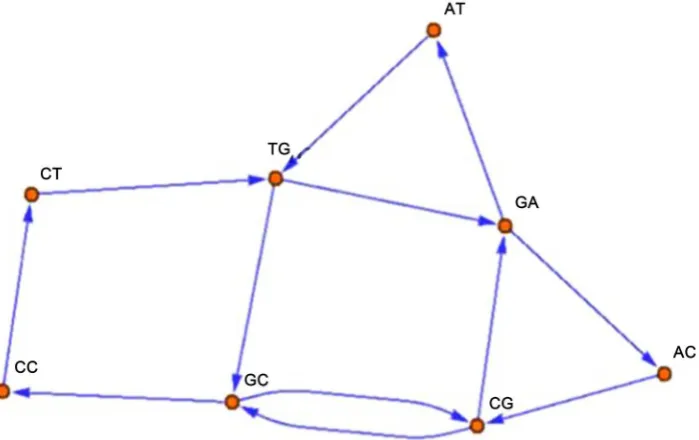
Ωij is defined to be 0 for Ωij = 0. This can also be called the graphentropy of the graph or entropy of the adjacency matrix A. For illustration, Let us con-sider a short sequence:
ATGCCTGATGCGACGC
AT TG GC CC CT TG GA
AT TG GC CG GA AC CG GC
→ → → → → → →
→ → → → → → →
We draw a graph as in the Figure 1. For our sequence, graph entropy
,
( ) ijlog( ij) 2.9614
i j
P
Η = − Ω
∑
Ω ≈3. Results
We have downloaded wide range of genome data, eukaryotes (animals, plants, insects, fungus) and prokaryotes (bacteria, archaea) from Gen Bank:
ftp://ftp.ncbi.nlm.nih.gov/genomes/.
We have implemented the Graph Entropy Algorithm in MATLAB platform and converted data to MATLAB format. Then we have computed graph entropy using our Graph Entropy Algorithm by scanning the data with a typical sample size of 512 base pairs (bp) and step size of 10 bp taking 3 nodes with 1 overlap. We have drawn graphs of entropy versus genome length of Acidovorax bacteria in Figure 2, Salmonella-Typhi CT18 bacteria in Figure 3, Caldicellulosiruptor Kristianssonii bacteria in Figure 4 and Human Chromosome-21 in Figure 5. We have studied the intervals visually where en-tropy was low and found some repetitive pattern in the sequence. Once we have a string of repetitive pattern we used MATLAB “strfind” command to find out exact positions of the repetitive patterns. We have included few examples in this paper, only the ones we thought important.
[image:4.595.199.549.463.683.2]In Figure 2 we looked at the lowest drop of entropy which is at: x: genome length = 871,100, y: entropy = 4.088. We took an interval (871,000, 871,600) around the lowest drop x = 871,100.
Figure 2. Acidovorax (bacteria) genome length vs entropy.
Figure 4. Caldicellulosiruptor kristianssonii (bacteria).
The following is the sequence in the interval taken. The colored string is repeating. ATAAAAAAACCCGGTGCATGCACCGGGTGGGACCAGCCCCGCGGGCGG GGCGGCTGGCTGCTGTCGTCGCTCAGGGCTTGGTGCCCGTCGGGAAGGG CCATGCGGCCTGCGGGTTCAGCGTGGTCTGTGCTGCGGGTGCAGGCGCA GGGGCAGAGGCCTTGGAGGCCGCCTTTTTCGGGGCAGCCTTCTTCGGTG CAGCGGCCTTGGTCGTGCCGGTGGCCTTCTTCGCCGGTGCAGCTGCCTTC
TTGGTGGAGGCTGCGGCCTTCTTTGCCGGTGCAGCTGCCTTCTTGGCGG
GGGCTGCGGCCTTCTTCGCCGGTGCAGCTGCCTTCTTGGCGGGGGCTGC
GGCCTTCTTTGCCGGTGCAGCTGCCTTCTTGGCAGGAGCTGCGGCCTTCT
TTGCCGGTGCAGCTGCCTTCTTGGCGGGGGCTGCGGCCTTCTTTGCCGGT
GCAGCTGCCTTCTTGGCAGGAGCTGCGGCCTTCTTTGCCGGTGCAGCTG
CCTTCTTGGCAGGAGCTGCGGCCTTCTTTGCCGGTGCAGCTGCCTTCTTG
GCGGGGGCTGCAGCCTTCTTCGCCGGAGCGGCCTTCTTCGTCGTGGCGG CGGCCTTCTT
Strfind(g,'GCCGGTGCAGCTGCCTTCTTGG') command gave us the following po-sitions of those repeats in the sequence.
871227 871269 871311 871353 871395 871437 871479 871521 The spacers are almost identical. These are tandem repeats.
Similarly in the Figure 3 we looked at the lowest drop of entropy which is at x = 2926000 y = 4.923.
We looked at the DNA sequence in the interval (2926000:2926650) around x = 2926000. The following is the sequence in the interval taken. The colored string is re-peating.
AAAAATGCATCCTTCCCGAACGGCAATAGCTGGCACGACGTACGGCTTG ATAATCAACAGCATATAGACAAGGCGCTGCCAGGGCGGATTGAGCGCCG TAGCCGCGATGTAGTGCGGATAATGCTGCCGTTGGTAAAAGAGCTGGCG AAGGCGGAAAAAACGTCCTGATATGCTGGTGAAACGTGTTTATCCCCGC
TGGCGCGGGGAACACGGACAGCAACCCGTGTCGGATATCAGACAGATCG
GTTTATCCCCGCTGGCGCGGGGAACACACGCGAATCGCCAATCGCCGCC
GCGTGAATTGCGGTTTATCCCCGCTGGCGCGGGGAACACCCACGATGTA TGCCGACCGTGATTTTTACCGCCGGTTTATCCCCGCTGGCGCGGGGAAC ACAGATACGCCTTTACGTCGCCCTCTTTGGCGCGCGGTTTATCCCCGCTG
GCGCGGGGAACACTAAAACACCGGTTGCGCAACCTCCGCGGGGATCGGT
TTATCCCCGCTGGCGCGGGGATCGGTTTATCCCCGCTGGCGCGGGGATC
GGTTTATCCCCGCTGGCGCGGGGAACACTCTAAATCTACCCAATTGAATT
TAAATACTTTTTTAGCGCACAAAAAACCCACCAACTTTTCCTAATTTTTA AAGATCTCTAA
We used strfind(g,'CGGTTTATCCCCGCTGGCGCGGGGAACAC') in MatLab and found more repeats outside the interval.
be-long to this region).
length('CGGTTTATCCCCGCTGGCGCGGGGAACAC')=29 strfind(g,'GTGTTTATCCCCGCTGGCGCGGGGAACAC'): 2926182
strfind(g,'CGGTTTATCCCCGCTGGCGCGGGGATCGG') 2926487 2926513. Starts: 2926182 Ends: 2926567.
In the interval (2926182, 2926513) we find three strings differing by 2 to 4 letters. These repeats are called CRISPR. This is only CRISPR so far known for this strain of the bacteria.
Again, we studied the pattern of the DNA sequence of Caldicellulosiruptor Kris-tianssonii (Bacteria) in intervals around the points of low entropy and found repetitive patterns. In Figure 4, we considered the drop at x = 2,672,000, y = 4.46. Following is the sequence in the interval (2671900, 2672600) around this drop. The repeats are shown in red color.
TATTGCAATTATTGTCCTATGCACAGAGTTTGTAGCCTTCCCGTTGGGGA
TTGAAACATAGATTTCATTTCGCAGCCAATAGAGCGGTTTATAGTTTGTA
GCCTTCCCGTTGGGGATTGAAACCTCAATTTCTGTTTCTCTTTTCTCAATT
ATTCTTGAGTTTGTAGCCTTCCCGTTGGGGATTGAAACTATAATAGCCCA TTCATCAAAAACTTTTTCATCGAAGTTTGTAGCCTTCCCGTTGGGGATTG AAACTATAATAGCCCATTCATCAAAAACTTTTTCATCGAAGTTTGTAGCC
TTCCCGTTGGGGATTGAAACCACAAAATTATAGTTTGGCGCAATGTAAA
CACGAACAGTTTGTAGCCTTCCCGTTGGGGATTGAAACTCTATGTCTTCT TCAAGATACATATCGAGCAGCTTATTGTTTGTAGCCTTCCCGTTGGGGAT
TGAAACATACTTTTTTTCTCACGGTCTGTATGGCCTGTTCAGT
We notice repeats and use Matlab to find the exact locations of that string. strfind(g,'GTTTGTAGCCTTCCCGTTGGGGATTGAAAC')
Columns 1 through 61
2666352 2666419 2666484 2666551 2666616 2666682 2666748 2666813 2666879 2666947 2667014 2667081 2667147 2667213 2667278 2667344 2667410 2667476 2667544 2667611 2667676 2667741 2667805 2667872 2667939 2670817 2670882 2670949 2671016 2671081 2671147 2671214 2671279 2671345 2671411 2671476 2671544 2671610 2671675 2671740 2671805 2671871 2671936 2672001 2672070 2672135 2672201 2672267 2672333 2672399 2672466 2672534 2672599 2672666 2672733 2672798 2672864 2672930 2672996 2673523 2673590
Length ('GTTTGTAGCCTTCCCGTTGGGGATTGAAAC')=30 61 repeats of length of 30, unique spacers
Starts: 2666352 Ends: 2673620 Period: 65/66/67 Total Length = 7268 These repeats are CRISPR.
CCGTTTATATCCACGCAGGCGTTTCCCCTTACCTGCACCGAGCCTCCATT
CCCGTTTATATCCACGCAGGCGTTTCCCCTTACCTGCACCGAGCCTCCCG
CCCCGTTTACATCCACGCAGGCGTTTCCCCTTACCTGCACCGAGCCTCCA
TTCCCGTTTATATCCACGCAGGCGTTTCCCCTTACCTGCACCGAGCCTCC
CGCCCCGTTTACATCCACGCAGGCGTTTCCCCTTACCTGCACCGAGCCTC
CATTCCCGTTTATATCCACGCAGGCGTTTCCCCTTACCTGCACCGAGCCT
CCCGCCCCGTTTACATCCACGCAGGCGTTTCCCCTTACCTGCACCGAGCC
TCCATTCCCGTTTATATCCACGCAGGCGTTTCCCCTTACCTGCACCGAGC
CTCCATTCCCGTTTATATCCACGCAGGCGTTTCCCCTTACCTGCACCGAG
CCTCCATTCCCGTTTATATCCACGCAGGCGTTTCCCCTTACCTGCACCGA
GCCTCCCGCCCCGTTTATATCCACGCAGGCGTTTCCCCTTACCTGCACCG
GGCCTGCCGCCCCGTTTACATCCACGCATGCGTTTCCCCTTACCTGCACT
G
strfind(g,'TTTCCCCTTACCTGCACCGAGCCTCCATTCCCGTTTATATCCACGCA GGCG')
Columns 1 through 18
44007626 44008952 44009105 44009156 44009258 44009360 44009462 44009513 44009615 44009717 44009819 44009870 44009921 44010023 44010125 44010227 44010278 44010329
The spacers are almost identical with this string except 4 letters (in purple). We also find the spacer string.
Strfind(g,“TTTCCCCTTACCTGCACCGAGCCTCCCGCCCCGTTTACATCCAC GCAGGCG”).
Columns 1 through 23
44007575 44007677 44007728 44007779 44007830 44007881 44007983 44008034 44008289 44008493 44008646 44008697 44008799 44008850 44008901 44009207 44009309 44009564 44009666 44009768 44009972 44010074 44010176
This is a repeat of a string without any gap in the region (44007575, 44010329).
Discussion
an alternative representation (namely, graph as it is given in [17]) in an attempt to make analysis more efficient. Future research plans are to modify the presented algo-rithm so that it is also able to identify repeats efficiently. Our code will be available to the reader upon request through email to one of the authors.
4. Conclusions
We have studied the following species:
Eukaryotes: Homo sapiens chromosome 19 & 21, Anopheles gambiae, Caenorhabdi-tis elegans, Plasmodium falciparum Saccharomyces cerevisiae.
Prokaryotes: Acidovorax, Ammonifex, Caldicellulosiruptor kristjanssonii, E.Coli, Salmonella Typhi, Listeria Monocyto genes, Bacillus clausii KSM, Chlamydia murida-rum Nigg, Cyanobacterium aponinum, Gluconacetobacter diazotrophicus, Haemophi-lus influenzae R2866, Mycobacterium tuberculosis, Mycoplasma genitalium, Neisseria meningitidis, Streptococcus pneumoniae, Thermosipho africanus, Truepera radiovic-trix (Bacteria), A. fulgidus (Archaea).
Viruses: HIV, Hepatitis B. After analyzing the DNA sequence at the points of low entropy for all these species, we conclude that low entropy in a genome graph corres-ponds to high repeatability in the sequence. These repeats can be classified as CRISPR or Tandem Repeats or something else.
Acknowledgements
This paper was written while two authors were Summer Faculty Fellow in SPAWARS YSCEN Atlantic, Charleston, SC funded by Office of Naval Research. Authors are thankful to their mentor for his assistance in the work.
References
[1] Grosse, I. (2000) Applications of Statistical Physics and Information Theory to the Analysis of DNA Sequences. Ph.D. Dissertation, Boston University, MA.
[2] Ussery, D.W., Binnewies, T.T., Gouveia-Oliveira, R., Jarmer, H. and Hallin, P.F. (2004) Genome Update: DNA Repeats in Bacterial Genomes. Microbilogy, 150, 3519-3521.
http://dx.doi.org/10.1099/mic.0.27628-0
[3] Hofnung, M. and Shapiro, J. (1999) On Bacterial Repeats. Research in Microbiology (Spe-cial November-December Double Issue on Bacterial Repeats), 150, 577-578.
[4] Mehrotra, S. and Goyal, V. (2014) Repetitive Sequences in Plant Nuclear DNA: Types, Dis-tribution, Evolution and Function. Genomics Protemics Bioinformatics, 12, 164-171.
http://dx.doi.org/10.1016/j.gpb.2014.07.003
[5] de Koning, A.P.J., Gu, W., Castoe, T.A., Batzer, M.A. and Pollock, D.D. (2011) Repetitive Elements May Comprise Over Two-Thirds of the Human Genome. PLoS Genet, 7, Article ID: e1002384. http://dx.doi.org/10.1371/journal.pgen.1002384
[6] Achaz, G., Coissac, E., Netter, P. and Rocha, E.P. (2003) Associations between Inverted Re-peats and the Structural Evolution of Bacterial Genomes. Genetics, 164, 1279-1289. [7] Rocha, E.P.C., Danchin, A. and Viari, A. (1999) Functional and Evolutionary Roles of Long
Repeats in Prokaryotes. Research in Microbiology, 150, 725-733.
[8] Shapiro, J.A. and von Sternberg, R. (2005) Why Repetitive DNA Is Essential to Genome Function. Biological Review, 80, 227-250.http://dx.doi.org/10.1017/S1464793104006657
[9] van Belkum, A. (1999) Short Sequence Repeats in Microbial Pathogenesis and Evolution. Cellular and Molecular Life Sciences, 56, 729-734.http://dx.doi.org/10.1007/s000180050019
[10] van Belkum, A., Scherer, S., van Alphen, L. and Verbrugh, H. (1998) Short-Sequence DNA Repeats in Prokaryotic Genomes. Microbiology and Molecular Biology Reviews, 62, 275- 293.
[11] Mojica, F.J., Diez-Villasenor, C., Soria, E. and Juez, G. (2000) Biological Significance of a Family of Regularly Spaced Repeats in the Genomes of Archaea, Bacteria and Mitochon-dria. Molecular Microbiology, 36, 244-246.
http://dx.doi.org/10.1046/j.1365-2958.2000.01838.x
[12] Doudna, J.A. and Charpemtier, E. (2014) Genome Editing: The New Frontier of Genome Engineering with CRISPR-Cas 9. Science, 346, 1258096.
[13] Jansen, R., Embden, J.D., Gaastra, W. and Schouls, L.M. (2002) Identification of Genes That Are Associated with DNA Repeats in Prokaryotes. Molecular Microbiology, 43, 1565–1575.
http://dx.doi.org/10.1046/j.1365-2958.2002.02839.x
[14] Bland, C., Ramsey, T.L., Sabree, F., Lowe, M., Brown, K., Kyrpides, N.C. and Hugenholtz, P. (2007) CRISPR Recognition Tool: A Tool for Automatic Detection of Clusetered Regularly Interspaced Palidromic Repeats. BMC Bioinformatics, 8, 209.
http://dx.doi.org/10.1186/1471-2105-8-209
[15] Benson, G. (1999) Tandem Repeats Finder: A Program to Analyze DNA Sequences. Nucleic Acids Research, 27, 573-580.http://dx.doi.org/10.1093/nar/27.2.573
[16] Grissa, I., Vergnand, G. and Pourcel, C. (2007) CRISPRFinder: A Web Tool to Identify Clustered Regularly Interspaced Short Palindromic Repeats. Nucleic Acids Research, 35, 52-57.http://dx.doi.org/10.1093/nar/gkm360
[17] Funkhouser, S. (2013) General Formulation for the Entropy of A Graph or Probability Ma-trix. Unpublished Paper, SPAWAR, SC.
Submit or recommend next manuscript to SCIRP and we will provide best service for you:
Accepting pre-submission inquiries through Email, Facebook, LinkedIn, Twitter, etc. A wide selection of journals (inclusive of 9 subjects, more than 200 journals)
Providing 24-hour high-quality service User-friendly online submission system Fair and swift peer-review system
Efficient typesetting and proofreading procedure
Display of the result of downloads and visits, as well as the number of cited articles Maximum dissemination of your research work