Munich Personal RePEc Archive
Endogenously Proportional Bargaining
Solutions
Saglam, Ismail
TOBB University of Economics and Technology
1 November 2012
Online at
https://mpra.ub.uni-muenchen.de/42386/
Endogenously Proportional Bargaining Solutions
Ismail Saglam
∗Department of Economics, TOBB University of Economics and Technology
Sogutozu Cad. No: 43, Sogutozu 06560 Ankara, Turkey
Abstract. This paper introduces a class of endogenously proportional bargaining solutions.
These solutions are independent of the class of Directional solutions, which Chun and
Thom-son (1990a) proposed to generalize (exogenously) proportional solutions of Kalai (1977).
En-dogenously proportional solutions relative to individual i are characterized by weak Pareto optimality and continuity together with two new axioms that depend on the pairwise total
payoff asymmetry of the bargaining problem with respect to each pair involving individual i. Each of these solutions satisfies the basic symmetry axiom and also a stronger axiom called
total payoff symmetry.
Keywords: Cooperative bargaining; proportional solutions; symmetry
JEL Classification Numbers: C71; C78
1
Introduction
In this paper, we introduce a class of endogenously proportional solutions to Nash’s (1950) bargaining problem, which is a subset of the n-dimensional euclidean space rep-resenting the utility alternatives available to a society involving n individuals. Each
∗Fax: +(90) 312 292 4213.
endogenously proportional solution relative to individualiassociates a vector of propor-tionality to the given bargaining problem. This vector is identical for any two distinct problems that have the same pairwise total payoff asymmetry with respect to each pair involving individual i.
While the proposed class of endogenous solutions is new, exogenously proportional solutions are already known. The first - and most well - known member of this class is the Egalitarian solution, recommended by Rawls (1971). This solution chooses in each bargaining problem the highest utility point with equal coordinates. Characterization of the Egalitarian solution was offered by Kalai (1977), who generalized this solution to a class of exogenously proportional solutions.1 In this class, given a positiven-tuple
p, the corresponding solution selects in each bargaining problem the highest utility point proportional top. Although the Egalitarian solution has been well studied, other exogenously proportional solutions have received less attention. Among a few stud-ies, Roth (1979) extended Kalai’s (1977) generalization to bargaining problems where utilities are not restricted to be freely disposable. Peters (1986) offered alternative characterizations of exogenously proportional solutions, focusing on ‘simultaneity of issues and additivity’ in bargaining games. Chun and Thomson (1990a) further gen-eralized exogenously proportional solutions to the Directional solutions, focusing on ‘uncertain disagreement points’ in bargaining games. Characterizations of the Direc-tional solutions and, in particular, exogenously proporDirec-tional solutions were proposed by Chun and Thomson (1990a, 1990b). Recently, Hougard and Tvede (2010) extended proportional solutions to bargaining games with nonconvex problems.
We show that the class of endogenously proportional solutions are independent of the class of Directional solutions. The proposed solutions relative to individual i
1Kalai (1977) simply calls these solutions
proportional solutions, whereas we call themexogenously
are characterized by weak Pareto optimality, continuity, and two new conditions that depend on the pairwise total payoff asymmetry of a given bargaining problem with respect to each pair involving individuali. Moreover, these solutions satisfy a stronger form of the basic symmetry axiom that we call total payoff symmetry.
The paper is organized as follows: Section 2 introduces the basic structures and Section 3 presents the results. Finally, Section 4 concludes.
2
Basic Structures
A 0-normalized n−person bargaining problem for a society of individuals N =
{1,2, . . . , n}, where n ≥ 2, is denoted by S, a non-empty subset of Rn+,
represent-ing von Neumann-Morgenstern utilities attainable through the cooperative actions of the individuals in N.2 If the individuals fail to agree on any point in S, then each of
them receives zero utility (for notational simplicity). Hence, the bargaining problems are 0-normalized. The bargaining problem (simply, problem) S satisfies the following two conditions:
(a) S is convex and compact, and there exists x∈S such that x >0.3
(b) S is comprehensive; i.e., ifx∈S,y ∈Rn
+, andx≥y theny∈S (implying that
utility is freely disposable).
Let Σn
0 denote the set of all bargaining problems.
A problem S is said to be symmetric if for all one-to-one functions γ :N → N, S ={y∈Rn
+| ∃x∈S such that yγ(i) =xi for all i}.
For a problem S, a point x ∈ S is said to be weakly Pareto optimal if there exists no y∈S such thaty > x. LetW P O(S) denote the set of weakly Pareto optimal
2 Rn
+={x∈R
n
|xi≥0 for all i}andRn
++={x∈R
n
|xi>0 for all i}.
3Given xandy in Rn
+,x≥y meansx
i
≥yi
for alliandx > y meansxi
> yi
points in S.
We denote the total payoff of each X ⊂ Rn
+ as T P(X) = R
x∈X dx. Note that
T P(λX) =λnT P(X) for all λ >0.
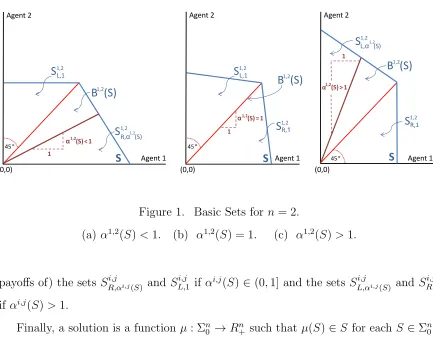
For each problem S and distinct individuals i and j, define the sets SL,βi,j = {y ∈
S|βyi < yj} and Si,j
R,β ={y∈S|βyi > yj} for each β >0.
For each problem S and distinct individuals i and j, also define αi,j(S) such that
T P(SR,αi,j i,j(S)) =T P(S i,j
L,1) if T P(S
i,j
L,1)≤T P(S
i,j R,1)
and
T P(SL,αi,j i,j(S)) = T P(S i,j
R,1) if T P(S
i,j
L,1)> T P(S
i,j R,1).
Clearly,αi,j(S) always exists and it is unique. In addition,αi,j(S) = 1/αj,i(S). We will
call αi,j(S) (a measure of) pairwise total payoff asymmetry of S with respect to
individuals i and j.
A problem S is said to satisfy pairwise total payoff symmetry with respect to individuals i and j if αi,j(S) = 1. Furthermore, S is said to satisfy total payoff
symmetry if it satisfies pairwise total payoff symmetry with respect to each pair
involving individual 1. Clearly, if S satisfies total payoff symmetry, then for eachiit is true thatS satisfies pairwise total payoff symmetry with respect to each pair involving individual i.
For each problem S and distinct individuals i and j, define the set
Bi,j(S) =
SR,i,j1\Si,j
R,αi,j(S) if αi,j(S)∈(0,1),
S\(SL,i,j1∪SR,i,j1) if αi,j(S) = 1,
SL,i,j1\Si,j
L,αi,j(S) if αi,j(S)>1.
Note thatBi,j(S) is always nonempty. We callBi,j(S) thepairwise balancing subset
Agent 2
S
B (S)1,2
L,1
1,2
Agent 1
45°
S (S) < 1
(0,0)
1
R,1,2 (S)
B (S)1,2
S1,2
1,2
Agent 2
S
B (S)1,2
L,1
1,2
Agent 1
45°
S
(S) = 1
(0,0)
1 SR,1
1,2
1,2
Agent 2
α (S) > 1
SL, (S)
B (S)
1 1,2 1,2 1,2 1,2 Agent 1
45° S
α (S) > 1
(0,0)
SR,1
[image:6.612.92.525.84.444.2]1,2
Figure 1. Basic Sets for n = 2.
(a) α1,2(S)<1. (b) α1,2(S) = 1. (c) α1,2(S)>1.
payoffs of) the sets SR,αi,j i,j(S) and S i,j
L,1 if αi,j(S)∈ (0,1] and the sets S
i,j
L,αi,j(S) and S i,j R,1
if αi,j(S)>1.
Finally, a solution is a function µ: Σn
0 →Rn+ such that µ(S)∈S for each S ∈Σn0.
3
Results
For each problemSand individuali, defineαi(S) = (αi,j(S))
j6=i. We say that a solution
µ isendogenously proportional relative to individual i if there exists a continuous
function ri,j : Rn−1
++ → (0,1] for all j 6= i such that µ(S) = λ(S)p(S) for all S ∈ Σn0,
where p(S) ∈ Rn
++ is such that pj(S)/pi(S) = 1−ri,j(αi(S)) +ri,j(αi(S))αi,j(S) for
all j 6= i and λ(S) = max{t|tp(S) ∈ Bi,j(S) for all j 6= i}. We will denote by EP i
the class of solutions that are endogenously proportional relative to individual i. Obviously, the class EPi is not independent of i since the (weight) functions ri,j
and rj,i are independent for all i, j such that i 6= j. Any solution µ in the class EP i
p(S) =p(T) =µ(T)/λ(T) if there exists no individual j that the pairwise total payoff asymmetry with respect to individuals i and j is different for S and T. On the other hand, the proportionality of any solution µ in EPi is endogenous since the vector of
proportionality p is not invariant to changes in the problem S that affect αi(S), the
profile involving pairwise total payoff asymmetries relative to individual i. Note also that the range of the functionsri,j in the definition ofEP
i excludes the point 0, which
would yield a vector of proportionality corresponding to the Egalitarian solution, an exogenously proportional solution.
The distinction between our solutions and Kalai’s (1977) exogenously proportional solutions should be apparent, given the definition that a solution µ over Σn
0 is
ex-ogenously proportional if there exists p ∈ Rn++ such that µ(S) = λ(S)p for each
S ∈Σn
0, where λ(S) = max{t|tp∈S}.
Moreover, our solutions are also independent of the class of Directional solutions, to which Chun and Thomson (1990) further generalized exogenously proportional so-lutions. To see this, consider a class of n-person problems Σn, where each problem
involves a bargaining set S ⊂ Rn satisfying the usual feasibility assumptions and a disagreement point dinS, where the individuals end up if they fail to agree on a point in S. If for a given solution µ there exists a continuous function p from the set of feasible bargaining sets to the n-dimensional simplex ∆n such that for all (S, d)∈Σn,
µ(S, d) = d+λ(S)p(S), where λ(S) = max{t|d+tp(S) ∈ S}, then µ is called the
Directional solution relative to p.
To make a comparison with the Directional solutions, we can simply extend the class of solutions EPi for anyifrom Σn0 to Σn, by settingµ(S, d) = d+λ(S)p(S) for allµin
EPi and replacingαi,j(S) by αi,j(IR(S−d,0)) for all j 6=i, whereIR(S−d,0) ={x∈
S−d|x≥0}. Obviously, we can, without loss of generality, restrictpi(S), which is kept
Directional solutions. But, there remains a significant difference between this class of solutions and ours: For any solution belonging to our class, the vector of proportionality, p(S), on a given problemSis not independent ofdover Σn. The reason is that over Σn,
any solution µinEPi would require on any problem S a vector of proportionalityp(s)
satisfying pj(S)/pi(S) = 1−ri,j(αi(IR(S−d,0))) +ri,j(αi(IR(S−d,0)))αi,j(IR(S−
d,0)) for all j 6= i, where αi(IR(S −d,0)) = (αi,j(IR(S −d,0)))
j6=i. Therefore, no
member of the class of endogenously proportional solutions is a Directional solution. Below, we present four axioms to characterize our solutions. The first two axioms are well known. The third and fourth axioms are stated for each individual i.
Weak Pareto Optimality (WPO): µ(S)∈W P O(S).
Continuity (CON): If {Sk} converges in the Hausdorff topology to S, then {µ(Sk)}
converges to µ(S).
Balancedness Relative to Individual i (BAL-i): µ(S)∈Bi,j(S) for all j 6=i.
Invariance of Payoffs Relative to Individual i under Constant Pairwise Total Payoff Asymmetry (IPRI-i): IfS, T are such thatαi,j(S) =αi,j(T) for some
i and j 6=i, then µj(S)/µi(S) =µj(T)/µi(T).
also be the same in these problems.
Below, we will show that WPO and IPRI−i together imply the well known
homogeneity axiom. We will use this result in proving our characterization theorem.
Homogeneity (HOM). µ(cS) = cµ(S) for all c > 0.
Lemma 1. A solution satisfies HOM if it satisfies WPO and IPRI−i for some i.
Proof. Let a solution µ satisfy WPO and IPRI−i for some individual i. Fix i. Pick any S and c > 0. By WPO, µ(S) ∈ W P O(S) and µ(cS) ∈ W P O(cS). It follows that cµ(S) ∈ W P O(cS) since cW P O(S) = W P O(cS). Clearly, αi,j(cS) = αi,j(S)
for all j 6= i. Then, by IPRI−i, µj(cS)/µi(cS) = µj(S)/µi(S) for all j 6= i. Suppose
µi(cS) > cµi(S); then µ(cS) > cµ(S), contradicting cµ(S) ∈ W P O(cS). Similarly,
µi(cS)< cµi(S) would implyµ(cS)< cµ(S), contradictingµ(cS)∈W P O(cS). So, we
must have µi(cS) = cµi(S), implying µ(cS) =cµ(S).
Theorem 1. A solution on Σn
0 satisfies WPO, CON, BAL-i, and IPRI−i if and only
if it is endogenously proportional relative to individual i.
Proof. Obviously, any solution in the class EPi satisfies all four axioms. Conversely,
let µbe a solution satisfying WPO, CON, BAL-i, and IPRI−i. Pickφj ∈
R++ for all
j 6=i. Let φ= (φj)
j6=i. Consider the problem
D(i,φ) = {y∈Rn+|y
i
Pick k6=i. We haveαi,k(D(i,φ)) =φk, since
T P(DL,i,k1(i,φ)) = φ
k
2
Y
j6=k j6=i
p
φj =T P(Di,k
R,φk(i,φ)) if φ
k ∈(0,1], and
T P(DL,φi,kk(i,φ)) =
1 2
Y
j6=k j6=i
p
φj =T P(Di,k
R,1(i,φ)) if φ
k
>1.
By BAL-i, we have µ(D(i,φ))∈Bi,k(D(i,φ)), implying
µk(D(i,φ))
µi(D(i,φ)) ∈
[φk,1) if φk ∈(0,1),
{1} if φk = 1,
(1, φk] if φk >1.
Let
ri,k(φ) = 1
φk−1
µk(D(i,φ))
µi(D(i,φ)) −1
if φk 6= 1. Clearly, ri,k is defined at all n−1 tuples (φj)
j6=i ∈ ℜn−++1 such that φk 6= 1.
Let ri,k((φ−k,1)) = lim
φk→1ri,k((φ−k, φk)), where φ−k = (φj)j6=i j6=k
∈ Rn−++2 and φk ∈
R++\{1}. (Note thatµk(D(i,(φ−k, φk)))/µi(D(i,(φ−k, φk))) is continuous in (φ−k, φk),
since µ satisfies CON; hence the above limit exists.) Note that ri,k(φ) ∈ (0,1] for all φ ∈ Rn−++1. Since k was arbitrary, we have constructed a continuous function ri,j :
Rn−++1 →(0,1] for each j 6=i.
Now pick a problem S. Given αi(S) = (αi,j(S))
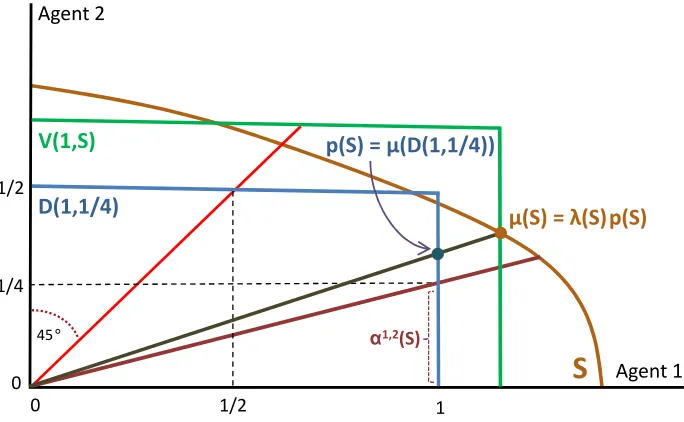
j6=i, let p(S) = µ(D(i,αi(S))).
By construction, pj(S)/pi(S) = 1−ri,j(αi(S)) +ri,j(αi(S))αi,j(S) for all j 6= i. Let
λ(S) = max{t|tp(S) ∈ Bi,j(S) for all j 6= i}. Clearly, λ(S)p(S) ∈ W P O(S) since µ
satisfies WPO.
then we have
T P(VL,i,j1(i, S)) = [λ(S)]nT P(Di,j L,1(i,α
i(S)))
= [λ(S)]nT P(Di,j
R,αi,j(S)(i,α i(S)))
= T P(VR,αi,ji,j(S)(i, S)).
On the other hand, if αi,j(S)>1, then we have
T P(VR,i,j1(i, S)) = [λ(S)]nT P(Di,j R,1(i,α
i(S)))
= [λ(S)]nT P(Di,j
L,αi,j(S)(i,α i(S)))
= T P(VL,αi,ji,j(S)(i, S)).
Since j was arbitrary, it follows that αi,j(V(i, S)) =αi,j(D(i,αi(S))) = αi,j(S) for all
j 6=i.
Agent 1 Agent 2
45° D(1,1/4)
1,2(S)
0 1/4
0 1/2 1
1/2
p(S) = μ(D(1,1/4))
S
μ(S) = λ(S)p(S)
[image:11.612.139.481.390.601.2]V(1,S)
Figure 2. Sketch of the Proof for n= 2 and α1,2(S) = 1/4.
αi,j(V(i, S)) = αi,j(S). Moreover, µ(V(i, S)) ∈ W P O(V(i, S)), since µ satisfies
WPO. Then, µi(V(i, S)) = µi(S) for all j 6= i, for otherwise we would have either
µ(V(i, S)) > µ(S) contradicting µ(S) ∈ W P O(S) or µ(V(i, S)) < µ(S) contradict-ingµ(V(i, S)) =λ(S)p(S)∈W P O(S). Therefore,µ(S) = µ(V(i, S)) =λ(S)p(S).
The axioms WPO and CON are also satisfied by exogenously proportional solu-tions, as already shown by Kalai (1977). Besides, these solutions satisfy IPRI−i as well, since by definition the vector of proportionality of any exogenously proportional solution is invariant to changes in the bargaining problem. Thus, endogenously and exogenously proportional solutions are only distinguished, in our characterization, by
the balancedness axiom. It should be evident from the definition of endogenously
pro-portional solutions that any possible alternative characterization of the class EPi may
constantly depend on the axiom BAL-i. This dependence is similar to the constant appearance of thestrong individual rationality(SIR) axiom in three alternative charac-terizations of exogenously proportional solutions offered by Kalai (1977).4 The axiom
SIR requires that for each problem the solution should assign a positive utility to each individual.5 The need forSIRby the class of exogenously proportional solutions is
obvi-ous as these solutions restrict the vector of proportionality to strictly positive n-tuples. On the other hand, SIRis not strong enough to account for the demanding restrictions our solutions put on the vector of proportionality corresponding to each problem. The restrictions put by any solution in EPi require, for each problem, the exact knowledge
of the pairwise total payoff asymmetry with respect to each pair involving individual i,
4Kalai (1977) shows that exogenously proportional solutions are characterized by
WPO, HOM,
SIR together withmonotonicity orstep-by-step negotiations or a collection of three axioms involving
independence of irrelevant alternatives,individual monotonicity andcontinuity.
5Note that
WPOandBAL-itogether implySIR. Therefore any solution in the classEPi trivially
hence the direct reflection of these restrictions onto an axiom like BAL-i seems to be inevitable.
We should also note that the separation of endogenously and exogenously propor-tional solutions with regard to the balancedness axiom implies that the two classes of solutions also differ with respect to their relation to a basic axiom in the bargaining literature, called symmetry.
Symmetry. IfS is symmetric, then µi(S) = µj(S) for all i and j.
While symmetry is satisfied by no exogenously proportional solution except for the Egalitarian solution, it is satisfied by every endogenously proportional solution. The reason is that given any i, this axiom is implied by BAL−i, because if S is symmetric, then αi,j(S) = 1 and Bi,j(S) = {y ∈ S|y
i = yj} for all j 6= i. In fact, endogenously
proportional solutions satisfy a stronger form of symmetry, as well.
Total Payoff Symmetry. IfS is total payoff symmetric, then µi(S) = µj(S) for all i
and j.
It is clear thattotal payoff symmetryimpliessymmetry, since every bargaining prob-lem is total payoff symmetric if it is symmetric. But, the converse is not true since there are total payoff symmetric problems that are not symmetric. For example, consider n = 2 and S = convex hull ({(0,0),(0,3/2),(1/2,3/2),(1,1),(7/4,0)}). Clearly, S is not symmetric, but it is total payoff symmetric since T P(SL,1,21) = T P(SR,1,21) = 7/8 and α1,2(S) = 1.
class of solutions. Obviously, each bargaining solution already satisfyingWPO and
CON can be simply extended to be a member of this general class of solutions, by picking some individual i and restricting the solution outcome on each problem S to the set ∩j6=iBi,j(S).
4
Conclusion
In this paper, we have introduced a class of endogenously proportional solutions. The solutions relative to individualiare characterized byweak Pareto optimality,continuity
and two new axioms that depend on the pairwise total payoff asymmetry of a given problem with respect to each pair involving individual i.
Interestingly, endogenously proportional solutions satisfy a stronger form of the
symmetry axiom, while exogenously proportional solutions, except for the Egalitarian
solution, fail to satisfysymmetry. Definitely, for non-Egalitarian members of the Kalai’s (1977) class of solutions this is not a deficiency per se, since in environments where the players may not have the same bargaining power, asking for symmetry would be unreasonable. On the other hand, in environments where the bargaining problem is known to intrinsically contain the bargaining power of the players, it would be natural to focus on solutions that choose symmetric outcomes in symmetric problems. The solutions we propose may enable players in such environments to use proportional solutions without dispensing with symmetry. However, one difficult problem that was already addressed by Kalai (1977) for exogenously proportional solutions is what the vector of proportionality should be. For the case of each endogenously proportional solution relative to individual i, this problem boils down to how the weight functions
{ri,j}
j6=i, which determine the direction of the solution inside the set ∩j6=iBi,j(S) for
Finally, new bargaining solutions can be derived from the already known solutions in the literature, restricting the outcome chosen by any proposed solution to lie in the intersection of the pairwise balancing subsets of the bargaining problem relative to a given individual. This procedure can be especially useful for finding symmetric extensions of solutions that fail to satisfy symmetry.
References
Chun, Y., Thomson, W., (1990a). Bargaining with uncertain disagreement points. Econometrica. 58, 951-959.
Chun, Y., Thomson, W., (1990b). Egalitarian solutions and uncertain disagreement points. Economics Letters. 33, 29-33.
Hougaard, J.L., Tvede, M., (2010). n-Person nonconvex bargaining: Efficient propor-tional solution. Discussion Papers 10-21, University of Copenhagen. Department of Economics.
Kalai, E., (1977). Proportional solutions to bargaining situations: Interpersonal utility comparisons. Econometrica. 45, 1623-1630.
Nash, J. F. (1950). The bargaining problem. Econometrica. 28, 155-162.
Peters, H.J.M., (1986). Simultaneity of issues and additivity in bargaining. Economet-rica. 54, 153-169.
Rawls, J., (1971). A Theory of Justice. Harvard University Press, Cambridge, Mas-sachusetts.