The London School of Economics and Political
Science
Social representations and homelessness: a study on
the construction o f exp ertknowledge.
Alicia Renedo Udaondo
UMI Number: U613372
All rights reserved
INFORMATION TO ALL USERS
The quality of this reproduction is dependent upon the quality of the copy submitted.
In the unlikely event that the author did not send a complete manuscript and there are missing pages, these will be noted. Also, if material had to be removed,
a note will indicate the deletion.
Dissertation Publishing
UMI U613372
Published by ProQuest LLC 2014. Copyright in the Dissertation held by the Author. Microform Edition © ProQuest LLC.
All rights reserved. This work is protected against unauthorized copying under Title 17, United States Code.
ProQuest LLC
789 East Eisenhower Parkway P.O. Box 1346
r
Library
BrtDBhLfxary of Political
Declaration
I certify that the thesis I have presented for examination for the
MPhil/PhD degree o f the London School o f Economics and Political
Science is solely my own work other than where I have clearly
indicated that it is the work of others (in which case the extent o f any
work carried out jointly by me and any other person is clearly
identified in it).
The copyright o f this thesis rests with the author. Quotation from it is
permitted, provided that full acknowledgement is made. This thesis
may not be reproduced without the prior written consent of the author.
I warrant that this authorization does not, to the best o f my belief,
ABSTRACT
In this thesis I develop a social representational approach to understanding expert
knowledge on homelessness. I relate the concept of cognitive polyphasia with
Bakhtin’s views on the'polyphony o f the person, and Herman & Kempen’s concept
of the dialogical self. I link dialogical epistemology and ontology to show that, (i)
polyphony and polyphasia of self and knowledge are two sides o f the same coin, and
(ii) the inner plurality of the person is grounded in the multiple self-other
relationships within which identity and knowledge are co-constituted and where
different ideas and practices clash and compete. I show that our ability to position
ourselves in relation to the knowledge o f others explains how the meanings, practices
and identities that co-exist within individuals and groups are put to use, enabling us
to function in multiple relationships and contexts. The research involved a
multidimensional approach comprising: (1.) narrative interviews and focus groups
with homelessness professionals (HPs) working in the UK voluntary sector and (2.)
participative observation at conferences, and in a voluntary agency. The research
showed that homelessness is a contested and contradictory notion. Expert
representational fields are simultaneously, identity and knowledge struggles, sharply
characterized by cognitive polyphasia, whose contents and dynamics are drawn from
the dialogues and battles between the voluntary and the statutory sector and the
public at large. I conclude by suggesting that identity and knowledge are inseparable
from both the multiple relationships in which they develop and from processes of
self-other positioning.
Keywords: Cognitive polyphasia, Dialogical self, Homelessness, Identity, Social
ABSTRACT... 4
ACKNOWLEDGEMENTS...9
1. THE RESEARCH PROBLEM... 11
1.1. Homeless in the UK; Current Realities...11
1.1.2. How Do You Establish Which Elements Constitute Someone as ‘Homeless’? ... 14
1.2. Research on Homelessness: Towards a Socio-psychological Understanding of ‘Homelessness’...18
1.2.1. Homelessness ontology: relational and representational dimensions 21 1.3. Beyond Material Aspects: The Symbolic Meaning of ‘Homelessness’ 24 1.3.1. The Symbolic Construction of Reality... 24
1.3.2. A Critical Social Psychology o f Homelessness: The Relevance of Social Representations... 31
1.4. The Privileged Position of Homelessness Professionals (HPs) Working in The Voluntary Sector...35
1.5. Aims o f The Study: Research Questions...39
1.5.1. Objectives... 41
2. THEORISING PROFESSIONAL PRACTITIONERS KNOWLEDGE...43
2.1. The Theory of Social Representations, a Theory of Social Knowledge 45 2.1.2. Knowledge as a Social Communicative Practice... 49
2.2. The Social Process of Emergence and Development o f Knowledge: Representations in The Making... 53
2.2.1. The Dialogical Making o f Social Representations: The Relationship Between Interacting Forms of Knowledge... 60
2.2.2. The ‘Use’ of Social Representations: Identity and Social Positioning 65 2.3. Professional Practitioners’ Social Representations...70
2.4. Conclusion... 72
3. COGNITIVE POLYPHASIA AND THE POLYPHONIC SELF... 77
3.1. The Polyphonic Self: ‘Traces’ of Others in the Self... 80
3.3. Critical Use of Representations: Contesting The Other Through Rhetorical
Positioning... 96
3.3.1. Socio-ideological Representing and Becoming...100
4. INVESTIGATING HPS’ EXPERT KNOWLEDGE: METHODOLOGICAL ‘DIAGNOSIS’ AND ‘PRESCRIPTION’... 108
4.1. Epistemological Underpinning: Dialogism / Constructivism... 109
4.1.1. Reflexivity On The Dialogue Between Researcher (Self) - Researched (Other)...114
4.2. Method... 117
4.2.1. Methodological Strategies... 117
4.2.2. Segmentation o f the Social Milieus of HPs... 132
4.3. Quality Assurance...136
4.4. Conclusion...138
5. SOCIAL REPRESENTATIONS OF HOMELESSNESS: DIALOGICALLY NARRATED EXPERT KNOWLEDGE... 141
5.1. Analytical Model and Processes... 141
5.1.1. Meta-analysis o f Internal Dialogues... 141
5.1.2. Analysis of Content...145
5.1.3. Procedure...145
5.2. Findings...148
5.2.1. Discourses of Humanization...153
5.2.2. Institutional Discourses... 160
5.2.3. Discourses of Identity... 166
5.3. The Dynamics of Knowledge Production...169
5.3.1. The Dialogical Co-existence o f Polyphasic Themes...169
5.4. Participating and Observing... 175
5.4.1. Discourses of Humanization...175
5.4.2. Institutional Discourses... 178
5.4.3. Discourses of Identity... 179
5.5. Conclusions...182
6. SOCIALLY REPRESENTING EXPERT KNOWLEDGE AND DIALOGICALLY CO-CONSTRUCTING AN IDENTITY... 185
6.1. Analytical Model and Processes...186
6.2.1. Discourses o f Relatedness... 192
6.2.2. Discourses of Reification and Politization...199
6.2.3. Epistemological and Ontological Discourses ... 205
6.3. Group Dynamics: Constructing Social Representations o f Homelessness and a Concomitant Identity... 211
6.4. Participating and Observing...217
6.4.1. Discourses of Relatedness... 217
6.4.2. Discourses of Reification and Politization... 219
6.4.3. Epistemological and Ontological discourses...221
6.5. Conclusions...223
7. CONTESTED KNOWLEDGES AND IDENTITY STRUGGLES... 226
7.1. Towards a Dialogical Understanding of Self and Knowledge... 227
7.1.1. Polyphony and Polyphasia in Self and Knowledge... 227
7.1.2. Socio-ideological Determinants of Knowledge and Identity...229
7.1.3. The Critical Potential of Social Representations...230
7.2. Contested Knowledges: Representations in the Battlefield...234
7.3. Dialogicality, Regulation and Ontology...237
7.3.1. Battles of Humanization & Relatedness... 239
7.3.2. Battles of Institutionalization, Reification and Politization...241
7.3.3. Battles of Identity... 244
7.3.4 Contestation and Critical Potential o f Social Representations... 246
7.4. Prospects for Future Research...249
REFERENCES... 256
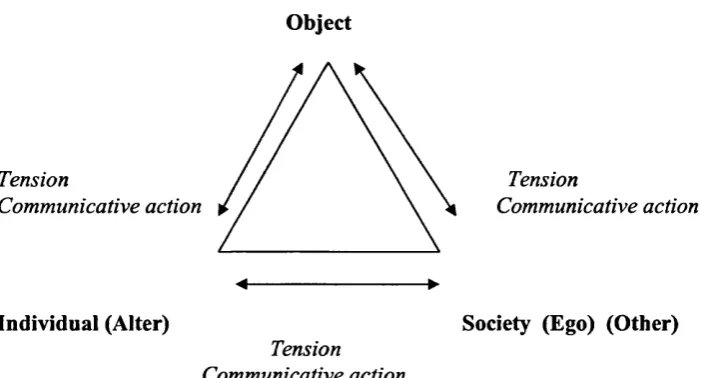
Figure 1: The dialogical triad...62
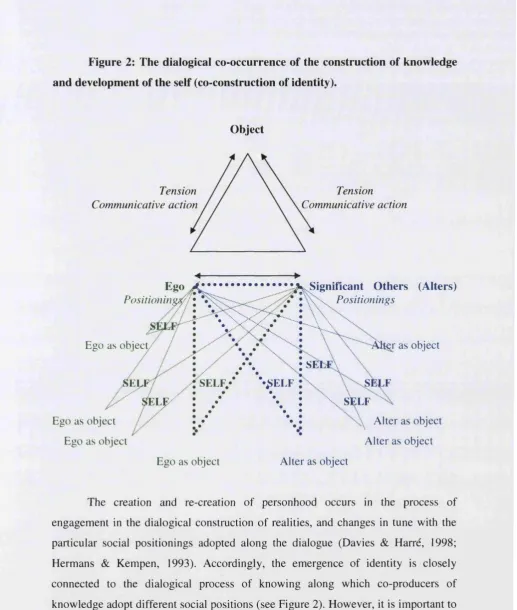
Figure 2: The dialogical co-occurrence o f the construction of knowledge and development o f the self (co-construction of identity)... 68
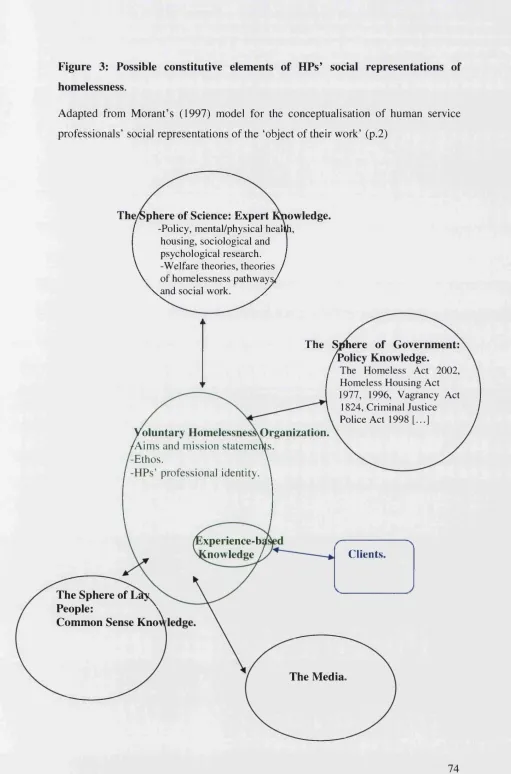
Figure 3: Possible constitutive elements of HPs’ social representations of homelessness...74
Figure 4: Knowledge spheres involved in HPs’ social representations of homelessness...75
Figure 5: Methodological prescription...108
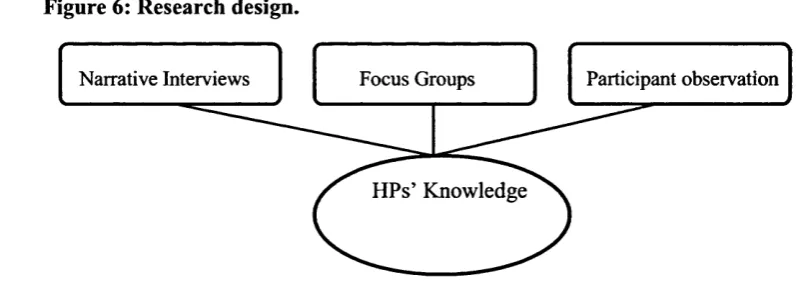
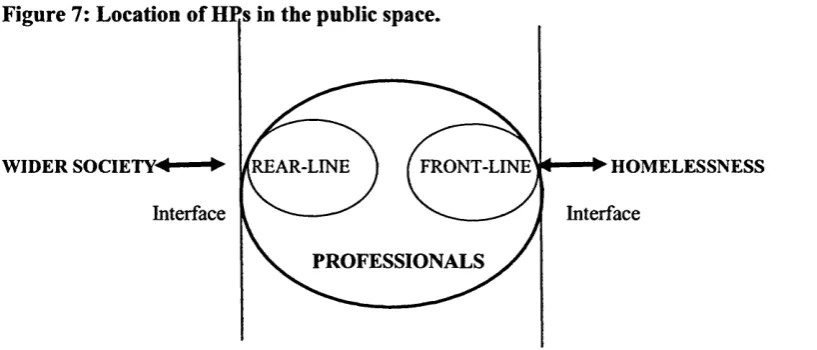
[image:9.595.80.463.89.545.2]Figure 7: Location of HPs in the public space...134
Figure 8: Inter-subjective and intra-subjective dialogues... 144
Figure 9: Dialogical co-existence of polyphasic themes...152
Figure 10: General patterns of dialogue...174
Figure 11: Polyphasic knowledge and plural identity... 191
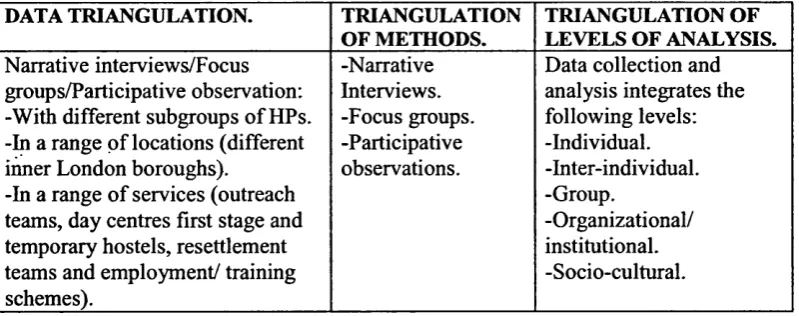
Table 1: Strategies of triangulation... 119
Table 2: Data collection methods and participants...120
Table 3: Segmentation o f participants... 136
Table 4: Quality indicators... 138
Appendix 1: Interview schedule... 271
Appendix 2: Focus groups schedule... 272
Appendix 3: Conference programme details...277
Appendix 4: Description o f each area o f work... 282
Appendix 5: Fragments from coded interviews and comments inserted during the coding process... 284
Appendix 6: Interview codes... 339
ACKNOWLEDGEMENTS
I am deeply indebted to my supervisor and mentor, Sandra Jovchelovitch, for
accompanying me along this journey. She has been a continuous source o f
inspiration and support. She has communicated to me her passion for social
psychology and has drawn my attention to the importance of dialogue and context in
the study o f knowledge. Sandra has conscientiously read my drafts and provided me
with invaluable and at times challenging feedback. I should also like to thank
Caroline Howarth, Darrin Hodgetts and Bradley Franks for their constructive
feedback and advice. I owe special thanks to my colleagues and close friends at the
LSE Institute of Social Psychology. With them I have shared very special moments
of friendship and conversation that have helped shape the thinking and get the energy
that allowed me to write this thesis. I would like to mention especially Alex
Steinberg, Asi Sharabi, Giuseppe Veltri, Sharon Attia and Stavroula Tsirogianni. My
parents, my brother Cesar and aunt Ulla have encouraged me and given me the
foundations that have supported me throughout my work. I wish to acknowledge the
support o f the Basque Government in Spain who made his thesis possible through
their funding.
Finally, I dedicate this thesis to my beloved Michael, for taking care o f me
throughout this project, for spending our weekends reading every single line o f this
thesis, for making me laugh at the difficult moments, for being patient, for always
1. THE RESEARCH PROBLEM
1.1. Homeless in the UK; Current Realities.
Homelessness continues to be a pressing social problem and a major case of
socio-economic exclusion in the UK. While it has received a great deal of attention
since the mid-1990s from policy makers, researchers and service providers, there
remains much controversy about the extent of the problem, its underlying causes, and
the most effective ways to address it. These controversies are partly due to the fact
that in the UK there is widespread disagreement on the definition o f homelessness,
which is subject to a contested variety of meanings and interpretations. This is
expressed in the ongoing debate over the ways to define what ‘homelessness’1 is and
to identify which people belong to this group. The homeless have been unanimously
identified as a socially excluded group and various policies, such as the Rough
Sleepers Unit, have been implemented to tackle the issue (Pleace & Quilgars, 2003).
However, support and care structures are diversified across two clashing and co
existing sectors: the voluntary and the statutory, each holding different definitions
and competing approaches to the problem.
The voluntary sector encompasses a wide array of organizations, which
provide services such as; housing advice, training and vocational guidance, basic
health provision, hostels, social services and psychological support. Despite being
independent from the public and private spheres, the privatization of state social
welfare and transference of its responsibility to local authorities and voluntary
agencies has led to the blurring of boundaries between the voluntary and
governmental sectors and the overlapping of their jurisdictions (Daly, 1997). These
developments have had a pronounced impact on the nature and functions o f the
voluntary sector in the UK. Its former philanthropic role has evolved into the
‘provider’ of the statutory ‘financial enabler’ (Daly, 1997), which has meant a
transformation towards a professional homeless industry (Wames, Crane, Whitehead,
& Fu, 2003).
Despite these increased interdependencies, there is a general lack o f
agreement between sectors on the definition of homelessness. This creates a number
of practical problems, ranging from difficulties in estimating the total number o f
homeless people and the different categories among them. It also has consequences
at the level of provision of services, models of intervention and policy design. While
state estimations indicate a decline in numbers (see ODPM, 2006), sources from the
voluntary sector reveal that there is a vast number of homeless people that are not
included in these statistics (Crisis, 2006) because they do not fit within statutory
definitions or because they belong to so-called ‘hidden’ populations (i.e. those
sleeping on a friend’s sofa). The contested nature o f definitions about homelessness
makes it difficult to achieve consensual estimations (Hutson & Liddiard, 1994) and
impacts negatively on the social, psychological, structural and health needs o f those
who are not officially considered homeless by statutory definition (Crane & Wames,
2001).
Like most problems of social exclusion, homelessness is constructed through
networks of unstable and contested meanings (Anderson, 1997). Tackling the
problem effectively requires a clear understanding of how the issue is framed by
different stakeholders and social actors motivated by competing interests. Such
knowledge of the socio-political context in which homelessness is constructed and
addressed has not been enabled by British Homeless research (Jacobs et al.,-1999).
The nature of welfare policies, care-related practices, the interventions deemed
appropriate to prevent and respond to homelessness, and how the homeless person is
treated are all based on meanings and definitions of homelessness. As Pleace and
Quilgars (2003) concluded in their examination of British homeless research, there is
an urgent need for academics of the social sciences to explore the socially
constructed nature o f homelessness in the UK from a de-politicized framework; one
that is neither led by government funding or by that of voluntary advocates. The
social construction o f homelessness is an important focus o f inquiry since it
participates in the marginalization o f this social group (Pleace & Quilgars, 2003). It
permeates policies, interventions and the matrix of relationships within which the
In this thesis my purpose is to contribute towards this understanding, by
examining social psychological dimensions and their link to socio-political contexts,
involved in the constitution of homelessness. These play a central role in the living
conditions, the framing of interventions and the production o f subjectivities and
health o f the homeless. I focus on how professionals working with homeless people
in the voluntary sector (from now on HPs2) produce knowledge about homelessness.
HPs offer a privileged entry point for understanding processes o f social construction
of homelessness due to their positioning as key social actors at the interface between
the homeless, the statutory sector, policy makers and society as a whole. HPs are
experts in context: mediators, translators and integrators o f beliefs, meanings and
images of homelessness circulating in the UK. Definitional disagreements and
conflict o f approaches with the statutory sector are core dilemmas with which HPs
have to cope in their everyday practices and relationships with clients and other
social actors.
Drawing on the theory o f social representations (Jodelet, 1989/1991;
Moscovici, 2000) and the concept of cognitive polyphasia (Jovchelovitch, 2002,
2007; Moscovici, 1961/1976) and from a Bakhtinian approach (Bakhtin, 1981, 1984a,
1986), I argue that HPs’ knowledge production is a plural phenomenon. It is shaped
by the definitional clashes and competing approaches that characterize the context of
service provision. It is constructed in relation to dialogical3 others; moving between
the streets, hostels and meetings with statutory agencies, and accommodating their
experience-based knowledge and ethos to the definitions and models of intervention
of statutory agencies. HPs are in a continuous state of negotiations and resolutions
about homelessness, and it is through the struggle between adjusting to and
contesting others’ perspectives on homelessness that their knowledge and self are co
constructed. Understanding how they make sense of the problem and develop
practices to deal with it is an important task for a social psychology o f homelessness.
It can produce valuable insights into the intricacies involved in defining
homelessness in the UK and contribute to improving the care and support services
2 It is important to note that with the term ‘HP’ I am only referring to those professionals working in the voluntary sector.
needed by homeless people. Which representations emerge from HPs’ relations with
others along their different positions in the social landscape? How do their
constructions of homelessness represent who the homeless person is and how should
she be treated? And how can their knowledge help us to understand the way the
clashes between different forms of knowing in contemporary public spheres impact
on the definition and resolution of social problems such as homelessness?
1.1.2. How Do You Establish Which Elements Constitute Someone as ‘Homeless’?
Definitions of what constitutes homelessness as a social problem are highly
unstable and subject to conflicting pressures and debate (Jacobs et al., 1999). Clear
unanimous concern about the importance o f a meaningful and comprehensive
approach to homelessness has not dissipated widespread disagreements about what
homelessness means, who belongs to this group, and what are the best solutions to
combat it. At the heart o f these disagreements is the very context of service provision
for the homeless in the UK, which is based on both statutory (public sector, state
controlled) and non-statutory (voluntary sector) agencies. Clashes and ongoing
struggles between these two sectors are common. These are framed by different
definitions of homelessness, diverging understandings o f its causes, competing
approaches and disagreements in relation to the intentionality behind homelessness
and the priority given to the needs of certain groups (i.e families as opposed to
individuals). Defining to which extent the homeless person is intentionally causing
the homelessness situation sharply differentiates the approaches between statutory
and voluntary agencies and constitutes a site for substantial conflict and negotiation
between sectors. At the root of these differences are more profound social
psychological and political dimensions related to the role o f the individual and the
social in the construction of homelessness and in the attributions of responsibility for
it.
The general approach o f the statutory sector is based on access to housing,
the intentionality of the individual person in causing the situation o f homelessness
unintentionally lacking secure or permanent accommodation (Wames et al., 2003).
Once assessed to fit within criteria of eligibility for aid and basic categories of
priority need, people are channeled into the official procedures for the provision of
accommodation and referred to welfare services. The absence of coordination and
comprehensive joined-up strategies between housing and other specialist public
services (CESI, 2005), and the lack of a more comprehensive, flexible and
responsive approach, which offers continuity and assists the emotional and social
needs of the homeless have constantly led to the recurrence o f episodes of
homelessness. Statutory responses tend to be short-term and ad hoc by nature, thus
leaving a lacuna in services that are left to be filled by the voluntary sector (Daly,
1997). As various commentators have pointed out (Jacobs et al., 1999; Wames et al.,
2003), in adopting very narrow eligibility criteria to establish the boundaries of its
target population and to frame its responses, the statutory sector deals with very
restricted dimensions of homelessness, reducing the phenomena to a problem of a
‘lack of roof over one’s head’. The statutory definition o f homelessness is
ideologically4 loaded as it constructs ‘homelessness’ as attributable to internal causes,
implies moral assumptions about the person, and reduces the homeless experience to
an issue of lack of housing. The way homelessness is defined is critical since it has
practical consequences such as the symbolic and structural marginalization o f groups
that are in real need. It might have implications on the consideration of the
importance o f this social problem and the policy response to it (Hutson & Liddiard,
1994). Constructions of ‘homelessness’ based on intentionality locate responsibility
in the individual. Thus, they serve to legitimately sustain certain patterns o f welfare
action to the exclusion of others, concealing the heterogeneity of the group and the
intricacy o f the problem, thus justifying state lack o f assistance.
Policies have constructed two different groups o f people: those who are
homeless not as a result of individual choice and are therefore considered statutory
and those who are intentionally homeless. This criterion of eligibility has in turn
generated two groups of people: the deserving and the undeserving; those who are
regarded as unintentionally homeless and therefore deserve state welfare services and
support structures, and those who are deemed homeless through conditions o f their
own individual choice and therefore do not deserve the assistance o f statutory
services (Clapham, 2003). The latter group is not officially regarded as homeless and
has no legal rights to housing, state support services, or benefits and are left to seek
assistance from the voluntary sector. Therefore, the voluntary sector assists the needs
of those who are symbolically and materially marginalized by government policies
and services.
The hallmark o f the voluntary sector’s definition of homelessness is that it
does not include the criterion o f intentionality. It defines homelessness in broader
terms and comprehensively understands it as a multi-faceted phenomena that affects
all aspects of one’s live. It recognizes that beyond ‘roofless-ness’ there are multiple
forms of homelessness, and takes into account the heterogeneity of the homeless
population as well as the intricacy o f the social and emotional support needs that
exist alongside the lack o f housing. Their interventions are not restricted to the
alleviation of a specific situation or crisis (i.e. through outreach work), but are also
motivated by an agenda o f prevention and continuity of assistance along their
pathway o f services towards independence (i.e. advice and tenancy support, training).
The aim o f voluntary services is to comprehensively tackle the diverse and
intertwined dimensions of homelessness, deal with its underlying causes and enable
clients to rebuild their lives. This is pursued through an individualised and responsive
approach based upon flexibility, creativity and accessibility (Daly, 1997). However,
these attributes and the autonomy o f the voluntary sector to put into practice its own
agenda, are threatened by dramatic transformations o f the welfare system. Increased
dependency on government funding, greater governmental contract and partnership
work, has meant being subject to its competitive bidding to decide which voluntary
agency is awarded short-term state funding. This has proved a double-edged sword
for the voluntary sector, which though nominally independent from central
government, is having to increasingly adapt to statutory practices, bureaucracies and
paradigms of ‘homelessness’. The wide gap between both sectors in the definition
and framing o f homelessness, continuous to be at the core o f the difficulties
stability, control, order, accountability and cost-cutting, jeopardizes the voluntary
sector’s approach and ultimately the clients’ interests, since voluntary agencies are
compelled to conform to the rigid agenda of statutory bureaucrats as a condition of
funding (Daly, 1997). Within this context the essential role of the voluntary sector in
response to homelessness is seriously at threat, and critically needs to be funded and
recognized by the Government (Daly, 1997).
The ongoing debate around issues of homelessness and disagreements about
what are the best practices for the improvement o f the living conditions and
resettlement of homeless people are underpinned by dualism between individual and
social dimensions. British research and policy discussions have been framed in terms
of minimalist or maximalist constructions of homelessness (Clapham, 2003; Jacobs
et al., 1999). Minimalist definitions locate the causes o f homelessness on the
individual, have led to the dichotomy between deserving and undeserving homeless
producing polices and interventions designed to deal only with individual factors
(Clapham, 2003). Maximalist definitions construct homelessness as the outcome of
social-economic shortcomings and emphasize the role of policy as the key solution to
end homelessness (Clapham, 2003). These definitions stress the importance of either
social structures or psychological and personal factors, but neglect the connections
between them (Clapham, 2003). Both frame how homelessness is constructed and
dealt with in the public sphere, and provide the backdrop against which policies and
responses to homelessness take place. Working in such a contested and contradictory
context and operating within increased interdependency from the government, HPs
face the challenges o f sustaining and putting into practice their approach and
conceptualizations while simultaneously dealing with the pressures and requirements
of the statutory sector.
This has not dissipated the voluntary sector’s role as a watchdog of the
government and also advocate of the homeless in its campaigning to educate the
public and to contest homelessness policies. Indeed, it performs a pivotal task in
communicating and explaining ‘homelessness’ to the public, politicians and the
media (Hutson & Liddiard, 1994). However, despite voluntary agencies’ concerns
with the need to broaden the limited representations of homelessness, in their
the most effective way to secure funding (Jacobs et aL, 1999). Hodgetts and
colleagues (2005) have shown that when accessing British television media in order
to fit public representations, charity representatives use victimizing characterizations
that emphasise the needs of homeless people.
It is against the socio-political context and network of relationships described
above that HPs construct knowledge and practices related to homelessness.
Considering the social position o f these professionals and the matrix of inter
relations that frames their daily experience is key to understanding the nature of their
knowledge and the practices they develop towards the homeless person.
Understanding their knowledge is important since professionals working in the
voluntary sector are well located for the exploration of the different values, meanings
and practices that configure how homelessness is constructed and dealt with in the
public sphere. Within the context of homeless service provision HPs’ knowledge
plays an invaluable role in the drawing up and implementation o f strategies. They
have unsurpassed experience and critical understanding of the breadth of problems
faced by homeless people, of the scarce welfare resources and o f effective working
methods. As a group, they have expertise, which combines theoretical and practical
knowledge o f homelessness, that no statutory agency has (Crane & Wames, 2001).
The value of HPs’ knowledge will be further explored in section 1.4.
1.2. Research on Homelessness: Towards a Socio-psychological
Understanding o f ‘Homelessness’.
Academic interest on the homeless commenced in the 1980’s, and in 1994, it
was claimed, that the homeless population was one of the most popular areas of
study since the mid eighties (Snow, Anderson, & Koegel, 1994). Since then research
has predominantly focused on either characteristics of individual homeless such as
health factors or alternatively on the structural elements underlying homelessness (i.e.
housing) (Clapham, 2003). Within the UK, much of the research comes from the
field of housing, sociology (e.g. Fitzpatrick, Kemp, & Klinker, 2000; Hutson &
Clapham, 1999; Jacobs et al., 1999) and policy studies (e.g. Somerville, 1999).
Bramley, 1995; Fitzpatrick & Stephens, 1999), provision and homeless persons’
admission to accommodation, and access to housing (e.g. Anderson, 1994; 1999).
Within this literature there has been a considerable contribution to developing the
concept of homelessness as a social construct (e.g. Hutson & Liddiard, 1994; Jacobs
et al., 1999). Nonetheless, a large volume o f research has concentrated on socio
demographic characteristics and on homelessness statistics (e.g. Burrows, 1997;
Fisher, Turner, Pugh, & Taylor, 1994; Pleace, Burrows, & Quilgars, 1997).
Even though there is a great contribution of homelessness theoretical and
empirical research from a number of disciplines, this remains compartmentalized
(Anderson, 2003; Christian, 2003; Pleace & Quilgars, 2003). Consequently,
theoretical explanations are conflicting and do not offer an integrative and multi
disciplinary approach to homelessness (Anderson, 2003). Except for few
comprehensive studies from the field o f social psychology (See Hodgetts, Hodgetts,
& Radley, 2006; Hodgetts, Radley, Chamberlain, & Hodgetts, 2007; Radley,
Hodgetts, & Cullen, 2006; Radley, Hodgetts, & Cullen, 2005), generally research in
the UK has not questioned the interwoven relationship between socio-political
contexts and material, symbolic, relational and psychological dimensions of
homelessness. In general, research can be classified in two groups, namely: the
situationist and person-centred research (Clapham, 2003; Fitzpatrick et al., 2000).
The former is focused on the context and structures in which ‘homelessness’ emerges
(i.e. lack of housing, cuts in social benefits) and searches for patterns and common
themes. The latter, focuses on the characteristics o f homeless individuals in order to
identify risk factors (i.e. unemployment, physical/sexual abuse) (Fitzpatrick et al.,
2000). It takes the ‘homeless’ individual as the only focus o f inquiry (Christian,
2003), abstracting it as an entity and detracting attention from the matrix of
relationships and contexts among which she moves. It is certainly within these
contexts and relationships where meanings of homelessness circulate, defining
practices and interactions, and shaping the homeless person’s subjectivity and
experience. Adopting a framework marked by the sovereignty o f either structural or
individual explanations is overly reductionistic (Clapham, 2003; Fitzpatrick et al.,
2000) and has prevented British research from contributing to a wider understanding
socio-cultural, political and symbolic dimensions, as well as the material conditions
and matrix o f relationships in which the homeless live.
With the exception o f few studies (See Hodgetts et al., 2006; Hodgetts et al.,
2007; Radley et al., 2006; Radley et al., 2005), the general marker of the largely
absent socio-psychological research in the UK, has been the lack of exploration of
the interwoven dimensions of homelessness. The focus of inquiry of some o f these
studies has been the measurement o f attitudes and self-categorization variables
(social identity) through item-based questionnaires in order to predict peoples’
intentions and behavioural uptake of support services (Christian & Abrams, 2003;
Christian & Armitage, 2002). For instance, in order to construct a model for the
prediction o f access to services, one o f these studies used quantitative questionnaire
techniques to measure homeless people’s attitudes to institutional authority and
towards their own participation in the service, together with self-categorization
variables (as homeless and as service user) (Christian & Abrams, 2003). The results
of this limited social psychology of homelessness are disappointing. Strong emphasis
is put on the psychological component (i.e. individual’s perceptions, motivations,
choices and attitudes) as a predictor o f service uptake, and the methodologies used
fail to appreciate how the behaviour and subjectivity of the individual are
inextricably linked to the meanings and relationships o f the socio-political and
cultural context in which the persons lives.
Attempts to understand intentions and behaviour through these theoretical
frameworks are limited. Decades of research on the attitude-behaviour causal link
argued by Fishbein & Ajzen (1975) have shown that it does not exist as such (Wicker,
1969). Attitudinal research is grounded in cognitive determinism (Gaskell, 2001) and
is unable to account for the wider socio-cultural processes involved in the behaviour
(i.e strategies o f survival) and subjectivity o f individuals (i.e identity, sense o f self-
worth). Indeed, other fields such as health psychology, have shown how health
promotion strategies designed on the assumption o f the predictability o f the attitude
concept have not been successful in their attempts to change health-related
behaviours (Crossley, 2000). The reason is a failure to take into account the symbolic
their complex connections to socio-economic, and moral environments where social
actors find themselves (Crossley, 2000).
Homelessness does have a psychological component (Christian, 2003),
however, it is important to take into account how this is interwoven with the
relational, symbolic and socio-political, since all contribute to the production o f the
ontology o f the homeless individual. The relationship between these dimensions has
been explored through research on homelessness cultures, which has used a blend of
methodologies; narrative interviews, photo-production methods, photo-based
discussions and qualitative narrative analysis o f media coverage (Hodgetts, et al.,
2007; Radley et al., 2006; Radley et al., 2005). Such research has studied media
representations of homeless people in the UK (Hodgetts et al., 2005) and has
documented how homeless people actively use these mediated representations in
order to develop a sense of self and o f one’s socio-psychological and material
experience as homeless (Hodgetts, et al., 2006; Radley et al., 2006; Radley et al.,
2005). Hodgetts and colleagues (2006) show how homeless people are aware o f the
symbolic power of media institutions to influence their subjectivities and
engagement with the social world through characterizations of themselves that
constrain their participation in the community and their development of a sense of
dignity. Symbolic meanings of homelessness circulating in British society percolate
the homeless experience and are actively re-negotiated by the person when making
sense of her self and when taking decisions about everyday practices (Hodgetts et al.,
2006; Hodgetts et al., 2007; Radley et al., 2006; Radley et al., 2005). This body o f
work has offered a useful framework for the interpretation of how homeless people
make decisions about accessing services, engaging in health-related behaviors and
participating in mainstream domiciled society. It demonstrates the need to consider
the social and symbolic environment in which homeless people live in order to
understand their lived-experiences, actions and ontologies.
1.2.1. Homelessness ontology: relational and representational dimensions.
Increasingly, researchers are recognising the intricacy of the multiple factors
late conceptualizations have moved towards a dynamic understanding o f
homelessness as a socio-psychological, relational and physical ‘process* dependent
on larger socio-political, symbolic and material living conditions (Clapham, 2003;
Fitzpatrick et al., 2000; Radley et al., 2005). It is suggested that a conceptual research
framework focused on pathways in and out of homelessness offers an innovative
opportunity to consider the complex link between symbolic (i.e policy definitions,
discourses embedded in services), relational and personal dimensions (i.e. agency) of
homelessness (Clapham, 2003). An expanded understanding of these interwoven
dimensions makes visible the connections of homelessness with socio-political and
cultural contexts showing that material deprivation and social exclusion have direct
impact on the experiences o f homeless people. Relationships with domiciled and
homeless others and the discourses held by others about one’s self or social group,
which penetrate these relationships, impact directly on their identity, psychological
and physical experience (i.e. capacity to engage in health related practices and
decisions about seeking support). Stigma, coping strategies, neglect, low sense of
self-worth and substance abuse, all emerge through relational processes between the
homeless and the social world, which are permeated by meanings of homelessness.
The conceptual framework advocated by Clapham (2003), points at the
importance o f the relational and representational dimensions. He argues; ‘Each
homeless person does not construct their life in a vacuum, but is influenced by the
way they are treated by their family and others they come into contact with, as well
as their projection in the media, and their treatment by professionals and public
services they interact with. O f course homeless people themselves reinforce or
challenge these discourses through their individual words and actions as well as
collectively through organizations lobbying on their behalf.’ (Clapham, 2003, p. 123).
He puts special emphasis on how the discourses of the homeless that frame service
provision and staff interaction with clients, are central to how homeless people
respond to interventions and construct a sense o f self (Clapham, 2003).
This is corroborated by studies on the importance granted to meaningful
personal relationships by the homeless and on the impact that meanings o f
homelessness that inform relationships have on the homeless person. Tosi (2005)
and the personal character o f their relationships with HPs, a fundamental resource for
their material and emotional support, for reintegration and for re-establishing
equilibrium in their lives. Zufferey and Kerr (2004) found that marginalizing
representations inscribed in homeless agencies’ institutional controls made clients
feel they were judged negatively by workers (i.e. as deviant) and was translated into
challenging behaviours, refusal to engage with staff and to access services. Other
studies also showed how homeless people’s resistance to take up services,
constituted a responsive reaction to stigmatizing representations o f themselves held
by staff and other service users (Randall & Brown, 1995 ). Certainly, homeless
people live in dialogicality with the excluding representations held by the
‘domiciled’ other. Hodgetts and colleagues (2007) have shown that otherizing
processes, mediated or communicated through social relationships with the
domiciled other and through the regulation o f social spaces- that construct deviance
and separation from mainstream society- are materialized in the body o f the
homeless producing ill-health and a reduced sense o f social worth and self-esteem.
These dimensions make clear that symbolic constructions circulating in
society lead to particular practices, penetrate relationships shaping the identity and
experience o f the homeless and crystallizing in behaviors that can undermine their
health and place them in a situation of increased risk. Within this context, the
processes whereby the knowledge of experts working in the voluntary sector define
the experience and the self-understanding of the homeless person are an important
focus of inquiry since they shape interventions and inform the relationships with
clients. HPs contribute decisively to the social construction of ‘homelessness’ and in
consequence to the self-understanding of homeless people. The meanings that HPs’
knowledge project onto the experience of homeless people determine whether
services are lived by the person as either ‘spaces o f care’ or ‘spaces o f fear’
(Johnsen, Cloke, & May, 2005). The former provide refuge and therapeutic shelter to
the user and constitute a source of stability and security (Johnsen et al., 2005). The
latter, constitute a context of estrangement (Radley et al., 2005) which subject the
person to institutional regulations, telling her about her deviance and need to be
I hope I have made clear why understanding how the community o f HPs
makes sense of homelessness is far from being trivial. HPs’ knowledge constitutes an
important symbolic environment that shapes the very experience and subjectivity o f
those it refers to, and thus the need to investigate how their notions o f homelessness
are constructed. I believe that without this understanding, policy would remain
partial and disconnected from what happens on the ground. Focusing on their
knowledge means engaging with the wider socio-political environment o f
homelessness, thus implying an engagement with a form o f ‘psychopolitics’ (Hook,
2004) o f homelessness. This refers to the practice of drawing upon the political
within psychology in order to understand how the psychological is intimately
interwoven and framed by the socio-political forces of its context (Hook, 2004). To
my knowledge, there is no socio-psychological research that specifically explores
HPs’ knowledge o f ‘homelessness’ .
I have discussed the question o f the centrality o f meaning. In the following
section, I will unfold the argument o f why the symbolic domain is important in the
construction o f ‘reality’, and in particular its centrality to the phenomena o f
‘homelessness’. Before I engage in a discussion of the importance o f social
knowledge, I would like to be explicit about one issue. I do not seek to ignore the
material and physical elements of the reality of ‘homelessness’, yet I shall emphasise,
in the following section, that the symbolic realm comes to constitute the material as
well as psychological experience of homelessness, and thus needs to be granted
importance.
1.3. Beyond
Material
Aspects:
The
Symbolic
Meaning
o f
‘Homelessness’.
1.3.1. The Symbolic Construction of Reality.
In section 1.1, I have discussed how homelessness is constructed through
networks of contested and contradictory meanings. Definitional clashes and
competing approaches between voluntary and statutory sectors characterize the very
underlies HPs’ symbolic construction o f homelessness. I have highlighted the
importance of HPs’ knowledge of homelessness in framing understandings o f
homelessness and consequent policies. In section 1.2,1 have suggested that symbolic
knowledge is an important social psychological dimension to be taken into account
since it is involved in the constitution of homelessness and it plays a role in the
identity, living conditions and health o f the homeless. In this section I delve into the
essential role of the symbolic realm, which is at the heart of our experience o f the
world. The exploration of the importance o f symbolic practices in the experience o f
‘reality’5, is necessary to the delimitation o f my research problem, this being social
knowledge of ‘homelessness’ and the processes whereby this knowledge is brought
about.
In the following pages I shall draw upon social constructionist theory, in
order to unfold the argument that, it is within symbolic practices that social
knowledge of the world is produced, is taken for granted as the ‘truth’ permeating the
constitution of things and crystallizing in the ontology of individuals and groups. To
understand this, it is necessary to problematise traditional approaches to ‘reality’.
There is an essential dispute between the conventional Cartesian
conceptualisation o f ‘reality’, which underpins mainstream psychology and
psychological forms of social psychology (Farr, 1996), and the ‘reality’ that social
constructionist approaches advocate. The former implies that there is a real ‘world
out there’ in which things exist with their real material characteristics and meaning,
and that representations6 come after them. This implies a separation between the
individual with her representational practices, and ‘the world out there’. On the
contrary, the latter, which is the one I propose as the underpinning theoretical
framework for my investigation, refers to a conceptualisation o f the production,
circulation, and transformation of meaning as ‘entering the very constitution of
things’ (Hall 1997, p.5). It recognizes the centrality of symbolic practices, together
with the material and structural ones, in the constitution o f ‘reality’. Through an
5 Inverted commas indicating something that is standing in for the object, substituting reality.
emphasis on symbolic practices, one is able to overcome the dualism embedded in
the empiricist and rationalist tradition and to understand the nature of what counts as
‘reality’ for us (that is, as ‘truth’ facts). I will, at this point, introduce the basic tenets
o f Social Constructionism and explore its central role for critically engaging with the
world.
The basic underlying idea that underpins Social Constructionism is the
argument that reality as such does not exist. It is its symbolic construction that is
taken for granted as ‘reality’. This thesis is underpinned by the assumption that
human nature has the essential need to make sense of the chaotic avalanche of
information that is encountered in the world. ‘Reality’ is accessed through
communicative processes o f symbolic construction between social agents. It is
through processes of re-presenting reality that we are able to communicate with each
other, and understand the events, people, and things in our everyday lives, whilst co-
developing the self. Hence, the central tenet of constructionism is that things and
persons only acquire meaning within representational systems. ‘Reality’, is not so
much a set o f things out there, as a set of representational practices that take place in
dialogical processes with others. Primarily, ‘reality’ refers to the production and
circulation of meanings between people, which is the source for the production of
social knowledge and ontology. The production of meaning is the principal focus of
social constructionist’s body o f thought (Gergen, 1985).
The individual is conceived as an active agent in the struggle to construct the
world through the multiple social relations with others. Berger and Luckmann (1966),
argue that the life o f an individual is characterized by an ongoing dialectical
relationship with her socio-cultural environment, through which she constructs both
herself and the social order. They challenge the monological tradition of Descartes
by arguing that all that is human in nature is a social enterprise, including meaning
production. (Berger & Luckmann, 1966).‘Reality’ is not something that is located in
the individual psyche or in ‘the world out there’, instead it lives in the inter-
subjective space, in the dialogical relationships between individuals. Many have
pointed out the dialogical nature o f representations (Hall, 1997; Jovchelovitch, 2007;
Markova, 2003a) and ontology o f the person (Bakhtin, 1986; Hermans & Kempen,
position the process of understanding is not automatically driven by the forces of
nature, but is the result o f an active, cooperative enterprise o f persons in
relationship .’ (p.267, emphasis added). Relationships between self and others are the
very basis o f knowledge, selfhood and social life (Jovchelovitch, 2007). Therefore,
the ‘texture’ and dynamics o f representational systems express dialogic processes
between individuals and groups struggling to make sense o f the world.
The fact that we interpret the world around us through constructing systems
o f meanings that stand for what is re-presented, is what makes unfeasible an
objective reflection of reality (Gergen, 1985). The existence of a ‘reality’ (as an
entity) that can be objectively grasped, as argued by Cartesian approaches, is
problematised, since its very nature implies the inescapable fact o f co-authorship o f
multiple social actors in communication and dialectical relations with the world. The
social constructionist approach moves beyond the utopia of positivist-empiricist
tradition, which has wrongly assumed that objective knowledge is the outcome of
accurate mapping o f reality by a knowing subject separated from the world o f others.
It is the meaning that we confer to our experience o f the world what constitutes our
knowledge and what we take for granted as ‘reality’. Hence the Cartesian duality can
be overcome if we think that ‘meaning is not in the object or person or thing, nor is it
in the world. It is we who fix the meaning so firmly that, after a while, it comes to
seem natural and inevitable.’ (Hall, 1997, p.21).
At this stage I would like to stress that I am neither denying the existence of
the physical world and the power o f social structures, nor I am granting sovereignty
to the symbolic realm. Instead, I highlight the centrality o f representational practices
as the counterpart of the material world. Far from neglecting the fact that things have
a real, material existence in the world out there, it is claimed that what counts for
human beings as ‘reality’ is the meaningful aspect o f it, that is, the symbolic
knowledge that is produced in our everyday lives and that penetrates the very
materiality of things and physicality and psychology o f subjects. As I will later
discuss (section 1.3.2.), this relationship between subjective and objective processes,
between symbolic and material conditions of human life, is at the heart o f the
theoretical framework of this thesis; the theory of social representations (Jodelet,
‘Reality’, that is, the set and processes of symbolic representation that
emerge in order to make sense o f our experience o f the world, has practical
consequences for our everyday practices and rituals. Symbolic knowledge stands for
the reality it re-presents and as such has a central role regulating social life. The
meaning constructed in the inter-subjective space between people, whilst not being
something that’s veracity can be checked against an external reality and proved to
have complete validity, constitutes what is ‘reality’ for us. For social reality is
socially constructed, and put into action by people in everyday life. Actions always
carry meaning (Kenwood, 1999) they are the enactment of our symbolic
constructions. Likewise, these constructions have material/physical effects, enter to
constitute our ‘reality’, being crystallized into our ontologies and relationships. The
knowledge of the world is so much ingrained in our everyday experience and
relationships, that it has consequences for people and for the unfolding o f social life.
For social constructionism, the wholesale rejection o f an objective reality has
a yet further implication; the fact that there is not a unique ‘truth’, since this, is
socially constructed. What we find in the world, and particularly in contemporary
times, is a multiplicity of voices in conflict and divergence between their different
versions of reality claimed to hold the unique ‘truth’. Inasmuch as meaning is not an
inherent, constitutive (permanent) quality o f the objects in the natural world but the
product of social processes of representation, it can never be completely established
(Hall, 1997) or finalized (Bakhtin, 1984a). Different groups of people would claim
different versions o f ‘reality’ and different symbolic knowledge that is taken for
granted as unquestionable ‘truths’ and in this way they protect particular interests
over others. In other words, this involves the battle to seal meaning, which is at the
core of our social life.
The concern is not only that meanings are naturalised, and taken for granted
as being the constitutive fixed qualities, of objects, subjects and events in the natural
world, but the fact that there is an unequal distribution o f symbolic power between
groups to direct processes o f social construction. This is understood as the ‘power of
constructing reality’ (Bourdieu, 1991, p. 166), which is exercised through
Foucault (1980) has claimed, there will always be relations of power in the dispute
over who owns the1 meaning. Certain forms o f knowledge are predominant and
widely accepted as the truth, not because their ‘empirical validity’, but because o f
their communicative processes o f defending one’s version o f reality and challenging
others (Gergen, 1985, p.268). Acquiring the power to install ‘the truth’ depends on
the authority that one holds and the social position that one occupies to direct social
processes of meaning making. This authority is granted to certain ‘expert’ groups in
society, whose knowledge enjoys high prestige as establishers o f ‘reality’. The
concern is with how symbolic practices are used to support particular interests over
others, thus maintaining the status quo and perpetuating the inequality o f
marginalised groups.
The line o f argument of social constructionism, is an adequate theoretical
underpinning for this research and has important implications for the
conceptualisation of knowledge, since:
(a) It demystifies the authority of certain forms o f knowledge and
debunks the idea o f the existence o f a unique ‘truthful’ knowledge that is the
outcome o f empiricist and objective processes. Hence, in adopting a social
constructionist perspective to the study o f social knowledge, I have to be aware o f
the confusion that comes when an individual meets a member of another group, that
is, when the different types of knowledge that people produce meet. These
encounters imply the arena of how within 21st century, plurality of meaning gets
institutionalized and thus imposed as the dominant legitimate way o f understanding
reality. This is ingrained in the hierarchical representation o f knowledge
(Jovchelovitch, 2007), which establishes what is considered to be the most valuable,
right and true knowledge o f reality. Meaning bears the antagonistic quality o f being
both a creative opportunity and a constraint for the exercising o f power. The concern
here is that those groups situated in the lower levels o f the hierarchy may find it
difficult to resist the meaning imposed by the representations of those at the top-end
(Jovchelovitch, 1997). Relations between different forms of knowing embed
possibilities for contestation and critique. However, there is a tendency to maintain
the status quo o f those in higher levels o f the hierarchy o f knowledge because they
enjoy a privileged position to access the public sphere of debate and critique
(Habermas, 1989). Hence, the diversity of knowledge is subjugated to that
knowledge considered to be rational, which legitimates certain versions of reality,
practices and ontologies whilst discrediting others.
(b) It maintains a perspective on common-sense knowledge, as being
significant and valuable. Accordingly, it calls for the need of a critical approach to
the study of knowledge. This implies an engagement with the knowledge of those
symbolically and socio-economically excluded in society and a distrust o f dominant
forms o f knowledge. This involves the double task o f focusing on; (1) neglected and
marginalised forms o f knowledge and, (2) how these symbolically and thus
materially marginalised people negotiate, accommodate, and contest dominant forms
o f knowledge.
A social constructionist approach is an important critical tool that enables one
to sceptically distrust what is legitimately instituted as a unique ‘reality’. This is
indeed the starting point of my thesis; social constructionist’s questioning of social
knowledge that is taken for granted as the ‘truth’. Indeed, in the case of
‘homelessness’, there are spheres of knowledge, which have acquired widespread
authority to impose their social construction o f ‘homelessness’. The concern is that
those with a privileged position for the fixing of knowledge are, through their
symbolic power, governing and regulating social life and social practices around
‘homelessness’. Hence, perpetuating certain meanings o f ‘homelessness’ that might
be ideological, in Thompson’s sense (1990 ), because of naturalising and legitimising
socio-economic exclusion. I believe that a constructionist approach would invite us
to understand ‘homelessness’ in alternative ways, to re-consider it as a socio-
psychological process, to raise interesting questions about the function of certain
constructions o f ‘homelessness’, and how when brought about in social practices,
these are responsible for the sustaining and exclusion of certain knowledges and
ontologies. Constructions about homelessness have a direct impact on the definition
o f interventions, the design of policies, the production of practices towards the
I conclude by arguing that social knowledge is a strong element in
understanding any contemporary phenomena. However, an act of mapping the
meanings that constitute the content of a particular social knowledge would not be a
powerful critical tool unless it does enable a wider analysis o f the dynamics o f
symbolic power and possibilities of contestation and critique. The concern is not only
with how meaning is produced through representational practices, but it needs to be,
with how dialogical processes of knowledge production are a means for the exercise
of power to impose constructions upon others or to contest these representations.
This power does not simply involve the attempt to cement and ingrain in our
everyday experiences and identities, particular meanings as truthful representations
of the world. It also refers to possibilities for questioning and rejecting ideological
symbolic forms that constrain our identities knowledges and projects (Thompson,
1990 ). Therefore, we need to study those social processes of negotiation, conflict,
contestation, and assimilation of meaning that are at the heart o f the warranting and
challenging of particular versions of ‘reality’. This involves studying those social
constructions in the social practices in which they exist focusing in the interactive
relations between different forms of knowing.
In the light of these issues I call for a critical engagement with the symbolic
construction of ‘homelessness’ and an analysis of the battles to institute meaning of
‘homelessness’. I will examine in the following section, the specific social
constructionist approach within social psychology that I have adopted to approach
the object o f my investigation.
1.3.2. A Critical Social Psychology of Homelessness: The Relevance of Social Representations.
An adequate social constructionist stance in which I locate in order to
approach the object of my investigation, is that o f the theory of social representations
(Moscovici 1961; 1973; 1984; 1988; 1998). Firstly, and this is central to the present
research, this is a powerful socio-psychological theoretical framework for the
conceptualisation of processes of social knowledge, its production and circulation
(1898) concept o f collective representations, which Moscovici renovated into a more
flexible, dynamic, social phenomenon stating that it should be social psychology’s
fundamental object o f study (1984b). It is through social representations theory that
the interplay between cognitive, cultural, and social processes in the construction,
progression and change o f social knowledge can be best understood. This is a key
conceptual approach to social phenomena within social psychology, which provides
an understanding o f the dialogue between the individual and society (Jovchelovitch,
1996) and between the representations o f self and others in the co-construction of
knowledge and identity. The concept o f social representations allows one to restore a
connection between psychological processes and the social, thus providing the means
for studying social life as an influential element in the psychology of the individual.
In general, according to Moscovici (1984b), a socio-psychological approach directs
attention towards the interactions between the individual and society, specifically,
towards how groups and individuals socially construct their reality- the process and
content of social representations.
Secondly, social representations are the symbolic constructions (content and
processes) that stand for the object, and hence, re-present ‘reality’. As a form of
social knowledge, the social representations shared by a particular group, are the
common symbolic resources, through which that collectivity make sense o f then-
social world (Moscovici, 1984b). They are symbolic resources through which people
give meaning to social structures, experiences and material circumstances.
‘system (s) o f values, ideas and practices with a two-fold function; first, to
establish an order which will enable individuals to orient themselves in their material
and social world and to master it; and secondly to enable communication to take
place among the members o f a community by providing them with a code for social
exchange and a code for naming an classifying unambiguously the various aspects of
their world and their individual an group history.’ (Moscovici, 1973 p.xiii ).
Social representations act as the catalyst o f behaviour and all social
phenomena, and thus, all behaviour has a symbolic nature (Moscovici, 2000). Reality
is mediated through social representations, which have the symbolic power of
which the meanings embedded in social representations operate in social life. How
meaning is produced and transformed and how symbols relate to meaning are all
aspects linked to the process of social representations.
This approach does not seek to reify the power of the symbolic realm. Whilst,
a preoccupation with meaning is central to the study of social representations,
material elements o f the world are not ignored within this theory. Social
representations emerge and are developed as the symbolic devices through which
people give meaning to social structures, experiences and material circumstances. It
is not the case that social representations ‘stand in’ for the object in the literal sense
of the word to the point that material circumstances do not affect our everyday lives.
Instead, what the theory does is emphasise the power of social representations to
inform and permeate social/institutional practices, relationships and structural
arrangements, all of which are inscribed with meanings. Hence, social
representations, imply the existence of material structures that we make present and
thus meaningful in the process o f re-presenti