in the Development of
Corporate Information Infrastructure
Daniel Osei-Joehene
Information Systems and Innovation Group Department of Management
London School of Economics and Political Science Houghton Street, London WC2A 2AE
United Kingdom
April 2007
Dissertation submitted in the fulfillment of the requirement for the award of the degree of Doctor of Philosophy in the faculty of
All rights reserved
INFORMATION TO ALL USERS
The quality of this reproduction is dependent upon the quality of the copy submitted.
In the unlikely event that the author did not send a complete manuscript and there are missing pages, these will be noted. Also, if material had to be removed,
a note will indicate the deletion.
Dissertation Publishing
UMI U237778
Published by ProQuest LLC 2014. Copyright in the Dissertation held by the Author. Microform Edition © ProQuest LLC.
All rights reserved. This work is protected against unauthorized copying under Title 17, United States Code.
ProQuest LLC
789 East Eisenhower Parkway P.O. Box 1346
Comfort Osei-Mensah (1942 - 1996)
& Daniel Osei-M ensah (1940 - 2002)
•'
/ KJ
m m im
\ J l $
SA/ata tAat Aerenely ‘ !^ « V
^/aa reAt an AiyA
^aryiae yanr Aan
eaaldn t Aay yaadAye
(~3§u-l QfieatA waA a tyrant
(0n tAe rieAt (and
3^ndyaa Aad written
^niymaA in my A and
&Ae mare tAey try
'^f>reAAyaa dawn
■^TJte mare 6eaati/a(
raiaA yaur eratan
'3tfrid naia y a a
3(£re aA a Aytritaal daae
Cffiw-elljareaer
.y^n aar eternal lave
ABSTRACT
In recent years, a significant body of literature has emerged on the subject of information
infrastructure (II) within the IS field. Nevertheless, issues of risk in the development of II have
seldom been addressed. This dissertation addresses this important gap by drawing on recent
contributions to sociological theories of risk to study the relationship between risk, culture and the
occurrence of danger in the development of IT as corporate information infrastructure (CII). The
thesis is established on findings from an ethnographic study of risk in the development of II with a
multinational banking corporation.
This thesis makes several key contributions to the field of IS, firstly to the understanding of risk in
the development of II. Secondly, to theory development in IS risk research through the novel
integration of sociological theories of risk into a theoretical model for the analysis of risk, culture,
and danger in the development of ICT. A further contribution to IS research is achieved through the
adoption of the impressionist autoethnographic approach, as a novel means of narrative construction
Undertaking the PhD was always going to be a challenging journey. The most difficult challenge
for me was the loss of my father and last remaining parent. This marked the beginning of a
succession of personal difficulties, which at times proved too great for me to bear. It was the
unremitting support of my supervisor, Professor Ian Angell that guided me through these and other
GLOSSARY OF ACRONYMS
AD Active Directory
BPR Business Process Reengineering
BRC Business Recovery Centre
CIBC Canadian Imperial Bank of Commerce Pic
CII Corporate information infrastructure
CSCW Computer Supported Co-operative Work
ESD Engineered Safety Devices
FP Financial Products (a trading group specialising in derivatives products in
the World Markets Investment Banking Sector of CIBC)
FP Tech The technology support group of Financial Products.
GEM Global Enterprise Management (technology management group)
GT Global Technology (CIBC WM technology support group)
II information infrastructure
MDS Market Data Services
MS Microsoft Pic
NAT Normal Accident Theory
NOS Network Operating System
NT MS Windows NT (New Technology) Desktop Network Operating System
OECD Organisation for Economic Co-operation and Development
RAM Random Access Memory
SISP Strategic Information Systems Planning
SMS Systems Management Service (remote PC desktop computer management
and installation application).
STR Sociological Theory of Risk
Windows MS Desktop Operating System
WM CIBC World Markets
No. Type Description Page
Fig. 2.1 Figure Characteristics of (information) infrastructures 54
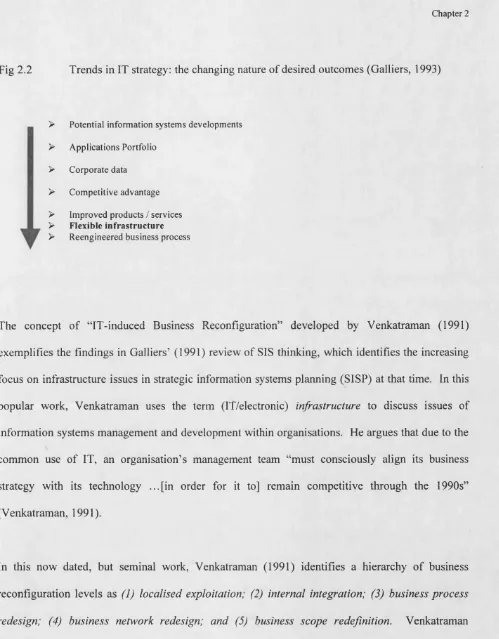
Trends in IT strategy: the changing nature of desired
Fig. 2.2 Diagram . 63
° outcomes
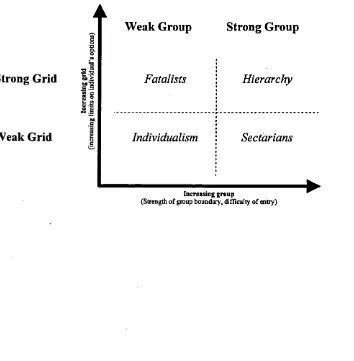
Fig. 3.1 Diagram Four cultural rationalities 69
p. - _ T , . Summary Comparison of Complex and Linear Systems
-a e Adapted from Perrow( 1984). 89
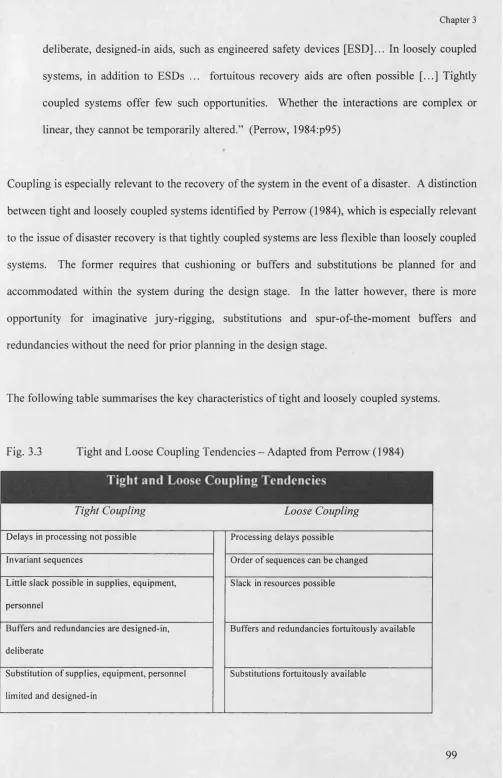
ir 'i 'i rp vi Tight and Loose Coupling Tendencies - Adapted from QO
Fig. 3.3 Table perrow( i 984)
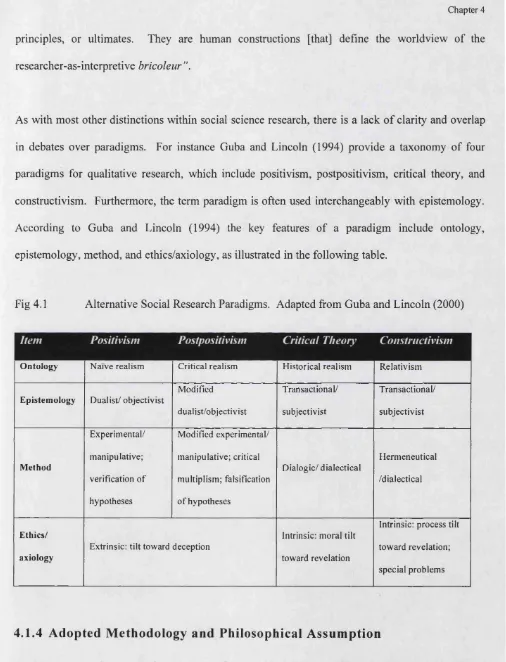
„ . . Alternative Social Research Paradigms. Adapted from
g Table Cuba and Lincoln, (2000) 124
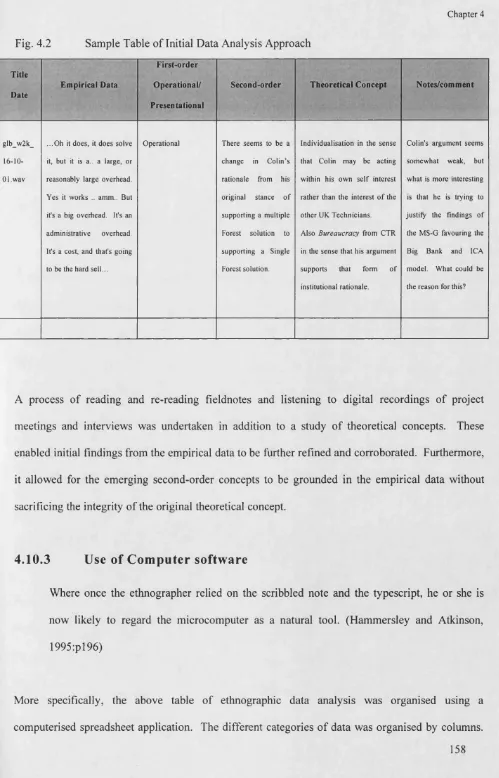
Fig 4.2 Table Sample Table of Initial Data Analysis Approach 151
CONTENTS
A B S T R A C T ... I I A C K N O W L E D G E M E N T ... I l l G L O S S A R Y O F A C R O N Y M S ... IV L IS T O F T A B L E S A N D F IG U R E S ... V
C H A P T E R 1: IN T R O D U C T IO N ...1
1.1 St r u c t u r eo f Diss e r t a t io n... 4
C H A P T E R 2: L IT E R A T U R E R E V I E W ...7
2.1 In t r o d u c t io n...7
2.2 Ris k Re s e a r c h - A His t o r ic a l Re v ie w...8
2.2.1 Ancient Times & the B elief in Fate...8
2.2.2 Renaissance & the Emergence o f Probability...9
2.2.3 Uncertainty and Economic Theory...12
2.2.4 Technoscientific Perspective...14
2.2.5 Sociological Concepts o f Risk...19
2.2.6 Key Findings from Risk Research Review...25
2.3 IS Ris k Re s e a r c h... 27
2.3.1 IS Software Risk...27
2.3.2 IS Management R isk...31
2.3.3 IS Security R isk... 34
2.3.4 IS Outsourcing Risk...35
2.3.5 Alternative IS Risk Research...36
2.3.6 Key Findings from IS Risk Research...37
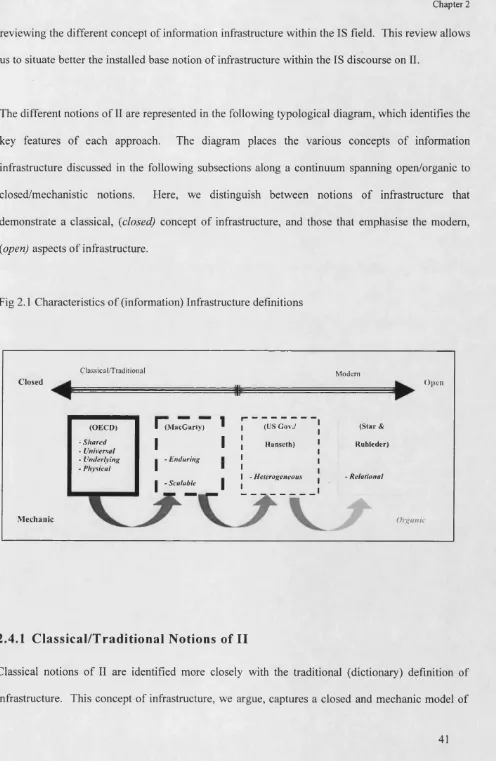
2.4 Th ec o n c e p to fin f o r m a t io nin f r a s t r u c t u r e... 40
2.4.1 Classical/Traditional Notions o f II...41
2.4.2 Modern Concept o f I I...43
2.5 IS Co r p o r a t e In f o r m a t io nin f r a s t r u c t u r e (C II) Re s e a r c h... 49
2.5.1 Infrastructure in Strategic Information Systems Research...49
2.5.4 Findings from Review o f II Research...58
2.6 Re s e a r c h Fo c u s... ... 59
2.7 Re s e a r c h Qu e s t io n s...61
2.8 Ch a p t e r Su m m a r y... 62
CHAPTER 3 : T H E O R E T IC A L FR A M E W O R K... 63
3.1 In t r o d u c t io n... 63
3.2 Cu l t u r a l Th e o r yo f Ris k (C T R )...64
3.2.1 Risk and Culture...66
3.3 H o w In s t it u t io n s Th in k... 67
3.3.1 Definition o f Institution...68
3.3.2 Alternative Notions o f Institution...69
3.3.3 Philosophical Underpinnings...72
3.4 Gr id-Gr o u p An a l y s is... 75
3.4.1 Hierarchical Culture...77
3.4.2 Individualist Culture... 79
3.4.3 Sectarian Culture...81
3.4.4 Fatalist Culture...83
3.4.5 Concerns over Risk: Individualist vs. Hierarchy... 84
3.5 Lim it a t io no f C T R ... 87
3.6 Hig h Ris k Co m p l e x Sy stem sa n d No r m a l Ac c id e n t Th e o r y...87
3.6.1 Key Concepts o f NAT....'...89
3.6.2 Complexity, Interactions an d C o u p lin g...91
3.6.3 Tight and Loose Coupling...97
3.6.4 CII as Complex Systems...100
3.6.5 Limitation o f N A T... 102
3.7 Th e So c io l o g ic a l Th e o r yo f Risk (S T R )... 103
3.7.1 First-Order and Second-Order Observation...103
3.7.2 Risk and D anger...105
3.8 Ch a p t e r Su m m a r y...106
CHAPTER 4: RESEARCH METHODOLOGY... 108
4.1 Ph il o s o p h ic a l Is s u e s... 108
4.1.1 Ontological and Epistemological Considerations...108
4.1.2 Quantitative vs. Qualitative Research...109
4.1.3 Social Science Research Paradigms...I l l 4.1.4 Adopted Methodology and Philosophical Assumption... !. 112
4.2.2 Philosophical Influence o f Ethnography...115
4.3 Au t o e t h n o g r a p h y... 119
4.3.1 Reflexive E thnographies...119
4.3.2 Complete-Member Researchers...120
4.3.3 Personal Narratives...120
4.3.4 Literary Autoethnographies...121
4.3.5 Choice o f A utoethnographic Method....121
4.4 Et h n o g r a p h yint h e IS Fi e l d...122
4.4.1 History o f IS Ethnographic Research...122
4.4.2 Autoethnography and IS Research...125
4.5 Ju s t if ic a t io no f Re s e a r c h Ap p r o a c h... 127
4.5.1 Feeling Confined by Ethnography... :...127
4.5.2 The Journey to A utoethnography...128
4.6 Et h n o g r a p h ic Da t a Co l l e c t io n...130
4.6.1 Participant Observation...130
4.6.2 Ethnographic Interviews... 133
4.6.3 Fieldnotes...134
4.6.4 My Experience o f Collecting Ethnographic Data...139
4.7 Et h n o g r a ph ic Wr it in g...139
4.7.1 Characteristics o f Impressionist Tales...140
4.7.2 Other Styles o f Ethnographic Writing...144
4.8 Se l e c t io no f Or g a n is a t io n... 146
4.8.1 Negotiating Access to the Research S ite...147
4.9 Et h ic a l Co n s id e r a t io n s... 148
4.9.1 Covert vs. Overt Research...149
4.9.2 Privacy...151
4.9.3 Consideration o f ethics...153
4.10 Da t a An a l y s is... 153
4.10.1 Data Analysis Techniques... 154
4.10.2 Adapted method o f Analysis...156
4.10.3 Use o f Computer software...158
4.10.4 The Role o f Theory...159
4.11 Ch a p t e r Su m m a r y... 160
5.1.2 WM IT Departments: GT and the Formation o f FP Tech...163
5.2 Joining FP Tech from M D S ...167
5.2.1 Early Experiences in FP Tech...168
5.2.2 Unattended LD Build...171
5.2.3 Impacting Crisis o f Asian Financial Markets...175
5.2.4 Cost Cutting through Restructuring...177
5.2.5 History o f Email Infrastructure Development...180
5.2.6 FP Tech MS Exchange 5.5 Email Project...183
5.2.7 Deciding to Leave CIBC World M arkets...186
5.3 Global MS Exchange Email Integration... 186
5.3.1 Opposition to the Global Messaging Infrastructure...189
5.3.2 Resurgence o f the London MS Exchange Solution...191
5.3.3 Compromise over Global Email Solution...192
5.4 The Easter Bank Holiday Email Disaster... 196
5.4.1 Causes o f the Email Disaster...197
5.4.2 Automated Disaster Recovery...198
5.4.3 Alternative (DS/IS) Recovery Process...199
5.4.4 Disaster Escalation: The Consequence o f Recovery... 201
5.4.5 New Email Maintenance Practices...206
5.5 G lo b a l Windows 2000 In fr a str u c tu r e ... 208
5.5.1 Hidden Agendas and the GT Desktop Project...208
5.5.2 London Active Directory Desktop Standards Project...210
5.5.3 Emergence o f the Global CIBC WM AD Project...,...212
5.5.4 Multiple vs. Single Forest AD Models...213
5.5.5 Canada Roundtable Meeting....215
5.5.6 Outcome o f Canada Round Table Meeting...219
5.5.7 Findings o f World Market AD Forest Evaluation...221
5.5.8 Management Approval o f Business Case...224
5.5.9 Hidden Agendas and the Decision to Adopt the Single Forest M odel...226
5.5.10 Progress o f the Win2k AD Project....*...227
5.5.11 Ending Ethnographic Fieldwork...228
5.6 Chapter Summary...229
6.2 Co m p e t in g Cu l t u r e so fCIBC...230
6.2.1 Culture o f CIBC Big Bank....231
6.2.2 World Market Investment Bank: a history o f individualist...231
6.2.3 World Markets IT Departments: FP Tech Individualist vs. G T Hierarchists...232
6.2.4 Hierarchical Intervention o f Corporate Restructuring...238
6.2.5 Em ail Infrastructure Development: FP M S E xchange...239
6.2.6 Expanding the Hierarchy through Global Email Integration:...242
6.3 De v e l o p m e n to fCII a s Hig h Ris k Te c h n o l o g y...245
6.3.1 MS Exchange Email Infrastructure as a Complex System...245
6.3.2 Complexity o f CIBC Em ail Infrastructure: From Loose to Tight Coupling....251
6.3.3 Bank Holiday Email Disaster...254
6.4 Glo b a lNOS In f r a s t r u c t u r e De v e l o p m e n t...260
6.4.1 Win2k Active D irectory P ro ject...261
6.4.2 Single vs. Multiple Forest Windows 2000 AD Models...263
6.4.3 C ultural Change: fro m Individualist to H ierarchy...266
6.5 Ke y Fin d in g s: C IIsa s Te c h n o l o g ie so f Da n g e r...272
6.5.1 Relating Risk, Culture and Danger in CII Development....273
6.5.2 Corporate IIs as System s o f D a n g er...280
6.5.3 Inclusive Risk Management: First, Second, and Third Order Risk Analysis...282
6.5.4 Limits o f First-Order Observation...283
6.5.5 Grid-group Analysis: From First-order to Second-Order Observation...283
6.5.6 Analysing Risk Analysts: From Second-order to Third Order Observation...285
CHAPTER 7: CONCLUSION...286
7.1 In t r o d u c t io n... 286
7.2 Ov e r v ie wo ft h e Dis s e r t a t io n...286
7.3 Co n t r ib u t io n... 290
7.3.1 Contribution to the Practice...290
7.3.2 Contribution to Research... ... ...292
7.3.3 Theoretical Contribution...293
7.4 Lim it a t io n sa n d Fu r t h e r Re s e a r c h... 297
7.4.1 Ethical Considerations...297
7.4.2 Culture o f Global Technology Support...299
7.4.3 Anxiety Amongst Global Corporate II Developers...299
CHAPTER 1: INTRODUCTION
The latter part of the 20th century has witnessed the introduction and widespread adoption of
Information Technologies (IT) throughout all areas of society. Advances in computing and
communications technologies have accompanied and enabled this rapid speed of adoption. Such
developments have forced an evolution in the character of IT over the past three decades, from
standalone, localised systems of the late 1970s and 1980s towards integrated, globalised networked
technologies of the contemporary Internet era.
Similar, but less obvious advances can be observed in the academic discourse on risk. Previously
the domain of the natural sciences, more recently the subject of risk has permeated many academic
areas as more and more social scientists acknowledge its importance to understanding the dynamics
of contemporary society. The widespread attention to risk within the social sciences is evidenced
by developments in sociological theories of risk, and by the important contributions they have made
to the risk discourse. The most significant of these has been to challenge the orthodoxy of the
dominant technoscientific theories of risk rooted in the natural sciences.
These advances in IT and in theories of risk expose significant deficiencies in IS risk research,
which we aim to address in this study. Firstly, the concept of IT used throughout the IS risk
research literature fails to capture important characteristics inherent in contemporary IT. Rather
than the globalised and open characteristics of today’s Internet based ICT, the domain of IS risk
generation of computing. Secondly, we observe a lag in the adoption of new sociological theories
of risk by IS risk researchers in favour of technoscientific concepts of risk inherited from the natural
sciences. Despite regular findings that identify the importance of culture and other non-technical
issues to understanding risk in the development of IT, IS risk research has failed to respond
adequately (Boehm, 1991; McFarlan, 1981; Vitale, 1986; Willcocks and Margetts, 1994). Here we
argue this failure can be explained by the limited adoption of sociological theories of risk within IS
risk research.
The present study aims to address these important deficiencies within the IS risk discourse by
adopting ideas from sociological theories of risk to study issues of risk in the integration of global
IT. More specifically, we combine important ideas from three sociological theories of risk into a
framework with which we examine the relationship between cultural practices, risk, and the
occurrence of danger in the development of corporate information infrastructure (II). To achieve
our objective, we draw evidence from detailed cases of corporate II development within a global
corporation named CIBC World Markets.
CIBC World Markets (WM) is the investment-banking arm of the Canadian Imperial Bank of
Commerce (CIBC). CIBC is a full service global financial institution comprising several business
units including: Retail Banking, Small Business Banking; Wealth Management; and CIBC World
Markets. Together, this group has over six million personal customers, 350,000 small business
customers, and 7,000 corporate and investment-banking customers.
The banking sector has undergone extensive deregulation and globalisation over recent decades,
following a long period of strict controls within national boundaries. Like many large banks, the
recent history of CIBC has been influenced by the Glass-Steagall banking regulations, dating back
wall between the activities of commercial and investment banks through the Bank Act of 1933
(commonly referred to as the Glass-Steagall Act); in addition the Bank Holding Act was passed in
1956. These legislations effectively curbed financial services conglomerates from amassing too
much power. However, in the last two decades of the century, several legislations were enacted to
dismantle this wall.
The deregulation of North America’s financial markets has been mirrored throughout much of the
western world. Developing economies, or “emerging markets”, with their often volatile, but high
rate of growth, have not been excluded from these developments, as financial corporations seek new
ways in which to balance investment portfolios (Macesich, 1996). All this has led to the emergence
of “a legitimate worldwide market in stocks, bonds, currencies and other financial instruments”
(Macesich, 1996:p9).
The significance of risk to the business of banking can in no way be understated. Such is the
significance of risk to banking that the work of investment banks is commonly described as the
buying and selling of risk. This significance has increased in recent decades through both
deregulation and the regulatory pressures to manage new forms of risk other than the traditional
credit and market risks, to which banks have long been accustomed (Michael, 2003).
For centuries, bankers have adopted various quantitative techniques originating from probability
calculus. However major changes in banking operations in recent decades, and the spate of high
profile failures that followed, have raised concerns over the way banks manage risk in their business
operations. Such concerns can be seen in the recent reforms to banking supervision through the
Basel 2 banking regulation project; and more recently, the Risk-based approach incorporated in the
Basel 2 is said to have elevated operational risk from a residual category of market and credit risk
management, into a category of equivalent merit, through the requirement for banks to undertake
the management and regulation of operational risk (Power, 2003). However, this has created
further problems for both the banks and their regulators, who have found their traditional
quantitative and technical methods of risk management ineffective in addressing issues of
operational risk. It is the contention of this dissertation that, where quantitative, technical concepts
of risk fail, sociological and cultural theories provide fresh opportunities to address the new forms
of risks inherent in our contemporary global society.
1.1 St r u c t u r e o f Di s s e r t a t i o n
The proceeding chapters of this dissertation are organised as follows:
Chapter 2 presents a review of literature. This chapter lays the foundations for our work in later
chapters by reviewing existing research in the areas of risk, Information Infrastructures, and IS risk,
which combine to form the domain of this study. Areas for further research are identified in each of
the three sections. The review identifies the dominance of the technoscientific approach in the risk
discourse dating back to the invention of probability calculus in the 17th century, and how this
dominance is reflected in IS risk research. This is despite the emergence of alternative sociological
theories of risk that challenge the assumptions of technoscientific approaches. The final part of this
chapter presents the gap in research, and the research questions addressed in the dissertation.
In chapter 3, we construct a theoretical framework to support the analysis of ethnographic data
undertaken in later chapters. This unique framework combines important contributions to the risk
discourse from sociological theories of risk. The chapter centres on the Cultural Theory of Risk
risk. CTR enables us to address matters of risk and culture, however, it is not as well adapted to the
detailed analysis of the occurrence and manifestation of dangers in global information technologies.
For this purpose we supplement CTR with concepts from Charles Perrow’s (1984) Normal
Accident Theory (NAT), and Niklas Luhmann’s (1993) Sociological Theory of Risk (STR). The
final sections of this chapter discusses concepts from these two additional theories.
Chapter 4 describes the research method of ethnography and autoethnography used to gather and
present empirical data. The chapter represents an effort to highlight the suitability of ethnography
to the IS research field, and the benefits that may be accrued by the IS community through the
adoption of autoethnography. Moreover, the chapter aims to show that rather than choosing
autoethnography, the researcher found himself being chosen by this ethnographic method through
his effort to convey his lived-experience as a member researcher within the corporate II
development team in the chosen research site. Attention is paid to the ‘crises of representation’
faced by ethnographic researchers. The adopted ‘impressionist’ style of ethnographic text is
situated amongst other writing styles to show its appropriateness as the presentational style of our
ethnographic narrative.
C hapter 5 contains the findings of our empirical study in which we present an impressionist
narrative of corporate II development. The narrative unfolds within the context of CIBC, a
multinational financial service corporation. The narrative charts the earliest experiences of the
researcher as an employee in the Market Data Services team on the trading floor of the London
office, through to the completion of fieldwork as a full-time PhD research candidate. The narrative
represents a montage of events that aims to bring to life experiences of culture, risk and danger in
the development of a global corporate II. In the spirit of impressionist ethnographic text, the
narrative invites the reader to relive the experiences of the researcher, so as to draw their own
Following the presentation of empirical study, in chapter 6 we draw on our integrated theoretical
framework of sociological theories of risk to analyse issues of risk, culture and danger that emerge
from the ethnographic narrative of the previous chapter. This analysis chapter divides into four
main sections. The first section draws on CTR to examine the culture and risk perceptions of key
groups in the corporate II development projects of concern. Analysis of the case of email
infrastructure development is undertaken in this section. The second section presents a detailed
analysis of disaster, and the occurrence of danger in the global MS Exchange email infrastructure
using NAT and STR. In the third section, we analyse the narrative of the global Windows 2000
Active Directory network operating systems (NOS) infrastructure development using CTR
Findings from the analysis are developed and presented in the final, fourth section.
Ethnographic research, rather then commencing with a set of hypotheses, mostly proceeds towards
the generation of hypotheses in its findings (Hammersley and Atkinson, 1995). Accordingly, each
of the key findings in this final section of the chapter represents hypotheses regarding issues of risk,
culture and danger in the development of corporate II. These key findings address the research
questions formulated in the last part of the literature review chapter.
Chapter 7 concludes the dissertation. This chapter provides a summary of the dissertation and the
contributions it provides to the areas of research, theory and practice in the IS field. In concluding,
we identify areas for further research based on limitations and obstacles encountered in the present
CHAPTER 2: LITERATURE REVIEW
2.1 In t r o d u c t i o n
This literature review surveys the terrain of the present study, and develops a research focus through
the identification of gaps in current knowledge. The structure of this chapter emerged as a response
to the present lack of research on the subject of risk and the development of IT as corporate
information infrastructure (CII). To address this problem, this literature review is organised around
the following three topics: risk research, IS risk research, and II research.
The first section presents the story of risk. Here we focus on key developments in the modem
concept of risk, from its inception in the seventeenth century to the present date. This detailed
review allows us to root ideas of risk identified in the IS literature into the wider discourse of risk
research. The key objective of our review of the risk discourse is to identify suitable ideas of risk
with which to undertake the present study.
In the second section we undertake a review of the wider topic of IS risk research. The focus of this
section is justified by the paucity of research on issues of risk in the literature on II. From this
review we are able to identify limitations to the treatment of risk within the IS field.
In the third section we review the concept of II, and discuss the ‘installed base’ notion of corporate
sections to identify gaps in research within the IS field that form the focus of research addressed in
this study.
2 .2 Ri s k Re s e a r c h - A Hi s t o r i c a l Re v i e w
The history of risk reveals three distinct stages of development in western societies. These three
stages, which mark changes in the perception of risk, are often identified as ancient times, the
modem (industrial) era, and the postmodern (contemporary) period, (Bernstein, 1996; Giddens,
1999; Hacking, 1975; Luhmann, 1993). In the following subsections we examine how ideas of risk
have evolved throughout these different epochs.
2.2.1 A ncient Tim es & the B e lie f in Fate
Most studies of risk in ancient times focus on gambling and games of chance within ancient
societies. The depiction of gambling games in Egyptian tombs and Greek mythology highlight the
important role of such games to human development. Nevertheless, none of the ancient
civilisations are acknowledged for developing quantitative techniques of risk management. It is
generally accepted that the concept of risk in ancient times revolved around the belief in fate.
“[The concept of risk during pre-modem times denotes] an objective danger an act of God, a
force majeure,” a natural event that could not be ascribed to human action.” (Luhmann
1993 :p226)
“All previous cultures, including the great early civilisations of the world, such as Rome, or
traditional China, have lived primarily in the past. They have used the ideas of fate, luck or
2.2.2 R enaissance & the Em ergence o f P rob ability
Since its discovery, the mathematical theory of probability remains the single most influential
concept on the understanding of risk within western societies. Pascal’s discovery came about
through his solution of how a group of players should divide the stakes of an unfinished game of
chance (Bernstein, 1996). Applying the principles of inductive method, Pascal created what we
refer to today as Pascal’s triangle, for determining the probability of possible outcomes.
Bernstein (1996) argues that the spirit brought about through the Renaissance movement made the
discovery of probability theory by Pascal possible. Jaeger et al (2001 :p20) identify this spirit as
the basis of the rational actor paradigm, whose origins they trace back to the “extraordinary
accomplishments in science and the arts” of the Italian Renaissance.
Ian Hacking (1975) undertakes one of the most rigorous studies into the history of probability.
Similar to Bernstein (1996), Hacking (1975) attributes the appearance of probability theory in the
mid 17th century to changes in Western thinking.
“I am inclined to think that the preconditions for the emergence of our concept of
probability determined the very nature of this intellectual object, ‘probability’, that we still
recognize and employ... The preconditions for the emergence of probability determined the
space of possible theories about probability. That means that they determined, in part, the
space of possible interpretations of quantum mechanics, of statistical inference, and of
inductive logic.” (Hacking, 1975:p9)
Hacking (1975) goes further than Bernstein (1996) to conduct an in-depth historical analysis of
Hacking, prior to the end of the Renaissance and the invention of probability, the term ‘probability’
was attributed to opinion rather than knowledge. Knowledge could only be gained through
demonstration. He argues that the concept of probability, as we understand it today, was essentially
dual:
“... on the one hand having to do with degrees of belief, on the other, with devices tending
to produce stable long-run frequencies... A probable opinion was not one supported by
evidence, but one which was approved by some authority, or by the testimony of respected
judges” (Hacking, 1975:piii).
Hacking (1975) argues that the missing piece in the jigsaw that enabled the invention of probability
was the idea of inductive evidence, which was enabled by the transformation of signs into evidence.
“Probability is a child of the low sciences, such as alchemy or medicine, which had to deal
in opinion, whereas the high sciences, such as astronomy or mechanics, aimed at
demonstrable knowledge. A chief concept of the low sciences was that of sign.... At the
end of the Renaissance, the sign was transformed into the concept of evidence [through the
idea of the inductive evidence of things]. This new kind of evidence conferred probability
on propositions, namely made them worthy of approval. But it did so in virtue of the
frequency with which it made correct predictions.” (Hacking, 1975:piii)
He argues that this “transformation from sign into evidence is the key to the emergence of a concept
of probability” developed by Pascal and his colleagues, and into the way it is understood today
Bernstein (1996) suggests that the contribution of Pascal and his fellow Frenchmen led to an
acceleration in the pace of developments in quantitative rules and theories that would form the basis
of risk management theories in economics, medicine, insurance, law, finance, military strategy and
much more, stemming from the period of the Enlightenment through to present day modem society.
Many of these concepts, (some of which are represented in the following list) remain central to
conventional wisdom on the subject of risk.
■ Statistical sampling by John Graunt (1620 - 1674): the use of present and past information
to make guesses about the future.
■ Hailey’s Life Tables by Edmond Hailey (1656- 1742): the tables provided the necessary
information for calculating life annuities.
■ Utility by Daniel Bernoulli (1700 - 1782): decision-making based on a desire for wealth and
opportunity. Bernoulli’s major contribution was the development of a procedure for the
introduction of subjective elements into decisions of uncertain outcome.
■ Priori and posteriori by Jacob Bernoulli (1710 - 1790): these ideas gave rise to the
development of probabilities from limited amounts of real-life information.
■ Concept of cause and effect by Jules Henri Poincare (1854 - 1912): the belief that
everything has a cause. Events that appear to be fortuitous are not; instead, their causes
stem from minute disturbances.
■ Regression and Correlation by Francis Galton (1822 - 1911): The measurement of how any
two series vary relative to one another.
Both Hacking (1970) and Bernstein (1996) associate the invention of the modem concept of risk
with the discovery of probability theory and the work of Pascal in the mid 17th century.
Nevertheless, there remain key distinctions in the theses of these authors. Both acknowledge the
new spirit of the Renaissance as an important factor behind the invention of probability. Bernstein
progress of human development (1996). Hacking on the other hand connects this spirit to the
acceptance of inductive evidence as a new form of rationality. For Hacking, it is this acceptance of
inductive evidence and the new form of rationality it supports that provide the force behind
probability and subsequent developments in mathematical techniques of risk assessment.
The key distinction between the thesis put forward by Bernstein and that of Hacking is that
Bernstein attributes to the Renaissance movement and the invention of probability an emancipating
influence on western thinking. For Bernstein, the rational actor paradigm captures a more objective
view of the world compared to ideas and beliefs in ancient times. Accordingly, he describes all
thinking on issues of risk prior to the Renaissance and the invention of probability as “naive belief
in fate” (Bernstein, 1996).
Hacking on the other hand, by attributing the discovery of probability to the acceptance of inductive
evidence and the change in rationale, does not ascribe the same value of progress to this change that
is implied in Bernstein’s thesis. Whereas Hacking’s description illuminates a subjective feature in
the concept of probability based on its dependence on inductive evidence, Bernstein’s interpretation
of the Renaissance movement as a key stage in the development of the modem concept of risk, and
more specifically, human progress, without unpacking or identifying key events behind this
movement, ascribes an objective attribute to the probability calculus and the modem concept of
risk.
2.2.3 U ncertainty and Econom ic Theory
Following the invention of probability theory and the rational risk assessment techniques by
ascribed to the idea of uncertainty. A central concept bom out of the Renaissance is that of the
universal applicability of measurement (Bernstein, 1996). One of the earliest thinkers on the topic
of risk to reject this idea through his distinction between risk and uncertainty was the American
economist Frank Knight. Despite being attributed to Knight (1921), the economic distinction
between risk and uncertainty appeared earlier, in the mid-nineteenth century in the work of J.H. von
Thunen, through his explorations in the theory of entrepreneurship (Reddy, 1996).
Through a similar investigation on entrepreneurship, Knight, later makes a more elaborate
distinction between probabilizable and non-probabilizable, or, calculable and non-calculable forms
of indeterminacy. He identifies the former as “risk”, and the latter as “uncertainty” (Reddy
1996:p227). Knight argues that surprise is common in systems where decisions depend on forecasts
of the future. He pointed to defects in the use of empirical studies into the frequency of past
occurrences as a means to eliminating indeterminacies of the future. Knight maintained that
uncertainty is a primary aspect of economic activity. He argued that no event is ever identical to an
earlier event, or to an event yet to happen.
Following on from Knight, John M. Keynes (1948) joined the attack on previous rational thinkers,
arguing that probability theory has little relevance to real-life situations. Similar to Frank Knight,
Keynes view of economics rejected any theories of risk that discounted uncertainty. However,
unlike Knight, Keynes does not distinguish between risk and uncertainty. His economic
prescriptions support the idea that as we make decisions, we change the world.
Bernstein attributes the rejection of the universal applicability of measurement to a new era of
ideology within Western society. This was illustrated by Einstein’s demonstration of the
imperfections of Euclidean geometry, and Sigmund Freud’s declaration that irrationality is the
“economics as a risk-less system that always produced optimal results” slowly began to crumble
(Bernstein, 1996).
2.2.4 T echnoscientific Perspective
The invention of probability theory in the seventeenth century is widely acknowledged as the birth
of (what is commonly referred to within the risk discourse as) the technoscientific perspective of
risk. Within the social science risk discourse, technoscientific risk research is often only traced
back to concepts developed in the mid-twentieth century (Lupton, 1999; Renn, 1998). However,
mostly all technoscientific concepts of risk have their origins in earlier ideas of risk, which first
appeared in the Enlightenment and Victorian era. This perspective captures ideas from risks to
appear from fields such as statistics, engineering, actuarial science, economics and epidemiology.
Technoscientific perspectives represent the most dominant approach to risk in the social sciences,
hence they warrant a detailed. In the following subsections we review some influential concepts to
have emerged from technoscientific perspective over the past century.
Game Theory
Despite the achievements of authors in the economic theory of indeterminacy, the invention of
game theory in the mid-twentieth century is said to mark the resurgence of rational concepts in the
history of risk (Bernstein, 1996). In John von Neumann’s (1940) game theory, two or more people
attempt to maximize their utility simultaneously, in conscious awareness of the activities of others.
Game theory claims the true source of uncertainty lie in the intentions of others. The principles of
people always understand their preferences clearly, apply them consistently, and lay them out in the
[same] fashion [as the actors in Game Theory]” (Bernstein, 1996:p245).
D iversified P ortfolio
Henry Markowitz’s (1952) concept of the diversified portfolio is one such theory that follows on
from the principles of game theory. The concept of the diversified portfolio assumes that
diversification reduces risk. Combining these risky shares into a stock portfolio can mitigate the
risk of holding individual high volatility securities. This concept of the diversified portfolio is
based on the definition of risk as volatility. Bernstein argues that Markowitz’s work provided the
groundwork for “just about all the theoretical work in finance that followed” (Bernstein,
1996:p257). Not only in finance (as we shall see in later sections of this chapter) Markowitz’s
concept of the diversified portfolio has also been influential as an approach for managing corporate
II (Broadbent et al., 1999; Weill and Vitale, 2002).
Both game theory and the diversified portfolio have been criticised for their obvious shortcomings
rooted in the rational approach of the classical thinkers on risk. The fundamental focus of these
critiques is the assumption of the rational human actor in situations of uncertainty (Bernstein,
1996:p258).
P sychological P erspective
One of the most influential ideas into how people understand and come to make decisions over risks
has appeared through the work of psychologists Daniel Kahneman and Amos Tversky (1979), and
their concept of Prospect Theory. Here, psychological models of human behaviour are used to
show how people respond cognitively and behaviourally to risk (Lupton, 1999). Prospect Theory
Proponents of Prospect Theory argue that, in situations of uncertainty, people employ heuristic or
‘mental strategies’, guidelines of various sorts, rather than following the principles assumed within
the rational actor model (Slovic 1987:p281) (Kahneman et al., 1982).
Key concepts to emerge from the psychological perspective to risk include:
■ Ambiguity Aversion: refers to the idea that people prefer to take risks in situations of
known, rather than unknown probabilities. Ambiguity aversion “is driven by the feeling
of incompetence ... [and] will be present when subjects evaluate clear and vague
prospects jointly, but it will greatly diminish or disappear when they evaluate each
prospect in isolation” (Bernstein, 1996:p281).
■ Decision Regret: psychologist David Bell’s concept of decision regret explains the
behaviour of investors concentrating on the assets they would have had if only they had
made the correct choice.
■ The Endowment Effect: the disparity between prices for which people are willing to buy
and sell identical items. The term (endowment effect) describes our tendency to set a
higher selling price on what we own (are endowed with), than what we would pay for
the identical item if we did not own it (Bernstein, 1998:p294).
Kahneman and Tversky’s work is said to have been instigated by earlier cognitive science based
risk research in Chauncey Starr’s (1969) seminal paper ‘Social Benefits versus Technological Risk’.
Starr’s work shows people have a greater tolerance for voluntary risks (such as sporting activities)
than they do for involuntary risk (i.e. electric power generators). From this finding, Starr
(1969:pl235) concludes “as one would expect, we are loath to let others do unto us what we happily
do to ourselves”. Starr’s research identified differences between that risk assessment of those who
these findings to public awareness of benefits, using advertising “as a crude measure of public
awareness of associated social benefits” (Starr, 1969: p i 237).
A number of points have been raised against both the psychological perspective, and the
psychometric models that they employ. Lupton (1999:p21) remarks that the perspective “relies
upon an understanding of the human actor in which there is a linear relationship between
knowledge of a risk, developing the attitude that one is at risk and adopting a practice to prevent the
risk happening to oneself’.
Bradbury points to epistemological problems between the idea of risk used in psychometric and
psychological research fields: “In examining the individual’s response to risk, this research provides
a subjectivist interpretation within a realist paradigm.” (Bradbury, 1989)
A major problem identified with cognitive science and the wider technoscientific perspective is that
they reduce the understanding of risk to an individualistic level. This is said to be only convenient
for the technique of psychometric statistical testing and modelling, which results in an over
simplification of the phenomena of study. In this perspective:
“Perception is limited to how humans see and understand the world through their senses and
brain-functioning, without acknowledging the ways in which cultural conceptual categories
mediate judgement. People tend to be positioned outside the cultural and political
frameworks, relationships and institutions within which they construct their beliefs and
Furthermore scientific knowledge, in technoscientific literature, is usually given status as expert
knowledge over other forms of knowledge such as the public, who are often regarded with a level of
contempt.
“[The technoscientific perspective demonstrates] an ill-masked contempt for lay people’s
lack of what is deemed to be ‘appropriate’ or ‘correct’ knowledge about risk. Lay people
are often portrayed as responding ‘unscientifically’ to risk, using inferior and
unsophisticated sources of knowledge such as ‘intuition’.” (Lupton, 1999:pl9)
There is a tendency in this approach to view the risk calculations of scientific experts as objective
facts, whilst ignoring the role played by the ways of seeing that may bias scientific research
(Douglas, 1992). According to this perspective the understanding of risks displayed by scientific
experts is “neutral and unbiased” (Lupton, 1999:pl9).
Douglas (1992) also points to limitations in the concept of humans maintained by the
technoscientific approach:
“Warm-blooded, passionate, inherently social beings though we think we are, humans are
presented in this context as hedonic calculators calmly seeking to pursue private interests.
We are said to be risk-averse, but, alas, so inefficient in handling information that we are
unintentional risk-takers; basically we are fools.” (Douglas 1992:pl3)
This critique shows that the view of the rational actor, which is supported under the psychological
perspective, is too narrow. It should include other aspects of human judgement, such as
2.2.5 S ociological C oncepts o f Risk
Critiques of technoscientific theories of risk have been stimulated by the emergence of social and
cultural theories of risk towards the latter quarter of the 20th century. Such theories are often
categorised under the heading of sociological concepts of risk, as we have done here. Theories of
risk that fall under this heading include the reflexive modernisation thesis, Cultural Theory of Risk,
and the Social Systems Theory of Risk (Beck, 1992; 1995; 1999; Douglas, 1992; Douglas and
Wildavsky, 1982; Giddens, 1990 148; 1999; Luhmann, 1993; Perrow, 1999). The following
subsections present a review of key ideas and contributions that have appeared from this new area
of the risk discourse.
Reflexive M odernisation and R isk Society Perspective
The primary exponents of this perspective are the sociologists Anthony Giddens and Ulrich Beck
(1992). These authors draw on the notion of risk to discuss what they see as fundamental changes
in modernity. Their works examine the structural and political features of risk in contemporary
Western society. Giddens and Beck (1992) focus mostly on the macro-social processes they see as
characteristics of late modem societies and their relation to concepts of risk. These processes
include reflexive modernisation and individualization.
Ulrich Beck’s book Risk Society: Towards a New Modernity (1991) remains one of the most
significant contributions to studies of risk within sociology (Lash & Wynne, 1992). In this work
(originally published in German in 1986, and then in English in 1992) Beck puts forward the thesis
that people in contemporary Western societies are living in a period of transitions between
industrial society and Risk Society. This period is captured by the term reflexive modernization
the outcome of modernization processes. Individuals in contemporary Western societies are more
conscious of risks than ever, having to deal with risks on a daily basis: “Everyone is caught up in
defensive battles of various types, anticipating the hostile substances in one’s manner of living and
eating” Beck (1994: p45).
Beck distinguishes between the characteristics and manageability of risks in contemporary society,
with those of early modem and pre-modem societies. In his analysis of risk and hazards in pre
modem societies, he shows agreement with the general thesis put forward by Bernstein, that this
early period was characterised by a belief in fate such as magic, and gods.
Central to Beck’s thesis of Risk Society is the idea that risks have undergone a transformation from
locally bounded, perceptive dangers of the early industrial period, to globally distributed risks of
contemporary society. Beck’s Risk Society is characterised then, by the spread of global hazards.
The key characteristic of global risks during reflexive modernisation contributes towards the
breakdown in principles of risk calculation developed in the previous (classical) era.
“...the ecological and high-tech risks that have upset the public for some years now [...]
have a new quality... By their nature they endanger all forms of life on this planet.” (Beck,
1992 emphasis added)
As a consequence of the incalculable nature of hazards in contemporary society, the notion of risk is
reversed back to “pre-modem notions of incalculable insecurities” (Lupton, 1999). However, the
distinction between the hazards of the pre-modem era and those of contemporary society is that the
Under Risk Society, the dependence on scientific institutions of the industrial epoch for identifying
and controlling risks still remain. However, the incalculability of contemporary risks disables the
scientific method, therefore undermining the authority of scientific experts.
Uncertainty features heavily in Beck’s theory of Risk Society through concepts like unintended
consequences and side-effects. The uncertainty of the Risk Society is said to result from the efforts
of industrial society to achieve control via instruments of rationality; the outcome of which is
unforeseen side-effects.
“...In the Risk Society the unforeseeable side effects and after-effects of this demand for
control, in turn lead to what had been considered overcome, the realm of the uncertain [...]
Uncertainty returns and proliferates everywhere.” (Beck, 1992)
The theory of risk society and Reflexive Modernisation is not without its critics. Like other
prominent sociological theories, various limitations have been identified. Jeffrey Alexander
(1996:pl33), for instance, argues that Beck and Giddens assume a “simplistic modernization
argument”. Furthermore, they seem to offer very little evidence to support the argument that
industrial production centres are responsible for the outcome of dangers like global warming within
contemporary society. A sociological theory of risk that overcomes this limitation is the Cultural
Theory of Risk (CTR).
Cultural P erspective
Mary Douglas, a British social anthropologist, and Aaron Wildavsky, an American political
of the cultural perspective are rooted in anthropological studies carried out by Douglas in the 1960s
and 1970s on matters of selfhood, the body, and the regulation of danger (Lupton, 1999).
Douglas and Wildavsky draw on anthropological research on groups in primitive societies, such as
the Lele tribe of Zaire, and western industrialised societies such as environmental movement groups
in America. They note, for instance, people in America face more risks to their health from lung
cancer through smoking than from car accidents. Nevertheless, Americans seem to pay more
attention to, and place more resources on risks to health, which arise from industrial pollution
(Covello and Johnson, 1987:pix). In explaining these findings, the cultural perspective transcends
the basic argument that risks are selectively chosen to provide an understanding of why certain risks
are chosen, and others ignored. The assertion maintained by proponents of the cultural perspective
is that:
“...people’s concerns and fears about different types of risks can often be more accurately
seen as ways of maintaining social solidarity than as reflecting health or environmental
concerns. As such, health or environmental concerns should never be taken at face value.
Instead, the analysis must look further to discover what social norms, policies, or institutions
are being defended or attacked.” (Covello and Johnson, 1987:p ix)
According to cultural theory, the features of a society that form its culture, equally determine the
risk profile of that society. Hence, the conventional notion of risk represents a contemporary
Western approach for dealing with danger. Douglas and Wildavsky (1982) argue that judgements
of risks are non-scientific. Far from constituting the objective outcomes of scientific enquiry, they
The Sociological Theory o f R isk
The systems perspective on risk is most clearly articulated by Niklas Luhmann’s Sociological
Theory of Risk. His work provides one of the most elaborate reviews of the concept of risk
(Luhmann, 1993). Luhmann’s theory of risk is based in his Social Systems Theory, which follow
the functional approach of Talcott Parsons (1937).
Social systems theory differs from technoscientific understanding of risk. In the latter, risk results
from the objective possibility that an undesired event occurs as a result of a chosen action, whereas
in the former, risk describes an attribution process (Luhmann, 1993). One of the key functions of
social systems is to provide meaning to individuals, even when the chosen course of action results
in an outcome that is different from those wanted or expected (Jeager et al, 2001).
One of the most important contributions to the risk discourse to emerge from Luhmann’s work is
said to be the concept of risk he develops, based in the distinction he makes between risk and
danger. This presents a framework that distinguishes between unexpected and undesired outcomes.
Accordingly, the combination of these two (the unexpected and the undesired) represents the
potential threat facing any system.
In the social environment of modem society the ability of actors to calculate the outcome of a
particular course of action is superseded by the problem of indeterminism. Risk supports a
framework that provides meaning to guide the behaviour of social actors by validating decisions
and choices. Greater uncertainty becomes the norm of modem society, as an outcome of the
complex formation of social systems, which disable any capacity to determine the outcome of
Luhmann’s Sociological Theory of Risk has been mostly criticised for its vagueness (Luhmann,
1993). Furthermore, this theory is said to provide “little guidance for the management of specific
risks”, especially when compared to “the rich toolbox” of risk management techniques offered by
technoscientific approaches (Jaeger et al, 2001: p204).
N orm al A ccident Theory (NAT)
NAT represents an alternative systems theory that provides an elaborate set of tools for the
management of risk, and therefore goes someway towards addressing the criticism against
Luhmann’s ideas. Developed by the sociologist Charles Perrow, Normal Accident Theory (NAT) is
similar to Ulrich Beck’s theory of Risk Society in that it focuses on the risks associated with
hazards stemming from the process of modernisation. However, whereas Beck (1992) focuses on
risk by highlighting the inadequacy of conventional risk analysis in addressing risk issues in
contemporary Western societies, Perrow’s NAT focuses on the types of accidents that occur in
particular forms of systems.
Furthermore, Perrow’s work focuses more on the identification of strategies to reduce “systems
accidents”, than the issue of risk. NAT points to the imperfections in systems, especially the
fallibility of technical systems. According to this idea, all systems, regardless how much work is
put in, are prone to failure, because nothing is perfect (Perrow, 1999). Because NAT holds no hope
for the total elimination of accidents in any system, it places emphasis on the development of the
systems in such a way that the system is able to accommodate accidents, and reduce potentially
2.2.6 Key Findings from R isk Research R eview
From our review of the risk discourse, we find an imbalance of research in favour of
technoscientific, natural science notions of risk. Although risk has been extensively documented
throughout social science fields, such as economics (over the past century) and psychology (from
the mid-twentieth century on), the notions of risk expressed in these fields have their origins in
earlier natural science ideas of Enlightenment and Victorian thinkers.
As such we argue that, even in the social science risk discourse, the dominant concept of risk is
firmly rooted in the natural scientific notion of risk as probability. This fact can be explained by the
earlier invention of risk in mathematics, and its subsequent historical development as a quantitative
subject for several hundred years, before attracting the attention of social scientists.
When we chart the historical development of risk from the initial work of Pascal in 1656 through to
the present day, it becomes possible to appreciate the relative infancy of alternative concepts of risk
originating from social sciences, such as sociology and anthropology. Consequently we find that,
as a result of this relative infancy leading to the imbalance of existing research within the risk
discourse, further research that draws on and develops sociological notions of risk is warranted.
Integration o f Social and A nthropological Concepts o f R isk
A further finding from our review of the risk discourse is the scope for combining key ideas from
the emerging sociological theories of risk. This may serve to provide a more useful theoretical
framework, which can better support the analysis of specific, risk issues within contemporary
Elsewhere, the suggestion has been put forward for the integration of sociological and
technoscientific concepts of risk (Jaeger et al., 2001). This interdisciplinary approach, it has been
claimed, allows researchers to draw useful ideas from both the emerging body of sociological risk
theories, and earlier technoscientific perspectives. However, this suggestion suffers from the
potential of limiting the researcher to the defects of classical risk concepts, which many authors of
sociological risk theories are struggling to overcome.
Here we propose an alternative strategy to overcome the deficiencies associated with sociological
theories of risk. Our proposal involves the integration of different sociological theories into a
theoretical framework that best meets the needs of risk analysis. This proposal goes some way
towards addressing the argument that, due to their relative infancy, the different social and
anthropological theories of risk remain underdeveloped in their individual capacity to provide a
comprehensive toolset to address issues of risk, when compared to long standing technoscientific
concepts. Moreover, it avoids the criticism of adopting the defects of technoscientific concepts
through their incorporation.
A review of sociological risk research provides evidence of the exchange of ideas between deferent
theories. This evidence supports the above recommendation to overcome limitations in recent
sociological and cultural theories of risk. For instance, Douglas (1992) in her writing on the
Cultural Theory of Risk draws on the distinction between risk and danger, put forward by Luhmann
(1993) in his writing on social systems theory of risk. Additionally, Beck (2000) argues that his
thesis of Risk Society is compatible with the ideas put forward by Douglas and Wildavsky (1982) in
their Cultural Theory of Risk. The suggested integrated use of emerging sociological and cultural
theories of risk could then be seen as a sort of continuation of existing practice of the borrowing of
2.3 IS
Ri s k Re s e a r c hOver the past two decades, a significant body of research has appeared on the topic of risk within
the IS field (Boehm, 1989; 1995; Jurison, 1995; Maguire, 2002; McFarlan, 1981; Vitale, 1986;
Willcocks, 1998). However, the amount of research in this area that tackles issues of risk in the
development of IT as an information infrastructure (II) remains scarce. In absence of any extensive
body of risk research on the development of II, this section focuses on the wider topic of IS risk
research. Categories for this review of risk research in the IS field include: IS software risk; IS
management risk; IS security risk; and IS outsourcing risk. In the following subsections we aim to
review present studies of risk in the IS field based on these four categories with the aim of
identifying key features and areas for further research.
2.3.1 IS Softw are R isk
The field of software engineering represents one of the most established areas of risk research in the
IS field. Both academics and practitioners have been writing on the issue of risk in software
development since the 1970s (Keil et al, 1998:77). The US government’s Department of Defence
played an influential role during this early stage of software risk research, mostly through funding
and guidance to many organisations in this area (Hall, 1998). The main focus of research on risk in
software development has been on the management of risk within this process (Pressman, 1997).
Common strategies support principles of planning through risk identification, followed by the
identification of effective controls and their implementation. However, the implementation of
control measures once a risk has been identified is generally taken for granted.
Attention towards the issue of risk in the process of software development appeared in the late
1980s. According to Pressman (1997), there has been considerable debate regarding the proper