How different are the visual representations used for
object recognition in middle childhood and adulthood?
Dean Petters
1, John Hummel
2, Martin J¨uttner
3, Ellie Wakui
4, Jules Davidoff
5Abstract. Recent experimental studies have shown that develop-ment towards adult performance levels in configural processing in object recognition is delayed through middle childhood. Whilst part-changes to animal and artefact stimuli are processed with similar to adult levels of accuracy from 7 years of age, relative size changes to stimuli result in a significant decrease in relative performance for participants aged between 7 and 10. Two sets of computational experiments were run using the JIM3 artificial neural network with adult and ‘immature’ versions to simulate these results. One set pro-gressively decreased the number of neurons involved in the rep-resentation of view-independent metric relations within multi-geon objects. A second set of computational experiments involved de-creasing the number of neurons that represent view-dependent (non-relational) object attributes in JIM3’s Surface Map. The simulation results which show the best qualitative match to empirical data oc-curred when artificial neurons representing metric-precision relations were entirely eliminated. These results therefore provide further ev-idence for the late development of relational processing in object recognition and suggest that children in middle childhood may recog-nise objects without forming structural description representations.
1 Introduction
Compositionality is the property that the meaning of any linguistic or logical expression with multiple parts is determined not just by the meanings of those parts but the way they are put together. In addition to language, compositionality is found is a diverse range of other entities in the world. In our interactions with objects the perception of compositionality can be manifested across multiple modalities [14]. We can perceive visual compositionality in scenes and objects and thus form structural descriptions. So objects can be recognised by relations between their components parts [2].
The ‘Recognition by Components’ (RBC) theory of object recog-nition is distinguished from other structural description theories of object recognition because it postulates that geons (geometric com-ponents derived from readily detectable properties of edges) are the fundamental unit of representation in objects [2]. Geons can there-fore be compared to phonemes in spoken language. In both systems, a small number of representational primitives can code for a very large number of component representations (words or visual objects, respectively). In the original RBC theory 36 geons are proposed as components for all objects, compared with the 55 phonemes required
1University of Northampton, UK, email: [email protected] 2University of Illinios at Urbana-Champagne, USA
3University of Aston, UK 4University of East London, UK 5Goldsmith’s College, London, UK
to represent virtually all words in human speech [2]. A key similar-ity of these systems is that how the primitives are combined matters. One way in which phonemes and geons differ is that phonemes form words by linkage in serial chains where the order matters. However, visual objects can be formed of multiple geons with several different types of relations, such as larger-smaller, and above-below or beside. Artificial Neural Networks can represent visual compositionality and hence model natural cognition [8, 15]. Visual compositionality is also of interest in machine representations because it can facilitate artificial systems extracting verbal descriptions of scenes or objects. Active research questions include the comparative benefits of mecha-nisms for neural instantiation of visual combinatorial representations [15, 4], and how generalised shape information develops [5].
2 Recent empirical results in the development of
configural processing in object recognition
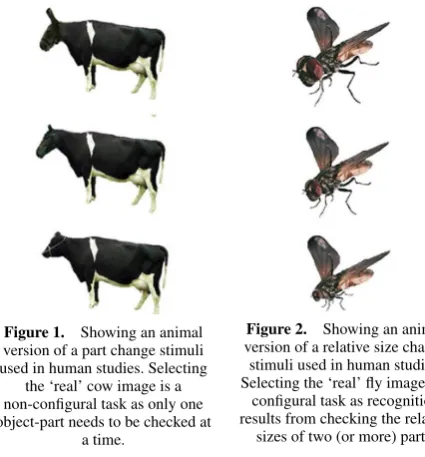
[image:1.595.314.527.490.719.2]A number of behavioural studies suggest there is a retarded devel-opmental trajectory for object recognition - with object recogni-tion skills continuing to significantly improve during adolescence [3, 14, 11]. Recently, J¨uttner et al [12] examined developmental trends associated with identification of correct pictures when pre-sented alongside incorrect distracters (in a 3 AFC task). Two dis-tracter types were compared: part-changed stimuli, where one part of the stimuli was substituted for an incorrect part (figure 1); and a change to the overall proportions of the object (the configural change condition, figure 2).
Figure 1. Showing an animal
version of a part change stimuli used in human studies. Selecting
the ‘real’ cow image is a non-configural task as only one object-part needs to be checked at
a time.
Figure 2. Showing an animal
version of a relative size change stimuli used in human studies. Selecting the ‘real’ fly image is a
configural task as recognition results from checking the relative
Figure 3. Results of experiments where participants of different ages were tested with part and configural changed stimuli.
In both part change and configural (relative size) change condi-tions, the task is to choose the ‘correct’ image. So in figure 1 the bottom ‘cow’ is the only image with a cows head. In figure 2 the middle ‘fly’ is the only one with eyes that are the correct size in proportion to its body. In addition to stimuli derived from a set of naturalistic animal images, experiments were undertaken with stim-uli from naturalistic images of defined-base, rigid artefacts (see [12] page 163, for examples). Responses to defined-base, rigid artefact stimuli showed the same pattern of results to the animal stimuli.
The part change and configural change sets of experimental stim-uli were calibrated to be equally difficult for adults - with an 0.8 mean accuracy set for both conditions. After calibration with adults on upright stimuli, adult performance was recorded on inverted (up-side down) versions of the stimuli. Then the same stimuli set was used to assess recognition performance in school children aged be-tween 7 - and 16- years of age in upright and inverted conditions. Overall, 32 participants were used in each of 6 age ranges (7-8, 9-10, 11-12, 13-14, 15-16, and adult).
The full description of method and results for these experiments is detailed in [12]. Performance in terms of accuracy, and latency pre-ceding a correct response, show a similar pattern of results to each other, with no evidence of a speed/accuracy trade-off. The key empir-ical results for younger children (7-10 year olds) are that whilst part-change performance is marginally lower than adult levels, relative size change performance is significantly lower. For older children (11-16 year olds), part change performance has reached the adult level whilst relative size change performance is still not fully consol-idate [12]. Figure 3 shows mean and standard errors of the recogni-tion accuracy, with results combined across animals and artefacts as the stimulus type (animal/artefact) did not significantly affect recog-nition accuracy or latency nor interact with any other experimental variable. To evaluate a possible dual process explanation for these results this paper now presents simulation results gained by develop-mentally regressing JIM3 [8], a prominent dual process model that simulates visual object recognition.
3 Overview of JIM3
3.1 Introduction to JIM3
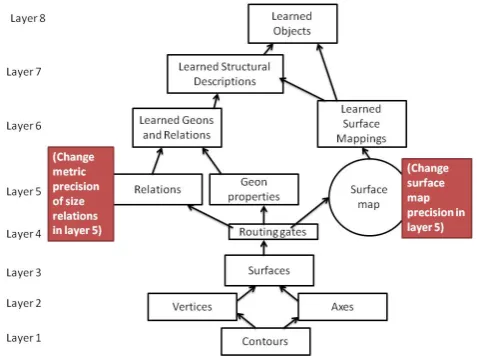
JIM3 is an eight layer Artificial Neural Network model of visual ob-ject recognition [9, 10, 8]. It takes as input a representation of con-tours from a single object’s image. The output is a representation of an object’s identity. Figure 4 (adapted from [8]) shows JIM3’s 8 lay-ers and the two places where changes were made to developmentally regress the architecture.
Figure 4. Diagram of JIM3 showing the two locations in the architecture
where changes were made to capture this architecture’s performance for an earlier developmental stage.
3.2 Layers 1 to 3 From feature maps to
independent geons
[image:2.595.309.548.417.598.2]present in the image. Layer 2 uses these contours to compute ver-tices and axes which are then processed by layer 3 as it computes the surfaces that belong to each geon. So the overall behaviour of this subsystem is to determine what individual geons are present in an image from the simultaneous presentation of a complete multi-geon contour set. These individual multi-geons are then output from this subsystem as isolated and independent object parts with no explicit relationship to other geons arising from the same object.
When an object is initially presented to the model all the features of an image will tend to fire at once. This event is simulating the first tens of ms of natural object perception and occurs in the running simulation in the first several processing iterations. Then in an atten-tive process which involves inhibition and competition the attributes from different geons become temporally separated. This process oc-curs through the global action of a particular kind of artificial neural network connection termed by [9] as Fast Enabling Links (FELs).
The first three layers of JIM3 three act together to output each component geon at a different point in time. If this did not happen and attributes of separate geons fired synchronously then their at-tributes would get super-imposed. The three conditions which cause FELs to treat units as from the same geon are: local course coding of image contours; cotermination in a intra-geon vertex; and, distant collinearity through lone terminations. The simultaneously firing fea-tures become organised so that only the attributes for a single geon fire at one time by an iterative process of competition and inhibition.
3.3 Layer 4 Routing gates (Passing each
independent geon forward separated in time
from the other geons)
The 4th layer is a set of routing gates that splits the output from the first three layers and sends this output to two separate subsystems in layer 5. The information carried by these routing gates is of attribute sets for individual geons. After an initial period of phase locking the information about individual geons are sent as temporally separated signals. That is, geons attributes for individual geons are transmitted together and separated in time from the transmission of attributes describing the other geons present in the target object. This means that at any particular time the output from the routing gates is just an attribute set for one individual geon from the target object. Then after a gap in time the next geon is transmitted. Then after further gaps in time more geons are transmitted until the details of all geons present in the target object are communicated through these routing gates.
3.4 Layer 5 View dependent and independent
bindings: Two parallel ways to put the
separated geons back together again
JIM3s 5th layer comprises two separate parallel components. These are both concerned with combining inputs arising from the feature maps in the first three layers. So in both of these parallel components the geons which were separated in layers 1 to 3 are ‘put back together again’ into two different representations of the single whole object. However, these two subsystems are distinguished because they ac-complishing binding of the output of the feature maps in very dif-ferent ways, and the resulting representations are also very difdif-ferent. It is these two components of layer 5 which are the two locations in JIM3 that were chosen to change and hence implement models of less developed object recognition abilities found in adolescents and younger children (see figure 4).
3.5 The view-independent subsystem
A view independent subsystem called the Independent Geon Ar-ray (IGA) acts to form representations of explicit relations between geons - thus dynamically (but slowly!) forming a view independent structural description of the object. It accomplishes binding of the geons which result from the first three layers by identifying how in-dividual geons relate to each other in terms of relative size and rel-ative position within the overall object they originated from. So this attention-requiring component of layer 5 is a serial mechanism rather than the global parallel and distributed processing mechanism that operates in the view dependent surface map.
This subsystem achieves several important outcomes not achieved by the faster view dependent system. First, the attribute-relation structure is formed explicitly. Since relations among geons are made explicit they allow humans to be able to appreciate relational similar-ities between objects independently of whether similar object parts stand in corresponding relations. So we can appreciate two objects are similar if they have a large geon above a small geon, whatever the non-accidental properties of any of the geons. Second, relations are dynamically bound to the geons they describe. So this provides the potential for recognising complex multi-geon objects with a va-riety of interrelationships between the geons - to do this with static binding mechanisms such as templates might involve an impracti-cally large set of templates ([10], page 204). Thirdly, forming rela-tions which are invariant with geon identity and viewpoint allows the formation of a structural description that will remain the same under translation, scale and left-right reflection and is relatively insensitive to rotation in depth [9].
3.6 The view-dependent subsystem
The soonest to complete is the surface map representation in the other subsystem in layer 5. This accomplishes a view dependent static binding of geons by coding where each geon is fixed at a specific po-sition in a Holistic Surface Map. This 2D representation captures the interrelation of geons as they were perceived in one particular view. The mapping from the output of the feature maps in the first sub-system preserves the topological relations of the geon attributes but discards their absolute sizes and location in the image. This means that the target image representation in the Holistic Surface Map is in-variant with translation and scale. However, because the topological relations that are preserved in the Holistic Surface Map come from only one particular view of the object this representation is sensi-tive to rotation in depth and the picture plan and left-right reflection ([8], page 498). Although this second subsystem in layer five does not form structural descriptions it does have the advantage of being much faster as it does not need to wait for its inputs to include tem-porally separated geons, a process which takes time and can include errors.
3.7 Layers 6 to 8 Learning about multi-geon
objects and recognising them when learnt
4 Simulation results for experiments using animal
and artefact stimuli
4.1 Procedure for Simulation Experiments
To simulate the results from the animals and artifacts experiment of [12] we developmentally regressed JIM3 by changing two proper-ties of the model. Figure 4 shows that the locations where the two parameters which were changed were both in layer 5 of JIM3. The parameters chosen to make less mature ‘child’ versions of JIM3 were the numbers of ‘neurons’ involved in processing in these two com-ponents. It was assumed that at earlier levels of development there might be either less resources given to recognition tasks (or perhaps these resources would be used less effectively) and this would be expected to decrease performance.
First, on the assumption that children have a less metrically-precise holistic representation of object shape than do adults, we re-duced the number of locations in the model’s surface map from 17 (the center plus two radii and eight orientations away from the cen-ter) to nine (the center plus two radii and four orientations ); five (the center plus one radius and four orientations); and one (a single cen-tral location). Second, on the assumption that children are generally much less relational than adults in their thinking (an assumption for which there is a great deal of empirical support [5]) we removed re-lation units from the model’s Independent Geon Array (IGA) for the child simulations. As a result of this change, the ‘child’ version of the model has an implicit representation of an object’s inter-part re-lations in the surface map at an adult level, but less resources given to an explicit representation of those relations.
Before these developmentally regressed versions of JIM3 were used, we decided upon a performance measure which would allow straightforward comparison between the performance of JIM3 and the results reported by J¨uttner et al.’s experiments with human partic-ipants [12]. We also developed a set of stimuli which was calibrated in a similar manner to the calibration carried out in the empirical studies with humans.
4.1.1 Performance Measure
In the original experiments of [12], human subjects (adults and chil-dren of various ages), were tested for their ability to choose the cor-rect picture of an animal or an artifact from a display depicting an un-altered picture of that animal or artifact along with two distracters. There were two main conditions arising from use of two different types of distracter - a variant constructed by changing one part of the original object and another variant created by changing the relative part sizes of the original object (and thus effectively changing the metric relations among the object’s parts).
JIM3 is not capable of performing this ‘choose the correct object out of three’ task (instead, it simply views one object at a time and attempts to find the best match in its LTM). Therefore, we devel-oped a performance measure to estimate how well it would perform the choice task based on how well each object matched the correct (trained) object and each of the distracters activated the trained ob-ject’s representation in the model’s LTM. This measure was based on the model’s response time to recognize an object (the number of it-erations until an object [trained object or distracter variant] activated the corresponding trained object’s representation in LTM to crite-rion; [8]). A second possible measure which might be used when the model could not activate the corresponding trained object representa-tion was model’s accuracy (i.e., the likelihood that an object [trained
or distracter] would activate the corresponding trained object’s rep-resentation in LTM). However, this was not used because the sim-ulations typically ‘recognized’ both target objects and distracters as the target object, with the only distinction between conditions how many simulation cycles this took (since the distracter objects were not present in the set of recognition targets present in the learning phase).
The logic of these measures is that the more closely a distracter matches the representation of a trained object in LTM the more dif-ficult it would be for the model to correctly reject that distracter in favour of the trained target. Accordingly, our RT-based measure of performance consists of the model’s RT to ‘correctly’ recognize a distracter (either NAP or size change) as an instance of the trained target So although the model did not correctly reject the distracters (even very long durations eventually resulted in recognition of the learned target), it is the closest performance measure to a ‘rejection’ of a distracter that the current implementation of JIM3 can support.
A drawback of this performance measure is that since it compares human performance accuracy with simulation timing it does not pro-vide a straightforward comparison between different types of task that take different amounts of time to be carried out within the sim-ulation. This applies to the upright and inverted stimuli tasks - with inverted stimuli taking longer to be recognised than upright stim-uli. This does not of course mean that inverted stimuli are easier to recognise. So within a manipulation this performance measure does allow for comparisons, but between manipulations we cannot say that longer to recognition in JIM3 infers better discrimination per-formance.
4.1.2 Calibration of stimuli for equal difficulty with the adult version of JIM3
The original behavioural experiments involved a calibration stage where part-change and configural change stimuli sets were formed to be of equivalent difficulty. Following this original design, we ran pilot simulations with JIM3 to equate the discriminability of the NAP and size-change variants of the trained stimuli.
Specifically, we made 5 novel multi-part part objects and trained JIM3 to recognize them, along with the dozen or so objects it was trained to recognize in the simulations reported in [8]. We then made two variants of each trained stimulus. An NAP distracter was made by changing one non-accidental property of one geon in the corre-sponding trained object; and a size-change distracter was made by changing the size of one geon in the corresponding trained object. During piloting we made several variants of each size-change dis-tracter and chose, for the final simulations, the variant whose discrim-inability from the corresponding trained object most closely matched that of the NAP distracter. That is, following the original experiment, we explicitly equated the NAP and size-change distracters for their discriminability from the corresponding trained objects to adults. For the adult version we used JIM3 in its original 2001 version [8], withσ
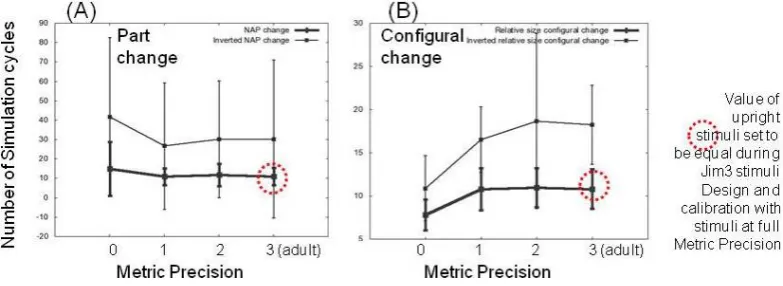
Figure 5. Showing simulation results of animals and artefacts experiment with Metric Precision at four different levels of ’development’.
4.2 Results of simulation of Animals and Artifacts
Experiment
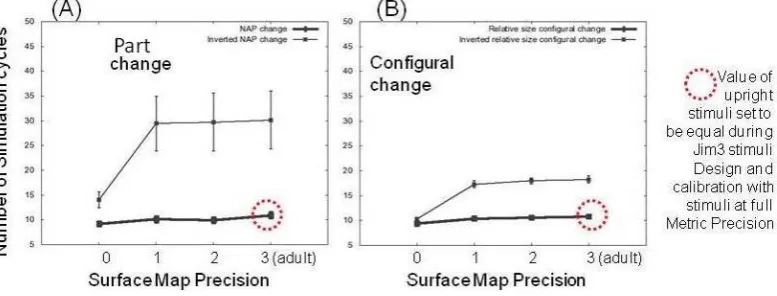
Figures 5 and 6 show the results of the two sets of computational experiments with JIM3 developmentally regressed from adult levels (3) to three lower levels of development (level ‘0’ being the most regressed) - with figure 5 presenting results with metric relation pre-cision in the IGA decreased and figure 6 with surface map prepre-cision decreased. Both these graphs show adult results in the upright condi-tion circled with a dashed line - denoting that they were calibrated to be similar in value.
Figure 5 shows that as metric precision in the IGA is decreased there is a different pattern of results in the NAP change and config-ural change conditions. As metric precision tends to zero neurons being used, recognition performance in the configural change con-dition drops. However, we seem to see a performance increase with the NAP change condition when metric precision is decreased. So these simulated results show the same qualitative pattern found in the empirical results presented by [12].
Figure 6 shows that as surface map precision is decreased there is no evidence to suggest a different pattern of results between the NAP change and configural change conditions. This pattern of results is therefore different to the empirical results presented in [12]
4.2.1 Statistical analysis for MP manipulated architecture The simulation data were analyzed with a 4 (Metric Precision level: MP level 3 (adult with 45 neurons from three receptive field classes) vs MP level 2 ( 30 neurons from 2 receptive field classes) vs MP level 1 (15 neurons from 1 receptive field class) vs MP level 0 (no neurons) x 2 (Manipulation: Part change versus Relative size change) x 2 (Ori-entation: Upright vs Inverted) mixed ANOVA with Metric Precision level as the between factor. The analysis yielded significant main ef-fects for Manipulation [F(1, 799) = 41.08, p<0.0005] and
Orien-tation [F(1, 799) = 84.56, p<0.0005] but not for Metric Precision Level [F(1, 799) = 0.571, p = 0.634.
Significant interactions were found between Metric Precision Level and Manipulation [F(3, 799) = 5.41, p = 0.001] and between Orientation and Manipulation [F(1, 799) = 24.773, p<0.005]
Two post-hoc independent-samples t-tests were conducted to ex-plore the interactions:
• a first independent samples t-test was conducted to compare the
two most developmentally separated metric precision levels for the relative size change manipulation upright condition: MP level 3 (adult with 45 neurons from three receptive field classes) vs MP level 0 (no neurons). There was a significant difference in scores for adult MP level 3 (adult) and MP level 0; t (98) = 7.28, p<
0.0005, two tailed). The magnitude in the difference of the means (mean difference = 3, 95% Cl: 2.18 to 3.82) was large (eta squared = 0.353).;
• a second independent samples t-test was conducted to compare the two most developmentally separated metric precision levels for the NAP change manipulation upright condition: MP level 3 (adult with 45 neurons from three receptive field classes) vs MP level 0 (no neurons). There was a non-significant difference in scores for adult MP level 3 (adult) (M = and MP level 0; t (98) = -1.947, p = 0.054, two tailed). The magnitude in the difference of the means (mean difference = 4, 95% Cl: -8.072 to 0.77) was large (eta squared = 0.85).
4.2.2 Discussion for MP manipulated architecture
The analysis showed that there is a significant difference between relative size changed and NAP changed stimuli - but this main ef-fect may not be a clear match to the required discrepancy between relative size changed and NAP changed conditions specified in sec-tion 1. This is because the inverted results may produce much of this main effect difference and the difference between simulations of up-right stimuli may not be significant when considered on their own against each other. So a post-hoc test, discussed below, provides a finer detailed analysis of the relative size change and NAP change manipulations in the upright condition.
There is also a significant main effect of orientation between up-right and inverted stimuli - with the inverted stimuli taking longer to be incorrectly recognised. Our performance measure suggests that within the same task, taking longer to be recognised is equivalent to a more accurate recognition. But between tasks this relationship does not hold. So since the simulation will actually take longer to recog-nise inverted stimuli because they are upside down this main effect does not show that inverted stimuli are easier to discriminate.
met-Figure 6. Showing simulation results of animals and artefacts experiment with the Surface Map at four different levels of ’development’.
ric precision level and manipulation. So as the simulation parame-ters modelled ‘younger’ parameparame-ters in the relative size change con-dition, performance decreased and in the NAP change condition per-formance increased. So these results do match the empirical results, but as noted above - the larger component of this difference between manipulation conditions may have come from the inverted results - as these mean values differ more widely than the upright condi-tions. The interpretation that the inverted conditions provide most of the difference between manipulation conditions is strengthened by the significant interaction between orientation and manipulation, with inverted relative size changed stimuli having the longest num-ber of simulation cycle to recognition (in the MP = 0 condition over 40 cycles).
The complications in the analysis of considering upright and in-verted orientations together was resolved with a post-hoc t-test which only looked at upright results to consider whether the ‘youngest’ MP regressed condition was significantly different to the adult perfor-mance level. This gave a very clear result, that whilst the relative size change condition showed lower recognition performance, than the NAP change condition was not significantly different (see figure 7 ).
4.2.3 Statistical analysis for SM manipulated architecture
The simulation cycle data were analysed in a 4 (Surface Map level: SM level 3 (adult with 17 neurons in two further orientations from the center neuron) vs SM level 2 ( 9 neurons in two further orienta-tions from the center) vs SM level 1 (5 neurons in one further orien-tation from the center) vs SM level 0 (1 neuron with no further ori-entations from central neuron) x 2 (Manipulation: Part change versus Relative size change) x 2 (Orientation: Upright vs Inverted) mixed ANOVA with Metric Precision level as the between factor. The anal-ysis yielded significant main effects for Manipulation [F(1, 799) = 14.42, p<0.0005] and Orientation [F(1, 799) = 71.81, p<0.0005]
and for Surface Precision Level [F(1, 799) = 6.4, p<0.0005]. Significant interactions were found between Manipulation and Orientation [F(1, 799) = 16.13, p<0.0005] and between Surface Map Precision and Orientation [F(1, 799) = 24.773, p<0.001]. The interaction between Surface Map Precision Level and Manipulation was not significant.
Two post-hoc independent-samples t-tests were conducted to ex-plore the interaction:
• a first independent samples t-test was conducted to compare the two most developmentally separated surface map precision levels for the relative size change manipulation upright condition: SM level 3 (adult with 17 neurons) vs SM level 0 (1 neuron). There was a significant difference in scores for SM level 3 (adult) and SM level 0; t (98) = 2.81, p = 0.006, two tailed). The magnitude in the difference of the means (mean difference = 1.24, 95% Cl: 0.36 to 2.11) was moderate (eta squared = 0.074).;
• a second independent samples t-test was conducted to compare the two most developmentally separated surface map precision levels for the NAP change manipulation upright condition: SM level 3 (adult with 17 neurons) vs SM level 0 (1 neuron). There was a sig-nificant difference in scores for adult SM level 3 (adult) (M = and SM level 0; t (98) = 2.31, p = 0.023, two tailed). The magnitude in the difference of the means (mean difference = 1.74, 95% Cl: 0.24 to 3.23) was moderate (eta squared = 0.047).
4.2.4 Discussion for SM manipulated architecture
The analysis showed that there is a significant difference between relative size changed and NAP changed stimuli - but as in the MP changed architecture, the SM changed inverted results may produce much of this main effect difference. So a post-hoc test, reported be-low, provided a test of this point.
As with the MP regressed architecture, there is also a significant main effect of orientation between upright and inverted stimuli in the SM regressed experiments. The same explanation applies here as above - the inverted condition involves a different task so we cannot conclude inversion increases recognition performance.
There was a main effect for surface map precision level. As the simulation modelled ‘younger’ versions, performance levels de-crease. Again, as with the MP regressed architecture, the SM-changed simulations show an interaction between surface map preci-sion and orientation - with the longest number of simulation cycles recorded in the inverted condition. There is not a significant interac-tion between surface map precision and manipulainterac-tion
[image:6.595.102.491.73.221.2]condition, with a similar effect size. This pattern of results is clearly different to the empirical results reported by [12].
Figure 7 highlights the results of the post-hoc t-tests for both the MP regressed and SM regressed architectures.
Metric relation MP 0 MP 3 ∆ effect
regressed (adult) size
Part ( NAP) change 14.94 10.94 +4* large* Config change 7.8 10.8 -3 large
Surface map SMP 0 SMP 3 ∆ effect
regressed (adult) size
Part (NAP) change 9.2 10.94 -1.74 moderate Config change 9.56 10.8 -1.24 moderate
Figure 7. Key comparisons from post-hoc t-tests. This table presents
results from the two computational experiments, one which simulated the developmental regression of metric relation precision (top half of table) and
the other experiment which regressed surface map precision (* not a significant difference, p = 0.054)
5 Conclusions
This paper shows that recent empirical results presented by J¨uttner et al[12] can be explained in terms of dual process models of ob-ject recognition. Simulations with the JIM3 artificial neural network suggest that a non-attentive process develops early in humans and al-lows part-based recognition at adult levels with the children in 7-10 age range. According to this dual process explanation, the observed developmental delay in the relative size change stimuli results from the later development of attention requiring processes that support perception of relations between object parts and the production of structural descriptions in object perception and recognition.
Removing neurons from the non-attentive surface map in JIM3 did not cause a significant difference to appear in JIM3’s performance on the part (NAP) change and configural (relative size) change con-ditions. However, a notable and surprising result was that it took reducing the neurons all the way to zero in the attention requiring IGA to bring about a significant difference between these experi-mental conditions in the other set of computational experiments with JIM3. The psychological inferences that can be taken from this find-ing are discussed in more detail below. However, just viewfind-ing this result from the perspective of processing with machine representa-tions provides a key lesson for articial systems engineering. This is that the dual processes in JIM3 interact together in producing be-haviour so that deficiencies in attention requiring processes were masked by non-attentive processes. This highlights a more general challenge in empirical research on the structures used to represent reality - how should experimentalists untangle the interacting effects linked to multiple representation types?
The purpose of running simulations with varying precision lev-els for metric-relations in the IGA and the holistic surface-map was to see if either of these simulations captured the pattern of results shown in empirical observation of humans. What the human results from [12] showed was that performance for younger participants on configurally changed stimuli decreased compared with adult lev-els whereas performance on NAP changed stimuli stayed the same. A successful simulation should therefore show equal performance between stimuli distracter types for ‘adult’ parameters and show a
lower performance on relative size change stimuli than part change stimuli for developmentally younger simulation parameters. As can be seen comparing figures 3 and 5, the simulations where metric-relation precision level changes in the IGA were decreased provide a good qualitative fit to the pattern observed with J¨uttner et al.’s arti-fact and animal stimuli [12]. Since the human participants performed a different task than did the model, it is impossible to provide a pre-cise quantitative fit between the empirical and simulation data.
The limitations in this particular modelling exercise using JIM3 are of four types. Firstly, the task that the simulation carried out was probably more simple than various strategies likely used by the human participants to eliminate distracters. In the JIM3 exper-iments time to recognition is always taken for stimuli presented on their own. The ‘choose 1 from 3 task’ gives more potential for using complex memory retrieval strategies than simply measuring time to recognition for a single object. In addition, which strategies might be used in either task is likely to change through development inde-pendently of the changes to resources given over to metric relation or surface map precision. Developing proficiency in metacognition and increasing cognitive resources have been presented as competing explanations in memory development [6]. So we might expect analo-gous competing theories of ‘increasing metacognition’ and ‘increas-ing cognitive resources’ when attempt‘increas-ing to explain developmental trajectories in object recognition.
Secondly, the images that JIM3 learns and then recognises are spler than the naturalistic 2D images used by [12]. The naturalistic im-ages possess difference in texture and colour which the stimuli used by JIM3 do not possess.
Thirdly the modelling exploration has been set up as a two horse race, to decide which of these changes to JIM3 provides the best fit for the pattern of empirical results for adults and children described by [12]. Each of these regressions was ‘clean’ in the sense that only one parameter at a time was regressed. In a real infant we might ex-pect both MP and SM precision to decrease as well as there being a number of other changes that involve lower recognition performance for younger participants. For example, on the assumption that chil-dren have less stable and/or precise memories for objects than do adults, we might changeσon the Gaussian receptive fields in layer 6 of JIM3 from 0.5 (the value in the adult simulations) to 1.0. This increase would have the effect of making any given unit in Layer 6 more tolerant of deviations from its preferred pattern (correspond-ing to the center of the distribution). Possible future computational experiments with JIM3 might therefore involve co-varying the two existing changes with each other and with changes inσ. However,
preliminary experiments have shown that decreasingσon its own does not cause relative size stimuli to be processed less effectively -with mean simulation runs actually higher for relative size stimuli at a value ofσthat gives minimal recognition performance.
Lastly, both the empirical results and the modelling research do not rule out the impact of differing life experience and consequent encoding differences in memories might have in the performance of JIM3 after layer 5.
age 7 to 9 years old really do have a much lower than previously expected ability to make metric judgements in visual object recog-nition. That this is not apparent in day to day life or in other kinds of object recognition experiment may be because this lower ability will only be apparent when children view objects in a way that their highly performing 2D systems cannot quickly produce recognition. Otherwise partial-orderings rather than absolute metric judgements may suffice. So one suggestion for future work is to adapt JIM3 so that it can support more complex tasks and more complex strategies, with image simplicity matched, with many parameters being sys-tematically changed during simulations, and with learning regimes matched to those that the adults participants experienced. Some of these suggestions have already been carried out - for example ex-periments have been conducted which control for differing previous experience with novel objects - see [12] experiment 3. The finding that JIM3 needs to have no metric relation precision to qualitatively match 7-9 year old human performance might also suggest new em-pirical studies where participants learn novel objects but are then pre-sented with very different views of these objects so that the view de-pendent system would not be expected to maintain high performance levels.
There are also a number of deeper issues linked to the core features of JIM3. For example, in JIM3, both the view dependent and view in-dependent routes through the architecture use geons as a fundamental representational unit. However, it is not a settled issue what the basic level in structural descriptions in visual object recognition are. For example, children from 3 to 4 made less use than adults of the shape boundaries that distinguish different types of geons [1]. So to model children’s performance we might want to relax the requirement that geons are a fundamental representational unit at earlier stages in de-velopment. In addition, it is also worth noting that JIM3 possesses surfaces in layer 3 of the architecture, but these surfaces are only used in the assignment of geons before layer 4 - rather than primi-tives for the spatial relationships recorded in the view independent component of layer 5. However, surfaces have been proposed as rep-resentational primitives within spatial relationships [13] .
In addition, in JIM3 there is limited opportunity for processing in later layers to influence earlier processing in an on-line dynamic fashion. For example, top-down effects of memory on processing be-fore layer 5 through backward projections do not occur in JIM3. We might imagine that attention emerges over moment to moment as an internal representation of an object emerges - a dynamic process not captured within JIM3. Instead, in JIM3, attention is ‘on full’ as the object starts to be represented.
Lastly, JIM3 is a dual process model where each process is sup-ported by different hardware, in the form of separate neural networks in layer 5. Other dual process theories have a similar arrangement. For example, object perception and action are proposed to occur in two separate dorsal and ventral streams [7]. Alternatively, the idea of dual processes can be de-linked from the idea of dual ‘systems’. It may be different processing occurs at different times on a common substrate. So ‘dual process - one system’ could be a design schema for a new object recognition system where compositional and non-compositional processes are separated in time but not space.
So in summary - a version of JIM3 with regressed metric relation precision in the IGA has been shown to provide a better match to empirical results than a regressed holistic surface map version. An interesting finding is that even small numbers of neurons present in the IGA can provide similar level of recognition performance to an ‘adult’ JIM3 with its full complement of neurons. Though the lessons for human psychology from this are still to be worked out this work
does provide an example for research in machine representation of the benefits of dual representation systems. Future work has also been suggested that: (1) would involve adapting JIM3 to more closely match the types of task and stimuli and learning pattern used in em-pirical studies of object recognition development; (2) that would in-volve empirical testing of younger adolescents with stimuli that have been rotated so that the view dependent mechanisms do not provide an effective route to recognition; and (3) would involve developing alternatives to JIM3 that support surfaces as a representational prim-itive, provide more backward projections to provide top down effects of existing knowledge, and development of dual process-single sys-tem models where differences in processing exist across time but not across resources.
Philosophers have long theorised about compositionality and its benefits. This research illustrates the challenges in investigating how object representations develop. These include that, in natural systems, there is no transparent access to internal representations, multiple representational forms can interact to produce complex behavioural patterns, and the existing implemented computational models do not always neatly fit completely with emerging empiri-cal paradigms. However, computational modelling can nonetheless show how neural systems can support representational diversity in humans, other animals and machines.
REFERENCES
[1] M. Abecassis, M.D. Sera, A. Yonas, and J. Schwade, ‘What’s in a shape? children represent shape variability differently than adults when naming objects’,Journal of Experimental Child Psychology,78, 213– 239, (2001).
[2] I. Biederman, ‘Recognition by components: A theory of human image understanding’,Psychological Review,94, 115–147, (1987). [3] J. Davidoff and D. Roberson, ‘A theory of the discovery and predication
of relational concepts’,Journal of Experimental Child Psychology,85, 217–234, (2002).
[4] L. Doumas, K. Holyoak, and J. Hummel, ‘The problems of using asso-ciations to carry binding information’,Behavioral and Brain Sciences,
29, 74–75, (2006).
[5] L. Doumas, J. Hummel, and C. Sandhofer, ‘A theory of the discovery and predication of relational concepts’,Psychological Review,115, 1– 43, (2008).
[6] J.H. Flavell, ‘First discussant’s comment: What is memory develop-ment the developdevelop-ment of?’,Human Development,14, 272–278, (1971). [7] M.A. Goodale and A.D. Milner, ‘Separate visual pathways for
percep-tion and acpercep-tion’,Trends in Neurosciences,15(1), 20–25, (1992). [8] J. Hummel, ‘Complementary solutions to the binding problem in
vi-sion: Implications for shape perception and object recognition’,Visual Cognition,8, 489–517, (2001).
[9] J. Hummel and I. Biederman, ‘Dynamic binding in a neural network for shape recognition’,Psychological Review,99, 480–517, (1992). [10] J. Hummel and B. J. B.J. Stankiewicz, ‘Categorical relations in shape
perception’,Spatial Vision,10, 201–236, (1996).
[11] M. Juttner, A. Muller, and I. Rentschler, ‘A developmental dissocia-tion of view-dependent and view-invariant object recognidissocia-tion in ado-lescence’,Behavioural Brain Research,175, 420–424, (2006). [12] M. Juttner, E. Wakui, D. Petters, S. Kaur, and J. Davidoff,
‘Develop-mental trajectories for part-based and configural object recognition in adolescence’,Developmental Psychology,48, Online first publication March 26, 2012, No pagination specified, (2013).
[13] E.C. Leek, I. Reppa, and M. Arguin, ‘The structure of three-dimensional object representations in human vision: evidence from whole-part matching.’,Journal of experimental psychology. Human perception and performance,31, 668–84, (2005).
[14] I. Rentschler, M. Juttner, E. Osman, A. Mller, and T. Caelli, ‘Develop-ment of configural 3d object recognition’,Behavioural Brain Research,
149, 107–111, (2004).
[15] F. van der Velde and M. de Kamps, ‘Neural blackboard architectures of combinatorial structures in cognition’,Behavioral and Brain Sciences,