University of East London Institutional Repository: http://roar.uel.ac.uk
This paper is made available online in accordance with publisher policies. Please
scroll down to view the document itself. Please refer to the repository record for this
item and our policy information available from the repository home page for further
information.
Author(s):
Gillan, Charles; Kilpatrick, Peter; Spence, Ivor; Brown, T. John;
Bashroush, Rabih; Gawley, Rachel;
Article title:
Challenges in the Application of Feature Modelling in Fixed Line
Telecommunications
Year of publication:
2007
Citation:
Gillan, C. et al. (2007) ‘Challenges in the Application of Feature Modelling
in Fixed Line Telecommunications.’ Proceedings of the First International Workshop
on Variability Modelling of Software-intensive Systems (VaMoS2007), Lemrick,
Ireland, Jan 16 -18, 2007.
Link to published version:
Challenges in the Application of Feature Modelling in Fixed Line
Telecommunications
C.J. Gillan, P. Kilpatrick, I. Spence, T.J. Brown, R. Bashroush and R. Gawley
The Institute for Electronics Communications and Information Technology (ECIT)
The Queen’s University of Belfast (QUB), The Northern Ireland Science Park
Queen’s Road, Queen’s Island, Belfast, Northern Ireland BT3 9DT, UK
c.gillan,[email protected]
i.spence,tj.brown,p.kilpatrick,[email protected]
Abstract
The global telephone system is a complex transmission network, the features of which are defined to a very high level by ITU-T standards. It is therefore a prime candidate at which to target the application of software product line techniques, and feature modelling in particular, in order to handle the inherent commonality of protocols and variabil-ity in equipment functionalvariabil-ity. This paper reports on an ex-perimental feature modelling notation and illustrates it with application to the modelling of embedded software for the core network elements. We look at three of the fundamen-tal challenges facing the adoption of feature modelling in the field and explain how we have strived to address these within our tools set.
1. Introduction
The global telephone system is a technology space which is almost entirely defined by standards, mostly interna-tionally agreed, and therefore should be a fruitful proving ground for the application of studies in variability manage-ment techniques. There are however relatively few such studies[1] in the literature.
As a market, the telecommunications sector is currently influenced by a number of factors for change meaning that there will continue to be an evolution of the inherent feature set. The global system continues to evolve in order to ac-commodate new service requirements, one example being the modifications such as real and virtual concatenation[2] introduced over the last decade to accommodate transport of data rates such as Gigabit Ethernet (GbE) and also Storage Area Networking technologies (SAN) such as Fibre Chan-nel (FC) in addition to the traditional multiplexed hierar-chies of 64 Kbit/s voice channels.
[image:2.612.313.534.339.557.2]The next major evolution of the system is the incorpo-ration of low cost Passive Optical Networks (PONs). A PON replaces the final mile copper network with an Op-tical Line Terminal (OLT) located at the local telephone ex-change connected to an Optical Network Unit in the home (ONU) and for this reason is sometimes known as the Fi-bre To The Home (FTTH) solution. The roll-out of PON
technology has so far mostly taken place in the Asia-Pacific region but is expected to generate a global market oppor-tunity approaching $2.2 billion by the end of the current decade. It is worth noting that the financial case for PON role-out is based on the continuing update of novel broad-band services as the revenue generating potential of tra-ditional voice telephony approaches saturation, at least in the developed world. The addition of new services obvi-ously introduces yet more variability into an already com-plex system. In turn, the System on Chip (SoC) revolution, which we briefly describe later in this paper, has lowered the cost of equipment manufacture, even for large multiplexers, thereby opening the vendor space to Small and Medium Enterprises (SMEs) whereas previously it was essentially the sole preserve of a small number of large multi-national companies with sufficient resources to fund ASIC develop-ments. Of course, this also generates intense competition which translates to severe Time To Market (TTM) pressures on any company working in the space. At present there are estimated to be more than twenty five companies actively developing equipment in the PON sub-space.
Clearly, the telecommunications sector is critically de-pendent on software both at the embedded level, for device control and monitoring of the Network Elements (NEs), and in terms of the management, service and business level ap-plications which are the tools with which a telecommuni-cations operator leverages option value from their installed base of NEs. Although extreme programming is now being considered as viable alternative in some areas of embedded systems programming[3], legislative restrictions and the re-quirement for five nines reliability (99
.999percent) within
the telecommunications industry is such that it will proba-bly remain tightly bound to the traditional software devel-opment life cycle for some time to come. Telecommuni-cations software engineering is by its nature a very con-servative environment although somewhat less so than the aeronautical and nuclear industries. Related to this is the fact that ISO9001 certification is essentially mandatory for any telecommunications equipment manufacturer and this seems to generate a level of conservatism favouring the tra-ditional waterfall life cycle of software development. Still, appropriate software engineering techniques applied to this domain can help ameliorate the increasing TTM pressures faced by all vendors in the telecommunications space and we believe that feature modelling is one such technique.
There are, as we see it, three main challenges facing the adoption of feature modelling in telecommunications devel-opment.
1. the number of variability points is excessively large, reflecting the network itself. In addition, as new tech-nology, such as PON, arrives the feature set will grow rapidly. So, clearly we need some mechanism of stan-dardizing our approach to domain modelling.
2. The second problem, driven by advances in hardware engineering, and is that SoC concepts drive more and more functionality out of the software into hardware within any one product but sometimes only well be-yond the first release. This can be due to either added new functionality or sometimes to cost reduction activ-ities providing an opportunity to migrate functionality on a board away from the processor onto an FPGA de-vice or similar.
3. The third challenge facing the adoption of feature modelling in telecommunications software develop-ment is the fact that elucidation of a set of binary yes-no feature points is woefully inadequate to reflect the functionality of a device. One needs to encompass be-haviour within the feature modelling in order to cap-ture fully the behaviour of a software load.
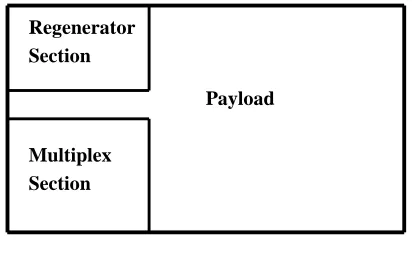
Regenerator Section
Multiplex Section
[image:3.612.317.523.250.377.2]Payload
Figure 2. The generic physical view of the SDH frame structure. This needs to be con-trasted with the logical layered view shown in figure 3.
In this paper, we report on the strategies that we have fol-lowed to begin to address each of these challenges and we illustrate these with examples from our research tools set. However, we stress at the outset that much work remains to be done to achieve a successful application of feature mod-elling to telecommunications and we comment at the end of our paper on what we believe to be the way forward. Telecommunications is in itself a diverse field presenting substantial challenges for variability management some of which are unique to the field itself. We have developed our strategies within the telecommunications field and have not as yet attempted to apply them in a wider context.
1.1. Focusing on the Core
the fibre optic backbone, at the heart of the global telecom-munications system. Differences with the US and Canada at the protocol level notwithstanding, this implements the Synchronous Digital Hierarchy (SDH) protocol[4].
Our group has considerable experience in this sub-space through participation over several years in a program of in-dustrial research, known as JigSAW, funded by Nortel Net-works. So, for the rest of this paper we shall be applying feature modeling to SDH concepts. However, we stress that the points that we make are generally applicable in other telecommunications technology spaces.
2. Divide and Conquer: The ITU-T Standards
and TMN
Perhaps the key enabler which facilitates global tele-phone systems, and that includes all technologies not just SDH, is that it is subject to strict standardization under the direction of the United Nations by the sub-division known as The International Telecommunications Union Standard-ization Sector (ITU-T). ITU-T is responsible for “studying technical, operating and tariff questions and issuing Recom-mendations on them with a view to standardizing telecom-munications on a worldwide basis.” In order to react to the changing telecommunications environment.
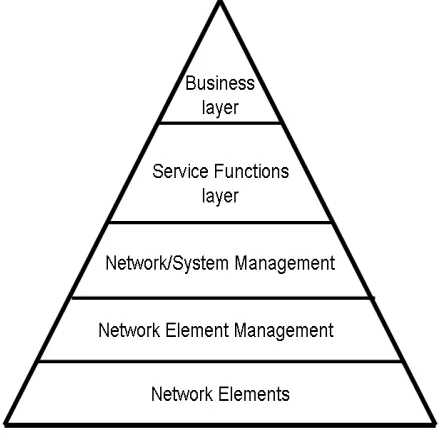
At the outset of the digital communication era, in the 1980s, the ITU defined the Telecommunications Manage-ment Network (TMN) model to specify a set of stan-dard functions and interfaces for management of a multi-technology network thereby reflecting the functionality of-fered by a system. The TMN framework is typically viewed as a pyramid composed of layers enjoying a client-server re-lationship to each other as shown in figure 1. Perpendicular to these layers are a set of vertical functional areas:
• Fault
• Configuration
• Accounting
• Performance
• Security
known as the FCAPS model for short. This TMN based strategy, we therefore propose, is the one that should be fol-lowed in order to divide and conquer the problem of feature scalability and evolution in telecommunications. We have approached feature modelling therefore by classifying fea-tures in line with the FCAPS model. This also, we have found, lowers the barrier to adoption by telecommunica-tions software engineers.
An alternative perspective is to take a hardware engi-neer’s perspective and to view the features in terms of
1. the overhead bytes within the protocol definition (see figure 2)
2. the traffic rate layer within the SDH frame at which the overhead is found (see figure 3).
Physical RS MS VC-4 (HP) VC-3 (LP) VC-12 (LP)
Figure 3. Some of the logical layers, from the standard ITU-T G.707, within an SDH sig-nal. An STM-1 frame contains 1xRS, 1xMS, 1xVC-4 containers. The VC-4 container has 3xVC-3s and each VC-3 has 21xVC-12. VC-4 is known as a high path layer (HP), VC-3 and VC-12 as low path layers (LP)
In our experience, the latter approach alone generates a fea-ture model with many more cross linkages, being there-fore much more complex to maintain and manipulate, than starting with an FCAPS based model. Note, however, that within the FCAPS model, as shown in figures 4 and 5, gen-erating using our tools set which is discussed later in the paper, there is still a need to take account of the traffic rates. However, we have to add that this FCAPS distinction alone is not sufficient to guarantee a unique feature model, and this in itself is a problem. For example figures 4 and 5 are essentially representing the same thing, that is the collection of performance monitoring data on the overhead bytes of a telecommunications signal.
In figure 4,the sub-tree under Performance Monitoring has been developed to incorporate the logical layers of the signal which are shown in figure 3. This is why there is a dense mesh of features on the lower left-hand side of the screen. For example the overhead bytes B3 and G1 which are present in the High Path (HP) signals are shown as a sub-tree under the HP feature. The B3 byte is further expanded to encompass all of the properties pertaining to it such as 24
hour and 15 minute history bin collection.
im-Figure 4. A small number of the variability points related to SDH performance monitor-ing and their couplmonitor-ing to the multiplexmonitor-ing hi-erarchy (dashed lines). The named bytes are described in ITU-T G.707. The amount of clut-ter is clear.
Figure 5. An alternative, but equally valid way to present the same set of features as in fig-ure 4. This illustrates the non-unique natfig-ure of the feature modelling technique.
plicit contained within the Traffic Handling sub-tree on the right-hand side of the figure, a tree which is apparently de-coupled from the Defect Monitoring feature. In this repre-sentation the Defect Monitoring feature incorporates all of the process issues surrounding collection of bit rate errors but does not distinguish the details for individual bytes. In general, we would probably also need to define a depen-dency between the Traffic Handling and Defect Monitoring feature. Indeed, this approach would be extensible to other functional areas of the system, such as the treatment of the features associated with the configuration of data for each port. This is because each port is ultimately involved in a connection at some particular data rate. However it would be just as valid to define a port in terms of logical layers.
3. Co-design feature models: handling the
im-pact of FPGAs
System-on-a-chip (SoC) design, in its most general form, is about integrating all the components of an electronic sys-tem into a single chip, for example containing digital, ana-log, mixed-signal, and often radio-frequency functions all on one chip. SoC is therefore a key driver in decreasing the size of electronic boards. An SoC consists of this hardware but also of the software that controls the microprocessor and/or DSP cores, peripherals and interfaces. The design flow for an SoC aims to develop this hardware and soft-ware in parallel. For example, most SoCs are developed from pre-qualified blocks for the hardware elements (called IP cores), together with the software drivers that control their operation. The hardware blocks are put together us-ing CAD tools; the software modules are integrated usus-ing a software development environment. The Field Program-mable Gate Array (FPGA) is one technology that has facil-itated the SoC revolution because, as its name implies, it is hardware which can be reprogrammed hardware. Often in the early life cycle of a product and FPGA will be used and later the hardware design will be migrated into an ASIC which remains the more cost effective solution for high vol-ume production.
[image:5.612.68.272.358.587.2]counts into relevant data bins and performs various summa-tions on the counts. Every fifteen minutes, as mandated by standards, we must roll over to a new bin but retain several of the previous bins, typically up to 96 of them. On top of this recording mechanism, at any instant, a management in-terface request to be given visibility of any bin, active or his-torical, may need to be handled. In essence, this is the set of features being recorded in figures 4 and 5; it is a significant part of the software implementation on any SDH equipment and scales in portion to the number of traffic channels car-ried. However, today it is possible to buy COTS ASICs that perform essentially all of this activity and thus render the entire software module for performance collection obsolete in any product variant which adopts such an ASIC. All that is required is to interface the management application to the registers holding history data.
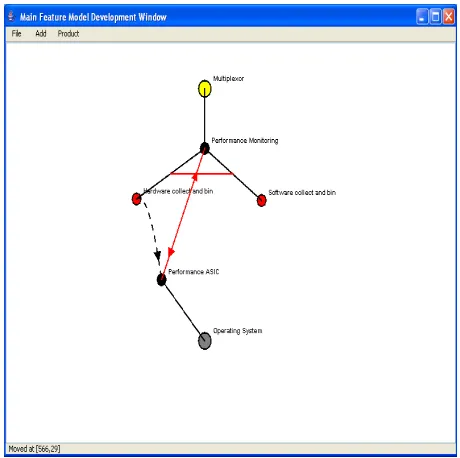
[image:6.612.53.283.295.524.2]So, we need to able, in our feature models to handle the situation whereby we have this migration of a feature into hardware. We have previously introduced the concept of bi-directional feature modelling[5] to handle this situation. We illustrate its role in figure 6 in which we present a drasti-cally simplified feature model for the situation. This figure
Figure 6. This figure illustrates the role of the platform node in our bi-directional feature modelling notation. In the potential migration of the PM collect-and-bin function from soft-ware to hardsoft-ware is shown.
has been created by condensing the features in figure 5 into subsets and then showing the relationship between the sub-sets. Being much less cluttered, figure 6 is also able to show the link between functional features and the ASIC and
Op-erating System.
4. Adding Behaviour
Feature modelling, at least in its original form [6] is sim-ply a set of binary points for which any given product adds the values yes/no. This alone is not sufficient to classify the behaviour of a telecommunications product as we show in figures 7 and 8 and discuss below.
Consider first the case of a feature point with two manda-tory child features and one alternative child feature, such as the one shown in figure 7. The collection, storage and re-porting of performance monitoring data is one example of this. The two mandatory child features are
1. collection
2. sorting into bins.
[image:6.612.319.537.376.563.2]The alternative child feature relates to the way in which the data is reported. In older systems, where there are relatively few monitoring points and perhaps few history bins, it is vi-able to report performance monitoring data at the command line interface (CLI) without otherwise impacting the NE it-self or indeed the management network overhead channels (the 192 Kbit/s D1-D3 DCC bytes defined in G.707) that
link the management monitoring workstation to the NE be-ing investigated. However, in larger NE systems this puts a heavy load on both the processor and the DCC channels, so it is preferable to perform bulk FTP transfers of com-pressed files at set intervals. They key point here is that the behaviour of the parent feature can be classified as ex-ecution of each child in succession from left to right; that is the behaviour pattern is always the same. We have aug-mented out feature modelling GUI to include the Use Case Maps (UCM) notation to capture behaviour. Actually this is line with totally independent recommendations of the ITU where UCM has been adopted and renamed URN. The ITU-T Z Series, Languages and General Software Aspects for
Telecommunications Systems, has two standards which are
of particular relevance:
Z.150 User Requirements Notation (URN) - language
re-quirements and framework
Z.152 ITUT Study Group 17, Progress work on URN
-Use Case Map Notation (Z.152). This is not yet for-mally adopted as a standard but it is expected that it soon will be adopted.
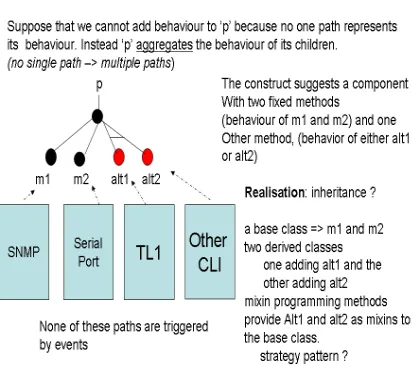
Of course not all features will have a unique behaviour assigned to them. Consider for example the feature shown in figure 8. At first sight this looks the same as the fea-ture in figure 7 with two mandatory child feafea-tures and one alternative child feature. However, in this case the feature represents the presence of a variety of management inter-faces.
All products require a serial port interface, which is typ-ically based on an Intel NS16550 chip, so that they can be commissioned in the field. This interface can be connected to the serial port on laptop PC using an appropriate serial port cable. As serial ports are readily supported, for ex-ample by the Microsoft Windows HyperTerminal program, this interface provides the simplest type of physical con-nection to the NE obviating the need for the presence of a network of any kind. Of course, there needs to be a layer of software to handle commands and to provide responses to those commands at the interface. In summary, the se-rial port interface is the primary route by which an NE is commissioned onto the network and brought into service making it a mandatory feature. Once in this state, network based management interfaces are clearly more suitable and at least one such networked interface will always be pro-vided thereby enabling the capacity to remotely manage the NE from a Network Operations Centre (NOC) which could, in principle, be anywhere in the world.
Almost all products now incorporate an SNMP interface as that is a very popular management interface in the en-terprise field. SNMP standards for Simple Network Man-agement Protocol (SNMP) which is a part of the Internet Protocol (IP) suite as defined by the Internet Engineering
Task Force (IETF). With reference to the ISO seven layer model, SNMP is considered as an application layer proto-col and in turn it uses UDP, at layer four, as a server layer. Therefore, SNMP is used by network management systems to monitor network-attached devices particularly for alarm conditions requiring administrative attention.
[image:7.612.322.531.197.380.2]There will additionally be at least one kind of Command Line Interface (CLI) for the system. CLIs are generally pre-ferred by telecommunications operators as opposed to the use of SNMP by enterprise operators or even for Customer Premises Equipment (CPE). A key advantage of any CLI
Figure 8. For this parent the child features do not have an associated unique behaviour pattern and so represent an entirely different type of feature than the one in figure 7.
is that one can write scripts, for example in Perl, to auto-mate any amalgam of required command line operations. By contrast, when using SNMP, a layer of client software is required.
(OSS) such as Network Monitoring and Analysis (NMA) uses TL1 as the Element Management System (EMS) pro-tocol for example and therefore drove NE vendors to imple-ment TL1 in their devices. Generally though in the case of embedded systems, each vendor will also define their own CLI and a proprietary set of rules to which all commands within their CLI conform. One such example is Cisco IOS. This diversity of CLIs is represented by the features alt1 and
[image:8.612.67.277.158.389.2]alt2 in figure 8.
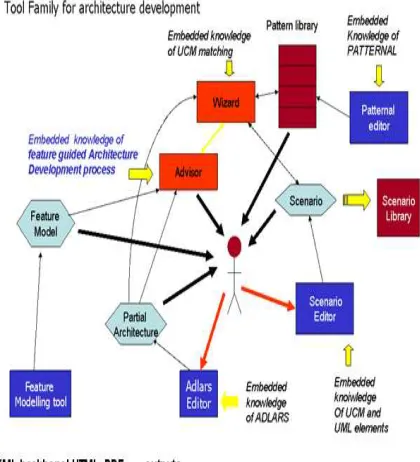
Figure 9. Overview of the QUB/ECIT tools set for feature guided architecture development which is explained further in the text.
We cannot assign a unique behaviour path to the parent feature here. So, clearly, the parent feature in figure 8 is an entirely different one than that depicted in figure 7. So, it is only by adding a notation for behaviour to the features that permits us to make a distinction between them. We have found UCM to be well suited to this. We have also found, by distinguishing features in this way, that we can gain in-formation on possible implementation strategies. Figures 7 and 8 include comments on the possible relevant object oriented patterns for implementation in each case.
5. Beyond Feature Modelling
To conclude the paper we point out that we do not see our work on feature modelling in isolation from other ef-forts that must be undertaken to deliver a working software
system[7, 8, 9]. Our feature modelling tool, which has been illustrated earlier in this paper, is part of a wider research ef-fort to generate feature architecture development tools. This is reflected in the grand view of our QUB/ECIT tools set in figure 9.
If we consider the actor in the centre of figure 9 as the end goal of creating a running software system, we can identify several steps to achieving this by working inwards from the periphery of the figure. On the left-hand side we have the feature modelling tool which we have illustrated in this paper. The output from this tool feeds directly into the architecture editor (ADLARS) tool within which we can add event driven behaviour, this being a well known tech-nique for construction of embedded systems. The ADLARS tool can create code although currently only Java. The PAT-TERNAL tool, which is still being actively researched is used to represent object-oriented patterns in visual notation.
5.1. Addressing the documentation
require-ments
It is our observation that in the telecommunications soft-ware industry today the process of preparation of ISO9000 compliant documentation is largely divorced from the cre-ation of the core asset code base thereby leading to sub-stantial duplication of effort. Yet there are now many tech-niques, driven largely by Web technologies, that would fa-cilitate substantial auto-generation of documentation. In ad-dition, one then removes the problem of keeping document and code in synchronization, a working practice that is par-ticularly difficult to maintain under TTM pressures.
We have found that it is actually quite straightforward to incorporate the aforementioned Web technologies into our tools set therefore overcoming, we suggest, the afore-mentioned disconnection between documentation and im-plementation. To this end, we use an XML representa-tion behind the scenes of our GUIs and combine this with XSL transforms to generate documentation from our feature models in such formats as PDF, Word, Excel, HTML, etc. The Word for PDF formats remain, in our experience, by far the most popular for ISO 9000 review process in most companies.
6. Summary and Conclusions
In this work, we have addressed some of the main chal-lenges facing the adoption of feature modelling within the telecommunications software industry and have focused on the role of performance monitoring within SDH network el-ements to illustrate out ideas.
We propose firstly that, in order to overcome the sheer size of the variability management problem, the analysis of features should be guided by existing domain specific par-titioning ideas, specifically the FCAPS model. This will lower the barriers to adoption of the techniques in what is quite a conservative industry. Next, we have explained how the role of SoC forces us to integrate hardware co-design features at least into the software engineering feature model. We have then argued the case for the need to add behav-iour to a feature model in order to clarify its meaning. Fi-nally, we have explained how we are incorporating behav-iour guided feature modelling into out tools set for architec-ture development.
As we have shown, there is no unique way to express the feature model for a telecommunications system and we believe that overcoming this hurdle would expedite the ac-ceptance of the technology in the field. Clearly, there is a requirement for more and deeper case studies in the area.
7. Acknowledgements
The Institute for Electronics Communications and In-formation Technology (ECIT) is jointly funded by The Queen’s University of Belfast, Invest Northern Ireland and The Department of Employment and Learning for Northern Ireland.
References
[1] K Lee, K C Kang, S Kim and J Lee,
Feature-Oriented Engineering of PBX Software Proceedings
of the Sixth Asia-Pacific Software Engineering Con-ference (APSEC’99) page 394, pub: IEEE Computer Society.
[2] See ITU-T standards: G.707 Virtual Concatena-tion (VCAT), G.7041 Generic Framing Procedure (GFP) and G.7042 Link Capacity Adjustment Scheme (LCAS).
[3] P Manhart and K Schneider, Breaking the Ice for
Agile Development of Embedded Software: An In-dustry Experience Report, Proceedings of the 26th
International Conference on Software Engineering (ICSE’04), pages 378-386, pub: IEEE Computer So-ciety
[4] See the ITU-T section at the web address http://www.itu.int.
[5] T J Brown, R Gawley, R Bashroush, I Spence, P Kil-patrick and C J Gillan, Weaving Behavior into Feature
Models for Embedded System Families, Proceedings
10th International Software Product Line Conference, Baltimore Maryland, IEEE Computer Society, pp52-64, August 2006, ISBN 0-7695-2599-7.
[6] K C Kang, S G Cohen, J A Hess, W E Novak and A S Patterson, Feature Oriented Domain Analysis (FODA)
feasibility study. Technical Report
CMU/SEI-90-TR-21, available from the Software Engineering Institute, Carnegie-Mellon University 1990.
[7] T J Brown, I Spence and P Kilpatrick, A Relational
Architecture Description Language for Software Fam-ilies in Proceedings of the 5th International Workshop
on Product Family Engineering, Sienna, Italy 2003.
[8] T J Brown, R Bashroush, I Spence and P Kilpatrick,
Feature-guided architecture development for embed-ded system families, in Proceedings IEEE/IFIP
Work-ing International Conference on Software EngineerWork-ing (WICSA ’05), pp. 223-226, Pittsburgh, 2005.
[9] R Bashroush, T J Brown, I Spence and P Kilpatrick,
ADLARS: An Architecture Description Language for Software Product Lines, Proceedings of the 29th
IEEE/NASA workshop on software architecture, Nov. 2005.
[10] D. Knuth, Literate Programming, 1992, pub: Center
for the Study of Language and Information - Lecture Notes, ISBN 0-937-07380-6
[11] D. Knuth, The CWEB System of Structured