Understanding the Use of IT Evaluation Methods in Organisations
Mannus Hendrik-Jan Nijland
Department of Information Systems
London School of Economics and Political Science
Dissertation submitted in partial fulfilment of the requirements
for the award of the degree of Doctor of Philosophy
by the University of London
UMI Number: U183348
All rights reserved
INFORMATION TO ALL USERS
The quality of this reproduction is dependent upon the quality of the copy submitted.
In the unlikely event that the author did not send a complete manuscript and there are missing pages, these will be noted. Also, if material had to be removed,
a note will indicate the deletion.
Disscrrlation Publishing
UMI U183348
Published by ProQuest LLC 2014. Copyright in the Dissertation held by the Author. Microform Edition © ProQuest LLC.
All rights reserved. This work is protected against unauthorized copying under Title 17, United States Code.
ProQuest LLC
789 East Eisenhower Parkway P.O. Box 1346
i OF Î
f POLITICAL I AND
I H £ S £ S
F
Ab s t r a c t
Abstract
This thesis explores the apparent paradox o f information technology (IT) evaluation methods not being broadly employed despite their seemingly innate qualities o f assisting organisations in improving their management o f IT costs and benefits. This is paradoxical since a multitude o f evaluation methods exist and both academic and professional literature argue that their use will lead to beneficial effects.
The thesis aims to deepen understanding o f the employment process o f IT evaluation methods in organisations. Building on diffusion theory and actor-network theory (ANT), it is an in-depth case study o f the employment process o f an IT evaluation method at a Dutch insurance company. The diffusion theory is a good initial candidate for understanding the phenomenon o f underutilisation, but fails to unravel the paradox. An ANT analysis suggests that during a process o f mutual translation both the evaluation method and its surrounding actors enter into a dynamic negotiation mutually translating each other. The evaluation method is appropriated by its surrounding actors in a black-boxing attempt. These actors capitalise on weaknesses in the method’s inscriptions, increase their strength and follow anti- programs. The method also appropriates these surrounding actors, assigning them new roles (changing their work processes, responsibilities and prerogatives) and moving them to new positions in the actor-network. The resulting employment process has emergent properties and is characterised by improvisation rather than blue-print planning. When employed, the method is unlikely to resemble its initially planned outcome.
Ta b l eo fc o n t e n t s
Table of Contents
ABSTRACT... 2
TABLE OF CONTENTS... 3
LIST OF ACRONYMS AND ABBREVIATIONS...9
LIST OF TABLES AND FIGURES...10
Lis to ft a b l e s... 10
Lis to ff ig u r e s... 10
ACKNOWLEDGMENTS...11
CHAPTER 1: THE PARADOX OF UTILISATION OF IT EVALUATION METHODS IN ORGANISATIONS...13
1.1 In t r o d u c t io na n db a c k g r o u n d...13
1.1.1 Management o f IT costs and benefits: an issue o f growing importance 14 1.1.2 Problems in evaluating IF....17
1.1.3 The productivity paradox...19
1.1.4 FT evaluation and its usage...20
1.2 Re s e a r c hb a c k g r o u n da n dr e s e a r c hq u e s t i o n... 22
1.2.1 Background o f the research...22
1.2.2 Research purpose and question...23
1.3 St r u c t u r eo ft h et h e s is...25
CHAPTER 2: RESEARCH METHODOLOGY AND CASE SELECTION ..27
2.1 In t r o d u c t i o n... 27
2.2 Re s e a r c hp a r a d ig m sa n dt h e o r e t ic a la p p r o a c h e s... 27
2.2.1 Introduction....27
2.2.2 Philosophical assumptions... 28
2.2.3 The conventional and constructivist paradigm...30
2.2.4 The critical paradigm...34
Ta b l eo fc o n t e n t s
2.2.6 Conclusion on paradigms and theoretical approaches...41
2.3 R e s e a r c h a p p r o a c h , m e t h o d a n d c a s e s e l e c t i o n ...43
2.3.1 Introduction....43
2.3.2 Interpretive research in information systems...43
2.3.3 Case study strategy....45
2.3.4 Case selection...47
2.3.5 Data gathering and analysis...48
2.3.6 Conclusion...49
2.4 B a c k g r o u n d o f t h e r e s e a r c h e r ...49
2.5 C o n c l u s i o n ...51
CHAPTERS: LITERATURE REVIEW...52
3.1 I n t r o d u c t i o n... 52
3.2 E v a l u a t i o n m e t h o d s ...52
3.2.1 Introduction....52
3.2.2 Understanding evaluation...53
3.2.3 Evolution o f evaluation practices...58
3.2.4 The uniqueness o f IT evaluation...60
3.2.5 r r evaluation methods...63
3.2.6 Interpretive view on IT evaluation...69
3.2.7 Critical view on FT evaluation... 72
3.2.8 Conclusion on evaluation...76
3.3 T h e e m p l o y m e n t o f IT e v a l u a t i o n ...78
3.3.1 Introduction...78
3.3.2 Experiences with evaluation processes...78
3.3.3 The use o f evaluation results...80
3.3.4 Influences and difficulties in employing IT evaluation methods...83
3.3.5 Conclusion on employment...90
3.4 O r g a n i s a t i o n s ...90
3.4.1 Introduction....90
3.4.2 Images o f organisation...91
3.4.3 Organisational behaviour: agency versus structure...95
Ta b l eo fc o n t e n t s
3.4.5 Organisational decision-making...99
3.4.6 Conclusion on organisations...104
3.5 C o n c l u s i o n...105
CHAPTER 4: DIFFUSION THEORY AND ACTOR-NETWORK THEORY AS A THEORETICAL FRAMEWORK FOR ANALYSIS... 107
4.1 I n t r o d u c t i o n... 107
4.2 D i f f u s i o n t h e o r y ...107
4.2.1 Introduction....107
4.2.2 Diffusion theory...108
4.2.3 Diffusion theory in information technology research...110
4.2.4 Critiques on and limitations o f diffusion theory...I l l 4.2.5 Progressions in understanding diffusion o f innovations...113
4.2.6 Conclusion on diffusion theory...118
4.3 A c t o r - n e t w o r k t h e o r y... 119
4.3.1 Introduction....119
4.3.2 Actor-network theory...120
4.3.3 AN T in information systems research...126
4.3.4 Critiques on and limitations o f ANT....127
4.3.5 Conclusion on A N T...131
4.4 C o m p a r in g d i f f u s i o n t h e o r y a n d ANT... 132
4.5 C o n c l u s i o n ...133
CHAPTERS: THE EMPLOYMENT OF AN IT EVALUATION METHOD AT AN INSURANCE COMPANY... 135
5.1 I n t r o d u c t i o n ...135
5.2 E n v i r o n m e n t a n d t e c h n o l o g y in t h e i n s u r a n c e i n d u s t r y ...136
5.2.1 Introduction....136
5.2.2 Changes in the environment o f insurance...136
5.2.3 Changing organisational strategies...139
5.2.4 Insurance sector and IT applications...141
5.2.5 Insurance sector and IT evaluation...143
5.2.6 Conclusion on the dynamics in the insurance industry...144
Ta b l eo fc o n t e n t s
5.3.1 Introduction....144
5.3.2 History and context...144
5.3.3 Mission, structure and culture o f IIC...146
5.3.4 History o f IT at IIC...149
5.3.5 Organisation o f IT management at IIC...150
5.3.6 Conclusion on IIC...153
5.4 Ca s es t u d y: Th ee m p l o y m e n to fa n IT Ev a l u a t io n Me t h o da t I I C .. 154
5 .4.1 Introduction...154
5.4.2 The creation o f Program Management...154
5.4.3 The initial situation...155
5.4.4 Development o f FT Economics at PM....157
5.4.5 The IT evaluation method...158
5.4.6 Introduction o f ITEM to the business...165
5.4.7 Prioritisation 1999/2000 - a first time...173
5.4.8 Prioritisation 2000/2001 - a second tim e...175
5.4.9 A prioritisation platform...176
5.4.10 Current andfuture situation...178
5.4.11 Concl us ion on the case study...180
5.5 Co n c l u s io n... 180
CHAPTER 6; CASE ANALYSIS - FROM ADOPTION TO TRANSLATION...182
6.1 In t r o d u c t io n... 182
6 .2 An a n a l y s isu s in gd if f u s io nt h e o r y...183
6.2.1 Introduction....183
6.2.2 H E M seen as the adoption o f an innovation...183
6.2.3 Becoming aware o f the needfor H EM ....184
6.2.4 Attitudes and behaviour towards the adoption o f H E M...186
6.2.5 Re-invention o f H E M...190
6.2.6 The adoption o f H E M using the diffusion theory...191
6.2.7 Discussion o f diffusion theory...192
6.2.8 Conclusion on diffusion theory...195
6.3 An a n a l y s isu s in ga c t o r-n e t w o r kt h e o r y...196
Ta b l eo fc o n t e n t s
6.3.2 The actor network before ITEM....197
6.3.3 ITEM as an actor....198
6.3.4 Employing IT E M - a successful translation?...205
6.3.5 Employing IT E M - a failed translation?...208
6.3.6 Translations by ITEM....216
6.3.7 Conclusion on actor-network theory...218
6.4 C o n c l u s i o n - u n d e r s t a n d i n g t h e e m p l o y m e n t p r o c e s s o f ite m AT I I C ... 221
CHAPTER 7: RESEARCH DISCUSSION... 224
7 . 1 In t r o d u c t io n... 22 4 7.2 Dis c u s s io no ff in d i n g s...225
7.2.1 Introduction....225
7.2.2 FT Evaluation methods are not neutral....226
7.2.3 FT Evaluation methods as actors...227
7.2.4 FF evaluation employment as a process o f mutual translation...228
7.2.5 FF evaluation employment: translation failure or success?...230
7.2.6 Conclusion on the findings...232
7.3 Dis c u s s io no ft h et h e o r e t ic a lf r a m e w o r k s...233
7.3.1 Introduction...233
7.3.2 Insights gainedfrom diffusion theory...233
7.3.3 Insights gainedfrom ANT....237
7.3.4 Conclusion on the theoretical frameworks...246
7.4 Co n c l u s io n...246
CHAPTER 8: CONCLUSION - A POSSIBLE RESOLUTION TO THE PARADOX... 248
8 .1 In t r o d u c t i o n...248
8.2 Ov e r v ie wo ft h er e s e a r c h...248
8.3 Lim it a t io n s a n ds u g g e s h o n sf o rf u r t h e rr e s e a r c h... 25 0 8.4 Re s e a r c hc o n t r i b u h o n s... 253
8.4.1 Theoretical contribution...253
Ta b l eo fc o n t e n t s
APPENDIX: ADOPTION-DIFFUSION IN INFORMATION SYSTEMS RESEARCH... 258
Lis to fa c r o n y m sa n d a b b r e v ia t io n s
List of Acronyms and Abbreviations
ABM Activity-Based Management CEO Chief Executive Officer
COPAFIT Commercial, Organisational, Personnel, Administrative, Financial, Informational and Technical aspects o f a project
CRM Customer Relationship Management EB Employee Benefits
EDI Electronic Data Interchange ERP Enterprise Resource Planning FGU Financial Group United
GOTIK Dutch acronym for: Geld (money), Organisatie (organisation), Tijd (time), Informatie (information), Kwaliteit (Quality) aspects o f a project IFIP International Federation for Information Processing
IIC International Insurance Company IRR Internal Rate o f Return
IS Information System IT Information Technology ITEM IT Evaluation Method JIT Just In Time
NPV Net Present Value PCM Project Control Method
PCT Project Characteristics Template PM Department o f Program Management ROI Return On Investment
SD Department o f System Development SDM System Development Methodology SPS Department o f System Process Support TQM Total Quality Management
Lis to ft a b l e s a n df ig u r e s
List of Tables and Figures
Lis to ft a b l e s
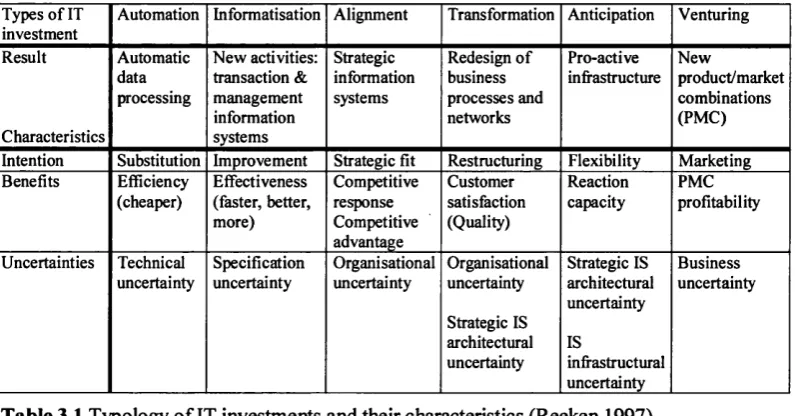
Table 2.1 The contrasting conventional and constructivist belief systems, copied from Guba and Lincoln (1989, p. 84, original emphasis)...32 Table 3.1 Typology o f IT investments and their characteristics (Reeken 1997)... 59 Table 3.2 Contrasting theorems from conventional and constructivist belief systems
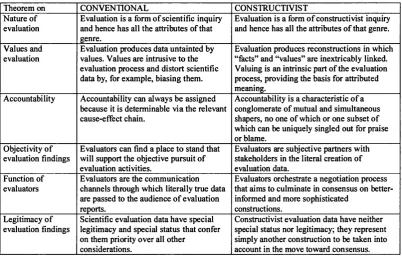
specific to evaluation, based on Guba and Lincoln (1989, p. 1 0 9 - 111)... 71 Table 3.3 Understanding IT evaluation methods and their employment, based on (a
minimalistic version of) Morgan’s organisational metaphors (Morgan 1986; Walsham 1991)... 94
Lis to ff ig u r e s
Ac k n o w l e d g e m e n t s
Acknowledgments
Sincere gratitude for her guidance, assistance and support goes out to my supervisor Dr. Chrisanthi Avgerou. Without our inspiring discussions, this thesis would not have been what it is today.
I am also grateful to Professor Egon Berghout for being my initial source of inspiration with regard to the study, for standing by me and for helping to keep me motivated. For insightful ideas and interesting conversations, I owe many thanks to Dr. Nathalie Mitev.
The support I received from the partners and colleagues at M&I/PARTNERS has been extremely valuable from start to finish. They not only provided me with the financial means, but also helped me to acquire hands-on experience with IT evaluation methods. I would especially like to mention my colleagues Patrick van Eekeren, Peter van Dijk, Arend de Jong and Dennis Prins for their insights gained from their own personal experiences in the field and their unfailing sense o f humour. I am especially indebted to Simon Bremer for showing a tremendous amount o f faith in my capabilities. He has never let me down. His role o f supporting me in my studies has been successfully passed on to Jan Houben - also thanks to him.
I would like to give credit to Henno van Maanen, Rick Klompé, Ryan Peterson and Theo-Jan Renkema for their interest and useful comments during the first stages o f the research. Many thanks also to John Spangenberg, I also wish to acknowledge the people at IIC for devoting their time and effort to this research.
Ac k n o w l e d g e m e n t s
Thanks to my fellow PhD friends, in particular Evi Kopanaki and Justine Johnstone, for our broad-ranging discussions and for sharing the joys and worries o f academic research.
Finally, I wish to express my gratitude to my family and friends who provided continuous understanding, patience, love and energy. In particular, I would like to express a heartfelt thanks to my parents for their infinite support in my research endeavours.
Ch a p t e r 1
Chapter 1: The Paradox of Utilisation of IT Evaluation Methods in
Organisations
1.1 In t r o d u c t io n A]\D BACKGROUND
This research attempts to develop an understanding o f the employment process o f information technology (IT) evaluation methods in organisations. Since the widespread ^plication o f computerised systems in business, organisations have been struggling to improve how they manage their IT from a cost / benefit perspective. This struggle continues despite the fact that numerous researchers over the last decades have provided various methods, concepts and approaches to assist organisations in improving their grip on IT costs and benefits \ Surprisingly, the dissatisfaction with managing the contribution o f information systems (IS) to organisations has not led to the expected use o f formal IT evaluation methods which specifically take into account the IT characteristics such as intangible benefits and IT investment risks. This paradox is central to this thesis.
Our analysis is based on the premise that a deeper understanding o f the process o f IT evaluation method employment is needed to gain insight into how organisations employ an IT evaluation method to improve their IT cost / benefit management. Understanding this process o f employment is, at the very least, as important to the improvement o f IT cost / benefit management as is understanding the characteristics (i.e. content, such as the criteria) such a method requires to be successful in achieving its goals. The characteristics of IT evaluation methods are a topic that is widely discussed from various theoretical perspectives in the existing literature relating to IT evaluations. However, the matter o f how to incorporate such a method in an organisation remains largely unexplored in the field o f academic research.
Ch a p t e r 1
In this chapter we will give a brief overview o f the need and justification for this research. We will also touch on some relevant topics in order to establish the background for the research questions. These topics will be discussed further in the following chapters.
1.1.1 Management o f IT costs and benefits: an issue o f growing importance
With the increase o f expenditure in IT, the topic o f IT evaluation continues to be an important issue in the management o f IS. Statistics in the Netherlands show that in 1999 expenditures relating to IT in businesses and government were estimated at over € 12 billion, an increase o f almost 17% compared to 1997 (CBS 1999). Comparable growth figures have been reported in other developed countries (Willcocks and Lester 1999a), and throughout the last decade. Moreover, a large portion o f IT costs can be seen as wasted due to the failure o f IT projects (i.e. projects that are aborted or fail to deliver their expected benefits). An estimate by Berghout (2002) shows that approximately € 4 billion o f the total € 23 billion in Dutch IT expenditures^ are wasted by such failures on an annual basis.
With growing IT costs, the notorious reputation o f costly IT failures, together with the notion that IT has become a critical component o f business, senior managers seek evidence verifying the contribution o f IT to the success o f the business (Thorp 1998). The desire for this evidence is strengthened by current fears o f economic recession in many Western countries, driving the need for justification o f the high IT costs.
Since the introduction o f computers in organisations, there have been considerable developments in IT, allowing for new applications to be made available. These new applications have significantly impacted the way in which organisations use IT. More than just supporting functional processes, IT has been increasingly applied to the cores of businesses (Scott Morton and Rockart 1984). Farbey, Land et al. (1993) note three distinct phases in IT that have manifested during the last few decades. The first phase started when IT was applied to functional areas. It brought efficiency and
Ch a p t e r 1
effectiveness benefits. For example, automating the payroll reduced staff costs and automating stock control provided better information on stockouts and deliveries. In the second phase, IT became part o f the individual workplace in organisations and was typified by the benefits associated with using microcomputers (e.g. word processing brought improvement to office workers). The third and present phase shows IT being associated with transformations and effecting the whole organisation in its business processes, services and products. A more detailed account o f the changes effecting IT evaluation is given in section 3.2.3.
With organisations becoming increasingly dependent on IT (Earl 1989), management o f IT has become more crucial through the years. Steadily rising IT costs and higher expectations with regard to the benefits associated with IT have increased the need for understanding the costs and benefits related to IT.
Ch a p t e r 1
The issue o f IT evaluation as an important topic both for managers and for researchers is not new. Keen (1991, p. 11) stated at the beginning o f the nineties: “Many senior managers feel caught in a trap. They feel that their firm carmot afford not to invest in IT, for many reasons o f competitive necessity; but they also think that they cannot afford to invest without clearer evidence o f its impact on financial performance.” He argues that senior managers lack a well-established management process for taking charge o f IT. Farbey, Land et a l (1993, p. 4) stated that “for the past three decades managers have expressed concerns about the value they are getting fi-om IT investments, and for the past three decades they have been searching for an ideal way o f solving the problems. [...] The problem o f finding convincing methods o f justifying expenditure on information systems appeared high on [...] the list [of critical management issues].” A recently published journal for senior executives states on the topic: “[Today] it is hard to pick up an IT-oriented publication that does not devote lots o f ink (or pixels) to cost /benefit analysis and justification for investments. [...] We have seen it before. Recessions from 1970 on have brought forth lots o f methodical approaches to IT cost-justification” (Clermont 2002). It is debatable whether such a development is strictly related to economic recession. Van Eekeren and Nijland (2003) argue that IT cost / benefit management continues to be a topic o f concern for organisational managers, irrespective of the economic climate. They note that in an economic depression cost-justification might receive more attention, but in economic better times, managers still face the task of proving insight into the potential benefits o f IT investments and allocating scarce resources to them - with IT capacity rather than financial means as the scare resource.
Ch a p t e r 1
In sum, we can conclude a growing importance o f economic management o f IT and inherently connected to it, the topic o f IT evaluation. The importance is noted both in organisational practice as well as in academic research.
1.1.2 Problems in evaluating IT
The literature suggests that organisational managers as well as IS professionals recognise IT evaluation to be one o f the important unresolved concerns in information management (e.g. Farbey, Land et al. 1993; Grembergen and Bloemen 1997). Evaluation o f IT investments is problematic not only because o f the inherent difficulties of evaluation (such as making estimates for future situations), but also due to typical characteristics o f such investments in comparison with other investments (Ballantine, Galliers et al. 1995). IT projects typically have numerous intangible costs and benefits, and they have a significant impact on many aspects within the organisation. These projects remain innovative and often involve (non proven) technology. Moreover, IT investments have a shorter life cycle due to continuous technology development. Whether IT projects really are different from other business projects remains a topic o f debate (see the discussion in section 3.2.4), but clearly IT projects pose several difficulties in managing them from a cost / benefit perspective.
Ch a p t e r 1
strategic benefits o f IT investments, such as quality improvement, cost avoidance and risks reduction are difficult to assess and inherently hard to quantify. Furthermore, the actual organisational benefits o f an IT investment depend on the secondary effects that occur due to changes that were initiated by the investment. For example, the increased number o f customers o f an organisation (secondary benefit) due to an investment in better quality products (primary benefit) is dependent on the effect that the customers acknowledge the quality improvement to be worthwhile. This not only results in benefits occurring at some distant point in the future, but also makes it harder to link acquired benefits directly to the specific IT investment. Similarly, investments in IT infrastructure will only prove profitable if the infrastructure is exploited in an effective manner (Renkema 1998; Renkema 2000). Because o f the difficulty in financially estimating effectiveness criteria and the indirect secondary effects, these benefits are said to be intangible.
At first glance costs, as opposed to benefits, seem to pose little problem with respect to quantification since they are measurable the moment they occur. However, so- called ‘hidden costs’ contribute to the problematic nature o f IT investments (Keen 1991; Looijen and Vorst 1998). These include background IT management costs, the costs o f end-users helping each other solve IT related problems and the costs o f downtime in the case o f IT failure (Maanen 2000a). Moreover, (visible) IT costs are administered very differently at each individual organisation, making it very difficult to obtain a clear view o f the actual costs related to IT, For example, often 30% to 40% o f IT expenditures is allocated outside the formal IT budget (Keen 1991; Willcocks 1996b). There seems to be no generally accepted accounting norms for administrating IT expenses (Davamanirajan, Mukhopadhyay et a l 2002).
Moreover, not only the quantification o f benefits and costs but also their identification is a problem fi*equently related to IT investments (Ballantine, Galliers
et a l 1999). One o f the most common deficiencies is not the determination o f a poor
Ch a p t e r 1
Further problems with IT evaluation are related to the difficulties of IT project-risk assessment and uncertainty o f investment results. The fact that IT investments have organisational impacts which are hard to quantify coupled with the fact that evaluation is intrinsically subjective, based on individual value judgements (including political considerations), contribute to the ambiguity surrounding IT evaluation. As a result, systems do not have clear definitions for ‘success’ and ‘failure’. In addition, investment objectives might change over time due to evolving user requirements (Keen and Scott Morton 1978). These aspects make a viable comparison between prior expectations and final outcomes very difficult.
To address these IT evaluation problems, numerous methods and techniques have been developed in the past to aid organisations in managing and controlling IT costs and benefits (Wolfsen and Lobry 1998). However, in practice few o f these methods are used (Yan Tam 1992; Bacon 1992; Willcocks 1996a; Ballantine and Stray 1998).
1.1.3 The productivity paradox
Ch a p t e r 1
the steam engine (1765-1810) and the manufacture o f steel, railroads, textiles (1865 - 1910), electricity generators (1880 - 1925), automobiles (1900-1945), aeroplanes and other technological innovations (1935 - 1980).
Many researchers have insisted that IT does increase productivity (e.g. Brynjolfsson and Hitt 1998; Dewan and Kraemer 1998), but just as many have demonstrated the opposite (notably Strassmann 1985). Numerous reasons for the inability to show productivity growth because o f the implementation o f IT have been brought to light. For example, Brynjolfsson (1993) blames measurement errors, delayed benefits, the redistribution o f organisational activities rather than the increase o f organisational activities (“IT rearranges the shares of the pie without making it any bigger”) and mismanagement due to the lack o f explicit measurements o f the value o f information (e.g. management being overwhelmed rather than helped by more information).
The productivity paradox remains a topic o f debate. However, it can be concluded that the debate itself gives us reason to believe that current strategies o f computerisation do not readily produce expected economic and social benefits in a vast number o f cases and that technology alone, even good technology, is not sufficient to create social or economic value (Kling 1999). The debate on the productivity paradox stimulates the search for better ways o f IT evaluation and our understanding o f such evaluation itself (Willcocks and Lester 1999c), both in research and in practice. It increases the quest for (expost) evaluation to determine in retrospect what the contribution o f IT has been, but also beforehand (ex ante) evaluation, to assess if potential IT investments will be able to deliver benefits.
1.1.4 IT evaluation and its usage
Ch a p t e r 1
Despite the long list o f enhanced methods especially geared to evaluating IT, research (Yan Tam 1992, Willcocks 1996a, Ballantine and Stray 1998, Bacon 1992) shows that the traditional discounted cash flow appraisal techniques, such as cost
benefit analysis, payback time and return on investment still dominate IT evaluation.
These general methods do not account specifically for IT characteristics. Moreover, although they are widely used, they are not always trusted (Farbey, Land et al. 1993) or considered an important factor in decision-making by the organisations that use them (Ballantine and Stray 1998). This seems to suggest that frequently these techniques are being used in a more ritualistic manner - for example, as a means to gain project approval - rather than contributing directly to the evaluation purposes.
Hochstrasser (1994) concludes from his research that only 16 percent o f companies use rigorous methods to evaluate and prioritise their IT investments. Kumar (1990) shows in his research that only 30 percent of the organisations perform a post implementation evaluation on a majority (75 percent or more) o f their information systems.
Despite the huge variety o f evaluation methods especially constructed for a large number o f goals, uses and organisational contexts, their actual use falls short o f what one would expect. It is unlikely that this lack is to blame on evaluation methods not addressing the right characteristics (e.g. technical or economic criteria) for IT investments. Still, many new evaluation methods are being developed to improve certain characteristics, displaying minor revisions o f already developed - but unused - methods. Such developments still are justified by a reaction to conventional investment appraisal methods since “these [traditional] methods simply do not work in today’s sophisticated technology-led environments” (Irani and Love 2001). Such arguments however seem to ignore the abundance o f more advanced evaluation methods already available.
Ch a p t e r 1
interpretive perspective offers a major contribution to traditional evaluation practices. However, findings from Serafeimidis and Smithson (1995a) support the hypothesis that the adoption o f a method is not automatically solved by applying a different type o f IT evaluation methodology. They found in their introduction o f an interpretive IT evaluation methodology at an insurance organisation in the UK that the method only achieved a limited level o f success and in the end it fell into disuse (Serafeimidis and Smithson 2000).
1.2 Re s e a r c hb a c k g r o u n da n dr e s e a r c hq u e s t io n
1.2.1 Background of the research
To summarise the above, we notice that organisations attempting to employ IT evaluation methods do so to improve IT cost / benefit management, a topic high on the agenda o f business managers and executives. There are many studies and suggestions about what constitutes a successful approach to IT evaluation, but research shows that in practice few o f these approaches are used. The majority o f evaluations is performed using capital investment appraisal techniques, such as cost- benefit analysis, payback and return on investment. There are many arguments against using (exclusively) these techniques for IT evaluation, primarily because only financial aspects o f IT are considered which form just a small portion o f the real impact o f IT investments.
Ch a p t e r 1
The noticed interest from organisations in better IT cost / benefit management (reinforced by the great attendance by managers to IT cost / benefit seminars and the abundance o f publications on evaluating IT investments in both business journals and academic publications - see section l . I .l ) stands in contrast with the lack o f use o f evaluation methods that address the shortcomings in their management o f IT costs and benefits. It can therefore be hypothesised that the introduction o f advanced IT evaluation methods does not automatically happen simply by their existence.
1.2.2 Research purpose and question
The purpose o f this research is to develop an understanding o f the employment
process o f IT evaluation methods in organisations. It is hypothesised that
organisational (social and political) changes have to take place for IT evaluation practices to be employed. The aim o f the research is not (in the first place) to understand the characteristics of a ‘successful’ IT cost / benefit management, an area o f research which already has received considerable attention, but to understand how
the process o f employment o f IT evaluation methods occurs. Though we do not deny
the importance o f developing IT evaluation methods that better support IT cost / benefit improvement, there is still a considerable gap between having sophisticated IT evaluation methods and actually employing them. It is argued that this gap needs to be bridged if difficulties in IT cost / benefit management are to be addressed.
Ch a p t e r 1
The research question is: “Why do organisations generally seem to be unsuccessful in employing IT evaluation methods that help them in clarifying costs and benefits o f IT, even when they express the need for more insight into the costs and benefits of IT?”
Some words on the clarification regarding the use o f “costs and benefits”, “unsuccessful” and “employing” in the research question. Firstly, costs and benefits do not necessarily have to denote quantifiable financial terms, but can also incorporate (negative and positive) qualitative aspects. Secondly, the difference between success and failure can be classified by intent or result (based on Nagel 1990). In terms o f intent, the employment process is successful if it achieves its intended goals and a failure if it does not. In terms o f result, the employment is successful if its resulting benefits minus its costs are maximised or at least positive, regardless o f whether the benefits or costs were intended. Both intent and result can be determined quantitatively by measurement or qualitatively by assessing the desirability o f the results.
Ch a p t e r 1
method). In this thesis, we will address both meanings and see that both are very much interlinked.
Thirdly, notice that we use the term ‘employment’ rather than (arguably the more obvious) term ‘adoption’. The reason for this is that adoption has strong connotations associated with the diffusion and adoption theory by Rogers (1995). Although this theory is part o f our research, we would like to refrain from connecting ourselves beforehand too strongly to this theory, since we will also employ actor-network theory, which has a different vocabulary. In this thesis, employment means the ‘initial uptake and continuous use’ o f an IT evaluation method by an organisation.
1 3 St r u c t u r e OF THE THESIS
This thesis is organised into 8 chapters. Chapter 2 explores our research methodology. It discusses a number o f research paradigms and theoretical streams influential in IS research. Adhering to a constructivist position, the thesis describes an interpretive approach to this research and details the selection o f a case study.
Chapter 3 presents an overview o f the literature on evaluation, in particular IT evaluation and findings regarding its employment. Moreover, it highlights important views on the phenomenon o f organisations. This gives a broad perspective on the topics o f concern for this study.
Building on the previous chapters. Chapter 4 is devoted to describing the theoretical frameworks that guide the analysis o f the research. Two distinct theoretical approaches that help to understand the employment process o f IT evaluation methods are discussed: diffusion theory and actor-network theory. Their contributions and limitations are presented.
Ch a p t e r 1
The findings from the case study are analysed in Chapter 6. Firstly, the case is analysed by using the difïusion theory, which though insightful cannot fully explain some o f the elements in the case study in the case study. An actor-network theory discussion is then presented, giving a better understanding o f the events at the case study.
Chapter 7 addresses specifically the research question and its inherent paradox. Building on the case study from Chapter 5 and the analysis o f Chapter 6, it relates the findings to a new understanding o f evaluation and its employment process.
Ch a p t e r 2
Chapter 2: Research Methodology and Case Selection
2.1 In t r o d u c t io n
This chapter discusses the choice o f research methodology. All research is based on some underlying assumptions or beliefs about what constitutes ‘valid’ research, what the ‘underlying nature o f phenomena’ are and which research methods are appropriate (i.e. generate valid evidence). In order to conduct (or evaluate) research, it is important to be aware o f these often hidden and implicit assumptions. Researchers therefore should be explicit about the philosophical assumptions underlying their research (Orlikowski and Baroudi 1991). This chapter presents a number o f dominant research paradigms in IS research and subsequently explains the philosophical assumptions which are adhered to throughout this thesis. These paradigms will reappear throughout this thesis, showing themselves to be influential in both the field o f research (e.g. visible in Chapters 3 en 4) and in daily life (e.g. visible in the case study described in Chapter 5 and analysed in Chapter 6).
Acknowledging the social character o f the research and the phenomenon under study, this chapter further elaborates on various beliefs about the social versus the technical. Based on the philosophical foundations, we believe an interpretive approach is appropriate for our research and a case study strategy appropriate as research method. We describe how we conduct our research and how we have selected our case study. Finally, we discuss the background o f the researcher, hopefully giving the reader more insight into the way this research has been conducted and ultimately lead to the results presented here.
2.2 Re s e a r c hp a r a d ig m sa n dt h e o r e t ic a la p p r o a c h e s
2.2 .1 In tr o d u ctio n
Ch a p t e r 2
these particular paradigms is based on their contrasting views and their influence on different streams o f research, especially IS research.
We use the conventional, constructivist and critical paradigms only to the extent that it allows us to position our research. Specifically, the first two paradigms are a means o f contrasting two diverging research approaches while the last, the critical paradigm, is more adjacent to a constructivist paradigm but holds some perspectives that are beneficial to this thesis.
2.2.2 Philosophical assumptions
Philosophers ask themselves the following three types o f questions when trying to understand how we come to know what we know (Cuba and Lincoln 1989, p. 83):
1. The ontological question: What is there that can be known? What is the nature o f reality? What is truth?
2. The epistemological question: What is the relationship between the knower and the known (or the knowable)? What kind o f knowledge can be obtained and what are the limits o f knowledge?
3. The methodological question: What are the ways of finding out knowledge? How can we go about finding out things?
Ontology is concerned with the beliefs about physical and social reality, existence or
being. Ontological beliefs have to do with the essence o f phenomena under
investigation, beliefs about human rationality and beliefs about social relations (Orlikowski and Baroudi 1991). Are the empirical world and its phenomena assumed to be objective and therefore independent o f humans, or inherently subjective and hence existing only through the actions o f humans in creating and recreating it? What intentions are ascribed to the humans studied? For example, in the discipline of economics humans are believed to act out o f utility-maximising under limited access to information. How do people socially interact in organisations, groups and society? Social interactions may be viewed as inherently stable or orderly, or by contrast, primarily dynamic and conflictive.
Epistemology is concerned with the beliefs about the origin, nature and limits of
Ch a p t e r 2
knowledge? Common epistemological stances are a positivist world view, an
interpretive perspective and a critical view. A positivist research perspective, which
regards scientific knowledge as consisting o f regularities, causal laws and explanations o f an objective world (Ivari 1991), is dominant in Western science and in life in general, including in information systems research (Lyytinen and Klein 1985; Orlikowski and Baroudi 1991). Generally speaking, research is classified as positivist if there is evidence o f formal propositions, quantifiable measures of variables, hypothesis testing and the drawing o f inferences about a phenomenon from a representative sample to a stated population (Orlikowski and Baroudi 1991). Positivistic research has been critiqued to be inadequate and inappropriate in explaining the human, group, organisational and societal matters which surround information systems (Lee and Liebenau 1997; Susman and Evered 1978). Moreover, the search for universal laws is viewed to disregard historical and contextual conditions as potentially triggering events or influencing human action.
Ch a p t e r 2
Methodology is concerned with the research methods, approaches and techniques appropriate for gathering valid empirical evidence. It deals with the systems, rules and conduct o f inquiry (Cuba and Lincoln 1989). Research approaches commonly used in information systems research include laboratory experiments, field experiments, surveys various types o f case studies, action research and simulations (Galliers 1991a).
There is no one choice with regard to these ontological, epistemological and methodological issues. The set of choices people make is the basic belief system or paradigm which is defined as “the most fundamental set o f assumptions adopted by a professional community which allow them to share similar perceptions and engage in commonly practices” (Hirschheim and Klein 1989, p. 1201). By being explicit about the underlying assumptions o f an employed paradigm, the researcher can become more aware o f the assumptions and beliefs he or she brings to bear in his research. Each paradigm, while it helps to generate understanding, still has its own strengths and weaknesses. Applying different paradigms can also bring new and creative solutions and insights (Hirschheim and Klein 1989; Robey 1996; Benbasat and Weber 1996). Three diverging paradigms commonly adhered to in IS research are: the positivistic (or conventional), constructivist (or interpretive) and critical paradigm. These will be discussed below.
2.2.3 The conventional and constructivist paradigm
Cuba and Lincoln (1989) argue that for many centuries the conventional (or
positivistic, scientific^) paradigm has been the one to prevail. In contrast, there is the
less widely accepted constructivist (or interpretive^) paradigm. Both are contrasted
^ Other paradigms compatible with the conventional paradigm include the scientific and positivistic paradigms. In addition, links with respect to its objectivist nature can be made to the rationalist, functionalist, instrumentalist, structuralist and realist paradigms (Burrell and Morgan 1979). They all presume that positivistic assumptions are appropriate for sociology (Giddens 1979), though they differ in other respects (e.g. a researcher in the positivistic paradigm can epistemologically be seen to intervene in experiments, rather than be a completely exterior observer. However these paradigms share the notation that a researcher is more or less detached from the phenomenon under study, and has the ability to look from a (symbolic) distance what is going on - e.g. after the researcher has intervened. Functionalism holds the particular view that social phenomena can be explained by showing their function in the constitution and maintenance o f social order (Scherer 2003). etc.).
Ch a p t e r 2
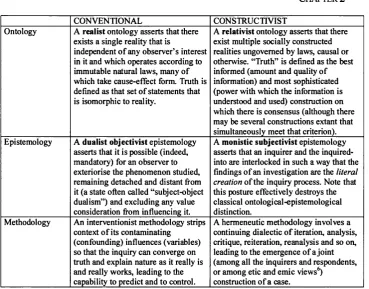
by the three types o f questions (ontological, epistemological and methodological) in Table 2.1. Notice that when the ontological posture is assumed, constraints are placed on the way in which epistemological questions can be answered^. For example, under the ontological assumption that an objective world exists, it is appropriate that the researcher assumes an objective distance from the phenomenon under study (i.e. with no or only very limited and controlled interaction), as to limit biases and prejudices. By contrast, under the assumption that reality consists o f a series o f mental constructions, the researcher is required to interact with the phenomenon and its context. So too, the answers to the methodological questions are dependent on both the ontological and epistemological assumptions. Some research approaches are more appropriate for certain assumptions than others (e.g. Galliers 1991a makes the distinction between scientific and interpretivist research approaches).
(e.g. an interpretive researcher is not always methodologically interested in coming to a joint construction o f the case, but can also settle for multiple constructions from various perspectives. Moreover, there may be stronger and weaker versions o f constructivism, for example, with regard to the multiplicity of reality. Interpretivism may acknowledge that a phenomenon may have different interpretations, whereas strong constructivism is inclined to argue that all phenomena have as many interpretations as there are interpreters - each having his/her own construction. Postmodernism stresses the concept of local truths defined by language games, rejecting any strive for unity and consensus, etc.). To acknowledge differences in similar paradigms (e.g. stronger and weaker versions o f the same paradigm) falls within the constructivist’s belief o f dissimilarities in social constructs - paradigms are after all also social constructs. Thus, paradigms are not fixed, stable bodies of knowledge that can be drawn on unquestionably by researchers, since the (shared) construct frequently is revised - as can be seen historically, for example, by the positivistic paradigm that was shaped by different schools o f researchers (Giddens 1979, p. 257) and, for instance, demonstrated by the different schools of functionalism (Scherer 2003). For a more in-depth and interesting discussion o f differences between various paradigms, see Scherer 2003.
Ch a p t e r 2
CONVENTIONAL CONSTRUCTIVIST Ontology A realist ontology asserts that there
exists a single reality that is
independent o f any observer’s interest in it and which operates according to immutable natural laws, many o f which take cause-effect form. Truth is defined as that set o f statements that is isomorphic to reality.
A relativist ontology asserts that there exist multiple socially constructed realities ungovemed by laws, causal or otherwise. “Truth” is defined as the best informed (amount and quality of information) and most sophisticated (power with which the information is understood and used) construction on which there is consensus (although there may be several constructions extant that simultaneously meet that criterion). Epistemology A dualist objectivist epistemology
asserts that it is possible (indeed, mandatory) for an observer to exteriorise the phenomenon studied, remaining detached and distant from it (a state often called “subject-object dualism”) and excluding any value consideration from influencing it.
A monistic subjectivist epistemology asserts that an inquirer and the inquired- into are interlocked in such a way that the findings o f an investigation are the literal creation o f the inquiry process. Note that this posture effectively destroys the classical ontologi cal -epi stemological distinction.
Methodology An interventionist methodology strips context o f its contaminating
(confounding) influences (variables) so that the inquiry can converge on truth and explain nature as it really is and really works, leading to the capability to predict and to control.
A hermeneutic methodology involves a continuing dialectic o f iteration, analysis, critique, reiteration, reanalysis and so on, leading to the emergence o f a joint (among all the inquirers and respondents, or among etic and emic views^
construction o f a case.
The contrasting conventional and constructivist belief systems, copied Table 2.1
from Guba and Lincoln (1989, p. 84, original emphasis)
The assumptions o f both paradigms relate to different beliefs about the relationship between knowledge and the empirical world (Orlikowski and Baroudi 1991). That is, what researchers believe they are able to accomplish with their research work.
The ontological assumption characteristic o f the conventional belief system is that there is a reality, in which things go on determined by certain laws, the root belief o f which is called determinism. The existence o f such driving laws leads the prime directive o f research (or science) in this belief, namely to predict and to control (Guba and Lincoln 1989). Control requires phenomena be made to act in desired ways. For researchers and scientists adhering to the conventional paradigm, research is about discovering causal laws; general laws and antecedent conditions that cause a phenomenon to occur. Its basis for explanation is founded on a
[image:34.595.96.466.106.395.2]Ch a p t e r 2
nomological model (Scherer 2003), where deduction from universal laws brings certainty about the occurrence o f a phenomenon. Realising that not all explanations o f empirical events make use o f deterministic laws, the conventional paradigm also makes use o f statistical laws (inductive and deductive-statistical models o f explanation). Prediction can be accomplished by relying on statistical-correlational bases, where the probability o f antecedents or likeliness o f the application o f general laws to a phenomenon are taken into account.
Ch a p t e r 2
deeper structure o f a phenomenon, which it is believed can then be used to inform other settings (Orlikowski and Baroudi 1991). They are not intended to ‘falsify’ theories, but to develop theories as ‘sensitising devices’ to view the world in a certain way (Klein and Meyers 1999).
2.2.4 The critical paradigm
In comparing and contrasting paradigms, Burrell and Morgan (1979) note that not only can paradigms be classified along a ‘objectivist-subjectivist’ dimension, as was done above, but also by an ‘order-conflict’ dimension^. The ‘order’ or unitary view emphasises a social world characterised by unity, order, stability, integration, consensus and functional coordination. Social groups and organisations are viewed as being united under an umbrella o f common goals and striving toward their achievement (Morgan 1986). It regards conflict as a rare and transient phenomenon, which can be removed through appropriate (managerial) action. By contrast, the ‘conflict’ or pluralist view stresses change, conflict, disintegration and coercion. The pluralist view emphasises the diversity o f individual and group interests. Formal goals are just o f passing interest to the social group and to organisations. It regards conflict as inherent and enduring and stresses the potentially positive or functional aspects o f it.
The conventional paradigm is located on the unitary side o f this spectrum. A paradigm that is typically located on the pluralist side is the critical paradigm. Ontologically speaking, it is compatible with the constructivist paradigm in that it adheres to the same premise that social reality is historically and socially constituted in human action and interaction. However, social reality is also understood to possess some global structural properties which tend to dominate human experience (Orlikowski and Baroudi 1991). Proponents o f the critical paradigm assume that people can consciously act to change their social and economic conditions, but does however also recognise that human ability to improve their conditions is constrained
Ch a p t e r 2
by various forms o f social, cultural and political domination as well as natural laws and resource limitations (Klein and Meyers 1999).
Moreover, the critical paradigm stresses the pluralist view in terms o f social relations which are seen to be inherently conflicting. Whereas the constructivist view deals with questions about the subjective meanings actors are creating and adheres to a
status quo o f the social order, the critical view makes an attempt to uncover and deal
with social conflicts and the distribution o f power (Scherer 2003). The contradictions inherent in existing social forms lead to inequalities and conflicts, from which new social forms emerge (Orlikowski and Baroudi 1991). An important objective of critical research is “to create awareness and understanding o f the various forms o f social domination, so that people can act to eliminate them” (ibid, p. 19). By promoting emancipation, the critical paradigm purports that people can enhance the opportunities for realising human potential (Alvesson and Willmott 1992a).
Epistemologically, critical researchers argue that interpretation o f the social world is needed, but not sufficient. In addition, the material conditions o f domination need to be understood and critiqued. This leads methodologically to interpretive research methods that go beyond the self-understanding o f participants and include critical analyses by means o f particular theoretical frameworks. There are, however, no commonly agreed upon and accepted theories or explanations in this respect yet (Orlikowski and Baroudi 1991). In fact, empirical analytical methods normally associated with the conventional paradigm can be considered completely legitimate both in the study o f natural and mathematical science as in the social sciences (Lyytinen and Klein 1985). The point is always to be critical about the methods employed and the suitability to the goals. The critical paradigm, on the other hand, tries to break open the exclusive validity o f traditional scientific methods in order to include the hermeneutic methods as well. No matter which methods are chosen, the researcher should always be aware o f their limitations and the validity as it relates to the research goals.
2.2.5 Theoretical approaches: the social and the technical
Ch a p t e r 2
the social and the technical in order to pinpoint our research approach. Different positions lead to different theoretical strands, a common occurrence in IS research. In this section we will discuss some o f these relationships to better establish our research methodology.
Seen as two extreme forms, there are theories favouring technological determinism on the one hand and theories favouring social determinism on the other. In the former view, information systems are regarded primarily as technical systems with social consequences. Problems regarding IT are technically complex and can be solved by using sophisticated technical solutions (tools, methods, models and principles). In the latter view, information systems are believed to be social systems that are technically implemented. They serve as the agent for significant social interactions, which implies their connection to human communication through the medium o f language (Hirschheim, Klein et a l 1995). IT thus is seen by its nature to be a social construction, since its existence depends on social institutions like language, the legitimacy and control o f power, social influences and other norms o f behaviour. In fact, it can be claimed from this perspective that all technological solutions are social solutions. Moreover, the design and management problems o f IS are regarded as dealing primarily with social complexity and only secondarily with technological complexity. Yet, the mainstream literature continues to deal with information systems as a one-dimensional technological issue (ibid, p. 2).
This perspective on information systems brings to bear certain assumptions about what is social and what is technical. Different beliefs or theories on this include technological determinism, social shaping and social determinism, socio-technical theories and the social construction o f technology. Relying on the views o f Knights and Murray (1994), these theories, their underlying assumptions and the degree to which they relate to the above-mentioned paradigms will be discussed below.
Technological determinism
Ch a p t e r 2
management performance, organisational structure and organisational behaviour, more so than (universal) administrative structures, interpersonal behaviour and leadership styles. For example, studies based on such theories demonstrate that the type o f technology used largely determined the levels o f conflict (Sayles 1958) and feelings o f job dissatisfaction (Blauner 1964) in organisations.
Innovation theories based on technological determinism argue that technologies develop within paradigms and logic that reside within these technologies. The primary drive for technological progress and diffusion is considered technology, relatively independent o f economic and social conditions (Nelson and Winter 1977). Ignoring the latter has been criticised as a major flaw in this aspect o f determinism. Its tendency to neglect environmental and socio-political contexts has been widely criticised. For instance, the ten-fold increase in computer calculation speeds every five years is not inherently linked to some technological trajectory or natural law (often denoted as Moore’s law, based on the paper by Moore 1965), but rather a self- fulfilling prophecy due to computer developers’ beliefs in the necessity for achieving competitive advantage (Mackenzie 1990).
Despite criticisms, Knights and Murray (1994) argue that technological determinism still has a firm place in research, though often only implicitly. IT is attributed an inherent progressive role based on the supposedly innate qualities o f the technology. For example, IT has been accorded with forces that automatically make enterprises more effective, flexible and adaptable; that make them less hierarchical and more democratic; that increase their learning capabilities and their productivity as well. Technological determinism seems naive in ascribing such an autonomous and independent role o f “neutral” change agent to IT. As such, it has been criticised for ignoring the issues o f power and politics in organisational change. Technological determinism typically adheres to a conventional paradigm.
Social shaping and social determinism
Ch a p t e r 2
are not seen as neutral and are therefore political to some extent. Far from shaping society, technology itself is shaped by the interests o f powerful groups (e.g. scientific communities) or classes (e.g. capitalism), at least according to the proponents o f the social-shaping model. The global context o f broader cultural and socio-economic practices in society is considered paramount in mobilising support for particular technological decisions and strategies. For example. Carpenter and Feroz (2001) argue that in the context o f American state governments all resistance to generally accepted accounting principles will ultimately fail. Not due the merits o f the accounting techniques, but because o f the potency o f the institutional social pressures that result from the well-organised professional accounting in the governmental institutional field. On the far end, we find social determinism, which suggest all technological change is guided by an omnipotent and unseen hand that serves the capitalist or other interests. Technologies are perceived to be reified social relations. Through the medium o f technological artefacts, domination and exclusion hide themselves under the guise o f natural and objective forces (Latour 1999b). These theories are supported by a critical paradigm (see section 2.2.4).
Social shaping has been criticised for its narrow focus on political and social interests. As a result o f its restricted scope focusing on social interests, it neglects the broader contextual issues that may be more unintended and often contradictory to particular interests. Social and technical relations often occur not as the direct outcome o f the interests o f individuals or groups, but as their unintended consequences. Moreover, the explanatory status o f focusing on interests can be questioned since such interests are not autonomous forces that created themselves, but are often already an outcome o f the exercise o f power and other interests.
Socio-technical approaches
Ch a p t e r 2
Within IS research, a socio-technical approach is an attempt to understand the notion o f ‘information systems’ not only as technology, but to include the idea o f social practices as well. In the 1980’s, a socio-technical approach was visible in the practice o f systems development. It can be seen in the work of Markus and Robey (1988) who suggest an interactive approach when discussing the causal structure used in explaining IT-related change. Such an interactive approach posits that the way we use IT is a function of the interaction between both human choice and technological (and contextual) characteristics. Mumford and Hensall (1979) propose a participative approach in the design o f information systems. Davis, Bagozzi et a l (1989) discuss a technology-acceptance model to predict how users will respond to computer systems. This model aims to help in altering the nature o f the systems and the implementation processes to improve user acceptance. Agarwal and Prasad (1998) propose a socio- technical approach to systems design to make systems compatible with preferred workflows and behaviour patterns.
The socio-technical approaches share a common view o f the social issues related to technology in that they hold on to a ‘rational’ technical perspective, which is limited in understanding the social. In such, these approaches have been called ‘socially naive’ (Avgerou 2002, p. 54). Though these approaches acknowledge both a social and technical side to information systems, they are treated independently and viewed from a similar (realist) paradigm.
Another limitation o f the socio-technical approach is its lack o f regard for organisational politics. It grants technologists the role of a ‘neutral’ change agent in organisational change and system development, thereby overlooking the fact that there may not be a neutral position in terms o f desired goals or a shared notion on what constitutes a successful system. It favours a very rational view o f technological and organisational change in that it neglects the various interpretations o f what technology does and whether or not it is beneficial. Politics, unless they can be mobilised in favour o f managerial goals, are considered disruptive.
(technology-Ch a p t e r 2
led) paradigm, compatible with a conventional one. Rather than a “matter o f [...] ‘needing to understand the organisational context, the stakeholders and the politics involved’ (Meyers, Lee et al. 2000), which is ontologically realist, [socio-technical approaches should aim to] understand how a phenomenon is collectively constructed as real, which is ontologically constructivist“ (Mitev forthcoming).
Social construction o f technology
The approach o f the social construction o f technology challenges the boundary between the technical and the social. Denying all a priori distinction between what is social and what is technical, it argues that the world can be perceived to exist out o f heterogeneous networks (Law 1992) made up o f human and non-human actors. The social construction o f technology denies giving a dominant role to either the technical (e.g. in technological determinism) or the social (e.g. in social shaping and determinism). Instead o f understanding technology as black-box with innate qualities, social constructionists seek to understand why particular technologies emerge and how they are adapted (Bijker, Hughes et al. 1987). They argue that the success or failure o f technological innovations is not just a matter o f technological attributes but dependent on the interpretative action from people in their social context. Moreover, technologies continue to be (re)shaped during their use.
Critiquing social shaping and social determinism, Latour (1999b, p. 198, original italics) argues: “Society is constructed, but not socially constructed. Humans, for million o f years, have extended their social relations to other actants with which and with whom they have swapped many properties and formed collectives.” He argues for more consideration o f the influence o f (technical) nonhumans in human action, since “humans are no longer by themselves” (ibid, p. 190). Technical artefacts, constructed in other times and other places, influence our current actions.