information.
Author(s):Wu, TinQin; Snailum, Nic P; Hosny, Wada
Title:Image processing techniques in a server robot waiterless restaurant
Year of publication:2006
Citation:Wu, T.; Snailum, N.P; Hosny, W. (2006) ‘Image processing techniques in a server robot waiterless restaurant’Proceedings of Advances in Computing and Technology, (AC&T) The School of Computing and Technology 1st Annual Conference, University of East London, pp.162-166
Link to published version:
IMAGE PROCESSING TECHNIQUES IN A SERVER ROBOT
WAITERLESS RESTAURANT
TinQin Wu, Nic P. Snailum, Wada Hosny
Control Research Group[email protected], [email protected], [email protected]
Abstract: A method is presented which locates the centres of circles of known radius in an image
containing clutter and Gaussian noise. This is used in a simulation to provide a robot server with the plate locations on a table- top. It is demonstrated to be robust to image noise and clutter.
1. Introduction
Robot vision is the science that develops the theoretical and algorithmic basis for automatically analysing and extracting information from an observed image of an object or item using image processing techniques (Haralick, 1992). The automatic analysis of the image is a highly desirable goal with a wide range of possible applications. The present paper applies this technique to one aspect of a server robot serving customers in a restaurant.
A simulation approach to locating dishes of a circular shape is presented. In respect of the fast development of vision controlled robotic technology and the wide use of unmanned working environments, Beijing Liankechuangtong Limited Corporation (Beijing,China), the University of East London and Automation College of Beijing Union University are collaborating to generate a microprocessor-based image processing system to interpret camera images as the ‘brain’ does for images from the ‘eye’, and extract relevant information. The image processing system will comprise a number of basic components.
Although the exact details may differ, the underlying principles involved are common to all systems. They consist of some sort of
‘eye’ which receives the light from the scene and converts it to an electrical signal. This signal has to be converted to a digital form acceptable to the computer, which one might consider as the brain of the system.
There will also be devices for the storage and retrieval of data, the output of data and for communication between the different parts of the system. The ‘eye’ is normally either a video camera or a solid state electronic image sensor.
Hoose (Hoose, 1991) developed a system for automatically detecting roundabouts in low resolution images, to enable traffic to be monitored. The main focus in this investigation is to illustrate using an image processing simulation the possibility of locating the centers of circular dishes on a table to enable the server robot to locate the circumference of these dishes assuming that their radii are known.
2. Tabletop image model
Figure 1 Tabletop model
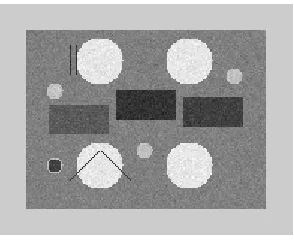
a tabletop containing circular plates and various other clutter in the form of shapes and greyscales. To this has been added Gaussian noise to simulate real conditions. Low resolution (160x120 pixel) images are used to increase processing speed, and to determine if the resolution is sufficient for the task in hand. The tabletop model is shown in Figure 1.
3. Circle location
There are several methods of automatically detecting circles in images, the most appropriate in a given situation depends upon the a-priori information available. In this case it is assumed that the circle radius is known, and the process proceeds by several stages. Firstly edge pixels in the image are detected, followed by calculating the angles of each edge pixel. There are many well established methods of locating edge pixels, but some are more prone to noise, and others are not so accurate in determining the edge angles. The two processes are conveniently and accurately performed using the Sobel edge detection mask, (Davies, 1997). In order to calculate the edge angles, two masks are applied to the image, one to locate horizontal edge components and the other to locate vertical edge components. The overall edge magnitude is calculated by vector addition using Pythagoras, though this is not always
scalar addition in many instances. In this paper we have used the more accurate method, but it remains to be tested whether the more efficient method is accurate enough. A Hough style accumulator of size equal to the image is then used to locate the circle centres. It proceeds as follows: At all edge pixel locations, a notional line is constructed normal to the edge tangent, and the point at a distance equal to the radius is added to the Hough accumulator. When all edge pixels and angles have been processed, the Hough accumulator contains an accumulation of all possible ‘circle centres’. The locations in the accumulator with the highest values indicate the most probable location(s) of circle centres of that particular radius in the image.
Note: If the circle radius had been unknown then an extra stage of processing would be required in order to project the edge normals by a ‘variable radius’ and thus accumulate each potential circle centre along the length of the normal instead of only at the known radius distance.
4. Results
Figure 2(a) Tabletop model
Figure 2(c) Sobel ‘vertical’ edges
Figure 2(e) Sobel combined edges
Figure 2(g) Edge normals projected to radius distance
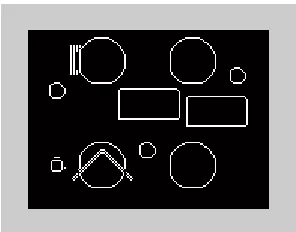
Figure 2(b) Edges using Matlab’s Sobel function
Figure 2(d) Sobel ‘horizontal’ edges
Figure 2(f) Sobel edge angles
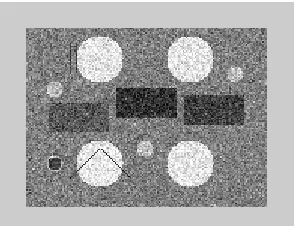
[image:4.595.341.489.106.222.2] [image:4.595.340.490.263.374.2] [image:4.595.341.490.414.531.2] [image:4.595.105.254.415.531.2] [image:4.595.342.489.567.683.2] [image:4.595.105.254.570.681.2]are shown in Figure 2(f), where again the two edges can be observed encoded for display purposes. Figure 2(g) shows some of the edge normals projected to the known radius of the circles being detected, where a concentration of points at the true circle centres indicates correct operation of the algorithm. It is noted however that there are also pixels forming a larger circle whose centres are coincident with the true centres. These are due to the ‘second edge’, whose normal points in the opposite direction and could be removed or reversed to give a more accurate centre location. Higher levels of noise were introduced into the model to determine its effect on the centre locations. As expected, more noise produces accumulator peaks which are more scattered and less accurate, as shown in Figures 3(a) and (b). The noise primarily affects the edge angles, which due to projection is amplified when the probable circle centre is plotted. In order to determine the circle centres, one final processing stage is required. The accumulator is found to be noisy producing many local maxima, so that a smoothing operator applied helps identification of the correct location. The smoothed accumulator is shown in Figure 4(a), and the accuracy of the method is indicated in Figure 4(b) which shows a line intensity profile of the accumulator in Figure 4(a) at the position
Figure 4(a) Hough accumulator smoothed using 5x5 box filter
Figure 3(a) Tabletop image with Gaussian noise 0.01
Figure 3(b) Hough accumulator with Gaussian noise 0.01
indicated. The correct centre indices are at coordinates 50 and 110. Low resolution images have been used which give a worse location performance than high resolution images due to quantisation of edge angles, but provide sufficient accuracy for the task in hand. The peaks differ in height due to the noise in the image. Finally a real image has been tested using the method described. The
0 20 40 60 80 100 120 140 160 0
0.5 1 1.5 2 2.5
Figure 4(b) Line profile of Hough accumulator at position indicated
Relative intensity
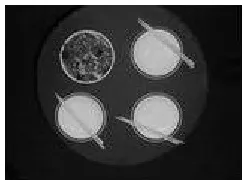
[image:5.595.342.489.107.220.2]Figure 5(a) Real tabletop image Figure 5(b) Hough accumulator for (a)
original tabletop image is shown in Figure 5(a), and the Hough accumulator is shown in Figure 5(b), from which it can be seen that the process works for real images.
5. Conclusion and Further Work
A method has been demonstrated by simulation to locate the centres of circles in an image. The method is robust to noise and clutter, and though not demonstrated here, the method is also robust to occlusion of the circle circumference. This is applied to the problem of locating plates on a tabletop for a server robot in a waiterless restaurant. The Sobel filter used produces two edges, but only one edge has been used in this work, the other produces noise in the accumulator
which should be removed in future iterations of the method.
6. References
Davies E.R., Machine Vision, Theory Algorithms Practicalities, Academic Press, California, 1997, pp. 211-269.
Haralick R.M., Shapiro L.G., Computer and Robot Vision, University of Washington, 1992, pp.1-34.
[image:6.595.362.483.133.226.2] [image:6.595.110.232.134.225.2]