Georgia State University
ScholarWorks @ Georgia State University
Mathematics Theses Department of Mathematics and Statistics
12-16-2015
Numerical Solutions to Two-Dimensional
Integration Problems
Alexander Carstairs
Follow this and additional works at:https://scholarworks.gsu.edu/math_theses
This Thesis is brought to you for free and open access by the Department of Mathematics and Statistics at ScholarWorks @ Georgia State University. It has been accepted for inclusion in Mathematics Theses by an authorized administrator of ScholarWorks @ Georgia State University. For more information, please [email protected].
Recommended Citation
NUMERICAL SOLUTIONS TO TWO-DIMENSIONAL INTEGRATION PROBLEMS
by
Alexander D. Carstairs
Under the Direction of Valerie Miller, PhD
ABSTRACT
This paper presents numerical solutions to integration problems with bivariate integrands. Using
equally spaced nodes in Adaptive Simpson’s Rule as a base case, two ways of sampling the domain
over which the integration will take place are examined. Drawing from Ouellette and Fiume,
Voronoi sampling is used along both axes of integration and the corresponding points are used as
nodes in an unequally spaced degree two Newton-Cotes method. Then the domain of integration
is triangulated and used in the Triangular Prism Rules discussed by Limaye. Finally, both of these
techniques are tested by running simulations over heavily oscillatory and monomial (up to degree
five) functions over polygonal regions.
NUMERICAL SOLUTIONS TO TWO-DIMENSIONAL INTEGRATION PROBLEMS
by
Alexander D. Carstairs
A Thesis Submitted in Partial Fulfillment of the Requirements for the Degree of
Master of Science
in the College of Arts and Sciences
Georgia State University
Copyright by Alexander D. Carstairs
NUMERICAL SOLUTIONS TO TWO-DIMENSIONAL INTEGRATION PROBLEMS
by
Alexander D. Carstairs
Committee Chair:
Committee:
Valerie Miller
Rebecca Rizzo
Michael Stewart
Electronic Version Approved:
Office of Graduate Studies
College of Arts and Sciences
Georgia State University
ACKNOWLEDGMENTS
I would like to first thank my thesis advisor, Valerie Miller, for everything she has done to
help me complete this thesis. I would to also thank my committee members, Rebecca Rizzo and
Michael Stewart, for their feedback during the editing process. I am also grateful for all of my
classmates that have shared their wisdom and support throughout this process. Finally, I would
TABLE OF CONTENTS
ACKNOWLEDGMENTS . . . iv
LIST OF FIGURES . . . vii
LIST OF TABLES. . . viii
Chapter 1 INTRODUCTION . . . 1
1.1 Voronoi Sampling . . . 2
1.2 One-Dimensional Newton-Cotes Quadrature . . . 5
1.3 Delaunay Triangulation . . . 8
Chapter 2 ALGORITHMS . . . 12
2.1 Point Insertion Algorithms . . . 12
2.2 Incremental Delaunay Triangulation Algorithm with Edge Flips . . . 16
2.3 Complexity . . . 17
2.4 Delaunay Integration . . . 19
2.5 Monte Carlo Integration . . . 21
Chapter 3 IMPLEMENTATION AND NUMERICAL RESULTS . . . 25
3.1 Implementation . . . 25
3.2 Integrands . . . 27
3.3 Results . . . 28
Chapter 4 CONCLUSIONS AND FUTURE WORK . . . 39
Appendices . . . 42
Appendix A VORONOI SAMPLING MATLAB CODE . . . 43
Appendix B VORONOI NEWTON-COTES MATLAB CODE . . . 45
Appendix C DTRIS2 MATLAB CODE . . . 49
Appendix D BOWYER-WATSON ALGORITHM MATLAB CODE. . . 56
Appendix E RESULTS TABLES . . . 69
Appendix F SURFACE FIGURES . . . 74
LIST OF FIGURES
1.1 Descartes’ Diagram . . . 2
1.2 Delaunay Criterion . . . 3
1.3 2D Voronoi Diagram . . . 4
1.4 Voronoi Sampling . . . 4
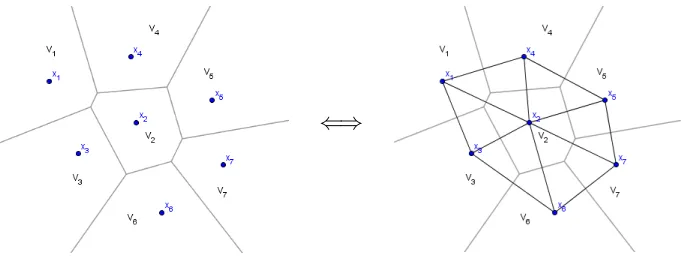
1.5 Voronoi Diagram to Delaunay Triangulation . . . 9
1.6 Delaunay Criterion . . . 9
2.1 Bowyer-Watson Algorithm . . . 14
2.2 Edge Swapping . . . 16
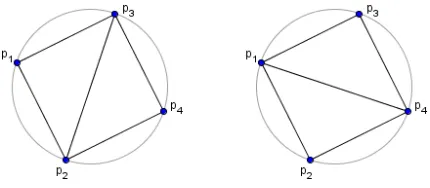
2.3 Circumcircles and containment for triangulations of four points [13] . . . 18
LIST OF TABLES
1.1 Delaunay triangulation of 110 points . . . 11
2.1 Lawson’s algorithm. . . 13
3.1 Voronoi Newton-Cotes v. Adaptive Simpson’s Rule on Monomials Condensed . . . . 29
3.2 15000 Max Iteration of Voronoi Newton-Cotes v. Adaptive Simpson’s Rule . . . 30
3.3 Voronoi Newton-Cotes v. Adaptive Simpson’s Rule on Monomials Add. Pts. Con-densed . . . 31
3.4 Voronoi Newton-Cotes v. Adaptive Simpson’s Rule on Functions A-F . . . 31
3.5 Graphs of Functions A, B, C, D, E and F . . . 32
3.6 Condensed Simpson’s Cubature Rule v. Adaptive Simpson’s Rule on Monomials . . 33
3.7 Voronoi Newton-Cotes v. Adaptive Simpson’s Rule on Functions A-F . . . 34
3.8 Graphs of Functions A, B, C, D, E and F . . . 35
3.9 Condensed All Methods on Monomials Accuracy Only . . . 36
3.10 Condensed All Methods on Monomials Time Only . . . 37
3.11 All Methods on Functions A-F Accuracy Only . . . 37
3.12 All Methods on Functions A-F Time Only . . . 38
3.13 Graphs of Functions A, B, C, D, E and F . . . 38
E.1 Voronoi Newton-Cotes v. Adaptive Simpson’s Rule on Monomials . . . 69
E.2 Voronoi Newton-Cotes v. Adaptive Simpson’s Rule on Monomials Add. Pts . . . . 70
E.3 Simpson’s Cubature Rule v. Adaptive Simpson’s Rule on Monomials . . . 71
E.4 All Methods on Monomials Accuracy Only . . . 72
E.5 All Methods on Monomials Time Only . . . 73
F.1 Graphs of Monomial Functions . . . 74
Chapter 1
INTRODUCTION
The subject of numerical integration is an essential topic in any numerical analysis course, and
while there has been extensive research into numerical techniques, there is no unifying technique
that works for all integrands. Choosing a technique can be based on many factors, but ultimately
the decision will depend on the application. In the field of computer graphics, numerical integration
is essential in determining the lighting of an object. In [9], Fiume and Ouellette outline several
techniques for applications in computer graphics problems all of which must balance the numerical
efficiency of the method with the aesthetics of the final image, i.e. sacrificing numerical accuracy for
a better looking image. One of the methods outlined by Fiume and Ouellette is a one-dimensional
Voronoi diagram-based sampling of the domain of integration. In this thesis this sampling technique
will be expanded in two ways.
The first method is to perform the one-dimensional Voronoi sampling described in [9] along
each axis of integration to get two sets ofn points. Then the Cartesian product of those two sets
is taken to create an n×n grid of nodes, which can then be used in a quadrature method. The
second method will be to triangulate the domain of integration using a Delaunay triangulation.
These methods will be described in greater detail along with some relevant background theory of
each in Chapters 1 and 2, respectively. The Voronoi sampling will be implemented in an adaptive
Newton-Cotes method of degree two, and the Delaunay triangulation will be implemented in the
midpoint, trapezoidal and Simpson’s rules described in [3]. These methods, along with adaptive
Simpson’s rule and Monte Carlo integration, will be used to integrate a variety of test functions
described in [14] and the set of monomials given in [8]. The results of these numerical simulations
1.1 Voronoi Sampling
In this section, the reader is introduced to the basics of Voronoi diagrams. The following
definitions of the Voronoi diagrams are consistent with those given in [2] and [9]. The topic of
Voronoi diagrams dates back to the 1600s to Descartes where he used the idea that a set S of
sites(point sites)pin a space M are given and theregionof a site p consists of all pointss such
that the influence of p is the strongest. This concept emerged independently in various fields of
science such as biology to model and analyze plant competition; robotics to find an optimal path
to avoid a set of obstacles; and meteorology to determine regional rainfall from a discrete set of
rain gauges. In most of these cases, names particular to the field of study have been used, e.g.
Thiessen polygons are used in meteorology. The mathematicians Dirichlet and Voronoi would be
the first to formally introduce the concept while working with quadratic forms, and the resulting
[image:12.612.237.380.353.578.2]structure has been given the name Dirichlet tessellation or Voronoi diagram [2].
Figure 1.1. Descartes’ diagram of the regions of influence for point sites [2]
Definition 1.1.1. LetS ⊂R2 be a set of points x
1, x2, . . . , xn for n≥ 3 andp∈R2 with d(xi, p) given as some metric. For anyxi, xj ∈S and i6=j, let
be the bisector ofxi and xj, i.e. B(xi, xj) is the perpendicular line through the center of the line
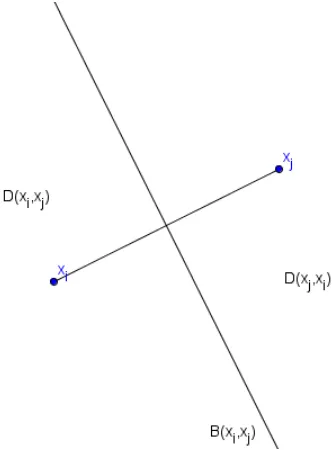
segment connectingxi and xj. Thus, the bisector separates the halfplane
D(xi, xj) ={p|d(xi, p)< d(xj, p)}
[image:13.612.225.391.197.422.2]containingxi from the halfplane D(xj, xi) containing xj.
Figure 1.2. Dividing halfplanes with bisector.
Using the halfplane described above, the Voronoi diagram can now be defined.
Definition 1.1.2. Let the Voronoi region of xi be given as
Vi =V(xi, S) =
\
xj∈S,i6=j
D(xi, xj)
with respect to S where Vi is an open set in the topological sense. Then the Voronoi Diagram of
S is defined as
V(S) = [
xi,xj∈S,i6=j
Vi∩Vj
whereV is the closure of set V, i.e. the open set V unioned with its boundary.
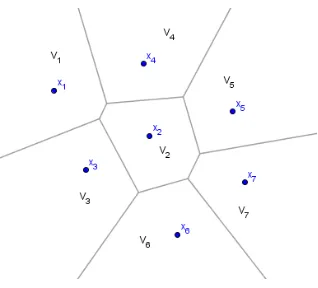
Figure 1.3. 2D Voronoi Diagram
a randomly chosen number from the uniform distribution over (a, b). Then the next n points are
determined by constructing the Voronoi regions corresponding to the location of the sample points
that already exist in the sequence. Let Vi represent the Voronoi region of xi and be defined as
Vi ={x∈[a, b]| |x−xj| ≤ |x−xi|, for all j ∈[1, n+ 3]}
for i ∈ [1, n + 3]. Let VM be the longest line segment as defined above with ties being broken
randomly. The next sample point in the sequence would the midpoint of the line segment
corre-sponding toVM. The abbreviationVmis used to denote a Voronoi sampling sequence ofnadditional
points wherem=n+ 3. In Fig 1.4, a quick example of the Voronoi sampling is given. Let a=−2,
b= 10 and x3 = 5. First, the midpoint (bisector) between the three points is found, which give us
m1 = 1.5 and m2 = 7.5. Then each Voronoi region is formed: V1 = (−2,1.5), V2 = (7.5,10) and
V3 = (1.5,7.5). Since V3 is the longest Voronoi region, the next point to be added to the sequence
isx4 = 4.5. The code written in MATLABc is given in Appendix A.
[image:14.612.128.485.588.630.2]1.2 One-Dimensional Newton-Cotes Quadrature
Now it is necessary to derive a generic one-dimensional quadrature method for integrating
over [a, b]. Given three arbitrary points a, m and b, where a < m < b, Lagrange interpolation is
used to find a degree two polynomial to approximate our functionf(x). This polynomial is given
by
p(x) =
3
X
j=1
f(xj)Lj(x),
whereLj(x) is the Lagrange polynomial
Lj(x) =
3
Y
i=1,i6=j
x−xi
xj −xi
, j = 1,2,3
Thus,p(x) may be written as
p(x) =
3
X
j=1
f(xj)Lj(x) =f(a)
(x−m)(x−b)
(a−m)(a−b) +f(m)
(x−a)(x−b)
(m−a)(m−b)+f(b)
(x−a)(x−m) (b−m)(b−a) =τ
(1.2.1)
Assuming thatp(x) approximates some function f(x) that needs to be integrated then
Z b
a
f(x)dx≈ Z b
a
p(x)dx=
3
X
j=1
wjf(xj) =w1f(a) +w2f(m) +w3f(b),
where the weightswj are given by
wj =
Z b
a
Lj(x)dx.
All of these steps are similar to those for the derivation of an arbitrary Newton-Cotes method
using equally spaced points and are given in almost any numerical analysis textbook. Indeed, a
derivation of Simpson’s rule (sometimes referred to as Simpson’s 1/3 Rule) generally follows from
1.2.1 by exploiting the equal spacing of the points and gives a nice simplification.
Setting up a general spacing of points yields
b−m=α
a−m=−cα,
which simplifies the right hand side of Equation (1.2.1) to get
τ = 1
α2c(1 +c)[f(a)(x−m)(x−b)−f(m)(1 +c)(x−a)(x−b) +cf(b)(x−a)(x−m)] (1.2.2)
To find the weights w1, w2 and w3 of f(a), f(m) and f(b), respectively, the function g(x) =
(x−u)(x−v) is integrated, which yields
Z b
a
(x−u)(x−v)dx= 1 2
(b−u)(b−v)2−(a−u)(a−v)2−1
6
(b−v)3 −(a−v)3=γ.
The right hand side of the above equation, γ, can then be simplified further according to the
following values ofu and v:
(i) If u=m, v=b: γ = 16α3(1 +c) (2c−1)
(ii) If u=a, v=b: γ =−1 6α
3(1 +c)3
(iii) Ifu=a, v=m: γ =−1 6α
3(1 +c)2(c−2)
Replacing the weights in (1.2.2) with the values above and simplifying gives
3
X
j=1
f(xi)Lj(x) =
α(1 +c) 6c
(2c−1)f(a) + (1 +c)2f(m) +c(2−c)f(b) .
This gives us our quadrature formula
I(f) =
Z b
a
f(x)dx≈ α(1 +c)
6c
(2c−1)f(a) + (1 +c)2f(m) +c(2−c)f(b) =I(p).
For the error, the equation
R(x) = I(f)−I(p) =
Z b f000(α)
is examined, and the function f is assumed to be at least three times differentiable over [a, b].
Since the cubic polynomial function changes sign over the interval [a, b], R(x) is broken into two
integrals in order to apply the weighted Mean-Value Theorem for Integrals:
R(x) = f
000(α
1)
6
Z m
a
(x−a)(x−m)(x−b)dx+ f
000(α
2)
6
Z b
m
(x−a)(x−m)(x−b)dx,
whereα1 ∈(a, m) and α2 ∈(m, b). It is now clear that only the general form of the integral above
is needed in order to proceed with the error analysis. Thus,
β =
Z v
u
(x−a)(x−m)(x−b)dx
= (v−u)
1
4(v+u)(v
2+u2)−a+m+b
3 (v
2 +uv+u2) + am+ab+bm
2 (u+v)−amb
.
Simplifyingβ according to the following values of u and v:
(i) If u=a and v =m: β = (m−12a)3 [2b−m−a]
(ii) If u=m and v =b: β = (b−12m)3 [2a−m−b]
gives the total error R(x) to be
R(x) = f
000(α
1)
6
(m−a)3
12 [2b−m−a] +
f000(α2)
6
(b−m)3
12 [2a−m−b]. (1.2.3)
Assuming thatf000 is essentially constant on [a, b], then
R(x)≈ A
6
(m−a)3
12 [2b−m−a] +
A
6
(b−m)3
12 [2a−m−b]
= A 72
(m−a)3[2b−m−a] + (b−m)3[2a−m−b]
= A
72(b−a)
3
[2m−b−a],
(b−m=α and a−m =−α) for the above error analysis, the same degree of accuracy for
Simp-son’s rule, but SimpSimp-son’s rule should have an extra degree of accuracy. The extra degree of accuracy
comes from the cancellation of the term containingf000 from the derivation of Simpson’s rule using
Taylor polynomials instead of Lagrange polynomials. To show this, Simpson’s rule is derived using
a Taylor expansion centered around the point m = b+2a to approximate f(x). Integrating the
Taylor expansion from a tob to yields
Z b
a
f(x)dx=f(m)(b−a) + f
0(m)
2
(b−m)2−(a−m)2+f
00(m)
6 [(b−m)
3−
(a−m)3]
+f
000(m)
24
(b−m)4−(a−m)4
+ f
(4)(ξ)
120
(b−m)5−(a−m)5
=f(m)(b−a) + f
0(m)
2
(α)2−(−α)2+ f
00(m)
6
(α)3−(−α)3+
f000(m) 24
(α)4−(−α)4+ f
(4)(ξ)
120
(α)5−(−α)5
= 2αf(m) +α3f
00(m)
3 +α
5f(4)(ξ)
60
= α
3[f(a) + 4f(m) +f(b)] +α
5f (4)(ξ)
60 .
The f0 and f000 terms cancel, and the additional degree of accuracy is gained for Simpson’s rule.
The Voronoi sampling and quadrature are implemented in the functionvadapt3 and are given
in Appendix B.
1.3 Delaunay Triangulation
According to Aurenhammer and Klein, Voronoi was the first to consider the dual of the
Voronoi diagram where he stated that any two point sites are connected if their regions share a
boundary. Later, Delaunay defined the dual in the following way:
Definition 1.3.1. Two point sites are connected if and only if the two sites lie on a circle whose
interior contains no point inS where S is the set defined in Definition1.1.1.
For this, the dual was given the name Delaunay tessellation or Delaunay triangulation. Given
a Voronoi diagram, one can easily construct a Delaunay triangulation by connecting the center
⇐⇒
Figure 1.5. Creating a Delaunay Triangulation from Voronoi diagram
it is not necessary to have a Voronoi diagram first. Using an alternate definition of a Delaunay
triangulation, a given triangulation can be checked to see if it is Delaunay.
Definition 1.3.2. A circumcircle is the circle that passes through the endpoints xi and xj for the
edge xixj and endpoints xi, xj and xk of triangle xixjxk for all combinations of i, j and k .
Definition 1.3.3. Let T be a triangulation with m triangles and a set of n points S where each
element ofS is a vertex of a triangleti ∈T for i= 1, . . . , m. T is consideredDelaunay if and only
if the circumcircle of every ti contains no other vertex in S.
Figure 1.6. Checking the Delaunay criterion holds for each triangle.
Both definitions 1.3.1 and 1.3.3 are known as the Delaunay criterion or empty circle
prop-erty for edges (1.3.1) and triangles (1.3.3), and are implemented in several algorithms used for
creating Delaunay triangulations. Since an edge only has two points, it can have infinitely many
circumcircles, but only one of the circumcircles has to be empty for the criterion to hold. On the
other hand, triangles will have a unique circumcircle defined by its three vertices, so there is only a
[image:19.612.247.373.430.554.2]that it maximizes the minimum angle of all of the triangles within the triangulation of a given set
of points, which helps avoid skinny triangles. As the number of triangles increases, the triangles
appear more uniform in size as shown in Table 1.1. This reduces the risk of peaks on the function
that is being integrated from being cut off by large skinny triangles, which improves the stability
of the calculations performed on the mesh. In graphics, the uniformity of the triangles yields a
Chapter 2
ALGORITHMS
There are three types of algorithms used in the construction of Delaunay triangulations:
incremental insertion algorithms, divide-and-conquer techniques, and a sweepline techniques. The
simplest are the incremental insertion algorithms, and they can be expanded to be used in higher
dimensions. The algorithms that use the divide-and-conquer or sweepline techniques are faster
than the incremental insertion techniques in two dimensions but are difficult to generalize (if at
all) to higher dimensions. To construct the Delaunay triangulation in this thesis, two algorithms are
combined: the methoddtris2from the GEOMPACK package and the Bowyer-Watson algorithm.
Both algorithms are incremental insertion algorithms, which means they maintain a Delaunay
triangulation into which points are inserted [5]. First, dtris2 is used to triangulate the set of
initial points including the vertices along the boundary of integration and a randomly chosen
point within the boundary. The centroid of the largest triangle is then inserted using the
Bowyer-Watson algorithm. In the following sections, each algorithm is examined and shown how they are
implemented into our integration problem.
2.1 Point Insertion Algorithms
The earliest incremental insertion algorithm was developed by Lawson [11] and is based on
edge flips. When a vertex is inserted, the triangle that contains the new point is found, and the
point is connected to the vertices of the containing triangle by inserting three new edges. (If the
new point falls on the edge of an existing triangle, the edge is deleted, and the point is connected
to the four vertices of the containing quadrilateral by inserting four new edges). The edges are
placed into a stack and are tested to determine if they pass the Delaunay criterion. If not, then
added to the stack, and the algorithm ends when the stack is empty yielding a globally Delaunay
[image:23.612.142.475.131.431.2]triangulation. A pictorial representation of Lawson’s algorithm is given below.
Table 2.1. Lawson’s algorithm.
In 1981 A. Bowyer and D. Watson simultaneously presented an algorithm that does not
depend on the use of edge flips and can easily be generalized to arbitrary dimensionality [11]. Our
implementation of the Bowyer-Watson algorithm is given below and starts
with already having a Delaunay triangulation of n points with a new point, xn+1, to be added.
1) Determine which triangle containsxn+1. Delete this triangle and add its neighbors to a stack.
2) Pop a triangle off the stack and determine if the new point is within the circumcircle of the triangle. If yes, delete the triangle and add the neighboring triangles to the stack.
3) Repeat 2 until stack is empty.
4) Triangulate the deleted region (The method dtris2 is used, which is discussed in the next section and our implementation is discussed in Chapter 3.).
Figure 2.1 shows the insertion of a point using the Bowyer-Watson algorithm. The Bowyer-Watson
algorithm can also be implemented from scratch with no preexisting triangulation. First, three
points are chosen that created a bounding triangle that encloses all of the points that need to
be triangulated. The algorithm as outlined above then follows. Once all of the points have
been inserted, the bounding triangle is then deleted along with all of its connections to the inner
[image:24.612.77.529.197.369.2]triangulation.
Figure 2.1. Bowyer-Watson Algorithm: A: Circumscribing circles that contain the new point with the edges to be deleted ; B: resulting triangulation
As stated above, this algorithm easily generalizes to higher dimensions. When the new point
is inserted, the tetrahedron that contains the point is found, deleted and its neighbors are placed
into a stack. The tetrahedra in the stack are then checked to determine if their circumsphere is
empty. If the circumsphere is not empty, then the corresponding tetrahedron is deleted. Once the
stack is empty, the empty polyhedron that is left is “triangulated” and the process is repeated
until all points are inserted [11].
In its simplest form, this algorithm is not robust against roundoff error, though. A degenerate
case can develop in which two triangles have the same circumcircle, but only one of them is deleted
due to roundoff error, and the triangle that is not deleted is between the new vertex and the
triangle that was not deleted. This gives an empty cavity that is not empty, and the resulting
triangulation of the cavity would be“nonsensical” [11]. This problem can be avoided by using
Lawson’s algorithm instead. Lawson’s algorithm is not absolutely robust to roundoff error, but
Bowyer-Watson algorithm can be implemented with a depth-first search of the containing triangle
and will perform equally as robust as Lawson’s algorithm. Another advantage of Lawson’s is
that it is slightly easier to implement due in part because the topological structure maintained
throughout the process stays a triangulation [11]. The Bowyer-Watson was chosen due to the nice
pairing that it has with the method dtris2 below. The method keeps track of a neighbor matrix,
which virtually negates the search time for the triangles that are effected by the new insertion
point. The time complexity is discussed in further detail in Section 2.3.
There are many other methods that can be used for creating a Delaunay triangulation such
as divide-and-conquer approaches. The first O(nlogn) algorithm to create a Delaunay
triangula-tion was a divide-and-conquer approach that first created a Voronoi diagram then was dualized to
form the Delaunay triangulation. Due to the unnecessarily complicated process, another
divide-and-conquer approach was developed that directly constructed a Delaunay triangulation. In this
approach, the existing set of points are recursively divided into two groups, each group is
trian-gulated separately, and the groups are then merged together [7]. This algorithm proved to be as
intricate and cannot easily be implemented in higher dimensions. The approach proved to not be
as useful as Bowyer-Watson for our application for two reasons. First, this approach could have
been used instead of the Bowyer-Watson algorithm, but it would triangulate the entire set of points
after every point insertion as opposed to Bowyer-Watson, which only requires the triangulation of
a small subset after each point insertion. Secondly, the divide-and-conquer approach could have
been used in place of dtris2, but since dtris2 is only used for small subsets of triangles, there
was no added benefit to using the divide-and-conquer approach given its intricacy.
Another well-known approach is the sweepline method. This algorithm can also be
imple-mented in O(nlogn), and it builds a triangulation by sweeping a horizontal line vertically across
the plane with the triangulation accreting below the sweepline. When the sweepline collides with
a vertex, a new edge is created connecting the vertex to the sweepline. Once the sweepline reaches
the top of the circumcircle of a Delaunay triangle, the algorithm determines there is no other
vertex inside that circumcircle; thus, the triangle is created. This method also has restrictions
generalizing to higher dimensions and is not as easily implemented as the incremental insertion
methods. Similar to the divide-and-conquer approaches, the sweepline algorithm assumes that the
Figure 2.2. A: Edge e1 is not locally Delaunay since there is no empty circumcircle, perform edge
swap; B: e0 is locally Delaunay; C: the left triangle does not have an empty circumcircle, so not Delaunay, perform edge swap; D: both triangles have empty circumcircles, so both are locally Delaunay
[7],[11].
2.2 Incremental Delaunay Triangulation Algorithm with Edge Flips
The methoddtris2as described by Joe [5] is a variation of the algorithm given by Sloan [12].
Sloan’s algorithm combines the techniques from the Bowyer-Watson and Lawson algorithms. First,
a super triangle is created that encompasses all of the points to be triangulated. Then a point P
is inserted into the triangulation. The triangle that containsP is found, andP is connected to the
three vertices of the containing triangle to create three new triangles. The Lawson flip algorithm is
then used to make sure the triangulation is still Delaunay. This process is repeated until all points
have been inserted [12]. Joe uses the same outline for dtris2 but disregards the initial bounding
triangle and initially sorts the points lexicographically [5]. The algorithm in dtris2 is outlined
below by starting with a set of pointsS that needs to be triangulated.
1) Sort S using an ascending indexed heap sort to obtain the sorted set of indices Ss.
2) Take the first three points according to Ss and create the first triangle.
3) Add the next point according to Ss and connect the new vertex to the vertices that are
“visible” to the new point.
4) Check to make sure the new triangles are Delaunay. If not, perform edge swaps until all
The code for dtris2 translated into MATLABc is given in Appendix C. A crucial component
of this algorithm is that edge swapping guarantees the new triangles created are both Delaunay.
Welzl [13] provides the following proposition and proof that guarantees any four points that are
not cocircular have exactly one Delaunay triangulation.
Proposition 2.2.1. Given a set P ⊂R2 of four points that are in convex position but not
cocir-cular. Then P has exactly one Delaunay triangulation.
Proof. LetP =pqrs be a convex polygon (as shown in Figure 2.3). There are two triangulations
ofP: a triangulation T1 using the edgepr and a triangulationT2 using edge qs. Now consider the
family C1 of circles through the edge pr, which contains the circumcircles C1 =pqr and C10 =rsp
of the triangles in T1. By assumption s is not on C1. If s is outside of C1, then q is outside of C10.
Consider the process of continuously moving from C1 to C10 in C1 (left image in Figure 2.3) then
point q is “left behind” immediately when going beyond C1 and only the final circle C10 “grabs”
the point s.
Similarly, consider the family C2 of circles through pq, which contains the circumcircles C1 =
pqr and C2 = spq, the latter belonging to a triangle in T2. As s is outside of C1, it follows that
r is inside C2. Consider the process of continuously moving from C1 to C2 in C2 (right image in
Figure 2.3). The point r is on C1 and remains within the circle all the way up to C2. This shows
that T1 is Delauny, where as T2 is not.
The case that s is located inside C1 is symmetric; just cyclically shift the roles of pqrs to
qrsp.
2.3 Complexity
Now the time complexity of the dtris2 method and the Bowyer-Watson algorithm are
ana-lyzed. LetT be the time it takes to triangulate a set of n additional points be given as
T =
n
X
k=1
Tk+Sk, (2.3.1)
where Tk is the amount of time it takes to find the triangle that contains the new point and Sk
Figure 2.3. Circumcircles and containment for triangulations of four points [13]
in dtris2, Sk = O(1) because it is proportional to the number of triangles in the cavity not the
number of points. The reason for this is that the search for the neighboring triangle becomes
obsolete as the number of points in the triangulation increases. Experimentally, the number of
triangles in the cavity per iteration is less than ten, so as n increases the number of triangles
affected stays essentially constant; thus, making Tk the dominating factor. In the worst case the
complexity of Tk is O(k), which gives us O(n2) [1]. This worst case scenario happens when all
existing triangles’ circumcircles contain the new point at every point insertion. However, in the
typical case, the number of triangles to be deleted at each point insertion does not depend on the
number of existing triangles as described above. Combining anO(nlogn) multidimensional search
for the triangle that contains the new point and the saved information of the neighbor relations
between triangles, the Bowyer-Watson algorithm computes the Delaunay triangulation ofn points
inO(nlogn).
In [5], Joe discusses the time complexity of dtris2 and determines it to also be O(mlogm).
Since the method is only used for the initial set of points and the vertices along the hull of the cavity
along with the new point, then asnincreases,mstays relatively constant and is significantly smaller
than n. Thus, the time complexity of dtris2 and Bowyer-Watson together is stillO(nlogn).
Whenever implementing a geometric algorithm, two problems always need to be addressed:
geometric degeneracies and numerical errors. For the Delaunay triangulation, four or more
co-circular points will result in a non-unique triangulation [6] as shown in Figure 2.3. In such a
increasing order, triangle p1p2p3 will be created first. The point p4 will be added and triangle
p2p3p4 is created. It then checks to make sure that the triangulation is Delaunay, which it is,
so the method will move to the next point without considering the triangulation on the right.
Another geometric degeneracy that needs to be considered is if three or more points are too close
to being co-linear. In this case,dtris2 checks for a “healthy” triangle when inserting a new point.
It determines this by checking if the third point is to the left or right of a directed ray between
the initial two points of the triangle. If the third point is within a certain tolerance of the directed
[image:29.612.201.416.244.338.2]ray, the method will break and return a fatal error.
Figure 2.4. Two valid Delaunay triangulations with four co-circular points.
Numerical errors are more difficult to handle. As discussed in Section 2.1, there is a degenerate
case for roundoff error in the Bowyer-Watson algorithm. Mavriplis also discusses this issue with
round-off error in [7]. In general, the nature of the problem will determine the accuracy
require-ments of the inputs and outputs. For our implementation, double-precision arithmetic is used, and
it proves to be very robust. An occasional error occurs when inserting several thousand points in
dtris2 that appears to happen when two points are too close to each other, which illustrates the
round-off error problems described in Section 2.1. Since the error rarely occurred, the iteration
was simply skipped but noted during the simulation process using a try/catch block.
2.4 Delaunay Integration
Now the triangulation of the integral domain is implemented in the triangular prism rules
described in [3] to approximate the integral
Z Z
D
function f(x, y) above with a two variable polynomial function p2 of total degree 2 whose values
at the points (x1, y1), (x2, y2), and (x3, y3) and (x1+2x2,y1+2y2), (x2+2x3,y3+2y3), and (x3+2x1,y3+2y1) are
equal to the values at f(x, y) at the same points. Then the “signed volume” under the surface
given byp2(x, y) is the “volume” of the paraboloidal triangular prism with its base Di, the lengths
of the 3 parallel edges equal to f(x1, y1), f(x2, y2), f(x3, y3), and the heights at the midpoints of
the sides are equal to the values of f(x, y) at those midpoints. This gives us a “cubature”[3] rule
in two variables that is analogous to Simpson’s rule in one-variable and is given by
Z Z
Di
f(x, y)dxdy≈ Area(Di)
3
f(x1+x2 2 ,
y1 +y2
2 ) +f(
x2+x3
2 ,
y2+y3
2 ) +f(
x3+x1
2 ,
y3+y1
2 )
,
(2.4.2)
whereDi ∈Dfor alli= 1,2, . . . , n. Although the 2D Simpson’s rule is the main method in which
our triangulation is implemented, the midpoint and trapezoidal equivalents described in [3] are
also used for added performance comparison.
For the midpoint rule, let (s, t) be the centroid of Di and replace the function f(x, y) from
2.4.1 with the constant functionp0(s, t). The “signed volume” under the surface given byp0 is the
“volume” of the triangular prism with the base Di and height f(s, t). This gives the “cubature”
rule as
Z Z
Di
f(x, y)dxdy≈Area(Di)f(s, t) =Area(Di)f
x1+x2+x3
3 ,
y1+y2+y3
3
,
where Di ∈D for all i= 1,2, . . . , n. Now replace the functionf(x, y) in 2.4.1 with a two variable
polynomial function p1 of total degree 1 whose value at (xi, yi) is equal to f(xi, yi) for i = 1,2,3.
The “signed volume” under the surface given by p1(x, y) is the “volume” of the obliquely cut
triangular prism with base Di, and the length of the three parallel edges are f(x1, y1), f(x2, y2)
and f(x3, y3). This gives us the two variable trapezoidal rule defined by
Z Z
Di
f(x, y)dxdy ≈Area(Di) [f(x1, y1) +f(x2, y2) +f(x3, y3)],
2.5 Monte Carlo Integration
Monte Carlo methods are numerical methods that depend on taking random samples to
ap-proximate their results. Monte Carlo integration applies this process to the numerical estimation
of integrals. In this section some of the fundamental properties of Monte Carlo integration as
de-scribed by Jarosz are given. All of the definitions and descriptions below are consistent with those
found in [4] but can be found in most sources that discuss probability and Monte Carlo methods.
Suppose random variableX, then thecumulative distribution function, or CDF, ofXis defined
as
cdf(x) = P {X ≤x} (2.5.1)
The corresponding probability density function, or PDF, is defined as the derivative of CDF, i.e.
pdf(x) = d
dxcdf(x). (2.5.2)
From 2.5.1 and 2.5.2, an important relationship forms that allows us to determine the probability
that a random variable lies between two values:
P {a≤x≤b}=
Z b
a
pdf(x)dx.
Now the expected values and variance of a random variable are investigated. Consider the
random variable Y =f(x) over a domain µ(x) then the expected value is defined as
E[Y] =
Z
µ(x)
f(x)pdf(x)dx, (2.5.3)
and thevariance is defined as
σ2[Y] =E(Y −E[Y])2, (2.5.4)
where σ is the standard deviation and is the square root of the variance. From 2.5.3 and 2.5.4, it
E[aY] =aE[Y], (2.5.5)
σ2[aY] =a2σ2[Y].
Furthermore, the expected value of the sum of random variables Yi is equal to the sum of their
expected values:
E "
X
i
Yi
#
=X i
E[Yi]. (2.5.6)
Combining these properties, 2.5.4 simplifies to the following:
σ2[Y] =EY2−E[Y]2.
Now, suppose f(x) is to be integrated over [a, b]:
F =
Z b
a
f(x)dx.
The integral, F, can then be approximated by averaging samples of the function f at random
points from a uniform distribution between a and b. Given a set of n uniform random variables
Xi ∈[a, b) with corresponding PDF of b−1a, then the Monte Carlo estimator for F is
hFni= (b−a) 1
n−1
n
X
i=0
f(Xi). (2.5.7)
SincehFniis a function of X
i, then it is a random variable as well, and this notation will be used
to denote that hFni is an approximation of F using n samples. Intuitively, equation 2.5.7 can be
viewed two ways: 1) the estimator in 2.5.7 computes the mean value of the functionf(x) over [a, b]
and multiplies by length of the interval (b−a), or 2) by moving (b −a) inside the summation,
the estimator is choosing the height at a random evaluation of the function and averaging a set of
rectangular areas computed by multiplying this height by the length of the interval (b−a). It is
E[hFni] =E "
(b−a)1
n
n−1
X
i=0
f(Xi)
#
= (b−a)1
n
n−1
X
i=0
E[f(Xi)] from eqns. 2.5.5 and 2.5.6
= (b−a)1
n
n−1
X
i=0
Z b
a
f(x)pdf(x)dx from eqn. 2.5.3
= 1
n
n−1
X
i=0
Z b
a
f(x)dx since pdf(x) = 1
b−a
=
Z b
a
f(x)dx
=F.
As n increases, the estimator hFni becomes closer to F, and due to the Strong Law of Large
Numbers, the exact solution is guaranteed in the limit:
P nlim
n→∞hF
ni=Fo= 1.
For the one-dimensional case, the convergence rate is determined by looking at the convergence
rate of the estimator’s variance:
σ[hFni]∝ √1 n.
Even though the convergence rate is slow compared to other one-dimensional techniques, it does
not get exponentially worse like many other techniques as the dimension increases. For instance,
a deterministic quadrature requires using nd samples for a d-dimensional integral, but the Monte
Carlo techniques provide the ability to choose any arbitrary number of points. The estimator,hFni,
can easily be extended to multiple dimensions by using random variables drawn from arbitrary
PDFs and solving the following:
F =
Z
ω
f(¯x)dx,¯
hFni= 1
n
n−1
X
i=0
f(Xi)
pdf(Xi)
.
Similar to before when showing E[hF2i] = F for pdf(x) = 1
b−a, the extended estimator has the
correct expected value:
E[hFni] =E "
1
n
n−1
X
i=0
f(Xi)
pdf(Xi)
# = 1 n n X i=0 E
f(Xi)
pdf(Xi)
= 1
n
n−1
X
i=0
Z
ω
f(¯x)
pdf(¯x)pdf(¯x)dx¯
= 1
n
n−1
X
i=0
Z
ω
f(¯x)dx¯
=
Z
ω
f(¯x)dx¯
=F.
As mentioned above the convergence rate stays constant atO(√1
n) with the added dimensions, so
σ[hFni]∝ √1 n.
The convergence rate can be improved by a variety of techniques that mainly deal with reducing
the variance using more advanced sampling techniques, but for our purposes, the convergence rate
atO(√1
Chapter 3
IMPLEMENTATION AND NUMERICAL RESULTS
In this chapter the implementation of the algorithms and theory that was presented in the
previous chapters is given. Then test functions are defined, and the numerical results given by
testing our implementations versus other known techniques discussed in Chapter 2 are also
dis-cussed. First, the adaptive Newton-Cotes quadrature discussed in Section 1.2 is tested against
adaptive Simpson’s. Then adaptive Simpson’s is compared to Simpson’s rule over the Delaunay
triangulation described in equation (2.4.2). Finally, the performance of all of the techniques are
compared to each other simultaneously.
3.1 Implementation
In Sections 2.1 and 2.2, the Bowyer-Watson algorithm and the method dtris2 were
inves-tigated. These methods were combined to create a hybrid method that is based mainly on the
Bowyer-Watson algorithm. Starting with an array,P, that contains the four points representing the
vertices of the rectangular integration domain and one randomly chosen point within the rectangle,
the initial triangulation is constructed using the dtris2 method. From this initial triangulation,
dtris2 produces three outputs: the number of triangles, a matrix verts that gives the vertices
of each triangle and another matrix nabes that gives the neighbor relations of the triangles. The
columns of each matrix refers to a triangle in the triangulation, i.e. column one refers to triangle
T1, column two refers to triangle T2, etc. The values of verts are indices referencing the location
(>0) or a boundary edge (<0). For example, let verts=
2 5 5 2
1 1 3 5
5 3 4 4
and nabes=
−7 1 2 1
2 −10 −14 3
4 3 4 −3
thenT1 has vertices visited counterclockwiseP2, P1 and P5, andT1 also neighbors trianglesT2 and
T4 along the edges P1P5 and P5P2 with edge P2P1 being a boundary edge.
Then the affected region is found by determining which triangles’ circumcircles contain the
new point. The boundary of the affected region is then stored in a temporary matrix with the
newly inserted point. The region is then triangulated using dtris2. If the region is concave then
the triangles that are created from bridging the concave vertices are deleted. If the region is convex
then the triangulation is correct, and there is no need to delete any triangles.
Now that the affected region is triangulated, it needs to inserted back into the main
trian-gulation. To do this, the referencing between the neighbor and vertex matrices of the affected
region need to be inserted into the neighbor and vertex matrix for the main triangulation. First
the point references in the vertex matrix are corrected. When triangulating the affected region
with m points, dtris2 labels the points 1,2, . . . , m, so the references need to be changed to their
original numbering from P that consists ofn points. Similar to the vertex matrix for the affected
region, the neighbor matrix is also updated to reflect the numbering of the whole triangulation.
While correcting the numbering of nabes, the entries that are boundary edges for the affected
region are set to 0 if they are not a boundary edge for the entire triangulation. If they are a
boundary edge for both the affected region and larger triangulation, then the entry remains the
same. Then the vertex and neighbor matrices for the affected region are merged with verts and
nabescorresponding to the overall triangulation. This is done by first noticing that if m triangles
were affected, then the new triangulation consists of m+ 2 triangles, so each column in nabes
onto the end. The corresponding columns in the vertex matrix for the affected region are added
in the same manner toverts. The vertex matrix is now complete and describes the triangulation
with the new point added. Lastly, all of the zeros in nabes are changed to their correct triangle
references, and all of the negative entries are updated as well. The triangulation is now complete
with correct vertex and neighbor matrices,verts and nabes, respectively. The code can be found
in Appendix D.
The algorithm described above is used in the cubature rules described in Section 2.4. The
implementation of each of the cubature rules follows the same general outline with the only
differ-ence being at what points the function is being evaluated as given by each rule. First, an initial
triangulation is found usingdtris2 along with the areas of each triangle. The areas are then placed
array in increasing order, and a matrix containing the boundary edge information is also created.
Then the functions is “integrated” using one of the three cubature rules described in [3] (Simpson’s,
midpoint and trapezoid). The error is then calculated to see if it is within the given tolerance.
If the volume is not within the given tolerance then the triangle with largest area is selected for
refinement, and its centroid is computed. This point becomes the new point to be inserted and
the algorithm above is run to determine the new triangulation. After triangulating, the areas of
the triangles affected during the triangulation are deleted, and the new ones are calculated and
sorted in ascending order. The two arrays of areas are then merged together. This process repeats
until the volume is within the given tolerance or a maximum number of iterations is reached.
This method involving the cubature rules is not implemented adaptively, so the error at each step
is compared to the previous step. However, the Voronoi Newton-Cotes method is implemented
adaptively similar to our base case of the two-dimensional adaptive Simpson’s Rule.
3.2 Integrands
In [14], Yu and Sheu examine solving the following double integral using the Mean-Value
theorem for integrals:
Z 2π
0
Z R
0
wheres, φ, R∈R, R >0, n∈Z+ and f(r, θ, s, φ, n) is one of the following functions:
A(r, θ, s, φ, n) = rexp
" n X k=0 n k
sn−krkcos [(n−k)φ+kθ]
# cos " n X k=0 n k
sn−krksin [(n−k)φ+kθ]
#
,
(3.2.1)
B(r, θ, s, φ, n) =rexp
" n X k=0 n k
sn−krkcos [(n−k)φ+kθ]
# sin " n X k=0 n k
sn−krksin [(n−k)φ+kθ]
#
,
(3.2.2)
C(r, θ, s, φ, n) = rsin
" n X k=0 n k
sn−krkcos [(n−k)φ+kθ]
# cosh " n X k=0 n k
sn−krksin [(n−k)φ+kθ]
#
,
(3.2.3)
D(r, θ, s, φ, n) = rcos
" n X k=0 n k
sn−krkcos [(n−k)φ+kθ]
# sinh " n X k=0 n k
sn−krksin [(n−k)φ+kθ]
#
,
(3.2.4)
E(r, θ, s, φ, n) = rcos
" n X k=0 n k
sn−krkcos [(n−k)φ+kθ]
# cosh " n X k=0 n k
sn−krksin [(n−k)φ+kθ]
#
,
(3.2.5)
F(r, θ, s, φ, n) = rsin
" n X k=0 n k
sn−krkcos [(n−k)φ+kθ]
# sinh " n X k=0 n k
sn−krksin [(n−k)φ+kθ]
#
.
(3.2.6)
Even though n can be an any integer such that n ≥ 1, it is only chosen to be between 1 and 3.
Whenn is increased, the results would become quite large (≥106) most of the time, which made it
more difficult to get a good graph and harder to determine what could be causing the inaccuracies.
The methods were also tested on functions of the form
Z d
c
Z b
a
xiyjdxdy
wherea, b, c, d∈R, i, j ∈Z+ and i+j ≤5.
Analytical solutions for eachf(r, θ, s, φ, n) is provided by Yu and Sheu, so the relative errors
of each trial could easily be calculated. Similarly, the analytical solutions for the monomials can
be found, so the relative error could easily be calculated.
3.3 Results
The Voronoi Newton-Cotes method is initially tested against Simpson’s rule on the set of
additional points between our boundaries at each step similar to how Simpson’s rule finds the
three midpoints (quartiles) between the boundaries. For all of the simulations shown in the
ta-ble, a tolerance of = 0.0001 is used, and the function is integrated over four randomly chosen
points to create a rectangle with vertices a = −0.00884120840760527, b = 2.71855632151155, c
= 2.88900981641759, d = 3.44868288240732. The full results of one of the simulations are given
in Table E.1 in Appendix E, and the graphs of the functions are given in Table F.1 in Appendix
F. From Table 3.1, it is obvious that the Voronoi Newton-Cotes Method is exact (within machine
epsilon) for polynomials of degree two or less but is not always exact for the polynomials of degree
three. As given in Equation 1.2.3, this is expected since the interpolating polynomial is only exact
through degree two, and there is no additional degrees of accuracy since the error term is only
proportional tof(3). Also, it is clear that Simpson’s rule is exact through degree three as expected
[image:39.612.107.512.398.571.2]as illustrated in Table 3.1.
Table 3.1. Condensed Voronoi Newton-Cotes (VNC) v. Adaptive Simpson’s Rule (AS) on Monomials with a = −0.00884120840760527, b = 2.71855632151155, c = 2.88900981641759, d = 3.44868288240732 and = 0.0001.
i j AS Time AS Rel. Error VNC Time VNC Rel. Error 0 0 0.008355225 1.45465E-16 0.007077289 0
0 1 0.000445179 1.83618E-16 0.000605689 1.83618E-16 0 2 0.000444923 1.15589E-16 0.000636664 1.15589E-16 0 3 0.000717303 1.45154E-16 0.028169894 4.20143E-08
1 0 0.00050585 0 0.000657144 0
1 1 0.000572153 1.35526E-16 0.000752119 2.71052E-16 1 2 0.000714487 3.41259E-16 0.000930037 3.41259E-16 2 0 0.000655608 1.18479E-16 0.000882165 1.18479E-16 2 1 0.000450042 4.48665E-16 0.000632312 1.49555E-16 3 0 0.000457722 1.16218E-16 0.498908685 8.96198E-08
For the higher degree (≥ 4) polynomials shown in Table E.1 in Appendix E, the Voronoi
Newton-Cotes method performs adequately giving four additional orders of accuracy for the given
epsilon in many cases. However, there are three cases that notably stand out: f(x, y) = x3y2,
f(x, y) = x4y1 andf(x, y) = x5, which are examined further in Table 3.2. Originally the maximum
number of iterations was set to 5000, and all three of those cases reached the maximum number,
are shown in Table 3.2. The relative errors again give us an additional four or five digits of accuracy
Table 3.2. 15000 Max Iteration Voronoi Newton-Cotes (VNC) v. Adaptive Simpson’s Rule (AS) on Monomials with a = −0.00884120840760527, b = 2.71855632151155, c= 2.88900981641759, d
= 3.44868288240732 and = 0.0001.
i j AS Time AS Rel. Error VNC Time VNC Rel. Error Iterations
3 2 0.000457210 0 3.063991277 1.30530E-08 6497
4 1 0.116197996 4.03868E-08 4.288516134 2.32547E-09 9069 5 0 0.211611352 7.10947E-08 7.329204530 3.50050E-08 14869
and even outperform adaptive Simpson’s rule on one of the runs. Unfortunately, the amount of
time taken spiked drastically. Since the desired accuracy was finally achieved, the next step was
to try to improve the speed of the method.
As stated above, the trials were initially run using the adaptive Voronoi Newton-Cotes with
the Voronoi sampling only being used for three additional points along each axis. When examining
the intermediate steps of both methods, the Voronoi Newton-Cotes had very long streaks of not
adding any values to the total volume. This meant it was spending a lot of time finding an accurate
enough approximation to be able to move on to the next quadrant. When looking at how the points
were generally distributed between the two values, there were large gaps on the tails of the interval
giving large areas to approximate over on the ends, which would then need more refinement. Since
Simpson’s rule uses the midpoints of each cell at every step, the empty space is filled much more
evenly than with the Voronoi sampling; therefore, Simpson’s rule was always using significantly
fewer iterations. In an effort to correct this, more points were sampled at each step (19 additional
for a total of 21 with the endpoints) but would only use the first, second and third quartiles of
the sampling. As shown in Table 3.3, the guaranteed accuracy through degree two for Voronoi
Newton-Cotes and degree three for Simpson’s rule remains unchanged. In Table E.2, the times for
the larger degree polynomials and did end up improving with the accuracy remaining roughly the
same as before. Since increasing the number of points helped the speed of the algorithm and also
gave us similar accuracy, the Voronoi sampling of 19 points over the three point method is used inn
the rest of the trials described in this thesis. Even with the additional increase in speed, adaptive
Simpson’s provides both better accuracy and speed on these simple functions overall, though. Now
Table 3.3. Condensed Voronoi Newton-Cotes (VNC) v. Adaptive Simpson’s Rule (AS) on Monomials with additional sampling anda = −0.00884120840760527, b = 2.71855632151155, c= 2.88900981641759, d = 3.44868288240732 and = 0.0001.
i j AS Time AS Rel. Error VNC Time VNC Rel. Error 0 0 0.001667055 0 0.005648840 1.45465E-16 0 1 0.000532987 0 0.001388274 3.67237E-16 0 2 0.000424188 2.31179E-16 0.001337843 0 0 3 0.000500475 1.45154E-16 0.022388000 4.90503E-08 1 0 0.000477947 0 0.001335283 4.29461E-16 1 1 0.000468731 1.35526E-16 0.001387250 0 1 2 0.000577018 0 0.001409522 1.70629E-16 2 0 0.000573178 2.36958E-16 0.001332467 4.73917E-16 2 1 0.000468475 2.99110E-16 0.001327091 1.49555E-16 3 0 0.000555770 1.16218E-16 0.432514594 4.00847E-08
Next tests were run on the functions described above from [14] using Voronoi Newton-Cotes
and Simpson’s rule. For all of the simulations shown in Table 3.4, again a tolerance of= 0.0001
is used, and the function is integrated over the rectangle given bya = 0, R = 5.480255137, c= 0,
d = 2π with R being a randomly chosen point. The parameters s, φ and n are randomly chosen
to bes= 2.444171059,φ = 5.69125859039527 and n= 1.
Table 3.4. Voronoi Newton-Cotes (VNC) v. Adaptive Simpson’s Rule (AS) on Functions A-F with a = 0, R = 5.480255137, c= 0, d = 2π, s= 2.444171059, φ = 5.69125859039527, n = 1 and
= 0.0001.
f
Type AS Time AS Rel. Error VNC Time VNC Rel. Error A 11.8374406 2.729767377 16.11166813 1.182096082 B 12.04885046 1.418534859 16.38065796 0.842777814 C 12.13505427 1.611736343 16.61918614 1.067504856 D 13.03777242 2.358085297 17.13948942 0.634025761 E 12.37735201 2.191400672 18.07931543 0.806867337 F 12.78167719 1.697312935 17.24927674 0.899201229
It is clear to see from Table 3.4 that neither Simpson’s rule nor the Voronoi Newton-Cotes
method performs well on the six functions. Looking at the graphs of these functions in Table
3.5, these functions have fairly sharp high and low peaks and are also oscillatory. Simpson’s rule
[image:41.612.94.520.494.619.2]functions appear to have equally high and low peaks, a similar cancellation could be affecting the
results. It is easy to see that the Voronoi Newton-Cotes method could also run into a similar
[image:42.612.89.542.180.445.2]problem given the right function and “midpoint.”
Table 3.5. Graphs of Functions A-F with a= 0, R = 5.480255137, c= 0, d= 2π,
s= 2.444171059, φ= 5.69125859039527,n = 1 and = 0.0001.
Similar to our simulations comparing the methods on monomials, the results displayed in
Table 3.4 have a maximum number of iterations of 5000. As before, the maximum number of
iterations was increased, this time all the way to 20000, but this did not improve the accuracy by a
significant amount (rarely getting even one additional order of accuracy). Ignoring the accuracy and
looking at the times it took to complete the simulation, Simpson’s rule still trumps the
Newton-Cotes method. Since both of the simulations are now executing the same number of iterations
(5000), it is highly likely the time difference is attributed to the extra work the Voronoi
Newton-Cotes has to do to perform the extra sampling.
Now that the Voronoi Newton-Cotes method and Simpson’s rule have been compared against
each other, Simpson’s rule is now compared against the Simpson’s rule analog using the
the performances of Simpson’s rule and Simpson’s cubature rule will first be compared over the
monomials to make sure the expected guaranteed accuracies hold. Then they will be tested on
the higher degree monomials. Both methods use a tolerance of = 0.0001 over the rectangle a
=−1.62110966800282,b =−1.37432067059289,c= −3.3239379751915,d = −1.72003265166653.
The results for the entire simulation are given in Table E.3 in Appendix E. Looking at Table 3.6,
both Simpson’s rule and Simpson’s cubature rule perform well through degree three and two
poly-nomials, respectively. Simpson’s cubature rule does not give us the extra third order of accuracy
as shown earlier when comparing the Voronoi Newton-Cotes and Simpson’s rule, but it does yield
[image:43.612.103.519.331.508.2]an additional two to three extra orders of accuracy, which is still quite adequate.
Table 3.6. Simpson’s Cubature Rule (SC) v. Adaptive Simpson’s Rule (AS) on Monomials with a
= −1.62110966800282, b = −1.37432067059289, c= −3.3239379751915, d =−1.72003265166653 and = 0.0001.
i j SC Time SC Rel. Error AS Time AS Rel. Error 0 0 0.016313693 2.80482E-16 0.000848376 2.80482E-16 0 1 0.005531337 7.78505E-16 0.000447996 6.67290E-16 0 2 0.006637502 5.11924E-16 0.000467707 5.11924E-16 0 3 0.025780223 2.19831E-05 0.000461051 2.54077E-16 1 0 0.005419978 1.87274E-16 0.000468731 1.87274E-16 1 1 0.005155789 1.48513E-16 0.000481531 1.48513E-16 1 2 0.009143973 3.05773E-06 0.000441084 6.83606E-16 2 0 0.005003726 4.99029E-16 0.000488443 7.48543E-16 2 1 0.005474249 2.78244E-06 0.000503547 3.95743E-16 3 0 0.004566226 1.31798E-07 0.000488187 0
When looking at their differences in speed, Simpson’s cubature rule is quite slow, even for
functions for which it is exact, compared to Simpson’s rule. Similar to the Voronoi Newton-Cotes
rule, Simpson’s cubature rule has to take the extra time to triangulate. The triangulation is slightly
more time consuming than the Voronoi sampling, so this is why there is a larger gap on average
between Simpson’s cubature rule and Simpson’s rule than the gap between Voronoi Newton-Cotes
and Simpson’s rule.
Looking at the higher degree (≥4) polynomials in Table E.3, Simpson’s cubature rule performs
about the same as it did for degree three in terms of accuracy. In the majority of cases, it gives at
better such as f(x, y) = x4 and f(x, y) = x5. Since Simpson’s cubature is always slower or the
same speed as Simpson’s rule, it is easy to see that it does an adequate job, but Simpson’s rule
[image:44.612.96.521.193.321.2]outperforms it in all categories for the simple functions, which is to be expected.
Table 3.7. Voronoi Newton-Cotes (VNC) v. Adaptive Simpson’s Rule (AS) on Functions A-F with a = 0, R = 1, c= 0, d= 2π, s = 1.83468664481796, φ = 5.71912370455419, n = 1 and = 0.0001.
f
Type SC Time SC Rel. Error AS Time AS Rel. Error A 0.181542123 0.008030536 2.271972965 3.01322E-08 B 0.162510249 0.009020936 2.453636943 2.98341E-08 C 0.091698284 0.000826563 1.233137896 3.37518E-07 D 0.263396794 0.125639992 1.315914670 1.77746E-05 E 0.447086736 0.054360408 1.355982622 2.10402E-06 F 0.071517238 0.025073541 1.362870489 5.59632E-08
Simpson’s cubature and Simpson’s rule are now compared on the functions A-F. Table 3.7
shows that even though adaptive Simpson’s gives much better accuracy, Simpson’s cubature is
either quicker or the same speed as Simpson’s rule. Looking at the figures in Table 3.8, the graphs
still have peaks and valleys like the previous example, but they are much less steep (only reaching
as high as ten as opposed to several thousand in the previous example) and do not seem to be as
oscillatory as the previous example. This definitely helps the accuracy of each method, but mainly
helps Simpson’s rule. Over the many simulations run, it was noticed that the convergence for these
functions is quite slow. Since Simpson’s cubature is not implemented adaptively, the method will
stop when the current iteration and the previous iteration are within of each other. These two
facts combined lead to the method terminating too early, which also explains its performance in
speed.
Lastly, all of the methods presented in the previous chapters including Monte Carlo integration,
midpoint rule, and trapezoid rule are compared against one another. Tables E.4 and E.5 in
Appendix E contain the accuracy and run times for each method, and the graphs of each monomial
are given in Table F.2 in Appendix F. Table 3.9 confirms that the midpoint Delaunay triangulation
is accurate through constant functions (with a bonus of accuracy through degree one), and the
Table 3.8. Graphs of Functions A-F with a = 0, R= 1, c= 0, d= 2π, s= 1.83468664481796,
φ = 5.71912370455419, n= 1 and = 0.0001.
The Monte Carlo method is also shown in Table 3.9 and was run for 50000 iterations. This
number proved to be large enough to give a competitive accuracy without taking a significant
amount of time. Since the Monte Carlo method is not a deterministic quadrature like the other
methods, there is no guaranteed exactness for a specific degree (except whenf(x, y) is constant), so
it does not perform as well with regards to accuracy for the lower degree polynomials when the other
methods are exact. However, Table 3.9 illustrates that it still does a good job of approximating
the functions and consistently provides three digits of accuracy.
For the lower degree (≤ 3) polynomials given in Table E.4, adaptive Simpson’s still remains
the superior choice in both time and accuracy. The Voronoi Newton-Cotes and Simpson’s cubature
rule perform giving several digits of accuracy and occasionally matching adaptive Simpson’s rule.
Both still lag behind in speed as shown in Table E.5, which is consistent with the analysis provided
above.
Now the methods are compared on monomials with degree ≥ 4. Two interesting cases are
examined further with their results presented in Tables 3.9 and 3.10 as well. When f(x, y) =
Carlo and Simpson’s cubature rule performing respectably giving three digits of accuracy. Even
though Simpson’s rule and the Voronoi Newton-Cotes provide the same level of accuracy, adaptive
Simpson’s rule is roughly three times faster than the Voronoi Newton-Cotes, so Simpson’s rule is
still a superior choice. On the other hand, Voronoi Newton-Cotes still provides better accuracy
and speed than the other four methods.
When f(x, y) = x5, it is clear that with respect to accuracy Simpson’s rule, Simpson’s
cuba-ture and Monte Carlo perform the best with the midpoint and trapezoid Delaunay triangulations
performing about the same and Voronoi Newton-Cotes performing the worst. However, when
re-viewing each method’s performance with respect to time, adaptive Simpson’s rule is the second
worst performer with Simpson’s cubature rule and Monte Carlo performing the best. As discussed
earlier with both Simpson’s rule and the Voronoi Newton-Cotes method, additional iterations can
be expensive with respect to time. The Voronoi Newton-Cotes and Simpson’s rules are still capped
at only 5000 iterations, but in this case, that amount is still too expensive. If needed, the
itera-tions could be increased to gain more accuracy with Simpson’s rule, but given its performance on
this example, the added digits of accuracy could be extremely expensive with time. The Voronoi
Newton-Cotes method performs the worst in both accuracy and speed, which could be improved
by increasing the number of sampled points to greater than 19, but based on previous results, this
[image:46.612.59.562.553.662.2]could marginally increase the accuracy but not improve the speed at all.
Table 3.9. Condensed accuracy only for Midpoint Delaunay triangulation (MDT), Trapezoid Delaunay triangulation (TDT), Simpson’s cubature (SC), Adaptive Simpson’s (AS), Vorono Newton-Cotes (VNC) and Monte Carlo (MC) on Monomials with a = 2.51778949114543, b = 5.67194769326589, c= −2.98410546965195,d = 5.22175955533465 and = 0.0001.
i j MDT Rel. Error
TDT Rel. Error
SC Rel. Error
AS Rel. Error
VNC Rel. Error
MC Rel. Error 0 0 1.37263E-16 1.37263E-16 0 1.37263E-16 2.74525E-16 0 0 1 1.22684E-16 1.22684E-16 1.22684E-16 0 1.22684E-16 0.005362692
1 0 1.34083E-16 0 1.34083E-16 0 0 0.001456460
2 2 0.041796026 0.391609471 0.003020576 2.90959E-16 2.90959E-16 0.006233964 5 0 0.022003814 0.087866804 0.001089610 0.009776169 0.888547317 0.004548625
Lastly, each of the methods is compared over the functionsA-F. As seen previously and now in
Table 3.10. Condensed time only for Midpoint Delaunay triangulation (MDT), Trapezoid Delaunay triangulation (TDT), Simpson’s cubature (SC), Adaptive Simpson’s (AS), Vorono Newton-Cotes (VNC) and Monte Carlo (MC) on Monomials with a = 2.51778949114543, b = 5.67194769326589, c= −2.98410546965195,d = 5.22175955533465 and = 0.0001.
i j MDT
Time TDT Time SC Time AS Time VNC Time MC Time 0 0 0.264221362 0.048522268 0.021801254 0.006768572 0.017867854 0.352805694 0 1 0.010175386 0.009185188 0.005659591 0.000578810 0.004228822 0.308191995 1 0 0.005873861 0.00499195 0.005412554 0.000433404 0.001324019 0.305286168 2 2 0.172706884 0.024697353 0.053885158 0.000398588 0.001289971 0.303935782 5 0 0.159462088 0.113784976 0.038072452 1.719201267 6.147717949 0.30707687
From Table 3.11, Simpson’s rule and the Voronoi Newton-Cotes both perform extremely poorly
with regards to accuracy and time. Analyzing the graphs of the functions in Table 3.13, the
functions again have fairly steep peaks and valleys with a couple of graphs maxing out in the
low thousands. As discussed earlier, the high peaks and valleys that appear in all of the graphs
could cause issues with the Newton-Cotes based methods.The maximum iterations could also be
increased to greater than 5000, but this would only increase the run times of adaptive Simpson’s
and Voronoi Newton-Cotes, which are already extremely long compared to the other methods as
shown in 3.12.
Table 3.11. Accuracy only for Midpoint Delaunay triangulation (MDT), Trapezoid Delaunay triangulation (TDT), Simpson’s cubature (SC), Adaptive Simpson’s (AS), Vorono Newton-Cotes (VNC) and Monte Carlo (MC) on functions A-F with a = 0, R = 4.310689426030381, c = 0,
d= 2π, s= 2.35651382285138, φ= 0.387434275655817, n= 1 and = 0.0001.
f Type
MDT Rel. Error
TDT Rel. Error
SC Rel. Error
AS Rel. Error
VNC Rel. Error
![Figure 1.1. Descartes’ diagram of the regions of influence for point sites [2]](https://thumb-us.123doks.com/thumbv2/123dok_us/9120786.986190/12.612.237.380.353.578/figure-descartes-diagram-regions-inuence-point-sites.webp)




![Figure 2.3. Circumcircles and containment for triangulations of four points [13]](https://thumb-us.123doks.com/thumbv2/123dok_us/9120786.986190/28.612.127.489.50.227/figure-circumcircles-containment-triangulations-points.webp)