LOCAL SEARCH PARTICLE SWARM OPTIMIZATION ALGORITHM
CHANNEL ESTIMATION BASED ON MC-CDMA SYSTEM
Ali Kareem Nahar
1, 2and Kamarul H. Bin Gazali
11Faculty of Electrical and Electronic Engineering, University Malaysia Pahang, Pekan, Malaysia 2Department of Electrical Engineering, Universities of Technology, Baghdad, Iraq
E-Mail: [email protected]
ABSTRACT
Channel estimation is an exact significant technique to work around the influence of channel fading’s which jamming pilot symbols and produced Bit Error Rate (BER) degradation. That the market for wireless communications infrastructure matures equipment vendors are under increasing pressure to provide low cost solutions toreduce and operators wireless technology complexity. In this paper, archive new channel estimate schema named Local Search Particle Swarm Optimization (LS-PSO) in the Multi Carrier Code Division Multiple Access (MC-CDMA) system suggested that was based on a combination of classic particle swarm optimization and genetic local search algorithms. The proposed channel estimator tested under channel fast fading for different situations. In addition, the transmitter and receiver design emphasis on the 16, 32 and 64-Quadrature Amplitude Modulation (QAM) system and gold code with length 8. Simulation results, in MATLAB, show that the proposed LS-PSO for MC-CDMA system could provide a better BER performance and flexible manner.
Keywords: MC-CDMA, BER, channel estimation, LS-PSO.
1.INTRODUCTION
The increase in consumer demand and the exponential growth of wireless systems, which enable consumers to communicate anywhere through the information, has in turn led to the emergence of many portable wireless communications products [1]. This research works mainly to the integration of targets as far as signal processing applications in a one device. Since integration through software applications concessions speed of the system, integration through hardware will be the better compliment. CDMA is a completely new idea in the field of wireless communications, Multi-carrier communications as MC-CDMA is usually to provide the ability to transfer high with high efficiency in bandwidth wireless communication systems [2].
From the channel has suffered from the time of the various factors and frequency selective fading to improve mobile communication systems. So channel estimation is the most critical factor need to do with inserting pilot symbols which is necessary before the demodulation MC-CDMA signals reduce the BER and achieve less distortion of the output data. It was used in wireless standards, mainly for broadband multimedia wireless facilities. The reason for this is the concern designers to reduce energy consumption of the system. In [3], subspace blind channel estimation for the downlink of is concerned for MIMO MC-CDMA with single transmits and receive antenna is proposed. In [4], subspace blind channel estimation for MC-CDMA with multiple transmits antennas is presented. Wen et al. have proposed a PSO algorithm based direct-sequence code-division multiple-access systems (DS-CDMA) for multiuser detector. Using considering both local and global exploration maximum
the BER versus Signal to Noise Ratio (SNR) to become the result much better.
2. THE CLASSIC PSO ALGORITHM
Particle swarm optimization is a population based stochastic optimization similar to simulate the social behavior of swarms of the birds. A swarm of particles, “fly”, in PSO algorithm, through research that the area of research in n-dimensional space the globally optimal. Kennedy and Eberhart established for the first time a solution to the problem of optimization of nonlinear complex by imitating the behavior of flocks of birds. They are produced the concept of function, optimized by a swarm of particles [11]. There are some parameters in the PSO that may affect performance. For any problem, optimize certain, some of these parameter values and choices have a significant impact on the efficiency of the method of PSO, and other parameters have an impact small or non-existent. Parameters PSO core is a swarm size or number of particles, the number of iterations, the components of velocity, and acceleration coefficients bellow pictured. Moreover, influenced by PSOsimilar weight, inertia, speed clamping, and the speed of construction and these standards
All particles of the two advantages related velocity and position. Each particle is also the best memory location that is found to the point (p-best), and finds the best site found so far by all particles in the population ( l-best). In each step of the algorithm, particles are moved from the current situation through the application of Transmission them [12]. The magnitude, velocity versus direction, is affected by the velocity in the prior redundancy and the location of the particles to compare its P, l-best. Therefore, each iteration algorithm and the direction and magnitude of movement of each particle is the purpose of its own history and social influence of the group. Overall, the PSO algorithm can be described as follows:
a) Initially, velocity and position of particles are produced randomly in search space. Each particle i has xi= (x1
i, x2i. . . xOi) position vector and velocity vector vi= (v1i,
v2
i, . . . , vOi), where O is length of solution space.
b) Calculate the fitness value of every particle and location of the particle according to the highest fitness. If the present value of fitness is greater than the value of the best fitness found in the particle so far, then p-best is updated and updated l-best.
c) Estimate the velocity, for each particle, based on the following equations:
)) ( ) ( )( ( 2 2 )) ( ) ( ( ) ( ) 1 ( t d i x t d i best l t i r c t d i x t d i best p t d i WV t d i V (1)
iteration
iteration
W
W
W
W
max
min
max
(2)
Where, c1and c2are constants that weigh the influence of individual learning and social influence, respectively, and ri are the random variables, between 0 and 1, representing the movement freedom of any particle, and W is the inertia of the system.
d) According to the next equation update the position (x) of every particle:
x𝑖𝑑(𝑡 + 1) = 𝑥𝑖𝑑(𝑡) + 𝑣𝑖𝑑(𝑡 + 1) (3)
e) Repeat the steps between 2 to4 until it reaches the event of termination either precision or the number of iterations. The PSO pseudo code has been applied as shown in Algorithm 1.
Algorithm 1: Pseudo-code algorithms
Require: 𝑋, 𝐿, 𝐾𝑝; For p=1:P do
𝑋𝑝= 𝜗𝑁×1
𝑋𝑝[𝑘] = 𝑋[𝑘], 𝑘 = 𝐾𝑝−1, … . . , 𝐾𝑝− 1
If p=P then
𝑋𝑝[𝐾𝑝] = 𝑋[𝐾𝑝]
END
𝑥𝑝(𝑡) = 𝑖𝑓𝑓𝑡(𝑋
𝑝, 𝑁𝐿)
For d=0: Dstep:DMaxdo
𝑥𝑑𝑝= 𝑒𝑗2𝜋𝑘𝑝𝑑⁄𝑁𝐿 Circshift (𝑥𝑝, 𝑑){Generate delay copies of the signal}
END
END
Return 𝑥𝑑 𝑝
3.MC-CDMASYSTEMBASEDLSPSO
The MC-CDMA system model consists of two parts, the transmitter and the receiver. On the transmitter side there is the number of blocks programmed and tested separately first, then connected together to form the transmitter part, Figure-1, shows MC-CDMA system block diagram.
The information data are modulated using an M-QAM modulator. The data modulated symbols are represented by:
The user specific gold code cg is generated from a pseudorandom noise (PN) generator, PN code sets can be generated from linear feedback shift registers, by changing its initial conditions [13];
]
,...,
,
,
[
)
(
g
c
1c
2c
3c
gC
(5)Where, Cg is equaled exclusive-or between C1 and
C2then,
CN (n) = P2 +P5+ ….. +Pn-1, n = 1, 2… g, P=1(6)
Spreading data symbols are converted from serial-to-parallel vector Ys of length Nd= n × g.
The pilot vector YP of length Npis signified by:
]
,....
,
[
1 2 npp
p
N
y
y
y
Y
(7) In additions, p n nn
y
y
y
n
N
y
1
3
....
2,
1
,
2
,...
(8)Where, 𝑌P is generated by varying the initial
conditions using the PN code generator given in equation (6), and now this vector is concatenated with the vector Ys to form a concatenated vector Ysp of length Nc ;
]
[
s p spY
Y
Y
(9)𝑁c = 𝑁d + 𝑁p is the number of sub-carriers of Inverse Fast
Fourier Transform (IFFT). Then,the parallel-to-serial (p/s) convertor of the transmitted signal will pass through the paths frequency selective fading channel. The channel is modeled using Jake's classical [14], where it’s discrete impulse response hn is defined as:
h𝑛= ∑ h𝑙 𝑠𝑖𝑛𝑐 {
𝜏𝑙
𝑇𝑠− 𝑛}
𝐿
𝑙=1
(10)
Where, Ts is the input sample period to the channel,𝜏𝑙 is the set of path delays, L is the total number of propagation paths, and is the l-th path gain.
At the receiver, (s/p) conversion, the received signal is sent to the FFT block which transforms it into a frequency domain vector QAM (k) of length NC.
)
(
)
(
)
(
)
(
k
Y
k
H
k
F
k
QAm
Spr
(11)Let Y (k) = YSPr for minimalism, H(k) =FFT{h(n)} and F(k) =FFT {Fading channel}. Also, 𝑄𝐴𝑚(𝑘)Is
de-interleaved, the received pilot signals P (k) of length Np are extracted and used to estimate the channel impulse response to the data sub-channels in the channel estimation block. The LSPSO channel estimator is used:
p LSPSO
Y k P
H ( )
(12)
𝐻𝐿𝑆𝑃𝑆𝑂is included channel estimation using local search
PSO methods, which were in section 2, The received data from the M-QAM(k) of length Nd is multiplied 𝐻𝐿𝑆𝑃𝑆𝑂with to find the estimated data vectors. The estimated data vectors, each of length Nd are summed; p/s is converted and applied to a de-spreader to obtain the estimated output data.
4. THE PRPOSED ALGORITHM
Figure-2 shows the block diagram for the proposed LS-PSO algorithm. The MSE function of LSE can be used to achieve the optimal level of pilot tones the objective of obtaining to the algorithm LSPSO. For the improving the quality of the solution is to implement a scheme of local search (LS), where it intends to explore the area less crowded in the current archive perhaps to get more non-dominated solutions. In this section, an amended local search scheme MLS is provided, which is a modification of the Hooke and Jeeves method to deal with the MOP [15]. General procedure for the MLS scheme can be described by next steps:
Step 1: Start with a randomly chosen point(𝑋m ∈
𝑅n) ∈ 𝐸𝑡, and the set step lengths Δxi in all of the
coordinate directions, 𝑢i, 𝑖 = 1. . . 𝑛. 𝑆𝑒𝑡 𝑚 = 0,
shoulder that m is the size of 𝐸𝑡.
Step 2: Set m = m + 1, and k = 1 where k is the number of tests (𝑠. 𝑡. , 𝑘 = 1, . . . , 𝑘𝑚𝑎𝑥) to obtain a more favoured solution than Xm.
Step 3: The variable xi is perturbed around the present provisional base point Xm to get the new temporary base point X’mas:
𝑥𝑚′ =
{
𝑥𝑚+ ∆𝑥𝑖𝑢𝑖 𝑖𝑓 𝑓+(. ) > 𝑓
𝑥𝑚−∆𝑥𝑖 𝑢𝑖 𝑖𝑓 𝑓−(. ) > 𝑓(. ) ∩ 𝑓+(. )
𝑥𝑚 𝑖𝑓 𝑓( .)>(𝑓+(.)∩𝑓− (.))
}
(13)
∀𝑖= 1, 2, . . . , 𝑛
Where, f(.)=f(Xm), f+ (Xm+ Δxiui), and f-(.)=f(Xm
-Δxiui). Assume f (.) is the evaluation of the objective functions at a point.
Step 4: If the point Xm is unchanged.
While the number of trial k not satisfied, reduce the step length Δxi using the following dynamic equation,
Where, r is a random number r ∈ [0, 1], and go to step 3.
Step 5: Else, if 𝑥𝑚′ is preferred than,𝑥𝑚0,(i.e.,(𝑥𝑚′ )>f(𝑥𝑚0) then the new base point is 𝑥𝑚′ and go to step 6.
Step 6: With the help of the base points 𝑥𝑚0 and
𝑥𝑚′ , establish a pattern's direction S as follows:
𝑆 = 𝑥𝑚′ − 𝑥𝑚 (15)
Find a point 𝑥𝑚′′
𝑥𝑚′′ = 𝑥𝑚′ + 𝜆𝑆 (16)
Where, λ is the step length, which could be taken as λ = 1.
Step 7: If f (𝑥𝑚′′) > 𝑓(𝑥𝑚′ ) set 𝑥𝑚= 𝑥𝑚′ , 𝑥𝑚′ =
𝑥𝑚′′and go to step 6.
Step 8: If 𝑓 (𝑥𝑚′′) ≤ 𝑓(𝑥𝑚′)set 𝑥𝑚= 𝑥𝑚′ , and go to step 4.
These steps apply to all non-dominated solutions in Et, which enables the algorithm to realize the less congested region in the external archive. Algorithm 2 shows the pseudo code of the proposed
Algorithm 2:Pseudo code of the proposed LSPSO
Initialize:Parameters for PSO Identify: local set= {},
Identify: global set; {The nearest member in Gt=0to the i-th particle is GPt=0}
Set: the external set;
While: travel not completed PSO algorithm While: sub-travel notcompleted
Generate
Evolve the infeasible particle unit they can be feasible
Update
Identify: 𝐺𝑃𝑖𝑡+1 Update: Et END
END LS Scheme
Start: with xm Generate
While: stopped criterion satisfied do
If ∆𝑥𝑖 Reduce then
∆𝑥𝑖= ∆𝑥𝑖(1 − (𝑟)𝑘/𝑘𝑚𝑎𝑥)
END
Establish a pattern's direction S
𝑆 = 𝑥𝑚′ − 𝑥𝑚 ;
𝑥𝑚′′ = 𝑥𝑚′ + 𝜆𝑆; λ is the step length If f (𝑥𝑚′′) > 𝑓(𝑥𝑚′ )
Set: 𝑥𝑚= 𝑥𝑚′ , 𝑥𝑚′ = 𝑥𝑚′′, Else if𝐒𝐞𝐭: 𝑥𝑚= 𝑥𝑚′ ,
END
END
5. RESULT AND DISCUSSIONS
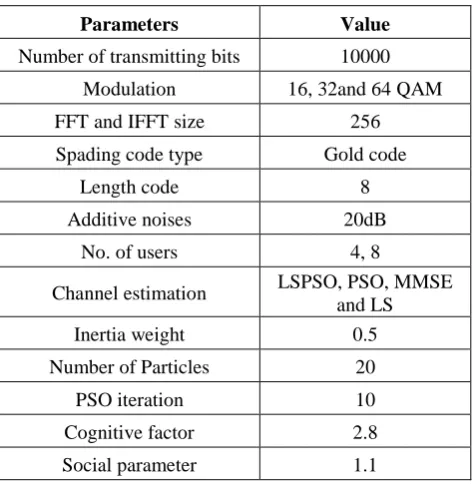
[image:4.595.309.546.257.501.2]In this section, performances of single user and multi-users of the MC-CDMA system based LSPSO channel estimation method are evaluated using MATLAB simulation program as shown in 3, Figure 4, Figure-5 and Figure-6. Moreover, the specification of the model parameters for MC-CDMA, which was used in Table-1.
Table-1. MC-CDMA Simulation Parameters.
Parameters Value
Number of transmitting bits 10000
Modulation 16, 32and 64 QAM
FFT and IFFT size 256
Spading code type Gold code
Length code 8
Additive noises 20dB
No. of users 4, 8
Channel estimation LSPSO, PSO, MMSE and LS
Inertia weight 0.5
Number of Particles 20
PSO iteration 10
Cognitive factor 2.8
Social parameter 1.1
Figure-3 and Figure-4 illustrate the BER vs. SNR of MC-CDMA system based 16 QAM with various types of channel estimation, LSPSO channel estimation, method, in four and eight users, is better. In Figure-5, 32QAMmodulation for four users is presented while, Figure 6 eight users 64 QAM modulation, Moreover, the proposed system based on Simulink program in MATLAB, the input is represented by a random integer generator frame based, both the spreading gold code and pilots which are LSPSO based are built as subprograms using MATLAB functions. The LSPSO channel estimation also builds using the MATLAB function the proposed system is tested for SNR= 20 dB in AWGN and 3-paths fast Rayleigh fading channel where the SER is recorded equal 0.312, as shown in Figure-7.
6. CONCLUSIONS
system, that's called LSPSO because it's a hybrid between PSO and genetic local search algorithms. The results of the simulation program explain BER improvement in LSPSO comparison with the other methods tested in various situations, the results also, show set of design
flexibility and ease of change and development. Finally, it has been shown that the proposed can relieve the effects of the problem and significant system capacity enhancement can be achieved using the proposed channel estimation instead of the conventional MC-CDMA receiver.
Figure-2. Block Diagram for Proposed LS-PSO Algorithm.
Calulate best point𝑥𝑚′′ =
𝑥𝑚′ + 𝜆𝑆
Ye s
Ye s
Reduc
Δxi
The value is best: 𝑥𝑚′ is preferred than 𝑋𝑚
f (
𝑥𝑚′′) > 𝑓(𝑥𝑚′)
No
No Ye
s
Access to aim the improvement of the
signal
N o
Start with arbitrarily point 𝑋𝑚
Estimate the fitness value
The Point Xm is unchanged
Establish a pattern's direction S
Set𝑥𝑚= 𝑥𝑚′
Set𝑥𝑚= 𝑥𝑚′ , 𝑥𝑚′ = 𝑥𝑚′′
Original receiver signal
Optimizing the PSO Parameters
Initialize practices position and velocity
Meet the requirement to achieve optimal
level of pilot tones
Applying the LS-PSO
Figure-3. BER vs. SNR performance of MC-CDMA system for four users with 16QAM.
Figure-4. BER vs. SNR performance of MC-CDMA system for eight users with 16QAM.
Figure-5. BER vs. SNR performance of the MC-CDMA system for four users using modulation 32QAM.
Figure-6. BER vs. SNR performance of the MC-CDMA system for eight users using modulation 64-QAM.
0 2 4 6 8 10 12 14 16 18 20
10-4 10-3 10-2 10-1
SNR(dB)
BER
LSPSO withoutCE PSO MMSE LS
0 2 4 6 8 10 12 14 16 18 20
10-4 10-3 10-2 10-1
SNR(dB)
BER
MC-CDMA with Chnnal Estmation
LSPSO-CE withoutCE PSO-CE MMSE-CE LS-CE
0 2 4 6 8 10 12 14 16 18 20
10-4 10-3 10-2 10-1
SNR(dB)
BER
MC-CDMA with Chnnal Estmation
LSPSO-CE withoutCE PSO-CE MMSE-CE LS-CE
0 2 4 6 8 10 12 14 16 18 20 10-4
10-3 10-2 10-1
SNR(dB)
BER
MC-CDMA with Chnnal Estmation
Figure-7. Simulink program building MC-CDMA system based LSPSO channel estimation.
REFERENCES
[1] N. Joseph, P. N. Kumar. 2012. Power consumption reduction in a SDR based wireless communication system using partial reconfigurable FPGA. International Journal of VLSI design and Communication Systems (VLSICS). 3(2).
[2] G. De Angelis, G. Baruffa, S. Cacopardi. 2010. Parallel PN Code Acquisition for Wireless Positioning in CDMA Handsets. 5th Advanced Satellite
Multimedia Systems Conference and the 11th Signal Processing for Space Communications Workshop, IEEE. pp. 343-348.
[3] Q. SHI and Y. KARASAWA. 2011. Blind Channel Estimation for MIMO MC-CDMA with Arbitrary Numbers of Antennas and Users. Fifth IEEE International Workshop on Signal Design and its Applications in Communications (IWSDA). pp. 177-180.
[4] S. N. Nazar, S. and I. N. Psaromiligkos. 2007. Minimum variance channel estimation in MC-CDMA systems: bias analysis and Cramer-Rao bound. IEEE Trans.Signal Process. 55(6): 3143-3148.
[5] J. H. WEN, C. W. CHANG2 and H. L. HUNG. 2008. Particle Swarm Optimization for Multiuser Asynchronous CDMA Detector in Multipath Fading Channel. WSEAS TRANSACTIONS on COMPUTERS. 7(7): 909-918.
[6] S. Iraji, T. Sipila and J. Lilleberg. 2003. Channel estimation and signal detection for MC-CDMA in multipath fading channels. The 14-IEEE 2003 international Symposium on Personal lndoor and Mobile Radio Communication Proceedings. pp. 2286-2290.
[7] Trivedi and R. Gupta. 2007. Pilot Symbol Assisted Channel Estimation for Uplink MC-CDMA Systems using Parametric Channel Modeling. International Symposium on Communications and Information Technologies (ISCIT). pp. 989-993.
[8] O.O. Oyerinde, S.H. Mneney. 2013. Recursive MMSE-based iterative channel estimation for OFDM-IDMA systems. Proc. IEEE AFRICON, Conf., ISSN: 2153-0025, pp. 1-5.
technique for communication networks using GHz frequency band solutions carrier. IET, Communications. 8(5): 1364-1373.
[10]Y. Xu, R. Qu, R. Li. 2013. A simulated annealing based genetic local search algorithm for multi-objective multicast routing problems. Springer Science, Ann Oper Res, New York. 206(1): 527-555.
[11]M. Zambrano, M. Clerc, R. Rojas. 2013. Standard Particle Swarm Optimization 2011 at CEC-2013: A baseline for future PSO improvements. IEEE Congress on Evolu. Comp. (CEC), México. pp. 2337-2344.
[12]J. He and H. Guo. 2013. A Modified Particle Swarm Optimization Algorithm. TELKOMNIKA. 11(10): 6209-6215.
[13]A. S. Kushwah, S. Manglasheril. 2014. Performance Estimation of 2*3MIMO-MC-CDMA using Convolution Code. International Journal of Computer Trends and Technology (IJCTT). 9(1): 21-25.
[14]M. G. Zia. 2014. Low Complexity Channel Estimation for MC-CDMA System Based Chaos under Fast Multipath Channel. IOSR Journal of Electronics and Communication Engineering (IOSR-JECE). 9(1): 28-35.