ScholarWorks @ Georgia State University
ScholarWorks @ Georgia State University
Early Childhood and Elementary Education
Dissertations Early Childhood and Elementary Education Department
Summer 8-12-2014
A Du Boisian Approach: How Does Double Consciousness
A Du Boisian Approach: How Does Double Consciousness
Manifest in the Experiences of Black Males in an Urban Teacher
Manifest in the Experiences of Black Males in an Urban Teacher
Preparation Program
Preparation Program
Brandon Lewis
Follow this and additional works at: https://scholarworks.gsu.edu/ece_diss
Recommended Citation Recommended Citation
Lewis, Brandon, "A Du Boisian Approach: How Does Double Consciousness Manifest in the Experiences of Black Males in an Urban Teacher Preparation Program." Dissertation, Georgia State University, 2014. https://scholarworks.gsu.edu/ece_diss/22
This dissertation, A DU BOISIAN APPROACH: HOW DOES DOUBLE CONSCIOUSNESS
MANIFEST IN THE EXPERIENCES OF BLACK MALES IN AN URBAN TEACHER
PREPARATION PROGRAM, by Brandon Lewis, was prepared under the direction of the
candidate’s Dissertation Advisory Committee. It is accepted by the committee members in
partial fulfillment of the requirements for the degree, Doctor of Philosophy, in the College of
Education, Georgia State University.
The Dissertation Advisory Committee and the student’s Department Chairperson, as
representatives of the faculty, certify that this dissertation has met all standards of excellence and
scholarship as determined by the faculty. The Dean of the College of Education concurs.
_________________________________
Diane Truscott, Ph. D. Committee Chair
_________________________________ _________________________________ Joyce King, Ph. D. Brian Williams, Ph. D.
Committee Member Committee Member
_________________________________
Olga Jarrett, Ph. D.
Committee Member
_________________________________
Date
_________________________________
Barbara Meyers, Ed. D.
Chairperson, Department of Early Childhood Education
_________________________________
Paul Alberto, Ph.D
By presenting this dissertation as a partial fulfillment of the requirements for the advanced degree
from Georgia State University, I agree that the library of Georgia State University shall make it
available for inspection and circulation in accordance with its regulations governing materials of
this type. I agree that permission to quote, to copy from, or to publish this dissertation may be
granted by the professor under whose direction it was written, by the College of Education’s
Director of Graduate Studies, or by me. Such quoting, copying, or publishing must be solely for
scholarly purposes and will not involve potential financial gain. It is understood that any copying
from or publication of this dissertation which involves potential financial gain will not be allowed
without my written permission.
All dissertations deposited in the Georgia State University library must be used in
accordance with the stipulations prescribed by the author in the preceding statement. The author
of this dissertation is:
Brandon Emmanuel Lewis 4450 Riverwood Circle
Decatur, GA. 30035
The director of this dissertation is:
Dr. Diane Truscott
Department of Early Childhood Education College of Education
Brandon Lewis
ADDRESS: 4450 Riverwood Circle Decatur, GA. 30035
EDUCATION:
2008- Present Ph.D. Early Childhood Education. Georgia State University, Atlanta, GA; anticipated completion: June 2014
2002-2003 M.Ed. Curriculum and Instruction: Early Childhood Education. University of Minnesota, Minneapolis, MN.
1997-2002 B.A. Early Childhood Education. Fort Valley State University, Fort Valley, GA.
RESEARCH INTERESTS
• Culturally responsive teaching • Multicultural education • Social justice education • Critical pedagogy • Social studies education
PROFESSIONAL EXPERIENCE:
UNIVERSITY Teaching
• (2013) Georgia Gwinnett College: EDUC 2130 & ECED 3300
Teacher Supervision
• (Fall 2013-Spring 2014) Georgia Gwinnett College, School of Education, ECE Program
• (Summer 2009,2010,2011,2012) Georgia State University, Urban Accelerated Certification Program (Pre-K-5)
PROFESSIONAL EXPERIENCE: ELEMENTARY
Woodson Elementary, Atlanta, GA.
2012-2013 Kindergarten Teacher
Idlewood Elementary, Tucker, GA.
2008-2012 Director of After-School Program (S.T.E.P. Consulting Services, LLC.)
Stone Mountain Elementary, Stone Mountain, GA.
2006-2008 5th Grade School Teacher (Grade Chair)
Snapfinger Elementary, Decatur, GA.
2004-2005 4th Grade School Teacher (Teacher Advisory Committee)
FELLOWSHIPS AND GRANTS
2013-2014 Dissertation Support Grant—College of Education. Georgia State University 2013-2014 FY 2014 Tech Fee Award—College of Education. Georgia State University 2011-2013 Urban Educational Think Tank Fellow—Alonzo A. Crim Center. Georgia State
University
2009-2011 UACM Mini-Grant Recipient—College of Education. Georgia State University 2008-2011 Urban Graduate Teaching Fellow—College of Education. Georgia State
University
2008-2011 PACT+ Research Fellow—Early Childhood Education. Georgia State University
RESEARCH
Publications
Lewis, B. (2010, December 29). [Review of the book Dreams Deferred: Dropping out and struggling forward, by C. Carger. International Journal of Multicultural Education. v12, 2
Conference Papers and Presentations
paper accepted to Sources Conference, Atlanta, GA.
Lewis, B. (2013, April). An oral history of Briggs vs. Elliott, paper accepted to Sources Conference, Atlanta, GA.
Lewis, B. (2013, September). Infusing Common Core Standards with Culturally Responsive Pedagogy, Guest Speaker for TEEMS Program at Georgia State University College of Education, Atlanta, GA.
Lewis, B. (2012, April). A history of segregation, a fragment of justice, and the difficulty with preserving a legacy: How administrators and teachers view the role of Brown v Board in a Title I school, paper presented at Sources Conference, Atlanta, GA.
Lewis, B. (2011, September). What parents need to know about teachers and their instruction: ensuring your child’s success. Guest Speaker for Idlewood Elementary for teachers,
administrators, staff, and parents, Tucker, GA.
Lewis, B. (2011, February). How does stepping towards educational progress (S.T.E.P) effect academic and behavioral performance? PACT + Retreat, Atlanta, GA.
Lewis, B. (2011, February).What is culturally responsive pedagogy? Guest Speaker at ECE Faculty Meeting for GSU Supervisors, Atlanta, GA.
Lewis, B. (2010, May). Stepping Towards Educational Progress, paper presented at Georgia National Association of Multicultural Education Convention, Atlanta, GA.
Lewis, B. (2010, March). Stepping Towards Educational Progress, paper presented at 36th Annual International Play Conference: Urban Play, Atlanta, GA.
Lewis, B. (2009, March).The Forgotten Case of Briggs vs. Elliott and its Impact on School Desegregation, paper presented at Southern History of Education Society, Charleston, SC.
SERVICE
Conference Proposal Reviewer
National Council for the Social Studies (2013)
North American Chapter of the International Group for the Psychology of Mathematics Education (2009)
PROFESSIONAL MEMBERSHIPS
Georgia National Association of Multicultural Education
THE EXPERIENCES OF BLACK MALES IN AN URBAN TEACHER PREPARATION
PROGRAM
by
Brandon Lewis
Under the Direction of Dr. Diane Truscott
ABSTRACT
The Black experience is complex; often portrayed as a double consciousness or a tension
between two warring ideas that penetrate the soul. Such duplicity can leave Black people
perplexed regarding how to navigate in a White world with one dark body. This study explored
the experiences of Black males in an urban teacher preparation program as they negotiated their
double consciousness in order to understand how race and gender impact teaching and learning in
urban schools. Four case studies were conducted representing self-identified Black male
structured interviews. The study illustrates the complex factors for Black males developing as
culturally relevant responsive teachers and provides voice to the challenges Black males face
while navigating in a capitalistic system that has historically denied equitable access. The research
found that prior experiences with double consciousness perpetuate Black males’ oppression and
forces them to see their perceived selves through their White counterparts’ and supervisors’ eyes.
Double consciousness has a twoness that causes distrustfulness of those that are perceived to be
oppressive while also inspires individuals to ‘be the best’. Cohort communities are a great way to
facilitate a community of learners but if not managed carefully can lead to racial and ethnic
separation. After graduating from the teacher preparation program, the Black males did not
remain consistent with their cultural responsiveness but were charged to use the teaching
profession as a means to create positive change for others. Findings from this study hold promise
for helping teacher education programs develop experiences for Black males that capture and
cultivate the unique embodiment of two clashing identities—American and Black.
INDEX WORDS: Black male teachers, Culturally responsive pedagogy, Double consciousness,
PROGRAM
by
Brandon Lewis
A Dissertation
Presented in Partial Fulfillment of Requirements for the
Degree of
Doctor of Philosophy
in
Early Childhood Education
in
Early Childhood Education
in
the College of Education
Georgia State University
Atlanta,GA
Copyright by Brandon E. Lewis
DEDICATION
I dedicate this work to Dr. William Edward Burghardt Du Bois. Although your life ended
ACKNOWLEDGMENTS
I would like to thank my wife, Dana. You showed amazing support and love, and I will always be
grateful. Although it was difficult, you always smiled and said “You got this”. Thank you for your
love, sacrifice, and understanding. To my daughters, Kya and Sara, thank you for serving as a
source of encouragement. To my father, mother, and brother, words cannot express my love for
you and my appreciation for all that you have done for me. To my grandmothers, Henrietta and
Sarah, your legacies continue to inspire me. To my Aunt Margaret, I have never met an individual
so kind. Thank you for always being there.
To my dissertation chair, Dr. Diane Truscott, thank you for pushing me harder than I’ve ever been
pushed before. You truly made me feel as if I can accomplish anything. There is no way I could
have done this without you. I look forward to continuing our journey together. To my committee,
thank you for the unwavering support you provided throughout this process. Your guidance and
expertise are unparalleled.
To my friends and loved ones: Anthony, Chad, Chuck, Donnel, Erica, Glen, Jeff, L.O.F., Lyn,
TABLE OF CONTENTS
1 INTRODUCTION ... 1
Significance of the Problem ... 19
2 CONTRIBUTIONS TO DOUBLE CONSCIOUSNESS ... 21
Rewriting the History of CRRT... 29
3 METHODOLOGY ... 49
4 WITHIN CASE FINDINGS ... 80
Case 1: Nia ... 81
Summary ... 95
Case 2: Allen ... 96
Acting White. ... 99
Summary ... 108
Case 3: Dan ... 109
Summary ... 119
Case 4: Peyton ... 120
Summary ... 130
5 FINDINGS: CROSS-CASE ANALYSIS ... 130
The Cohort Journey ... 131
Summary ... 151
6 DISCUSSION ... 153
Experiences With The Cohort Community ... 157
Experiences they entered with. ... 159
Experiences with responding to CRRT assignments. ... 160
CRRT experiences as teachers. ... 164
Experiences with double consciousness. ... 166
Implications for Urban Teacher Preparation Programs ... 174
and Future Research... 174
Limitations ... 176
Conclusion ... 178
LIST OF TABLE AND FIGURES
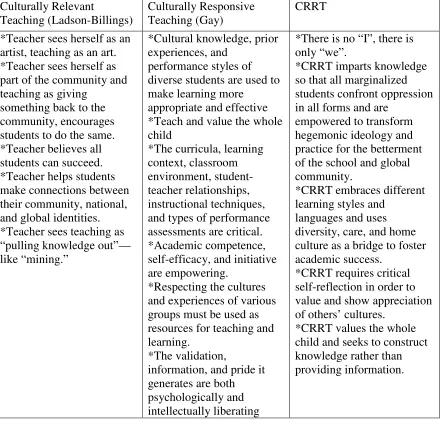
Table 1. Comparison of features of culturally relevant teaching, culturally responsive
teaching, and CRRT. ...42
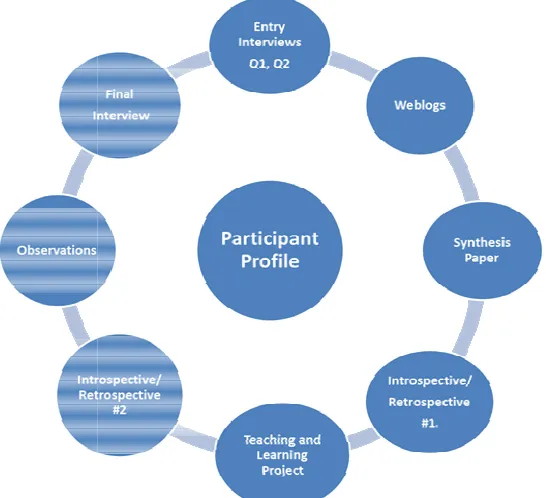
Figure 1.Data Collection Protocol ...62
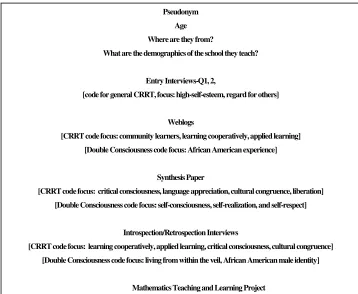
Figure 2. Analyzing Participant profile ...63
Figure 3. A pattern network for Nia’s casr study ...82
Figure 4. A pattern network for Allen’s case study ...97
Figure 5. A pattern network for Dan’s case study. ...109
1 INTRODUCTION
During a CNN interview on June 21, 2010, Secretary of Education Arne Duncan issued a
“call” for more Black male teachers. Duncan (2010) reported that African-American male
teachers represent 2% of the teacher population—less than 1 out of 50 teachers. According to
the National Center of Educational Statistics, from 2007–2008, men represented 24% of full- and
part-time teachers in the United States. White men represented 20% of full and part-time
teachers and Black men represented 2% of full and part-time teachers.
In this interview, Duncan (2010) claimed that the United States has a huge challenge to
ensure the success of Black males. He argued that men of color—particularly Black males—are
not becoming teachers due to the large high school dropout rate, and those men who graduate do
not want to become teachers because of teacher salaries. While there is much abstruseness in his
argument as to why Black male students are not performing in school like their White
counterparts, Duncan’s call draws attention to the power that Black male teachers have as
mentors and positive examples for Black youth.
While some may believe increasing the number of Black males in the teaching profession
will have a positive effect on students of all races/ethnicities and genders, it is equally important
to investigate the denial of equitable access in the educational system for Black males, which
may also impede their willingness to become teachers. Unfortunately, Duncan failed to mention
the unique experiences Black males within the United States bring to the educational arena—
feeling apart from, rather than a part of, the educational system. Serving as objects and not
subjects may challenge Black males’ eagerness to become elementary school teachers in the
United States (Asante, 1998). If teacher educators are to increase the percentage of Black male
Du Bois (1989a) notes:
The history of the American Negro is the history of this strife,—this longing to
attain self-conscious manhood, to merge his double self into a better and truer
self. In this merging he wishes neither of the older selves to be lost. He would
not Africanize America, for America has too much to teach the world and Africa.
He would not bleach his Negro soul in a flood of white Americanism, for he
knows that Negro blood has a message for the world. He simply wishes to make
it possible for a man to be both a Negro and an American, without being cursed
and spit upon by his fellows, without having the doors of opportunity closed
roughly in his face. (p. 4)
Here, Du Bois offers insight into the twoness, or double consciousness, many Black males
continue to face in the United States. While Du Bois posited his theory of double consciousness
in the early 20th century, it is important to build on this theory as we support the goal of
increasing the number of Black educators (Shockley, 2009). Previous investigations of Black
males in educational research addressed issues of class (Kozol, 1991), sexuality (Carbado, 1999),
and the school to prison pipeline (Children’s Defense Fund, 2011). Other researchers seek to
understand the Black perspective through an examination of Black culture (Du Bois; 1903,
Carver; Karenga, 1989; Woodson, 1990); Tillman, 2006) and identity (Cross’ (1991), Ellison
(1952); Hartigan (2010). Unfortunately, the duality that exists for Black males—living as
Americans and Blacks—is a topic that is overlooked when seeking to understand the Black
A need for more research on Black male teachers has been discussed in recent years
(Chmelynski, 2006; Martino, 2010), yet, this topic remains overshadowed by a focus on Black
boys in public schools (Noguera, 2008), or Black professorship (Allen, Epps, Guillory, Suh, &
Bonous-Hammarth, 2000; Bradley, 2005;Stanley, 2006). Although there is research that
specifically examines Black teachers (Foster, 1997; Mawhinney, Mulero & Pe’rez, 2012; Milner,
2005), there is limited research that has a specific focus on Black male teachers (Brown, 2011;
Lewis & Toldson, 2013; Lynn, 2006; Pabon, Anderson & Kharem, 2011). Foster (1997) explores
Black teachers after desegregation and the difficulties of providing quality education with
inequitable funding. Mawhinney, Mulero & Pe’rez (2012) also examine Black teachers but
focuses on pre-service teachers in an urban teacher program and their experiences post-program.
The findings suggest that the Black pre-service teachers developed a high regard for urban
education after completing the program but developed negative perceptions of urban parents.
Milner’s (2005) study takes a different approach by investigating a Black teacher who utilizes a
multicultural approach in a White high school. Although these research studies contribute to
Teacher Education and focus on Black teachers, there needs to more research that examines the
experiences of Black male teachers.
As Arnie Duncan indicates, Black male teachers have an enormous impact on students of
color. To increase the percentage of Black male teachers, there needs to be more research on the
experiences Black males bring with them to teacher preparation programs. This provides teacher
preparation programs with a structure for understanding and supporting Black males’
experiences both within and outside of the academy.
Despite the lack of research on Black male educators, teacher preparation programs
& Toldson, 2013; Pabon, Anderson, and Kharem (2011). There have been recent attempts to
increase the number of Black male teachers through targeted recruitment in teacher preparation
programs. Chmelynski (2006) offers insight into a national initiative that focuses on recruiting
and retaining more male teachers of color. In his study, Chmelynski examines the Call Me
Mister Program whereby field coordinator Winston Holton suggests, “All students need to see
black males in authority roles—roles of responsibility, academic roles showing there are
manifestations of black maleness other than athletics, entertainment, or, unfortunately, crime”
(Chmelynski, 2006, p. 42). Similarly, Byrd, et al. (2011) examined one Black former college
athlete and two athletic department academic advisors to investigate how teacher preparation
programs can benefit from adding diversity to the teaching profession by recruiting Black male
student-athletes. While useful in addressing strategies for recruiting Black male teachers, these
studies are insufficient. Although these scholars draw attention to the need for Black male
teachers, accomplishing the goal of recruiting more Black male teachers requires that we first
draw attention to why the teaching profession would be a viable option, given the historical
inequitable treatment of Black children in urban schools.
In 2012, the United States Department of Labor listed the highest paying occupations;
teaching was not on the list. In fact, PayScale.com reported that the median income for teachers
in the U.S. is approximately $46,000. Living in a capitalistic, patriarchal society like the United
States presents males with a confounding professional quandary; whether or not to pursue
teaching while grappling with the notion that they will probably make less money than their
counterparts who hold degrees in other fields. In a recent study, Pabon, Anderson, and Kharem
(2011) found that the three most influential factors for Black males entering the teacher
Additionally, Brown and Butty (1999) found that Black males in a suburban public school
district chose to become teachers due to the motivation, or desire, to impart knowledge. Similar
to findings from Brown and Butty’s study, Durden and Truscott (2013) interviewed a
21-year-old Black male, Ronald, who indicated one of his reasons for becoming an educator was to serve
as a change agent. According to a questionnaire, Ronald indicated that every child encompasses
a racial, cultural, and communal identity, and he wanted to ensure that each child sees
connections between him, or herself, and the “real world.”
While many people choose to teach because of a desire to “make a difference” in a
child’s life, it may be argued that many Black teachers bring an internalized understanding of
struggle,—pre- and postdating Brown vs. Board (Siddle-Walker, 1996)—which creates a
commitment to improving the social and economic conditions for Blacks. Understanding the
Black experience in the United States may offer insight into other factors that prohibit Black
males from pursuing the teaching profession, including statistics that portray the failure of the
educational system for Black males who are overrepresented among dropouts (50%),
incarcerated (44%), and suspended or expelled from schools (35% black children grades 7-12)
(Schott Report, 2012; NAACP Fact Sheet, 2013). It becomes paradoxical, to some extent, to
become interested in pursuing a profession that has a long history of failing many Black students
rather than educating them (Hilliard, 1998) and even now continues to reinforce zero tolerance
policies which feed a school-to-prison pipeline (Children’s Defense Fund, 2011).
Notwithstanding the pernicious factors that may prohibit the zeal for pursing education as
a viable career path for Black males, those who are qualified and choose to devote themselves to
the teaching profession must carry the societal perceptions imbued with stereotypical
than as the sons of kings and queens, inventors, orators, and pioneers of the earliest known
civilizations (Clark, 1992; Du Bois, 1972). Even today, Blacks are labeled as a “problem”
(Howard, 2013). If more Black males entered the teaching profession, students—particularly
Black boys—will challenge the narrative of deficit ideology and social misconceptions that
permeate maligned constructions of Black male embodiment (Lewis & Toldson, 2013; Lynn,
2006).
This study explored the experiences of Black males as they developed as pre-service
teachers in an urban teacher preparation program. It provides a unique examination of double
consciousness within the context of pedagogy that is culturally relevant and responsive. As a
Black male teacher and teacher educator with a focus on urban education, I brought to the study
both personal and professional experiences. These experiences and beliefs warrant sensitivities
to racial oppression, yet offer depth for analysis that served as powerful tools for this
exploration. It is important to note that while the participants and I self-identify as Black, this
term is a social construct. Omi and Winant (1994) contend:
The concept of race continues to play a fundamental role in structuring and representing
the social world…Thus, we should think of race as an element of social structure rather
than as an irregularity within it; we should see race as a dimension of human
representation rather than an illusion (p. 55).
The following section describes my experience as a Black male in graduate school and how the
social structure of race made me cognizant of my double consciousness.
The Veil
I believe, with conviction, that double consciousness is a real and complex feeling within
daily. The veil may be described as an oppressive space whereby your double consciousness is
conflated with conflict and resolution. The veil forces you to see yourself through the eyes of the
oppressor while simultaneously maintaining pride, respect, and admiration of a people that have
been globally disenfranchised and misunderstood. The veil is used to describe double
consciousness—having the awareness to see your identity from within the veil and honoring
your racial group and its cultural norms—something closed to the oppressor who remains outside
of the veil. Double consciousness also allows you to see yourself from outside the veil—starring
at yourself through a racist lens—perceiving what White people really think of you. This
provides you with knowledge of how to survive in White spaces, but it also forces you to control
your actions from an oppressive stance. Because you are able to see yourself from outside of the
veil, with the oppressor’s eyes, every move you make or sound you utter, is controlled from a
psychological reaction to what you think will be most pleasing to the oppressor. Shaefer (2008)
claims, “The veil has variously been interpreted as race itself and its impact on the lives of Black
Americans, the racial lens through which White Americans view Black Americans, and the
double consciousness with which Black Americans experience their world” (p. 3). The veil may
be used as a metaphor to describe a duality that is caused by racism. Du Bois felt that the veil
was a gift and a curse. The veil provides Blacks with two sights—their true selves and their
oppressed selves. This is beneficial because you are able to understand the psychology of the
oppressor. The veil also cements a bond amongst fellow Blacks. Given that this feeling of double
consciousness is shared amongst fellow Blacks, there is an understanding of White people and
racism that only individuals with double consciousness are able to recognize. Conversely, when
you operate from a space of oppression, two-warring souls are in conflict. There is an undeniable
race lens creates a psychosis whereby race and racism controls your every thought, movement,
and way of life.
Du Bois finds that Black people represent the rarity of the world: a group that is able to
navigate in the extreme conditions of racism because they understand White psychology.
Conversely, White people are not conscious of the veil. They operate from a state of privilege.
Given that White people cannot be affected by racism, they do not understand what it is like to
operate from an oppressed state. This two-ness can only be described by Blacks. Du Bois
contends that while Blacks can navigate in a White world, White people do not have the
understanding for navigating in Black spaces. Schaefer explains:
White Americans are free from both life underneath the veil and the double
consciousness that stems from it. As a result, White Americans are often seen in
terms of their individual attributes and personalities, rather than being viewed as
representatives of their race and accordingly feared, distrusted, ignored, or
otherwise marginalized. This has led to the reality that many White Americans do
not recognize the role that their race plays in their lives, and thus, the inability to
develop the kind of race consciousness that minorities in the United States may
develop as a result of the veil (p. 5).
Although Du Bois understands the power Blacks have by understanding racism, he laments the
complexity of living with duality or a two-ness because it creates a constant friction of living life
as if there is something to prove to those that have created the oppressive condition; operating
with calculated precision to ensure that you are not what society perceives you to be.
I offer a brief personal illustration of how I, a Black male, experienced double
first course, which happened to be Cultural Foundations. The professor entered the class,
walked to the whiteboard, and, with a blue marker, wrote Old Country in large letters. She
proceeded to inform the class that the first assignment would be for us to write down how our
ancestors migrated from the “old country.” She asked each student to think before writing and to
begin when ready. As I pondered my response, I realized the best information I could offer was
my great-great-grandmother on my father’s side and my great-grandparents on my mother’s side.
As each student rose to walk to the whiteboard and began writing his or her ancestral ties to
Scandinavia, Ireland, and other European countries, I was perplexed on what to say regarding my
forbearers. Understandably frustrated that my parents had not prepared me enough for this
activity, I recognized that, while I could not go back several generations—for a number of
reasons—I had never considered how my bloodline extended beyond American soil, yet, here I
was being asked about the “Old Country.”
I went to the whiteboard with trepidation and wrote “Mother Tate.” Mother Tate was my
great-great-grandmother on my father’s side. She started churches all over the country (i.e., The
House of God) and had gained a certain celebrity throughout much of the United States and
especially within the Lewis family. When I sat down, eager to tell the story of my great-great
grandmother Mother Tate followed by great-grandmother Big Momma Keith, a classmate with
whom I partnered volunteered to go first. As I listened to her family history dating back over
300 years, I was quite impressed with the description she was able to provide. Whereas I knew
my story would be limited to a U.S. context, I applauded her efforts and began to tell my story.
Before I could complete my first sentence, she stopped me and asked why I started with a U.S.
experience. Not having access to computer software that now enables you to easily trace your
ancestral roots beyond the United States. I remember it as though it were yesterday. Her reply
was, “Well since you’re Black, can’t you just say Africa? I mean, isn’t that where all you guys
come from?” I replied, “Well, the body of the first [wo]man was found in Africa. Why can’t you
extend beyond European soil and continue south toward Africa? Furthermore, Africa is a
continent made up of many countries. Merely saying Africa does not provide you with an
accurate description of where many Black people in the United States can trace their ancestry.”
While this was not the first time I felt “othered” (Johnson-Bailey, 2001) and certainly
would not be the last, this experience was the first time I began living in a way that was dictated
by others’ opinions of me—constantly questioning how my White counterparts saw me. Students
would partner with me because they wanted to know what Black people thought about a
particular topic; additionally, I was consistently referred to as “the Black guy in class,” much like
Du Bois (1989b) when he stated, “They approach me in a half-hesitant sort of way, eye me
curiously or compassionately, and then, instead of saying directly, How does it feel to be a
problem? They say, ‘I know an excellent colored man in my town’” (p. 7). The most awful
experience was having a professor use the word “nigger” while looking directly at me during a
course lecture. I attest that this “peculiar sensation” creates a persistent conflict—a warring of
two ideas—that encourages hard work and dedication to demystifying the ideas that surround
Blacks, while also questioning if you are being perceived as a “nigger” no matter what you do.
I internalized scrutiny, which ultimately affected my mental health and
self-personification. I lived and acted as an oppressed being—questioning if my colleagues align my
identity with what is portrayed and marketed on television. This feeling was manifested in my
To be clear, double consciousness may also be referred to as a sense of “psychic duality”
(Stewart, 1983). The psychosis of living with double consciousness as a Black male is
operationalized in every facet of living in the United States. It is my contention that when a
Black male decides to enter an occupation, he brings his twoness with him—consciously or
unconsciously. Not only does this elicit a complex soul, but it also has barring on the type of
thinker he will be—in this case a teacher.
While I have chosen the “Old Country” anecdote to illuminate the peculiar sensation of
double consciousness, Du Bois (1989b) recalls his first encounter with double consciousness was
when he was in grade school, and a new White girl in class refused to accept his Valentine’s Day
card because he was “colored.” This was the first time he was made to feel “negro,” and this
experience would motivate his life’s work towards dismantling the tenets of White supremacy.
Although I am referencing Black males in this study, I am convinced that all Blacks embody this
twoness.
It is important to note, in this study double consciousness will be interchanged with duality,
twoness, and inner conflict. Du Bois has characterized double consciousness as two souls, two
thoughts, two unreconciled strivings, and two warring ideals. The duality and twoness are used
to describe the inner conflict of living as a Black American and an American—having pride as a
Black American, while remaining aware of what being Black means in America. There is an
inner conflict because Blacks are aware of what can happen when non-Blacks—particularly
those in power—are not privy to Black culture and use misconceptions as their guide. This
results in Black people trying to hide their Black culture within the veil for fear of being
discriminated or stereotyped—only revealing their Black cultural nuances to fellow Blacks.
while also understanding that in order to succeed, certain characteristics that are aligned with
Black people must be hidden. This creates a duality.
When Black males encounter racialized experiences (Nasir, 2012), they are responding to
a racial identity that was created for them from those in power for the sole purpose of
maintaining power. Blacks are able to remain aware of their heritage and traditions, while
understanding the oppressor sees them through a racialized lens. Although racialized experiences
contribute to identity development and formation, identity is an advanced field associated with multiple
categories (e.g. gender, class, profession, race, age, etc.). This study does not investigate identity
specifically but recognizes that identity formation does influence double consciousness.
Although this study will focus on Black males, Black women are subjected to mental and
physical oppression as well. Hooks (1981) explores the multiple forms of oppression Black
women encounter and how Black feminism can be used as a model for mental liberation. Hooks
contends that Black women have endured sexism, racism, and devaluation beginning as early as
slavery. Collins (1990) also utilizes Black feminism to understand the experiences of Black
women in America. She finds that Black women are not only marginalized by race, due to
patriarchy, they are also subjected to sexism. Although Black women’s experiences are an
important factor to understanding experiences with double consciousness in teacher preparation
programs, it was determined that it was important to begin with a specific focus on males as an
attempt to expedite the process of recruiting and sustaining more Black males in the teaching
profession.
How double consciousness manifests in the experiences of Black male teachers is of
the prevailing stereotypes and propaganda that are disseminated globally about who they are—
particularly in the United States. This warring of identities—perception versus reality—is not
only a factor in the school structure, but an everyday experience for Black males. It is my
contention that this “twoness” will forever be a burden until the prevailing misconceptions of
Black males in the United States are confronted and disrupted. By researching the Black male
experience in an urban teacher preparation program, I shed light on something that is critical to
early childhood educational research—the development of Black male teachers.
Culturally Relevant Responsive Teaching (CRRT)
Du Bois (1989) felt it was necessary to train Negro men to do the bidding for their race
and to be well-equipped teachers, leaders, and social statesmen so they may develop an inner
consciousness of unwavering pride and high moral principle. To assist in being a well-equipped
educator, this research draws upon the conceptual framework of culturally relevant responsive
teaching (CRRT). CRRT uses Ladson-Billings’ (1994) and Gay’s (2000) culturally relevant and
responsive frameworks to situate examples of both paradigms into one model (see figure
1).CRRT is used as an acronym to describe the pedagogical applications that Black male
pre-service teachers engage in while enrolled in an urban teacher preparation program that is
designed to ensure the success of students in urban public schools. A rationale for the use of a
new, combined framework in understanding Black male teachers’ experiences is provided below.
In 1994, Ladson-Billings cemented her legacy in the education reform movement with
The Dreamkeepers: Successful Teachers of Black Children, an ethnographic view of the
culturally relevant teaching framework. Ladson-Billings is now revered as one of the pioneers of
cultural responsiveness and her work is widely used amongst teacher education programs in the
representations in curricula, establishing a community of learners, moving beyond the textbooks,
illustrating care, applying real-world connections, using cultural competence, self-critique, and
reconstructing knowledge for students. Ladson-Billings provides examples from eight teachers
who model culturally responsive pedagogy. These teachers were identified by students’ parents
and administrators from the school for being effective teachers with Black students.
Ladson-Billings discovered that students achieve academic excellence when teachers provide care,
establish relationships, set high expectations, incorporate cultural competence to make learning
meaningful, and illustrate authentic value of students’ culture.
Gay’s framework of culturally responsive teaching includes a similar mission of
increasing achievement for all marginalized students; however, Ladson-Billings focuses
specifically on Black students. Gay incorporates all “multiethnic frames of reference”—
particularly marginalized and underachieving groups that have a Latino, Native American, and
Black background. Thus, researchers that employ a culturally responsive pedagogy framework
for Hispanic or Latino students would actually fall under Gay’s framework as opposed to that of
Ladson-Billings. Gay also contends that culturally responsive teaching alone will not cure the
problems concerning education for marginalized students. Close examination of funding,
administrators, and policy making is required to change the underlying societal inequities. Gay
takes a close look into standardized testing and recognizes that students are not being assessed
through multiple intelligences; rather, she contends that multiple learning styles must be
considered to include everyone’s individual differences and illustrate cultural congruence. To be
clear, cultural congruence requires teachers to alter their speech patterns, communication, and
participation structures to connect more closely with the students’ culture (Ladson-Billings,
variety of ways, Gay’s ideas of multiple learning styles extend beyond illustrations of Ladson
Billing’s model of culturally relevant practice. Although Ladson-Billings provides a solid
foundation in the variety of ways Black students learn (e.g. rap music, community, Ebonics),
Gay offers multiple learning styles through a variety of context to teachers’ that are ethnically
based. She notes that “Overall characterizations of learning styles suggest that they are not
monolithic, situationally idiosyncratic, or static traits. Instead, there are multidimensional,
habituated processes that are the ‘central tendencies’ of how students from different ethnic
groups engage with learning encounters” (p. 151).
Examples of Gay’s conceptual framework for multiple learning styles are an
amalgamation of different ethnic groups which include: procedural (pacing rates, distribution of
time) communicative (how thoughts are organized and conveyed in spoken and written form),
substantive (concepts and principals or factual information), environmental (physical, social, and
interpersonal settings for learning, organizational (preferred structural arrangements for work
and study space), perceptual (visual, tactile, auditory, kinetic, oral, or multiple sensory
modalities), relational (preferred interpersonal and social interaction modes in learning
situations), and motivational (preferred incentives or stimulations that evoke learning—including
individual accomplishment or group well-being). Gay defines culturally responsive teaching as,
“Using the cultural knowledge, prior experiences, frames of reference, and performance styles of
ethnically diverse students to make learning encounters more relevant to and effective for them”
(p. 29).
Another justification for combining the two frameworks is that culturally responsive
research can become cumbersome if it is not positioned in specific culturally responsive theories.
does this specifically mean Billings’ framework , or is the researcher using
Ladson-Billings’, Gay’s, or Cazden and Lagget’s model of cultural responsive pedagogy? I argue that we
must now consider adopting a new term—culturally relevant responsive teaching (CRRT).
I am contributing a new term to the culturally responsive field because culturally
responsive education has evolved into a space where there are limited perimeters when
discussing the use of culture to engage and value students. Questions of whether researchers are
using the term culturally responsive teaching as an amalgamation of all theorists makes it
difficult to determine whose model was used. In The Guiding 100, the urban teacher preparation
program in this study, all of the language used reflects the term culturally responsive pedagogy.
Yet, much of the instruction focuses on ESOL populations, the oppression of various groups, and
ways to empower students in urban schools. The Guiding 100 is using inaccurate language. To
be correct, The Guiding 100 would only be able to focus on enhancing the education for Black
students. Thus, combining Gay’s concept of all marginalized students would be more appropriate
for The Guiding 100.
To further problematize this issue, researchers may use the term culturally relevant
pedagogy (Ladson-Billings, 1994)but decide to investigate a topic that is under the culturally
responsive teaching framework (Gay, 2000). For example, if a researcher were looking at ways
to utilize multiple intelligences for impoverished Hmong students, it may be assumed that a
culturally relevant pedagogy approach (Ladson-Billings) would be useful. However, given that
Gay extends beyond Black students and incorporates multiple intelligences for different
ethnicities/races under her framework, Gay would be the most appropriate. Another example can
be found in the topic of textbooks. Ladson-Billings and Gay include examples of how teachers
beyond the textbooks to critically engage students regarding the power and racism in textbooks;
Gay also includes examples of marginalized groups in textbooks but also offers a descriptive
model and illustrates various organizations and initiatives that illustrate how teachers can
examine textbooks to check for cultural responsiveness and what happens when there is more
inclusiveness. When Ladson-Billings and Gay’s ideas come together, there is a broader
perspective offered: teachers are provided models of what other teachers are doing to reach their
students to offer critical engagement outside of the textbook, and teachers are provided with
resources for how to assess textbooks with a culturally responsive lens and ways to participate
with organizations that are doing this type of work. The last example for why it was determined
that combining these theories provides more benefit to the culturally responsive field…if I
determined that Gay was most appropriate for this study and decided to look at ways Black
males create a community in the classroom and spaces for students to learn from each other and
construct knowledge together, and how these Black males place themselves within the students’
home community—Gay would not provide the necessary model; Ladson-Billings’ community of
learners would be more appropriate. I contend that many researchers are unintentional when
using the appropriate culturally responsive framework because they are unaware of the
differences. In this study, I was deliberate about what pieces out of each framework were critical
for this study and how this study may not have worked if forced to choose between one over the
other. Both frameworks offer critical and necessary components for culturally responsive work,
which makes CRRT the best approach for research and practical implementations for this study.
This study offers a new model to provide a deliberate focus on cultural responsiveness.
Although cultural responsiveness is designed for marginalized groups, its execution has been for
population, cultural responsiveness was a framework that modeled how to teach Black students
particularly for White female teachers. This study offers new ways to consider how Black males
implement cultural responsiveness. To avoid speculation as to whose framework is being used,
CRRT was developed by examining Ladson-Billings’ and Gay’s framework and illustrates
concepts from each theorist. This framework is very specific and does not include every facet of
Ladson-Billing’s culturally relevant teaching framework nor Gay’s culturally responsive
teaching framework. I considered the major themes from each framework and created a model
that is inclusive of the overarching tenets from both.
CRRT proposes the following tenets: I am because we are; It imparts knowledge so that
students confront oppression in all forms and are empowered to transform hegemonic ideology
and practice for the betterment of the school and global community; It embraces different
learning styles and languages and uses diversity, care, and home culture as a bridge to foster
academic success; It requires critical self-reflection in order to value and show appreciation of
others’ cultures; It values the whole child and seeks to construct knowledge rather than
providing information.
CRRT enhances teachers’ understandings of what students bring to the classroom
structure (e.g., race, socioeconomic status, community, multiple intelligences, and language),
while students’ abilities and motivation are able to be transformed through the concept of
relationship to the instruction. CRRT is able to capture students’ attention and effectively
Significance of the Problem
The focus on Black males’ development as CRRTs in an urban teacher preparation
program is significant because there is limited research that examines this process. Lynn (2006)
states:
The voices of Black men have been marginalized within the discourse on teachers and
teaching. There is little written about how Black men’s ways of knowing contribute to the
development of a knowledge base on cultural teaching in urban schools. (p. 2497)
Applying Dubois’ theory of double consciousness provides a space to interpret the challenges
that may be present for Black males in an urban teacher preparation program that focuses on
CRRT.
Examining how one lives within the veil, while constantly seeing himself through the
eyes of the oppressor, will illustrate the complexity for Black males not only to develop as
CRRTs but will also provide voice to the challenges Black males face in a teacher preparation
program when working within a system that has historically denied equitable access (e.g., urban
public schools; higher institutions). Lynn (2006) notes:
Although close attention should be paid to the ways in which Black males are
disenfranchised in a racist and patriarchal society, it is also important to look closely at
Black men’s pedagogical practice, especially the practices of Black male teachers who
express a commitment to using their classrooms as a tool to improve the social conditions
Findings from this study extend Duncan’s (2010) call regarding Black male teachers by
interpreting the experience of developing as an elementary public school teacher, while
completing a teacher preparation program designed to prepare teachers to be culturally
responsive in urban elementary schools. DuBois’ theory of double consciousness was used as a
theoretical lens to explain the complexity of “two-ness” encompassed within Black males, which
were manifest in the tasks they were asked to complete during their teacher preparation program
and currently as urban educators.
This study cannot generalize (Creswell, 2013) all Black male teachers; rather, its aim is to
understand the process of developing as a CRRT educator and whether Black male teachers
encounter double consciousness prior to, during, and after their teacher preparation program
experience. Black male pre-service teachers data sources were examined from the time they
interviewed for selection into the program through the duration of their teacher preparation.
Within this investigation, I used various data sources to provide opportunities for the participants
to reflect upon their experiences as a Black male teacher. The data sources represent different
stages of their journey: pre-program, during program, and post-program. Introspection and
retrospection interviews were used to elicit discussions of the Black male experience of
becoming a teacher and how their racial and gender identity impacted their experience in the
program. The participants also found it beneficial when they were asked to connect their
experiences as a Black male student in a predominantly White institution to their experience now
as a Black male teacher. This reflective approach fostered an introspective view of where they
have been and helps them internalize where they are headed.
The next chapter provides an overview of the history of double consciousness to illustrate
double consciousness because it illustrates the racial and gender experiences each participant
brings to the program, which helps draw conclusions regarding why the participant thought or
acted the way he did. The literature review builds a foundation for the design of this study and
informs the analysis and interpretations of the findings.
2 CONTRIBUTIONS TO DOUBLE CONSCIOUSNESS
In 1845, Dr. David Skae, defined a mental patient as having a double consciousness, what would
be referred today as a “split personality.” This is the first known record of the term “double
consciousness.” Although double consciousness is a widely used term that is usually situated
under Du Boisian philosophy, it has historical implications prior to Du Bois. Double
consciousness is referred to as alternating personalities in the examination of William James. It is
important to recognize that James was Du Bois’ advisor while at Harvard, and Du Bois admired
his work. When looking at James’ and Du Bois’ relationship, Townsend (1996) explains, “The
two might seem conjoined in their use of the idea of double consciousness…a phrase that had
already made its appearance in James’s Principles of Psychology before Du Bois used it” (p. 73).
Although James defined double consciousness as an alternating personality, Du Bois situated this
expression within his existence as having two warring ideas—living “within the veil.” Du Bois
(1989) recalls numerous encounters with Whites who saw him, not as the person he is, but as
something else—a problem. Hilliard (1995) explains:
The double consciousness problem is not the problem of a split personality in the
Freudian sense, nor is it a Dr. Jekyll and Mr. Hyde transformation as popularized
in the literature. It is an issue of the surrender of self-definition and responsibility.
someone else before there can be a “self-concept” is the final victory for an
enemy over a slave. The mind is gone and a zombie remains. (p. 56)
Double consciousness is a feeling that evokes racialization (Omi & Winant, 1986)—
meaning that racial formations are predicated and dictated by the dominant group’s
ideology—particularly for the purposes of continued control. Racialization becomes the
primary factor in navigating in White spaces and forces Blacks to operate in a space
whereby “self” is conditioned according to what oppressive forces have created the “self”
to be. Woodson (1990) exclaims:
When you control a man's thinking you do not have to worry about his actions. You do
not have to tell him not to stand here or go yonder. He will find his “proper place” and
will stay in it. You do not need to send him to the back door. He will go without being
told. (p. xiii)
Woodson’s analysis examines the psychological oppression racism creates for Blacks and
Whites. Similar to Du Bois’ theory of double consciousness, Woodson understands the racism
and xenophobic constraint placed upon the darker race as did Du Bois. Although Du Bois’
theory of double consciousness focuses on racial oppression, other theorists and authors also
used a concept of double consciousness in their work. Prior to William James, even poet Ralph
Waldo Emerson injected the importance of double consciousness in his writings on the soul.
Bruce (1992) argues that Emerson employed the phrase “double consciousness” from the
standpoint and illustrated where one soul was pulled down by living life in a society, and the
demands of societal oppression. In his comparison between Emerson and Du Bois, Bruce
distinguishes between the two by noting:
By double consciousness Du Bois referred most importantly to internal conflict in the
Black individual between what was African and what was American. …Using double
consciousness thus placed the African spirituality Du Bois sought to celebrate in
connection with a more general body of Romantic ideas and imagery. (p. 301)
Such imagery as “two warring souls,” whereby the soul is in constant conflict because of outer
forces, such as racism, are at constant work to oppress the internal soul; and “living within the
veil,” which focuses on the ability to keep your identity hidden beneath the veil, while looking at
yourself through the eyes of the oppressor, exposes the internal conflict within African
Americans and also reveals a certain type of gift of seeing with a second sight (Du Bois, 1989a).
Unlike Skae, James, and Cooley who see double consciousness as a split personality that
is labeled as a mental condition, Du Bois uses a “spirituality” to connect with African Americans
and describes the feelings of seeing yourself through the oppressor’s eyes as a “peculiar
sensation” that enables Blacks to navigate in a White world by understanding the sociology of
racism. Du Bois (2009) was very outspoken on what he called the “gift of Black folk,” or how
the spirituality of the African was a gift to the European. Here, Du Bois recognizes Blacks as
being spiritual people, which he considers to be a gift to the souls of evildoers. An example of
Blacks strong tie to spirituality can be found in the peculiar institution of slavery whereby
Africans would sing “negro” spirituals even in the harshest of conditions.
Given that Du Bois recognized Blacks’ spirituality, he did not define double
spiritual attribute, rather than a mental condition, to better connect with Black people. Shaefer
(2008) explains, “Much of Du Bois's work carries a deeply spiritual aspect, and many have
interpreted his concept of double consciousness to refer to what Du Bois felt African Americans
had to offer U.S. society: a deeply spiritual African identity, which could help to offset the harms
and conflict many felt inherent to the materialism of U.S.” (p. 3). In The Souls of White Folks,
Du Bois (1969) discusses how his experiences, particularly within the academy, allowed him a
certain vantage point whereby he was able to see White people better than they were able to see
themselves. His sense of double consciousness gave him the ability not only to understand his
truer self, but also provided him with the ability to know what his oppressors were thinking.
Du Bois encountered this “two-ness” constantly. While he accepted his role as a student
at Harvard, Townsend (1996) indicates that Du Bois was in Harvard, but not of it. D’Souza
(1995) notes:
In one sense Du Bois deplored this double consciousness as an imposition of white
racism, but in another he celebrated it. Appealing to a pan-African identity, Du
Bois argued that blacks have a unique spiritual and social “message”. This
message was not inferior, only different, from the white civilization message. The
racialism of Du Bois contains a notion that many blacks would later embrace: that
if race is the key to the problems faced by blacks, race would also be the key to
their solution. (p. 188)
Du Bois (1989) understood that by disproving the misconception of what being Black
meant in the United States, the common discourse around racial generalizations would be
transformed, while understanding, “the problem of the 20th century would be the problem
regarding marginalized peoples. His theory of double consciousness was a direct attempt to
educate the masses on the power of oppression. Du Bois’ notion that African Americans
are a spiritual and intelligent race that has brought many gifts to the world served two
purposes: 1.) To educate White people about the atrocities that was being committed
toward African Americans, and 2.) To educate African Americans on the proud history
they come from, which would counter the stereotypes and misconceptions they think of
themselves. Du Bois felt that by educating White people on their racist behavior, they
would be able to save their souls from evil tendencies. Thus, CRRT illustrates care for
others, transforming knowledge, and resisting oppression, which is all connected to the Du
Bois’ framework. It is important to note that Du Bois believed that education is the vehicle
that should be used to transport Blacks from degradation to liberation (Provenzo, 2002).
Du Bois’ notion of the “Talented Tenth” claimed that “We must give to our youth as
training designed above all to make them men of power, of thought, of trained and cultivated
taste; men who know wither civilization is tending and what it means” (as cited in Provenzo,
2002, p. 10). In his opposition to Booker T. Washington, Du Bois sought to reshape the
education of Blacks. In the early 1900s, Washington’s Tuskegee Model sought to provide
vocational training to aspiring Negro students; yet, Du Bois felt there needed to be something
more. Vocational training would limit Blacks to be the workers of society on a bottom scale;
whereas, liberal education would create space for social power. Du Bois notes:
Such social power means, assuredly, the growth of initiative among negroes, the spread
of independent thought, the expanding consciousness of manhood; and these things today
are looked upon by many with apprehension and distrust, and here is systematic and
Men openly declare their design to train these millions as a subject caste, as men to be
thought for, but not to think; to be led, but not to lead themselves. (as cited in Provenzo,
2002, p. 68)
To grasp Du Bois’ urging of obtaining social power, it is important to critique those that educate
Black students. How do teachers work to prepare Black students and, more importantly, what
experiences are teachers—particularly Black male teachers—bringing with them to the
classroom? Provenzo (2002) reminds us that Du Bois felt a “crying necessity among Negroes
that the heads of educational system—the teachers in the normal schools, the principals of public
systems, should be unusually well trained men” (p. 67).
Seeking social empowerment does not develop without scrutiny from the White
establishment. Du Bois knew this and articulated the difficulty Blacks would encounter while in
public schools. Du Bois (1989a) indicates that Blacks would be forced to work under the
comparison of their White counterparts. I echo Dubois’ thoughts that there is a crying necessity
for Black males to be unusually well-prepared; ultimately, Black males’ consciousness creates
awareness of the complexity and challenges others like them will face in the public school
setting and beyond. Black male identity is complex with many nuances. In the following
section, I explore Black male identity to understand the experiences Black males bring to the
classroom.
Black Male Identity
Hartigan (2010) suggests that in order to understand Blackness, one must have a grasp of
Whiteness. When research is conducted by measuring a cultural group or racial identity, there
relationship may be found in the notion of Acting White (Fordham & Ogbu, 1986; Ogbu, 2004;
Stinson; 2010). Acting White serves as one aspect of Black’s double consciousness—the idea of
being an American means you must emulate those in power. Acting White (Fordham & Ogbu,
1986) is described as Blacks not achieving academic success for fear that they will be outcasts by
their cultural group because it is not “cool” to be smart. Thus, to reaffirm the identity of a Black,
one must embrace the polar opposite of what is perceived as White identity. The argument is
that Acting White plays a significant role in identity development. If it is not “cool” to be smart,
theoretically a Black student will try to identify with what is deemed as “cool”— or assuming a
nonacademic stance.
While this is one way of exploring Black identity, Toldson and Owens (2010) have
studied a second attribute of the twoness felt by Black students, which they describe as “Acting
Black,” which could fall under the second aspect of double consciousness—the self-pride one
has for being Black. “Acting Black” is the idea that academic success is valued and labeled
“cool” amongst Black youth. However, Toldson and Owens argue that it is not a question of
whether Black students’ identities reflect academic success, the questions researchers should
pursue are how to promote positive teacher-student relationships and how to overcome racial and
class disparities. Thus, this twoness of Acting White and Acting Black reflects Cross’ (1991) idea
that Black identity is not static—it is fluid. When one examines the feelings of self-hatred
pre-1960s and the embracing of “Black Power” during the pre-1960s, there is an identity shift within
Black culture (Cross, 1991). While this argument may be valid, one should not deny that the
idea of double consciousness has remained; in fact, it is used here to simultaneously explain the
First and foremost, blackness can be regarded as a form of consciousness and experience
that develops from both historical and contemporary conditions of racialization resulting
from discrimination and domination. …But blackness can also be recognized as
collection of images that whites have projected onto people of African descent (p. 119).
While Black male identity may be construed as one categorical representation, it is important to
recognize that identity is not fixed; much of the identity that is formalized depends on a range of
factors. For example, class, community, and background experiences may all impose certain
identity traits amongst cultural and racial groups; some characteristics will overlap amongst the
same group, but there will be other identity traits that will be rejected due to other influences.
An example of this phenomenon is seen through hip-hop education (Bridges, 2011), whereby
hip-hop is recommended as a strategy to relate particularly to Black male identity. In this study,
10 Black male students who related well to hip-hop music expressed that their self-awareness,
call to service, and resistance to social injustice could be attained by including hip-hop in public
pre-K–12 schools. Contrarily, Way, N., Hernandez, M., Rogers, L. and Hughes, D. (2013)
conducted a study on racial identity development and found three themes: intersecting
stereotypes, contrasting stereotypes, and resisting stereotypes. In the category of resisting
stereotypes, two Black boys, Joseph and John, decided to resist the stereotypes that every Black
male has to be a rapper or basketball player. However, they both felt that these were not merely
stereotypes but realities that encourage them to be defined as something different.
Thus, Black male identity is methodically and systematically characterized as unwanted
in society, which undeniably affects their identity development. Nogeura (2008) speaks to the
assumptions held toward Black males and finds that the more they are labeled as having
exercised largely in classrooms, are something Black men must contend with throughout their
schooling process. Nasir (2012) examines black students’ experiences in schools and
understands that there are racial group memberships and unique cultural practices.
Unfortunately, as Nasir illustrates, students construct identity that align with their experiences
and encounters from various settings. These ideas about who they are and what they are
supposed to be greatly impact their identity development and many of these students are forced
to carry their double consciousness with them as they enter the professional arena. However,
there are educational reform models that work to stifle the impact of moral panic and stereotype
threat has on Black students—particularly the way society sees Black students and how Black
students see themselves. These reform models provide a space to utilize their cultural and racial
identity as a means for individual and collective empowerment. CRRT, in particular, addresses
this pedagogy concern and is used to illustrate to teachers ways that benefit minority students in
the public school classroom.
Rewriting the History of CRRT
Culturally responsive education has continued to evolve since the emergence of Black
Studies, African Centered Education, and multicultural education. Since the 1980’s, new ways of
describing education that places emphasis on cultural value continue to emerge. Cultural
appropriate (Au and Jordan, 1981), culturally responsive (Cazden and Leggett, 1981), cultural
synchronization (1990), culturally relevant teaching (Ladson-Billings, 1994), culturally
responsive pedagogy (Ladson-Billings, 1995) and culturally responsive teaching (Gay, 2000),