Influence of Multilayer Textile Biopolymer Foam doped with Titanium
Dioxide for Sound Absorption Materials
Anika Zafiah M. Rus
1,a, Nik Normunira M. H.
1, Rahimah A.bd Rahim
1 1Sustainable Polymer Engineering,Advanced Manufacturing and Material Centar (AMMC), Faculty of Mechanical and Manufacturing Engineering,
Universiti Tun Hussein Onn Malaysia, 86400, Parit Raja, Batu Pahat, Johor, MALAYSIA.
Keywords: Sound absorption, Titanium dioxide, Polyester fabric, Methylene diphenyl diisocyanate (MDI).
Abstract. Biopolymer foam was prepared by the reaction of bio-monomer based on vegetable oil with commercial Polymethane Polyphenyl Isocyanate (Modified Polymeric-MDI) and titanium dioxide (TiO2). The acoustic study of biopolymer foam with 2.5% TiO2 loading was examined by
impedance tube test according to the ASTM E-1050 and laminated with three types of textile such as polyester, cotton and single knitted jersey. It was revealed that the thicker the fabric the higher the sound absorption coefficient (α) at low frequency level. The higher the number of layers or thickness of the fabric, the sound absorption through the fabric increases at low frequency but after the maximum it remains almost unaltered. Three layer of cotton fabric gives maximum α approximately equal to 0.578 which is 1.472mm thickness at low frequency level of 1000-2000Hz and single knitted jersey gives maximum α at 3th layer. Meanwhile , the α of biopolymer foam with 2.5% TiO2 loading laminated with polyester fabric approximately equal to 1 at lower frequency
level of 1000-2000Hz with lower thickness that is 0.668mm. Polyester fabric with lowest thickness shows better α at lower frequency level due to the structure of the fabric. The relationships among the fiber properties such as fiber density, fiber diameter, fibrous material layer were considered as a factor that influences the sound absorption property.
Introduction
Developing renewable resources such as soybean oil, canola oil, rapeseed oil, corn oil, palm oil, sunflower and linseed oil for polymer industry become highly desirable for both economic and environmental reasons. The natural vegetable oil are consider to be one of the most important classes of renewable sources has high potential to synthesis and become a new polyol sources for polyurethane and can be replace for commercial polyol in manufacturing polyurethane [1-2]. In polymer industry, vegetable oils which represent a major potential source of chemicals have been utilized as an alternative feedstock for monomers [3-4].
For automotive industries, sound absorption is the important issue where sound insulation developed should be efficient by means of getting the sound reduced and in economically ways of producing sound absorbing material which is cheap, user friendly and moderate sound absorbent coefficient. The absorption is desired at lower frequencies, thickness and weight. Sound absorber with different specific airflow resistance can be used to achieve desirable results. One method of increasing flow resistivity is the addition of a flow resistant scrim or film layer. Scrim means a fibrous cover layer with finite flow resistance and film means a plastic cover layer with infinite flow resistance [5].
sound absorbing material [6]. The property of textile is lightweight and less expensive as compared to steel like material and additionally environmental-friendly materials was enhances highest consumption in interior part of automotive industry. The cotton and polyester fabric were characterized as a nonwoven fabric with less aesthetic appearances as compared to single knitted jersey. Knitted fabrics are mostly used for noise reduction in automotive area due to their superior drapability properties [7].
Sound absorbing materials absorb most of the sound energy striking them and making them very useful for the control of noise. Organic and inorganic lamination on the absorbing material may also help in increase the sound absorption coefficient as compared to the product without laminated [8]. The lamination will help and improved the efficiency and the performance of the sound absorber due to its lamination of foam, and gives highly versatile acoustic foam.
Experiment Procedure
Materials. Bio-monomer; titanium dioxide (TiO2); Polymethane Polyphenyl Isocyanate (Modified
Polymeric-MDI) (viscosity at 25oC = 120 – 160cps, specific gravity at 25oC = 1.18 – 1.20g/ml, NCO Content, % wt = 26.3 – 27.3) ;Polyester fabric (warp density = 40 end/cm, weft density = 40 pick/cm, thickness = 0.167mm);Single knitted jersey fabric (warp density = 22 end/cm, weft density = 8 pick/cm, thickness = 0.45mm); and Cotton fabric (warp density = 13 end/cm, weft density = 13 pick/cm, thickness = 0.368mm);
Foam Production. Bio-monomer based on waste cooking oil from Small Medium Entrepreneur (SME’s) was prepared beginning with a preparation of the catalyst to generate the epoxides from unsaturated fatty compound and comprised the acid-catalyst ring opening of the epoxides to form polyols [4,9-12]. There are three types of textile fabric such as cotton, polyester and single knitted jersey were used and laminated with biopolymer. The bio monomer is mixed with Modified Polymeric-MDI and different percentages of TiO2 which is neat, 2.5%, 5.0%, 7.5% and 10.0% were
prepared by simple open casting method to produce the biopolymer foam [13-17].
Characterization Methods. The sound absorption coefficient was carried out using Impedance Tube Test; type SSC 9020B/K, according to ASTM E1050 and ISO 10534-2 which is for horizontally mounted orientation sensitive materials for the frequency range of 100-6300 Hz.The Impedance tube is used to test sound absorption coefficient of biopolymer foam at low frequency level by 100mm diameter, while sound absorption coefficient at high frequency were determined by using 28mm diameter at 10mm of thickness. The biopolymer foam with 2.5% TiO2 loading was
laminated with three types of textile such as cotton, single knitted jersey and polyester fabric. The testing was conducted with different layer of fabric to obtain the sound absorption performances at low and high frequency level.
Result and discussion
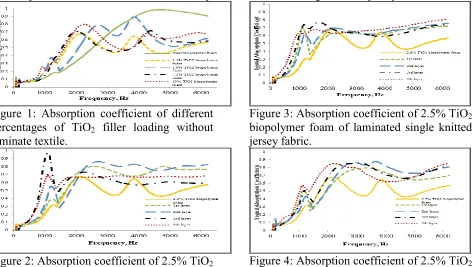
Fig. 1 shows the ability of the biopolymer foam to act as sound absorbing materials in the frequency range 100-6300 Hz. At low frequency level where human sensitivity to noise is high in which below 1600 Hz, biopolymer foam exhibit increasing of α due to increasing of TiO2 loading from
2.5% up to 10% TiO2 loading. By examining the curve, the highest ability for normal incident α of
Table 1: Properties of textile for sound absorption performance Types of textile Warp density
( end/cm) Weft density (pick/cm) Thickness (mm) Maximum (α) Maximum laminated layer Cotton 13 13 1.472 1000-2000Hz 4rd layer
Single knitted jersey 22 8 1.350 1000-2000 Hz 3nd layer
Polyester 40 40 0.668 1000-2000Hz 4nd layer
Fabric density was affected the sound property of laminated biopolymer foam with polyester fabric with increasing layer and thickness. Polyester fabric has the higher warp density of 40 end/cm and weft density of 40 pick/cm as compared to cotton and single knitted jersey fabric as tabulated in Table 1. Referring to Fig. 2, α was gradually increase with increasing layers of polyester fabric 2.5% TiO2 loading and gives maximum α at low frequency level of 1000-2000Hz is
0.987.The α is the highest at 1000Hz to 2000Hz indicates additional of thickness laminated layer with polyester fabric of highest warp and weft density. The α increases due to ability of porous material to convert the incident sound energy into the heat energy and other types of energy by vibration, friction and air viscosity [8], in which polyester fabric has higher density and revealed that the pore size of fabric is smallest as compared to cotton and single knitted jersey fabric.
Figure 1: Absorption coefficient of different percentages of TiO2 filler loading without
[image:3.595.66.540.282.549.2]laminate textile.
Figure 2: Absorption coefficient of 2.5% TiO2
biopolymer foam of laminated polyester fabric.
Figure 3: Absorption coefficient of 2.5% TiO2
biopolymer foam of laminated single knitted jersey fabric.
Figure 4: Absorption coefficient of 2.5% TiO2
biopolymer foam of laminated cotton fabric.
The α increases with the smaller fiber diameter in such a way the impermeable size is much smaller as compare to sound wavelength. The change from the sound energy to heat energy will increase due to the vibration of friction of air particle [19]. Therefore, thickness of a fabric is often considered to be the important factor that governs the sound absorption behavior of the material. The consideration of biopolymer foam with 2.5% TiO2 loading laminated with single knitted jersey
fabric whereby gives an increase α with the increasing number of layers and thickness of fabrics. By examining the curve of Fig. 3, α shows maximum at 3rd layer of single knitted jersey fabric in which approximately equal to 0.722 at range 1000-2000 Hz. Hence, the suitable thickness was observed by laminating with single knitted jersey fabric at range of 1.35mm. The characteristic of sound absorption of porous material are totally depended on the important factor which is thickness of fabric, size and type of pores. When the sound wave has to enter the porous material, there should have enough pores on the surface of the material for the sound to pass through and get dampened [20].
amount of original energy less the remaining unabsorbed energy compared to the original energy leads to the measurement referred to as the absorption coefficient [18]. Referring to Fig. 4 increasing layers of cotton fabric gives maximum α at medium frequency level of 1000-2000Hz which is 0.578 at the 4th layers. It is observed that the optimum thickness of cotton fabric is
1.472mm to gives a good sound absorption at lower frequency. As the layer increases, the samples introduce an air gap between the layers and influence the sound coefficient level [21]. Hence, the maximum thickness of cotton fabric was observed up to 4th layer was achieved the α of the highest at lower frequency range.
Conclusion
The sound absorption coefficient of the three types of textile were measured with a two microphone impedance tube according to the ASTM E1050 and ISO 10534-2 standard. The effect of number of laminated layer and fabric thickness with biopolymer foam with 2.5% TiO2 loading were analyzed
and shows highest α of polyester fabric at 1000Hz to 2000Hz approximately equal to 1 due to lesser thickness and high warp and weft density as compared to cotton fabric and single knitted jersey fabric. The technique lamination of multilayer textiles gives improvement of the absorption property to increase sound absorption coefficient at lowest frequency for automotive applications.
Acknowledgement
The author would like to thank the Malaysian Government and University Tun Hussein Onn Malaysia (UTHM), Johor and Malaysian Technical University Centre of Excellence (MTUN CoE) for supporting this research study under grant Vot C104 and Experimental Research Grant Scheme (ERGS, Phase I/2013).
References
[1] E. Triwulandari, H. Prihastuti, A. Haryono and E. Susilo: Synthesis and Structure Properties of Rigid Polyurethane Foam from Palm Oil based Polyol. Indonesian Journal of Material Science ISSN:1411-1098. (2008), p. 32-36
[2] L. Zhang, H.K. Jeon, J. Malsam, R. Herrington and C.W. Macosko: Substituting Soybean Oil-based Polyol into Polyurethane Flexible Foam. Polymer Vol. 48 (2007), p. 6656-6667
[3] S.N. Suresh, X. Kong, L. Bouzidi and P. Sporns: Physical Properties of Polyurethanes Produced from Polyols from Seed Oils: II. Foams, Journal of American Oil Chemists’s Society Vol. 84 (2007), p.65–72
[4] M.R. Anika Zafiah: Effect of Titanium Dioxide on Material Properties for Renewable Rapeseed and Sunflower Polyurethane, International Journal of Integrated Engineering (Issues on Mechanical, Materials and Manufacturing Engineering),Vol.1 (2009), p.15-22
[5] Zhou Hong, L. Bo, H. Guangsu, and H. Jia: A Novel Composite Sound Absorber with Recycled Rubber Particles. Journal Sound Vibration (2007), p. 304-400
[6] M. Tascan and E.A. Vaughn: Effect of Total Surface Area and Fabric Density on the Acoustical Behaviour of Needlepunched Nonwoven Fabric. Textile Research Journal Vol 78, (2008) p. 289
[7] M. Kucukali, B.U Nergis and C. Candan. A Study of the Influences of Fabric Structure on Sound Absorption Behavior of Spacer Knitted Structures. 7th International Conference-TEXSCI (2010)
[9] M.R. Anika Zafiah: Degradation Studies of Polyurethanes Based On Vegetables Oils. (Part I)., Prog in Reaction Kinetic And Mechanism, Science Reviews Vol. 33 (2008), p. 363-391
[10]M.R. Anika Zafiah: Material Properties of Novelty Polyurethane Based On Vegetable Oils, The 11th International Conference on QiR (Quality in Research), Depok, Indonesia, 3-6 August (2009)
[11]M.R. Anika Zafiah: Degradation Studies of Polyurethanes Based on Vegetable Oils. Part 2; Thermal Degradation and Materials Properties, Prog React Kinetic and Mechanism, Science Reviews,Vol. 34 (2009), p.1-43
[12]M.H.N. Normunira, M.R. Anika Zafiah, S. Nurulsaidatulsyida, and S.R. Mohid: Acoustic Study based on Sustainable Green Polymer Treated with H2O. Advanced Materials Research
Vol. 748 (2013), p. 281-285
[13]S. Nurulsaidatulsyida, M.R. Anika Zafiah: Influence of TiO2 on Selfclean Bio Coating. Applied
Mechanics and Materials Vol. 315 (2013), p. 399-403
[14]S.R. Mohid, M.R. Anika Zafiah, S. Nurulsaidatulsyida, D. A. Talib, and T. M. Y. S. Tuan Ya: Mechanical Properties of UV Irradiated Bio Polymer Thin Films Doped With Titanium Dioxide. Advanced Materials Research Vol. 748 (2013), p. 165-169
[15]M. R. Anika Zafiah, S. R. Mohid, S. Nurulsaidatulsyida, and N. Marsi: Biopolymer Doped with Titanium Dioxide Superhydrophobic Photocatalysis as Self-Clean Coating for Lightweight Composite, Advances in Materials Science and Engineering, Hindawi Publishing Corporation Vol. 2013 (2013)
[16]S.R. Mohid, M. R. Anika Zafiah, and N. H. Harun: Influence of Bio Polymer Composites as Heat Absorption Coating, Applied Mechanics and Materials Vol. 315 (2013), p. 404-407
[17]S. Nurulsaidatulsyida and M.R. Anika Zafiah : Morphology and Mechanical Properties of HDPE / Bio-polymer as Compounding Materials. Advanced Materials Research Vol. 748 (2013) p. 150-154
[18]D.V Parikh, Y. Chen and L. Sun: Reducing Automotive Interior Noise with Natural Fiber Nonwoven Floor Covering System. Textile Research Journal Vol. 76 (2006), p. 813-820
[19]M.R. Anika Zafiah, M.H.N. Normunira, and S. Nurulsaidatulsyida: Influence Of Biopolymer Doped With Eco-Fillers As Sound Absorption Materials. Global Engineers & Technologists Review Vol. 2 (2012), No.4.
[20]J.F. Allard, C. Depollier and P. Guignouard: Free Field Surface Impedance Measurements of Sound-Absorbing Materials With Surface Coatings. Applied Acoustics Vol. 26 (1989), p. 199-207