Available online at www.jocpr.com 163
Fast Dissolving Tablet: An Overview
Debjit Bhowmik*, Chiranjib.B, Krishnakanth, Pankaj, R.Margret Chandira Rajeev Gandhi college of Pharmacy
Nautanwa, Maharajganj, Uttar Pradesh
______________________________________________________________________________
Abstract
Fast dissolving Tablets are disintegrating and/or dissolve rapidly in the saliva without the need for water. Some tablets are designed to dissolve in saliva remarkably fast, within a few seconds, and are true fast-dissolving tablets. Others contain agents to enhance the rate of tablet disintegration in the oral cavity, and are more appropriately termed fast-disintegrating tablets, as they may take up to a minute to completely disintegrate. Oral delivery is currently the gold standard in the pharmaceutical industry where it is regarded as the safest, most convenient and most economical method of drug delivery having the highest patient compliance. This tablet format is designed to allow administration of an oral solid dose form in the absence of water or fluid intake. Such tablets readily dissolve or disintegrate in the saliva generally within <60 seconds. Fast- or mouth dissolving tablets have been formulated for pediatric, geriatric, and bedridden patients and for active patients who are busy and traveling and may not have access to water. Such formulations provide an opportunity for product line extension in the Many elderly persons will have difficulties in taking conventional oral dosage forms (viz., solutions, suspensions, tablets, and capsules) because of hand tremors and dysphagia. Swallowing problems also are common in young individuals because of their underdeveloped muscular and nervous systems. Other groups that may experience problems using conventional oral dosage forms include the mentally ill, the developmentally disabled, and patients who are uncooperative, on reduced liquid-intake plans, or are nauseated. In some cases such as motion sickness, sudden episodes of allergic attack or coughing, and an unavailability of water, swallowing conventional tablets may be difficult.
______________________________________________________________________________
Introduction
Available online at www.jocpr.com 164 conventional dosage forms such as tablet when water is not available, in the case of the motion sickness (kinetosis) and sudden episodes of coughing during the common cold, allergic condition and bronchitis. For these reason, tablets that can rapidly dissolve or disintegrate in the oral cavity have attracted a great deal of attention. Or dispersible tablets are not only indicated for people who have swallowing difficulties, but also are ideal for active people4. Fast dissolving tablets are also called as mouth-dissolving tablets, melt-in mouth tablets, Orodispersible tablets, rapimelts, porous tablets, quick dissolving etc. Fast dissolving tablets are those when put on tongue disintegrate instantaneously releasing the drug which dissolve or disperses in the saliva5. The faster the drug into solution, quicker the absorption and onset of clinical effect. Some drugs are absorbed from the mouth, pharynx and esophagus as the saliva passes down into the stomach. In such cases, bioavailability of drug is significantly greater than those observed from conventional tablets dosage form. The advantage of mouth dissolving dosage forms are increasingly being recognized in both, industry and academics7. Their growing importance was underlined recently when European pharmacopoeia adopted the term “ Orodispersible tablet” as a tablet that to be placed in the mouth where it disperses rapidly before swallowing.According to European pharmacopoeia, the ODT should disperse/disintegrate in less than three minutes. The basic approach in development of FDT is the use of superdisintegrants like cross linked carboxymethyl cellulose (croscarmellose), sodium starch glycolate (primogel, explotab), polyvinylpyrollidone (polyplasdone) etc, which provide instantaneous disintegration of tablet after putting on tongue, their by release the drug in saliva. The bioavailability of some drugs may be increased due to absorption of drug in oral cavity and also due to pregastric absorption of saliva containing dispersed drugs that pass down into the stomach. More ever, the amount of drug that is subjected to first pass metabolism is reduced as compared to standard tablet. The technologies used for manufacturing fast-dissolving tablets are freeze-drying, spray-drying, tablet molding, sublimation, sugar-based excipients, tablet compression, and disintegration addition.As a result of increased life expectancy, the elderly constitute a large portion of the worldwide population today. These people eventually will experience deterioration of their physiological and physical abilities.
Criteria for Fast dissolving Drug Delivery System:
The tablets should
Not require water to swallow, but it should dissolve or disintegrate in the mouth in matter of seconds.
Be compatible with taste masking.
Be portable without fragility concern.
Have a pleasant mouth feel.
Leave minimum or no residue in the mouth after oral administration.
Exhibit low sensitive to environmental condition as temperature and humidity.
Allow the manufacture of the tablet using conventional processing and packaging equipments at low cost.
Available online at www.jocpr.com 165
Ease of Administration to the patient who can not swallow, such as the elderly, stroke victims, bedridden patients, patient affected by renal failure and patient who refuse to swallow such as pediatric, geriatric & psychiatric patients.
No need of water to swallow the dosage form, which is highly convenient feature for patients who are traveling and do not have immediate access to water.
Rapid dissolution and absorption of the drug, which will produce quick onset of action.
Some drugs are absorbed from the mouth, pharynx and esophagus as the saliva passes down into the stomach. In such cases bioavailability of drug is increased.
Pregastric absorption can result in improved bioavailability and as a result of reduced dosage; improve clinical performance through a reduction of unwanted effects.
Good mouth feel property helps to change the perception of medication as bitter pill particularly in pediatric patient.
The risk of chocking or suffocation during oral administration of conventional formulation due to physical obstruction is avoided, thus providing improved safety.
New business opportunity like product differentiation, product promotion, patent extensions and life cycle management.
Beneficial in cases such as motion sickness, sudden episodes of allergic attack or coughing, where an ultra rapid on set of action required.
An increased bioavailability, particularly in cases of insoluble and hydrophobic drugs, due to rapid disintegration and dissolution of these tablets.
Stability for longer duration of time, since the drug remains in solid dosage form till it is consumed. So, it combines advantage of solid dosage form in terms of stability and liquid dosage form in terms of bioavailability.
Benefits of fast dissolving tablets
Administered without water, anywhere, any time.
Suitability for geriatric and pediatric patients, who experience difficulties in swallowing and for the other groups that may experience problems using conventional oral dosage form, due to being mentally ill, the developmentally disable and the patients who are un-cooperative, or are on reduced liquid intake plans or are nauseated.
Beneficial in cases such as motion sickness, suede episodes of allergic attack or coughing, where an ultra rapid on set of action required.
An increased bioavailability, particularly in cases of insoluble and hydrophobic drugs, due to rapid disintegration and dissolution of these tablets.
Stability for longer duration of time, since the drug remains in solid dosage form till it is consumed. So, it combines advantage of solid dosage form in terms of stability and liquid dosage form in terms of bioavailability.
Limitations of Mouth Dissolving Tablets
• The tablets usually have insufficient mechanical strength. Hence, careful handling is required.
Available online at www.jocpr.com 166 •
Techniques for Preparing Fast disolving Tablets
Many techniques have been reported for the formulation of Fast dissolving tablets or Orodispersible tablets.
1. Freeze drying / lyophilization 2. Tablet Moulding
3. Spray drying 4. Sublimation
5. Direct compression 6. Mass extrusion
Freeze-Drying or Lyophilization
Freeze drying is the process in which water is sublimed from the product after it is frozen. This technique creates an amorphous porous structure that can dissolve rapidly. A typical procedure involved in the manufacturing of ODT using this technique is mentioned here. The active drug is dissolved or dispersed in an aqueous solution of a carrier/polymer. The mixture is done by weight and poured in the walls of the preformed blister packs. The trays holding the blister packs are passed through liquid nitrogen freezing tunnel to freeze the drug solution or dispersion. Then the frozen blister packs are placed in refrigerated cabinets to continue the freeze-drying. After freeze-drying the aluminum foil backing is applied on a blister-sealing machine. Finally the blisters are packaged and shipped. The freeze-drying technique has demonstrated improved absorption and increase in bioavailability. The major disadvantages of lyophillization technique are that it is expensive and time consuming; fragility makes conventional packaging unsuitable for these products and poor stability under stressed conditions.
Tablet Molding:
Molding process is of two types i.e. solvent method and heat method. Solvent method involves moistening the powder blend with a hydro alcoholic solvent followed by compression at low pressures in molded plates to form a wetted mass (compression molding). The solvent is then removed by air-drying. The tablets manufactured in this manner are less compact than compressed tablets and posses a porous structure that hastens dissolution. The heat molding process involves preparation of a suspension that contains a drug, agar and sugar (e.g. mannitol or lactose) and pouring the suspension in the blister packaging wells, solidifying the agar at the room temperature to form a jelly and drying at 30○C under vacuum. The mechanical strength of molded tablets is a matter of great concern. Binding agents, which increase the mechanical strength of the tablets, need to be incorporated. Taste masking is an added problem to this technology.
Available online at www.jocpr.com 167 In this technique, gelatin can be used as a supporting agent and as a matrix, mannitol as a bulking agent and sodium starch glycolate or crosscarmellose or crospovidone are used as superdisintegrants. Tablets manufactured from the spray-dried powder have been reported to disintegrate in less than 20 seconds in aqueous medium. The formulation contained bulking agent like mannitol and lactose, a superdisintegrant like sodium starch glycolate & croscarmellose sodium and acidic ingredient (citric acid) and/or alkaline ingredients (e.g. sodium bicarbonate). This spray-dried powder, which compressed into tablets showed rapid disintegration and enhanced dissolution.
Sublimation:
To generate a porous matrix, volatile ingredients are incorporated in the formulation that is later subjected to a process of sublimation. Highly volatile ingredients like ammonium bicarbonate, ammonium carbonate, benzoic acid, camphor, naphthalene, urea, urethane and phthalic anhydride may be compressed along with other excipients into a tablet. This volatile material is then removed by sublimation leaving behind a highly porous matrix. Tablets manufactured by this technique have reported to usually disintegrate in 10-20 sec. Even solvents like cyclohexane; benzene can be used as pore forming agents.
Direct Compression:
Direct compression represents the simplest and most cost effective tablet manufacturing technique. This technique can now be applied to preparation of ODT because of the availability of improved excipients especially superdisintegrants and sugar based excipients.
(a) Superdisintegrants:
In many orally disintegrating tablet technologies based on direct compression, the addition of superdisintegrants principally affects the rate of disintegration and hence the dissolution. The presence of other formulation ingredients such as water-soluble excipients and effervescent agents further hastens the process of disintegration.
(b) Sugar Based Excipients:
This is another approach to manufacture ODT by direct compression. The use of sugar based excipients especially bulking agents like dextrose, fructose, isomalt, lactilol, maltilol, maltose, mannitol, sorbitol, starch hydrolysate, polydextrose and xylitol, which display high aqueous solubility and sweetness, and hence impart taste masking property and a pleasing mouthfeel. Mizumito et al have classified sugar-based excipients into two types on the basis of molding and dissolution rate.
Type 1 saccharides (lactose and mannitol) exhibit low mouldability but high dissolution rate. Type 2 saccharides (maltose and maltilol) exhibit high mouldability and low dissolution rate.
Mass-Extrusion:
Available online at www.jocpr.com 168 Important Patented Technologies for Fast Dissolving Tablets
1. Zydis Technology :
Zydis formulation is a unique freeze dried tablet in which drug is physically entrapped or dissolved within the matrix of fast dissolving carrier material. When zydis units are put into the mouth, the freeze-dried structure disintegrates instantaneously and does not require water to aid swallowing. The zydis matrix is composed of many material designed to achieve a number of objectives. To impart strength and resilience during handling, polymers such as gelatin, dextran or alginates are incorporated. These form a glossy amorphous structure, which imparts strength.
To obtain crystallinity, elegance and hardness, saccharides such as mannitol or sorbitol are incorporated. Water is used in the manufacturing process to ensure production of porous units to achieve rapid disintegration while various gums are used to prevent sedimentation of dispersed drug particles in the manufacturing process. Collapse protectants such as glycine prevent the shrinkage of zydis units during freeze-drying process or long-term storage. Zydis products are packed in blister packs to protect the formulation from moisture in the environment.
2. Durasolv Technology:
Durasolv is the patented technology of CIMA labs. The tablets made by this technology consist of drug, filler and a lubricant. Tablets are prepared by using conventional tabletting equipment and have good rigidity.
These can be packaged into conventional packaging system like blisters. Durasolv is an appropriate technology for product requiring low amounts of active ingredients.
3. Orasolv Technology:
CIMA labs have developed Orasolv Technology. In this system active medicament is taste masked. It also contains effervescent disintegrating agent. Tablets are made by direct compression technique at low compression force in order to minimize oral dissolution time. Conventional blenders and tablet machine is used to produce the tablets. The tablets produced are soft and friable.
4. Flash Dose Technology:
Flash dose technology has been patented by fuisz. Nurofen meltlet, a new form of ibuprofen as melt in mouth tablets prepared using flash dose technology is the first commercial product launched by biovail corporation. Flash dose tablets consist of self-binding shear form matrix termed as “floss”. Shear form matrices are prepared by flash heat processing.
5. Wow tab Technology:
Wow tab technology is patented by Yamanouchi Pharmaceutical Co. WOW means “Without Water”. In this process, combination of low mouldability saccharides and high mouldability saccharides is used to obtain a rapidly melting strong tablet. The active ingredient is mixed with a low mouldability saccharide (eg. lactose, glucose, and mannitol) and granulatedwith a high mouldability saccharide (eg. Maltose, oligosaccharides) and compressed into table
Available online at www.jocpr.com 169 Prographarm laboratories have patented the Flash tab technology. Tablet prepared by this system consists of an active ingredient in the form of micro crystals. Drug micro granules may be prepared by using the conventional techniques like coacervation, micro encapsulation and extrusion spheronisation. All the processing utilized conventional tableting technology.
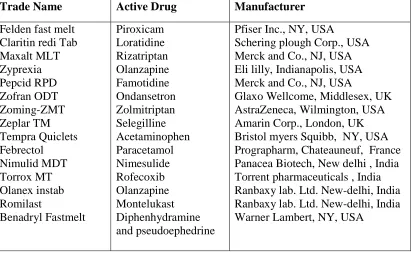
Table -1
List of commercially Available Fast dissolving tablets:
Trade Name Active Drug Manufacturer
Felden fast melt Claritin redi Tab Maxalt MLT Zyprexia Pepcid RPD Zofran ODT Zoming-ZMT Zeplar TM Tempra Quiclets Febrectol Nimulid MDT Torrox MT Olanex instab Romilast Benadryl Fastmelt Piroxicam Loratidine Rizatriptan Olanzapine Famotidine Ondansetron Zolmitriptan Selegilline Acetaminophen Paracetamol Nimesulide Rofecoxib Olanzapine Montelukast Diphenhydramine and pseudoephedrine
Pfiser Inc., NY, USA
Schering plough Corp., USA Merck and Co., NJ, USA Eli lilly, Indianapolis, USA Merck and Co., NJ, USA
Glaxo Wellcome, Middlesex, UK AstraZeneca, Wilmington, USA Amarin Corp., London, UK Bristol myers Squibb, NY, USA Prographarm, Chateauneuf, France Panacea Biotech, New delhi , India Torrent pharmaceuticals , India Ranbaxy lab. Ltd. New-delhi, India Ranbaxy lab. Ltd. New-delhi, India Warner Lambert, NY, USA
Mechanism of Superdisintegrants:
There are four major mechanisms for tablets disintegration as follows
1. Swelling:
Perhaps the most widely accepted general mechanism of action for tablet disintegration is swelling. Tablets with high porosity show poor disintegration due to lack of adequate swelling force. On the other hand, sufficient swelling force is exerted in the tablet with low porosity. It is worthwhile to note that if the packing fraction is very high, fluid is unable to penetrate in the tablet and disintegration is again slows down.
2. Porosity and capillary action (Wicking):
Available online at www.jocpr.com 170 towards aqueous fluid is necessary which helps in disintegration by creating a hydrophilic network around the drug particles.
WICKING SWELLING
Water is pulled by disintegrant Particles swell and break up And reduced the physical the matrix form within Bonding force between particles
3. Due to disintegrating particle/particle repulsive forces
Another mechanism of disintegratn attempts to explain the swelling of tablet made with ‘non-swellable’ disintegrants. Guyot-Hermann has proposed a particle repulsion theory based on the observation that nonswelling particle also cause disintegration of tablets. The electric repulsive forces between particles are the mechanism of disintegration and water is required for it. Researchers found that repulsion is secondary to wicking.
4. Due to deformation
During tablet compression, disintegranted particles get deformed and these deformed particles get into their normal structure when they come in contact with aqueous media or water. Occasionally, the swelling capacity of starch was improved when granules were extensively deformed during compression. This increase in size of the deformed particles produces a break up of the tablet. This may be a mechanism of starch and has only recently begun to be studied.
DEFORMATION REPULSION
Particles swell to precompression Water is drawn into pores and
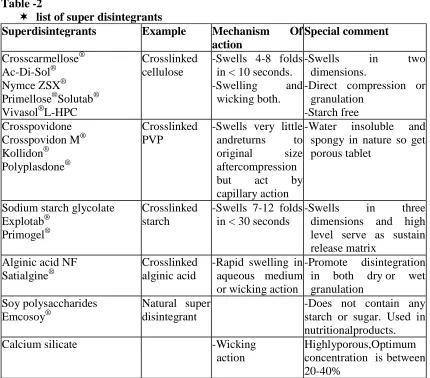
Available online at www.jocpr.com 171 Table -2
list of super disintegrants
Superdisintegrants Example Mechanism Of action
Special comment
Crosscarmellose® Ac-Di-Sol® Nymce ZSX®
Primellose®Solutab® Vivasol®L-HPC
Crosslinked cellulose
-Swells 4-8 folds in < 10 seconds. -Swelling and
wicking both.
-Swells in two dimensions.
-Direct compression or granulation
-Starch free Crosspovidone
Crosspovidon M® Kollidon®
Polyplasdone®
Crosslinked PVP
-Swells very little andreturns to original size aftercompression but act by capillary action
-Water insoluble and spongy in nature so get porous tablet
Sodium starch glycolate Explotab®
Primogel®
Crosslinked starch
-Swells 7-12 folds in < 30 seconds
-Swells in three dimensions and high level serve as sustain release matrix
Alginic acid NF Satialgine®
Crosslinked alginic acid
-Rapid swelling in aqueous medium or wicking action
-Promote disintegration in both dry or wet granulation
Soy polysaccharides Emcosoy®
Natural super disintegrant
-Does not contain any starch or sugar. Used in nutritionalproducts.
Calcium silicate -Wicking
action
Highlyporous,Optimum concentration is between 20-40%
Preformulation studies fast dissolving tablet
Preformulation study relates to pharmaceutical and analytical investigation carried out proceeding and supporting formulation development efforts of the dosage form of the drug substance. Preformulation yields basic knowledge necessary to develop suitable formulation for the toxicological use. It gives information needed to define the nature of the drug substance and provide frame work for the drug combination with pharmaceutical excipients in the dosage form. Hence, the following preformulation studies were performed on the obtained sample of drug.
1. Bulk Density (Db):
Available online at www.jocpr.com 172 Db = M/ Vb
Where, M is the mass of powder
Vb is the bulk volume of the powder.
2. Tapped Density (Dt):
It is the ratio of total mass of the powder to the tapped volume of the powder. Volume was measured by tapping the powder for 750 times and the tapped volume was noted if the difference between these two volumes is less than 2%. If it is more than 2%, tapping is continued for 1250 times and tapped volume was noted. Tapping was continued until the difference between successive volumes is less than 2 % (in a bulk density apparatus). It is expressed in g/ml and is given by
Dt = M / Vt
Where, M is the mass of powder
Vt is the tapped volume of the powder.
3.Angle of Repose (θθθθ):
The friction forces in a loose powder can be measured by the angle of repose (θ). It is an indicative of the flow properties of the powder.
It is defined as maximum angle possible between the surface of the pile of powder and the horizontal plane
tan ( θθθθ ) = h / r θθθθ = tan-1 (h / r)
Where, θ is the angle of repose. h is the height in cms
r is the radius in cms.
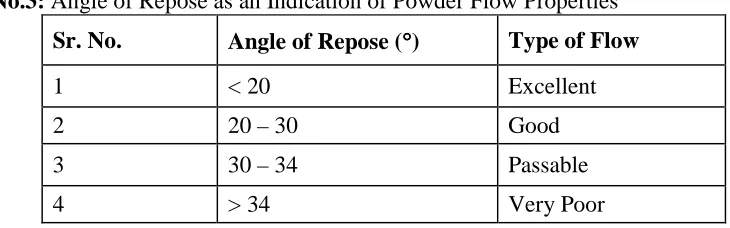
[image:10.595.106.471.565.679.2]The powder mixture was allowed to flow through the funnel fixed to a stand at definite height (h). The angle of repose was then calculated by measuring the height and radius of the heap of powder formed. Care was taken to see that the powder particals slip and roll over each other through the sides of the funnel. Relationship between angle of repose and powder flow property.
Table No.3: Angle of Repose as an Indication of Powder Flow Properties
Sr. No. Angle of Repose (°°°°) Type of Flow
1 < 20 Excellent
2 20 – 30 Good
3 30 – 34 Passable
4 > 34 Very Poor
Available online at www.jocpr.com 173 It indicates powder flow properties. It is expressed in percentage and is give
Dt – Db
I = --- ×××× 100 Dt
Where, Dt is the tapped density of the powder and
[image:11.595.122.387.260.406.2]Db is the bulk density of the powder.
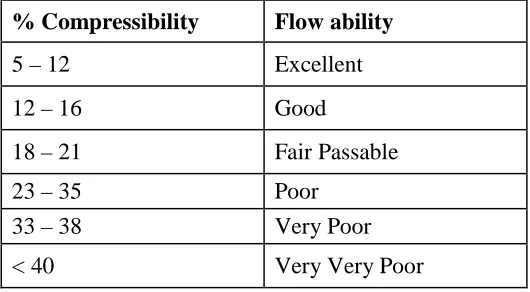
Table No.4: Relationship between % compressibility and flow ability
% Compressibility Flow ability
5 – 12 Excellent
12 – 16 Good
18 – 21 Fair Passable
23 – 35 Poor
33 – 38 Very Poor
< 40 Very Very Poor
5.Hausner ratio:
Hausner ratio is an indirect index of ease of powder flow. It is calculated by the following formula.
Dt
Hausner ratio = --- Db
Where, Dt is the tapped density.
Db is the bulk density.
Lower hausner ratio (<1.25) indicates better flow properties than higher ones (>1.25).
Identification of drug sample:
It was confirmed by melting point determination and also by FT-IR spectral analysis
Drug excipient Compatibility study:
Compatibility of the drug with excipients was determined by FT-IR spectral analysis, this study was carried out to detect any changes on chemical constitution of the drug after combined it with the excipients. The samples were taken for FT-IR study.
Evaluation of fast dissolving tablets Weight variation:
20 tablets were selected randomly from the lot and weighted individually to check for weight variation. Weight variation specification as per I.P. is shown in table No.5
Available online at www.jocpr.com 174 Average Weight of Tablet % Deviation
80 mg or less ±10
More than 80 mg but less
than 250 mg ±7.5
250 mg or more ±5
Hardness:
Hardness or tablet crushing strength (fc ), the force required to break a tablet in a diametric
compression was measured using Monsanto tablet hardness tester. It is expressed in kg/cm2.
Friability (F):
Friability of the tablet determined using Roche friabilator. This device subjects the tablet to the combined effect of abrasion and shock in a plastic chamber revolving at 25 rpm and dropping a tablet at I height of 6 inches in each revolution. Preweighted sample of tablets was placed in the friabilator and were subjected to the 100 revolutions. Tablets were dusted using a soft muslin cloth and reweighed. The friability (F) is given by the formula.
Winitial - Wfinal
F = --- ×××× 100 Winitial
4.Wetting time:
Wetting time is closely related to the inner structure of the tablets and to the hydrophilicity of the excipient. According to the following equation proposed by Washburn E.W (1921), the water penetration rate into the powder bed is proportional to the pore radius and is affected by the hydrophilicity of the powders.
dl/dt = rϒϒϒϒcosθθθθ/(4ηηηηl)
Where l is the length of penetration, r is the capillary radius, ϒ is the surface tension, η is the liquid viscosity, t is the time, and θ is the contact angle. It is obvious that pores size becomes smaller and wetting time increases with an increase in compression force or a decrease in porosity. A linear relationship exists between wetting time and disintegration time. Thus wetting is the important step for disintegration process to take place.
A piece of tissue paper folded double was placed in a Petri plate (internal diameter is 6.5 cm) containing 6ml of water. The tablet was placed on the paper and the time for complete wetting of the tablet was measured in seconds. The method was slightly modified by maintaining water at 37ο.
Available online at www.jocpr.com 175 5. In-Vitro drug release:
Release of the drug in vitro, was determined by estimating the dissolution profile.
Dissolution test:
USP 2 Paddle apparatus was used and paddle was allowed to rotate at 50 rpm .phosphate buffer (PH 6.8) (900 ml) was used as a dissolution medium.
Mechanical Strength:
Tablets should possess adequate strength to withstand mechanical shocks of handling in manufacturing, packaging and shipping. Crushing strength and friability are two important parameter to evaluate a tablet for its mechanical strength.
Crushing Strength:
It is the force required to break a tablet by compression in the radial direction, it is an important parameter in formulation of mouth dissolve tablets because excessive crushing strength significantly reduces the disintegration time.
In the present study the crushing strength of the tablet was measured using Pfizer hardness testers. An average of three observations is reported.
Friability testing:
The crushing test may not be the best measure of potential behavior during handling and packaging. The resistance to surface abrasion may be a more relevant parameter. Friability of each batch was measure in “Electro lab friabilator”. Ten preweighed tablets were rotated at 25 rpm for 4 min, the tablets were then re weighed and the percentage of weight loss was calculated.
Rapidly Disintegrating Property
To evaluate the tablets for their rapid disintegration properties, following tests were carried out.
Wetting time:
Five circular tissue papers of 10 cm diameter are placed in a petridish with a 10 cm diameter. Ten millimeters of water-containing Eosin, a water-soluble dye, is added to petridish. A tablet is carefully placed on the surface of the tissue paper. The time required for water to reach upper surface of the tablet is noted as a wetting time.
Modified disintegration test:
Available online at www.jocpr.com 176 Disintegration in oral cavity
The time required for complete disintegration of tablets in oral cavity was obtained from six healthy volunteers, who were given tablets from the optimum formulation.
Water absorption Ratio-
A piece of tissue paper folded twice was placed in a small Petri dish containing 6 ml of water. A tablet was put on the paper & the time required for complete wetting was measured . The wetted tablet was then weighed. Water absorption ratio, R, was determined using following equation,
R=10(wa/wb) where,
Wb is weight of tablet before water absorption & wa is weight of tablet after water absorption.
In-vitro dispersion time-
Tablet was added to 10 ml of phosphate buffer solution, ph 6.8 at 37+0.5ºc, Time required for complete dispersion of a Tablet was measured.
Conclusion
Available online at www.jocpr.com 177 a fast-dissolving/disintegrating dosage form, leads to increased revenue, while also targeting underserved and under-treated patient populations. Although the cost to manufacture these specialized dosage forms exceeds that of traditional tablets, this additional cost is not being passed on to the consumer.
Reference
1) Kuccherkar, B.S., Badhan, A.C., Mahajan, H.S., Mouth dissolving tablets: A novel drug delivery system, Phrma. Times, 2003, 35, 3-10.
2) Amin, A.F., Shah, T.J., Bhadani, M.N., Patel, M.M., Emerging trends in orally disintegrating tablets, www.pharminfo.net, 2005.
3) Lailla, J.K., Sharma, A.H., Freeze-drying and its applications, Indian Drugs, 1993, 31, 503-513.
4) Seager, H., Drug delivery products and zydis fast dissolving dosage form, J. Pharm. Phamacol., 1998, 50, 375-382.
5) Renon, J.P., Corveleyn, S., Freeze-dried rapidly disintegrating tablets, US Patent No. 6,010,719, 2000.
6) Masaki, K., Intrabuccaly disintegrating preparation and production there of, US Patent No.5,466,464, 1995.
7) Pebley, W.S., Jager, N.E., Thompson, S.J., Rapidly disintegrating tablets, US Patent No. 5,298,261, 1994.
8) Allen, L.V, Wang, B., Method of making a rapidly dissolving tablet. US Patent No. 5,635,210, 1997.
9) Allen, L.V, Wang, B., Process for making a particulate support matrix for making rapidly dissolving tablets. US Patent No. 5,587,180, 1996.
10) S. S. Biradar, S. T. Bhagavati and I. J. Kuppasad, Fast Dissolving Drug Delivery Systems: A Brief Overview, Internet J. Pharmacology, 2006, 4(2).
11) Lachmann, L., Liebermann, H.A., Kiang, J.L., The theory and practice of Industrial Pharmacy, 3rd Ed., Varghese Publishing House, Bombay, 1998, 430-440.
12) Kaushik, D, Dureja, H, Saini, T. R., Mouth Dissolving Tablets: A review. Indian Drugs, 2004, 41(4), 187-193.