Web-Based Appointment System using Short Message Service
Technology: Usability Aspect
Mohd Helmy Abd Wahab1, Ooi Lee Lee2, Ariffin Abdul Mutalib3, Norlida Hassan4, Roslina Mohd Sidek5, Mohamad Farhan Mohamad Mohsin6
1,2,4
Universiti Tun Hussein Onn Malaysia P.O. Box 101, Pt. Raja, Batu Pahat, Johor, Malaysia [email protected], [email protected], [email protected]
3,6
Universiti Utara Malaysia 06010 Sintok, Kedah, Malaysia [email protected], [email protected]
5
Universiti Malaysia Pahang 26300 Kuantan, Pahang, Malaysia
ABSTRACT
This paper presents an ongoing research that helps students and lecturers to be always aware of the appointment no matter where they are. It contributes to the teaching and learning process, in which communication is made easy using short messaging system (SMS) technology. It starts with examples of previous success stories of the implementation of SMS in many areas. The objectives of the paper are to discuss about the hardware and software requirement, and integrate them to be measured in terms functional. The research method is outlined next, and some discussions on current outcome of the research are addressed. The research is planned to be continued with full implementation of the proposed system that is called Student Appointment System using SMS technology.
Keywords
Web-based, SMS technology, appointment system, GSM modem
1.0 INTRODUCTION
The mobile communication technology has become more important in our life. One of the advantages of this technology is that it ensures communication is always ubiquitous (Sheereen and Rozumah, 2009). In terms of device for mobile communication, mobile phone is the most widely used (Sri Kurniawan, Yanuar dan Murni, 2006). There are two reasons affecting the widely distributed of mobile phones, which can be seen in the affordability, and capabilities. In current situation, almost everyone can afford for a mobile phone, because
it is relatively cheap. In addition, the hand phone itself contain various capabilities with the most basic functions include such as call, SMS, Multimedia Message Services (MMS), calculator, calendar, and games. In addition to the standard voice function of a mobile phone, current mobile phones may support many additional services, and accessories, such as email, packet switching for access to the Internet, Bluetooth and infrared, camera with video recorder and MP3 player, radio and Global Positioning System (GPS).
Among all functions of a mobile phone, SMS is a very popular service throughout the world. It involves transmission of alphanumeric messages between two parties which enables the communication between a mobile subscribers and external systems such as paging, electronic mail and voice-mail systems. In fact, it is expected be the most attractive and effective service for future commercial use (Nor Shahriza, Siti Hawa, and Ramlah, 2006).
2.0 RELATED WORK
SMS technology has been used to solve many problems in many fields such as engineering (Junaini and Abdullah, 2006), business (Xue, Teo, and Wang, 2002) and education (Bollen, Eimler, and Hoppe, 2004). Some of the previous success stories of SMS technology are discussed in the following paragraphs.
made delivering agricultural information faster and more conveniently. Moreover, it provides manual operation platform, which can manage the agricultural information resource and short messages to satisfy the rural users’ requirements. Advanced ADO.NET technology is used for database management.
SMS application also has been used in education to send notification to group of student in campus (Mohammad and Norhayati, 2003). The advantages of the work includes that the information could be received quickly and it reduces the number of student who are not notified. The project was developed using Visual Basic 6.0 with Query based on Structured Query Language (SQL) and ActiveX Data Object 2.0 Library (ADO) while database was held on Microsoft Access 97. The project was used Simple wire’s wireless text-messaging platform as a gateway between the Internet and mobile device for sent the message to respective mobile phone.
Muhammad Nurzaihan (2007) developed a SMS application for book loan due date notification system. This system utilizes SMS application to notify the upcoming appointment due date. The advantages of the system are to reduce the time lag problem, to enhance the management of the library such as the issues of the borrowing book and returning book that relate to the time and date.
Suomi, Serkkola and Mikkonen (2006) have developed an application of a mobile time reservation system for dental care. The system was used to allocate, cancel dentist times to new customers and to the customers who search for the waiting list using Global System for Mobile Communications (GSM) and SMS messages. They found that the system has low transaction costs and the quality of the services was improved.
Pramsane and Sanjaya (2006) also developed mobile education system which includes features such as grade release, enrollment information, and announcement using SMS to support the student’s need in a university. The advantages of the system are the student could receive the latest information easily and faster in university. The system was programmed in Visual Basic, Java and other applications which have the capability to connect the mobile phone through serial port or Bluetooth.
Another application was developed by Zoubi, Tahat and Hasan (2001), which was designed to connect a mobile phone with a PC or a microcontroller PIC in order to perform remote control and monitoring of electronic and virtual devices via SMS. The system was developed in C++. The system provided an efficient method for educational experimentation including measurements in addition to control and sensing.
Helmy, Gopalakrishna and Johari (2008) proposed a system to trap over-speeding foreign vehicles on the North-South Highway (NSH). The high speed digital
camera was used to capture the over-speeding vehicles. The photo of the over-speeding vehicles can be sent to Malaysian Police Department and Malaysian Immigration Department data bases through the MMS. Check point personnel may key-in the vehicle registration number on real time basis to access the information in the databases.
Bollen, Eimler and Hoppe (2004) developed a system for communication and discussion toolkit using SMS for use in schools. The PDA was used in the project together with wireless network to build or create an emulating the environment. The messages sent by students were stored in a database and establish a basis for discussion and analysis using a graph based modeling and discussion system.
Based on the studies discussed in the above paragraphs, this study recommends that SMS technology can help solving students’ dilemma in making appointment with lecturers. The problem can be seen in this scenario: Meeting lecturers is important for students. It is easy when the lecturers are visible meet or make appointments. However, lecturers are busy with activities such as attending meeting, handling and conducting classes and tutorials, administrative works, outstation for conferences, and courses.
In practice, when lecturers are not visible, students would just leave a note on lecturers’ board to make an appointment. But lecturers tend to miss the notes. A series of survey involving 50 university students found that 80% of their appointment notes were not responded and they failed to meet their lecturers. This needs an urgent attention. This study suggests that when the lecturers are out of the office and are invisible anywhere, a technology should be used to play the role. Therefore, a Student Appointment System (SAS) is proposed to ensure the appointment can be set by a student with a lecturer. With SAS, lecturers can always be aware about new appointment made by students.
This paper aims at reporting the state of the art of SAS, which utilizes the SMS technology. Currently, SAS is 80% complete and is ready to be imparted onto the mobile phone. To be specific, the objective of the paper is to discuss about (1) the design of hardware and software of SAS, (2) the integration of hardware and software, and (3) to test the SAS.
3.0 SYSTEM ARCHITECTURE
same time, the lecturer SMS back to the student through SAS using his\her mobile phone. With this, the student can be notified about the appointment status.
Figure 1: SAS Architecture
In SAS, a special hardware is required because it involves different technologies, i.e. the Web and mobile phone. It utilizes GSM to enable communications between different technologies, which is elaborated in the next section.
4.0 HARDWARE REQUIREMENT
GSM modem is a wireless embedded GSM communicating module similar to the SIM card in cell phones. At one side, it constructs wireless connection with the SMS Center, on the other side, it connects to the computer through RS232 serial port to make calls, receive/send messages and deal with other business transactions. GSM modem has many advantages such as high reliability, no batteries, wireless, sending /receiving SMS at any time and low price.
WaveCom GSM modem is used for this project. Figure 2 illustrates the GSM network architecture which consists of Mobile Station (MS), Base Station Subsystem (BSS) and the Network Subsystem (NS) and common for both SMS and MMS. Mobile Station consists of physical terminal and contains the radio transceiver, the display and digital signal processors and Subscriber Identity Module (SIM). SIM allows users to access a network and provides subscribed services for them (Helmy, Gopalakrishna and Johari, 2008).
Figure 2: The basic of GSM
The BSS is composed of two parts: Base Transceiver Station (BTS) and Base Station Controller (BSC) . These two communicate across the specified Abis Interface. BTS defines the cell, handle radio link protocols with MS. Depending on the number of MSs in a particular area, the number of BTSs can change.
In detail, the BSC handles radio channel setup, frequency hopping, and handoffs. BSC is a connection between MS and MSC. The BSC also converts 13kbits/s voice channel (used by the radio link) to the standardized 64kbits/s (used by the Public Switched Phone Network (PSTN).
While, the NS is mainly developed on Mobile Switching Center, which takes care of registration, authentication, location updating, handovers, and routing to a roaming subscriber. It also acts as a gateway to the PSTN or Integrated Services Digital Network (ISDN).
5.0 SOFTWARE REQUIREMENT
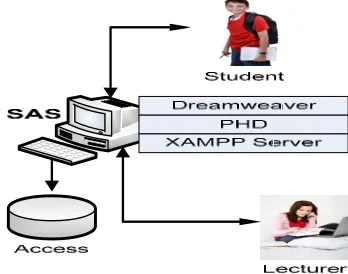
Development of SAS was initiated on a Web-based environment. There are four components involved in developing SAS as depicted in Figure 3, which includes the database (Ms Access), client application (Dreamweaver), server application (Hypertext Preprocessor – PHP), and the server (XAMPP Server).
[image:3.612.337.511.485.622.2]The diagram in Figure 3 explains that users (i.e. students and lecturers) can access SAS through its client application which interfaces in between. From the client side, the users can input new data, and update or delete the existing data. The information retrieval is seamless, and all transactions are processed by the server side scripting using PHP.
Figure 3: Components of SAS
5.1 Database
[image:3.612.82.274.573.672.2]5.2 Client Side Interface
The advantage of using Macromedia Dreamweaver to create a Web Site is that it is a flexible tool. With ‘What you see is what you get’ editor, it is easy to develop. Besides the visual HTML tool, Dreamweaver incorporate all the state-of-the-art features that professional web page developers need to produce effective and dynamic pages (Deann and Cowitt, 2004). Moreover, embedding server-side scripting requires less technical skills, because the HTML codes are auto-generated from the visual editor. In fact, it supports various server technologies such as Microsoft Active Server Pages (ASP and ASP.net), Sun Java Server Pages (JSP), Macromedia ColdFusion which writes ColdFusion Markup Language (CFML), and PHP.
5.3 Server Side
To make sure SAS is robust and can be retrieved by many users concurrently, PHP is used for the server side scripting. In this component, the scripts are used to process users’ request. It transmits the requests from users to the server, waits until the results are located, and retransmits the signals to the clients for user view. The process is totally seamless to the users.
5.4 XAMPP Server
Server is set up to process all request. It is very important, acting as the engine. In this study, SAS utilizes XAMPP as the server because of its advantages in terms of the ability to perform on multi-platforms including Apache HTTP Server, MySQL database, and interpreters for scripts written in the PHP and Perl programming languages.
6.0 METHODOLOGY
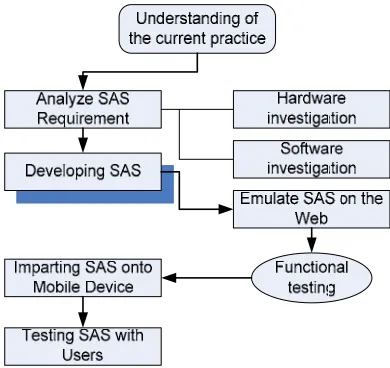
[image:4.612.328.523.65.249.2]This study was started with understanding the problem in current practice. A preliminary study was carried out in which university students were asked on their experience regarding appointment notes. Result of the preliminary study is discussed precisely in the beginning part of the paper. Other activities in this study involved analyzing the requirement for SAS, development of SAS and testing with users. Figure 4 illustrates the summary of research methodology.
Figure 4: Summary of Methodology
7.0 CURRENT OUTCOME
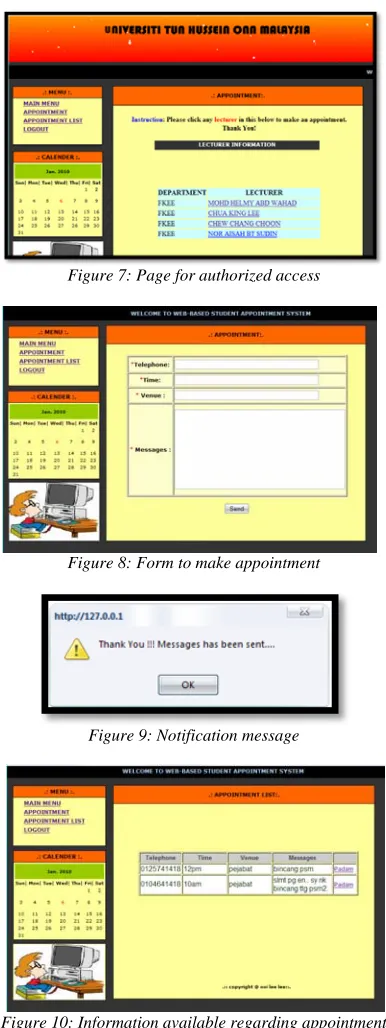
[image:4.612.331.517.359.619.2]SAS is currently fully emulated, and the main page when users enter into the system is depicted in Figure 5. Figure 6 shows the authentication mechanism, to ensure than only authorized or registered people can access the SAS.
Figure 5: The main page
Figure 6: Authentication page
receiver (lecturer), it notifies the sender as can be seen Figure 9. If a user views his/her appointment status, the information as shown in Figure 10 is provided.
Figure 7: Page for authorized access
Figure 8: Form to make appointment
[image:5.612.80.273.114.628.2]Figure 9: Notification message
Figure 10: Information available regarding appointment status
8.0 CONCLUSION
SAS has shown the success in its functional aspects. All modules work perfectly when tested, as discussed precisely in the above section. In future, SAS will be imparted onto the mobile device, and will be further tested on how users perceived the system on its usefulness and ease of use. Besides, this study will also examine on how well SAS fits to the design principles as outlined by Usability Professional Association (2010) so that it can serve the users as they intend.
REFERENCES
Bollen, L., Eimler, S. and Hoppe, H.U. (2004). “SMS-based Discussions – Technology Enhanced Collaboration for a Literature Course”. 2nd IEEE International Workshop on Wireless and Mobile Technologies in Education, pp. 1-2.
Dean, D. and Cowitt, A. (2004). Macromedia Studio MX 2004, USA: Wiley Publishing, Inc.
Gao, W., Zhang, G. and Jiang, X. (2009) .“Study Implementation of Agricultural SMS Management
System”. IEEE International Conference on
Information Technology and Computer Science, pp. 1-4
Helmy, M., Gopalakrishna, S. and Johari, A. (2008). “Speed Trap Image Transfer through GSM
Network”. Proceedings of the World Congress on
Engineering and Computer Science 2008 WCECS 2008, pp. 231-235.
Junaini, S.N. and Abdullah, J. (2008). “Malaysian Mobile Halal Product Verification using Camera Phone Barcode Scanning and MMS”. IEEE International Conference on Computer and Communication Engineering, pp. 528-532.
Mohammad Nurzaihan Ismail (2007). Library SMS Notification Services. Universiti Tun Hussein Onn Malaysia (UTHM). Tesis Projek Sarjana Muda. Mohammad, M. and Norhayati, A. (2003). “A Short
Message Service for Campus Wide Information
Delivery”. 4th IEEE National Conference on
Telecommunication Technology, 14-15 Jan 2003 , Shah Alam, Malaysia. pp. 216-221.
Paramsame, S. and Sanjaya, R. (2006). “Mobile Education Services Based on SMS and Their Architecture Comparison”. 3th IEEE International Conference On E -Learning For Knowledge Based Society, pp. 1-9.
Shereen, N. Z. and Rozumah, B. (2009). Mobile Phone use Amongst Student in University in Malaysia: It correlates and relationship to Psychological Health. European Journal of Scientific Research. 37(2) pp. 206 – 218.
GSM Based SMS Time Reservation System for Dental Care. The International Journal of Technology and Human Interaction. 30(4), 1-18.
Usability Professional Association. (2010).
Principles for Usable Design. Retrieved 4 February
2010, from http://www.usabilitybok.org/design/p287
Xu, H., Teo, H. and Wang, H. (2002). “Foundations of SMS Commerce Success: Lessons from SMS Messaging and Competition”. IEEE Proceedings of
the 36th Hawaii International Conference on System Sciences, pp. 1-10.