Journal of Chemical and Pharmaceutical Research, 2013, 5(8):48-53
Research Article
ISSN : 0975-7384
CODEN(USA) : JCPRC5
Study on removal of hexavalent chromium [VI] from aqueous solution using
beach sand
Prithwijit Sarkar
1, Shreya Bhagavatula
1, Ramanathan K.
2and Shanthi V.
1*1
Industrial Biotechnology Division, School of Bio Sciences and Technology, VIT University,
Vellore, Tamil Nadu, India
2
Bioinformatics Division, School of Bio Sciences and Technology, VIT University, Vellore, Tamil
Nadu, India
_____________________________________________________________________________________________
ABSTRACT
The use of fine beach sand to remove hazardous Chromium [VI] ions from aqueous solutions was investigated. Removal of chromium ions from stock solution of known concentration of Potassium dichromate was carried out by two sand samples, one pretreated with 70% nitric acid and one washed with distilled water. The experiment was carried out as a function of pH, where the nitric acid pretreated sand had a pH=1, and the water-pretreated sand had a pH=7. The experiment was carried out at room temperature (31°C). The adsorption time for both the solutions was 180 minutes. The main principle of this experiment was the adsorption of chromium [VI] ions to the sand particles. The rate of removal of chromium [VI] ions was observed both qualitatively as well as quantitatively. Higher removal of chromium ions was obtained at pH=1 compared to pH=7 sand samples. For Cr [VI], the Langmuir isotherm gave the best fit for adsorption. The results are discussed in terms of the chromium species present in the solution and the effect of contact time and pH on the rate of adsorption and removal efficiency has been studied.
Keywords: Beach sand, Chromium, Adsoprtion, Removal efficiency, pH.
_____________________________________________________________________________________________
INTRODUCTION
Today’s environment faces major threats of pollution, and living organisms are greatly affected by deteriorating conditions of the environment. Humanity is at risk of various harmful effects of these pollutants, and thus there is a very crucial need to abate and remove these contaminants to provide a safe and healthy living environment not only for us, but also for our future generations.
There have been studies using activated carbon for the bioremediation of polluted soils and water, and it has been shown to be an efficient adsorbent of chromium from effluent [6-8]. The disadvantage of using activated carbon is that it is fairly expensive and raises the cost of the experiment. Hence, removal of chromium from polluted soils and water using a low cost and non toxic adsorbent is the need of the present scenario. In these recent times, many studies have been carried out by scientists all over the world where they have used various naturally available and cheap resources as adsorbents for the removal of harmful heavy metal pollutants [9–11]. Some of these resources include china clay, and various waste materials like exhausted coffee, saw dust, fly ash, dead biomass, etc [16-24].
Sand is a natural resource present in abundance in the environment. Employment of this widely available resource to remove harmful chromium [VI] ions from the contaminated is not only a cost effective but also eco-friendly [10-16]. This experiment aims to compare the efficiency of removal of Cr [VI] ions by sand samples using sand samples pretreated with nitric acid (pH=1) and distilled water (pH=7).
EXPERIMENTAL SECTION
(i) Materials and Instruments:
The chemicals required for the experiment were obtained from the laboratories of VIT University. The materials used in the experiment include the samples of fine beach sand taken from Vishakhapatnam (Fig1), 70% Nitric acid, distilled water and Potassium dichromate. The instruments used in the experiment were: hot air oven, to dry the pre-treated sand, orbital shaker (set at 100 rpm) and UV-visible spectrophotometer to check the decrease in the levels of chromium [VI] ions in the potassium dichromate solutions.
Fig1 – Fine beach sand of Vishakhapatnam Fig2 – Pretreatment of the sand
(ii) Pretreatment of the sand:
Fig3 – Formation of dark blue precipitate in the acid treated sand
(iii) Batch adsorption study
The pre-treated sand was put in hot air oven for drying at 110◦C. Stock solution of 1000ppm of potassium dichromate solution was prepared. Two conical flasks were taken; 50 ml of this solution was poured in each flask. In one flask 1 gram of sand treated with nitric acid was added, and in the other 1 gram of sand treated with distilled water was added. Spectrophotometric method was used to measure the decrease in levels of chromium as time progressed. The initial reading was taken at t=0 minutes followed by constant shaking at 100 rpm in an orbital shaker till the next reading. The readings were taken for every 15 minutes till 3 hours passed (t=180 minutes).
Removal efficiency was expressed as the percent of chromium ion concentration removed.
Where Ci is final concentration and Ce is initial concentration [26].
[image:3.595.78.512.86.251.2]RESULTS AND DISCUSSION
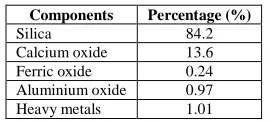
Table 1: Physiochemical analysis of beach sand
Components Percentage (%)
Silica 84.2
Calcium oxide 13.6 Ferric oxide 0.24 Aluminium oxide 0.97 Heavy metals 1.01
Table II: Contact time vs. % removal of chromium[VI] with the two pretreated sands
Ser. No. Contact time (in min)
Removal efficiency of nitric acid pretreated
sand sample (in %)
Removal efficiency of distilled water pretreated sand sample (in %)
1 0 0.000 0.000
2 15 5.714 0.714
3 30 6.939 1.122
4 45 7.806 1.378
5 60 8.061 1.531
6 75 9.010 2.500
7 90 9.949 2.806
8 105 10.710 3.110
9 120 10.800 2.640
10 135 10.710 4.180
11 150 12.140 3.469
12 165 12.600 4.690
[image:3.595.231.366.490.551.2]Qualitative results:
The colour of potassium dichromate solution is bright orange. The colour of potassium dichromate is observed to fade as the contact time increases.
Quantitative results:
From the readings taken (Table II) a graph was plotted which is shown (Fig4). The graph was plotted against efficiency of the removal and contact time. From the graph it was observed that with increase in contact time the efficiency of removal of chromium increases. Equilibrium adsorption value was taken from the literature and was analyzed according to Langmuir adsorption [27] and Freundlich adsorption [28] isotherms. The adsorption of metal ions on sand proceeds through a protonation and de-protonation of sand. This is called the ion exchange mechanism between ions which are already adsorbed on sand and chromium ions in potassium dichromate solution [29, 30]. The adsorption of chromium on negatively charged surfaces cannot be explained by or adsorption forces alone. There are specific chemical interactions which take part in the removal [31].
In acidic range there is presence of nitrate ion and there is an ion exchange of chromate-nitrate which is reported to remove the chromium [VI] ions. A detailed study on the effect of pH in removal of chromium ions is given in the references [32, 33]
Effect of pH:
pH plays an important role in removal of chromium using sand. pH is marked as the master variable [34].There is a drastic change in the results with the change in pH. It was observed that the efficiency of removal is higher at lower pH. The sand which is treated with nitric acid (pH=1) has greater efficiency than the sand treated with distilled water (pH=7). The graph for the same is shown in (Fig4). Maximum chromium removal observed at pH 1 can also be associated with the high electrostatic forces between the adsorbent and adsorbate. [35] The efficiency of removal increases with contact time. The efficiency of sand at pH=1 increased from 5.714% to 12.600% and for sand at pH=7 increased from 0.714% to 5.102% in a constant contact time of 180 minutes.
Fig4. Contact time vs. % removal of chromium [VI] at different pH sands
The efficiency of removal increases with contact time. The efficiency of sand at pH=1 increased from 5.714% to 12.600% and for sand at pH=7 increased from 0.714% to 5.102% in a constant contact time of 180 minutes.
CONCLUSION
The fine beach sand taken is a non toxic and easily available natural resource. The removal of chromium from potassium dichromate solution was observed to be successful using the sand. The efficiency increased with increase in contact time. It can also be concluded that pH plays a major role in altering the efficiency. Lower pH results in higher efficiency. The efficiency at pH=1 was much greater than the efficiency at pH=7. Therefore the pretreatment of sand with nitric acid was an essential step as there was a decrease in pH which resulted in increase of efficiency. The % removal was 12.60 at pH=1 and was 5.102 at pH=7. Removal of hexavalent chromium is higher at acidic pH. Therefore the adsorbent used in the experiment can serve as a potential material to remove chromium from many effluents and industrial wastes.
Acknowledgements
We would like to thank our Beloved and Honorable Chancellor, Dr. G. Viswanathan for establishing this institution and giving us the platform to shine in academics. We would also like to thank Dr. Shanthi V. for giving us this opportunity to perform this project and also our parents for their constant moral support. Also to be thanked are the lab attendants and assistants who helped us with the materials and instruments required for the completion of this project.
REFERENCES
[1]M Khamis; F Jumean; N Abdo. Journal of Hazardous Materials, 2009, 169, 948–952.
[2]YC Sharma; B Singh; A Agrawal; CH Weng. Journal of Hazardous Materials, 2008, 151, 789–793 [3] AK Shanker; C Cervantes; H Loza-Tavera; S Avudainayagam. Environ. Int., 2005, 31, 739–753. [4] S Park; WY Jung. Carbon Sci., 2001, 2, 15–21.
[5]YC Sharma. J. Colloid Interface Sci., 1995, 173, 66–70.
[6]JW Shim; SM Lee; BS Rhee; SK Ryu. The European Carbon Conference “carbon 96”, New Castle, UK, 1996. [7]T Kurniawan; GYS Chan; W Lo; S. Babel. Sci. Total Environ., 2006, 366, 409–426.
[8]SK Ouki; RD Neufeld; R Perry. J. Chem. Technol. Biotechnol., 1997, 70, 38.
[9]YH Huang; CL Hsueh; HP Cheng; LC Su; CY Chen. J. Hazard. Mater., 2006, 10, 061. [10] PA Kumar; M Ray; S Chakraborty. J. Hazard. Mater., 2006, 007, 067.
[11]YS Ho. Water Res., 2006, 40, 119–125.
[12]MM Aslam; I Hassan; M Malik. Electron. J. Agric. Food Chem., 2004, 3, 792–798. [13]MA Baig; B Mehmoud; A Martin. J. Agric. Food Chem., 2003, 2, 374–379.
[14]N Muhammad; J Parr; MD Smith; A Wheatley. 24th WEDC Conference, Sanitation and Water for All, Islamabad, Pakistan, 1998, pp. 346–349.
[15]N Muhammad; J Parr; MD Smith; AD Wheatley. Proceedings of 24th WEDC Conference, Islamabad, Pakistan, 1998, pp. 346–349.
[16]M Awan; I Qazi; I Khalid. J. Environ. Sci., 2003, 15, 413–416.
[17] YC Sharma; G Prasad; DC Rupainwar; KK Panday. Int. J. Environ. Anal. Chem., 1990, 39, 310–321. [18] Y Orhan; H Buyukgungor. Water Sci. Technol., 1993, 28, 247–256.
[19]VP Dikshit; IC Agrawal; NP Shukla. Asian Environ., 1990, 12, 64–69. [20] AK Bhattacharya; C Venkobachar. J. Environ. Eng. Div., 1984, 10, 110–122. [21] HL Kutat; DL Michelson. AIChE Symp. Ser. Water, 1973, 136, 384–392. [22]JN Jha; L Iyengar; AVSP Rao. J. Environ. Eng. ASCE, 1988, 144, 962–973. [23]WJ Weber; JC Morris; J Sanit. Eng. Div. ASCE, 1963, 89, 31–39.
[24] J Kim; J Joltek. Prog. Water Technol., 1977, 9, 943–952.
[25] J Atkinson; C Hibbert. Chemistry for AQA, Heinemann, UK, 2001, pp. 255. [26]C Namasivayam; RT Yamuna. Chemosphere, 1995, 30, 561–578.
[27] L Langmuir. J. Am. Chem. Soc., 1918, 40, 1361–1403. [28]H Freundlich. Z. Phys. Chem., 1907, 57A, 385–470.
[29]M Awan; I Qazi; I Khalid. J. Environ. Sci., 2003, 15, 413–416.
[30]BM Murray. Environmental Chemistry of Soils, Oxford University Press, 1994, Chapt. 3. [31] M Mahto. Ph.D. Thesis, Ranchi, 2004.