Journal of Chemical and Pharmaceutical Research, 2013, 5(5):369-373
Research Article
ISSN : 0975-7384
CODEN(USA) : JCPRC5
Development and validation of a normal phase HPLC method for separation
of anacardic acid isomers in cashew nut shell liquid
Praveen Kumar S. N.a, Bhadre Gowda D. G.*a, Vathsala Deepu C.a, Mantelingu K.b and Rangappa K. S.b
aDepartment of Studies in Chemistry, Yuvaraja’s College, University of Mysore, Mysore, Karnataka, India bDepartment of Studies in Chemistry, Manasagangothri, University of Mysore, Mysore, Karnataka, India
_____________________________________________________________________________________________
ABSTRACT
A simple normal phase HPLC method was developed and validated for the separation and determination of anacardic acid isomers present in cashew nut shell liquid. A Chiralpack, IA Chiral column (250 mm x 4.6 mm, packed with 5 microns) is used as stationary phase. An isocratic mode with mobile phase consists of 0.1% trifluroacetic acid in n- Hexane and IPA in ration of 1:1000:10 (v/v/v), at a flow rate of 1 mL/min. and the eluent was monitored at a wavelength of 210 nm. The result obtained from method validation showed a good agreement with the declared content. The method shows good linearity in the range of 0.06-0.24 mg/mL with correlation coefficient 0.9997-0.9999. Analytical recovery was between 99.0 -102.0 %. The proposed method successfully applied for separation of anacardic acid isomers i.e. saturated, monoene, diene and triene present in cashew nut shell liquid. The established normal phase HPLC method is precise, accurate and selective, because of its sensitivity and reproducibility.
Key words: Anacardicacid; Cashew nut shell liquid; HPLC; Validation.
_____________________________________________________________________________________________
INTRODUCTION
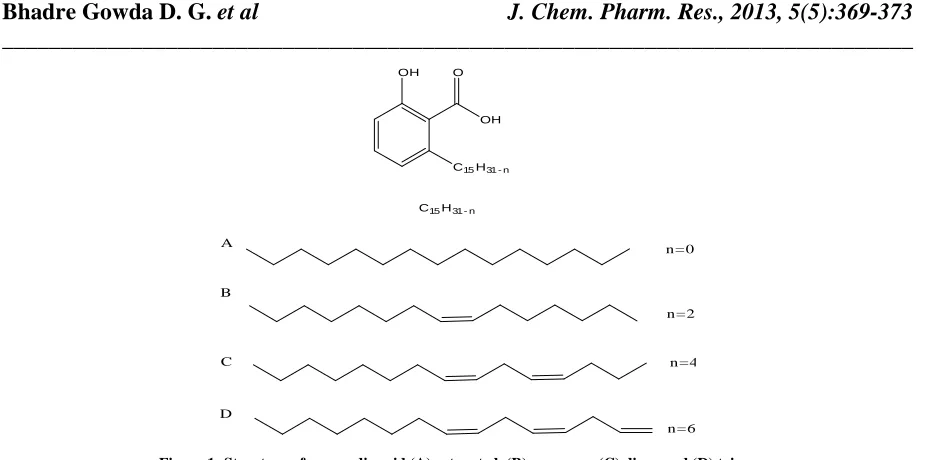
Anacardic acid is chemically known as 2-hydroxy-6-[(8Z, 11Z)-pentadeca-8, 11, 14-trienyl] benzoic acid [8]. The term "anacardic acid" is used to describe the mixture of 6-n-alkylsalicylic acids which constitute the major part of the extract of cashew nut shells (Anacardium occidentale). Its principal components, 6-pentadecy1, 6-(pentadec-8-enyl), 6-(pentadec- 8, ll-dienyl) and 6-(pentadec-8, 11, 14-trienyl) salicylic acids are accompanied by small amounts of the C13 to C17 side chain homologues. As they are closely related to urushiol, they also cause an allergic skin rash
O H O
O H
C 15 H 31 - n
C 15 H 31 - n
n = 0
n = 2
n = 4
n = 6 A
B
C
[image:2.595.69.532.72.302.2]D
Figure 1: Structure of anacardic acid (A) saturated, (B) monoene, (C) diene and (D) triene
The analytical method was validated [9-11] as per current International Conference on Harmonization (ICH) guidelines [12].
EXPERIMENTAL SECTION
Apparatus and Chromatographic Conditions: Agilent 1200 series HPLC, G1331A Quaternary pump connected
with G1314B Variable Wavelength detector, G1316A Thermostatted Column Compartment, G1329A ALS autosampler. The data acquisition was performed by Agilent Chemstation software. The chromatographic separation was performed using a Chiralpack, IA Chiral column (250 mm x 4.6 mm, packed with 5 microns) is used as stationary phase. An isocratic mode with mobile phase consists of 0.1% trifluroacetic acid in n- Hexane and IPA in ration of 1:1000:10 (v/v/v), at a flow rate of 1 mL/min. and the eluent was monitored at a wavelength of 210 nm. The column temperature was maintained at 25 °C temperature and injection volume 5 µL was used. The total runtime was 30 min. The mobile phase was filtered through 0.45 µm nylon membrane (Millipore) prior to use.
Reagents: n-Hexane (HPLC grade, MERCK), Isopropyl alcohol (IPA) (HPLC grade, Thomas Baker) and
trifluoroacetic acid (AR grade), saturated, monoene, diene and triene anacardic acid.
Preparation of Mobile Phase:
The mobile phase consists of 0.1% trifluroacetic acid in n- Hexane and IPA in ration of 1:1000:10 (v/v/v), mix well. Mobile phase was filtered through a 0.45 µm nylon membrane (Millipore) and degassed in an ultrasonic bath (Branson-5510). Mobile phase used as diluent for standard and sample preparations.
Preparation of Standard Solution:
The standard stock solution 2 mg/mL of saturated, monoene, diene and triene was prepared in diluent. The resulting solution was transferred to standard analytical HPLC glass vials and injected into the HPLC.
Preparation of Sample Solution:
______________________________________________________________________________
RESULTS AND DISCUSSION
Method Development:
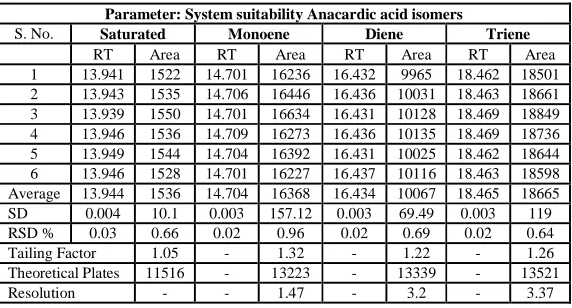
The object of this work was to develop and validate a simple, rapid and sensitive isomer separation method for the determination of saturated, monoene, diene and triene anacardic acid. To achieve the object, different options were evaluated. Optimization of the chromatographic conditions is intended to take into account that various goals of method development like good resolution, runtime sensitivity, peak symmetry, theoretical plates, tailing factor, etc. The chromatographic conditions were optimized by changing the mobile phase composition and buffers used in the mobile phase. Different ratios were experimented to optimize the mobile phase. Finally a mixture of IPA and 0.1 % trifluroacetic acid in n-Hexane in the ratio of 10:1000 was found to be suitable. 5 µL of the assay preparation using the optimized chromatographic condition was injected in to the NP-HPLC. The retention time of anacardic acid isomers is Saturated (~13.941 min), Monoene (~14.701 min), Diene (~16.432 min) and Triene (~18.462 min) and the typical chromatogram is shown in figure 2.
Figure 2: A typical chromatogram showing the peaks of anacardic acid (A) saturated, (B) monoene, (C) diene and (D) triene
Accuracy and Precision:
Accuracy of developed method was confirmed by doing recovery study as per ICH norms. A known quantity of the pure compound was added to the test sample at three different concentration levels 50 %, 100 % and 150 % by replicate analysis (n=3). From the recovery study it was clear that the method is very accurate for quantitative estimation of anacardic acid isomers in CNSL as all the statistical results were within the range of acceptance between 99. 0 -102.0 %, which indicates accuracy of the method. The precision of method was ascertained from the peak area response obtained by actual determination of six replicates of a fixed amount of drug. The percent relative standard deviations were calculated for anacardic acid isomers and presented in the table 1.
System Suitability:
Table 1: Precision study of anacardic acid
Parameter: Precision
Set Anacardic acid isomers No. Method Intermediate
1 99.27 99.24 2 99.18 99.16 3 99.31 99.56 4 99.68 99.47 5 99.18 99.19 6 99.61 99.74 Mean 99.37 99.39 SD 0.22 0.23 RSD % 0.22 0.24
Linearity:
The linearity of the method was tested from 0.06 - 0.12 mg/mL for saturated, 0.12- 0.24 mg/mL for monoene, 0.06- 0.12 mg/mL for diene, and 0.12- 0.24 mg/mL for triene anacardic acid. Linearity solutions were injected in triplicate and the calibration graphs were plotted as peak area of the analyte against the concentration of the sample in mg/mL. In the simultaneous determination, the calibration graphs were found to be linear for both the analytes in the mentioned concentrations and the correlation coefficients for the regression line were 0.9999, 0.9997, 0.9998 and 0.9997 for saturated, monoene, diene and triene anacardic acid respectively see figure 3.
Table 2: System suitability test results of anacardic acid
Parameter: System suitability Anacardic acid isomers
S. No. Saturated Monoene Diene Triene RT Area RT Area RT Area RT Area 1 13.941 1522 14.701 16236 16.432 9965 18.462 18501 2 13.943 1535 14.706 16446 16.436 10031 18.463 18661 3 13.939 1550 14.701 16634 16.431 10128 18.469 18849 4 13.946 1536 14.709 16273 16.436 10135 18.469 18736 5 13.949 1544 14.704 16392 16.431 10025 18.462 18644 6 13.946 1528 14.701 16227 16.437 10116 18.463 18598 Average 13.944 1536 14.704 16368 16.434 10067 18.465 18665 SD 0.004 10.1 0.003 157.12 0.003 69.49 0.003 119 RSD % 0.03 0.66 0.02 0.96 0.02 0.69 0.02 0.64 Tailing Factor 1.05 - 1.32 - 1.22 - 1.26 Theoretical Plates 11516 - 13223 - 13339 - 13521 Resolution - - 1.47 - 3.2 - 3.37
Solution Stability:
In order to demonstrate the stability of both standard and sample solutions during analysis, both solutions were analyzed over a period of 24 hours at an interval of 2 hours at room temperature. The results show that for solutions, the retention time and peak area of anacardic acid isomers remained unchanged and no significant degradation within the indicated period, this indicates that both solutions were stable for 24 hours.
Robustness:
______________________________________________________________________________
Figure 3: Graph showing linearity and range of Anacardic acid
CONCLUSION
The proposed NP-HPLC method for separation of anacardic acid isomers is simple, precise, accurate, robust and selective. The validation of the analysis proved that the method is reproducible and efficient for the determination of anacardic acid in CNSL form without any interference from the sample excipients. Hence, the method can be easily and conveniently applied for routine analysis in quality control laboratories and research institutes for the determination and separation of saturated, monoene, diene and triene anacatdic acid.
Acknowledgements
The authors are thankful to Dr. Ravi Datar, R&D Manager, FMC India R&D Center, Indian Institute of Science Campus, Bangalore, Karnataka, India, for providing facilities to carry out this work.
REFERENCES
[1]S.W.Donald, M. Robert, C. Richard, Journal of Chemical Ecology, 1988, 14(3), 743-751. [2]Lakshman Swamy Parasa, T. Sunita, K. Babu Rao, J.Chem.Pharm. Res., 2011, 3(5), 736-742. [3]H.A. Lloyd, C. Denny, G. Krishna, Journal of Liquid Chromatography, 1980, 3(10), 1497-1504. [4]Y.N.P. Joseph, B. Josepj, L.M. Lupituko, J. Agric. Food Chem., 2007, 55, 8870-8876.
[5]J.H.P. Tyman, D. Wilczynski, M.A. Krshani, Journal of The American Oil Chemists Society, 1978, 55,663-668. [6]J.H.P. Tyman, V. Tychopouls, P. Chan, et al., Journal of Chromatography A, 1984, 303, 137-150.
[7]R. Paramashivappa, P.P. Kumar, P.J. Vithayathi, J. Agri Food Chem., 2001, 49(5), 2548-2551. [8]J.Y. Philip, J. Da Cruz Francisco, E.S. Dey, J. Agri Food Chem., 2008, 56(20), 9350-9354. [9]B.K. Sharma, A manual of Analytical Technique, A good Laboratory practices, 2009, pp.84-85.
[10]B.K. Sharma, Instrumental methods of Chemical Analysis, Goel Publishing House, Meerut, 2007, pp. 4-5. [11]USP 29/NF 24, the United States Pharmacopoeia, 29 th Rev. and the National Formulary, Rockville, MD: United States Pharmacopoeial Convention Inc., 2006, pp. 1964-1966.