The SPARQL Usage for Mapping
Maintenance and Reuse Methodology
A thesis submitted to the
University of Dublin, Trinity College in fulfilment of the requirements of the degree of
Doctor of Philosophy
Alan Meehan
Knowledge and Data Engineering Group (KDEG) School of Computer Science and Statistics
Trinity College, Dublin Ireland
Supervised by Prof. Declan O’Sullivan Co-supervised by Dr. Rob Brennan
ii
Declaration
I, the undersigned, declare that this work has not been previously submitted as an exercise for a degree at this or any other University, and that, unless otherwise stated, it is entirely my own work.
iii
Permission to lend or copy
I, the undersigned, agree that the Trinity College Library may lend or copy this thesis upon request.
iv
Acknowledgements
I would like to thank my supervisors, Declan O’Sullivan and Rob Brennan, for all of their support and guidance throughout this Ph.D. I could not have done it without them.
v
Abstract
This thesis presents the SPARQL Usage for Mapping Maintenance and Reuse (SUMMR) methodology, which is for the support of performing maintenance and reuse of Linked Data mappings.
The providers of Linked Data datasets have made a great effort in recent years to publish more Linked Data on the web. These datasets cover a wide range of knowledge domains. For some datasets, their knowledge domains overlap. Due to the de-centralised nature of their development, ownership and management they use heterogeneous vocabularies. This leads to diversity of vocabulary term representations and data instance representations for overlapping terms and instances. Mappings can be used to overcome these heterogeneities, but the creation of new mappings can be a difficult and time consuming task. Therefore, reusing existing mappings, to aid in the creation of new mappings becomes appealing to dataset maintainers. In addition datasets can change over time. These changes can effect existing mappings that reference the changed dataset, causing the mappings to become invalid and no longer produce correct results. Mapping maintenance is concerned with the discovery and repair of invalid mappings and this is also a difficult and time consuming task.
Through a systematic literature review, modelling and evaluation, the SUMMR methodology unifies both mapping maintenance and mapping reuse, through identifying use cases from both and combining them together, along with specific tasks, into a common methodology. SUMMR provides standard SPARQL query templates to perform maintenance and reuse use cases and tasks over RDF-based mapping representations and datasets. SUMMR provides a specialised mapping representation – named the SPARQL Centric Mapping Representation (SCMR). SCMR is designed to represent two categories of ontology mappings (i) those used to transform data described from one Linked Data vocabulary into another and (ii) interlinks between semantically similar instances in Linked Data datasets. The SCMR represents these categories of mappings with sufficient detail to maximise support for SUMMR templates. However, SUMMR can be used with alternative RDF-based mapping representations.
vi
SCMR. An additional lab-based experiment provides evidence the SCMR is sufficiently expressive for representing ontology mappings which are concerned with the transformation of data from one vocabulary to another. The case study evaluation was performed to evaluate the usefulness of SUMMR in a real world Linked Data dataset management situation. SUMMR was applied to the interlink management process of the DBpedia dataset, through an open-source software tool - named the SUMMR Interlink Validation Tool, to provide SUMMR-based invalid interlink category mapping detection. The SUMMR Interlink Validation Tool was used to validate 1,679,634 interlink category mappings that were to be published in the v.2015-10 DBpedia dataset release and discovered that 53,418 of these interlink category mappings were invalid.
vii
Table of Contents
Declaration ... ii
Permission to lend or copy ...iii
Acknowledgements ... iv
Abstract... v
Table of Contents ...vii
List of Figures...xii
List of Tables ...xiv
Abbreviations ...xvi
1. Introduction ... 1
1.1. Motivation ... 1
1.2. Research Question ... 4
1.2.1. Definitions ... 4
1.2.2. Research Objectives ... 6
1.2.3. Thesis Contributions... 7
1.2.4. Assumptions and Constraints ... 10
1.3. Research Methodology... 11
1.4. Evaluation Strategy ... 12
1.5. Thesis Overview... 15
2. Background... 17
2.1. Ontology Matching and Mapping ... 17
2.1.1. The Matching Process ... 17
2.1.2. The Mapping Process ... 18
2.2. Linked Data Mappings ... 19
2.2.1. Uplift and Lowering Category of Mappings ... 19
2.2.2. Vocabulary Category of Mappings ... 20
2.2.3. Interlink Category of Mappings ... 20
2.3. Chapter Summary... 21
3. State of the Art... 22
3.1. Introduction ... 22
viii
3.2.1. DyKOSMap... 23
3.2.2. DSNotify ... 24
3.2.3. Khattak et al. ... 26
3.2.4. Maveric... 27
3.2.5. LogMap ... 28
3.2.6. Dependency Model ... 28
3.2.7. WOD-LMP ... 29
3.2.8. COMA++ ... 30
3.2.9. MooM ... 31
3.2.10. LinkLion ... 31
3.2.11. BioPortal ... 32
3.2.12. Community Driven O ntology Matching ... 33
3.2.13. Li et al. ... 33
3.2.14. Alignment API... 34
3.2.15. Sabou et al. ... 35
3.2.16. Section Summary... 36
3.3. Existing Approaches for O ntology Mapping Representation ... 37
3.3.1. LinkLion Mapping ... 37
3.3.2. BioPortal Mapping ... 38
3.3.3. OWL ... 39
3.3.4. Jena-Rules ... 39
3.3.5. SWRL ... 40
3.3.6. SPARQL CONSTRUCT Queries ... 40
3.3.7. SPIN Rules ... 40
3.3.8. R2R Mapping Language ... 41
3.3.9. Alignment Format and EDOAL ... 41
3.4. Mapping Maintenance and Reuse Use Cases and Tasks... 42
3.5. Analysis of Existing Approaches for Mapping Maintenance and Reuse and for Mapping Representation ... 46
3.6. Chapter Summary... 49
4. Refinement of Use Cases for a Query-Based Methodology for Mapping Maintenance and Reuse... 50
4.1. Refined Use Cases... 50
ix
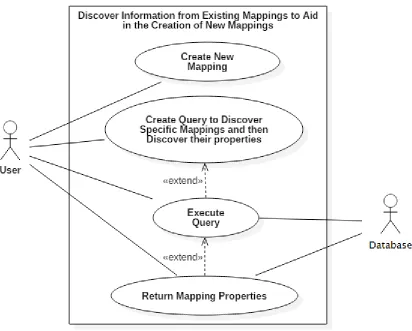
4.1.2.Refined Use Case 2: Discover Information from Existing Mappings to Aid
in the Creation of New Mappings ... 51
4.1.3.Refined Use Case 3: Discover Mapping Paths to Aid in the Creation of New Mappings ... 53
4.1.4.Refined Use Case 4: Discover Back Links to Aid in the Creation of New Mappings ... 55
4.1.5.Refined Use Case 5: Discover Invalid Mappings due to Changes in Datasets a Mapping References ... 56
4.1.6. Refined Use Case 6: Repair of an Invalid Mapping... 58
4.2. Chapter Summary... 60
5. Design of the SUMMR Methodology ... 61
5.1. Introduction to the SUMMR Methodology... 61
5.1.1. Brief Overview of SUMMR ... 62
5.2. Elements of SUMMRs Design ... 63
5.2.1. SPARQL Centric Mapping Representation (SCMR) ... 63
5.2.2. SUMMR Templates... 67
5.2.2.1. Maintenance and Reuse Task Templates ... 68
5.2.2.2. Maintenance and Reuse Use Case Templates... 73
5.2.3. SUMMR Templates Summary ... 76
5.3. Operation of the SUMMR Methodology ... 76
5.3.1. Operation of SUMMR in a Mapping Lifecycle ... 78
5.4. SUMMR Implementation... 80
5.4.1. SUMMR Interlink Validation Tool ... 80
5.4.2. Potential SUMMR Tools ... 83
5.4.3. SUMMR Implementation Summary ... 83
5.5. Reflections upon the Design of SUMMR ... 84
5.5.1. Features and Limitations ... 84
5.5.2. Specialising SUMMR for Mapping Maintenance and Reuse for Other Domains 85 5.6. Chapter Summary... 87
6. Evaluation ... 88
6.1. Introduction ... 88
6.2. Experiment 1: Evaluation of the SPARQL Centric Mapping Representation ... 91
x
6.2.2. Hypotheses ... 93
6.2.3. Datasets ... 94
6.2.4. Methodology ... 96
6.2.5. Procedure... 96
6.2.6. Results ... 97
6.2.7. Discussion ... 98
6.2.8. Conclusion... 99
6.3. Experiment 2: Evaluation of SUMMR for Mapping Maintenance and Reuse Tasks 1 to 3 ... 100
6.3.1. Introduction ... 100
6.3.2. Hypotheses ... 102
6.3.3. Datasets ... 102
6.3.4. Mapping Retrieval Use Cases ... 103
6.3.5. Methodology ... 106
6.3.6. Procedure... 107
6.3.7. Results ... 108
6.3.8. Discussion ... 109
6.3.9. Conclusion... 111
6.4. Experiment 3: Evaluation of SUMMR to Perform Mapping Maintenance and Reuse Tasks 4 and 5 ... 111
6.4.1. Introduction ... 112
6.4.2. Hypotheses ... 112
6.4.3. Datasets ... 113
6.4.4. Methodology ... 114
6.4.5. Procedure... 116
6.4.6. Results ... 118
6.4.7. Discussion ... 119
6.4.8. Conclusion... 120
6.5. Case Study: Applying SUMMR in the DBpedia Interlink Management Process... 121
6.5.1. Introduction ... 121
6.5.2. DBpedia Interlink Management Process... 123
6.5.3. SUMMR Applied to the Process ... 124
6.5.4. Approach and Procedure ... 125
xi
6.5.6. Conclusion... 128
6.6. Chapter Summary... 129
7. Conclusion ... 131
7.1. Evaluation of Achievement of Research Objectives ... 131
7.1.1. Objective 1: Review Existing Approaches for Mapping Maintenance and Reuse... 131
7.1.2. Objective 2: Design a Query-based Methodology for Mapping Maintenance and Reuse ... 132
7.1.3. Objective 3: Implement the Query-based Methodology ... 133
7.1.4. Objective 4: Evaluate the Ability of the Query-based methodology to Support Performing Mapping Maintenance and Reuse ... 133
7.1.5. Objective 5: Evaluate the Usefulness of the Query-based Methodology in a Real World Linked Data Situation ... 135
7.2. Contributions ... 135
7.3. Further Work ... 137
7.4. Final Remarks ... 138
References ... 139
Appendix A. SUMMR Use Case Template Examp les... 147
Appendix B. DVD Contents ... 150
xii
List of Figures
Figure 2-1. Depiction of the matching process. ... 18
Figure 2-2. Example of data uplifted from XML to RDF and lowered back to XML [Bi12]. ... 19
Figure 2-3. Example of data described according to the DBpedia vocabulary, transformed to be described according to the Linked Movie Database vocabulary. ... 20
Figure 2-4. Examples of four interlinks from the DBpedia dataset to the Linked Movie Database, FreeBase, OpenCyc and YAGO datasets. ... 21
Figure 3-1. Classes and properties of the DSNotify Eventset Vocabulary [Po11]. ... 25
Figure 3-2. Core Elements of the Change History Log [Kh15]. ... 26
Figure 3-3. LinkLion mapping representing an interlink category mapping between the DBpedia and Linked Movie Database datasets. ... 38
Figure 3-4. BioPortal Mapping representing an interlink category mapping between two biomedical databases in the BioPortal repository. ... 39
Figure 3-5. R2R mapping for a movie runtime vocabulary resource between the DBpedia and Linked Movie Database datasets. ... 41
Figure 4-1. UML diagram for the refined use case of retrieving specific mappings for sharing. ... 51
Figure 4-2. UML diagram for the refined use case of discovering information from existing mappings to aid in the creation of new mappings. ... 52
Figure 4-3. UML diagram for the refined use case of discovering mapping paths to aid in the creation of new mappings. ... 54
Figure 4-4. UML diagram for the refined use case of discovering back links to aid in the creation of new mappings. ... 56
Figure 4-5. UML diagram for the refined use case of discovering invalid mappings due to changes in datasets a mapping references. ... 57
Figure 4-6. UML diagram for the refined use case of the repair of an invalid mapping. 59 Figure 5-1. Overview of the SUMMR Methodology. ... 63
Figure 5-2. Example of SPARQL CONSTRUCT Query Encoded in RDF via the SPIN SPARQL Syntax. ... 64
Figure 5-3. Example of a SCMR Vocabulary Transformation Category Mapping. ... 66
Figure 5-4. Example of an SCMR Interlink Category Mapping. ... 66
Figure 5-5. SUMMR Task Template 1 Specialised for SCMR. ... 70
xiii
Figure 5-7. SUMMR Task Template 3. ... 71
Figure 5-8. Example of SUMMR Task Template 4 Specialised for SCMR. ... 72
Figure 5-9. Example of SUMMR Task Template 5 Specialised for SCMR. ... 72
Figure 5-10. Depiction of SUMMR Task Templates that combine to create SUMMR Use Case Templates. The different coloured arrows emanating from the Task Templates point towards the Use Case Templates that they combine together to make up. ... 74
Figure 5-11. Example of SUMMR Use Case Template 1 specialised for SCMR. ... 75
Figure 5-12. Example of SUMMR Use Case Template 5. ... 75
Figure 5-13. Flow diagram of the Operation of SUMMR. ... 77
Figure 5-14. Extended OISIN Mapping Lifecycle diagram (from Thomas [Th13]). ... 78
Figure 5-15. Extended OISIN mapping lifecycle with the SUMMR Methodology. ... 79
Figure 5-16. Operation of the SUMMR Interlink Validation Tool. The arrows indicate the flow of information/data among the different components. ... 81
Figure 5-17. Characteristics of the Proposed Mapping Representation to be provided by the Query-based Methodology. ... 86
Figure 5-18. Overview of an abstracted Query-based Methodology. ... 87
Figure 6-1. Breakdown of vocabulary transformation category mapping dataset into correspondence patterns. ... 95
Figure 6-2. DBpedia Interlink Management Process. ... 123
Figure 6-3. DBpedia Interlink Management Process with Interlink Validation Provided by the SUMMR Interlink Validation Tool. ... 124
Figure A-1. Example of SUMMR Use Case Template 2 specialised for SCMR. ... 147
Figure A-2. Example of SUMMR Use Case Template 3. ... 148
Figure A-3. Example of SUMMR Use Case Template 4. ... 149
xiv
List of Tables
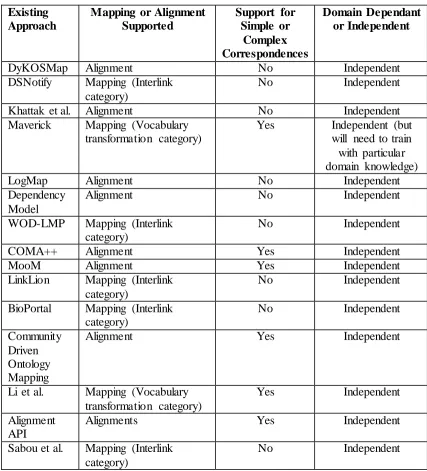
Table 3-1. Breakdown of existing approaches as to whether they support performing maintenance and reuse over mappings or alignments, mappings or alignments derived
from complex correspondences and whether they are domain independent or not. ... 36
Table 3-2. Six mapping maintenance and reuse use cases. ... 43
Table 3-3. Five mapping maintenance and reuse tasks. ... 46
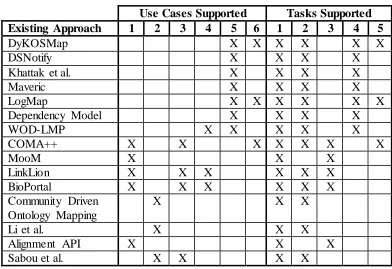
Table 3-4. Mapping maintenance and reuse use cases and tasks supported by the existing approaches reviewed from the state of the art. ... 47
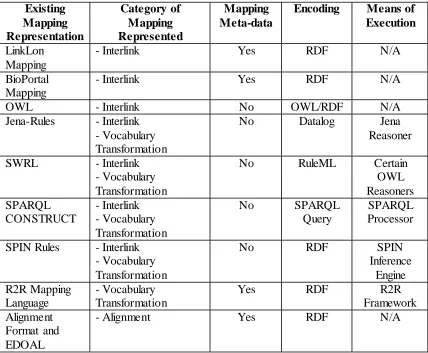
Table 3-5. Characteristics of Existing Mapping Representations Reviewed. ... 48
Table 5-1. SUMMR Mapping Maintenance and Reuse Task Templates ... 68
Table 5-2. SUMMR Use Case Templates ... 73
Table 6-1. Mapping Maintenance and Reuse Tasks. ... 90
Table 6-2. Number of identical and non-identical execution results of mappings from the R2R and SP-CON vocabulary mapping datasets. ... 97
Table 6-3. Number of mappings able and not able to be encoded in RDF via the SPIN SPARQL syntax. ... 98
Table 6-4. Average number of triples per mapping broken down by correspondence pattern. ... 98
Table 6-5. Mapping retrieval use cases from Thomas et al [Th11]. ... 103
Table 6-6. Experiment 2 mapping retrieval use cases. ... 105
Table 6-7. Concrete experiment 2 mapping retrieval use cases. ... 106
Table 6-8. Recall (R) and Precision (P) results of the bespoke queries and SUMMR templates performed over mappings represented in SCMR and the R2R Mapping Language for the 12 concrete mapping retrieval use cases. ... 108
Table 6-9. Mean execution time of the bespoke queries and templates performed over mappings represented in SCMR and the R2R Mapping Language for the 12 concrete use cases. ... 109
Table 6-10. Recall and Precision results of SUMMR Use Case Template 5 specialised for SCMR to discover invalid vocabulary transformation category mappings and invalid interlink category mappings and the invalid mappings ID numbers. ... 118
xv
xvi
Abbreviations
CSV Comma Separated Values
OWL Web Ontology Language
RDF Resource Description Framework
SCMR SPARQL Centric Mapping Representation SPARQL SPARQL Protocol and RDF Query Language
SUMMR SPARQL Usage for Mapping Maintenance and Reuse TSV Tab Separated Values
1
1.
Introduction
1.1.
Motivation
The Linked Data principles [Bi09] were set out by Tim Berners-Lee as guidance for data providers when creating Linked Data datasets and publishing them on the web. A Linked Data dataset is structured information published with web technology, represented in the Resource Description Framework (RDF), linked to other datasets and accessible through HTTP [Bi08]. Based on the Linked Data principles, data providers have published over 1000 datasets on the web [Je11, Sc14]. One example is the work by Debruyne et al. [De16] which aims to provide Ireland’s national geospatial data as Linked Data. A well-known project called the Linking Open Data [Bi09] project has a goal to publish open (freely available data) datasets according to the Linked Data principles. These open datasets are now collectively known as the Linked Open Data cloud. According to two surveys of the Linked Open Data cloud [Je11, Sc14], the number of datasets in the cloud has increased from 295 in 2011 to 1014 in 2014. This increase in the number of datasets in the Linked Open Data cloud shows that data providers are making a concerted effort to grow the cloud and it is likely to keep growing given the current trends.
Datasets in the Linked Open Data cloud cover a wide range of knowledge domains and in some cases, their knowledge domains overlap. For example, the DBpedia [Le15], FreeBase [Bo09], GeoNames [Ah13] and LinkedGeoData [St12] datasets all contain geographical information and DBpedia, FreeBase and LinkedMovieDatabase [Ha09] also contain information about movies. Due to the de-centralised nature of their development, ownership and management, these datasets use heterogeneous vocabulary term representations1 and instance representations2 to model their data. These heterogeneities can cause interoperability issues between the datasets [Bi10] which can lead to implementation problems for supporting tasks such as information sharing, data integration and query answering [Eu07]. Ontology mappings3 [Eu13] can be created
1 Different vocabularies can have different representations of the same class or property. For example the DBpedia and the Linked Movie Database datasets both contain separate representations of the class “Film”.
2 Different datasets can have different representations of the same instance. For example, the DBpedia and the GeoNames datasets contain representatio ns of the concept of the country of Ireland that differ in terms of RDF graph structure, vocabularies used, completeness and so on .
3 A mapping, as defined by Euzenat and Shvaiko [Eu07] is “…the oriented, or directed, version of an
2
between the datasets to overcome data heterogeneity and hence improve interoperability. Mappings can be used to transform data from the vocabularies of multiple datasets into a common vocabulary4 or through linking related instances across the datasets5 (no. 4 of the Linked Data principles [Bi09]). Transformation of data from non-RDF data formats into RDF can also be achieved through a mapping (e.g. R2RML [Da12]) but these types of mappings are not focused upon in this thesis.
A problem common to all mapping types is that their creation can be a time consuming task [Fa11] often requiring the input of knowledge from domain experts [Ra11]. Therefore, mapping research has recognised that it would be advantageous to be able to reuse previously created mappings for the purpose of reducing the time it can take to create new mappings [Gr11]. Mapping reuse consists of discovering and sharing specific existing mappings [Th13], discovering information from existing mappings to help with the creation of new mappings [Zh06] and discovering and using the properties from existing mappings to aid in the creation of new mappings [Au05, Vo09].
Datasets can evolve and change [Um10] as new versions are periodically released or updated over time. This evolution can cause changes to the representation of vocabulary terms and instances within a dataset. When a change occurs to a vocabulary term or instance, its identifier (URI) may also change causing the old identifier to no longer dereference [Po11]. This can cause problems as, per the Linked Data principles [Bi09], URIs should be used to identify data and the URIs should be dereferenceable and provide information about the data. With regard to mappings, a change to the identifier of the representation of a vocabulary term or instance can cause mappings, which reference the old identifier, to become invalid [Do15a]. An invalid mapping (as defined in this thesis) is a mapping that no longer produces correct results due to changes in the representation of vocabulary terms or instances in the datasets referenced by the mapping. Invalid mappings produce incorrect results, cause interoperability issues and hence reduce the quality of the dataset where they are employed. Therefore it is important to discover invalid mappings so decisions can then be made to repair the invalid mapping or to retire it. The discovery and repair of invalid mappings are part of
mapping maintenance [Do15]. Mapping maintenance is a time consuming task [Do15], similar to the creation of new mappings, and it is compounded further when considering
4 This category of mapping is used to transform instance data that is represented according to the vocabulary of one dataset into the vocabulary of another dataset (see Section 2.2.2).
5 This category of mapping is used to link related instances across Linked Data datasets (see Section
3
the number of mappings that exist between some Linked Data datasets [Ne16]. For example, the DBpedia dataset has over 27 million mappings (interlink category) to external datasets [Le15].
Existing approaches that support mapping maintenance or mapping reuse vary in the type of features they support. For example, DyKOSMap [Do15a] is a tool specifically designed to support mapping maintenance that does not support the reuse of mappings. COMA++ [Au05] is an ontology matching tool, which supports aspects of mapping reuse and maintenance, but does not support the discovery of invalid mappings. MooM [Th11] is a mapping retrieval tool that only supports the discovery of specific mappings. To the author’s knowledge, there exists no single methodology or tool that supports both mapping maintenance and mapping reuse. In addition (to the authors knowledge), no set of common practices or principles exist to support users who wish to perform both. Since mapping maintenance and mapping reuse are not reliant upon each other, one can be performed without performing the other. However, mapping maintenance does complement mapping reuse. Since mapping reuse is concerned with reusing existing mappings, it is important to ensure those mappings to be reused are not invalid (mapping maintenance is concerned with discovering invalid mapping).
4
on standard SPARQL queries, to support users in performing mapping maintenance and reuse tasks.
1.2.
Research Question
The research question investigated in this thesis is:
To what extent can a query-based methodology improve the range of Linked Data mapping maintenance and reuse tasks compared to the state of the art?
1.2.1. Definitions
The definition of the terms used in the research question and definitions used in the wider context of this thesis are explained here.
A methodology is defined as a body of methods, rules and postulates employed by a discipline [Ie00].
A mapping as defined by Euzenat and Shvaiko [Eu07] is “…the oriented, or directed, version of an alignment: it maps entities [or resources] of one ontology [or dataset] to at most one entity [or resource] of another ontology [or dataset]”. An alignment [Eu07] consists of resources from source and target datasets, along with their correspondences - which is a relation between the source and target resources (such as equivalent, not equivalent, etc.). An alignment describes the relationship between source and target resources and a mapping is what enforces (or executes) that relationship (such as a set of rules or a query). The terms entity and resource are used interchangeably in this thesis.
The definition of mapping maintenance defined by Dos Reis et al. [Do15] is adopted in this thesis, which is: “[mapping maintenance is]…the task aiming to keep existing mappings in an updated and valid state, reflecting changes affecting KOS’s [Knowledge Organisation System] entities at evolution time”. Dos Reis et al. further refine this definition of mapping maintenance into four sub-problems:
The identification of changes in KOS resources defining mappings that can potentially invalidate them.
The decision concerning the impact of the identified KOS changes on the validity of mappings.
5
The implementation of specified actions for executing modifications on mappings.
It is important to note that in the literature, the definition of a mapping differs. For example the definition of a mapping by Dos Reis et al. [Do15] is not the same as the definition of that by Euzenat and Shvaiko [Eu07]. The Dos Reis et al. definition of a mapping is equivalent to the definition of a correspondence by Euzenat and Shvaiko (described above). Given this difference between the two definitions of a mapping, the author of this thesis believes that the definition of mapping maintenance by Dos Reis et al. is still appropriate, as changes to correspondences can have an effect on alignments which in turn can have an effect on mappings.
To the knowledge of the author of this thesis, a formal definition for mapping reuse
does not exist. The definition of mapping reuse used in this thesis was created by the author and was derived from the examination of existing approaches that support the reuse of mappings in some manner. Mapping reuse is defined as the use of existing mappings in three situations:
Specific mappings can be discovered and shared for direct use [Th13]. Sharing mappings involves sending mappings to or publishing mappings for others to use.
Information from existing mappings can be discovered to provide insight to help with the creation of new mappings [Zh06]. Such information could be discovering the exact terms from a dataset’s vocabulary that must be used and whether any values need to undergo a transformation (converting minutes to seconds or miles to kilometres) in order to be valid according to a dataset’s vocabulary. Another example would be discovering other vocabulary terms that are used in a mapping. If a mapping is searched for based on the term ‘film’ - what other vocabulary terms associated with ‘film’ also appear in that mapping - duration, producer, director, actors and so on.
6
Mapping maintenance and reuse tasks are defined as five individual tasks that should be supported by an approach for both mapping maintenance and reuse. The five tasks are derived from mapping maintenance and reuse use cases which were identified from the state of the art review in this thesis. See Chapter 3 for a description of these use cases and how the tasks were derived.
The terms ontologies, vocabularies, and datasets occur in this thesis. An ontology is a set of assertions that are meant to model a particular domain of knowledge [Eu07]. Data in ontologies can be broken into two components: the Tbox (terminological component) and Abox (assertion component) [Gu16]. The Tbox contains the declaration of classes and properties which are used to describe knowledge within a domain, along with rules, constraints and reasoning axioms about those classes and properties. The Abox consists of instance data (described according to the classes and properties from the Tbox). In this thesis, the term vocabulary refers to a Tbox component that consists of the declaration of classes and properties but does not consist of rules, constraints or reasoning axioms. A vocabulary could be considered as a lightweight Tbox component. The term dataset is used to describe a collection of information. Specifically for RDF (and hence Linked Data) datasets this refers to a collection of RDF triples. A dataset is a meaningful collection of triples that deals with a certain topic, originate from a certain source or process, are hosted on a certain server, or are aggregated by a certain custodian [Al09]. A dataset, can consist of both Tbox and Abox components, or just Abox components.
1.2.2. Research Objectives
In order to address the research question outlined above, the following research objectives were identified for this thesis:
RO1: Perform a state of the art review of existing approaches for mapping maintenance or mapping reuse, or both, and existing approaches for representing ontology mappings.
RO2: Design a query-based methodology for undertaking both mapping maintenance and reuse. This will include an appropriate mapping representation6 and query templates to perform maintenance and reuse.
RO3: Design a prototype software tool that implements the new query-based methodology from RO2.
7
RO4: Evaluate the query-based methodology from RO2 in lab-based experiments. This will involve evaluating (i) the expressivity of the mapping representation used by the methodology, and (ii) the ability of the query templates to support to support mapping maintenance and reuse tasks.
RO5: Evaluate the utility of the query-based methodology from RO2 in a case study, where the software tool from RO3 will be deployed in the release process of a real world Linked Data dataset.
1.2.3. Thesis Contributions
8
use cases. In terms of mapping reuse use cases, two existing approaches - LinkLion [Ne14] and BioPortal [No08] support three out of four of these use cases but support no maintenance use cases. Only one approach from the state of the art supports use cases from the maintenance and reuse category. This approach is COMA++ [Au05] which supports one maintenance use case and two reuse use cases. No single existing approach from the state of the art support performing all six of these use cases and hence, and all five of the tasks. The SUMMR methodology advances the state of the art as it does support performing all use cases and tasks. As well as advancing the state of the art, it is envisaged that the SUMMR methodology will also be of benefit to the providers and maintainers of Linked Data datasets who wish to discover and repair invalid mappings. It is also envisaged that SUMMR will also benefit dataset providers and maintainers who wish to discover and create new mappings related to datasets of interest, through the reuse of existing mappings.
A minor contribution of this thesis is the mapping representation that was developed as part of the SUMMR methodology, named the SPARQL Centric Mapping Representation (SCMR). The SCMR is an RDF-based mapping representation for representing that is designed to represent two categories of Linked Data ontology mappings (mappings that transform data between vocabularies and mappings that link semantically similar instances between Linked Data datasets) at a fine grain level. The granularity of a mapping refers to how properties of a mapping are modelled and described. A fine grain mapping refers to a mapping where all the properties of a mapping are modelled and described explicitly in a knowledge representation format. A coarse grain mapping is the opposite where the entirety of the mapping is modelled as a single string. SCMR, whether used with or without SUMMR provides a way to represent ontology mappings and also allows for mapping meta-data annotation. SCMR provides support for mapping maintenance and reuse through facilitating fine grained discovery and retrieval of a mapping and its properties. It is envisaged that its fine grained nature will be useful in other applications (beyond mapping maintenance and reuse), such as mapping governance [De15], that require retrieval or analysis of mappings.
The second minor contribution of this thesis is an open-source software tool named the SUMMR Interlink Validation Tool7. The SUMMR Interlink Validation Tool is an open-source, java-based command line tool that implements SUMMR for the discovery
9
of invalid interlink category mappings. The tool was used in the case study of this thesis to validate the interlink category mappings that were published in the v.2015-10 DBpedia dataset release (no invalid interlink detection has been conducted before in the dataset). The tool is now part of multiple technologies used by the DBpedia dataset administrators and has been incorporated into the H2020 ALIGNED8 project’s DBpedia Phase 2 Trial Platform. The SUMMR Interlink Validation Tool would be useful to other Linked Data datasets administrators, that need to maintain interlink category mappings from a source dataset to multiple target datasets. The administrators can use the tool to discover if any of the interlink category mappings they maintain, have become invalid as the source dataset or any target datasets evolve.
There have been three publications associated with the research in this thesis to date:
Meehan, A., Kontokostas, D., Freudenberg, M., Brennan, R. and O’Sullivan, D. "Validating Interlinks Between Linked Data Datasets with
the SUMMR Methodology." In OTM Confederated International
Conferences" On the Move to Meaningful Internet Systems", pp. 654-672.
Springer International Publishing, 2016.
This publication presents the SUMMR methodology in detail and presents the evaluation related to the mapping maintenance aspect of the SUMMR methodology which is presented in Section 6.4 in this thesis. This publication also presents the SUMMR methodology case study, which applied SUMMR to the DBpedia interlink management process. That case study is presented in
Section 6.5 in this thesis.
Meehan, A., Brennan, R. and O'Sullivan, D. “SPARQL based mapping management”. In Semantic Computing (ICSC), 2015 IEEE International
Conference on (pp. 456-459). IEEE, 2015.
This publication presents a preliminary version of the SUMMR methodology, focusing on the mapping reuse aspect of the SPARQL-based methodology. This publication also presents an initial evaluation related to the mapping reuse aspect of the SUMMR methodology which is presented in Section 6.3 in this thesis.
Meehan, A., Brennan, R., Lewis, D. and O’Sullivan, D. "Mapping
Representation based on Meta-data and SPIN for Localization Workflows."
10
In Proceedings of the Second International Workshop on Semantic Web
Enterprise Adoption and Best Practice at the European Semantic Web
Conference (ESWC), 2014.
This publication presents an initial version of the SPARQL Centric Mapping Representation (SCMR), developed as part of the SUMMR methodology. The publication also presents the evaluation related to the SCMR which is presented in Section 6.2 in this thesis.
In summary, the major contribution of this thesis is the SUMMR methodology. The minor contributions are the SPARQL Centric Mapping Representation (SCMR) and the open-source SUMMR Interlink Validation Tool.
1.2.4. Assumptions and Constraints
The assumptions and constraints of the research in this thesis are outlined below:
This research is concerned with performing mapping maintenance and reuse over two categories of Linked Data ontology mappings. These two categories are transforming data described from one vocabulary into another (see Section 2.2.2) and for interlinks between similar instances in different datasets (see
Section 2.2.3). Two other categories of mappings which are not considered in this research are those which are used to transform (uplift) data from a non-RDF form into RDF and transform (lower) data from RDF to another form (see
Section 2.2.1).
The research in this thesis can be applied to ontology mappings (from the two categories described in the previous bullet point) that would be derived from both simple and complex correspondences (see Section 2.2.1 for definition of simple and complex correspondences).
This research is not concerned with the automatic repair of mappings as this is beyond scope. Rather, the research is concerned with how existing mappings can be altered in order to repair it.
11
hierarchies and enumerated types. Ontology matching tools are commonly employed in this task to aid human experts. However, while not directly concerned, the research in this thesis could be used in conjunction with ontology matching tools to supplement them with mapping maintenance and reuse support.
This research is concerned with the use of standard SPARQL queries (queries that adhere to the SPARQL standard specification set out by W3C) to perform mapping maintenance and reuse tasks and use cases over mappings. This provides the advantage of performing the mapping maintenance and reuse tasks and uses on any standard SPARQL processor.
Since SPARQL is designed to operate over data encoded in RDF, this research is particularly interested in mappings that are encoded in RDF.
1.3.
Research Methodology
Initially, a state of the art review of existing approaches that support mapping maintenance, mapping reuse or both was undertaken. Six mapping maintenance and reuse use cases were identified. From an analysis of these six use cases, five mapping maintenance and reuse tasks were derived. These five tasks, derived from the six use cases, are what needs to be supported by an approach for mapping maintenance and reuse, in order to perform the use cases. The mapping maintenance and reuse use cases were refined further (see Chapter 4) and detail how a query-based methodology would perform those use cases. The SUMMR methodology was designed, based on the state of the art review and from the six refined use cases in Chapter 4.
12
implements SUMMR was developed named the SUMMR Interlink Validation Tool. Through consultation with the DBpedia dataset maintainers at the University of Leipzig in Germany, requirements for the tool were gathered. The tool facilitates SUMMR’s invalid interlink category mapping detection. It is an open-source, java based command line tool that is used to discover invalid interlink category mappings between a source Linked Data dataset and multiple target Linked Data datasets.
Evaluation of SUMMR was undertaken through the execution of three lab-based experiments and a case study. The expressivity of the SCMR was evaluated in the first experiment described in this thesis (Section 6.2). SUMMR query templates were evaluated with respect to the support they provide to a user to perform mapping maintenance and reuse tasks, described in the second (Section 6.3) and third (Section 6.4) experiments in this thesis. The usefulness of the SUMMR methodology in a real world Linked Data dataset management situation was evaluated through the case study (Section 6.5) described in this thesis.
The next section provides more detail of the evaluation strategy used.
1.4.
Evaluation Strategy
The strategy used to evaluate the SUMMR methodology was as follows:
Identify individual mapping maintenance and reuse tasks: From reviewing existing approaches that support mapping maintenance and reuse, five individual tasks that these approaches perform were derived. These tasks were then used to ensure SUMMR query templates could perform them in two evaluations of the SUMMR methodology.
13
identical. This evaluation provides evidence that the SCMR and R2R Mapping Language are equally as expressive when it comes to representing mappings. What separates the two is that the R2R Mapping Language is not specified to represent interlink category mappings, whereas the SCMR is designed to represent another category of mapping too - mappings that link instances across datasets.
Evaluate SUMMR’s ability to support a user to perform mapping reuse
tasks: This evaluation tested the effectiveness of the SUMMR query templates support for performing mapping reuse tasks. This was achieved through using SUMMR templates to discover mappings and mapping properties based on mapping retrieval use-cases. Two specialisations of SUMMR templates were used, one specialisation for execution over mappings represented in SCMR and the other for mappings represented in the R2R Mapping Language. The two sets of mappings used in experiment 1 are used in the evaluation (72 mappings represented in SCMR and the R2R Mapping Language). The common information retrieval metrics of precision and recall were used in this experiment. They were used to evaluate the ability of the SUMMR templates to perform the mapping retrieval use-cases. It was found that the SUMMR query templates specialised for SCMR could correctly perform all the mapping retrieval use-cases for the mappings represented in SCMR. However the SUMMR templates specialised for the R2R Mapping Language could not perform all the mapping retrieval use cases. This was found to be caused by the coarse granularity of how the R2R Mapping Language represents mapping properties. This evaluation provides evidence that SUMMR will support performing mapping reuse tasks (as retrieval is at the core of any reuse task) but the effectiveness of a SUMMR template is effected by the granularity of the mapping representation that it is performing over.
Evaluate SUMMR’s ability to support a user to perform mapping
14
standard datasets were created (see Section 6.4.3 for description of datasets and how they were created). The first gold standard dataset contained invalid mappings (from both the vocabulary transformation and interlink category) from the two datasets used in the experiment. The second gold standard dataset was created after the first and it contained the execution results of the repaired versions of the invalid mappings found from the first gold standard dataset. Precision and recall were used as metrics to compare the results of applying the SUMMR template to discover invalid mappings, to the results in the first gold standard dataset. The mappings that were repaired using the appropriate SUMMR template to repair invalid mappings, were executed and their execution results were directly compared to the second gold standard dataset. It was found that the SUMMR query templates could be used to correctly discover all invalid mappings and could successfully repair them when a new vocabulary term or dataset instance is provided to replace the invalid ones in a mapping. This evaluation provides evidence that SUMMR templates support performing mapping maintenance tasks.
Evaluate the usefulness of the SUMMR methodology in a real world Linked
15
DBpedia v.2015-10 release by discovering that 53,418 of these interlink category mappings were invalid.
In summary, the first three evaluations were lab-based experiments to test the SUMMR methodology features, i.e. SCMR and the query templates. The final evaluation used a case study approach to evaluate the usefulness of the SUMMR methodology in a real world Linked Data management situation at a large scale.
1.5.
Thesis Overview
The remainder of this thesis is structured as follows:
Chapter 2: Background
This chapter presents useful context for readers of this thesis. It begins with information about the processes typically involved in the creation of mappings. It then describes four different categories of mappings used within the Linked Data domain: mappings to transform data from a non-RDF form to RDF and vice versa; mappings to transform data between different Linked Data vocabularies and mappings that link similar instances across Linked Data datasets.
Chapter 3: State of the Art
This chapter provides a review of existing approaches for mapping maintenance and reuse and a review of existing mapping representations. It identifies six mapping maintenance and reuse use cases and five tasks. The six use cases are further refined in
Chapter 4, which influenced the design of SUMMR and the five tasks are used in the evaluation of the SUMMR templates in Chapter 6.
Chapter 4: Refinement of Use Cases for a Query-Based Methodology for Mapping
Maintenance and Reuse
This chapter refines the set of six mapping maintenance and reuse use cases identified in
Chapter 3. These refined use cases detail how a query-based methodology would perform the mapping maintenance and reuse use cases.
Chapter 5: Design of the SUMMR Methodology
16
SUMMR query templates (specialised for SCMR) and examples are provided. This chapter also discusses how a user would apply the SUMMR methodology to perform mapping maintenance and reuse. Reflections upon the design of SUMMR are also presented, discussing limitations of the methodology and thoughts on the generalisation of SUMMR for application of the Linked Data domain.
Chapter 6: Evaluation
This chapter describes three experiments and a case study as outlines in Section 1.4.
Chapter 7: Conclusion
17
2.
Background
This chapter presents background information related to the research in this thesis that will aid a reader that is unfamiliar with the data mapping domain. Presented in Section 2.1 are the processes of ontology matching and mapping, which are the processes concerned with increasing interoperability between heterogeneous datasets. Section 2.2
presents four different types of mappings in the area of Linked Data.
2.1.
Ontology Matching and Mapping
This section briefly describes the processes of ontology matching and ontology mapping [Eu07]. These two processes are carried out between heterogeneous ontologies or datasets. The purpose of these processes is to discover semantically similar resources between the heterogeneous datasets (matching) and establish a means to increase interoperability between them (mappings). The research in this thesis is concerned with the maintenance and reuse of existing mappings. Therefore this section will provide more context as to how those mapping are typically created.
2.1.1. The Matching Process
The ontology matching process, depicted in Figure 2-1 below, takes two inputs and produces one output. The two inputs can be in the form of source and target ontologies [Sh05]. The matching process aims to discover correspondences, which is a semantic relationship (such as equivalent, not equivalent, more general than, less general that etc.), between the entities or resources of the source and target inputs. The output of the matching process is a set of alignments, which consist of entities or resources from the source and target inputs and the correspondence which holds between them. Correspondences fall into two categories which are simple and complex [Gi13]. A
18
Figure 2-1. Depiction of the matching process.
There are many different software tools in existence which are designed to support the ontology matching process [Sh13, Ot14]. These employ different techniques for discovering correspondences between resources in ontologies. For example, two such techniques are lexical and structural comparison techniques. Lexical comparison techniques involve comparing the names, labels and descriptions of resources from ontologies for semantic equivalence, and often employ auxiliary information such as synonym tables, domain specific taxonomies or general taxonomies such as WordNet [Mi95]. Structural comparison techniques involve representing an ontology in a hierarchical structure, usually in the form of a graph, to easily group classes and sub-classes, and properties together. This makes it easier to detect structural similarities between two ontologies, with the intuition being that if the structure of two resources from different ontologies are similar, then this increases the likelihood that these resources are overall similar. Some tools provide a graphical user interface to visually display ontologies along with established correspondences [Fa11, Au05]. Such applications typically provide a drag and drop environment where resources from ontologies can be linked together and correspondences established between them.
2.1.2. The Mapping Process
19
While not all ontology matching tools contain the functionality to support the creation of mappings from alignments, some such tools do exist [Sc12, To17, Vo09].
2.2.
Linked Data Mappings
In this section, four different categories of mappings are described - uplift and lowering mappings, vocabulary mappings and interlink mapping. The research in this thesis focuses on the maintenance and reuse of vocabulary and interlink categories. However, uplift and lowering mappings are also described to indicate the purpose of other types of mappings.
2.2.1. Uplift and Lowering Category of Mappings
Uplift [Bi12, Da12, Di14, Co15] mappings are concerned with transforming data encoded in a non-RDF form (e.g. relational data, XML, CSV, TSV) into an RDF form. The mappings specify how the non-RDF encoded data is retrieved i.e. which table and column from relational data to access or the path through which XML data is accessed. This non-RDF encoded data is the source of the mapping. The target of the mapping is concerned with specifying how the source data is encoded in RDF, how to structure it and the vocabulary terms to use to describe the data.
Lowering mappings [Bi12] do the opposite of uplift mappings. It transforms data encoded in RDF into a non-RDF encoded form. For lowering mappings, the source of the mapping specifies how the RDF data is accessed and the target of the mapping specifies how that source data should be encoded in the chosen non-RDF form. Figure 2-2 depicts an example of XML data that is lifted into RDF and lowered back to XML.
20
2.2.2. Vocabulary Category of Mappings
The vocabulary category of mappings [Bi10, Ko13] are concerned with transforming instance data from one dataset, and described according to the vocabulary of that dataset, to describing it according to the vocabulary of another dataset. These mappings are used in Linked Data integration situations [Sc12]. They are used to transform data from multiple datasets, described by multiple heterogeneous vocabularies, into a single vocabulary. The intuition behind this is that by having the data in a more homogeneous form, it will be easier to access and manage. Figure 2-3 presents an example what a vocabulary is concerned with. In the figure, data about the Goodfellas movie, described according to the DBpedia vocabulary is transformed to be described according to the Linked Movie Database vocabulary.
Figure 2-3. Example of data described according to the DBpedia vocabulary, transformed to be described according to the Linked Movie Database vocabular y.
2.2.3. Interlink Category of Mappings
Interlinks [Vo09] are used to link semantically similar instances across Linked Data datasets and are part of principle 4, of Tim Berners-Lee’s four Linked Data principles [Bi09]. The term interlink is used in this thesis to specify links that go from (instances) of one dataset to (instances) of a separate external dataset.
An interlink is a single RDF triple where: the subject of the triple interlink is an instance from a source dataset, the object of the triple is an instance from a target dataset and the predicate of the triple is the relation between the two instances. The purpose of establishing interlinks is so instances within specific datasets can be supplemented with additional data (about the same instance) from external datasets.
21
Figure 2-4. Examples of four interlinks from the DBpedia dataset to the Linked Movie Database, FreeBase, OpenCyc and YAGO datasets.
2.3.
Chapter Summary
The aim of this chapter was to make a reader, who may be unfamiliar with data mappings, gain an understanding of the processes typically involved in their creation and provide examples of different categories of mappings typically uses with the Linked Data domain.
22
3.
State of the Art
This chapter presents the state of the art of approaches for mapping maintenance, mapping reuse and mapping representation. Section 3.1 presents an introduction to the chapter and provides formal definitions of mapping maintenance and mapping reuse.
Section 3.2 reviews thirteen existing approaches for mapping maintenance and reuse.
Section 3.3 reviews eight existing approaches for representing Linked Data ontology mappings. Section 3.4 consolidates the mapping maintenance and reuse use cases that were identified by the author during the review of the existing approaches in Section 3.2
and then derives the individual tasks needed to perform the use cases. Section 3.5
presents an analysis of the extent to which existing mapping maintenance and reuse approaches support the use cases and tasks identified. Also presented is an overall comparison of the existing mapping representations with respect to selected characteristics. Section 3.6 finishes the chapter with a brief summary.
3.1.
Introduction
The purpose of this chapter is to provide a state of the art review of the research in the fields of mapping maintenance, mapping reuse and mapping representation. For this review, existing approaches that support mapping maintenance, mapping reuse or both are examined. These approaches are examined for the mapping maintenance or reuse use cases they support. Existing approaches for mapping representation are reviewed on their characteristics such as: what category of mapping they represent (vocabulary transformation and/or interlinks), whether they support annotation with meta-data, how they are encoded and if they are executable.
3.2.
Existing Approaches for Mapping Maintenance and Reuse
23
3.2.1. DyKOSMap
The DyKOSMap (Dynamic Knowledge Organisation System Mapping) [Do15a] framework is for the semi-automatic detection and repair of invalid alignments between datasets. DyKOSMap does this in a three step approach which first involves (i) dataset evolution, followed by (ii) mapping interpretation and finishes with (iii) mapping adaptation.
The dataset evolution step involves performing an analysis between two different versions of a dataset to detect changes between the two caused by dataset evolution. DyKOSMap employs the COnto-Diff (Complex Ontology Diff) [Ha13] algorithm for dataset change detection. COnto-Diff operates by performing an ontology matching operation, using the GOMMA tool [Ki11], over two versions of a dataset which results in a set of alignments between the two versions. Taking the two dataset versions and their alignments as input, a series of rule-based algorithms are used to detect both syntactic and semantic changes between the two versions of the dataset. The output of the COnto-Diff algorithm are “diff evolution mappings” which contain the changes between the two versions of the dataset.
The mapping interpretation step involves interpreting (analysing) the alignments (that are checked to determine if they are valid or invalid) to discover and retrieve the source and target dataset resources within the alignment.
24
are then applied, which alter the alignment for the purpose of attempted repair. The potentially repaired alignments are output to be validated by a user.
DyKOSMap is an advanced framework able to detect invalid alignments caused by both syntactic and semantic changes to resources in a dataset the alignment references. DyKOSMap also provides semi-automatic repair of alignments. There is no mention of a formal alignment representation in the literature on DyKOSMap. DyKOSMap supports two mapping maintenance use cases:
Discover invalid alignment due to changes in datasets an alignment references. Repair of an invalid alignment.
3.2.2. DSNotify
DSNotify (DataSet Notify) [Po11] is framework designed to detect change events (create, remove, move, update) in Linked Data datasets with the aim to support the maintenance of interlink category mappings between the datasets.
DSNotify employs a monitor component, which periodically accesses a dataset (via SPARQL queries) for dataset instances. The monitor can be configured to search for specific instances (for example only find instances that are cars, or countries or movies etc.) For each new instance representation it encounters, it creates a feature vector related to that representation.
A feature vector in this case is data associated with an instance representation. In terms of RDF data - this is all the triples associated with an instance representation. The feature vector can be configured to consider the subject, predicate and object of a triple, or just the subject and predicate. Feature vectors are categorised according to (i) recently added data to a dataset, (ii) recently removed data from a dataset and (iii) data removed a longer time ago from a dataset.
Feature vectors from the three categories are monitored to detect change events in a dataset. DSNotify employs a housekeeper component that is used to call an algorithm to detect move and remove change events. To detect move change events, the algorithm compares feature vectors from the categories of (i) recently added data to a dataset and
25
removed data from a dataset category to the (iii) data removed a longer time ago from a dataset category. For each feature vector moved in this way, a remove change event is issued. To detect update change events, the monitor component is used. It compares newly created feature vectors (from its current monitoring activity) to the feature vectors in the (i) recently added data to a dataset category - if available to do so. String similarity measures are used again to compare the similarity of the feature vectors. If the measure is below a threshold value, then the instance representations is classed as having undergone an update and an update move change event is issued. Create events are issued for each new instance representation the monitor component encounters.
[image:41.596.124.534.328.559.2]DSNotify provides an RDF-based vocabulary – named the DSNotify Eventset Vocabulary for describing and logging change events. The vocabulary describes how why and when instances within datasets change. Figure 3-1 depicts the classes and properties of the DSNotify Eventset Vocabulary.
Figure 3-1. Classes and properties of the DSNotify Eventset Vocabulary [Po11].
The purpose of DSNotify is to detect change events in Linked Data datasets for the purpose of supporting the maintenance of interlink category mappings between those datasets. DSNotify does not directly detect invalid interlink category mappings, it supports this activity through detection of the events which can cause the mappings to become invalid and logging those events according to the Eventset Vocabulary. A user will use the logs to detect if any mappings (that the user is concerned with) have become invalid. DSNotify partially supports the mapping maintenance use case of:
26
3.2.3. Khattak et al.
The research of Khattak et al. [Kh15] proposes an alignment maintenance approach with the goal to discover invalid alignments and minimise the time required to discover new alignments. This approach consists of two main components: the Change History Log and the Reconciliation of Mappings.
The Change History Log is an RDF-based vocabulary proposed to log all changes that occur to a dataset as it evolves over time. The changes that it is designed to record are the addition, renaming and deletion of classes, properties or instances. In addition, the log also records why these changes were made, when they were made and who or what made them (could refer to a person or a machine). Figure 3-2 displays the core elements of the Change History Log.
Figure 3-2. Core Elements of the Change History Log [Kh15].
27
Log. Then these resources are input to ontology matching tools to discover new alignments.
The approach by Khattak et al. relies on recorded changes to resources from a dataset in the Change History Log. These recorded changes can then be used to discover invalid alignments by checking if alignments reference any of the changed resources. This approach does not repair invalid alignments, instead it deletes invalid alignments and attempts to discover new alignments. The approach by Khattak et al. supports the mapping maintenance use case of:
Discover invalid alignments due to changes in datasets an alignment references.
3.2.4. Maveric
Maveric (Mapping verification) [Mc05] is an application for the detection of invalid mappings between data integration systems. It operates in two main phases: a training phase and a verification phase.
In the training phase, sensors are set up for a dataset. A number of queries are then established to probe the dataset. The dataset that is being probed has a number of existing mappings established to external datasets that are known to be correct at the time of the probing. Therefore the probing queries are set up to retrieve data that is reliant on data from the external datasets (via the established mappings). The results from the probing queries are used as training data. Maveric expands the training data by artificially introducing errors to the probing query results. This combined training data is then used to train the sensors for a dataset. The sensors are trained so when they are used in the validation phase, they will be able to detect variations in expected query results. This variation could be caused by mappings being no longer valid.
The verification phase is concerned with verifying that the existing mappings are still valid. This is done by periodically querying the dataset (for data what would rely on the established mappings). The results from these queries are then input to the sensors which calculate a score based on the variation of the query results compared to what is expected. If the score is over a threshold value, an alert is sent to a filter module for further processing to determine if the alarm is a correct or false. If an alarm has been deemed (automatically) to be correct, an alert is made to a user about a potentially invalid mapping.
![Figure 3-1. Classes and properties of the DSNotify Eventset Vocabulary [Po11].](https://thumb-us.123doks.com/thumbv2/123dok_us/8793174.910291/41.596.124.534.328.559/figure-classes-properties-dsnotify-eventset-vocabulary-po.webp)