14th International Conference on Wireless Communications, Networking and Mobile Computing (WiCOM 2018) ISBN: 978-1-60595-578-0
The Research and Design of Intelligent Safe-driving Detecting
System Based on the Eeg Sensor
Yan-ling Zhou1 and Si-cheng Zhang2
ABSTRACT
The intelligent safe-driving warning system can detects the brain wave signal of the driver through the eeg sensor and analyze the current mental state of the driver. It can process the the eeg data of the different types. It can reduce the noise of the collected brain wave data resulted in the outside factors. The small packet data can be received and analyzed by the Bluetooth receiver. The large packet data can be dealt with and analyzed by the eSense algorithm. The data of concentration and distraction can be extracted from the brain wave signal data. And then, judging the degree of the concentration and distraction, it can roughly determine the brain activity. The eeg wave signals can communicate via Bluetooth and be sent to the client and processed. At the same time, according to the set benchmark of the client, it can analyze and judge the driver’s current mental state and decide whether to remind the driver of the driving safety finally.
Keywords: Eeg sensor; brain wave signal; Bluetooth; Microprocessor base station; Intelligent driving
INTRODUCTION
With the rapid development of science and technology, the frequency of the traffic accidents in the various regions have increased greatly, which has resulted in the huge economic, human and material losses. The analysis shows that there are two main factors causing the traffic accidents, including the human factors and the natural factors. We cannot change the natural factors, but we can improve and control the human factors. The Intelligent safe-driving detecting system based on the egg sensors (ISDDS-ES) can monitor the change of the human brain at any time and promptly notify the driving condition of the driver. It can make the driver concentrate and supervise the staff to maintain safety of car. It can reduce the traffic accident due to inattention. In ISDDS-ES, the brain sensor will continue to capture
1
Department of Computer Science and Technology, Hefei University, Hefei, China (Email: [email protected])
2
the human brain electrical signal, send to the microprocessor base station to handle and summarize. The microprocessor base station will send the does not guarantee the data to the client for the final processing and analysis after guaranteeing the dropping-packet rate no more than ten percent. At the client, the data will be compared with the set benchmark, and the system decides whether to alert driver to drive safely. The ISDDS-ES system communicates via Bluetooth and use the environmental information to determine the alerting-data base. The system is cheap and can meet the needs of a large number of customers.
THE RESEARCH ON BRAIN WAVE DATA ACQUISITION TECHNOLOGY
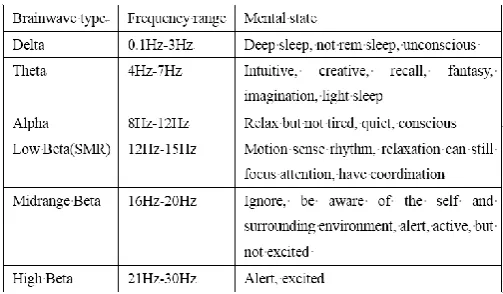
[image:2.612.171.423.521.668.2]The brainwave signal is the weak electrical potential difference produced by the neuron during the discharge. There are two ways of forming the potential difference, including the spontaneous brainwave activity and the event-related brain activity. The spontaneous brainwave activity is a potential change in the cerebral cortex without the external stimulation. The event-related brain electrical activity can produce the corresponding potential change when the complex external factors such as light, sound and electric shock are received. There are two kinds of common eeg collecting methods [1], including the cortical electroencephalogram and the eeg gathering system. The cortical electroencephalogram makes the electrode connect to the cerebral cortex in order to obtain the brain electrical signal. The eeg gathering system provides the reliable link between the electrodes and the scalp and records the electrical activity through an electroencephalograph. The ISDDS-ES system uses the contact with the scalp to obtain the brain wave data. The data provided by the researchers are shown in table I. The brain waves can convey the attention and distraction of the drivers. These data are also the part of the benchmark for processing data.
THE RESEARCH ON BRAIN WAVE SIGNAL PROCEEDING
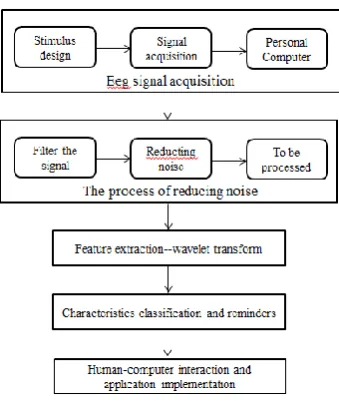
There are many interference factors when acquiring the weak brain electrical signal. The factors such as the nerve tension, the muscle of jitter, the environment noise, the blink of the eye and the shortness of breath will affect the quality of the collected signal. The active cerebral cortex can produce quite a bit of data. The brain wave sensor gets the electrical signals and then carries out the bandpass filtering operation. Due to the noise interfering, the collecting eeg signal is the unreasonable signal. Therefore, the noise reduction process should be processed to increase the processible eeg signal [2]. The common brain-electrical signal processing algorithms include the Bayesian method [5], the wavelet transform [6], the chaotic method [7], the multidimensional statistical analysis [8], the public space mode and the other methods. The ISDDS-ES system adopts the wavelet transform algorithm. The wavelet-transforming signal processing method inherits the idea of the Fourier transform [9]. It can not only clearly detect the instantaneous pulse of the egg signals, but also analyze the signal frequency through the variable video window. The idea of the Fourier transform was that decomposing the waveform to the sine wave, superposing the sine wave and summing. Set the infinite extension of the sinusoidal wave on the opposite direction as the orthogonal basis functions, and then spread out the periodic function of the Fourier series, integrates the functions of the aperiodic format for the Fourier integral form. Here using the Fourier transform to the function for the analysis of the spectrum, it can reflect the whole signal spectrum characteristics; show the complete forms and features of the stable signal clearly. The wavelet transform can improve the mismatch problem between the frequency variation and the video window displaying size. It can provide a technique to analyze and process the signal. There are two noise-reducing technologies including the active noise reduction and the passive nose reduction. The passive noise reduction has the obvious effect on the high frequency noise [3]. The effect of the active noise reduction is particularly obvious on the low frequency. The ISDDS-ES system uses the earphones to carry out the active noise reduction and filter the filtering technology.
THE COMPOSITION OF THE ISDDS-ES SYSTEM
The TGAM Brain Wave Module
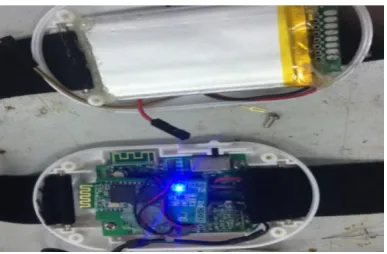
[image:4.612.201.395.314.441.2] [image:4.612.203.395.477.590.2]The brain wave sensor [4] module contains the TGAT that can perceive the biological signals in order to capture the signal and output the rate of the brain wave spectrum. The signal quality of the brain waves is decided by three parameter values. They are the degree of concentration, the degree of dispersion and the blink frequency. The TGAM module can realize the function of the dry electrode monitoring the eeg signal, filtering the interference signal, signal interpretation and the man-machine interaction. The mico-process base station is mainly responsible for parsing the original data of the eeg signal. The data such as the concentration degree and the dispersion degree is extracted from the large packet data by the eSense algorithm. By judging the degree of the concentration and the dispersion, the activity level of the human brain can be roughly determined and detected and the different reminders can be made according to the specified benchmark. The figure 1 is the physical image of the eeg sensor used in the ISDDS-ES system. The figure 2 shows the appearance diagram of the microprocessor base station.
Figure 1. The physical image of the eeg sensor used in the ISDDS-ES system.
Figure 2. The appearance diagram of the microprocessor base station.
The Bluetooth Transmission Module
low consumption, and the low cost and uses the open interface standards. It can be mainly used for data transmission and data communication. The computer receives the data transmitted by the eeg sensor via a Bluetooth receiver. When using the Bluetooth for data transmission, the process occurs between the master and slave devices. The master device can access to the slave device selectively, and go on a quick transition in the rotation way. The Bluetooth’s master device can communicate with no less than seven devices in a temporary network typically, which greatly increases the difficulty of connecting master device to the slave device. In the ISDDS-ES system, a headset sends a request link to the device that is a viable wireless connection. It requires the USB Bluetooth adapter or software. The device that sends the request is referred to as the master device that is the source of the signal and the initiator of the connection. In the next time, it will be used as a slave device to a corresponding operation. Therefore, in the process of data communication, there will be the transformation of roles through the protocol.
The Serial Port Communication Module
The serial port communication can accepts the brain electrical signal via the Bluetooth receiver. The data is stored in the TXT text file in the formats of the small packet and the big packet in order to analyze the brain wave signal easily. The serial port can read the data while receiving the packet that is not particularly large because it is easy to generate data coverage. There is no large data transmission because that receiving and reading the large data will appear out of sync. So it requires that the large data is divided into many small data. They need read many times. When the communication channel becomes unreliable, it needs introduce redundancy mechanism to ensure the correctness of the data.
The Design of the Overall Architecture
Figure 3. The structure diagram of ISDDS-ES system.
THE DESIGN OF THE ISDDS-ES SYSTEM
The Data of the TGAM
The TGAM module can collect the brain electrical signals. The number of packets collected at one minute. It can send 513 packets per minute. The TGAM module can send two package including small packet data named raw data and large packet data. The small packet data is sent at 512HZ by TGAM and the large packet data is sent at 1HZ frequency used in the eSense algorithm.
The Raw Data
The small package data is 8 bits and 16 decimal data: AA AA 04 8002 xxHigh xxLow xxCheckSum, where: code xxHigh and xxLow is the raw data, which is used by the developer to study the data, and xxCheckSum is the checksum. The checksum calculation is used to detect the correctness of the packet. If the package is correct, the value of rawdata is further calculated, otherwise the package is discarded. The average packet loss rate is below 10 percents and will not affect the results of the study. The bytes in the front are the same.
The Large Packet Data
dispersion degree, the 513th parcel data includes eight brain wave energy value used to represent a signal strength, concentration and dispersion degree. Through concentration and dispersion degree of the threshold value set judging, the system can response to a different state of mind. The large package data is quite fixed. By analyzing large package data, it can extract the concentration degree and dispersion degree, and complete corresponding functions according to the established benchmark.
The large packet data extracts the egg signal data of concentration and dispersion through the eSense algorithm. It can roughly determine the brain activity by judging the concentration degree and the dispersion degree. Data analysis is regard to the complete packet. Through data analysis, it is concluded that the recognized part of the data is used to identify the type on the reference of the brainwave data.
The Algorithm Process of Brainwave Data
[SYNC][SYNC][PLENGTH][PAYLOAD][CHKSUM][PAYOAD...] AA AA 04 80 02 xxHigh xxLow xxCheckSum
The data will be read continuously, when recognizing the label [SYNC], the algorithm will continue to perform.
It continues to identify the next byte, if it equals to (SYNC), the algorithm will perform the step 3; othersize, execute the before steps.
It continues to identify the next byte, called [PLENGTH], if [PLENGTH] equals to 170, repeat step 3 operation; If more than 170, returns the first operation.
The valid data is read, that is, the bytes behind [PLENGTH], saved to the storage space. Value is added such as checksum + = byte.
It is the calculation of checksum. It is as following: int value = (xxHigh < < 8) | xxLow; Sum = (18 + 0 (0 * * 02 + xxHigh + xxLow) ^ 0 * FFFFFFFF) & 0 * FF.
Add up four bytes of 04 behind, invert, again take low eight bits. Take the low byte, and invert them by bit.
Compare the sum with the xxCheckSum, if equal, parsing; on the other hand, return to the first step and the data is invalid.
concentration and dispersion. Through judgment of concentration and dispersion degree, it can roughly determine the brain activity.
INTELLIGENT SAFE DRIVING SYSTEM PERFORMANCE ANALYSIS
AND TESTING
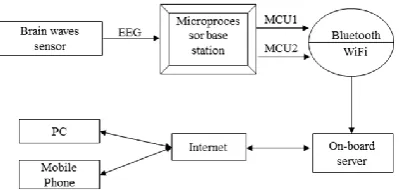
[image:8.612.212.412.365.460.2]The ISDDS-ES system m consists of three parts: sensor, micro-processing forwarding base station (portable) and mobile client. Sharing data is mainly in Bluetooth and WiFi. The brainwave sensor's communication protocol only allows one module to be connected to its corresponding module device. The adaptability is not strong and many mobile phones cannot even be paired with it. For this purpose, a base station is set up to process and forward brainwave data. At the same time, the packet loss rate is far less than 1 percent and will not affect other devices to process the data. It facilitates the joining and compatibility of new modules in the later period. Handheld devices may not be able to interact with most sensors. The micro-processing repeater can help mobile phones or other devices solve some of the signal and protocol issues. The figure 4 is the data communication diagram of the system.
Figure 4. The data communication diagram of the system.
is relatively concentrated. From 42:26 to 42:37, the driver's spirit appears to be scattered. At 42:37, the ISDDS-ES warned the driver that after 42:37, the driver's attention was restored to normal. Figure 6 reflects the concentration and decentralization linearity of the analysis of data collected by brain waves during driver's fatigue driving. During the time period between 44:47 and 45:05, the driver’s mental state has been in a decentralized state, and the degree of dispersal has been significantly higher than the concentration of attention. At 45:05, the ISDDS-ES system warned the driver that after 45:05, the driver's attention returned to normal. When the system reminds more than 3 times, the system will advise the driver to stop and rest to ensure driving safety during driving.
Figure 5. Brain wave information concentration and dispersion line chart under normal conditions.
Figure 6. Brain wave information concentration and dispersion line chart under fatigue driving.
CONCLUSION
[image:9.612.197.405.447.590.2]inattentive or tired, driving safety can be improved by alerting the driver to the driving conditions. The system implements the collection and processing of signals through Bluetooth and brainwave sensors. The human brain scalp directly contacts with brainwaves and continuously captures the body's brainwave signals. The Bluetooth receiver receives the brain wave signal and analyzes the small packet data. For the large packet data, the eSense algorithm extracts the data such as the degree of concentration and dispersion of the brain wave signal. The type of concentration and degree of dispersion is judged by the base station to determine the degree of brain activity of the driver. The data is transmitted to the client through Bluetooth communication with noise reduction processing and analysis, and finally it is determined whether to provide the driver with a reminder message. To a certain extent, it is easy for drivers to drive. And this safe driving system is easy to carry, low in power consumption, and it can last for four to five days. In addition to this, the client users can directly understand their own mental state at this time, not only for driving, but also for work and study.
ACKNOWLEDGEMENT
This paper is supported by Natural science fund project from the department of education of Anhui province (KJ2016A609), Major University Science Research Project of Anhui Province (KJ2016A605), Major Nature Science Project of Hefei University Research and Development Foundation (16ZR13ZDA) and Science Research Talents Foundation of Hefei University (13RC02).
REFERENCES
1. Abdel-Rahman, A., Seddik, A.F., Shawky, D.M.An affordable approach for detecting drivers’ drowsiness using EEG signal analysis[C]. 2015 International Conference on Advances in Computing, Communications and Informatics (ICACCI), IEEE (2015):1326–1332.
2. J.H. Jang, J.H. Kim, J.Y. Yun. Differences in Functional Connectivity of the Insula Between Wave Vibration in Meditators and Non-meditators [J]. Mindfulness 2018, 3 (10) 1-10.
3. Mooneyham, B. W., Mrazek, M. D., Mrazek, A. J., & Schooler, J. W. Signal or noise: brain network interactions underlying the experience and training of mindfulness [J]. Annals of the New York Academy of Sciences, 2016, 1369(1), 240–256.
4. Hironori Hiraishi. Designing a robot controller by using a simple brain-wave sensor and a machine learning technique[J]. Artificial Life and Robotics. 2015, 20(3):217-221.
5. Haiyan Yang, Xiaolin Huang. A New Bayesian Method for Jointly Sparse Signal Recovery[C]. International Conference on Neural Information Processing, ICONIP 2017: 886-894.
7. Chandra S. Pappu, Benjamin C. Flores. Chaotic Oscillators for Wideband Radar Signal Processing[C]. ICAND 2016: Proceedings of the 4th International Conference on Applications in Nonlinear Dynamics. ICAND 2016: 161-176.
8. Pawel K. Stefaniak, Radoslaw Zimroz. Multidimensional Signal Analysis for Technical Condition, Operation and Performance Understanding of Heavy Duty Mining Machines[C]. Advances in Condition Monitoring of Machinery in Non-Stationary Operations. 2015: 197-210.