2019 International Conference on Artificial Intelligence and Computing Science (ICAICS 2019) ISBN: 978-1-60595-615-2
The Information Literacy Assessment of Trainees Based
on Cluster Analysis
Hai-yan ZHENG, Rui-li ZHANG and Chao-ran GUO
*Qingdao Campus of Naval Aviation University, No.2 Middle Sil-liu Road, Qingdao City, Shandong Province, China
*Corresponding author
Keywords: Large data analytics, Index system, Second-order cluster analysis.
Abstract. In this paper, the evaluation index system of information literacy of trainees is determined by expert Delphi method. Questionnaires are conducted according to the problems in the second-level indicators, and the results are analyzed by second-order cluster analysis. The information literacy level of trainees is divided into groups, and the existing problems and shortcomings are pointed out, which provides effective guidance for further information literacy education.
Introduction
With the arrival of the era of big data, how to quickly extract key information from massive data and bring value to enterprises and individuals is the focus of attention. At present, many traditional data analysis methods can also be used in large data analysis, such as clustering analysis, factor analysis, correlation analysis and regression analysis. At present, many traditional data analysis methods can also be used in large data analysis, such as clustering analysis, factor analysis, correlation analysis and regression analysis. Information literacy is the essential basic quality of new military talents, the need of lifelong learning and the motive force of innovation. The evaluation of information literacy of cadets in military academies is the research direction of the further development of information literacy theory. By referring to the information literacy standards and indicators formulated by scholars at home and abroad, this paper tries to formulate an “information literacy evaluation index system” for our cadets, and based on this evaluation body. The department evaluates and analyses the current situation of trainees' information literacy.
Cluster Analysis
Cluster analysis is a statistical method for partitioning objects, referring to the classification of objects or things with some similar characteristics. The purpose of cluster analysis is to distinguish the unknown and similar things in some characteristics, and divide the samples into several categories or groups according to these characteristics, so that the things in the same category have a high degree of homogeneity, while the different things have a high degree of heterogeneity. The second-order clustering analysis in clustering analysis is exploratory analysis. It is mainly applied to pattern classification in cross-domain of data mining and multi-metadata statistics. Using distance measure, it is assumed that the variables of clustering model are independent variables, and that is continuous variables are assumed to be normal distribution, and classified variables are polynomials. Empirical internal test method is used to stabilize the interference of independent variable hypothesis and distribution hypothesis. Second-order clustering analysis can produce different clustering discriminant information, such as the clustering frequency of the final clustering, descriptive statistics of the final clustering, and pie chart, bar chart and importance map of the variables of the clustering frequency.
select clustering numbers and determine the optimal clustering number by comparing model selection criteria of different clustering results; thirdly, it can effectively analyze large sample data.
Information Literacy Evaluation Index System
The principle of determining the first-level indicators of information literacy assessment is: through the decomposition and refinement of the constituent elements of trainees' information literacy by consulting experts, and drawing lessons from the existing local information literacy assessment standards, preliminary establishment of the first-level indicators project, decomposition and interpretation of the first-level indicators to obtain the second-level indicators.
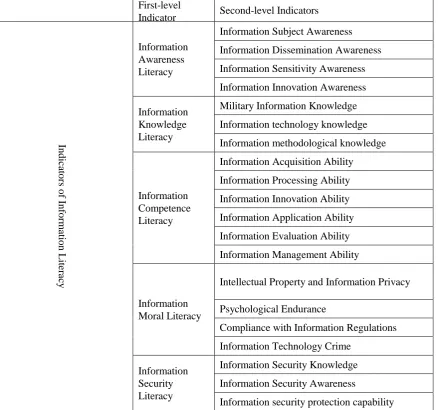
[image:2.595.82.521.333.743.2]On the fact that information literacy education is close to the general direction of the army, we choose the expert Delphi method to determine the evaluation index. We select nine experts from colleges and universities. They are in the fields of Library and information, computer, education and politics. Six experts in the army are aged 35-55. The selection of experts are take into account the factors of educational background, professional title and specialty, and the selected experts are representative. Finally, it is established that the index system consists of 5 first-level indicators and 20 second-level indicators. The evaluation index system is shown in Table 1.
Table 1. Information literacy evaluation index system. First-level
Indicator Second-level Indicators
Indi cat or s of I nf or m at ion Lit er acy Information Awareness Literacy
Information Subject Awareness
Information Dissemination Awareness
Information Sensitivity Awareness
Information Innovation Awareness
Information Knowledge Literacy
Military Information Knowledge
Information technology knowledge
Information methodological knowledge
Information Competence Literacy
Information Acquisition Ability
Information Processing Ability
Information Innovation Ability
Information Application Ability
Information Evaluation Ability
Information Management Ability
Information Moral Literacy
Intellectual Property and Information Privacy
Psychological Endurance
Compliance with Information Regulations
Information Technology Crime
Information Security Literacy
Information Security Knowledge
Information Security Awareness
Evaluation of Information Literacy of Trainees
The second-order cluster analysis of the survey results was carried out by using SPSS software. The number of samples was 76. Each sample gave a certain score to 20 factors. In statistical analysis, the method of dealing with missing values is to get the average value. By clustering analysis, the subjects are grouped and the objects with the same characteristics are clustered together to analyze the common features in the same groups.
Model Summary Diagram in Cluster Analysis
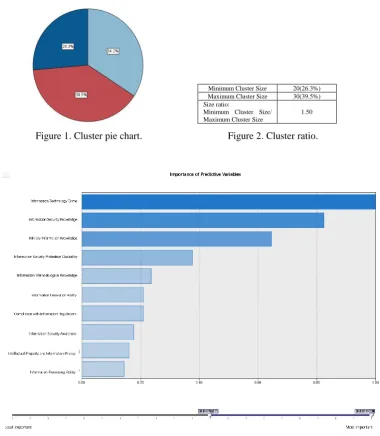
The View menu in the model browser can get detailed information such as “clustering size” and “clustering proportion”. As shown in Fig. 1 and Figure 2, when the number of clusters is specified as three categories, we can get the proportion of members in each category, of which 20 individuals are in the first category, accounting for 26.3%; 26 individuals in the second category, accounting for 34.2%; and 30 individuals in the third category, accounting for 39.5%.
Minimum Cluster Size 20(26.3%) Maximum Cluster Size 30(39.5%) Size ratio:
Minimum Cluster Size/ Maximum Cluster Size
[image:3.595.105.486.261.698.2]1.50
Figure 1. Cluster pie chart. Figure 2. Cluster ratio.
Figure 3. Factor importance sorting chart.
Importance of Predictive Variables
crime, information security knowledge, military information knowledge, information security protection ability, information method knowledge, information innovation ability, information compliance quality, information security awareness, intellectual property rights and information privacy issues, information processing ability, information innovation awareness, information management ability, information acquisition ability, information sensitivity awareness, information evaluation ability, psychological endurance ability, information dissemination awareness, information subject awareness, information technology knowledge, information application ability. It shows that the prior factor in classification is the front factor. According to the trainees' scoring situation, the first several factors are considered as the important basis for classification. It shows that in the minds of trainees, information security knowledge, military information knowledge, information security protection ability and other factors are relatively prominent for military academies, and the trainees' scores are quite different. These factors can be used as an important basis for classification, achieve our test objectives, and show that the factors affecting trainees' information quality exist, as shown in Figure 3.
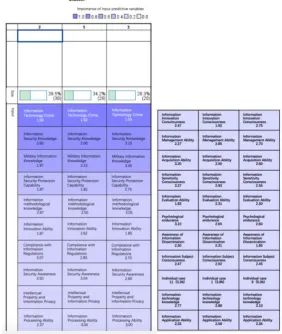
Figure 4. Clustering characteristic chart.
Clustering Characteristics of Groups
quality in all aspects, and they basically have high information security. Quality, information ability quality, information knowledge quality and information morality quality have achieved satisfactory results in other aspects besides the weak awareness of information subject and dissemination. This shows that there are differences in the evaluation of information quality by the current indicator system among the college trainees.
Through investigation and analysis, it reflects some problems existing in the information literacy of cadets in military academies. The information literacy evaluation system is an interrelated comprehensive system. The scores of each factor are often causal. Evaluation is not the final station, but a means. Through evaluation, the main influencing factors and shortcomings are found out, and the causes of the problems are analyzed, and provide training and lessons for the later stage. It is also an indispensable part of the current research on information literacy assessment.
Conclusion
Some trainees’ information awareness needs to be improved. The survey results show that some trainees have weak information awareness and have not yet formed a clear information awareness. In this respect, the second type of trainees have low information innovation awareness. The first and third types of trainees are lack information subject awareness and information sensitive awareness. Through interviews, it is found that these trainees have the desire to make full use of information and information technology, but actively explore knowledge. Lack of initiative, inadequate ability to use the media, and inappropriate choice of media, of course, the relatively closed educational environment of military academies is also a factor leading to the lack of information awareness of some trainees.
Some trainees are lack knowledge of information. Through cluster analysis, the first group of trainees generally scored low in the quality of information knowledge, and their ability to understand and apply the basic knowledge and methods of information technology was not strong. Some trainees even did not know the basic knowledge, meaning and characteristics of military information. Many trainees did not know the main sources of information and the retrieval methods of professional information. The ability to use information to analyze problems is seriously lacking in the ability to solve the best solutions or methods.
Some trainees are not good at information. In terms of information ability, the first group of trainees generally scored lower, and their information awareness was not high. The second group of trainees only had lower information acquisition ability. The interviews with this group of trainees showed that the trainees performed better at the basic level of information ability, but poorer at the higher level of information ability.
Trainees have information morality quality, but they lack understanding of information morality and law. The survey results of information morality show that all the trainees have certain information morality quality. They said they would not use information technology to commit crimes. In other aspects of information ethics, the first group of trainees are lower than other trainees in respect of compliance with information regulations, respect for intellectual property rights and information privacy issues and psychological endurance ability, and these trainees have higher information ability quality. Interview shows that this part of the trainees' resistance to bad information on the Internet is relatively weak, the information copyright and personal privacy issues involved in information activities are not well understood, and the relevant laws and codes of conduct involved in information activities are still lack of in-depth understanding. Therefore, it is necessary to strengthen the information ethics quality education of this part of the trainees through various ways.
References
[1] Lazer D., et al. Computational Social Science [J]. Science. 2009, 323: 721-723.
Engineering, 2012, 35(2): 33-45.
[3] Shute J., Oancea M., Ellner S., et al. Fl: The fault tolerant distributed RDBMS supporting Google’s ad business [C]//Proc of SIGMOD 2012. New York: ACM, 2012: 777, 778.