2018 2nd International Conference on Modeling, Simulation and Optimization Technologies and Applications (MSOTA 2018) ISBN: 978-1-60595-594-0
Estimating Energy-saving Capability of Urban Rail Timetable Using
Optimized Train Operation Strategy
Jiang LIU
1,*, Si-yu XIAO
1, Jiao ZHANG
2and Hao XIE
2 1School of Electronic and Information Engineering, Beijing Jiaotong University, Beijing, China
2
Vehicle and Equipment Technology Department, Beijing Subway Operation Technology Centre, Beijing, China
*Corresponding author
Keywords: Energy-saving Operation, Urban Rail Transit, Timetable, Train Schedule, Optimization.
Abstract. This paper focuses on the estimation of the energy-saving capability of timetable for urban rail transit. The energy-saving feature of the timetable may not be the first aim during the establishing stage. To enhance the efficiency of energy conservation, a solution of estimating energy-saving space for a given timetable is presented. In this solution, potential train operation speed profiles are involved based on the time-space constraint from the schedule data. Optimization strategy for driving remiges is introduced to predict probable train operations for an energy-saving target. With the integration of top-stage train schedule and possible driving remiges at the bottom layer, we present a general scheme for estimating the achievable optimization space to reduce the energy consumption in field operation. Timetable from Batong Line in Beijing Metro is utilized to demonstrate the energy-saving capability when an optimized train operation strategy is adopted. Results illustrate effectiveness of this solution and show the potential in generating customized suggestions for future update of the timetable.
Introduction
The metro system is playing an important role in the rapid development of metropolis in China. The energy consumption of train operation has been a significant concern in recent years. Improvement of energy efficiency is widely expected to reduce the amount of carbon dioxide emissions and enhance the environmental friendliness of rail transit system [1]. The energy consumption of train operation is influenced by several factors. Existing researches within this field mainly focus on the optimization of applied driving strategy according to the timetable, which is regarded as one major cause [2]. Lots of algorithms and techniques have been proposed and tested to find optimized eco-driving solutions [3]. At the same time, it should be noticed that the given time schedules would also significantly affect the capability of those advanced driving solutions. Energy-efficient train timetabling has been considered in establishing better timetables [4]. However, it is also important for the rail operators to adjust and optimize the existing timetables, which is of great significance to improve the energy efficiency of the urban rail transport system. In this paper, we aim at the estimation of the energy saving capability of the in-use timetables by considering the train speed control and time scheduling integratedly.
Train Operation Strategies
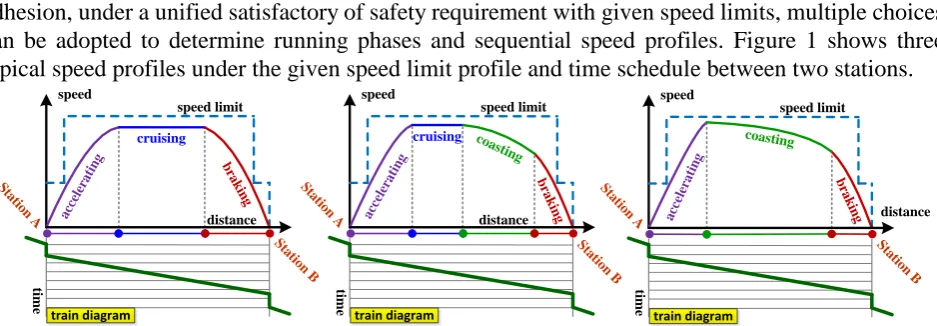
With specific optimization target, i.e. energy conservation, passenger comfort degree, timetable adhesion, under a unified satisfactory of safety requirement with given speed limits, multiple choices can be adopted to determine running phases and sequential speed profiles. Figure 1 shows three typical speed profiles under the given speed limit profile and time schedule between two stations.
speed distance speed limit acce lera tin g cruising b rak in g speed distance speed limit acce lera tin g cruising b rak in g speed distance speed limit acc eler ati ng b rak in g
coasting coasting
train diagram train diagram train diagram
Sta tio n A Sta tio n B Sta tio n A Sta tio n B Sta tio n A Sta tio n B tim
[image:2.595.66.535.89.252.2]e time time
Figure 1. Different speed profiles for a same train under the time schedule constraint.
The timetable describes the low-resolution time-space information about the planned trip of trains. Differently, the speed profile of each train planned in the timetable depicts the detailed relationship of speed-time or speed-mileage at a higher-resolution. Conventional results in generating energy-saving speed profiles aim to reduce the in-trip energy consumption when a time schedule has to be followed. To evaluate the capability of the timetable, optimization of the speed profiles of all the planned trains in a timetable can be carried out to derive an integrated estimation of the saving rate, where the trains are expected to operate in the rail sections according to the optimized speed profiles. The integration of the low-resolution time schedule and high-resolution speed control strategies makes it possible of evaluating the potential space when the timetable is executed in real implementation.
Energy Consumption Model of Train Traction Control
The energy consumption model of running trains is the first step for speed profile optimization for timetable evaluation. The operation of trains in a rail section has to be influenced by the speed limits due to the rail traffic management and signaling conditions. The energy-consumption model would be complicated when the speed limits cover multiple phases. Due to the limited distribution of metro rail stations, the speed limit profiles are usually not very complicated. Thus, each operation condition may occur only once in a section. That means in the estimation of energy consumption capability we only have to consider a standard driving regime sequence as accelerating-cruising-coasting-braking.
Based on the kinematical model of the train and the force analysis for the along-track longitudinal speed control, the energy consumption model of the train can be built corresponding to each regime. Given the characteristic parameters of the mechanical power system, the energy consumption of train traction can be calculated as
auxiliar
traction y
0
( ) ( )
(
)
( , )
i S i iu m F v
E
S
dm
P
T
u v
. (1)where F v( ) is the traction force which is determined by the train speed v, u m( ) denotes the train’s
mechanical power coefficient that is determined by the running distance m, ( , )u v indicates the
transformation efficiency, Pauxiliary is the auxiliary power, (S Ti, i) denote the given running distance
along the track and the corresponding time cost.
To fulfil the energy conservation target in timetable evaluation, it is expected to minimize the total
energy consumption Etraction(Si). The optimization of train speed profiles with a constrained energy
the conventional kinematic modeling strategy, the traction force for pursuing a min
Etraction(Si)
canbe computed for each operation condition as follows. (1) Accelerating condition
Both the traction and resistance force are considered to derive the resultant force. Therefore, the traction force for the energy consumption model in (1) is
( )
( )
( )
total accelerating
F
t
F t
W t
. (2)where total ( )
accelerating
F t indicates the resultant force of a train, W t( ) is the resistance, including basic and
additional resistance. The basic resistance is usually represented by a function of running speed. The additional resistance is determined by the conditions of the rail lines.
(2) Cruising condition
During the cruising process, the resultant force is expected to be zero constantly, which illustrates that the traction is equal to the resistance at each time instant.
( ) 0, ( ) ( )
total cruising
F t F t W t . (3)
Thus, the traction force will be adaptive to the dynamic change of the resistance and contribute to a constant speed operation under the pre-defined speed limit.
(3) Coasting condition
There is no traction force involved in the coasting process. The resistance will lead to the reduction of train speed until the driver brakes the train when it approaches the destination station.
( ) ( ) , ( ) 0
total coasting
F t W t F t . (4)
(4) Braking condition
The driver brakes the train before it approaches the destination station to ensure an on-time arrival. Therefore, the train will operate with an integrated force based on the resistance and braking force.
total braking
F ( )t W t( ) B t( ) , ( )F t 0. (5) Different from the resistance that can be calculated with the specific function of running speed, the traction force and braking force are usually computed by the traction and braking characteristic curves dedicated to the type of a train. Based on that, energy consumption of traction can be modeled through speed deduction and traction force computation during the accelerating and cruising processes.
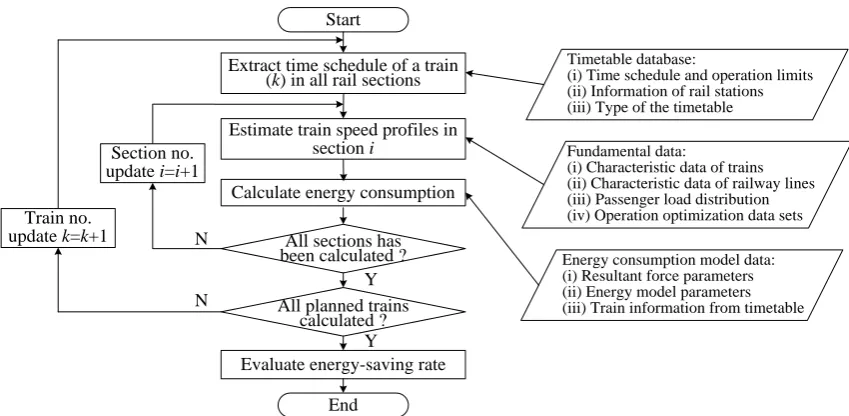
Energy-saving Capability Estimation of Timetable
Calculate energy consumption Start
Extract time schedule of a train (k) in all rail sections
Estimate train speed profiles in section i
All sections has been calculated ?
All planned trains calculated ?
Evaluate energy-saving rate Section no.
update i=i+1
Train no. update k=k+1
End
Timetable database:
(i) Time schedule and operation limits (ii) Information of rail stations (iii) Type of the timetable
Fundamental data:
(i) Characteristic data of trains (ii) Characteristic data of railway lines (iii) Passenger load distribution (iv) Operation optimization data sets
Energy consumption model data: (i) Resultant force parameters (ii) Energy model parameters (iii) Train information from timetable
Y
Y N
[image:4.595.84.509.71.279.2]N
Figure 2. Framework of energy-saving capability estimation for the given timetable.
(1) Data collection from timetable
Fundamental data of the planned arriving and departure time of the train in all the track sections will be extracted from the train plan operation graph from the rail dispatching system. The parameters about the traction curve and braking curve have to be determined according to the in-operation trains. In addition, featured data about the railway lines are extracted for calculating the resistance, including the along-track mileage, curvature, gradient and other related track parameters.
(2) Estimation of detailed train operation in each section
Train traction calculation can be carried out to estimate the exact speed profiles of the trains using the fundamental data. For an evaluation purpose, specific optimization logic can be adopted to derive optimized speed profiles. Aiming at reducing the energy consumption level, trains’ traveling planned in the timetable is optimized with an objective of enhancing the energy efficiency, and the calculated speed-distance or speed-mileage curves will be different from the results by traction calculation.
(3) Model-based computation of expected energy consumption
With the energy model, speed profiles can be divided into several pieces according to the adopted
driving remiges. Thus, possible traction force F v( ) at a location point or time instant can be predicted,
and the possible energy consumption will be computed with given model parameters. For a complete trip of a train from the originating station to the destination, the sum of energy consumption for all the
driving regimes will be recorded, where t traction
N
N i
i
E E S
1
( ) and Nt is the train’s ID number.
(4) Evaluation of energy-saving capability
By comparing the energy consumption from an optimized train control profile and that from basic train traction calculation, achievable energy-saving capability for a given timetable can be evaluated before the timetable is adopted in the train dispatching system. Furthermore, the relationship between the energy conservation level and the parameters of the time schedule could be explored to determine possible principles for adjusting and enhancing the timetable in the future.
Case Study
A numerical example based on the real-world data from Beijing Metro Batong Line of China is presented to illustrate the capability of the estimation solution. The Batong line covers 13 stations and 12 sections with a total length of 18.964 km. Data from the workday timetable is used to demonstrate the energy-saving capability using an optimized operation strategy over basic traction calculation.
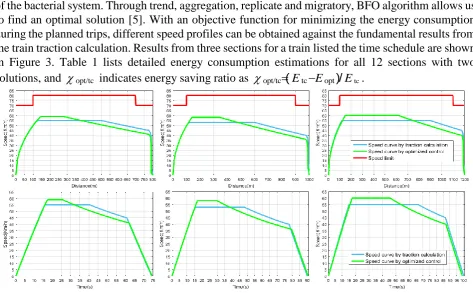
of the bacterial system. Through trend, aggregation, replicate and migratory, BFO algorithm allows us to find an optimal solution [5]. With an objective function for minimizing the energy consumption during the planned trips, different speed profiles can be obtained against the fundamental results from the train traction calculation. Results from three sections for a train listed the time schedule are shown in Figure 3. Table 1 lists detailed energy consumption estimations for all 12 sections with two
solutions, and opt/tc indicates energy saving ratio as opt/tc(EtcEopt)/Etc.
[image:5.595.62.536.73.366.2]Figure 3. Comparison of speed profiles by different operation strategies during capability estimation.
Table 1. Estimated energy-saving results in all the sections for a planned train.
Sec
no. 1 2 3 4 5 6 7 8 9 10 11 12 Total
Etc 14.69 11.48 17.69 15.95 22.97 23.07 27.51 27.17 27.17 28.63 21.98 21.85 260.16
Eopt 13.41 10.65 16.85 14.24 21.99 22.74 26.23 25.56 25.42 25.29 20.74 20.48 243.60 χopt/tc 8.71 7.23 4.75 10.72 4.27 1.43 4.65 5.93 6.44 11.67 5.64 6.27 6.37
According to the running analysis, it can be found that the optimized train operation strategy using BFO algorithm makes it possible of generating energy-efficient speed profiles over traditional method. An increased ratio of the coasting regime indicates that a driver or ATO (Automatic Train Operation) on-board could reduce the usage of the traction working condition by adjusting the speed at the shift points of speed control. An average energy saving ratio of 6.37% has been achieved in the estimation. However, it just represents the theoretical result for evaluation and guidance of the timetable. For the filed operation, the practical achievable energy-saving capability would be limited by multiple factors, i.e. tracking error to a planned speed profile, signaling conditions and adjustment of train diagrams.
Conclusion and Future Plans
Acknowledgement
This work was financially supported by National Key R&D Program of China (2017YFB1201105).
References
[1] B. Lin, Z. Du, Can urban rail transit curb automobile energy consumption? Energ. Policy, 105 (2017) 120-127.
[2] A. Gonzalez-Gil, R. Palacin, P.Batty, J. Powell, A systems approach to reduce urban rail energy consumption, Energ. Convers. Manage. 80 (2014) 509-524.
[3] G.Scheepmaker, R. Goverde, L. Kroon, Review of energy-efficient train control and timetabling, Eur. J. Oper. Res. 257 (2017) 355-376.
[4] D. Canca, A. Zarzo, Design of energy-Efficient timetables in two-way railway rapid transit lines, Transpot Res. B. 102 (2017) 142-161.