R E S E A R C H
Open Access
Gamma distribution approach in
chance-constrained stochastic programming model
Kumru D Atalay
1*†and Aysen Apaydin
2†* Correspondence: [email protected]
1Department of Medical Education,
Faculty of Medicine, 06490, Bahçelievler, Ankara, Turkey Full list of author information is available at the end of the article
Abstract
In this article, a method is developed to transform the chance-constrained programming problem into a deterministic problem. We have considered a chance-constrained programming problem under the assumption that the random variablesaijare
independent with Gamma distributions. This new method uses estimation of the distance between distribution of sum of these independent random variables having Gamma distribution and normal distribution, probabilistic constraint obtained via Essen inequality has been made deterministic using the approach suggested by Polya. The model studied on in practice stage has been solved under the assumption of both Gamma and normal distributions and the obtained results have been compared.
Keywords:chance-constrained programming, Essen inequality, Gamma distribution
1. Introduction
A chance-constrained stochastic programming (CCSP) models is one of the major approaches for dealing with random parameters in the optimization problems. Charnes and Cooper [1] have first modelled CCSP. Here, they have developed a new conceptual and analytic method which contains temporary planning of optimal stochastic decision rules under uncertainty. Symonds [2] has presented deterministic solutions for the class of chance-constraint programming problem. Kolbin [3] has examined the risk and indefiniteness in planning and managing problems and presented chance-con-straint programming models. Stancu-Minasian [4] has suggested a minimum-risk approach to multi-objective stochastic linear programming problems. Hulsurkar et al. [5] have studied on a practice of fuzzy programming approach of multi-objective sto-chastic linear programming problems. They have used fuzzy programming approach for finding a solution after changing the suggested stochastic programming problem into a linear or a nonlinear deterministic problem. Liu and Iwamura [6] have studied on chance-constraint programming with fuzzy parameters. Chance-constraint program-ming in stochastic is expanded to fuzzy concept by their studies. They have presented certain equations with chance constraint in some fuzzy concept identical to stochastic programming. Furthermore, they have suggested a fuzzy simulation method for chance constraints for which it is usually difficult to be changed into certain equations. Finally, these fuzzy simulations which became basis for genetic algorithm have been suggested for solving problems of this type and discussing numeric examples. Mohammed [7] has studied on chance-constraint fuzzy goal programming containing right-hand side
values with uniform random variable coefficients. He presented the main idea related with the stochastic goal programming and chance-constraint linear goal programming. Kampas and White [8] have suggested the programming based on probability for the control of nitrate pollution in their studies and compared this with the approaches of various probabilistic constraints. Yang and Wen [9] presented a chance-constrained programming model for transmission system planning in the competitive electricity market environment. Huang [10] provided two types of credibility-based chance-con-strained models for portfolio selection with fuzzy returns. Ağpak and Gökçen [11] developed new mathematical models for stochastic traditional and U-type assembly lines with a chance-constrained 0-1 integer programming technique. Henrion and Strugarek [12] investigated the convexity of chance constraints with independent ran-dom variables. Parpas and Rüstem [13] proposed a stochastic algorithm for the global optimization of chance-constrained problems. They assumed that the probability mea-sure used to evaluate the constraints is known only through its moments. Xu et al. [14] developed a robust hybrid stochastic chance-constraint programming model for supporting municipal solid waste management under uncertainty. Abdelaziz and Masri [15] proposed a chance-constrained approach and a compromise programming approach to transform the multi-objective stochastic linear program with partial linear information on the probability distribution into its equivalent uni-objective problem. Goyal and Ravi [16] presented a polynomial time approximation scheme for the chance-constrained knapsack problem when item sizes are normally distributed and independent of other items.
The classical linear programming problem, which is a specific class of mathematical programming problem, is formulated as follows
maxz(x) =
n
j=1
cjxj
n
j=1
aijxj≤bi i= 1, ...,m
xj≥0 j= 1, ...,n
where all coefficients (technologic coefficientsaij, right-hand side valuesbiand
objec-tive function coefficientscj(j= 1,...,n i= 1,...,m)) are deterministic. However, when at
least one coefficient is a random variable, the problem becomes a stochastic program-ming problem.
In this article, we have assumed that theaij, (i= 1,...,m, j= 1,...n) which are the
ele-ments of, m×ntype technologic matrixA, are random variables having Gamma dis-tribution. In case that these coefficients having Gamma distribution are independent, the estimation of the distance between the distribution of sum of them and normal distribution has been obtained. Essen inequality has been used for these and determi-nistic equality of chance constraints has been found. The model with random variable coefficients has been solved via the suggested method and it has been implemented on a numeric example. The model has been examined again for the case to have coeffi-cients with normal distribution. It has been observed that the case aijcoefficients have
Gamma distribution or normal distribution has given similar results for large values of
2. Chance-constrained stochastic programming
Stochastic programming deals with the case that input data (prices, right hand side vector, technologic coefficients) are random variables. As parameters are random vari-ables, a probability distribution should be determined. Two frequently used approaches for transforming stochastic programming problem into a deterministic programming problem are chance constraint programming and two-staged programming.
“Chance-constrained programming”which is a stochastic programming method con-tains fixing the certain appropriate levels for random constraints. Therefore, it is generally used for modelling technical or economic systems. The practices include economic plan-ning, input control, structural design, inventory, air and water quality management pro-blems. In chance constraints, each constraint can be realized with a certain probability.
Stochastic linear programming problem with chance constraints is defined as follows
max(min)z(x)=
n
j=1
cjxj
P ⎡
⎣n
j=1
aijxj≤bi ⎤
⎦≥1−ui
xj≥0, j= 1, ...,n
ui∈(0, 1), i= 1, ...,m
(2:1)
wherecj,aijandbiare random variables andui’s are chosen probabilities.kth chance
constraint given in model (2.1) is obtained as
P ⎡
⎣n
j=1
akjxj≤bk ⎤
⎦≥1−uk (2:2)
with lower bound (1 -uk). Where it is assumed thatxj decision variables are
deter-ministic.cj,akjandbkare random variables with known variances and means [17,18].
If bkis the random variable in the model, and its distribution function isFbthen the
deterministic equivalent of chance constraint can be calculated as Pakjxj≤bk
≥uk⇔ P
bk≥akjxj
≥uk
⇔1−Fb akjxj
≥uk
⇔akjxj≤F−b1(1−uk)
(2:3)
Assume that akj is a random variable having normal distribution with the meanE
(akj) and the varianceVar(akj). Furthermore, covariance between the random variables akjandaklis zero. Then, random variabledkis defined as follows
dk= n
j=1
akjxj
whereak1,..., akn’s are random variables with normal distribution and x1,...,xn’s are
unknowns, chance constraint given with inequality (2.2) is defined as follows
φ
bk−E(dk)
Var(dk)
≥φ Kuk
where Kuk denotes the value of standard normal variable and φ Kuk
= 1−uk.
Therefore, deterministic equivalent of inequality (2.4) is stated as E(dk)+Kuk
Var(dk)≤bk
Solution methods for models constituted by dual and triple combinations of cj,akj
andbkcoefficients and also for the case thatcj’s are random variable are different. In
this article, these are not mentioned [5,19-21]. 3. Gamma distribution approach for CCSP
Let, X1, X2,...,Xnbe independent random variables with a distribution functionFn(x).
LetF(x) be a standard normal distribution function. Then, supremum of absolute dis-tance between Fn(x) and F(x) can be found. The theorem related to this, which is
known as Essen Inequality, is as follows.
Theorem 3.1Let X1,X2,...,Xnbe independent random variables with given
EXj= 0and E|Xj|3<∞j= 1, ...,n
where if it is as follows
σ2
j =EX2j, ...,Bn= n
j=1
σ2
j , ...,Fn(x) =P ⎡ ⎣B−n1/2
n
j=1 Xj<x
⎤
⎦, ...,Ln=B−−n 3/2 n
j=1 E|Xj|3
then
sup
x |
Fn(x)−(x)|≤SLn (3:1)
is defined. Here, S is an absolute positive constant[22].
Proof to Theorem 3.1 can be found in [[22], pp. 109-111]. In case of equality, as a result of Essen inequality we can give the following equation, for large values ofn
P
⎡ ⎣B−n1/2
⎛ ⎝n
j=1 Xj−E
⎛ ⎝n
j=1 Xj
⎞ ⎠ ⎞ ⎠<x
⎤ ⎦=φ (x)+
n
j=1
EXj−E Xj3e
−x2 2 1−x2
6√2πB 3 2
n
+o(n−21) (3:2)
Equation 3.2 is used for approximation to standard normal distribution [23].
After defining the Essen inequality given in Theorem 3.1, now we explain Gamma distribution approach for CCSP model. In linear programming, the constraints are con-structed as follows:
Ax≤b⇔
⎡ ⎢ ⎢ ⎢ ⎢ ⎢ ⎢ ⎢ ⎢ ⎢ ⎣
a11a12...a1n
..
. ... . .. ...
ak1ak2...akn
..
. ... . .. ...
am1am2...amn ⎤ ⎥ ⎥ ⎥ ⎥ ⎥ ⎥ ⎥ ⎥ ⎥ ⎦
⎡ ⎢ ⎢ ⎢ ⎢ ⎢ ⎢ ⎢ ⎢ ⎢ ⎣
x1 .. .
xk
.. .
xn ⎤ ⎥ ⎥ ⎥ ⎥ ⎥ ⎥ ⎥ ⎥ ⎥ ⎦
≤
⎡ ⎢ ⎢ ⎢ ⎢ ⎢ ⎢ ⎢ ⎢ ⎢ ⎣
b1 .. .
bk
.. .
bm ⎤ ⎥ ⎥ ⎥ ⎥ ⎥ ⎥ ⎥ ⎥ ⎥ ⎦
(3:3)
Here, the matrixAindicates a coefficients matrix. Letdk =ak’x k= 1,...,mthenkth
dk≤bk⇔[ak1,ak2, ...,akn] ⎡ ⎢ ⎢ ⎢ ⎢ ⎢ ⎢ ⎣
x1 .
xk
.
xn ⎤ ⎥ ⎥ ⎥ ⎥ ⎥ ⎥ ⎦
≤ bk (3:4)
If akj’s which arekth row of coefficients matrixAare independent gamma random
variables, chance constraints given in model (2.1) are as follows
P(dk≤bk)≥1−uk, k= 1, 2, ...,m (3:5)
Assume that each random variable akjhas Gamma distribution with (akj, bkj)
para-meters in (3.4). For the purpose of using Essen inequality given in Theorem 3.1, the random variable rj =akjxj -E(akjxj),j = 1,...,nis taken into account. Expected value
and variance of each random variable akjas follows:
E(akj) =αkjβkj Var(akj) =αkjβkj2
Therefore, the expected value of random variablerjwill be as follows:
E(rj) =E(akjxj−E(akjxj)) =xj
αkjβkj−αkjβkj
= 0
and its variance will be as follows: Var(rj) =E(dj)2−
E(dj) 2
=x2jVar(akj) =x2jαkjβkj2
Absolute third moment of random variabledjis found in the following equality
E|rj|3=E|akjxj−E(akjxj)|3=x3jE|akj−αkjβkj|3 (3:6)
The expected value in equality (3.6) can be written as follows:
Eakj−αkjβkj
3
=
∞
0
akj−αkjβkj
3 f(akj)dakj
=
αkjβkj
0
akj−αkjβkj3f(akj)dakj+ ∞
αkjβkj
akj−αkjβkj3f(akj)dakj
= Ikj+ IIkj (3:7)
Then, Ikjis rewritten as follows
Ikj= αkjβkj
0
− akj−αkjβkj 3
f(akj)dakj
=− 1
(αkj)βkjαkj αkjβkj
0
a3kj−3a2kjαkjβkj+ 3akjα2kjβkj2−α3kjβkj3
aαkj−1
kj e −akj/βkj
dakj
If it is taken as, − 1
(αkj)βkjαkj
= in integral thenIkjcan be written as follows
Ikj=
αkjβkj
0
aαkjkj+2e−akj/βkjda
kj− 3αkjβkj
αkjβkj
0
aαkjkj+1e−akj/βkjda
kj+
3α2kjβkj2
αkjβkj
0 aαkj
kje
−akj/βkjda
kj
− α3
kjβ3kj
αkjβkj
0 aαkj−1
kj e
−akj/βkjda
kj
= ω1+ 3αkjβkj
ω2+
3α2
kjβkj2
ω3+
α3
kjβkj3
Here, by making variable change βakj
kj
=tkj,
ω1=βαkj
+3 kj
αkj
0
tαkj+2
kj e−tkjdtkj
is obtained. Incomplete gamma function is defined as follows I(a,x) = γ(a,x)
(a)
here
γ(a,x) =
x
0
ta−1e−tdt
Therefore, ω1can be rearranged as follows:
ω1=βαkj
+3
kj (αkj+ 3)I(αkj+ 3,αkj)
Similarly, it can be written as follows
ω2=βαkj
+2
kj (αkj+ 2)I(αkj+ 2,αkj)
ω3=βαkj
+1
kj (αkj+ 1)I(αkj+ 1,αkj)
ω4=βkjαkj(αkj)I(αkj,αkj)
The second part of the integral can be written as follows
IIkj= ∞
αkjβkj
akj−αkjβkj 3
f(akj)dakj
= 1
(αkj)βkjαkj ∞
αkjβkj
a3kj−3a2kjαkjβkj+ 3akjα2kjβ 2 kj−α
3 kjβ
3 kj
aαkjkj−1e−akj/βkjda
kj
If it is taken as 1
(αkj)βkjαkj
=− in integral then IIkjcan be written as follows
IIkj=−
∞
αkjβkj aαkj+2
kj e
−akj/β
kjda
kj+ 3αkjβkj
∞
αkjβkj aαkj+1
kj e
−akj/β
kjda
kj−
3α2
kjβkj2
∞
αkjβkj aαkj
kje
−akj/β
kjda
kj
+ α3
kjβkj3
∞
αkjβkj aαkj−1
kj e
−akj/βkjda
kj
=− ξ1+ 3αkjβkj
ξ2−
3α2
kjβkj2
ξ3+
α3
kjβkj3
ξ4
where
ξ1=
∞
0
aαkj+2
kj e −akj/β
kjda
kj− αkjβkj
0
aαkj+2
kj e −akj/β
kjda
kj
=βαkj+3
kj (αkj+ 3)
1−I(αkj+ 3,αkj)
In the same way it will be
ξ2=βαkj
+2
kj (αkj+ 2)
1−I(αkj+ 2,αkj)
ξ3=βkjαkj+1(αkj+ 1)
1−I(αkj+ 1,αkj)
ξ4=βkjαkj(αkj)
1−I(αkj,αkj)
.
Therefore, for any finite akjandbkj, it can easily be seen thatEdj= 0 andE|dj|3<∞.
Therefore, the conditions in Theorem 3.1 are satisfied, then σj2 andBnis obtained as
σ2
j =Erj2=x2jαkjβkj2
Bn= n
j=1
σ2
j = n
j=1
x2jαkjβkj2
The third absolute moment of random variable, rj, in terms of integrals Ikj and IIkjis
written as follows
E|rj|3=x3j Ikj+ IIkj
Then, Lnis obtained as follows
Ln=B −3/2 n
n
j=1
Erj3 = n j=1
x3j Ikj+IIkj
n j=1
x2 jαkjβkj2
3/2 (3:8)
Even if Lndefined in Theorem 3.1 is maximum it can be a useful upper bound for
left side of (3.1). Following lemma is related to this situation.
Lemma 3.1Maximum value of Lnin Equation 3.8 is given by
maxLn=
nL∗
nx∗α∗(β∗)23/2
= nL
∗
n3/2(x∗α∗)3/2(β∗)3 (3:9)
ProofMaximum value ofLngiven in Equation 3.8 is obtained by maximizing
nomi-nator while minimizing the denominomi-nator, i.e.
max
j n
j=1
x3j Ikj+ IIkj
and
min
j ⎡
⎣n
j=1
x2jαkjβkj2 ⎤ ⎦ 3/2
Therefore,
max
j
x3j Ikj+IIkj=L∗
and
min
j |x 2
equalities are defined. Then maximum value of Lngiven in Equation 3.8 is found as
Equation 3.9. This completes the proof of Lemma 3.1.
In Theorem 3.1, using Lngiven in (3.8), following inequality is obtained
sup
x |
Fn(x)−(x)|≤SLn
sup
x |
Fn(x)−(x)|≤S n j=1
x3j Ikj+IIkj n j=1 x2 jαkjβkj2
3/2 (3:10)
If the suggested constantS= 0.7975 [22] in inequality (3.10) and if the value max Ln
given with (3.9) is used following inequality is obtained
sup
x |
Fn(x)−(x)|≤0.7975
L∗ √
n(x∗α∗)3/2(β∗)3 (3:11)
Here, Fn(x) is Gamma distribution function,F(x) is that of standard normal
distribu-tion. Thus, fordk
dk− n j=1
xjE(akj)
n j=1
x2 jVar(akj)
=
dk− n j=1
xjαjβj
n j=1
x2 jαjβj2
is defined. Therefore, constraint (3.5) can be written as follows
P ⎡ ⎢ ⎢ ⎢ ⎢ ⎣ n j=1
akjxj− n j=1
xjαjβj
n j=1
x2 jαjβj2
≤ bk−
n j=1
xjαjβj
n j=1
x2 jαjβj2
⎤ ⎥ ⎥ ⎥ ⎥
⎦≥1−(uk+SLn)
Here, the following inequality is written
⎡ ⎢ ⎢ ⎢ ⎢ ⎣
bk− n j=1
xjαjβj
n j=1
x2jαjβj2 ⎤ ⎥ ⎥ ⎥ ⎥
⎦≥1−(uk+SLn). (3:12)
There are decision variables xj (j = 1,..., n) in Ln which is on the left side of the
inequality (3.12). Since these decision variables are the results of the problem solved after model (2.1) is made deterministic, they are unknown here. Therefore,Ln is not a
numeric and it cannot be solved using F-1(1-(uk)+SLn). Therefore, using the approach
suggested [24] right side of inequality (3.12) can be written as follows
⎡ ⎢ ⎢ ⎢ ⎢ ⎣
bk− n j=1
xjαjβj
n j=1
x2 jαjβj2
⎤ ⎥ ⎥ ⎥ ⎥ ⎦= 1 2 ⎛ ⎜ ⎜ ⎜ ⎜ ⎜ ⎜ ⎝ 1 + ⎧ ⎪ ⎪ ⎪ ⎪ ⎨ ⎪ ⎪ ⎪ ⎪ ⎩
1−exp
⎛ ⎜ ⎜ ⎜ ⎜ ⎝− 2 π ⎡ ⎢ ⎢ ⎢ ⎢ ⎣
bk− n j=1
xjαjβj
n j=1
x2 jαjβj2
⎤ ⎥ ⎥ ⎥ ⎥ ⎦ 2⎞ ⎟ ⎟ ⎟ ⎟ ⎠ ⎫ ⎪ ⎪ ⎪ ⎪ ⎬ ⎪ ⎪ ⎪ ⎪ ⎭ 1/2⎞ ⎟ ⎟ ⎟ ⎟ ⎟ ⎟ ⎠
and deterministic constraint belonging to inequality (3.12) is then written as fallows 1 2 ⎛ ⎜ ⎜ ⎜ ⎜ ⎜ ⎜ ⎝ 1 + ⎧ ⎪ ⎪ ⎪ ⎪ ⎨ ⎪ ⎪ ⎪ ⎪ ⎩
1−exp
⎛ ⎜ ⎜ ⎜ ⎜ ⎝− 2 π ⎡ ⎢ ⎢ ⎢ ⎢ ⎣
bk− n
j=1 xjαjβj
n
j=1 x2
jαjβj2
⎤ ⎥ ⎥ ⎥ ⎥ ⎦ 2⎞ ⎟ ⎟ ⎟ ⎟ ⎠ ⎫ ⎪ ⎪ ⎪ ⎪ ⎬ ⎪ ⎪ ⎪ ⎪ ⎭ 1/2⎞ ⎟ ⎟ ⎟ ⎟ ⎟ ⎟ ⎠
≥1−
⎡ ⎢ ⎢ ⎢ ⎢ ⎢ ⎢ ⎣
uk+ 0.7975
⎛ ⎜ ⎜ ⎜ ⎜ ⎜ ⎜ ⎝ n j=1 x3
j Ikj+IIkj
n j=1 x2
jαkjβkj2
3/2 ⎞ ⎟ ⎟ ⎟ ⎟ ⎟ ⎟ ⎠ ⎤ ⎥ ⎥ ⎥ ⎥ ⎥ ⎥ ⎦
. (3:14)
Using Equation (3.2) we can construct the following inequality
1 2 ⎛ ⎜ ⎜ ⎜ ⎜ ⎜ ⎜ ⎝ 1 + ⎧ ⎪ ⎪ ⎪ ⎪ ⎨ ⎪ ⎪ ⎪ ⎪ ⎩
1−exp
⎛ ⎜ ⎜ ⎜ ⎜ ⎝− 2 π ⎡ ⎢ ⎢ ⎢ ⎢ ⎣
bk− n j=1 xjαkjβkj n j=1
x2jαkjβkj2 ⎤ ⎥ ⎥ ⎥ ⎥ ⎦ 2⎞ ⎟ ⎟ ⎟ ⎟ ⎠ ⎫ ⎪ ⎪ ⎪ ⎪ ⎬ ⎪ ⎪ ⎪ ⎪ ⎭ 1/2⎞ ⎟ ⎟ ⎟ ⎟ ⎟ ⎟ ⎠
≥1−
⎡ ⎢ ⎢ ⎢ ⎢ ⎢ ⎢ ⎢ ⎢ ⎢ ⎢ ⎢ ⎢ ⎢ ⎢ ⎢ ⎢ ⎢ ⎢ ⎢ ⎢ ⎢ ⎢ ⎢ ⎢ ⎢ ⎢ ⎢ ⎢ ⎢ ⎣
uk+ n j=1
x3
j2αkjβkj3e
− ⎛ ⎜ ⎜ ⎜ ⎜ ⎝
bk− n j=1 xjαkjβkj n j=1
x2jαkjβkj2 ⎞ ⎟ ⎟ ⎟ ⎟ ⎠ 2 2 ⎛ ⎜ ⎜ ⎜ ⎜ ⎝1−
⎛ ⎜ ⎜ ⎜ ⎜ ⎝
bk− n j=1 xjαkjβkj n j=1 x2
jαkjβkj2 ⎞ ⎟ ⎟ ⎟ ⎟ ⎠ 2⎞ ⎟ ⎟ ⎟ ⎟ ⎠
6√2π
# n j=1
x2
jαkjβkj2 $3 2 ⎤ ⎥ ⎥ ⎥ ⎥ ⎥ ⎥ ⎥ ⎥ ⎥ ⎥ ⎥ ⎥ ⎥ ⎥ ⎥ ⎥ ⎥ ⎥ ⎥ ⎥ ⎥ ⎥ ⎥ ⎥ ⎥ ⎥ ⎥ ⎥ ⎥ ⎦ (3.15)
4. Numerical experiments Consider the CCSP model as follows
maxz= 7x1+ 2x2+ 4x3
P[a11x1+a12x2+a13x3≤8]≥0.95
P5x1+x2+ 6x3≤b2
≥0.10
xj≥0 j= 1, 2, 3
(4:1)
Here, assume that akj j = 1,2,3 are independent random variables distributed as
Gamma distribution with the following parameters (akj,bkj)
α11= 4, β11= 1, α12= 2, β12= 2,α13= 3, β13= 2. (4:2)
b2is normal random variable with the following expected value and variance
E(b2)= 7, Var(b2)= 9
rj=akjxj−E akjxj
here, Var rj
=x2j αkjβkj2
is found and fork= 1,Bnis obtained as follows
Bn= 4x21+ 8x22+ 12x23
Then, Lnis written as follows
Ln= 3 j=1
x3
j Ikj+ IIkj
4x21+ 8x22+ 12x233/2
As a result of the solution of the integrals, Ikj (k= 1,j = 1,2,3) and IIkj (k= 1, j=
1,2,3) inLncan be obtained as
I11= 3.2824, II11= 11.2824
I12= 6.9766, II12= 38.9766
I13= 15.3291, II13= 63.3291
Then, Lnis found as
Ln=
14.5648x3
1+ 45.9532x32+ 78.6582x33
4x21+ 8x22+ 12x233/2
.
Therefore, in the case where akj is a random variable with Gamma distribution,
deterministic equality of the first chance constraint in model (4.1), using inequality (3.14) is obtained as follows
1 2 ⎡ ⎢ ⎢ ⎢ ⎣1 +
⎧ ⎪ ⎨ ⎪ ⎩1−exp
⎛ ⎜ ⎝−2π
⎡ ⎢
⎣8%−(4x1+ 4x2+ 6x3) 4x2
1+ 8x22+ 12x23 ⎤ ⎥ ⎦ 2⎞
⎟ ⎠ ⎫ ⎪ ⎬ ⎪ ⎭
1/2⎤ ⎥ ⎥ ⎥ ⎦≥1−
⎡
⎣0.05 + 0.7975 ⎛ ⎝14.5648x3
1+ 45.9532x32+ 78.6582x33 4x2
1+ 8x22+ 12x23 3/2
⎞ ⎠ ⎤ ⎦ (4:3)
Using inequality (3.15) we can write as:
0.5
⎛ ⎝1 +
&
1−exp
#
−0.6366(8−x4)
x5
2$'1/2⎞
⎠≥0.95−
⎡ ⎢ ⎢ ⎣(8x
3
1+ 32x32+ 48x33)e
−x6 2 (1−x6)
6(6.28)x
3 2 5
⎤ ⎥ ⎥ ⎦
x4−4x1−4x2−6x3= 0
x5−(4x21+ 8x22+ 12x23) = 0
x6x5−(8−x4)2= 0
(4:4)
Using inequality (2.3) for the second chance constraint, deterministic inequality is obtained as
5x1+x2+ 6x3≤10.855
Then, deterministic equality of CCSP model given in (4.1), using inequality (4.3), can be found as follows
1 2 ⎡ ⎢ ⎢ ⎢ ⎣1 +
⎧ ⎪ ⎨ ⎪ ⎩1−exp
⎛ ⎜ ⎝−π2
⎡ ⎢
⎣8%−(4x1+ 4x2+ 6x3) 4x2
1+ 8x22+ 12x23 ⎤ ⎥ ⎦ 2⎞
⎟ ⎠ ⎫ ⎪ ⎬ ⎪ ⎭
1/2⎤ ⎥ ⎥ ⎥ ⎦≥1−
⎡
⎣0.05 + 0.7975 ⎛ ⎝14.5648x3
1+ 45.9532x32+ 78.6582x33 4x2
1+ 8x22+ 12x23 3/2
⎞ ⎠ ⎤ ⎦
0.7975 ⎛ ⎝14.5648x3
1+ 45.9532x32+ 78.6582x33 4x2
1+ 8x22+ 12x23 3/2
⎞ ⎠≤0.95
(4:5)
5x1+x2+ 6x3≤10.855
xj≥0 j= 1, 2, 3
The second constraint is given for controlling of non-negativity on the right side of first constraint. The nonlinear problem given in (4.5) has been solved with condition
0≤x1,x2,x3≤2
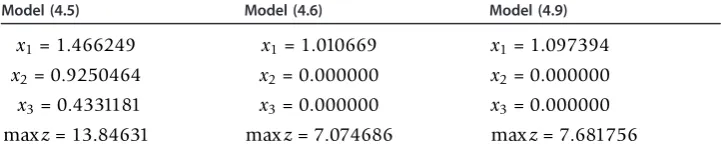
using software Lingo 9.0and the results are shown in Table 1.
Deterministic equality of CCSP model given in (4.1), using inequality (4.4), can be found as follows
maxz= 7x1+ 2x2+ 4x3
0.5
⎛ ⎝1 +
&
1−exp
#
−0.6366(8−x4)
x5
2$'1/2⎞
⎠≥0.95−
⎡ ⎢ ⎢ ⎣(8x
3
1+ 32x32+ 48x33)e
−x6 2 (1−x6)
6(6.28)x
3 2 5
⎤ ⎥ ⎥ ⎦
x4−4x1−4x2−6x3= 0
x5−(4x21+ 8x22+ 12x23) = 0
x6x5−(8−x4)2= 0
(4:6)
5x1+x2+ 6x3≤10.855
xj≥0 j= 1, 2, 3, 4, 5, 6
As a second case, let us assume that akjcoefficients in the first chance constraint in
model (4.1) are independent normal random variables with the following expected valueE(akj) and varianceVar(akj)
E(a11)= 4, Var(a11)= 4
E(a12)= 4, Var(a12)= 8
E(a13)= 6, Var(a13)= 12
(4:7)
Then, deterministic equality of chance constraint can be arranged as follows
4x1+ 4x2+ 6x3+ 1.645 %
[image:11.595.117.478.654.732.2]4x21+ 8x22+ 12x23≤8 (4:8)
Table 1 Solutions results of models (4.5), (4.6), (4.9)
Model (4.5) Model (4.6) Model (4.9)
x1= 1.466249
x2= 0.9250464
x3= 0.4331181
maxz= 13.84631
x1= 1.010669
x2= 0.000000
x3= 0.000000
maxz= 7.074686
x1= 1.097394
x2= 0.000000
x3= 0.000000
Therefore, deterministic equality of CCSP model given in (4.1) can be found as fol-lows:
maxz= 7x1+ 2x2+ 4x3
4x1+ 4x2+ 6x3+ 1.645 %
4x2
1+ 8x22+ 12x23≤8
(4:9)
5x1+x2+ 6x3≤10.855
xj≥0 j= 1, 2, 3, 4
Model (4.9) has been solved by software Lingo 9.0and the results are listed in Table 1.
5. Conclusion
In this study, a new method is suggested for the solution of the deterministic equiva-lence of the CCSP. The main purpose of this article is to transform the chance-con-strained model into a deterministic model based on the Essen inequality. According to the Essen inequality, the estimation of the distance between the distribution of a sum of independent random variables and the normal distribution is less than or equal to
SLn. This study considers a stochastic optimization model with random technology
matrix in which the random variables are independent and follow a Gamma distribu-tion. Deterministic equality of these kinds of problems has been obtained via the sug-gested method. Furthermore, by adding a second constraint having normal distribution in the right-hand side value, a problem with two chance constraints has been obtained. In this problem, both cases that akjcoefficients have gamma and normal distributions
have been examined and for the solution of deterministic models Lingo 9.0 has been used.
As a result, the upper bounds of the chance constrained are derived by the Essen inequality and developed approximate deterministic equivalent of the model.
The solutions obtained by including the supremum distance defined by the Essen inequality in the model are shown clearly in the solutions results (4.5) and (4.6) in Table 1.
For large values of n, the solution results of the models having Gamma and normal distributions are closed to each other. This can be observed in Table 1 by examining the solution results (4.6) and (4.9). Here, it can be seen that coefficients of the objec-tive function and decision variables are very similar.
Author details
1Department of Medical Education, Faculty of Medicine, 06490, Bahçelievler, Ankara, Turkey2Department of Statistics,
Faculty of Science, 06100, Tandogan, Ankara, Turkey
Authors’contributions
All authors conceived of the study, participated in its design and coordination, drafted the manuscript, participated in the sequence alignment, read and approved the final manuscript.
Competing interests
The authors declare that they have no competing interests.
References
1. Charnes, A, Cooper, WW: Chance constrained programming. Manag Sci.6, 73–79 (1959). doi:10.1287/mnsc.6.1.73 2. Symonds, GH: Deterministic solutions for a class of chance constrained programming problems. Oper Res.5, 495–512
(1967)
3. Kolbin, VV: Stochastic Programming. D. Reidel Publishing Company, Boston (1977)
4. Stancu-Minasian, IM: Stochastic Programming with Multiple Objective Functions. D. Reibel Publishing Company, Dordrecht (1984)
5. Hulsurkar, S, Biswal, MP, Sinha, SB: Fuzzy programming approach to multi-objective stochastic linear programming problems. Fuzzy Set Syst.88, 173–181 (1997). doi:10.1016/S0165-0114(96)00056-5
6. Liu, B, Iwamura, K: Chance constrained programming with fuzzy parameters. Fuzzy Set Syst.94, 227–237 (1998). doi:10.1016/S0165-0114(96)00236-9
7. Mohammed, W: Chance constrained fuzzy goal programming with right-hand side uniform random variable coefficients. Fuzzy Set Syst.109, 107–110 (2000). doi:10.1016/S0165-0114(98)00151-1
8. Kampas, A, White, B: Probabilistic programming for nitrate pollution control: comparing different probabilistic constraint approximations. Eur J Oper Res.147, 217–228 (2003). doi:10.1016/S0377-2217(02)00254-0
9. Yang, N, Wen, F: A chance constrained programming approach to transmission system expansion planning. Electric Power Syst Res.75, 171–177 (2005)
10. Huang, X: Fuzzy chance constrained portfolio selection. Appl Math Comput.177, 500–507 (2006). doi:10.1016/j. amc.2005.11.027
11. Ağpak, K, Gökçen, H: A chance constrained approach to stochastic line balancing problem. Eur J Oper Res.180, 1098–1115 (2007). doi:10.1016/j.ejor.2006.04.042
12. Henrion, R, Strugarek, C: Convexity of chance constraints with independent random variables. Comput Optim Appl.41, 263–276 (2008). doi:10.1007/s10589-007-9105-1
13. Parpas, P, Rüstem, B: Global optimization of robust chance constrained problems. J Global Optim.43, 231–247 (2009). doi:10.1007/s10898-007-9244-z
14. Xu, Y, Qin, XS, Cao, MF: SRCCP: a stochastic robust chance-constrained programming model for municipal solid waste management under uncertainty. Resour Conserv Recy.53, 352–363 (2009). doi:10.1016/j.resconrec.2009.02.002 15. Abdelaziz, FB, Masri, H: A compromise solution for the multiobjective stochastic linear programming under partial
uncertainty. Eur J Oper Res.202, 55–59 (2010). doi:10.1016/j.ejor.2009.05.019
16. Goyal, V, Ravi, R: A PTAS for the chance-constrained knapsack problem with random item sizes. Oper Res Lett.38, 161–164 (2010). doi:10.1016/j.orl.2010.01.003
17. Kall, P, Wallace, SW: Stochastic Programming. Wiley-Interscience Series in Systems and Optimization. John Wiley & Sons, Chicherster, UK (1994)
18. Prekopa, A: Stochastic Programming. Kluwer Academic Publishers, London (1995)
19. Hillier, FS, Lieberman, GJ: Introduction to Mathematical Programming. Hill Publishing Company, New York (1990) 20. Sakawa, M, Kato, K, Nishizaki, I: An interactive fuzzy satisficing method for multiobjective stochastic linear programming
problems through an expectation model. Eur J Oper Res.145, 665–672 (2003). doi:10.1016/S0377-2217(02)00150-9 21. Sengupta, JK: A generalization of some distribution aspects of chance constrained linear programming. Int Econ Rev.
11, 287–304 (1970). doi:10.2307/2525670
22. Petrov, VV: Sums of Independent Random Variables. Springer-Verlag, New York (1975)
23. Feller, W: An Introduction to Probability Theory and Its Applications. John Wiley and Sons, Inc., New YorkII(1966) 24. Johnson, NL, Kotz, S: Distributions-I. A Wiley-Interscience Publication, New York (1970)
doi:10.1186/1029-242X-2011-108
Cite this article as:Atalay and Apaydin:Gamma distribution approach in chance-constrained stochastic
programming model.Journal of Inequalities and Applications20112011:108.
Submit your manuscript to a
journal and benefi t from:
7 Convenient online submission 7 Rigorous peer review
7 Immediate publication on acceptance 7 Open access: articles freely available online 7 High visibility within the fi eld
7 Retaining the copyright to your article